
Loading...
The Moons of Pluto and the New Horizons spacecraft are also described on this page.
See also Mike Brown’s book How I Killed Pluto and Why It Had It Coming, Wikipedia, Space•Com, Nineplanets•Org, space•About•Com, Windows2universe•Org.
You might also find one of my stories, The Plutonian, to be of interest.
Dwarf planets are Ceres, Eris, Haumea, Makemake and Pluto; probable dwarf planets are (225088) 2007 OR10, Sedna, Quaoar, (55565) 2002 AW197, Orcus and 2012 VP113.
Many of the small pictures on this page can be clicked on to enlarge them.

Pluto in natural colour from New Horizons
Pluto, formal designation 134340 Pluto, is the second-most-massive known dwarf planet in the Solar System (after Eris), and the tenth-most-massive body observed directly orbiting the Sun. Originally classified as the ninth planet from the Sun (in 1930), Pluto was recategorized as a dwarf planet and plutoid owing to the discovery that it is only one of several large bodies within the Kuiper belt (in 2006).
Like other members of the Kuiper belt, Pluto is composed primarily of rock and ice and is relatively small, approximately one-sixth the mass of the Earth’s Moon and one-third its volume. It has an eccentric and highly inclined orbit that takes it from 30 to 49 AU (4.4 to 7.4 billion km) from the Sun. This causes Pluto to periodically come closer to the Sun than Neptune. As of 2011, it is 32.1 AU from the Sun.

Computer-generated map of Pluto from Hubble images, synthesized true colour and among the highest resolutions possible with current technology
From its discovery in 1930 until 2006, Pluto was classified as a planet. In the late 1970s, following the discovery of minor planet 2060 Chiron [also known as comet 95P/Chiron, which itself is an interesting object] in the outer Solar System and the recognition of Pluto’s relatively low mass, its status as a major planet began to be questioned. In the late 20th and early 21st centuries, many objects similar to Pluto were discovered in the outer Solar System, notably the scattered disc object Eris in 2005, which is 27% more massive than Pluto. On 24th August 2006, the International Astronomical Union (IAU) defined what it means to be a “planet” within the Solar System. This definition excluded Pluto as a planet and added it as a member of the new category “dwarf planet” along with Eris and Ceres. After the reclassification, Pluto was added to the list of minor planets and given the number 134340. Many scientists hold that Pluto should continue to be classified as a planet, and that other dwarf planets should be added to the roster of planets along with Pluto.
[It is rumoured that Pluto may be reinstated as a planet, a promotion from its current classification as a “dwarf planet”. If that happens, it could open the flood-gates to dozens, hundreds, maybe thousands of other orbiting objects like Eris and Sedna being so classified, or even Triton or the Moon! But what’s in a name? They are all roughly spherical large lumps of rock, ice and gas that orbit the sun.]
Pluto has five known moons, the largest being Charon [discovered in 1978], along with Nix, Hydra [2005], Kerberos [2011], and Styx [2012]. Pluto and Charon are sometimes described as a “binary system” because the barycentre of their orbits does not lie within either body. However, the IAU has not yet formalised a definition for binary dwarf planets, and as such Charon is officially classified as a moon of Pluto.

In the 1840s, using Newtonian mechanics, Urbain Le Verrier predicted the position of the then-undiscovered planet Neptune after analysing perturbations in the orbit of Uranus. Subsequent observations of Neptune in the late 19th century caused astronomers to speculate that Uranus’s orbit was being disturbed by another planet besides Neptune. In 1906, Percival Lowell, a wealthy Bostonian who had founded the Lowell Observatory in Flagstaff, Arizona in 1894, started an extensive project in search of a possible ninth planet, which he termed Planet X. By 1909, Lowell and William H Pickering had suggested several possible celestial coordinates for such a planet. Lowell and his observatory conducted his search until his death in 1916, but to no avail. Unknown to Lowell, on 19th March 1915, his observatory had captured two faint images of Pluto, but did not recognise them for what they were. Lowell was not the first to unknowingly photograph Pluto. There are sixteen known pre-discoveries, with the oldest being made by the Yerkes Observatory on 20th August 1909.
Because of a ten-year legal battle with Constance Lowell, Percival’s widow, who attempted to wrest the observatory’s million-dollar portion of his legacy for herself, the search for Planet X did not resume until 1929, when its director, Vesto Melvin Slipher, summarily handed the job of locating Planet X to Clyde W Tombaugh, a 23-year-old Kansan who had just arrived at the Lowell Observatory after Slipher had been impressed by a sample of his astronomical drawings.
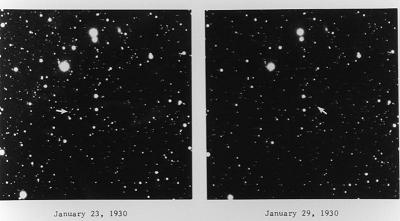
Tombaugh’s task was to systematically image the night sky in pairs of photographs taken two weeks apart, then examine each pair and determine whether any objects had shifted position. Using a machine called a blink comparator, he rapidly shifted back and forth between views of each of the plates to create the illusion of movement of any objects that had changed position or appearance between photographs. On 18th February 1930, after nearly a year of searching, Tombaugh discovered a possible moving object on photographic plates taken on 23rd January and 29th January of that year. A lesser-quality photograph taken on 21st January helped confirm the movement. After the observatory obtained further confirmatory photographs, news of the discovery was telegraphed to the Harvard College Observatory on 13th March 1930.
The discovery made headlines across the globe. The Lowell Observatory, which had the right to name the new object, received over 1,000 suggestions from all over the world, ranging from “Atlas” to “Zymal”. Tombaugh urged Slipher to suggest a name for the new object quickly before someone else did. Constance Lowell proposed “Zeus”, then “Percival” and finally “Constance”. These suggestions were rejected. The name “Pluto” was proposed by Venetia Burney (1918 – 2009), an eleven-year-old schoolgirl in Oxford, England, who was interested in classical mythology as well as astronomy, and considered the name, a name for the god of the underworld, appropriate for such a presumably dark and cold world. She suggested it in a conversation with her grandfather, a former librarian at the University’s Bodleian Library and the name eventually reached the United States.
The name was announced on 1st May 1930 after each member of the Lowell Observatory had been allowed to vote on a short-list of three: Minerva (which was already the name for an asteroid), Cronus and Pluto. “Pluto” received every vote. Upon the announcement, Venetia received £5 (worth over £200 now), as a reward. (The choice of name was partly inspired by the fact that the first two letters of Pluto are the initials of Percival Lowell, and Pluto’s astronomical symbol is a monogram constructed from the letters ‘PL’).
The name was soon embraced by wider culture. In 1930, Walt Disney introduced for Mickey Mouse a canine companion, named Pluto apparently in the object’s honour; in 1941, Glenn T Seaborg named the newly created element plutonium after Pluto, in keeping with the tradition of naming elements after newly discovered planets, following uranium and neptunium.
Once found, Pluto’s faintness and lack of a resolvable disc cast doubt on the idea that it was Lowell’s Planet X. Estimates of Pluto’s mass were revised downward throughout the 20th century. Astronomers initially calculated its mass based on its presumed effect on Neptune and Uranus. In 1931 Pluto was calculated to be roughly the mass of the Earth, with further calculations bringing the mass down to roughly that of Mars. In 1976, Pluto’s albedo was measured for the first time – it matched that for methane ice; this meant Pluto had to be exceptionally luminous for its size and therefore could not be more than 1% the mass of the Earth. (Pluto’s albedo is 1.3 to 2.0 times greater than that of Earth.)
In 1978, the discovery of Pluto’s moon Charon allowed the measurement of Pluto’s mass for the first time. Its mass, roughly 0.2% that of the Earth, was far too small to account for the discrepancies in the orbit of Uranus. Subsequent searches for an alternative Planet X, notably by Robert Sutton Harrington, failed. In 1992, data from Voyager 2’s 1989 flyby of Neptune, which had revised the planet’s total mass downward by 0.5%, recalculated its gravitational effect on Uranus. With the new figures added in, the discrepancies and with them the need for a Planet X vanished. Today, the majority of scientists agree that Planet X, as Lowell defined it, does not exist. Lowell had made a prediction of Planet X’s position in 1915 that was fairly close to Pluto’s position at that time but this was probably a coincidence.
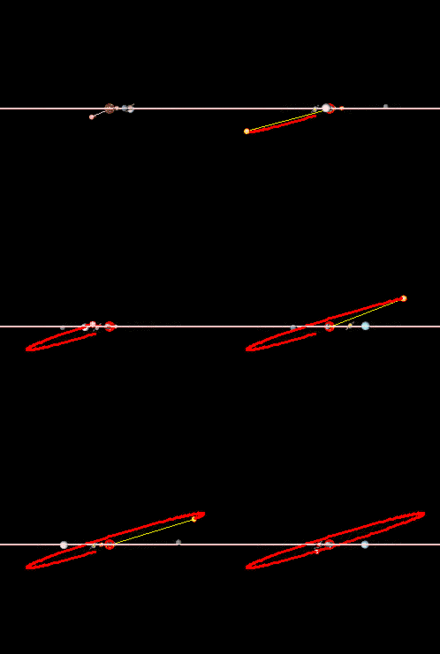
Orbit of Pluto, ecliptic view;
this ‘side view’ of Pluto’s orbit (in red)
shows its large inclination to Earth’s ecliptic orbital plane
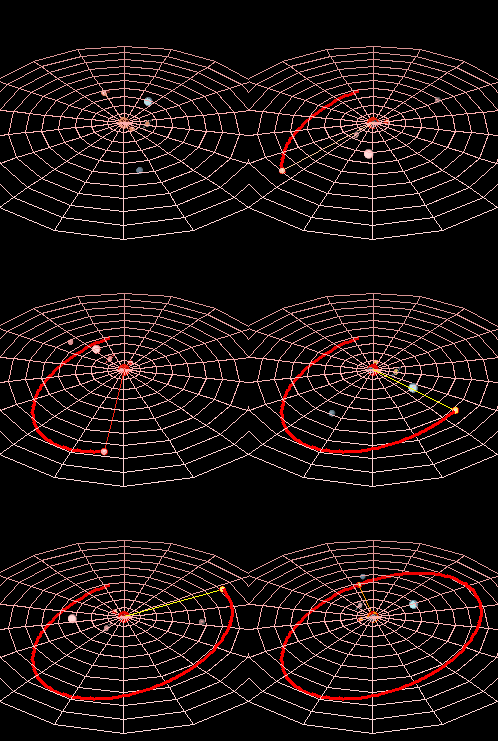
Pluto’s orbit and the ecliptic
Pluto’s orbital period is 248 Earth years. Its orbital characteristics are substantially different from those of the planets, which follow nearly circular orbits around the Sun close to a flat reference plane called the ecliptic. In contrast, Pluto’s orbit is highly inclined relative to the ecliptic (over 17°) and highly eccentric (elliptical). This high eccentricity means a small region of Pluto’s orbit lies nearer the Sun than Neptune’s. The Pluto-Charon barycentre came to perihelion on 5th September 1989, and was last closer to the Sun than Neptune between 7th February 1979 and 11th February 1999.
In the long term Pluto’s orbit is in fact chaotic. While computer simulations can be used to predict its position for several million years (both forward and backward in time), after intervals longer than the “Lyapunov” time of 10 to 20 million years, calculations become speculative: Pluto’s tiny size makes it sensitive to unmeasurably small details of the Solar System, hard-to-predict factors that will gradually disrupt its orbit. Millions of years from now, Pluto may well be at aphelion, at perihelion or anywhere in between, with no way for us to predict which. This does not mean Pluto’s orbit itself is unstable, but its position on that orbit is impossible to determine so far ahead. Several resonances and other dynamical effects keep Pluto’s orbit stable, safe from planetary collision or scattering.
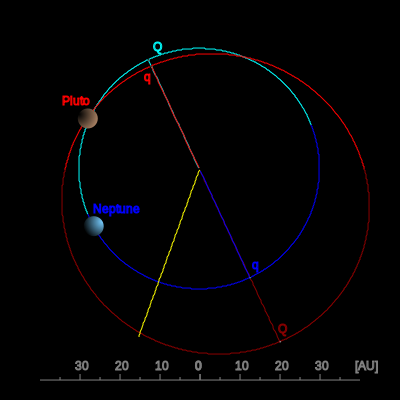
Orbit of Pluto, polar view. This ‘view from above’ shows how Pluto’s
orbit (in red) is less circular than Neptune’s (in blue), and how Pluto
is sometimes closer to the Sun than Neptune. The darker halves of
both orbits show where they pass below the plane of the ecliptic.
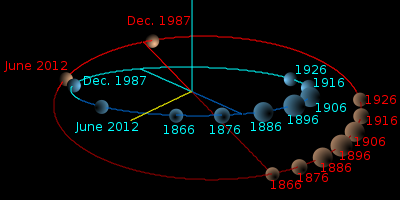
This diagram shows the relative positions of Pluto (red) and Neptune (blue) on selected dates. The size of Neptune and Pluto is depicted as inversely proportional to the distance between them to emphasise the closest approach in 1896.
Pluto’s rotation period, its day, is equal to 6.39 Earth days. Like Uranus, Pluto rotates on its “side” on its orbital plane, with an axial tilt of 120°, and so its seasonal variation is extreme; at its solstices, one-fourth of its surface is in continuous daylight, while another fourth is in continuous darkness.
Despite Pluto’s orbit appearing to cross that of Neptune when viewed from directly above, the two objects’ orbits are aligned so that they can never collide or even approach closely. At the simplest level, the two orbits do not intersect. When Pluto is closest to the Sun, and hence closest to Neptune’s orbit as viewed from above, it is also the farthest above Neptune’s path. Pluto’s orbit passes about 8 AU above that of Neptune, preventing a collision. Pluto’s ascending and descending nodes, the points at which its orbit crosses the ecliptic, are currently separated from Neptune’s by over 21°.
This alone is not enough to protect Pluto; perturbations from the planets (especially Neptune) could alter aspects of Pluto’s orbit (such as its orbital precession) over millions of years so that a collision could be possible. However, Pluto lies in the 2:3 mean motion resonance with Neptune: for every two orbits that Pluto makes around the Sun, Neptune makes three. The two objects are then in their initial positions and the 500-year cycle repeats. In each 500-year cycle, the first time Pluto is near perihelion Neptune is over 50° behind Pluto. By Pluto’s second perihelion, Neptune will have completed a further one and a half of its own orbits, and so will be a similar distance ahead of Pluto. Pluto and Neptune’s minimum separation is over 17 AU. In fact Pluto comes closer to Uranus (11 AU) than it does to Neptune. The 2:3 resonance between the two bodies is highly stable, and is preserved over millions of years. This prevents their orbits from changing relative to one another; the cycle always repeats in the same way, and so they can never pass near to each other. Even if Pluto’s orbit were not highly inclined the two bodies could never collide.
Pluto’s argument of perihelion, the angle between the point where it crosses the ecliptic and the point where it is closest to the Sun, librates around 90°. This means that when Pluto is nearest the Sun, it is at its farthest above the plane of the Solar System, preventing encounters with Neptune. This is a direct consequence of the “Kozai” mechanism, which relates the eccentricity of an orbit to its inclination to a larger perturbing body. Relative to Neptune, the amplitude of libration is 38°, and so the angular separation of Pluto’s perihelion to the orbit of Neptune is always greater than 52° (=90°−38°). The closest such angular separation occurs every 10,000 years.
The longitudes of ascending nodes of the two bodies (the points where they cross the ecliptic) are in near-resonance with the above libration. When the two longitudes are the same, that is, when one could draw a straight line through both nodes and the Sun, Pluto’s perihelion lies exactly at 90°, and it comes closest to the Sun at its peak above Neptune’s orbit. In other words, when Pluto most closely intersects the plane of Neptune’s orbit, it must be at its farthest beyond it. This is known as the “1:1 superresonance”, and is controlled by all the Jovian planets.
To understand the nature of the libration, imagine a polar point of view, looking down on the ecliptic from a distant vantage point where the planets orbit counter-clockwise. After passing the ascending node, Pluto is interior to Neptune’s orbit and moving faster, approaching Neptune from behind. The strong gravitational pull between the two causes angular momentum to be transferred to Pluto, at Neptune’s expense. This moves Pluto into a slightly larger orbit, where it travels slightly slower, according to Kepler’s third law. As its orbit changes, this has the gradual effect of changing the pericentre and longitudes of Pluto (and, to a lesser degree, of Neptune). After many such repetitions, Pluto is sufficiently slowed, and Neptune sufficiently speeded up, that Neptune begins to catch Pluto at the opposite side of its orbit (near the opposing node to where we began). The process is then reversed, and Pluto loses angular momentum to Neptune, until Pluto is sufficiently speeded up that it begins to catch Neptune again at the original node. This whole process takes about 20,000 years to complete.
Pluto’s distance from Earth makes in-depth investigation from Earth-based telescopes difficult. Many details about Pluto remained unknown until 2015, when the New Horizons spacecraft passed by.
Pluto’s visual apparent magnitude averages 15.1, brightening to 13.65 at perihelion. To see it you’d need a telescope around 30 cm aperture or more. It looks star-like with no visible disk even in large telescopes, because its angular diameter is only 0.11 arc-minutes.
The earliest maps of Pluto, made in the late 1980s, were brightness maps created from close observations of eclipses by its largest moon, Charon. Such maps used images from the Hubble Space Telescope (HST), which offered the highest resolution available, and showed considerable detail, resolving variations several hundred kilometres across, including polar regions and large bright spots. The two cameras on the HST used for these maps are no longer in service.
These maps, together with Pluto’s light-curve and the periodic variations in its infrared spectra, revealed that Pluto’s surface is remarkably varied, with large changes in both brightness and colour. Pluto is one of the most contrastive bodies in the Solar System, with as much contrast as Saturn’s moon Iapetus.
This was claimed to be a picture of Pluto in October 2014. Let’s compare it with the latest photos of the planet and Charon.
Pluto’s surface apparently changed between 1994 and 2002/2003: the northern polar region brightened and the southern hemisphere darkened. Pluto’s overall redness also increased substantially between 2000 and 2002. These rapid changes are probably related to seasonal condensation and sublimation of portions of the atmosphere, amplified by Pluto’s extreme axial tilt and high orbital eccentricity.
Spectroscopic analysis of Pluto’s surface reveals it to be composed of more than 98% nitrogen ice, with traces of methane and carbon monoxide. The face of Pluto oriented toward Charon contains more methane ice, while the opposite face contains more nitrogen and carbon monoxide ice.
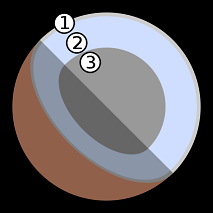
Observations by the Hubble Space Telescope place Pluto’s density at between 1.8 and 2.1 g/cm3, suggesting its internal composition consists of roughly 50 to 70% rock and 30 to 50% ice by mass. Because decay of radioactive minerals would eventually heat the ices enough for the rock to separate from them, scientists expect that Pluto’s internal structure is differentiated, with the rocky material having settled into a dense core surrounded by a mantle of ice. The diameter of the core should be around 1,700 km, 70% of Pluto’s diameter. It is possible that such heating continues today, creating a subsurface ocean layer of liquid water some 100 to 180 km thick at the core-mantle boundary. The DLR Institute of Planetary Research calculated that Pluto’s density-to-radius ratio lies in a transition zone, along with Neptune’s moon Triton, between icy satellites like the mid-sized moons of Uranus and Saturn, and rocky satellites such as Jupiter’s Europa.
Pluto’s mass is 1.31×10²² kg, less than 0.24% that of the Earth, while its diameter is 2,306± 20 km, or roughly 66% that of the Moon. Pluto’s atmosphere complicates determining its true solid size within a certain margin. Its albedo varies from 0.49 to 0.66.

The discovery of Pluto’s satellite Charon in 1978 enabled a determination of the mass of the Pluto–Charon system by application of Newton’s formulation of Kepler’s third law. Once Charon’s gravitational effect was measured, Pluto’s true mass could be determined. Pluto in occultation with Charon allowed the diameter to be assessed more accurately, while the invention of adaptive optics allowed the shape to be determined more accurately.
Among the objects of the Solar System, Pluto is much less massive than the terrestrial planets, and at less than 0.2 lunar masses, it is also less massive than seven moons: Ganymede, Titan, Callisto, Io, Earth’s Moon, Europa and Triton. Pluto is more than twice the diameter and a dozen times the mass of Ceres, the largest object in the asteroid belt. It is less massive than Eris. Given the error bars in the different size estimates, it is currently unknown whether Eris or Pluto has the larger diameter; both are estimated to have solid-body diameters of about 2330 km. Determinations of Pluto’s size were complicated by its atmosphere, and possible hydrocarbon haze.
Pluto’s atmosphere consists of a thin envelope of nitrogen, methane, and carbon monoxide gases, derived from the ices of these substances on its surface. Its surface pressure ranges from 6.5 to 24 μbar. Pluto’s elongated orbit is predicted to have a major effect on its atmosphere: away from the Sun, it should freeze out and fall to the ground; closer in the ices to sublimate into gas. This creates an anti-greenhouse effect; this sublimation cools the surface of Pluto. Scientists using the Submillimeter Array have recently discovered that Pluto’s temperature is about 43 K (−230 °C), 10 K colder than would otherwise be expected.
The presence of methane, a powerful greenhouse gas, in Pluto’s atmosphere creates a temperature inversion, with average temperatures 36 K warmer 10 km above the surface. The lower atmosphere contains more methane than its upper atmosphere.
The first evidence of Pluto’s atmosphere came in 1985, and then confirmed by the Kuiper Airborne Observatory in 1988, from observations of occultations of stars by Pluto. An object with no atmosphere moving in front of a star, causes an abrupt disappearance; in the case of Pluto, the star dimmed out gradually. From the rate of dimming, the atmospheric pressure was determined to be 0.15 pascal, roughly 1/700,000 that of Earth.
In 2002, another occultation of a star by Pluto was observed and analysed by teams from the Paris Observatory, MIT, and Williams College. Surprisingly, the atmospheric pressure was estimated to be 0.3 pascal, even though Pluto was farther from the Sun than in 1988 and thus should have been colder with a more rarefied atmosphere. One explanation for the discrepancy is that in 1987 the south pole came out of shadow for the first time in 120 years, causing extra nitrogen to sublimate from the polar cap. It will take decades for the excess nitrogen to condense out of the atmosphere as it freezes onto the north pole’s now continuously dark ice cap. Spikes, in the data from the same study, revealed what may be the first evidence of wind in Pluto’s atmosphere. Another stellar occultation was observed by the MIT-Williams College team and a Southwest Research Institute team in 2006 from sites in Australia.
In October 2006, a New Horizons investigator of NASA/Ames Research Center announced the spectroscopic discovery of ethane on Pluto’s surface, produced from the photolysis or radiolysis (chemical conversion driven by sunlight and charged particles) of frozen methane on Pluto’s surface and suspended in its atmosphere.
Pluto’s origin and identity had long puzzled astronomers. One early hypothesis was that Pluto was an escaped moon of Neptune, knocked out of orbit by its largest current moon, Triton. This notion has been heavily criticised because Pluto never comes near Neptune in its orbit.
Pluto’s true place in the Solar System began to reveal itself only in 1992, when astronomers began to find small icy objects beyond Neptune that were similar to Pluto not only in orbit but also in size and composition. This trans-Neptunian population is believed to be the source of many short-period comets. Astronomers now believe Pluto to be the largest member of the Kuiper belt, a somewhat stable ring of objects located between 30 and 50 AU from the Sun. Like other Kuiper-belt objects (KBOs), Pluto shares features with comets; for example, the solar wind is gradually blowing Pluto’s surface into space, in the manner of a comet. If Pluto were placed as near to the Sun as Earth, it would develop a tail, as comets do.
Though Pluto is the largest of the Kuiper belt objects discovered so far, Neptune’s moon Triton, which is slightly larger than Pluto, is similar to it both geologically and atmospherically, and is believed to be a captured Kuiper belt object. Eris is also larger than Pluto but is not strictly considered a member of the Kuiper belt population. Rather, it is considered a member of a linked population called the scattered disc.
A large number of Kuiper belt objects, like Pluto, possess a 2:3 orbital resonance with Neptune. KBOs with this orbital resonance are called plutinos, after Pluto.
Like other members of the Kuiper belt, Pluto is thought to be a residual planetesimal – a component of the original protoplanetary disc around the Sun that failed to fully coalesce into a fully-fledged planet. Most astronomers agree that Pluto owes its current position to a sudden migration undergone by Neptune early in the Solar System’s formation. As Neptune migrated outward, it approached the objects in the proto-Kuiper belt, setting one in orbit around itself, which became its moon Triton, locking others into resonances and knocking others into chaotic orbits. The objects in the scattered disc, a dynamically unstable region overlapping the Kuiper belt, are believed to have been placed in their current positions by interactions with Neptune’s migrating resonances. A 2004 computer model by Alessandro Morbidelli of the Observatoire de la Côte d’Azur in Nice suggested that the migration of Neptune into the Kuiper belt may have been triggered by the formation of a 1:2 resonance between Jupiter and Saturn, which created a gravitational push that propelled both Uranus and Neptune into higher orbits and caused them to switch places, ultimately doubling Neptune’s distance from the Sun. The resultant expulsion of objects from the proto-Kuiper belt could also explain the Late Heavy Bombardment 600 million years after the Solar System’s formation and the origin of Jupiter’s Trojan asteroids. It is possible that Pluto had a near-circular orbit about 33 AU from the Sun before Neptune’s migration perturbed it into a resonant capture. The Nice model requires that there were about a thousand Pluto-sized bodies in the original planetesimal disk; these may have included the bodies which became Triton and Eris.
Pluto presents significant challenges for spacecraft because of its small mass and great distance from Earth. Voyager 1 could have visited Pluto, but controllers opted instead for a close flyby of Saturn’s moon Titan, resulting in a trajectory incompatible with a Pluto flyby. Voyager 2 never had a plausible trajectory for reaching Pluto. No serious attempt to explore Pluto by spacecraft occurred until the last decade of the 20th century. In August 1992, JPL scientist Robert Staehle telephoned Pluto’s discoverer, Clyde Tombaugh, requesting permission to visit his planet. “I told him he was welcome to it,” Tombaugh later remembered, “though he’s got to go one long, cold trip.” Despite this early momentum, in 2000, NASA cancelled the Pluto Kuiper Express mission, citing increasing costs and launch vehicle delays.

Styx, S/2012 (134340) 1 (also informally known as P5) is a small natural satellite of Pluto whose discovery was announced on 11th July 2012. It is the fifth confirmed satellite of Pluto, and was found approximately one year after Kerberos, Pluto’s fourth discovered satellite.
The satellite was discovered by a team led by astronomer Mark R Showalter, using fourteen sets of images taken between 26th June and 9th July 2012 by the Wide Field Camera 3 fitted to the Hubble Space Telescope. The discovery was announced on 11th July 2012. The new moon is about half as bright as the dimmest previously known object in the system, Kerberos, and about one hundred thousandth as bright as Pluto, its apparent magnitude being 27±0.3.
The survey work leading to the moon’s discovery was in preparation for the mission of the New Horizons space probe, which flew by the Pluto system on 14th July 2015. The discovery of another small Plutonian moon has heightened concerns that this region of space may harbour more bodies too small to be detected, raising fears that the probe may be damaged by an uncharted body or ring as it traverses the system at a speed of over 13 km/sec. Tiny moons, such as Saturn’s moon Pallene, tend to be associated with tenuous rings or arcs, because their gravity is unable to hold on to material ejected by meteoroid impacts; such diffuse material represents the chief navigational hazard. Current plans call for New Horizons to pass just inside the orbit of the innermost moon, Charon, but this could be changed if observations or modeling suggest a potential threat.
The unexpectedly complex moon system around Pluto may be the result of a collision between Pluto and another sizable Kuiper belt object in the distant past. Pluto’s moons may have coalesced from the debris from such an event, similar to the giant impact thought to have created the Earth’s Moon. The orbital resonances may have acted as “ruts” to gather material from the smashup.
The moon is estimated to have a diameter of between 10 and 25 kilometres. These figures are inferred from the apparent magnitude of the moon and by using an estimated albedo of 0.35 and 0.04 for the lower and upper bounds, respectively. It has an orbital period of 20.2±0.1 days, a value about 5.4% from a 1:3 mean motion resonance with the Charon-Pluto period. (With the other moons Nix, Kerberos and Hydra, it forms part of a remarkable 1:3:4:5:6 sequence of near resonances.) Its mean orbital radius is 42,000 km±2,000 km, putting it between the orbits of Charon and Nix, with an eccentricity and inclination both about 0. Because of its small size, the moon is likely to be irregular in shape. It is thought to have formed from the debris lofted by a collision, which would have led to losses of the more volatile ices, such as those of nitrogen and methane, in the composition of the impactors. This process is expected to have created a body consisting mainly of water ice.
All of Pluto’s moons appear to travel in orbits that are very nearly circular and coplanar, described by Styx’s discoverer Mark Showalter as “neatly nested ... a bit like Russian dolls”. Its name comes from the Greek goddess who ruled over the underworld river also named Styx.

Pluto has five known natural satellites: Charon, first identified in 1978 by astronomer James Christy; Nix and Hydra, both discovered in 2005, Kerberos (S/2011 (134340) 1, also known as P4), identified by the Hubble Space Telescope in 2011, and Styx found in 2012 and referred to as S/2012 (134340) 1 or P5. These moons are unusually close to Pluto, compared to other observed systems. They could potentially orbit Pluto up to 53% (or 69%, if retrograde) of the Hill sphere radius, the stable gravitational zone of Pluto’s influence. (For example, Psamathe orbits Neptune at 40% of the Hill radius.) In the case of Pluto, only the inner 3% of the zone is known to be occupied by satellites; the system appears compact and mostly empty.
The Pluto – Charon system is noteworthy for being one of the Solar System’s few binary systems, defined as those whose barycentre lies above the primary’s surface (617 Patroclus is a smaller example, the Sun and Jupiter the only larger one). This and the large size of Charon relative to Pluto has led some astronomers to call it a “dwarf double planet”. The system is also unusual in that each is tidally locked to the other: Charon always presents the same face to Pluto, and Pluto always presents the same face to Charon; from any position on either body, the other is always at the same position in the sky, or always obscured. So the rotation period of each is equal to the time it takes the entire system to rotate around its common centre of gravity. Just as Pluto revolves on its side relative to the orbital plane, so does the Pluto – Charon system. In 2007, observations by the Gemini Observatory of patches of ammonia hydrates and water crystals on the surface of Charon suggested the presence of active cryo-geysers.
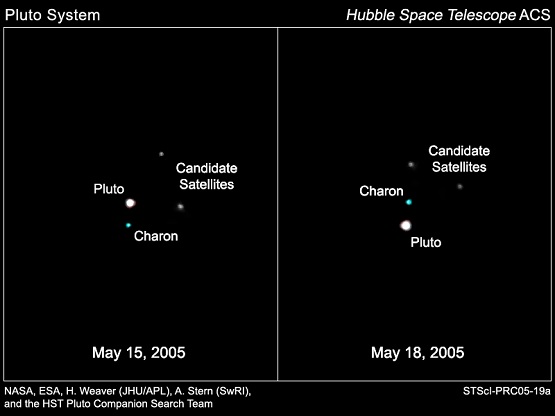
Discovery images of Plutonian satellites P1 (Hydra) and P2 (Nix). The enhanced-colour images of Pluto (the brightest object) and Charon (closest to Pluto) were constructed by combining short exposure images taken in filters near 475 nanometres (blue) and 555 nanometres (green-yellow). The images of the new satellites were made from longer exposures taken in a single filter centred near 606 nanometres (yellow), so no colour information is available for them
Two additional moons of Pluto were found by the Hubble Space Telescope on 15th May 2005, and are officially named Nix and Hydra. These small moons orbit Pluto at approximately two and three times the distance of Charon: Nix at 48,700 km and Hydra at 64,800 km from the barycentre of the system. They have nearly circular prograde orbits in the same orbital plane as Charon.
Observations of Nix and Hydra to determine their characteristics continue. Hydra is sometimes brighter than Nix, suggesting either that it is larger or that different parts of its surface may vary in brightness. Sizes are estimated from albedos. If the moons’ albedos are similar to Charon’s at 35%, then their diameters are estimated at 46 km for Nix and 61 km for Hydra. Upper limits on their diameters can be estimated by assuming the 4% albedo of the darkest Kuiper Belt objects; these bounds are 137±11 km and 167±10 km, respectively. At the larger end of this range, the inferred masses are less than 0.3% that of Charon, or 0.03% of Pluto’s.
The discovery of the two small moons suggests that Pluto may possess a variable ring system. Small-body impacts can create debris that forms planetary rings. Data from a deep optical survey by the Advanced Camera for Surveys on the HST suggest that no ring system is present. If such a system exists, it is either tenuous like the rings of Jupiter or is tightly confined to less than 1,000 km in width. Similar conclusions have been made from occultation studies.
On 20th July 2011 the SETI Institute announced the discovery of Kerberos. It was seen by the HST during a survey searching for rings around the dwarf planet. It has an estimated diameter of 13 to 34 km and is located between the orbits of Nix and Hydra. On 7th July 2012, Styx was discovered while looking for potential hazards for New Horizons.
Near Resonances: Nix and Hydra are very close to (but not in) 4:1 and 6:1 mean motion orbital resonances with Charon. Kerberos fits neatly into this arrangement with a near 5:1 resonance with Charon. Determining how close any of these near integer orbital period ratios might actually be to a true resonance requires accurate knowledge of the satellites’ precessions.
Quasi-satellite: At least one minor body is trapped in the 1:1 commensurability with Pluto, (15810) 1994 JR1, specifically in the quasi-satellite dynamical state. The object has been a quasi-satellite of Pluto for about 100,000 years and it will remain in that dynamical state for perhaps another 250,000 years. Its quasi-satellite behaviour is recurrent with a periodicity of 2 million years. There may be additional Pluto co-orbitals.
Charon is the largest satellite of Pluto. It was discovered in 1978 at the United States Naval Observatory Flagstaff Station (NOFS) by astronomer James Christy, using a 1.55-metre telescope, and was formally announced to the world via the International Astronomical Union on 7th July 1978. On 22nd June 1978, Christy had been examining highly magnified images of Pluto on photographic plates taken at the 61-inch Flagstaff telescope. He noticed that a slight elongation appeared periodically. Later, the bulge was confirmed on plates dating back to 29th April 1965. Following the 2005 discovery of two other natural satellites of Pluto (Nix and Hydra), in 2011, a fourth, Kerberos, and in 2012, a fifth Styx, Charon may also be referred to as (134340) Pluto I. The New Horizons mission visited Charon and Pluto in July 2015.
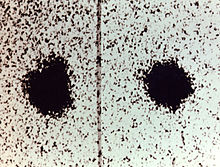
Subsequent observations of Pluto determined that the bulge was due to a smaller accompanying body. The periodicity of the bulge corresponded to Pluto’s rotation period, which was previously known from Pluto’s light curve. This indicated a synchronous orbit, which strongly suggested that the bulge effect was real and not spurious.
All doubts were erased when Pluto and Charon entered a five-year period of mutual eclipses and transits between 1985 and 1990. This occurs when the Pluto – Charon orbital plane is edge-on as seen from Earth, which only happens at two intervals in Pluto’s 248-year orbital period. It was fortuitous that one of these intervals happened to occur so soon after Charon’s discovery.
Images showing Pluto and Charon resolved into separate disks were taken for the first time by the Hubble Space Telescope in the 1990s. Later, the development of adaptive optics made it possible to resolve Pluto and Charon into separate disks using ground-based telescopes.
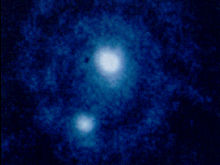
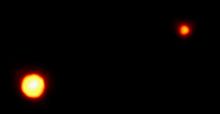
Charon’s diameter is about 1,207 kilometres (750 miles), just over half that of Pluto, with a surface area of 4,580,000 square kilometres (1,770,000 square miles). Unlike Pluto, which is covered with nitrogen and methane ices, the Charonian surface appears to be dominated by less volatile water ice, and also appears to have no atmosphere. In 2007, observations by the Gemini Observatory of patches of ammonia hydrates and water crystals on the surface of Charon suggested the presence of active cryo-geysers. Mutual eclipses of Pluto and Charon in the 1980s allowed astronomers to take spectra of Pluto and then the combined spectrum of the pair. By subtracting Pluto’s spectrum from the total, astronomers were able to spectroscopically determine the surface composition of Charon.
Charon’s volume and mass allow calculation of its density from which it can be determined that Charon is largely an icy body and contains less rock by proportion than its partner Pluto. This supports the idea that Charon was created by a giant impact into Pluto’s icy mantle.
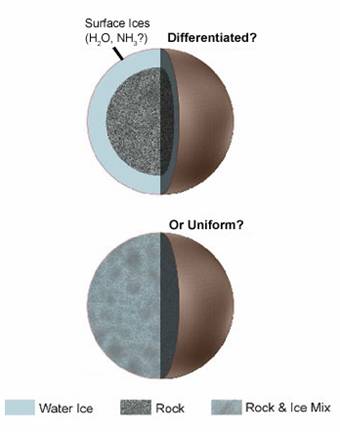
There are two conflicting theories about Charon’s internal structure: some scientists believe it to be a differentiated body like Pluto with a rocky core and an icy mantle while others believe Charon to be of uniform composition throughout. Evidence in support of the former position was found in 2007, when observations by the Gemini Observatory of patches of ammonia hydrates and water crystals on the surface of Charon suggested the presence of active cryo-geysers. The fact that the ice was still in crystalline form suggested it had been recently deposited, as solar radiation would have degraded older ice to an amorphous state after roughly thirty thousand years.
Photometric mapping of Charon’s surface shows a latitudinal trend in albedo, with a bright equator band and darker poles. In particular the south polar region seems darker than the north.

Charon and Pluto revolve about each other every 6.387 days. The two objects are gravitationally locked, so each keeps the same face towards the other. The average distance between Charon and Pluto is 19,570 kilometres (12,160 miles). The discovery of Charon allowed astronomers to accurately calculate the mass of the Plutonian system, and mutual occultations revealed their sizes. However, neither indicated the two bodies’ individual masses, which could only be estimated, until the discovery of Pluto’s outer moons in late 2005. Details in the orbits of the outer moons reveal that Charon has approximately 11.65% of the mass of Pluto. This shows it to have a density of 1.65±0.06 g/cm3, suggesting a composition of 55±5% “rock” to 45% ice, whereas Pluto is somewhat denser and about 70% “rock”.
Simulation work published in 2005 by Robin Canup suggested that Charon could have been formed by a giant impact around 4.5 billion years ago, much like the Earth and Moon. In this model a large Kuiper belt object struck Pluto at high velocity, destroying itself and blasting off much of Pluto’s outer mantle, and Charon coalesced from the debris. However, such an impact should result in an icier Charon and rockier Pluto than scientists have found. It is now thought that Pluto and Charon may have been two bodies that collided before going into orbit about each other. The collision would have been violent enough to boil off volatile ices like methane but not violent enough to have destroyed either body.
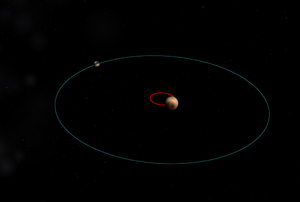
The centre of mass (barycentre) of the Pluto–Charon system lies outside either body. Since neither object truly orbits the other, and Charon has 11.6% the mass of Pluto, it has been argued that Charon should be considered to be part of a binary system. However, the International Astronomical Union (IAU) describes Charon simply as a satellite of Pluto.
In a draft proposal for the 2006 redefinition of the term, the IAU proposed that a planet be defined as a body that orbits the sun that is large enough for gravitational forces to render the object (nearly) spherical. Under this proposal, Charon would have been classified as a planet, since the draft explicitly defined a planetary satellite as one in which the barycentre lies within the major body.
In the final definition, Pluto was reclassified as a dwarf planet, but the formal definition of a planetary satellite was not decided upon. Charon is not in the list of dwarf planets currently recognized by the IAU. Had the draft proposal been accepted, even Earth’s moon would have been classified as a planet in billions of years when the tidal acceleration that is gradually moving the Moon away from the Earth takes the Moon far enough away that the centre of mass of the system no longer lies within the Earth.
The other moons of Pluto, Nix, Hydra, Kerberos and Styx, orbit the same barycentre, but they are not large enough to be spherical, and they are simply considered to be satellites of Pluto.
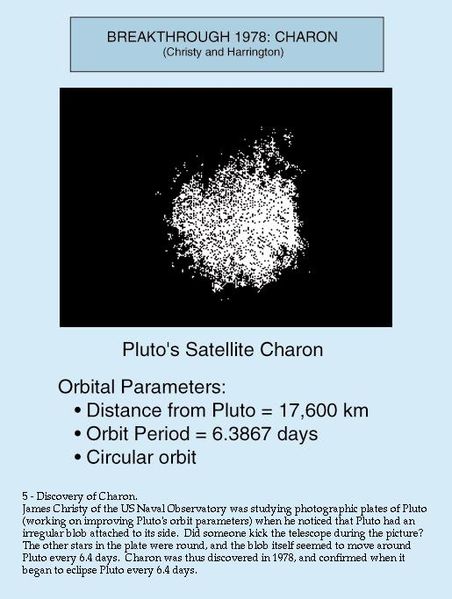
Charon was originally known by the temporary designation S/1978 P 1, according to the then recently instituted convention. On 24th June 1978, Christy first suggested the name Charon as a scientific-sounding version of his wife Charlene’s nickname, “Char”.
Although colleagues at the Naval Observatory proposed Persephone, Christy stuck with Charon after discovering that it coincidentally refers to a Greek mythological figure; Charon is the ferryman of the dead, closely associated in myth with the god Hades, whom the Romans identified with their god Pluto. Official adoption of the name by the IAU waited until late 1985 and was announced on 3rd January 1986.
There is minor debate over the preferred pronunciation of the name. The practice of following the classical pronunciation established for the mythological ferryman Charon is used by major English-language dictionaries such as the Merriam-Webster and the Oxford English Dictionary. These indicate only one pronunciation of “Charon” when referring specifically to Pluto’s moon: with an initial /k/ sound. Speakers of languages other than English, and many English-speaking astronomers as well, follow this pronunciation.
However, Christy himself pronounced the “ch” in the moon’s name as /ʃ/, after his wife Charlene. Because of this, as an acknowledgement of Christy and sometimes as an in-joke or shibboleth, the initial /ʃ/ pronunciation is common among astronomers when speaking English, and this is the prescribed pronunciation at NASA and of the New Horizons Pluto mission team.
In popular culture, the Mass Effect videogame franchise is built around the premise of a series of relays that allow faster-than-light travel around the Milky Way without time dilation. In the series, Charon is discovered in 2149 not to be a moon or a dwarf planet, but to be a chunk of ice containing an intricate piece of technology built by an ancient civilization that allows this travel to occur, leading to the discovery of other planetary systems and enabling their colonization.
NASA’s New Horizons spacecraft has returned the best colour and the highest resolution images yet of Pluto’s largest moon, Charon – and these pictures show a surprisingly complex and violent history.
New Horizons captured this [left] high-resolution enhanced colour view of Charon just before closest approach. The image combines blue, red and infrared images taken by the spacecraft’s Ralph/Multispectral Visual Imaging Camera (MVIC); the colours are processed to best highlight the variation of surface properties across Charon. Charon’s colour palette is not as diverse as Pluto’s; most striking is the reddish north (top) polar region, informally named Mordor Macula. Charon is 1,214 km across; this image resolves details as small as 2.9 km.
At half the diameter of Pluto, Charon is the largest satellite relative to its planet in the solar system. Many New Horizons scientists expected Charon to be a monotonous, crater-battered world; instead, they’re finding a landscape covered with mountains, canyons, landslides, surface-colour variations and more.
“We thought the probability of seeing such interesting features on this satellite of a world at the far edge of our solar system was low,” said Ross Beyer, an affiliate of the New Horizons Geology, Geophysics and Imaging (GGI) team from the SETI Institute and NASA Ames Research Center in Mountain View, California, “but I couldn’t be more delighted with what we see."
[Left] High-resolution images of Charon were taken by the Long Range Reconnaissance Imager on the spacecraft, shortly before closest approach, and overlaid with enhanced colour from the Ralph/Multispectral Visual Imaging Camera (MVIC). Charon’s cratered uplands at the top are broken by series of canyons, and replaced on the bottom by the rolling plains of the informally named Vulcan Planum. The scene covers Charon’s width of 1,214 km and resolves details as small as 0.8 km.
High-resolution images of the Pluto-facing hemisphere of Charon, taken by New Horizons as the spacecraft sped through the Pluto system on 14th July and transmitted to Earth on 21st September 2015, reveal details of a belt of fractures and canyons just north of the moon’s equator. This great canyon system stretches more than 1,600 km across the entire face of Charon and probably around onto Charon’s far side. Four times as long as the Grand Canyon, and twice as deep in places, these faults and canyons indicate a titanic geological upheaval in Charon’s past.
“It looks like the entire crust of Charon has been split open,” said John Spencer, deputy lead for GGI at the Southwest Research Institute in Boulder, Colorado. “With respect to its size relative to Charon, this feature is much like the vast Valles Marineris canyon system on Mars.”
This [left] composite of enhanced colour images of Pluto (lower right) and Charon (upper left), was taken on 14th July 2015. This image highlights the striking differences between Pluto and Charon. The colour and brightness of both Pluto and Charon have been processed identically to allow direct comparison of their surface properties, and to highlight the similarity between Charon’s polar red terrain and Pluto’s equatorial red terrain. Pluto and Charon are shown with approximately correct relative sizes, but their true separation is not to scale. The image combines blue, red and infrared images taken by the spacecraft’s Ralph/Multispectral Visual Imaging Camera (MVIC).
The team has also discovered that the plains south of Charon’s canyon – informally referred to as Vulcan Planum – have fewer large craters than the regions to the north, indicating that they are noticeably younger. The smoothness of the plains, as well as their grooves and faint ridges, are clear signs of wide-scale resurfacing.
One possibility for the smooth surface is a kind of cold volcanic activity, called cryovolcanism. “The team is discussing the possibility that an internal water ocean could have frozen long ago, and the resulting volume change could have led to Charon cracking open, allowing water-based lavas to reach the surface at that time,” said Paul Schenk, a New Horizons team member from the Lunar and Planetary Institute in Houston.
Images from New Horizons were used to create this  flyover video of Charon. The “flight” starts with the informally named Mordor (dark) region near Charon’s north pole. The camera then moves south to a vast chasm, descending from 1,800 km to just 60 km above the surface to fly through the canyon system. From there it’s a turn to the south to view the plains and “moat mountain”, informally named Kubrick Mons, a prominent peak surrounded by a topographic depression. New Horizons’ Long-Range Reconnaissance Imager (LORRI) photographs showing details at up to 400 metres per pixel were used to create the basemap for this animation. Those images, along with pictures taken from a slightly different vantage point by the spacecraft’s Ralph/ Multispectral Visible Imaging Camera (MVIC), were used to create a preliminary digital terrain (elevation) model. The images and model were combined and super-sampled to create this animation. [NASA/JHUAPL/SwRI/Stuart Robbins]
Even higher-resolution Charon images and composition data are still to come as New Horizons transmits data, stored on its digital recorders, over the next year – and as that happens, “I predict Charon’s story will become even more amazing!” said mission Project Scientist Hal Weaver, of the Johns Hopkins University Applied Physics Laboratory in Laurel, Maryland.
The New Horizons spacecraft is now more than 5 billion km from Earth, with all systems healthy and operating normally.
New Horizons is part of the New Frontiers Program, managed by the agency’s Marshall Space Flight Center in Huntsville, Alabama. APL designed, built, and operates the New Horizons spacecraft and manages the mission for NASA’s Science Mission Directorate. SwRI leads the science mission, payload operations, and encounter science planning.
More information and images are at www.nasa.gov/mission_pages/newhorizons/main/index.html and pluto.jhuapl.edu.
Nix is a natural satellite of Pluto. It was discovered along with Hydra in June 2005, and was visited along with Pluto by the New Horizons mission in July 2015.
Nix was found by the Hubble Space Telescope Pluto Companion Search Team, composed of Hal A Weaver, S Alan Stern, Max J Mutchler, Andrew J Steffl, Marc W Buie, William J Merline, John R Spencer, Eliot F Young, and Leslie A Young. The discovery images were taken on 15th May 2005, and 1th May 2005; the moons were independently discovered by Max J Mutchler on 15th June 2005, and Andrew J Steffl on 15th August 2005. The discoveries were announced on 31st October 2005, after confirmation by precoveries from 2002. The moons were provisionally designated S/2005 P 1 (Hydra) and S/2005 P 2 (Nix).
Nix is pronounced /nɪks/ and its adjective is Nictian; it was named after Nyx, the Greek goddess of darkness and night and mother of Charon; this name was announced on 21st June 2006. (The initial proposal was to use the classical spelling “Nyx”, but to avoid confusion with the asteroid 3908 Nyx the spelling was changed to Nix. The USGS Gazetteer of Planetary Nomenclature states that Nix is the “Egyptian spelling”, while Jürgen Blunck explains it as the “Spanish translation” of the Greek name.) Together with Hydra (Pluto’s third moon) the initials are those of the New Horizons probe. Nix’s alternative name is (134340) Pluto II.
The moon follows a circular orbit (eccentricity 0.0030) in the same plane as Charon. Its orbit has a semi-major axis of 48,708 km, and is inclined at 0.195°. Its orbital period of 24.856±0.001 days is close to a 1:4 orbital resonance with Charon, but the timing discrepancy is 2.7%, which suggests that there is no active resonance. A hypothesis explaining such a near-resonance is that it originated before the outward migration of Charon following the formation of all five known moons, and is maintained by the periodic local fluctuation of 9% in the Pluto–Charon gravitational field strength.
[Both Images: NASA / Johns Hopkins University Applied Physics Laboratory / Southwest Research Institute]
Although its size had not been directly measured from Earth, the moon has been calculated to have a diameter of between 46 km (if its geometric albedo is similar to Charon’s 35%) and 137 km (if it has a reflectivity of 4%, like the darkest Kuiper belt objects). Nix is now estimated to be 26 miles long and 22 miles wide. Its mass is 5×10¹⁶ – 2×10¹⁸ kg.
Nix is slightly fainter than Hydra, suggesting that it is somewhat smaller in size. In the discovery image, Nix is 6,300 times fainter than Pluto. The temperature is 33 – 55 K, and its apparent magnitude is 23.38 to 23.7 (measured).
Early research appeared to show that Nix was reddish like Pluto and unlike the other moons, but more recent reports have been that it is grey like the remaining satellites.
Hydra (Greek: Ύδρα) is the second outermost known natural satellite of Pluto. It was discovered along with Nix (details above) in June 2005, and was visited along with Pluto by the New Horizons mission in July 2015. The name is pronounced /haɪdrə/ and its adjectival form is Hydrian.
This image, taken by New Horizons’ LORRI camera on 14th July 2015, shows Hydra. [Image credit: NASA / Johns Hopkins University Applied Physics Laboratory / Southwest Research Institute]
Hydra (“water serpent”) is the name of the Lernaean Hydra, the nine-headed serpent which battled Hercules in Greco-Roman Mythology. The nine heads of Hydra are a reference to Pluto’s tenure as the ninth planet. Hydra’s alternative name is (134340) Pluto III
The satellite orbits the barycentre of the system in the same plane as Charon and Nix, with a semi-major axis of 64,749 km and an eccentricity of 0.0051; unlike other satellites of Pluto, its orbit is only nearly circular; its eccentricity is small, but significantly non-zero. Its orbital period of 38.206±0.001 days is close to a 1:6 orbital resonance with Charon, with the timing discrepancy being 0.3% (see the description of Nix). The orbital inclination is 0.212°. Hydra’s mass is 4.2×10¹⁷ kg. The temperature is 33 – 55 K, and its apparent magnitude is 22.9 to 23.3 (measured).
Although its size had not been directly measured from Earth, calculations based on its brightness give it a diameter of between 61 km (if its geometric albedo is similar to Charon’s 35%) and about 167 km (if it has a reflectivity of 4% like the darkest Kuiper belt objects). At the time of discovery, Hydra was about 25% brighter than its sister moon Nix, which led to the assumption that its diameter was some 10% larger. Hydra is now estimated to be 34 miles long and 25 miles wide. Pre-discovery data from Hubble observations in 2002–03 implied that Nix was the brighter moon. However, Hubble observations in 2005–06, specifically targeting the dim moons, once again showed Hydra to be a little brighter. Hydra appears to be spectrally neutral like Charon and Nix, whereas Pluto is reddish.
The New Horizon images show that Hydra has a much more complicated shape than Nix and looks a bit like a much bigger version of Comet 67P/Churyumov-Gerasimenko. As some have proposed for 67P/Churyumov-Gerasimenko, it is possible that Hydra is the result of a low-speed collision of two older moons.
Kerberos, S/2011 (134340) 1 (also informally known as S/2011 P 1 and P4) is a small natural satellite of Pluto whose existence was announced on 20th July 2011. Its discovery, following those of Charon in 1978 and Nix and Hydra in 2005, made it Pluto’s fourth known moon.
Kerberos was discovered by the Hubble Space Telescope’s Pluto Companion Search Team on 28th June 2011, using the Wide Field Camera 3, during an attempt to find any rings that Pluto might possess. Further observations were made on 3rd July and 18th July 2011 and it was verified as a new moon on 20th July 2011. It was later identified in archival Hubble images from 15th February 2006 and 25th June 2010. Kerberos’s brightness is only about 10% of that of Nix, and it was found because the discovery team took 8-minute exposures; earlier observations had used shorter exposures.
The provisional designation of the satellite varies based on the source used. The International Astronomical Union announced it as S/2011 (134340) 1, while the New Horizons mission website announced it as S/2011 P 1. The formal name for S/2011 (134340) 1 is Kerberos, in Greek mythology, the many-headed dog that guarded the entrance to the underworld.
With an estimated diameter of 13–34 km (8–21 miles), Kerberos is likely to be the second smallest known moon (after Styx which has an estimated diameter of 10–25 km (6–16 miles)). This diameter range is derived from an assumed possible geometric albedo range of 0.06 to 0.35.
Current observations suggest a circular, equatorial orbit with a radius of approximately 59,000 km (about 37,000 miles). The moon orbits in the region between Nix and Hydra and makes a complete orbit around Pluto roughly every 32.1 days. This period is close to a 1:5 orbital resonance with Charon, with the timing discrepancy being apparently less than 0.6%. As with the near resonances between Nix or Hydra and Charon (1:4 and 1:6, respectively), determining how close this relationship is to a true resonance will require more accurate knowledge of Kerberos’s orbit, in particular its rate of precession.
Like Pluto’s other satellites, it is suspected that Kerberos coalesced from the debris of a massive collision between Pluto and another Kuiper belt object, similar to the giant impact believed to have created the Earth’s Moon.
After an intense political battle, a revised mission to Pluto, New Horizons, was granted funding from the US government in 2003. New Horizons was launched successfully on 19th January 2006. The mission leader, S Alan Stern, confirmed that some of the ashes of Clyde Tombaugh, who died in 1997, had been placed aboard the spacecraft.
In early 2007 the craft made use of a gravity assist from Jupiter. Its closest approach to Pluto was on 14th July 2015; scientific observations of Pluto began five months before closest approach and continued for at least a month after the encounter. New Horizons captured its first (distant) images of Pluto in late September 2006, during a test of the Long Range Reconnaissance Imager (LORRI). The images, taken from a distance of approximately 4.2 billion kilometres, confirmed the spacecraft’s ability to track distant targets, critical for maneouvring toward Pluto and other Kuiper Belt objects.
New Horizons used a remote sensing package that includes imaging instruments and a radio science investigation tool, as well as spectroscopic and other experiments, to characterise the global geology and morphology of Pluto and its moon Charon, map their surface composition and analyse Pluto’s neutral atmosphere and its escape rate. New Horizons also photographed the surfaces of Pluto and Charon.
The discovery of Pluto’s two small moons, Nix and Hydra, presented unforeseen challenges for the probe. Debris from collisions between Kuiper belt objects and the smaller moons, with their relatively low escape velocities, may have produced a tenuous dusty ring. Were New Horizons to fly through such a ring system, there would have been an increased potential for micrometeoroid damage that could have disabled the probe.
A Pluto orbiter/lander/sample return mission was proposed in 2003. The plan included a twelve-year trip from Earth to Pluto, mapping from orbit, multiple landings, a warm water probe, and possible in situ propellant production for another twelve-year trip back to Earth with samples. Power and propulsion would come from the bimodal MITEE nuclear reactor system.
[Below] Artist’s impression of New Horizons at Pluto
This space mission is still ongoing, and reached Pluto in 2015. Discover its current status.


New Horizons is a NASA robotic spacecraft mission which flew by the dwarf planet Pluto. It was the first spacecraft to fly by and study Pluto and its moons, Charon, Nix, Hydra, S/2011 P 1, and S/2012 P 1 on 14th July 2015. NASA will then also attempt a flyby of another Kuiper belt object.
On 8th June 2001 New Horizons was selected by NASA, after a three month concept study before submission of the proposal, two design teams were competing: POSSE (Pluto and Outer Solar System Explorer) and New Horizons.
On 13th June 2005 the spacecraft left the Applied Physics Laboratory for final testing at the Goddard Space Flight Center (GSFC). On 24th September 2005 it was shipped to Cape Canaveral; it was moved through Andrews Air Force Base aboard a C-17 Globemaster III cargo aircraft. On 17th December 2005 it was ready for in-rocket positioning and was transported from the Hazardous Servicing Facility to the Vertical Integration Facility at Space Launch Complex 41.
New Horizons was launched by an Atlas V 551 on 19th January 2006 at 19:00:00 UTC directly into an Earth-and-solar-escape trajectory with an Earth-relative velocity of about 16.26 km/s (58,536 km/h) after its last engine was shut down. Thus, the spacecraft left Earth at the greatest-ever launch speed for a man-made object. It received the COSPAR ID 2006-001A.
Using a combination of monopropellant and gravity assist, it took only nine hours to reach the Moon’s orbit, and flew by the orbit of Mars on 7th April 2006 (about 2½ months from launch), Jupiter on 28th February 2007 (1 year), the orbit of Saturn on 8th June 2008 (2½ years), the orbit of Uranus on 18th March 2011 (5 years), and the orbit of Neptune on 25th August 2014 (8½ years).
New Horizons is the result of a long battle to take advantage of a once-in-a-lifetime opportunity for a Jupiter gravity assist trajectory to Pluto. It observed Jupiter over five months around the flyby in early 2007, with its closest approach on 27th February. It was the first spacecraft to observe the newly formed Little Red Spot, and also caught Io’s north polar volcano Tvashtar in the middle of a spectacular eruption. It passed within 10,000 kilometres of Pluto before travelling onward to a second encounter with a much smaller Kuiper belt object.
The latest information about New Horizons is at the New Horizons home page.
The spacecraft’s mass is 478 kg (1,050 lb), and its power source generates 228 W.
New Horizons is the first mission in NASA’s New Frontiers mission category, larger and more expensive than Discovery missions but smaller than the Flagship Program. The cost of the mission (including spacecraft and instrument development, launch vehicle, mission operations, data analysis, and education/public outreach) is approximately 650 million US dollars over 15 years (from 2001 to 2016). An earlier proposed Pluto mission – Pluto Kuiper Express – was cancelled by NASA in 2000 for budgetary reasons. Further information relating to an overview with historical context can be found at the IEEE website and gives further background and details.
The spacecraft was built primarily by Southwest Research Institute (SwRI) and the Johns Hopkins Applied Physics Laboratory. Overall control, after separation from the launch vehicle, is performed at Mission Operations Center (MOC) at the Applied Physics Laboratory. The science instruments are operated at the Clyde Tombaugh Science Operations Center (T-SOC) in Boulder, Colorado.
New Horizons was originally planned as a voyage to what was the only unexplored planet in the Solar System. When the spacecraft was launched, Pluto was still classified as a “planet”, later to be reclassified as a “dwarf planet” by the International Astronomical Union (IAU). Some members of the New Horizons team disagree with the IAU definition and still describe Pluto as the ninth planet. Pluto’s satellites Nix and Hydra also have a connection with the spacecraft: the first letters of their names, N and H, are the initials of “New Horizons”. The moons’ discoverers chose these names for this reason, in addition to Nix and Hydra’s relationship to the mythological Pluto.
In addition to the scientific equipment, there are several cultural artifacts travelling with the spacecraft. These include a collection of 434,738 names stored on a compact disc, a piece of Scaled Composites SpaceShipOne (a suborbital air-launched spaceplane that completed the first manned private spaceflight in 2004; that same year, it won the US$10 million Ansari X Prize and was immediately retired from active service), and an American flag, along with other mementos.
To commemorate the discovery of Pluto, one ounce of the ashes of Pluto’s discoverer Clyde Tombaugh are aboard the spacecraft, engraved with the words:
Interned herein are remains of American Clyde W. Tombaugh, discoverer of Pluto
and the solar system’s “third zone”
Adelle and Muron’s boy, Patricia’s husband, Annette and Alden’s father,
astronomer, teacher, punster, and friend: Clyde W. Tombaugh (1906-1997)
An exploration-themed coin (a Florida state quarter) is included officially as a trim weight but also as might be symbolically appropriate to pay Charon (mythology), the ferryman of the dead to the realm of Pluto. One of the science packages (a dust counter) is named after Venetia Burney, who, as a child, suggested the name “Pluto” after the planet’s discovery.
The launch of New Horizons was originally scheduled for 11th January 2006, but was initially delayed until 17th January to allow for borescope inspections of the Atlas rocket’s kerosene tank. Further delays related to low cloud ceiling conditions downrange, and high winds and technical difficulties – unrelated to the rocket itself – prevented launch for a further two days.
On 11th January 2006 the primary launch window opened; the launch was delayed for further testing. On 16th January 2006 the Atlas V launcher, serial number AV-010, was moved onto the launch pad. On 17th January 2006 the launch was delayed because of unacceptably high winds. On 18th January 2006 the launch was delayed again because of a morning power outage at the Applied Physics Laboratory.
The probe finally lifted off, after a brief delay due to cloud cover, from Pad 41 at Cape Canaveral Air Force Station, Florida, directly south of Space Shuttle Launch Complex 39, at 19:00:00 UTC on 19th January 2006.
The craft was launched by a Lockheed Martin Atlas V 551 rocket, with an ATK Star 48B third stage added to increase the heliocentric (escape) speed. This was the first launch of the 551 configuration of the Atlas V, as well as the first Atlas V launch with an additional third stage (Atlas V rockets usually do not have a third stage). Previous flights had used none, two, or three solid boosters, but never five. This puts the Atlas V 551 take-off thrust, at well over 2,000,000 lbf (9 MN), past the Delta IV-Heavy. The major part of this thrust is supplied by the Russian RD-180 engine, providing 4.152 MN (933,000 lbf). The Delta IV-H remains the larger vehicle, at over 1,600,000 lb (726,000 kg) compared to 1,260,000 lb (572,000 kg) of the AV-010. The Atlas V rocket had earlier been slightly damaged when Hurricane Wilma swept across Florida on 24th October 2005. One of the solid rocket boosters was hit by a door. The booster was replaced with an identical unit, rather than inspecting and requalifying the original.
The Centaur second stage ignited at 14:30 EST (19:30 UTC), successfully sending the probe on a solar-escape trajectory. New Horizons took only nine hours to reach the Moon’s orbit, passing lunar orbit before midnight EST that day.
The Star 48B third stage is also on a hyperbolic Solar System escape trajectory, and reached Jupiter before the New Horizons spacecraft. However, since it is not in controlled flight, it did not receive the correct gravity assist, and only passed within 200,000,000 km (120,000,000 miles) of Pluto.
New Horizons is often given the title of “Fastest Spacecraft Ever Launched”, although the Helios probes are arguably the holders of that title as a result of speed gained while falling toward the Sun. New Horizons, however, achieved the highest launch velocity and thus left Earth faster than any other spacecraft to date. It is also the first spacecraft launched directly into a solar escape trajectory, which requires an approximate velocity of 16.5 km/s (36,900 mph), plus losses, all to be provided by the launcher. However, it will not be the fastest spacecraft to leave the Solar System. This record is held by Voyager 1, currently travelling at 17.145 km/s (38,400 mph) relative to the Sun. Voyager 1 attained greater hyperbolic excess velocity from Jupiter and Saturn gravitational slingshots than New Horizons. Other spacecraft, such as Helios 1 and 2, can also be measured as the fastest objects, due to their orbital velocity relative to the Sun at perihelion. However, because they remain in solar orbit, their orbital energy relative to the Sun is lower than the five probes, and three other third stages on hyperbolic trajectories, including New Horizons, that achieved solar escape velocity, as the Sun has a much deeper gravitational well than Earth.
Although there were backup launch opportunities in February 2006 and February 2007, only the first 23 days of the 2006 window permitted the Jupiter fly-by. Any launch outside that period would have forced the spacecraft to fly a slower trajectory directly to Pluto, delaying its encounter by 2 to 4 years.
On 28th and 30th January 2006, mission controllers guided the probe through its first trajectory correction manoeuvre (TCM), which was divided into two parts (TCM-1A and TCM-1B). The total velocity change of these two corrections was about 18 metres per second. TCM-1 was accurate enough to permit the cancellation of TCM-2, the second of three originally scheduled corrections.
During the week of 20th February, controllers conducted initial in-flight tests of three onboard scientific instruments, the Alice ultraviolet imaging spectrometer, the PEPSSI plasma-sensor, and the LORRI long-range visible-spectrum camera. No scientific measurements or images were taken, but instrument electronics, and in the case of Alice, some electromechanical systems were shown to be functioning correctly.
On 9th March at 1700 UTC, controllers performed TCM-3, the last of three scheduled course corrections. The engines burned for 76 seconds, adjusting the spacecraft’s velocity by about 1.16 metres per second.
On 25th September 2007 on 16:04 EDT, the engines were fired for 15 minutes and 37 seconds, changing the spacecraft’s velocity by 2.37 metres per second.
On 30th June 2010 on 7:49 EDT, mission controllers executed a fourth TCM on New Horizons that lasted 35.6 seconds.
On 7th April 2006 at 10:00 UTC, the spacecraft passed the orbit of Mars, moving at roughly 21 km/s away from the Sun at a solar distance of 243 million km, and 1.7 AU from Earth.
New Horizons made a distant flyby of the small asteroid 132524 APL (2002 JF56), named “APL” after the “Applied Physics Laboratory”, at a distance of 101,867 km at 04:05 UTC on 13th June 2006. The best current estimate of the asteroid’s diameter is approximately 2.3 km, and the spectra obtained by New Horizons showed that APL is an S-type asteroid. It lies within the Asteroid Belt
The spacecraft successfully tracked the asteroid from 10th to 12th June 2006. This allowed the mission team to test the spacecraft’s ability to track rapidly moving objects. Images were obtained through the Ralph telescope.
New Horizons’ Long Range Reconnaissance Imager (LORRI) took its first photographs of Jupiter on 4th September 2006. The spacecraft began further study of the Jovian system in December 2006.
This mosaic of Jupiter’s “Little Red Spot” was taken by the New Horizons LORRI at a range of 3.5 million km (2.2 million miles) and at a resolution of 17 kilometers (10.5 miles) per pixel. The mosaic was obtained with the Little Red Spot close to the centre of the visible disk of Jupiter, to minimize foreshortening and give good illumination.
The flyby came within about 32 Jovian radii (3 Gm) of Jupiter and was the centre of a 4-month intensive observation campaign. Jupiter is an interesting, ever-changing target, observed intermittently since the end of the Galileo mission. New Horizons also has instruments built using the latest technology, especially in the area of cameras. They are much improved over Galileo’s cameras, which were evolved versions of Voyager cameras which, in turn, were evolved Mariner cameras. The Jupiter encounter also served as a shakedown and dress rehearsal for the Pluto encounter. Because of the much shorter distance from Jupiter to Earth, the communications link can transmit multiple loadings of the memory buffer; thus the mission actually returned more data from the Jovian system than it is expected to transmit from Pluto.
The primary encounter goals included Jovian cloud dynamics, which were greatly reduced from the Galileo observation program, and particle readings from the magnetotail of the Jovian magnetosphere. The spacecraft trajectory coincidentally flew down the magnetotail for months. New Horizons also examined the Jovian nightside for auroras and lightning.
New Horizons also provided the first close-up examination of Oval BA, a storm feature that has informally become known as the “Little Red Spot”, since the storm turned red. It was still a white spot when Cassini flew by.
New Horizons received a Jupiter gravity assist with a closest approach (periapsis) of 2.305 million km at 05:43:40 UTC on 28th February 2007. It passed through the Jupiter system at 21.219 km/s relative to Jupiter (23 km/s relative to the Sun). The flyby increased New Horizons’ speed away from the Sun by nearly 4 km/s putting the spacecraft on a faster trajectory to Pluto, about 2.5° out of the plane of the Earth’s orbit (the “ecliptic”). As of November 2009, the Sun’s gravity has slowed the spacecraft to about 16.656 km/s. New Horizons was the first probe launched directly toward Jupiter since the Ulysses probe in 1990.
The major (Galilean) moons were in poor position. The aim point of the gravity-assist manoeuvre meant the spacecraft passed millions of kilometres from any of the Galilean moons. Still, the New Horizons instruments were intended for small, dim targets, so they were scientifically useful on large, distant moons. LORRI searched for volcanoes and plumes on Io. The infrared capabilities of LEISA searched for chemical compositions (including Europa ice dopants), and nightside temperatures (including hotspots on Io). The ultraviolet resolution of Alice searched for aurorae and atmospheres, including the Io torus.
Minor moons such as Amalthea had their orbits refined. The cameras determined their position, acting as “reverse optical navigation”.

[Left] Jupiter’s satellite Himalia photographed by the New Horizons probe on 7th March 2007 at 00:00:01 UTC, exposure 40 ms, range 5.5M km
While at Jupiter, New Horizons’ instruments made refined measurements of the orbits of Jupiter’s inner moons, particularly Amalthea. The probe’s cameras measured volcanoes on Io and studied all four Galilean moons in detail, as well as long-distance studies of the outer moons Himalia and Elara. Imaging of the Jovian system began on 4th September 2006. The craft also studied Jupiter’s Little Red Spot and the planet’s magnetosphere and tenuous ring system.
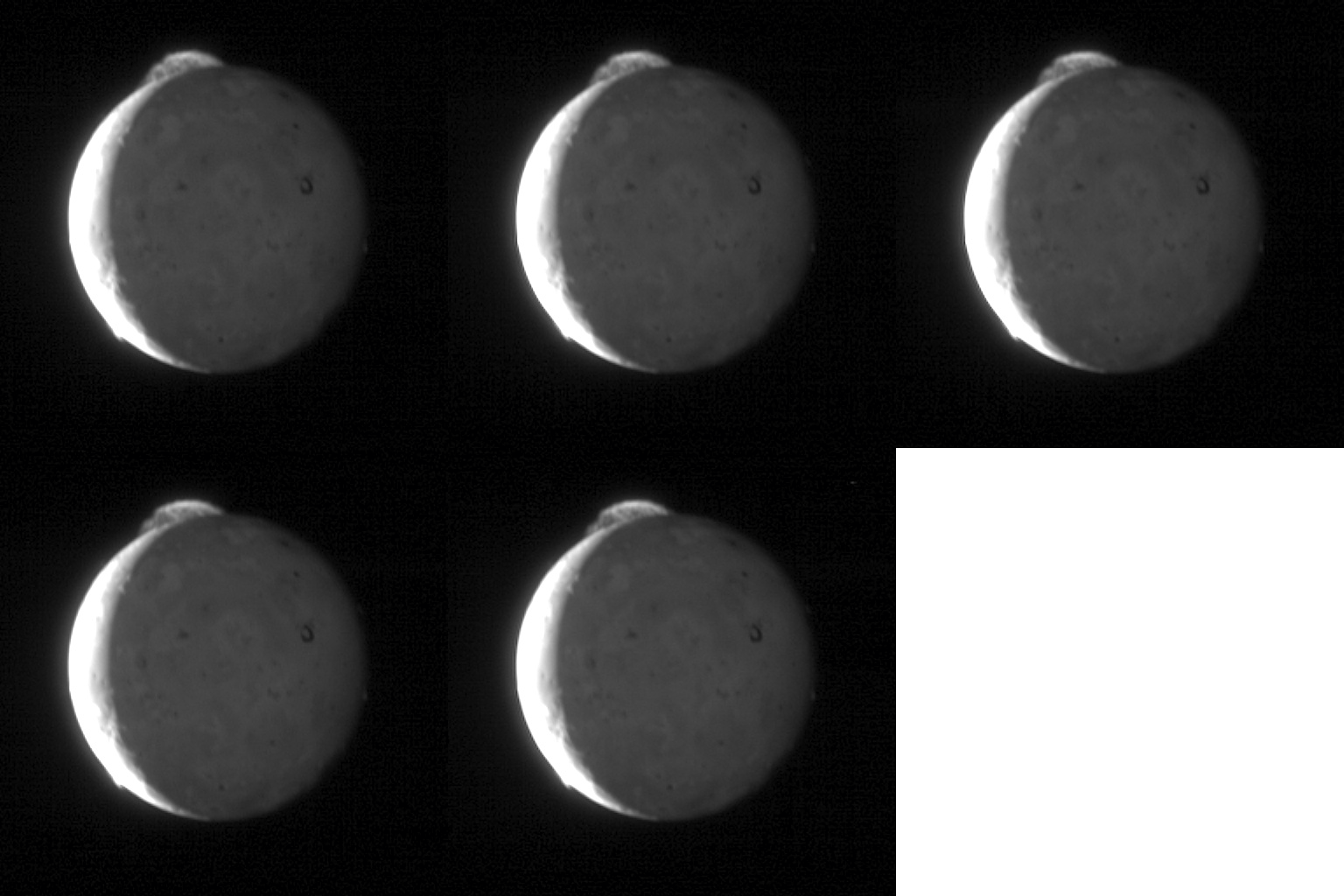
Sequence of five images taken by New Horizons on 1stMarch 2007, over the course of eight minutes from 23:50 UT. The images form an animation of an eruption by the Tvashtar Paterae volcanic region on the innermost of Jupiter’s Galilean moons, Io. The plume is 330 km high, though only its uppermost half is visible in this image, as its source lies over the moon’s limb on its far side
On 10th January 2007, New Horizons also made a navigation exercise near Jupiter, with long-distance observations of Jupiter’s outer moon Callirrhoe as a navigation exercise.
New Horizons completed its Jupiter flyby on 28th February 2007.
On 8th June 2008 the probe passed Saturn’s orbit, 9.5 AU from the Earth.
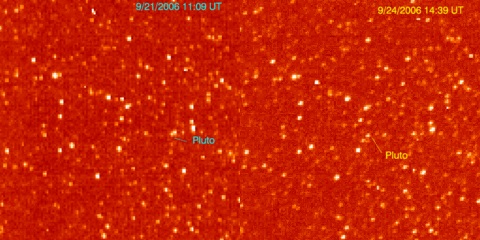
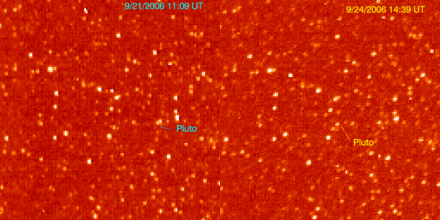
First sighting of Pluto by New Horizons (21st to 24th September 2006) during a test of the LORRI. The images, taken from a distance of approximately 4.2 billion km (2.6 billion miles), confirmed the spacecraft’s ability to track distant targets, critical for manoeuvring toward Pluto and other Kuiper belt objects. The image of Pluto was taken from a great distance, rendering the dwarf planet faint
On 29th December 2009, the probe became closer to Pluto than to Earth. Pluto was then 32.7 AU from Earth, and the probe was 16.4 AU from Earth.
On 25th February 2010 half the mission’s travel distance (2.38×10⁹ km) was reached.
On 18th March 2011 at 22:00 UTC, the probe passed Uranus’s orbit, the fourth planetary orbit the spacecraft crossed since its start.
On 2nd December 2011, New Horizons drew closer to Pluto than any other spacecraft has ever been. Previously, Voyager 1 held the record for the closest approach (about 10.58 AU).
On 11th February 2012 at around 4:55 UTC, New Horizons was 10 AU from Pluto.
On 24th August 2014 the probe passed Neptune’s orbit, the fifth planetary orbit the spacecraft crossed.
In February 2015 observations of Pluto began. New Horizons was then close enough to Pluto for the main science mission to begin.
By 5th May 2015, images should have exceeded the best Hubble Space Telescope resolution.
On 14th July 2015 New Horizons flew by Pluto, Charon, Hydra, Nix, S/2011 P 1 and S/2012 P 1; flyby of Pluto around 11:47 UTC at 13,695 km, 13.78 km/s (at closest approach), flyby of Charon, Hydra, Nix, S/2011 P 1 and S/2012 P 1 around 12:01 UTC at 29,473 km, 13.87 km/s (closest approach to Charon), although these parameters may have been changed during the flight.
After passing by Pluto, New Horizons continues farther into the Kuiper belt. Mission planners have found additional Kuiper belt objects (KBOs) of the order of 50 – 100 km in diameter for flybys similar to the spacecraft’s Plutonian encounter. As manoeuvring capability is limited, this phase of the mission is contingent on finding suitable KBOs close to New Horizons’s flight path, ruling out any possibility for a planned flyby of Eris, a trans-Neptunian object comparable in size to Pluto. The available region, being fairly close to the plane of the Milky Way and thus difficult to survey for dim objects, is one that has not been well-covered by previous KBO search efforts. The public helped to scan telescopic images for possible mission candidates by participating in the Ice Hunters project, although that project is now finished. Any attempted flybys will be in 2016 to 2020.
The Dwarf Planets mission will come to an end in 2026, according to NASA.
Artist’s ideas of the New Horizons spacecraft encountering Pluto and its largest moon, Charon in July 2015. [Illustrations: Johns Hopkins University Applied Physics Laboratory/Southwest Research Institute]
The probe left Earth in 2006, just after Pluto was demoted to being a dwarf planet. It has provided us with the first up close and personal images of this outer solar system object. Initial observations started in January 2015, but the best views occurred as it flew by the dwarf planet on 14th July 2015 before heading off to visit other objects far out in the Kuiper Belt.
[Fourth photograph above] Every spaceflight to a new world brings its own set of surprises. Apart from the high mountain ranges and almost complete absence of impact craters, Pluto has these large apparently flat plains that extend for great areas over the surface.

These images of Pluto are derived from data sent back from NASA’s New Horizons spacecraft. The bewildering diversity of Pluto’s surface features are revealed in the new images. These and other photographs from New Horizons can be found at the NASA/Johns Hopkins University Applied Physics Laboratory/Southwest Research Institute web-site which is being updated regularly [Photographs: Nasa/Rex Shutterstock]
The first image on the left is dominated by the informally named icy plain Sputnik Planum but also features a tremendous variety of other landscapes.
The second image includes dark, ancient heavily cratered terrain; bright, smooth geologically young terrain; assembled masses of mountains; and an enigmatic field of dark, aligned ridges that resemble dunes. The smallest visible features are 0.8km in size.
A comprehensive gallery of Photos of Pluto and Its Moons is on the Space.com web.
A comprehensive log of New Horizon’s flyby with many videos is in New Horizons Probe’s 14th July 2015 Pluto Flyby: Complete Coverage, also on Space.com.
More photos taken during New Horizon’s flyby of Pluto and its moons are planned by NASA to be released over the next several months or even years, as the data transmission rate is very low. Meanwhile tastes of what’s coming, with several video-clips and photo galleries, are in:
NASA News Conferences on 24th July 2015. NASA Releasing stunning new Earth-like Images of Pluto.Just when you think Pluto couldn’t get any more fascinating, it does. NASA said on 4th February 2016 that numerous, isolated hills – possibly fragments of water ice from Pluto’s surrounding uplands – are floating on the nitrogen ice glaciers on the dwarf planet’s surface. This is happening in the beautiful heart-shaped feature on Pluto known as Sputnik Planum. NASA said the hills individually measure one to several kilometres across. The hills are likely to be miniature versions of the larger jumbled mountains on Sputnik Planum’s western border.
Transmitted to Earth on 24th December 2015, this image [left] from the Long Range Reconnaissance Imager (LORRI) extends New Horizons’ highest-resolution swath of Pluto to the centre of Sputnik Planum, the informally named plain that forms the left side of Pluto’s “heart.” Mission scientists believe the pattern of the cells stems from the slow thermal convection of the nitrogen-dominated ices. The darker patch at the centre of the image is likely to be a dirty block of water ice “floating” in denser solid nitrogen, and which has been dragged to the edge of a convection cell. Also visible are thousands of pits in the surface, which scientists believe may form by sublimation. The image is about 72 kilometres wide.
For the scale here [left], notice the feature informally named Challenger Colles – honouring the crew of the lost Space Shuttle Challenger. It appears to be an especially large accumulation of these hills, measuring 60 by 35 km. This feature is located near the boundary with the uplands, away from the cellular terrain, and may represent a location where hills have been ‘beached’ due to the nitrogen ice being especially shallow.
The inset puts in context the larger view that covers most of Pluto’s encounter hemisphere. The inset was obtained by New Horizons’ Multispectral Visible Imaging Camera (MVIC) instrument. North is up; illumination is from the top-left of the image. The image resolution is about 320 metres per pixel. The image measures almost 500 kilometres long and about 340 kilometres wide. It was obtained at a range of approximately 16,000 kilometres from Pluto, about 12 minutes before New Horizons’ closest approach to Pluto.
The hills are thought to be fragments of Pluto’s rugged uplands that have broken away and are being carried by the nitrogen glaciers into Sputnik Planum. ‘Chains’ of the drifting hills are formed along the flow paths of the glaciers.
Because water ice is less dense than nitrogen-dominated ice, these water ice hills are probably floating in a sea of frozen nitrogen.
When the hills enter the cellular terrain of central Sputnik Planum, they become subject to the convective motions of the nitrogen ice, and are pushed to the edges of the cells, where the hills cluster in groups reaching up to 20 kilometres across.
“This part of Pluto is acting like a lava lamp, if you can imagine a lava lamp as wide as, and even deeper than, Hudson Bay.” according to William McKinnon, deputy lead of the New Horizons Geology, Geophysics and Imaging Team. Sputnik Planum is at a lower elevation than most of the surrounding area by a couple of miles, but is not completely flat. Its surface is separated into cells or polygons 16 to 40 km wide, and when viewed at low sun angles (with visible shadows), the cells are seen to have slightly raised centres and ridged margins, with about 100 metres of overall height variation.
Mission scientists believe the pattern of the cells stems from the slow thermal convection of the nitrogen-dominated ices that fill Sputnik Planum. A reservoir that’s likely to be several kilometres deep in some places, the solid nitrogen is warmed at depth by Pluto’s modest internal heat, becomes buoyant and rises up in great blobs, and then cools off and sinks again to renew the cycle.
Computer models by the New Horizons team show that these blobs of overturning solid nitrogen can slowly evolve and merge over millions of years. The ridged margins, which mark where cooled nitrogen ice sinks back down, can be pinched off and abandoned. The “X” feature is probably one of these – a former quadruple junction where four convection cells meet. Numerous, active triple junctions can be seen elsewhere in the LORRI mosaic.
The surface of Sputnik Planum appears darker toward the shore (at top), possibly implying a change in composition or surface texture. The occasional raised, darker blocks at the cell edges are probably dirty water “icebergs” that are floating in denser solid nitrogen.
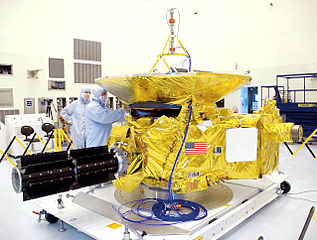
In the clean room at KSC’s Payload Hazardous Servicing Facility, technicians prepare the New Horizons spacecraft for a media event. Photographers and reporters will be able to photograph the New Horizons spacecraft and talk with project management and test team members from NASA and the Johns Hopkins University Applied Physics Laboratory. The RTG seen in this picture (the black tube to the left) is not the real flying unit and is only a mockup. The real RTG was installed shortly before launch.
The spacecraft is comparable in size and general shape to a grand piano and has been compared to a piano glued to a cocktail bar-sized satellite dish. As a point of departure, the team took inspiration from the Ulysses spacecraft, which also carried a radioisotope thermoelectric generator (RTG) and dish on a box-in-box structure through the outer Solar System. Many subsystems and components have flight heritage from APL’s CONTOUR spacecraft, which in turn had heritage from APL’s TIMED spacecraft.
The spacecraft’s body forms a triangle, almost 2.5 feet (0.76 m) thick. (The Pioneers had hexagonal bodies, while the Voyagers, Galileo, and Cassini–Huygens had decagonal, hollow bodies.) A 7075 aluminium alloy tube forms the main structural column, between the launch vehicle adapter ring at the “rear,” and the 2.1 m radio dish antenna affixed to the “front” flat side. The titanium fuel tank is in this tube. The RTG is attached with a 4-sided titanium mount resembling a grey pyramid or stepstool. Titanium provides strength and thermal isolation. The rest of the triangle is primarily sandwich panels of thin aluminium facesheet (less than 1⁄64 in or 0.40 mm) bonded to aluminium honeycomb core.
The structure is larger than strictly necessary, with empty space inside. The structure is designed to act as shielding, reducing electronics errors caused by radiation from the RTG. Also, the mass distribution required for a spinning spacecraft demands a wider triangle.
New Horizons has both spin-stabilized (cruise) and three-axis stabilized (science) modes, controlled entirely with hydrazine monopropellant. 77 kg (170 lb) of hydrazine provides a delta-v capability of over 290 m/s (649 mph) after launch. Helium is used as a pressurant, with an elastomeric diaphragm assisting expulsion. The spacecraft’s on-orbit mass including fuel is over 470 kg (1,036 lb) for a Jupiter flyby trajectory, but would have been only 445 kg (981 lb) for a direct flight to Pluto. This would have meant less fuel for later Kuiper belt operations and is caused by the launch vehicle performance limitations for a direct-to-Pluto flight.
There are 16 thrusters on New Horizons: four 4.4 N (1.0 lbf) and twelve 0.9 N (0.2 lbf) plumbed into redundant branches. The larger thrusters are used primarily for trajectory corrections, and the small ones (previously used on Cassini and the Voyager spacecraft) are used primarily for attitude control and spinup/spindown manoeuvres. Two star cameras (from Galileo Avionica) are used for fine attitude control. They are mounted on the face of the spacecraft and provide attitude information while in spinning or in 3-axis mode. Between star camera readings, knowledge is provided by dual redundant Miniature Inertial Measurement Unit (MIMU) from Honeywell. Each unit contains three solid-state gyroscopes and three accelerometers. Two Adcole Sun sensors provide coarse attitude control. One detects angle to the Sun, while the other measures spin rate and clocking.
A cylindrical radioisotope thermoelectric generator (RTG), protrudes from one vertex in the plane of the triangle. The RTG provides about 240 W, 30 V DC at launch, and is predicted to drop approximately 5% every 4 years, decaying to 200 W by the encounter with the Plutonian system in 2015. The RTG, model “GPHS-RTG”, was originally a spare from the Cassini mission. The RTG contains 11 kg (24 lb) of plutonium-238 oxide pellets. Each pellet is clad in iridium, then encased in a graphite shell. It was developed by the U.S. Department of Energy.
The use of a plutonium RTG battery was opposed by about 30 anti-nuclear protesters in minor demonstrations some days before launch. The amount of radioactive plutonium in the RTG is 10.9 kg, about one-third the amount on board the Cassini–Huygens probe when it was launched in 1997. That launch was protested by over 300 people. The United States Department of Energy estimated the chances of a launch accident that would release radiation into the atmosphere at 1 in 350 and monitored the launch as it always does when RTGs are involved. It was believed that a worst-case scenario of total dispersal of on-board plutonium would spread the equivalent radiation of 80% the average annual dosage in North America from background radiation over an area with a radius of 105 km (65 miles), at the Materials and Fuels Complex (formerly Argonne West), a part of the Idaho National Laboratory in Bingham County, near the town of Arco and the city of Idaho Falls. The plutonium was produced at Los Alamos National Laboratory in New Mexico. Less than the original design goal was produced, due to delays at the United States Department of Energy, including security activities, which held up production. The mission parameters and observation sequence had to be modified for the reduced wattage; still, not all instruments can operate simultaneously. The Department of Energy transferred the space battery program from Ohio to Argonne in 2002 because of security concerns. There are no onboard batteries. RTG output is relatively predictable; load transients are handled by a capacitor bank and fast circuit breakers.
Internally, the structure is painted black. This equalizes temperature by radiative heat transfer. Overall, the spacecraft is thoroughly blanketed to retain heat. Unlike the Pioneers and Voyagers, the radio dish is also enclosed in blankets which extend to the body. The heat from the RTG also adds warmth to the spacecraft in the outer Solar System. In the inner Solar System, the spacecraft must prevent overheating. Electronic activity is limited, power is diverted to shunts with attached radiators, and louvres are opened to radiate excess heat. Then, when the spacecraft is cruising inactively in the cold outer Solar System, the louvres are closed, and the shunt regulator reroutes power to electric heaters.
Communication with the spacecraft is via X band. At Pluto’s distance, a rate of approximately 1,000 bits per second is expected. The craft had a communication rate of 38 kbit/s at Jupiter. The 70 m Deep Space Network (DSN) dishes was used to relay data beyond Jupiter. Besides the low bandwidth, Pluto’s distance also causes a (one way) latency of about 4.5 hours.
The spacecraft uses dual redundant transmitters and receivers, and either right- or left-hand circular polarization. The downlink signal is amplified by dual redundant 12-watt TWTAs (travelling-wave tube amplifiers) mounted on the body under the dish. The receivers are new, low-power designs. The system can be controlled to power both TWTAs at the same time, and transmit a dual-polarized downlink signal to the DSN that could almost double the downlink rate. Initial tests with the DSN in this dual-polarized mode have been successful, and an effort to make the DSN polarization-combining technique operational is underway.
In addition to the high-gain antenna, there are two low-gain antennas and a medium-gain dish. The high-gain dish has a Cassegrain layout, composite construction, and a 2.1 metre diameter (providing well over 40 dB of gain, and a half-power beam width of about a degree). The prime-focus, medium-gain antenna, with a 0.3 metre aperture and 10-degree half-power beamwidth, is mounted to the back of the high-gain antenna’s secondary reflector. The forward low-gain antenna is stacked atop the feed of the medium-gain antenna. The aft low-gain antenna is mounted within the launch adapter at the rear of the spacecraft. This antenna was used only for early mission phases near Earth, just after launch and for emergencies if the spacecraft had lost attitude control.
To save mission costs, the spacecraft was in “hibernation” between Jupiter and Pluto. It awoke once per year, for 50 days, for equipment checkout and trajectory tracking. The rest of the time, the spacecraft was in a slow spin, sending a beacon tone which was checked once per week. Depending on frequency, the beacon indicates normal operation, or one of seven fault modes. New Horizons is the first mission to use the DSN’s beacon tone system operationally, the system having been flight-tested by the DS1 mission.
New Horizons records scientific instrument data to its solid-state buffer at each encounter, then transmit the data to Earth. Data storage is done on two low-power solid-state recorders (one primary, one backup) holding up to 8 gigabytes each. Because of the extreme distance from Pluto and the Kuiper belt, only one buffer load at those encounters can be saved. This is because New Horizons would have left the vicinity of Pluto (or future target object) by the time it takes to transmit the buffer load back to Earth. Part of the reason for the delay between the gathering and transmission of data is because all of the New Horizons instrumentation is body-mounted. In order for the cameras to record data, the entire probe must turn, and the one-degree-wide beam of the high-gain antenna would almost certainly not be pointing toward Earth. Previous spacecraft, such as the Voyager program probes, had a rotatable instrumentation platform (a “scan platform”) that could take measurements from virtually any angle without losing radio contact with Earth. New Horizons’ elimination of excess mechanisms was implemented to save weight, shorten the schedule, and improve reliability to achieve a lifetime of at least 15 years. (The Voyager 2 spacecraft experienced platform jamming at Saturn; the demands of long time exposures at Uranus led to modifications of the mission such that the entire probe was rotated to achieve the time exposure photos at Uranus and Neptune, similar to how New Horizons rotates.)
The spacecraft carries two computer systems, the Command and Data Handling system and the Guidance and Control processor. Each of the two systems is duplicated for redundancy, giving a total of four computers. The processor used is the Mongoose-V, a 12 MHz radiation-hardened version of the MIPS R3000 CPU. Multiple clocks and timing routines are implemented in hardware and software to help prevent faults and downtime. To conserve heat and mass, spacecraft and instrument electronics are housed together in IEMs (Integrated Electronics Modules). There are two redundant IEMs. Including other functions such as instrument and radio electronics, each IEM contains 9 boards.
On 19th March 2007 the Command and Data Handling computer experienced an uncorrectable memory error and rebooted itself, causing the spacecraft to go into safe mode. The craft fully recovered within two days, with some data loss on Jupiter’s magnetotail. No impact on the subsequent mission is expected.
The spacecraft carries seven scientific instruments. Their total mass is 31 kg, and their rated power is 21 watts (though not all instruments operate simultaneously).
Observations of Pluto, with LORRI and Ralph, began about six months before closest approach. The targets were only a few pixels across. 70 days out, resolution exceeded the Hubble Space Telescope’s resolution, lasting another two weeks after the flyby. This should have detected any rings or any additional moons (eventually down to 2 km diameter), for avoidance and targeting manoeuvres, and observation scheduling. Long-range imaging included 40 km (25 mile) mapping of Pluto and Charon 3.2 days out. This is half the rotation period of Pluto–Charon and allowed imaging of the side of both bodies that faced away from the spacecraft at closest approach. Coverage repeated twice per day, to search for changes due to snows or cryovolcanism. Still, due to Pluto’s tilt and rotation, a portion of the northern hemisphere was in shadow at all times.
During the flyby, LORRI should have obtained select images with resolution as high as 50 m/px (if the closest distance is around 10,000 km), and MVIC should have obtained 4-colour global dayside maps at 1.6 km resolution. LORRI and MVIC attempted to overlap their respective coverage areas to form stereo pairs. LEISA obtained hyperspectral near-infrared maps at 7 km/pixel globally and 0.6 km/pixel for selected areas. Meanwhile, Alice characterized the atmosphere, both by emissions of atmospheric molecules (airglow), and by dimming of background stars as they pass behind Pluto (occultation).
During and after closest approach, SWAP and PEPSSI sampled the high atmosphere and its effects on the solar wind. VBSDC searched for dust, inferring meteoroid collision rates and any invisible rings. REX performed active and passive radio science.
Ground stations on Earth transmitted a powerful radio signal as New Horizons passed behind Pluto’s disk, then emerged on the other side. The communications dish measured the disappearance and reappearance of the signal. The results resolved Pluto’s diameter (by their timing) and atmospheric density and composition (by their weakening and strengthening pattern). (Alice can perform similar occultations, using sunlight instead of radio beacons.) Previous missions had the spacecraft transmit through the atmosphere, to Earth (“downlink”). Low power and extreme distance means New Horizons was the first such “uplink” mission. Pluto’s mass and mass distribution were evaluated by their tug on the spacecraft. As the spacecraft sped up and slowed down, the radio signal experienced a Doppler shift. The Doppler shift was measured by comparison with the ultrastable oscillator in the communications electronics.
Reflected sunlight from Charon allowed some imaging observations of the nightside. Backlighting by the Sun would have highlighted any rings or atmospheric hazes. REX performed radiometry of the nightside.
Initial, highly-compressed images were transmitted within days. The science team selected the best images for public release. Uncompressed images take about nine months to transmit, depending on Deep Space Network traffic. It may turn out, however, that fewer months will be needed. The spacecraft link is proving stronger than expected, and it is possible that both downlink channels may be ganged together to nearly double the data rate.
Primary objectives (required)
Failure to meet any of these objectives would constitute a failure of the mission.
Secondary objectives (expected)
It is expected, but not demanded, that most of these objectives will be met.
Tertiary objectives (desired)
These objectives may be attempted, though they may be skipped in favour of the pevious objectives. An objective to measure any magnetic field of Pluto was dropped. A magnetometer instrument could not be implemented within a reasonable mass budget and schedule, and SWAP and PEPSSI could do an indirect job detecting some magnetic field around Pluto.
Because of the need to conserve fuel for possible encounters with Kuiper belt objects subsequent to the Pluto flyby, intentional encounters with objects in the asteroid belt were not planned. Subsequent to launch, the New Horizons team scanned the spacecraft’s trajectory to determine if any asteroids would, by chance, be close enough for observation. In May 2006 it was discovered that New Horizons would pass close to the tiny asteroid 132524 APL on 13th June 2006. Closest approach occurred at 4:05 UTC at a distance of 101,867 km (63,297 miles). The asteroid was imaged by Ralph (use of LORRI at that time was not possible due to the proximity to the Sun), which gave the team a chance to exercise Ralph’s capabilities, and make observations of the asteroid’s composition as well as light and phase curves. The asteroid was estimated to be 2.5 km (1.6 miles) in diameter.
Other possible targets were Neptune trojans. The probe’s trajectory to Pluto passed near Neptune’s trailing Lagrange point (“L5”), which may host hundreds of bodies in 1:1 resonance with the planet. In late 2013, New Horizons passed within 1.2 AU (180 million km) of the recently discovered large, high-inclination L5 Neptune trojan 2011 HM102, which was identified by the New Horizons KBO Search Survey team while searching for more distant objects for New Horizons to fly by after its 2015 Pluto encounter. At this range, 2011 HM102 might have been bright enough to be detectable by New Horizons’ LORRI instrument. However, the 2011 HM102 flyby came shortly before the Pluto encounter. At that time, New Horizons did not have significant downlink bandwidth, and thus free memory, for trojan encounter data.
New Horizons is designed to fly past one or more Kuiper belt objects (KBOs) after passing Pluto. Because the flight path is determined by the Pluto flyby, with only minimal hydrazine remaining, objects must be found within a cone, extending from Pluto, of less than one degree width, within 55 AU. Past 55 AU, the communications link becomes too weak, and the RTG wattage will have decayed significantly enough to hinder observations. Desirable KBOs are well over 50 km in diameter, neutral in colour (to compare with the reddish Pluto), and, if possible, possess a moon. Because the population of KBOs appears quite large, multiple objects may qualify. Large ground telescopes with wide-field cameras, notably the twin Magellan Telescopes, the Subaru Observatory and the Canada-France-Hawaii Telescope were used to search for potential targets up until the Pluto flyby; the Pluto aim point, plus subsequent thruster firing, would then determine the post-Pluto trajectory. The citizen science project Ice Hunters aided in the search for a suitable object. With the completion of the Ice Hunters project, 143 KBOs of potential interest were found.
An extension of the project, Ice Investigators, is being launched. KBO flyby observations will be similar to those at Pluto, but reduced due to lower light, power, and bandwidth. On 21st August 2012 the New Horizons team announced on their Twitter feed that they would attempt distant observations of the object VNH0004 just before the Pluto encounter in January 2015 at a distance of 75 million kilometres.
Provided it survives that far out, New Horizons is likely to follow the Voyager probes in exploring the outer heliosphere and mapping the heliosheath and heliopause.
Even though it was launched far faster than any outward probe before it, New Horizons will never overtake Voyager 1 as the most distant man-made object from Earth. Close fly-bys of Saturn and Titan gave Voyager 1 an advantage with its extra gravity assist. When New Horizons reaches the distance of 100 AU, it will be travelling at about 13 km/s, around 4 km/s slower than Voyager 1 at that distance.
New Horizons (2006-001A) was launched on 19th January 2006 at 19:00:00 UTC, and flew by Jupiter between January and May 2007. It reached Pluto in January to August 2015, with its closest approach on 14th July. It will continue flying by objects in the Kuiper Belt.
New Horizons is the result of a long battle to take advantage of a once-in-a-lifetime opportunity for a Jupiter gravity assist trajectory to Pluto. It observed Jupiter over five months around the flyby in early 2007, with its closest approach on 27th February. It was the first spacecraft to observe the newly formed Little Red Spot, and also caught Io’s north polar volcano Tvashtar in the middle of a spectacular eruption. It travelled within 10,000 km of Pluto before going onward to a second, much more distant encounter with a much smaller Kuiper belt object.
To see diagrams that show the current position of New Horizons, go to the Where Is? page of the New Horizons Web Site (as of July 2016 it was about 35 AU from the Earth, 3 AU from Pluto).
In November 2014, New Horizons was 31.27 AU (4.68 billion km) from the Earth, 2.01 AU (300 million km) from Pluto and 30.80 AU (4.61 billion km) from the Sun, and travelling at 14.65 km/s or 3.2 AU per year (relative to the Sun). Sunlight takes 4.33 hours to get to New Horizons. The brightness of the Sun from the spacecraft is magnitude -19.7. New Horizons is heading in the direction of the constellation Sagittarius.
From June to August 2014, the Hubble Space Telescope searched a region of the sky to find small Kuiper belt objects that New Horizons could reach after its Pluto encounter. The search yielded five objects, and Hubble performed follow-up observations from August to October. Those observations ruled out two, but confirmed that one in particular is 100% certain to be reachable by New Horizons. The three are:
| Object Name | PT1 (1110113Y) 2014 MU69 |
PT2 (E31007AI) |
PT3 (G12000JZ) |
|---|---|---|---|
| Arc length (days) | 58 | 24 | 19 |
| Magnitude | 26.8 | 26.3 | 26.4 |
| Estimated diameter (albedo 0.04 to 0.10) | 30–45 km | 35–55 km | 35–55 km |
| Probability that object can be reached by New Horizons | 100% | 7% | 97% |
| Most likely fraction of Available Delta-V required | 35% | >76% | 75% |
| Estimated Encounter Date | Jan 2019 | 2018–2019 | Jun 2019 |
| Estimated encounter distance from Sun | 43.4 AU | 43–44 AU | 44 AU |
The mission is expected to end in 2026. By 2038 New Horizons will be 100 AU from the Sun. If it is still functioning, the probe will explore the outer heliosphere. NASA commonly approves mission extensions for spacecraft that have finished their primary objective and are still in good working order.
NASA has selected the next destination for New Horizons, the spacecraft that made a historic flyby past Pluto in July 2015, the space agency announced at the end of August 2015. New Horizons will next set its sights on an object called 2014 MU69, NASA said. It is located in the Kuiper Belt.
2014 MU69 is about 30 miles across and orbits about 1.6 billion km beyond Pluto.
Because Kuiper Belt objects receive so little warmth from the sun, NASA says they are likely to be “a well preserved, deep-freeze sample of what the outer solar system was like following its birth 4.6 billion years ago.”
New Horizons performed a series of four manoeuvres in late October and early November to set its course toward 2014 MU69. It’s the only way to guarantee they’ll have enough fuel to conduct the extended mission if it gets approved.
New Horizons was designed with the intention of sending the probe beyond Pluto and its moons to explore more distant Kuiper Belt objects, with communication, power, and scientific systems designed to operate in conditions beyond Pluto’s orbit. The science team will be writing and submitting a research proposal in 2016 for external review.
The New Horizons team still has to do more assessments before finalizing the journey into the outer regions of the Kuiper Belt, including submitting a proposal to NASA in 2016 that will be evaluated by independent experts. But the spacecraft is expected to reach the tiny object on 1stJanuary 2019.
New Horizons Principal Investigator Alan Stern said that out of the more than a thousand identified Kuiper Belt objects, 2014 MU69 was selected because it would require the least fuel: “This Kuiper Belt Object (KBO) costs less fuel to reach than other candidate targets leaving more fuel for the flyby, for ancillary science and greater fuel reserves to protect against the unforeseen. The detailed images and other data that New Horizons could obtain from a Kuiper Belt Object flyby will revolutionize our understanding of the Kuiper Belt and KBOs”. The identification of PT1, which is in a completely different class of KBO than Pluto, potentially allows New Horizons to satisfy those goals. New Horizons has additional hydrazine fuel specifically for a flyby of such a KBO.
The Kuiper Belt marks the beginning of the “third zone” of the solar system, a region of icy asteroids, comets, and dwarf planets that mark some of the most ancient objects in the solar system. There’s so much that we can learn from close-up spacecraft observations that we’ll never learn from Earth, as the Pluto flyby demonstrated so spectacularly”.
It’s no “former ninth planet”, but for New Horizons, 2014 MU69 will have to do as its next destination. (We think it takes 293 Earth-years for it to make a single trip, but with a healthy margin of ±24 Earth-years error.) It also marks the shortest time between the discovery of a world and its exploration; planetary astronomer Jason Cook teases that it’s downright rare for a discoverer to get to see their new worlds.
In order to find the best options for its next mission, New Horizons had a bit of help from another intrepid spacecraft. Discovered in 2014 by the Hubble Space Telescope, scientists estimate it is just under 48 km in diameter, or between 0.5 and 1% the size of Pluto. SwRI leads the science mission, payload operations, and encounter science planning.
From Al Jazeera News and KRGW-TV (the Las Cruces PBS affiliate operating out of New Mexico State University).
Other interplanetary spacecraft (full list): Apollo, Cassini-Huygens (including Cassini End-of-Mission Options with Science Evaluation [circa 2008]), Luna [or Lunik], Lunar Orbiter, Mariner, Mars, New Horizons [this page], Pioneer, Surveyor, Vega, Venera, Voyager and Zond

Pluto and Charon from New Horizons
Since leaving the Pluto system, New Horizons has made more discoveries, in particular, the Kuiper Belt object 1994 JR1. This is 145 km wide and has a “day” of 5.47 hours. 1994 JR1 orbits the Sun at a distance of some five billion kilometres, and its location has been pinpointed to within 1,000 kilometres.
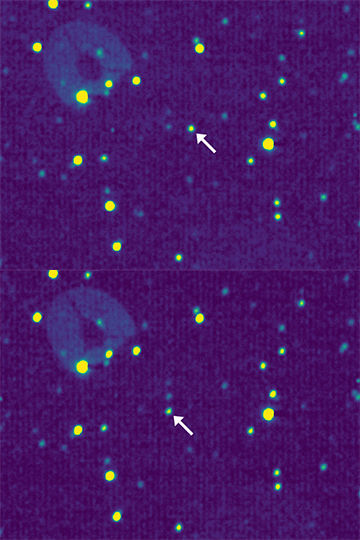
1994 JR1 [NASA/Johns Hopkins University Applied Physics Laboratory/Southwest Research Institute]