
Loading...
Loading...
Cassini spacecraft and its Huygens lander are described on this page.
The two Voyager craft also passed by Saturn, returning valuable information.
The other moons and the rings of the planet Saturn are described elsewhere.
You might also find one of my stories, The Plutonian, to be of interest.

Saturn and Titan; Saturn’s rings are edge-on and cast their shadows onto the planet
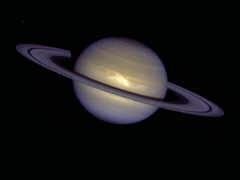
Saturn is the sixth planet from the Sun in the Solar System, and the second largest. It has about 200 observed satellites (about 61 with secure orbits including 53 that are named) and a magnificent ring system. (See also Moons of Saturn and Rings of Saturn.)
It orbits the Sun once in 10,759.22 Earth days (29.4571 years or 24,491.07 Saturn solar days).
Its temperature at the 1-bar pressure level is about 134 K, and at the 0.1-bar level is 84 K.
Saturn’s average distance from the Sun is 1,433,449,370 km (9.58201720 AU) varying between 1,353,572,956 km (9.04807635 AU) and 1,513,325,783 km (10.11595804 AU), an eccentricity of 0.055723219.
Its equatorial radius is 60,268±4 km (9.4492 Earth’s), and its polar radius is 54,364±10 km (8.5521 Earth’s); these numbers indicate a significant flattening of 0.09796±0.00018. Saturn’s surface area is 4.27×10¹⁰ km2 (83.703 times Earth’s), its volume is 8.2713×10¹⁴ km3 (763.59 times Earth’s). Its mass is 5.6846×1026 kg (95.152 times Earth’s). Its mean density is 0.687 g/cm3 which is less than water.
Saturn has a magnificent ring system and at least 61 moons.
Space probe Cassini is now studying the planet, its rings and many of its moons; its lander Huygens made important measurements of Saturn’s moon Titan.
Astronomers think they may finally have solved the mystery of what drives the jet streams [see the arrow in the photograph] that circle the gas giant Saturn from east to west and from west to east. Automated cloud-tracking software was used to monitor data from seven years’ worth of pictures from the orbiting Cassini probe. There had been some debate about whether the energy for the jet streams came from inside Saturn or from the sun. We now know they’re driven by heat from the planet’s interior.

Saturn is most well-known for its magnificent ring system, consisting of nine continuous main rings and three discontinuous arcs, composed mostly of ice particles with a smaller amount of rocky debris and dust. Sixty-two known moons orbit the planet; fifty-three are officially named. This does not include the hundreds of “moonlets” within the rings. Titan, Saturn’s largest and the Solar System’s second largest moon, is larger than the planet Mercury and is the only moon in the Solar System to have a substantial atmosphere.
The Ringed Planet has 61 known moons, most of which are only a few kilometres across. In these images from NASA’s Cassini orbiter, we see several of the planet’s 8 mid-sized satellites, objects a few hundred to 1,500 km across. The icy moon Enceladus, a prime target for future exploration because of its potential habitability for life, appears in all three of these images. In the far left image, it appears to the right of centre just above the ring plane. In the image above, the moon appears at the far right, in the ring plane. And in the image below, Enceladus appears just above and to the left of the rings.
Christiaan Huygens discovered the first satellite around Saturn in 1655. Generations of later astronomers struggled to learn more about this distant world, eventually named Titan, and in time discovered that its size and characteristics are more akin to those of a planet. With a diameter of 5,150 km, Titan is half as wide again as Earth’s moon, and it even outsizes Mercury. No other satellite boasts a dense atmosphere, let alone one dominated by nitrogen and laced with methane. In fact, planetary specialists regard Titan as a primordial Earth in deep freeze.
But even when Voyager 1 flew past at close range in 1980, Titan divulged few secrets. Opaque layers of hydrocarbon haze permeate the atmosphere, hiding the surface from view. Observers later exploited infrared “windows” that cut through the haze, resulting in crude maps of bright and dark surface markings. But that patchwork only whetted curiosity about this alien world. What, exactly, lay at the bottom of that dense, smoggy atmosphere?
Thanks to the Cassini–Huygens mission, which arrived at Saturn in July 2004, we finally have answers. The European Space Agency’s Huygens probe parachuted onto Titan’s surface in January 2005, and since then NASA’s Cassini Saturn orbiter has slipped past Titan dozens of times, probing beneath the enshrouding haze to piece together a global view of its frigid surface.
Some of the other moons of Saturn and its rings are described on other pages of this web site.
Titan is the largest moon of Saturn.
It was discovered on 25th March 1655 by Christiaan Huygens. Titan’s gravity is 1.352 m/s2 and it takes 16 days to orbit Saturn.
Titan is a strange, looking-glass version of Earth with a substantial atmosphere and a seasonal cycle. Wind and rain shape the surface to form river channels, seas, dunes and shorelines. But much of what’s familiar is also turned sideways: the moon’s mountains and dune fields are made of ice, rather than rock or sand, and liquid hydrocarbons take up many of the rôles played by water on Earth. The vast majority of Titan’s lakes and seas are concentrated around the north polar region. Just one of these bodies of liquid – Ligeia Mare – is estimated to contain about 9,000 cubic km of mostly liquid methane, equating to about 40 times the proven reserves of oil and gas on Earth.
Scientists believe they have detected the first liquid waves on the surface of another world. The signature of isolated ripples was observed in a sea called Punga Mare on the surface of Titan. However, these seas are filled not with water, but with hydrocarbons like methane and ethane. They exist in their liquid state on Titan, where the surface temperature averages about −180°C.
An image of Titan’s north pole taken by the Cassini probe during a flyby in July 2012 shows sunlight being reflected from surface liquid, a specular reflection. Dr Barnes, from the University of Idaho in Moscow, US, used a mathematical model to investigate whether the features in the image were compatible with waves. He told the meeting: “We think we’ve found the first waves outside the Earth. What we’re seeing seems to be consistent with waves at just a few locations in Punga Mare [with a slope] of six degrees.” He said other possibilities, such as a wet mudflat, could not be ruled out. But assuming these were indeed waves, Dr Barnes calculates that a wind speed of around 0.75 m/s is required to produce ripples with the requisite slope of six degrees. That points to the waves being just 2 cm high. However, Titan appears to be on the brink of major seasonal changes, which present important opportunities for scientists to gain a better understanding of this complex and endlessly surprising world. “The expectation is that any day now, the winds will start getting strong enough as we move into northern summer, and the waves will start picking up,” Ralph Lorenz, from the Johns Hopkins Applied Physics Laboratory (JHUAPL) in Maryland said.
“You can also get a phenomenon known as wind set-up, where wind over a body of water will cause the liquid to pile up, potentially causing a storm surge. A metre of storm surge, a metre of tides, is certainly within the realms of possibility for Titan. Whether we can see that [with Cassini] is another matter.” Dr Lorenz said he was hopeful that sea level rise of a metre in height could cause shorelines to migrate and that this could be picked up from orbit. Titan operates on a 30-year seasonal cycle, with the northern region currently approaching summer solstice, which it will mark in 2017. Computer models of Titan’s weather suggest that the northern summer is approaching the rainy season, in which liquid hydrocarbons are “pumped” from the south pole to the north by the climate cycle. Sometime soon, scientists expect, clouds will start to gather at the north pole and it should start to rain. “We have a long-term picture of liquid levels rising in the north and declining in the south. But that’s against the backdrop of seeing what we think are evaporite deposits around the northern seas and lakes,” Dr Lorenz explained.
These evaporite regions are Titan’s equivalent to salt flats on Earth where bodies of water evaporate, leaving behind minerals that had previously been dissolved in the water. “That suggests that while the sea level is rising in the current epoch, at some time in the past, the liquid level was much higher than it is today. We’ve now mapped most of the surface and there aren’t large areas where you could hide another sea,” he explained. The amount of moisture in the climate system might fluctuate because methane is continuously destroyed in the atmosphere by sunlight. But it could also be re-supplied via volcanic belches from beneath the moon’s surface.
Tidal roar: In his own presentation at the LPSC, Dr Lorenz focused on a narrow “throat” feature that separates the two main basins of Titan’s largest sea, Kraken Mare. Calling it the “Throat of Kraken”, he said it was similar in size to the Straits of Gibraltar and might generate fast-moving tidal currents through the narrow channel.
Dr Lorenz pointed out that on Earth, such circumstances can produce whirlpools, and in the case of the Corryvreckan off the coast of Scotland, a tidal maelstrom generates a roar that can be heard 16 km away. Whether such phenomena existed at this location on Titan was pure speculation, he said. Dr Lorenz explained: “It’s really getting quite exciting, because we’re starting to get a literal big picture, in the sense that the radar coverage [of Titan’s surface] is close to complete. But because we’re moving into northern summer, there’s better lighting, which means the camera and the near-infrared spectrometer on Cassini are also able to map the northern seas. Everything is really starting to come together, and the seas and lakes are very much becoming the central topic in Titan science.”
Titan’s surface abounds with organic molecules like methane (CH4) and ethane (C2H6) and water ice, but its frigid temperatures offer bleak prospects for life. At Titan’s −179°C surface temperatures, chemical reactions slow to a crawl, limiting the ability of complex molecules to form. But Titan’s interior is warm enough to sustain liquid water. Given the plethora of life’s building blocks on Titan, scientists cannot rule out the possibility that the moon harbours biological activity deep underground.
Titan is the only natural satellite known to have a dense atmosphere, and the only object other than Earth for which clear evidence of stable bodies of surface liquid has been found.
Titan’s lakes and seas are concentrated at the north pole.
Cassini’s radar has revealed numerous flat, smooth features, mainly at high northern latitudes, which scientists have interpreted as lakes. This view has been confirmed by recent spectral analysis. Titan and Earth are the only bodies in the solar system to have liquid bodies on their surface. The colours represent radar reflectivity, not what you’d see.
British scientists have proposed sending a boat to explore the moon’s methane oceans – one of the ambitions discussed at a meeting in London on 26th April 2012 to celebrate Britain’s entry to the space age 50 years ago, with apologies to John Masefield.
I must go down to the seas again,
to Titan’s sea and sky,
And all I ask is this small ship
and the stars to steer her by,
And the wheel’s kick and the wind’s song
and the hull softly shaking,
And a soft mist on the face of the sea,
When the orange dawn is breaking.
After leaving Saturn behind, Pioneer 11 passed the moon Titan at a distance of 360,000 km on 2nd September 1979 at 18:48 UT. The spacecraft took five images from which was constructed this picture of Titan
Titan and its lakes(“lacus” is Latin for lake) and seas (“mare”), photographed by the Huygens lander
The large sea called Ligeia Mare (Ligeia was one of the sirens in Greek mythology) is larger than Lake Superior on Earth, and is second only to Kraken Mare [see the top right photo in this section], similar in size to the Caspian Sea (the Kraken was a legendary sea monster). A mysterious object appeared in this sea; see two of the photographs above and this report.
Cassini imaged Ontario Lacus in near-infrared light. This feature is similar in size and shape to Lake Ontario, and is located near Titan’s south pole. Recent spectral observations have confirmed the presence of liquid ethane.
Cassini has also detected methane lakes in the ‘tropics’ of Saturn’s moon Titan. It was previously thought that only the polar regions of the moon contained permanent lakes. One of the tropical lakes appears to be about half the size of Utah’s Great Salt Lake, with a depth of at least 1 metre. The probe used its visual and infrared mapping spectrometer to identify the lakes. Saturn’s rings can be seen in the distance on this image.
One of the problems that Cassini’s radar scientists encountered was that they were unable to match up surface features wherever one of the instrument’s long image swaths overlapped another. The coordinates of a given surface feature could be off by up to 40 km from one swath to the next.
The team had assumed that Titan’s obliquity (axial tilt) was zero. If instead the pole could drift by nearly a half degree, the observations fit together much better. Yet even with the revised polar tilt, the radar images continued to show offsets of up to 3 km – and they were getting larger. Incredibly, the moon’s spin seemed to be speeding up!
Tides from Saturn should force Titan to keep one hemisphere constantly facing the planet, just as the Moon’s near side always faces Earth. Motions within Titan’s dense atmosphere can affect the spin rate slightly, but not if they have to tug the moon’s entire mass.
The only way to explain the growing mismatch is if the winds push only on Titan’s icy crust – and that’s only possible if a liquid-water mantle separates the moon’s crust from its rock-and-metal core. We’re not yet sure how far down this lubricating layer might lie, though the radar team estimates that Titan’s ice crust might be about 70 km thick.
A mosaic of nine processed images acquired during Cassini’s first very close fly-by of Saturn’s moon Titan on Oct. 26, 2004, constitutes the most detailed full-disc view of the mysterious moon. The view is centered on 15 degrees South latitude, and 156 degrees West longitude. Brightness variations across the surface and bright clouds near the south pole are easily seen. The images that comprise the mosaic have been processed to reduce the effects of the atmosphere and to sharpen surface features. The mosaic has been trimmed to show only the illuminated surface and not the atmosphere above the edge of the moon. The Sun was behind Cassini so nearly the full disc is illuminated. Pixels scales of the composite images vary from 2 to 4 km per pixel. Surface features are best seen near the centre of the disc, where the spacecraft is looking directly downwards; the contrast becomes progressively lower and surface features become fuzzier towards the outside, where the spacecraft is peering through haze, a circumstance that washes out surface features. The brighter region on the right side and equatorial region is named Xanadu Regio. Scientists are actively debating what processes may have created the bizarre surface brightness patterns seen here. The images hint at a young surface with no obvious craters. However, the exact nature of that activity, whether tectonic, wind-blown, fluvial, marine, or volcanic is still to be determined. The images comprising this mosaic were acquired from distances ranging from 650,000 km to 300,000 km.
 / ESA
/ ESA  / ASI
/ ASI  )
)[Left] One of the first raw images returned by the European Space Agency’s Huygens probe during its successful descent to Titan. It was taken from an altitude of 16.2 km with a resolution of approximately 40 m per pixel. It apparently shows short, stubby drainage channels leading to a shoreline. It was taken with the Descent Imager/Spectral Radiometer, one of two NASA instruments on the probe.
The smooth, rounded rocks and moist “soil” suggest this area was recently wet. Not knowing what awaited Huygens, ESA planners equipped the probe to land safely in liquid or on solid ground. The foreground rocks are made of water ice and are about the size of a fist.
Cassini-Huygens was launched on 15th October 1997 at 08:43:00 UTC. It used a Titan IV(401)B/Centaur rocket, and lifted off from Cape Canaveral SLC-40.
Cassini Passing through a Gap
in Saturn’s Rings
[artist’s impression, also that below]
According to NASA,
Saturn Spacecraft Samples Interstellar Dust
Cassini’s mission was to orbit Saturn; Huygens’ was to land on Titan, Saturn’s largest moon. The project’s COSPAR ID was 1997-061 (Cassini was 1997-061A). The project’s web-sites are ESA, NASA, and ASI.
Dry mass: 2,523 kg. Power: ∼880 watts (BOL), ∼670 watts (2010)
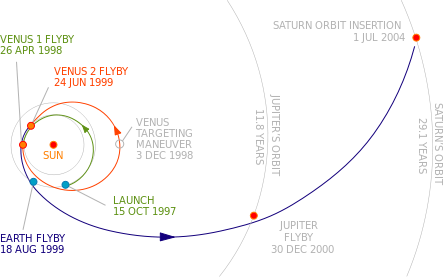
Cassini-Huygens’ path to Saturn required two gravity assist fly-bys of Venus (on 26th April 1998, and 24th June 1999); these took it into the asteroid belt but it was pulled by the Sun’s gravity back and had to make another gravity assist fly-by of the Moon and Earth (on 18th August 1999, closest approach to the Moon was 377,000 km, and to Earth at 03:28 UTC); it made one incidental fly-by of the asteroid 2685 Masursky (on 23rd January 2000 at 10:00 UTC), and one gravity assist fly-by of Jupiter (on 30th December 2000). During the Jupiter encounter, Cassini conducted coordinated observations with the Galileo spacecraft.
Cassini’s orbit insertion was on 1st July 2004 at 02:48:00 UTC. Cassini shapes its orbit around Saturn with numerous gravity-assist fly-bys of Titan, occasionally surveying Saturn from above or below (with lovely perspectives on the rings) and occasionally from within the ring plane (affording frequent encounters with Saturn’s other, smaller moons).
The Huygens probe descent on 14th January 2005 was wildly successful, revealing a strange new world of channels and basins on Titan, the first probe to land on a satellite of another planet.
Cassini’s Primary mission completed (between 3rd and 30th June 2008) but has been extended twice; on 15th April 2008, funding received for the “Equinox Mission” for two more years beginning 1st July 2008 and completed on 27th September 2010; further funding was received for the “Solstice Mission” ending with a plunge into Saturn’s atmosphere around the 2017 northern summer solstice on 15th September 2017, after 293 complete orbits of Saturn, to destroy the spacecraft which will end with the spacecraft’s plunge into the atmosphere.
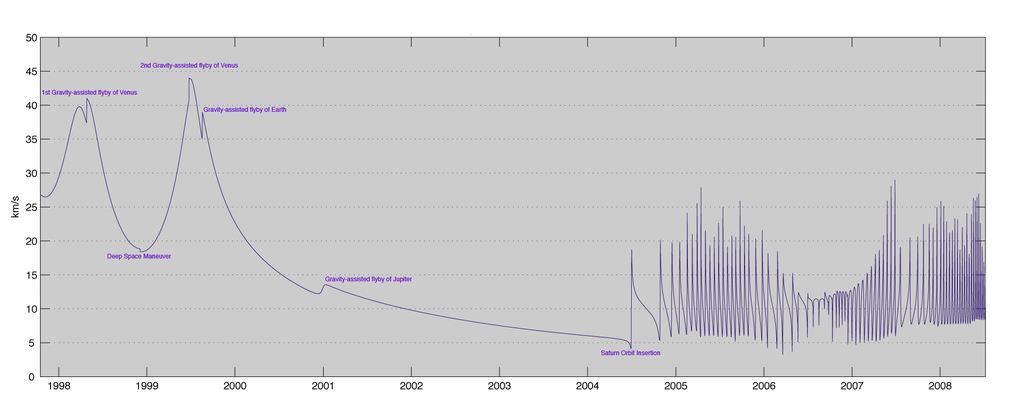
Cassini’s speed. The various gravity assists, two of Venus, one of the Earth and one of Jupiter, form visible peaks on the left, while the periodic variation on the right is caused by the spacecraft’s orbit around Saturn. The data was from JPL Horizons Ephemeris System. The speed above is in km/sec. Note also that the minimum speed achieved during Saturnian orbit is more or less equal to Saturn’s own orbital velocity, which is the ∼5 km/s velocity which Cassini matched to enter orbit.
The 6.7-year transit to Saturn was slightly longer than the six years needed for a Hohmann transfer, but cut the extra velocity (Δv) needed to about 2 km/s, so that the large and heavy Cassini probe was able to reach Saturn, which would not have been possible in a direct transfer even with the Titan IV, the largest launch vehicle available at the time. A Hohmann transfer to Saturn would require a total of 15.7 km/s Δv (disregarding Earth’s and Saturn’s own gravity wells, and disregarding aerobraking), which is not within the capabilities of current launch vehicles and spacecraft propulsion systems.
During planning for its extended missions, various future plans for Cassini were evaluated especially on the basis of science return, cost, and time. Some of the options examined include collision with Saturn atmosphere, icy satellite, or rings; another is departure from Saturn orbit to Jupiter, Uranus, Neptune, or a Centaur. Other options include leaving it in certain stable orbits around Saturn, or departure to a heliocentric orbit. Each plan requires certain amounts of time and changes in velocity. Another possibility was aerobraking into orbit around Titan.
| Option | Set Up Requirements | Execution Time | Operability + Assurance of EOL | Velocity change (Delta-V) required | Science Evaluation circa 2008 |
|---|---|---|---|---|---|
| Saturn Impact – Short Period Orbits | High inclination achievable via any XXM design | 2–10 months total | Short time between last encounter and impact | 5–30 m/s | D-ring option satisfies unachieved AO goals; cheap and easily achievable |
| Saturn Impact – Long Period Orbits | Specific orientation and inclination required | 4–22 months to set up long period orbit + 3 years for final orbit | 3 years between last encounter and impact | 5–35 m/s | Operations costs required for 3 years with no science could be applied elsewhere |
| Impact Icy Satellite | Can be implemented from any geometry | 0.5–3 months total | Short time between last encounter and impact | 5–15 m/s | Cheap and achievable anywhere/time |
| Impact Main Rings | Can be implemented from any geometry | 0.5–3 months total | Short time between last encounter and impact but difficult to prove spacecraft destruction | 5–15 m/s | Cheap and achievable anywhere/time; close-in science before impact |
| Escape to Gas Giant | Specific orbit period, orientation and inclination required + specific departure dates | 1.4-2.4 years to escape + long transfer time (Jupiter 12 years, Uranus 20 years, Neptune 40 years) | Planetary impact can only be guaranteed shortly after escape for Jupiter | 5–35 m/s | Gas giant science unlikely |
| Escape to Heliocentric orbit | Can be implemented from any geometry | 9–18 months to escape, open-ended Solar orbit | Last encounter goes to escape | 5–30 m/s | Solar wind data only |
| Escape to Centaur | Large target set offers wide range of departures | 1–2 years to escape + 3+ year transfer | Last encounter goes to escape; must maintain teams for 3+ years for Centaur science | 5–30 m/s | Multi-year lifetime and funding seems better spent in target-rich Saturnian environment |
| Stable Orbit Outside Titan | Specific orientation and orbit period required | 13–24 months + open-ended time in stable orbit | 200 days between last encounter and final orbit | 50 m/s | Limited Saturn / magnetospheric science, but for long period of time |
| Stable Orbit Outside Phoebe | Specific orientation and orbit period required | 8+ years + open-ended time in stable orbit | Many months between last encounter and final orbit | 120 m/s | Solar wind data; very rare passages through magnetotail |
| Key to colouring: | Poor | Fair | Good | Excellent |
The choice made was the first in this table, XXM (Cassini Solstice Mission), starting in 2010, with several years of fly-bys culminating in proximal orbits and Saturn impact in 2017
