Rings of Planet Saturn

Saturn’s Rings

[The thumbnail photographs can be enlarged by clicking on them.]

Saturn’s rings are arguably the flattest structure known to science. From end to end they would reach from Earth to the Moon, yet they’re hardly taller than a troupe of acrobats standing on one another’s shoulders. By analogy, if the rings were as thin as a sheet of paper, they would stretch 3 km across.

All four giant planets (Jupiter, Saturn, Uranus and Neptune) in our solar system have rings, but only Saturn has a bright and massive ring system. Is this uniqueness a matter of chance, or something more? What can Saturn’s rings tell us about the origin of our solar system and similar processes elsewhere in the galaxy? Ring systems have recently been found around an asteroid (Chariklo) and around some of Saturn’s moons including Phoebe.

Saturn’s rings
A glimpse of the complexity of Saturn’s rings

The planet Saturn, the largest moon Titan and some of its other moons are described on other pages of this web site.

If you thought Saturn had a spectacular set of rings, take a look at Exoplanet J1407b.

Saturn’s main rings are divided into the outermost A ring, the dense and bright B ring, and the inner, more delicate C ring. (Inside the C ring lie the Colombo Gap and Titan Ringlet and the Maxwell Gap and Ringlet [see Wikipedia]). The Cassini Division between the A and B rings is not empty but contains tenuous material analogous to the C ring. (At the inner edge of the Cassini Division lie the Huygens Gap, the lumpy Huygens Ringlet and another small ringlet [see Wikipedia]). The F ring is a wild and woolly narrow loop just outside the A ring, while three dusty, diaphanous rings are designated D (inside C), G (outside F), and E (outside G).

In 2013, Cassini spent 12 hours in Saturn’s shadow and used that opportunity to capture the rings brilliantly backlit by sunlight. Because the camera was viewing the system’s unlit side, opaque regions like the B ring look dark, while more tenuous rings of small dust particles look bright. The ring segment in shadow (at left) appears in silhouette against the planet’s faintly illuminated night side.

Saturn’s Rings


Saturn’s rings from Cassini, 2005

This startling view [left] of Saturn’s ring system shows how image-processing techniques can be used to convey scientific information. Saturn’s clouds are shown in their natural colours, but false-colour enhancement has been used to show the density of the icy particles making up the rings.


Earth and Moon

No, that little blue dot is not dropped pixels on your screen, it’s a picture of Earth [right] taken from some 1.44 billion kilometres away on 19th July 2013 by the wide-angle camera on the international Cassini spacecraft. It also captures Saturn’s F, G and E rings and you may be able to make out our moon.


New rings of Saturn discovered by Cassini

The robotic Cassini spacecraft now orbiting Saturn drifted in the giant planet’s shadow for about 12 hours in 2006 and looked back toward the eclipsed Sun. Cassini saw a view unlike any other. First, the night side of Saturn is seen to be partly lit by light reflected from its own majestic ring system. Next, the rings themselves appear dark when silhouetted against Saturn, but quite bright when viewed away from Saturn, slightly scattering sunlight, in this exaggerated colour image [left]. Saturn’s rings light up so much that new rings were discovered, although they are hard to see in the image. Seen in spectacular detail, however, is Saturn’s E ring, the ring created by the newly discovered ice-fountains of the moon Enceladus and the outermost ring visible above. Far in the distance, at the left, just above the bright main rings, is the almost ignorable pale blue dot of Earth. (See also the photograph of Earth from Voyager 1.)


Saturn by Cassini

Cassini spacecraft cameras were turned toward Saturn and the sun [right] so that the planet and rings are backlit. In addition to its visual splendour, the very-high-phase viewing geometry of the image lets scientists study ring and atmosphere phenomena.

Although many people think of Saturn’s rings as being made up of a series of tiny ringlets, true gaps are few. It is more correct to think of the rings as an annular disk with concentric local maxima and minima in density and brightness. On the scale of the clumps within the rings there is much empty space.

The rings have numerous gaps where particle density drops sharply: two opened by known moons embedded within them, and many others at locations of known destabilizing orbital resonances with Saturn’s moons. Other gaps remain unexplained. Stabilizing resonances, on the other hand, are responsible for the longevity of several rings, such as the Titan Ringlet and the G Ring.

The ring particles are made almost entirely of water ice, with some contamination from dust and other chemicals.

Well beyond the main rings is the Phoebe ring, which is tilted at an angle of 27 degrees to the other rings and, like the moon Phoebe, orbits in retrograde fashion (i.e. it goes round Saturn in the opposite way to all other moons).


Saturn and its rings

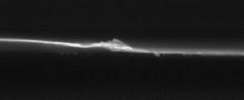
Saturn’s rings are so flat that when seen edge-on, as on the left, they almost disappear. This natural-colour Cassini image, taken only ⅓° out of the ring plane, shows the moon Dione hovering in front of the planet, on which the rings’ shadows are cast.

Another place, like the F ring, where the rings kick up dust is a small ringlet that was recently discovered to inhabit a gap in the Cassini Division. Voyager’s cameras should have been able to see this ringlet but did not, making it perhaps the newest addition to Saturn’s ring system. When it was first seen, one researcher exclaimed, “Look at that charming little ringlet!” The feature has since been nicknamed the Charming Ringlet. But when viewed in the forward-scattered light that highlights dust, the Charming Ringlet dominates the entire region, becoming so bright that it saturated some of the Cassini images.

Infrared spectra from Cassini’s Visual and Infrared Mapping Spectrometer confirm that the material in the Charming Ringlet looks like matter in the F ring and the Encke Division ringlets but unlike material in the rest of the main rings. Why is the Charming Ringlet different, and how did it get that way? Is it a recent creation? It may well be a product of the disruption (perhaps by a meteoroid impact) of an unseen moonlet that opened the gap in the first place.

Some More About Saturn’s Rings

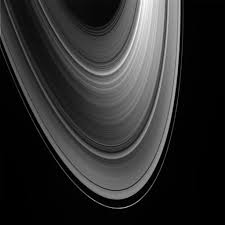
The densest parts of the Saturnian ring system are the A and B Rings, which are separated by the Cassini Division (discovered in 1675 by Giovanni Domenico Cassini). Along with the C Ring, which was discovered in 1850 and is similar in character to the Cassini Division, these regions comprise the main rings. The main rings are denser and contain larger particles than the tenuous dusty rings. The latter include the D Ring, extending inward to Saturn’s cloud tops, the G and E Rings and others beyond the main ring system. These diffuse rings are characterised as “dusty” because of the small size of their particles (often about a micrometre); their chemical composition is, like the main rings, almost entirely of water ice. The narrow F Ring, just off the outer edge of the A Ring, is more difficult to categorize; parts of it are very dense, but it also contains a great deal of dust-size particles.


Saturn and its rings

[Left] Cassini’s high-resolution camera took 126 images of Saturn and its rings on 6th October 2004, which scientists assembled into this natural-colour mosaic.


Waves in the A ring

Even though their scales and origins differ, spiral arms arise in both Saturn’s rings and galaxies. Resonant effects from larger, more distant moons generate spiral density waves in the rings, where particles bunch up in a rhythmic progression. Here we see these waves in the A ring.


Shepherds

The small moons Pan and Daphnis orbit in the Encke Division and Keeler Gap, respectively, and sweep away the material that would otherwise fill these gaps.


Shepherds (A)

Shepherds (B)

Shepherds (C)

Shepherds (D)

A: Pan is the small dot inside the Encke Division. The Keeler Gap is at upper right.

B: Pan’s gravity shapes this clumpy ringlet in the Encke Division.

C: Pan’s gravitational perturbations generate scalloped features on the edge of the gap.

D: Daphnis’ gravity sculpts a sharp saw-tooth pattern in the gap edge, rather than graceful scallops.

[Left] Daphnis drifts through the Keeler gap, at the centre of its entourage of waves. The little moon (7 km across) draws material in the Keeler gap (42 km wide) into these edge waves as it orbits Saturn. This view looks toward the lit side of the rings from about 25° below the ring-plane. The image was taken in visible light with the Cassini spacecraft narrow-angle camera in 2006 at a distance of approximately 325,000 km from Daphnis and at a Sun–Daphnis-spacecraft, or phase, angle of 36°. Image scale is 2 km per pixel.


Saturn’s second largest moon Rhea may have a tenuous ring system of three narrow bands in a disk of solid particles. These rings have not been seen, but their existence has been inferred from the depletion of energetic electrons in Saturn’s magnetosphere near Rhea. The Magnetospheric Imaging Instrument observed a gentle gradient with three sharp drops in plasma flow on each side of the moon, nearly symmetricly, which could be the absorbtion by solid material in an equatorial disk containing denser rings or arcs, with particles several decimetres to a metre in diameter. More recent supporting evidence is a set of small ultraviolet bright spots in a line that extends ¾ of the way around the moon within 2° of the equator, possibly the impact points of deorbiting ring material. However, observations by Cassini of the putative ring plane from several angles have turned up nothing, suggesting that another explanation is needed.


Mosaic of rings

The D, C, B, A and F Rings

Natural-color mosaic of Cassini narrow-angle camera images of the unilluminated side of Saturn’s D, C, B, A and F rings (left to right) taken on 9th May 2007.

[Scroll this image and the next horizontally]


F ring perturbations

The F Ring:
F is for Freewheeling

A mosaic of 107 images showing 255° (about 70%) of the F Ring as it would appear if straightened out. The radial width (top to bottom) is 1,500 km. [Scroll horizontally]

Saturn and its rings
A spiral arm winds all the way around Saturn

Just beyond the main rings is a narrow, tortured ribbon known as the F ring. This structure is hemmed in on either side by the shepherd moons Prometheus and Pandora, which average 102 and 84 km across, respectively. Each of the two moons appear to push ring material away from it by scattering nearby particles. As a result, this ring maintains an average width of only 1,500 km.

But neither the ring nor the shepherd moons maintain circular orbits. From the F ring’s perspective Prometheus and Pandora move in and out and up and down in a constant dance. These motions should hamper the moons’ ability to shepherd the ring between them, yet it remains confined. As a result, the ring’s central core contains countless knots and kinks, as it is worked and reworked by the moons. The inner moon, Prometheus, occasionally dips into the ring’s outskirts, each time carving a narrow channel that shears away downstream. Prometheus will penetrate the F ring’s core in 2009, an event that promises even more spectacular fireworks.

Cassini images have further revealed that parallel strands in the F ring connect with one another into a tightly wound one-arm spiral, possibly trailing away from a collision between a small moonlet and the ring’s core.

The complex structure of Saturn’s quirky F ring is unfurled in this mosaic [above] made up of images taken by Cassini. The images were processed to make the ring appear as if it has been straightened, making it easier to see its structure. Here, the vertical axis represents distance from Saturn and the horizontal axis represents longitude around Saturn. This frame of reference is centred on the bright core of the F ring, at the vertical centre of the mosaic. In this system, the core is considered to be stationary; objects closer to Saturn (or below vertical centre) move towards the right, and objects further from Saturn (here, above the core) move left. Ring scientists now understand a great deal about what causes the various features in the ring. In addition to the powerful perturbing effect of the moon Prometheus, there is thought to be a population of small objects in the F-ring region that interact with the ring’s core to produce the structures seen. Two of the images had flaws, which caused the vertical lines seen on the right side of the mosaic. There is also a faint, roughly vertical, wavelike pattern in the view, which is an artifact of the process used to straighten the ring’s shape. The clear spectral filter images in this mosaic were obtained with the Cassini spacecraft narrow-angle camera on 31st March 2007, at a distance of about 2 million km from Saturn.


The narrow F ring lies just outside the main rings and is confined by the small shepherd moons Prometheus (shown here) and Pandora

Narrow channels carved by Prometheus’s in-and-out motion shear away downstream

Disturbances in the F ring caused by imbedded moonlets or its shepherd moons

Saturn’s F ring

The incessant in-and-out, up-and-down dance of Prometheus and Pandora (shown here) relative to the ring gravitationally sculpts clumps and kinks in the ring’s core

More Rings


Saturn and its rings in ultraviolet

This representation [left] of ultraviolet data shows the composition of the rings changing from the A ring (right) to the B ring (left). Turquoise areas are almost pure water ice. The red regions are ice mixed with traces of unidentified compounds.


Saturn’s Enceladus and its associated E ring

On 15th September 2006, Cassini was in a perfect position to catch Enceladus and its associated broad, diffuse E ring [right]. The E ring is densest near the orbit of Enceladus, the spot inside the ring. Geysers near the moon’s south pole eject icy particles into space, where they are trapped by Saturn’s gravity to form the E ring. The Sun was almost directly behind Saturn when this image was taken, and this backlighting makes the dusty E ring appear much brighter than it normally does. The slightly larger moon Tethys appears as a crescent at the far left.

The B Ring: Land of Spokes


Saturn’s B ring

Saturn’s B ring

Voyagers 1 and 2 saw spokes galore in Saturn’s B ring, probably because of a favourable Sun angle. According to the laws of gravity, these mysterious radial striations should immediately break apart because inner spoke particles orbit Saturn faster than outer ones.

Cassini imaged these spokes, which exhibit pronounced shearing, on 28th September 2006. The number and intensity of spokes should increase over the next few years as the viewing geometry improves.

The B ring, like the A ring, is rife with tightly wound radial structure. But unlike the A ring’s spiral density waves, most of the B ring’s features do not correlate with known resonance locations, so the origin of the structure remains unexplained. The difficulty of studying the B ring has been compounded by its tight packing of particles, with so little space between them that Voyager’s stellar- and radio-occultation experiments failed to penetrate it. Cassini’s high-gain radio antenna overcame this obstacle in 2005, sending its powerful signal directly through the B ring to Earth. Data analysis is ongoing, but preliminary results indicate fine structure even in the densest regions of the B ring, which block as much as 99% of light passing through them.

The B ring is also famous for spokes, ghostly radial markings first seen by ground-based observers and later confirmed by Voyagers 1 and 2. The spokes appear suddenly and remain intact for much longer than Keplerian orbital motion should allow, since interior spoke particles should orbit faster than exterior ones. Cassini failed to observe a single spoke during its first year at Saturn, a disappointment chalked up to seasonal effects. Spokes seem to appear predominantly during Saturnian spring and autumn, when sunlight strikes the ring at a more glancing angle.

Spokes finally made their grand reappearance in September 2005, and they’ve been seen more recently whenever Cassini’s viewing geometry is favourable. Still, the spokes observed so far have been weak and few in number compared to those imaged by the Voyager spacecraft in 1980–81; scientists anticipate them gaining strength with the approaching 2009 equinox.

The spokes’ formation process remains unclear, though Saturn’s powerful magnetic field is almost certainly involved in maintaining their radial aspect. The imaging team hopes that high-speed movies will eventually catch spokes in the act of forming, leading to a resolution of the mystery.

Unlike Saturn’s other rings, but like one of Neptune’s rings, the G ring [left] has an arc, seen here as a region of enhanced brightness. This structure, probably held in place by a resonance with Mimas, could be hiding an unseen moon or a family of moonlets. The three white dots left of the ring are stars.

Cassini images taken on 12th December 2004, were combined to make this natural-colour mosaic stretching from the D ring (far left) to the F ring. Gaps, density waves, and spiral arms can all be seen. The mosaic covers a radial span of 65,000 km.

The Huge Phoebe Ring

Arguably Saturn’s most mysterious ring is the faint and dusty G ring, which occupies the void between the main rings and the E ring. Rings A through D form a unit, E clearly originates with Enceladus, and F is confined by the moons Prometheus and Pandora. By contrast, the G ring lacks any known parent moon or reason for existing. But Cassini has found a vital clue: an arc taking up some 10% of the ring’s circumference. The arc is five times brighter than the rest of the ring and turns out to be in a resonance with the moon Mimas, which orbits Saturn six times while the arc completes seven round trips. Only Neptune’s rings have been previously observed to have persistent arcs, and there also a resonance is probably responsible for preventing particles from spreading around the ring’s circumference. Could the arc be hiding the G ring’s parent moon or perhaps a belt of parent moonlets?


Saturn and the Phoebe ring

[Left] This diagram highlights a slice of Saturn’s largest ring. The ring (red band in the inset photo) was discovered by NASA’s Spitzer Space Telescope which detected infra-red light (heat) from the dusty ring material. Spitzer viewed the ring edge-on from its Earth-trailing orbit around the sun. The Spitzer data were taken by its multiband imaging photometer and show infrared light with a wavelength of 24 microns. The picture of Saturn was taken by NASA’s Hubble Space Telescope.

In October 2009, a tenuous disk of material just inside the orbit of Phoebe was reported. The disk can be loosely described as another ring. Although very large (the apparent size of two full moons as seen from Earth), it is virtually invisible. It was discovered using NASA’s infra-red Spitzer Space Telescope, and was seen over the entire range of the observations, which extended from 128 to 207 times the radius of Saturn, with calculations indicating that it may extend outward to 300 Saturn radii and inward to the orbit of Iapetus at 59 Saturn radii.

Phoebe orbits the planet at an average distance of 215 radii. The ring is about 20 times as thick as the diameter of the planet. Since its particles are assumed to have originated from impacts (micrometeoroid and larger) on Phoebe, they share its retrograde orbit, opposite to the orbital motion of the next inner moon, Iapetus. This ring lies in the plane of Saturn’s orbit, or roughly the ecliptic, and thus is tilted 27° from Saturn’s equatorial plane and the other rings. Phoebe is inclined by 5° retrograde with respect to Saturn’s orbit plane, and its resulting vertical excursions above and below the ring plane agree closely with the ring’s observed thickness of 40 Saturn radii.

Ring material migrates inward due to reemission of solar radiation, and strikes the leading hemisphere of Iapetus. Infall of this material causes a slight darkening and reddening of the leading hemisphere of Iapetus (similar to that on the Uranian moons Oberon and Titania) but does not directly create the dramatic two-tone coloration of that moon. Rather, the infalling material initiates a positive feedback thermal self-segregation process of ice sublimation from warmer regions, followed by vapour condensation onto cooler regions. This leaves a dark residue of “lag” material covering most of the equatorial region of Iapetus’s leading hemisphere, which contrasts with the bright ice deposits covering the polar regions and most of the trailing hemisphere.