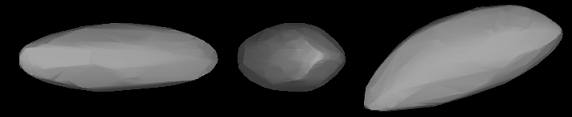
Asteroid 87 Sylvia and its satellites Romulus and Remus
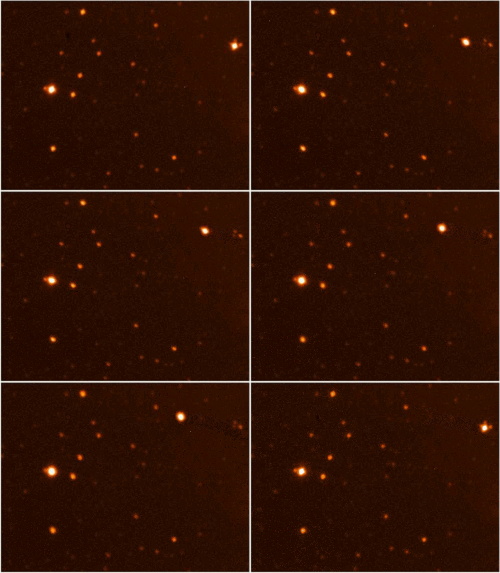
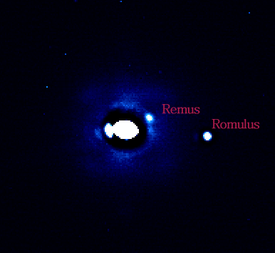 Adaptive Optics observations of
 87 Sylvia
, showing its two satellites, Remus and Romulus
87 Sylvia was discovered in 1866, and is a Cybele group asteroid in the outer main belt. It is one of the largest main-belt asteroids and is the first asteroid known to possess more than one moon. Sylvia is very dark in colour and probably has a very primitive composition. The discovery of its moons made possible an accurate measurement of the asteroid’s mass and density. Its density was found to be very low (around 1.2 times the density of water), indicating that the asteroid is porous to very-porous; from 25% to as much as 60% of it may be empty space, depending on the details of its composition. However, the mineralogy of the “X-type” asteroids is not known well enough to constrain this further. Either way, this suggests a loose rubble pile structure. Sylvia is also a fairly fast rotator, turning about its axis every 5.18 hours (giving an equatorial rotation velocity of about 230 km/h). The short axis is the rotation axis. Direct images indicate that Sylvia’s pole points towards ecliptic coordinates (+62.6°, 72.4°) with only a 0.5° uncertainty, which gives it an axial tilt of around 29.1°. Sylvia’s shape is strongly elongated.
Sylvia has two orbiting satellites. They have been named (87) Sylvia I Romulus and (87) Sylvia II Remus, after Romulus and Remus, the children of the mythological Rhea Silvia. Romulus was discovered on 18th February 2001 from the Keck II telescope. Remus was discovered over three years later on 9th August 2004 using the Yepun telescope of the European Southern Observatory (ESO) in Chile.
The orbital properties of the satellites are given here. The orbital planes of both satellites and the equatorial plane of the primary asteroid are all well-aligned within about 1° of each other, suggesting the satellites were formed in or near the equatorial plane of the primary. Remus has a mass of 7.3×10¹⁴ kg, a semi-major axis of 706.5 km, an orbital period of 1.37 days, and an orbital eccentricity of 0.027. The corresponding data for Romulus are: 9.3×10¹⁴ kg, 1357 km, 3.65 days, and 0.006.
Romulus (dimensions 18±4 km), the outer and larger moon of Sylvia, (not to be confused with the directly Sun-orbiting asteroid 10386 Romulus) and Remus (dimensions 7±2 km), the inner and smaller moon, both follow an almost-circular close-to-equatorial orbit around the parent asteroid.
Like 87 Sylvia, Romulus and Remus are probably smaller rubble piles which accreted in orbit around the main body from debris of the collision that resulted in Sylvia. In this case their albedo and density are expected to be similar to Sylvia’s. Romulus’ and Remus’ orbits are expected to be quite stable – they lie far inside Sylvia’s Hill sphere (about 1/50 of Sylvia’s Hill radius for Romulus, about 1/100 for Remus), but also far outside the synchronous orbit.
Asteroid 3208 Lunn: Discovery
I couldn’t resist including this asteroid, for purely selfish reasons – asteroid 3208 Lunn (1981 JM) is a main-belt asteroid (SPK-ID: 2003208). This section shows the enormous amount of information that is available for such a minor, insignificant object.
The asteroid was discovered at the Anderson Mesa (AM) (688) station, which is operated by the Lowell Observatory, Flagstaff, Arizona (see also Wikipedia). The Anderson Mesa station was established in 1959 as a dark-sky observing site for Lowell Observatory; it is located in Coconino County, Arizona (USA), about 12 miles southeast of Lowell’s main campus on Mars Hill in Flagstaff, Arizona. It was found on 3rd May 1981 by E. Bowell. Edward L. G. “Ted” Bowell, born in 1943 in London, an American astronomer, educated at Emanuel School London, University College, London, and the Université de Paris. He was principal investigator of the Lowell Observatory Near-Earth-Object Search (LONEOS). He has discovered a large number of asteroids (572), both as part of LONEOS and in his own right before LONEOS began. Among the latter are the Trojan asteroids 2357 Phereclos, 2759 Idomeneus, 2797 Teucer, 2920 Automedon, 3564 Talthybius, 4057 Demophon, and (4489) 1988 AK. He also co-discovered the periodic comet 140P/Bowell-Skiff and the non-periodic comet C/1980 E1.
3208 Lunn: STARDUST Spacecraft Microchip Names
As a public outreach effort, over 1 million names were collected and engraved on the STARDUST spacecraft, which visited Comet Wild 2 in 2004. Some of the names on the chip:
...LUNN, AMANDA L LUNN, ASTEROID 3208 LUNN, BEVERLY L LUNN, CHRISTOPHER M LUNN, CLAUDIA LUNN, GRAEME LUNN, JACQUELINE E LUNN, JOAN M LUNN, JOY E LUNN, KENNETH R LUNN, KEVIN B LUNN, LAYNE LUNN, MICHELLE R LUNN, NICHOLAS LUNN, ROBERT J LUNN, RON L LUNN, RONNIE J LUNN, ROSE LUNN...
3208 Lunn: Orbital Characteristics (epoch 14th May 2008)
Data is from JPL: Orbital Elements at Epoch 2456600.5 (2013-Nov-04.0) TDB (Barycentric Dynamical Time), Reference: JPL 3 (heliocentric ecliptic J2000). Uncertainties are 1-sigma values.
Aphelion: 3.444421154835977 AU (uncertainity 2.9687×10⁻⁸)
Perihelion: 2.801024338437844 AU (uncertainity 2.316×10⁻⁷)
Argument of perihelion: 26.57350850853789° (uncertainity 0.00014861°)
Time of perihelion passage: 2456505.642790259796 JED (Julian Ephemeris Date) (2013-Aug-01.14279026) (uncertainity 0.00016629)
Semimajor axis: 3.12272274663691 AU (uncertainity 2.6915×10⁻⁸)
Eccentricity: 0.1030185624213763 (uncertainity 7.3648×10⁻⁸)
Orbital period: 2015.573162329727 days (uncertainity 2.6058×10⁻⁵ days); 5.52 years (uncertainity 7.134×10⁻⁸)
Inclination to the ecliptic: 2.335585810873711° (uncertainity 6.4453×10⁻⁶)
Longitude of ascending node: 136.5846013889574° (uncertainity 0.00014556°)
Mean motion: 0.1786092446199717°/day (uncertainity 2.3091×10⁻⁹)
Mean anomaly: 16.942374578456° (uncertainity 2.9719×10⁻⁵)
[The mean anomaly is a parameter relating position and time for an orbiting body; it is based on the fact that equal areas are swept in equal intervals of time by a line joining the focus and the orbiting body (Kepler’s second law). The mean anomaly increases uniformly from 0 to 2π radians during each orbit; however, it is not an angle – the mean anomaly is proportional to the area swept by the focus-to-body line since the last periapsis (the point of closest approach of the two bodies).]
See the JPL Small-Body Database Browser on 3208 Lunn. The asteroid’s Earth MOID (Minimum Orbit Intersection Distance) is 1.808 AU, and its T_jup (Jupiter Tisserand invariant) is 3.206. [This is a measure of the orbital motion of an asteroid with respect to Jupiter, taking into account the semimajor axis, eccentricity, and inclination of the small body’s orbit, and remains broadly constant during the small body’s lifetime; it is named after the French astronomer François Félix Tisserand (1845–96).]
3208 Lunn: Designations and Name
Minor Planet Center: 3208 – Alternative Names: 1981 JM, 1931 GH, 1942 EA1, 1962 WN1
3208 Lunn was named in memory of Borge Lunn (1912 – 1986), a Danish civil engineer and metallurgist who did much to encourage the study of metal and iron meteorites. He invented a particular unmagnetized bronze for detailed experiments on the marine Galathea expedition in 1950, and for his work on the metallurgy of sleeve bearing metals he was awarded the Hunt Medal of the American Society of Lubrication Engineers. Twice chairman of the Danish Metallurgical Society, he served as head of the department of metallurgy at the Technical University of Denmark and was permanent censor in metallurgy in that department for 27 years.
Name proposed by the discoverer, following a suggestion of American planetary scientist Jonathan C. Gradie (who, in turn has asteroid 3253 named after him, also discovered at Anderson Mesa by Bowell).
3208 Lunn: Physical Characteristics
Absolute magnitude (H): 12.0 (Reference: PDS3 (MPC 28109) [The absolute magnitude (H) is the apparent magnitude that the object would have if it were one astronomical unit (AU) from both the Sun and the observer.]
Conversion of H to a diameter for a specific object requires knowledge of the object’s albedo. This quantity is not known for most objects including asteroid 3208 Lunn, so the diameters here are given as ranges. Most main-belt minor planets (of which 3208 Lunn is one) have albedos in the range 0.05 to 0.25. If a specific object has an albedo less than 0.05, the diameter will be larger than the upper limit listed here. For a rocky body, H = 12.0 corresponds to a probable diameter range of 11 to 24 km; for an icy body, the corresponding probable diameter range is 7 to 17 km.
3208 Lunn: Orbit Determination Parameters
Number of observations (all types) used in fit: 1269 – Number of days spanned by the data-arc: 29,982 days (82.09 years) –
Date of first observation used in the fit: 1931-04-08 – Date of last observation used in the fit: 2013-05-09
JPL planetary ephemeris used in the orbit determination: DE431 – JPL small-body perturber ephemeris used in the orbit determination: SB431-BIG16
Minor Planet Center “U” parameter (orbit uncertainty estimate 0-9, with 0 = good and 9 = highly uncertain): 0 – Normalized RMS (Root Mean Square) of the fit: 0.5085
Data source: ORB – Name of person (or institution) who computed the orbit: Otto Matic – Date of orbit determination: 2013-Aug-05 14:26:03
Close Approaches to Jupiter
Data sorted by Date/Time (TDB). Reference: DISCOVERY.DB, Last Updated: 2003-08-29
Date/Time (date HH:MM) – Nominal Distance (AU)
1929-07-15 16:51 – 1.90445984900976
1939-08-10 18:54 – 1.52042152306086
1949-09-03 14:31 – 1.77865380488157
2011-07-14 04:16 – 1.60831782240326
2021-08-04 08:33 – 1.60703121327334
2083-06-16 18:15 – 1.78071914067193
2093-07-06 22:19 – 1.5175749679223
2103-08-04 13:33 – 1.91285637388741
2155-05-12 10:13 – 1.98055580422426
2175-07-02 07:26 – 1.71540172114789
3208 Lunn: The Supplemental IRAS Minor Planet Survey (SIMPS)
Authors: Tedesco E.F., Noah P.V., Noah M., Price S.D. – SIMPS Missed-Predictions File (Summary of the always-missed asteroids, i.e., those asteroids which were predicted to have crossed the IRAS focal plane array but which were never detected). – Information from file: datafileFP206.txt
Asteroid number and name or principal provisional designation: 3208 Lunn – Number of times predicted to be scanned but missed: 5 – Absolute magnitude on the H, G system: 12.00 – Slope parameter, G, on the H, G band system: 0.150 – Estimated visual geometric albedo: 0.0400 – Greatest lower bound on estimated visual geometric albedo: 0.0189 – Estimated diameter: 50.50 km – Least upper bound on the diameter: 38.50 km
[Most of this information is from the JPL Small-Body Database Browser and Wikipedia]