Loading...
Loading...
Mars, the fourth planet in the Solar System from the Sun, has two small satellites, Phobos and Deimos, but no detected rings.
The length of a Martian day is 1 day 0 hour 40 minutes (in Earth terms), i.e. a little longer than the Earth’s.
It orbits the Sun once in 686.971 Earth days, which is 668.5991 sols (Martian ‘days’). Mars’s average distance from the Sun is 227,939,100 km; (the Earth’s is 149,597,870.700 km), varying between 249,209,300 km and 206,669,000 km.
Its radius is 3,396.2±0.1 km (0.533 of the Earth’s), giving it a surface area of 144,798,500 km2; (0.284 of the Earth’s). Its mass is 3.3022×10²³ kg (0.055 of the Earth’s mass). Mars’s gravity is 3.711 m/s2 (Earth’s is 9.81 m/s2).
See Astronomy Today and the British Astronomical Society for their information about Mars, and Wikipedia for more about Mars and its moons Phobos and Deimos.
Quite a few spacecraft have visited Mars, some flying by en route to another planet, some going into orbit to map the planet, some crashing into Mars either by accident or deliberately, taking photos all the way, and others landing and sending back lots of data about the atmosphere and surface and, of course, dramatic photographs. All those known of at the time of writing are listed on this web page.
And recently a comet Siding Spring passed close to the planet.

See also this very detailed USGS Map of Mars (1 page, size 55.89 x 42.70 in, file size 34.5 MB).
| Spacecraft | Launch date | Operator | Mission | Outcome | Remarks | Carrier rocket |
|---|---|---|---|---|---|---|
| 1M No.1 | 10 October 1960 | OKB-1 (Soviet Union) | Flyby | Launch failure | Failed to orbit | Molniya |
| 1M No.2 | 14 October 1960 | OKB-1 (Soviet Union) | Flyby | Launch failure | Failed to orbit | Molniya |
| Mars 1 (2MV-4 No.1) | 24 October 1962 | Soviet Union | Flyby | Launch failure | Disintegrated in low Earth orbit | Molniya |
| Mars 1 (2MV-4 No.2) | 1 November 1962 | Soviet Union | Flyby | Spacecraft failure | Communications lost before flyby | Molniya |
| 2MV-3 No.1 | 4 November 1962 | Soviet Union | Lander | Launch failure | Never left low Earth orbit | Molniya |
| Mariner 3 | 5 November 1964 | NASA (United States) | Flyby | Launch failure | Payload fairing failed to separate | Atlas LV-3 Agena-D |
| Mariner 4 | 28 November 1964 | NASA (United States) | Flyby | Successful | Closest approach at 01:00:57 UTC on 15 July 1965 | Atlas LV-3 Agena-D |
| Zond 2 (3MV-4A No.2) | 30 November 1964 | Soviet Union | Flyby | Spacecraft failure | Communications lost before flyby | Molniya |
| Mariner 6 | 25 February 1969 | NASA (United States) | Flyby | Successful | Atlas SLV-3C Centaur-D | |
| 2M No.521 | 27 March 1969 | Soviet Union | Orbiter | Launch failure | Failed to orbit | Proton-K/D |
| Mariner 7 | 27 March 1969 | NASA (United States) | Flyby | Successful | Atlas SLV-3C Centaur-D | |
| 2M No.522 | 2 April 1969 | Soviet Union | Orbiter | Launch failure | Failed to orbit | Proton-K/D |
| Mariner 8 | 9 May 1971 | NASA (United States) | Orbiter | Launch failure | Failed to orbit | Atlas SLV-3C Centaur-D |
| Kosmos 419 (3MS No.170) | 10 May 1971 | Soviet Union | Orbiter | Launch failure | Never left low Earth orbit; upper stage burn timer set incorrectly | Proton-K/D |
| Mariner 9 | 30 May 1971 | NASA (United States) | Orbiter | Successful | Entered orbit on 14 November 1971, deactivated 516 days after entering orbit | Atlas SLV-3C Centaur-D |
| Mars 2 (4M No.171) | 19 May 1971 | Soviet Union | Orbiter | Mostly Successful | Entered orbit 27 November 1971, operated for 362 orbits. Mapping operations unsuccessful due to dust storms on the surface | Proton-K/D |
| Mars 2 lander (SA 4M No.171) | 19 May 1971 | Soviet Union | Lander | Spacecraft failure | Deployed from Mars 2, failed to land during attempt on 27 November 1971 | Proton-K/D |
| Mars 3 (4M No.172) | 28 May 1971 | Soviet Union | Orbiter | Mostly Successful | Entered orbit 2 December 1971, operated for 20 orbits. Mapping operations unsuccessful due to dust storms on the surface | Proton-K/D |
| Mars 3 lander (SA 4M No.172) | 28 May 1971 | Soviet Union | Lander | Partial failure | Deployed from Mars 3; landed at 13:52 UTC on 2 December 1971 but contact lost 14.5 seconds later | Proton-K/D |
| Prop-M Rover (SA 4M No.172) | 28 May 1971 | Soviet Union | Rover | Spacecraft failure | Failed to deploy | Proton-K/D |
| Mars 4 (3MS No.52S) | 21 July 1973 | Soviet Union | Orbiter | Spacecraft failure | Failed to perform orbital insertion burn | Proton-K/D |
| Mars 5 (3MS No.53S) | 25 July 1973 | Soviet Union | Orbiter | Spacecraft failure | Failed after nine days in Mars orbit | Proton-K/D |
| Mars 6 (3MP No.50P) | 5 August 1973 | Soviet Union | Lander; Flyby | Spacecraft failure | Contact lost upon landing, atmospheric data mostly unreadable. Flyby bus collected data. | Proton-K/D |
| Mars 7 (3MP No.51P) | 9 August 1973 | Soviet Union | Lander; Flyby | Spacecraft failure | Separated from coast stage prematurely, failed to enter Martian atmosphere | Proton-K/D |
| Viking 1 orbiter | 20 August 1975 | NASA (United States) | Orbiter | Successful | Operated for 1385 orbits | Titan IIIE Centaur-D1T |
| Viking 1 lander | 20 August 1975 | NASA (United States) | Lander | Successful | Deployed from Viking 1 orbiter, operated for 2245 sols | Titan IIIE Centaur-D1T |
| Viking 2 orbiter | 9 September 1975 | NASA (United States) | Orbiter | Successful | Operated for 700 orbits | Titan IIIE Centaur-D1T |
| Viking 2 lander | 9 September 1975 | NASA (United States) | Lander | Successful | Deployed from Viking 2 orbiter, operated for 1281 sols | Titan IIIE Centaur-D1T |
| Fobos 1 (1F No.101) | 7 July 1988 | Soviet Union | Orbiter; Phobos Lander | Spacecraft failure | Communications lost before reaching Mars; failed to enter orbit | Proton-K/D-2 |
| Fobos 2 (1F No.102) | 7 July 1988 | Soviet Union | Orbiter; Phobos Lander | Partial failure | Orbital observations successful, communications lost before landing | Proton-K/D-2 |
| Mars Observer | 25 September 1992 | NASA (United States) | Orbiter | Spacecraft failure | Lost communications before orbital insertion | Commercial Titan III |
| Mars Global Surveyor | 7 November 1996 | NASA (United States) | Orbiter | Successful | Operated for seven years | Delta II 7925 |
| Mars 96 (M1 No.520) | 16 November 1996 | Rosaviakosmos (Russia) | Orbiter; Penetrators | Launch failure | Never left low Earth orbit | Proton-K/D-2 |
| Mars Pathfinder | 4 December 1996 | NASA (United States) | Lander | Successful | Landed at 19.13°N 33.22°W on 4 July 1997[8] | Delta II 7925 |
| Sojourner | 4 December 1996 | NASA (United States) | Rover | Successful | Operated for 84 days | Delta II 7925 |
| Nozomi (PLANET-B) | 3 July 1998 | ISAS (Japan) | Orbiter | Spacecraft failure | Ran out of fuel before reaching Mars | M-V |
| Mars Climate Orbiter | 11 December 1998 | NASA (United States) | Orbiter | Spacecraft failure | Approached Mars too closely during orbit insertion attempt due to unit conversion error and burned up in the atmosphere | Delta II 7425 |
| Mars Polar Lander | 3 January 1999 | NASA (United States) | Lander | Spacecraft failure | Failed to land | Delta II 7425 |
| Deep Space 2 | 3 January 1999 | NASA (United States) | Penetrators | Spacecraft failure | Deployed from MPL, no data returned | Delta II 7425 |
| 2001 Mars Odyssey | 7 April 2001 | NASA (United States) | Orbiter | Operational | Delta II 7925 | |
| Mars Express | 2 June 2003 | ESA (Europe) | Orbiter | Operational | Soyuz-FG/Fregat | |
| Beagle 2 | 2 June 2003 | ESA (Europe) | Lander | Lander failure | Deployed from Mars Express. Successful landing, but two solar panels failed to deploy, obstructing its communications. | Soyuz-FG/Fregat |
| Spirit (MER-A) | 10 June 2003 | NASA (United States) | Rover | Successful | Operated for 2208 sols | Delta II 7925 |
| Opportunity (MER-B) | 8 July 2003 | NASA (United States) | Rover | Operational | Delta II 7925H | |
| Rosetta | 2 March 2004 | ESA (Europe) | Gravity assist | Successful | Flyby in February 2007 en route to 67P/Churyumov–Gerasimenko | Ariane 5G+ |
| Mars Reconnaissance Orbiter (MRO) | 12 August 2005 | NASA (United States) | Orbiter | Operational | Atlas V 401 | |
| Phoenix | 4 August 2007 | NASA (United States) | Lander | Successful | Delta II 7925 | |
| Dawn | 27 September 2007 | NASA (United States) | Gravity assist | Successful | Flyby in February 2009 en route to asteroid 4 Vesta and dwarf planet Ceres | Delta II 7925H |
| Fobos-Grunt | 8 November 2011 | Roskosmos (Russia) | Orbiter (Phobos sample) | Spacecraft failure | Never left low Earth orbit (intended to depart under own power) | Zenit-2M |
| Yinghuo-1 | 8 November 2011 | CNSA (PR China) | Orbiter | Failure (Lost with Fobos-Grunt) | To have been deployed by Fobos-Grunt | Zenit-2M |
| Curiosity (Mars Science Laboratory) | 26 November 2011 | NASA (United States) | Rover | Operational | Atlas V 541 | |
| Mars Orbiter Mission (Mangalyaan) | 5 November 2013 | ISRO (India) | Orbiter | Operational | Entered Mars orbit on 24 September 2014. Mission extended by six months | PSLV-XL |
| MAVEN (Mars Atmosphere and Volatile Evolution) | 18 November 2013 | NASA (United States) | Orbiter | Operational | Orbit insertion on September 22, 2014 | Atlas V 401 |
| ExoMars Trace Gas Orbiter | 14 March 2016 | ESA/Roscosmos (Europe/Russia) | Orbiter | En route | Proton-M/Briz-M | |
| Schiaparelli EDM lander | 14 March 2016 | ESA (Europe) | Lander | En route | Carried by the ExoMars Trace Gas Orbiter | Proton-M/Briz-M |
Mars is the second smallest planet in the Solar System. Named after the Roman god of war, it is often described as the “Red Planet”, as the iron oxide prevalent on its surface gives it a reddish appearance.
The third photograph has Mars with the ‘Valles Marineris’ (Mariner Valleys, named after the US spacecraft Mariner 9) shown clearly.
[Left] Height comparison of Olympus Mons, Mauna Kea in Hawaii and Mount Everest.
[Right] Lava flows at the foot, photographed by ESA’s Mars Express probe. The image has been coloured to illustrate the topography of the region [blue is not water].
Holden Crater on Mars is a 140 km wide crater located in the southern highlands. It is named after Edward Singleton Holden, an American astronomer, and the founder of the Astronomical Society of the Pacific. The crater’s rim is cut with gullies, and at the end of some are fan-shaped deposits of material transported by water. The crater is of great interest to scientists because it has some of the best-exposed lake deposits. One of the layers has been found by the Mars Reconnaissance Orbiter to contain clays, which only form in the presence of water.
A field of crescent-shaped dunes in the northern polar region of Mars, which appear to be traversing a bumpy, boulder-strewn terrain. The image was captured by the HiRise camera on the Mars Reconnaissance Orbiter in July 2012.
The yardangs in the Danielson Crater [left] provide some evidence of climate change triggered by periodic shifts in the planet’s rotational axis. Yardangs are parallel rocky protrusions with streamlined shapes, formed by the removal of the softer surrounding material by wind-driven sandblasting to reveal the prevailing wind direction. These yardangs appear to show alternating dry and wet periods in Mars’s past.
Dry ice pits on Mars. Around the south pole of Mars, toward the end of every Martian summer, the warm weather evaporates some of the vast carbon dioxide ice cap. Pits begin to appear and expand where the carbon dioxide dry ice is turning from a solid into a gas. The precise composition of ‘gold lining’ of dust that defines the pit walls remains unknown. The HiRISE camera aboard the Mars Reconnaissance Orbiter captured the image in July 2012.
Grooves on Mars may be the result of blocks of dry ice sliding down slopes. NASA scientists say that these linear gullies may be caused by CO2 chunks breaking off a layer of seasonal frost and surfing down slopes in the spring. The grooves shown here, on the side of a large sand dune inside Russell Crater, are the longest linear gullies known, extending almost 2 km down this dune slope. Long, narrow grooves seen in the sand dunes of Mars were first spotted more than a decade ago and are still an enduring mystery as to how they were formed. This may be the explanation.
[Left] A towering dust devil casts a serpentine shadow over the Martian surface in this image acquired by NASA’s Mars Reconnaissance Orbiter.
In this image released by NASA in 2012, a chapter of the layered geological history of Mars is laid bare. This colour image from NASA’s Curiosity rover shows the base of Mount Sharp, the rover’s eventual science destination. The image is a portion of a larger image taken by Curiosity’s 100-millimetre Mast Camera on 23th August 2012. Scientists enhanced the colour in one version to show the Martian scene under the lighting conditions we have on Earth, which helps in analyzing the terrain. The pointy mound in the centre of the image, looming above the rover-sized rock, is about 300 metres across and 100 metres high.
[Left] Lichens survived for 34 days in conditions designed to simulate those on the surface of Mars. The experiment at the DLR Institute of Planetary Research in Berlin recreated the atmospheric composition and pressure, temperature cycles and solar radiation on the planet. The polar and Alpine lichens even managed to photosynthesise under these harsh conditions, suggesting that life as we know it is not out of the question on the Red Planet.
NASA rovers Spirit and Opportunity have spent a decade photographing the Red Planet. Here are their most awe-inspiring shots, from space blueberries to crater sunsets, from The Guardian.
Finally, there’s an impact crater on Mars named Tooting after the London suburb of that name because the discoverer “thought [his] mum and brother would get a kick out of having their home town paired with a place on Mars”!
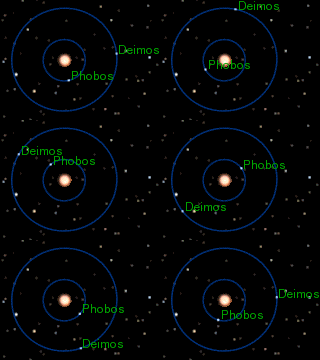
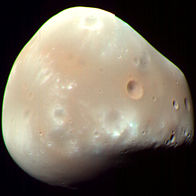
Mars has two tiny satellites, Phobos (Ancient Greek Φόβος) and Deimos (Δείμος), 11.1 km and 6.2 km in average diameter (they aren’t spherical). They were both discovered in 1877 by Asaph Hall. He became assistant astronomer at the US Naval Observatory in Washington DC and in 1875 he was given responsibility for the USNO 26-inch (66-cm) telescope, the largest refracting telescope in the world at the time. It was with this telescope that he discovered Deimos (on 12th August 1877 at 07:48 UTC) and Phobos (on 18th August 1877 at 09:14 UTC).
With a mean radius of 11.1 km, Phobos is 7.24 times as massive as Deimos. It is named after the Greek god “Phobos” (which means “Fear”), a son of Aphrodite (Venus) and Ares (Mars). Phobos was known for accompanying Ares into battle along with the ancient war goddess Enyo, the goddess of discord Eris (both sisters of Ares), and Phobos’ twin brother Deimos (“Terror”). In Classical Greek mythology, Phobos is more of a personification of the fear brought by war and does not appear as a character in any myths. Timor is his Roman equivalent.

The video clip includes interpolated frames smoothing out the motion between frames from Curiosity’s Mast Camera (Mastcam). Mastcam took images 1.4 seconds apart. With the interpolated frames, this clip has 10 frames per second. It runs for 20 seconds, matching the actual time elapsed. Curiosity’s observations of Phobos and Deimos help researchers’ knowledge of the moons’ orbits even more precise. Malin Space Science Systems, San Diego, built and operates Mastcam.
NASA’s Jet Propulsion Laboratory manages the Mars Science Laboratory mission and the mission’s Curiosity rover. The rover was designed, developed and assembled at JPL, a division of the California Institute of Technology in Pasadena. For more about NASA’s Curiosity mission, visit www.jpl.nasa.gov/msl, www.nasa.gov/mars, marsprogram.jpl.nasa.gov/msl and Mars Curiosity Rover below.

 Here’s a video taken by Mars Curiosity Rover of Phobos eclipsing the Sun. A total eclipse is impossible because Phobos is much smaller in the sky than the Sun. The same applies to Deimos.

Phobos is a small, irregularly shaped object with a mean radius of 11 km. It orbits 6,000 km from the Martian surface, closer to its primary than any other known planetary moon. It is so close that it orbits Mars faster than Mars rotates. As a result, from the surface of Mars it appears to rise in the west, move across the sky in 4 hours 15 min or less, and set in the east, twice each Martian day. Due to tidal interactions, Phobos is drawing closer to Mars by one metre every century, and it is predicted that in 50 million years it will collide with the planet or break up into a planetary ring. Phobos is one of the least reflective bodies in the Solar System, and features a large impact crater, Stickney. The temperatures range from about −4°C to −112°C, on the sunlit and shadowed sides respectively.
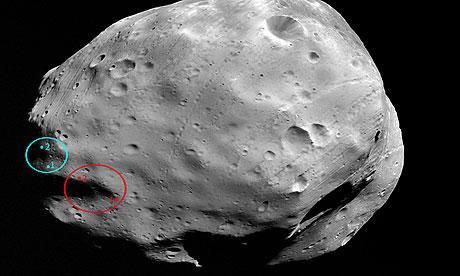
Photograph of Phobos, the larger of the Martian moons, taken from Mars Express when it flew by on 9th January 2011. The red ellipse marks the previously planned landing site for Phobos-Grunt, the blue ellipse marks the landing site currently under consideration.
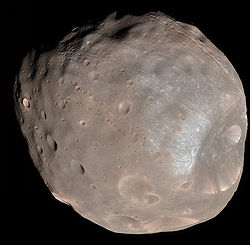
Enhanced-colour view of Phobos obtained by Mars Reconnaissance Orbiter on 23rd March 2008. Stickney crater, the largest, is on the right side.
Phobos has no atmosphere due to its low mass and low gravity. It is one of the least reflective bodies in the Solar System. Spectroscopically it appears to be similar to the D-type asteroids, and is apparently of composition similar to carbonaceous chondrite material. Its density is too low to be solid rock, and it is known to have significant porosity; it might contain a substantial reservoir of ice. Spectral observations indicate that the surface regolith layer lacks hydration, but ice below the regolith is not ruled out.
Phobos is heavily cratered – the most prominent surface feature is the crater Stickney, named after Asaph Hall’s wife, Angeline Stickney Hall, Stickney being her maiden name. The impact that created Stickney must have nearly shattered Phobos. Many grooves and streaks also cover the oddly shaped surface. The grooves are typically less than 30 metres deep, 100 to 200 metres wide, and up to 20 km long, and were originally assumed to have been the result of the same impact that created Stickney. Analysis of results from the Mars Express spacecraft, however, revealed that the grooves are not in fact radial to Stickney, but are centred on the leading apex of Phobos in its orbit (which is not far from Stickney). Researchers suspect that they have been excavated by material ejected into space by impacts on the surface of Mars. The grooves thus formed as crater chains, and all of them fade away as the trailing apex of Phobos is approached. They have been grouped into 12 or more families of varying age, presumably representing at least 12 Martian impact events.
Faint dust rings produced by Phobos and Deimos have long been predicted but attempts to observe these rings have, to date, failed. Recent images from Mars Global Surveyor indicate that Phobos is covered with a layer of fine-grained regolith at least 100 metres thick, possibly created by impacts from other bodies, but it is not known how the material stuck to an object with almost no gravity.
The unique Kaidun meteorite is thought to be a piece of Phobos, but this has been difficult to verify since little is known about the detailed composition of the moon.
Phobos could be a second-generation Solar System object that coalesced in orbit after Mars formed, rather than forming concurrently out of the same birth cloud as Mars.
Another hypothesis is that Mars was once surrounded by many Phobos- and Deimos-sized bodies, perhaps ejected into orbit around it by a collision with a large planetesimal. The high porosity of the interior of Phobos is inconsistent with an asteroidal origin. Observations of Phobos in the thermal infrared suggest a composition containing mainly phyllosilicates, which are well known from the surface of Mars. The spectra are distinct from those of all classes of chondrite meteorites, again pointing away from an asteroidal origin. Both sets of findings support an origin of Phobos from material ejected by an impact on Mars that reaccreted in Martian orbit, similar to the prevailing theory for the origin of Earth’s moon.
On 25th March 2010, the European Space Agency (ESA) announced on their blog that ESA’s study of the mass of Phobos had been accepted for publication in the scientific journal Geophysical Research Letters. The announcement gave startling conclusions of ESA’s findings: “We conclude that the interior of Phobos likely contains large voids. When applied to various hypotheses bearing on the origin of Phobos, these results are inconsistent with the proposition that Phobos is a captured asteroid.”
Geological features on Phobos (apart from the largest crater, Stickney, named after Asaph Hall’s wife Angeline Stickney) are named after astronomers who studied Phobos and people and places from Jonathan Swift’s Gulliver’s Travels. See the list in Wikipedia. There is one named regio (a large area that is strongly differentiated in colour or albedo), Laputa Regio (from the fictional Laputa, a flying island in Gulliver’s Travels), and one named planitia (a plain), Lagado Planitia (Gulliver’s imaginary capital of the fictional nation Balnibarbi). The only named dorsum (a ridge on a hill) is Kepler Dorsum, named after the astronomer Johannes Kepler.
Below is a labelled map of Phobos by the United States Geological Survey; click to enlarge. It is an equirectangular projection map with shaded relief.
See also the Phobos spacecraft programme by the USSR.
Deimos is the smaller and outer of the two natural satellites of Mars with a mean radius of 6.2 km. It takes 30.3 hours to orbit Mars at an orbital velocity of 1.35 km/s. It has an escape velocity of 5.6 m/s and apparent magnitude of 12.45. Like most bodies of its size, Deimos is highly non-spherical with triaxial dimensions of 15 × 12.2 × 11 km making it 0.56 times the size of Phobos. It orbits 23,460 km distant from Mars.
Deimos, like Phobos, has spectra, albedos and densities similar to those of a C- or D-type asteroid. It is composed of rock rich in carbonaceous material, much like C-type asteroids and carbonaceous chondrite meteorites. It is cratered, but the surface is noticeably smoother than that of Phobos, caused by the partial filling of craters with regolith. The regolith is highly porous and has a radar-estimated density of only 1.471 g/cm3.
Only two geological features on Deimos have been given names. They are the two largest craters, Swift (at 12.5°N 358.2°W, diameter 1000 m, named after Jonathan Swift the author of Gulliver’s Travels) and Voltaire (at 22°N 3.5°W, diameter 1900 m, “Voltaire” was the nom-de-plume of François-Marie Arouet). The two craters are named after writers who speculated on the existence of two Martian moons before Phobos and Deimos were discovered.
Deimos’s orbit is nearly circular and is close to Mars’s equatorial plane. Because the orbit is relatively close to Mars and has only a very small inclination to Mars’s equator, it cannot be seen from Martian latitudes greater than 82.7°. It is possibly an asteroid that was perturbed by Jupiter into an orbit that allowed it to be captured by Mars, though this hypothesis is disputed.
Unlike Phobos, which orbits so fast that it actually rises in the west and sets in the east, Deimos rises in the east and sets in the west. However, the Sun-synodic orbital period of Deimos of about 30.4 hours exceeds the Martian solar day (“sol”) of about 24.7 hours by such a small amount that 2.7 days elapse between its rising and setting for an equatorial observer.
This [left] is one of the highest-resolution images ever taken from an orbiting or flyby spacecraft. The image covers an area of 1.2 km by 1.5 km and features as small as 3 metres across can be seen. Note that many of the craters are covered over by a layer of regolith estimated to be about 50 metres thick. Large blocks, 10 to 30 metres across, are also visible. North is at 11:30.
The comet image shown here is a composite of Hubble exposures taken between 18th October 2013 8:06 a.m. EDT and 19th October 11:17 p.m. EDT. Hubble took a separate photograph of Mars at 10:37 p.m. EDT on 18th October.
The Mars and comet images have been added together to create a single picture to illustrate the angular separation, or distance, between the comet and Mars at closest approach. The separation is approximately 1.5 arc minutes, or one-twentieth of the angular diameter of the full Moon. The background star field in this composite image is synthesized from ground-based telescope data provided by the Palomar Digital Sky Survey, which has been reprocessed to approximate Hubble’s resolution. The solid icy comet nucleus is too small to be resolved in the Hubble picture. The comet’s bright coma, a diffuse cloud of dust enshrouding the nucleus, and a dusty tail, are clearly visible.
This is a composite image because a single exposure of the stellar background, comet Siding Spring, and Mars would be problematic. Mars is actually 10,000 times brighter than the comet, and so could not be properly exposed to show detail in the Planet. The comet and Mars were also moving with respect to each other and so could not be imaged simultaneously in one exposure without one of the objects being motion blurred. Hubble had to be programmed to track on the comet and Mars separately in two different observations.
[Image: NASA, ESA, PSI, JHU/APL, STScI/AURA] The images were taken with Hubble’s Wide Field Camera 3.
Mars (tracking from right to left) and Comet Siding Spring crossed paths on 19th October 2013.
The comet, estimated to have a nucleus 700 m in size, passed Mars at approximately 87,000 miles (about one-third of the distance between Earth and the Moon) at 2:28 p.m. EDT on 19th October 2014. At that time, the comet and Mars were approximately 149 million miles from Earth.
The comet is on its first visit to the inner Solar System from the Oort cloud and in common with such objects its behaviour is notoriously difficult to predict.
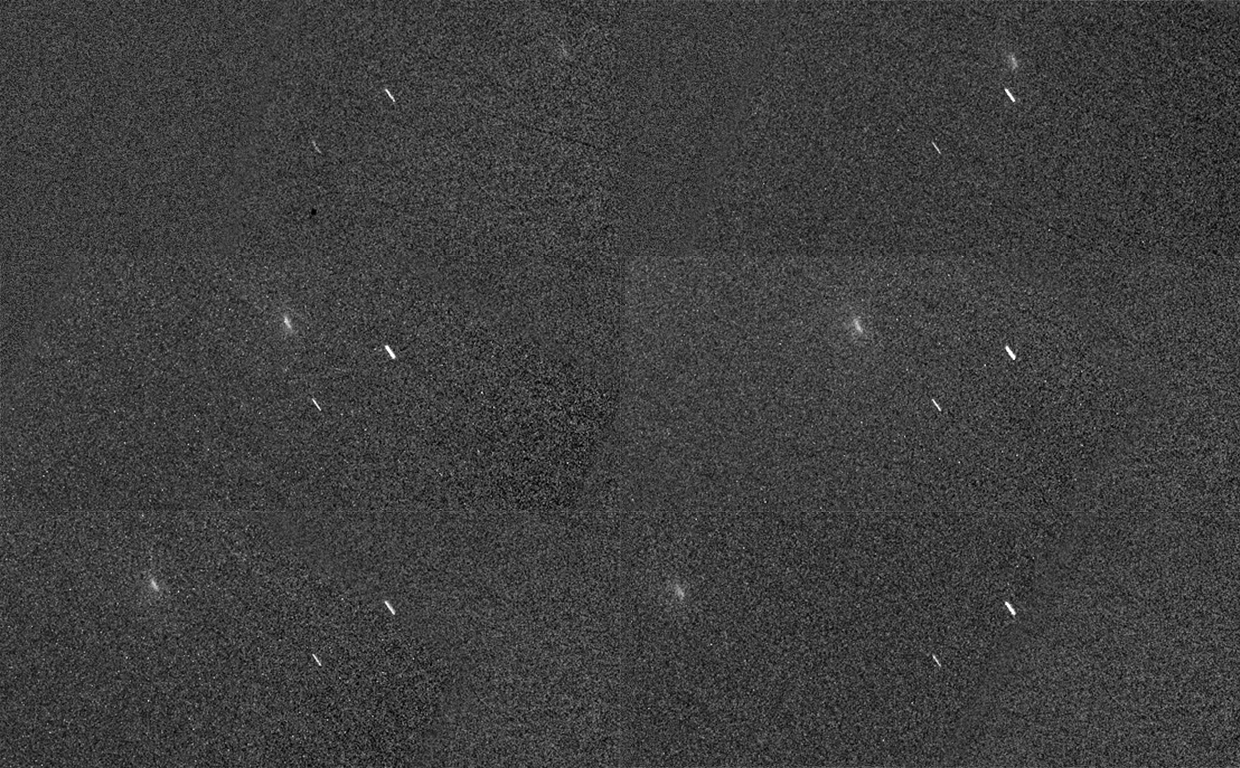
The animation consists of 10 exposures of 25 seconds each, taken between 21:33 UT and 00:34 UT on 20th October. The exposures are projected onto a celestial frame. The still is an image from the animation. Most of the specks are electronic noise. The short, straight streaks are stars.
[Image: NASA/JPL-Caltech/MSSS/TAMU with enhancements by Astronomy Now’s Greg Smye-Rumsby]
Comet Siding Spring’s close shave by Mars provided a rare glimpse into how Oort Cloud comets behave, according to new research. The comet flew by Mars at a range of just 135,000 kilometres – close enough for the outer ridges of its tenuous atmosphere to pummel the planet with gas and dust. In just a short flyby, the comet dumped about 1,000 to 2,000 kg of dust made of magnesium, silicon, calcium and potassium – all of which are rock-forming elements – into the upper atmosphere, the new study found.
Viking 1 Orbiter (1975-075A) was launched on 20th August 1975 at 2122:00 UTC, and successfully orbited Mars from June 1976 to August 1980. The Viking 1 Lander (1975-075C) sent the first images from surface between 20th July 1976 and 13th November 1982.
Viking 2 Orbiter (1975-083A) was launched on 9th September 1975 at 1839:00 UTC, and successfully orbited Mars from August 1976 to July 1978. The Viking 2 Lander (1975-083C) was a success from 3rd September 1976 to 11th April 1980.
The Mars Observer also known as the Mars Geoscience/Climatology Orbiter was a 1,018 kg (1992-063A) spacecraft, launched on 25th September 1992 at 17:05 UTC from Cape Canaveral by a Commercial Titan III/TOS. It was based on a commercial Earth-orbiting spacecraft and designed to study the Martian surface, atmosphere, climate and magnetic field and take high-resolution photography of the Martian surface. In 1992, it was to be the United States’ first mission to the Mars in 17 years. However, the mission ended prematurely on 21st August 1993 at 01:00 UTC when contact with the spacecraft was lost just before it was to enter orbit around Mars. Attempts to re-establish communication with the spacecraft were unsuccessful.
It carried a Gamma Ray Spectrometer, a Magnetometer/Electron Reflectometer, a Laser Altimeter, a Pressure Modulator Infrared Radiometer, a Thermal Emission Spectrometer, a Camera and a Mars Balloon Relay.
Its intended orbit around Mars was to have a semi-major axis of 3,766.159 km, with an eccentricity of 0.004049, inclined at 92.869°. However it failed to enter orbit, flying by Mars with a closest approach on 24th August 1993.
Mars Global Surveyor (1996-062A) was launched on 7th November 1996 at 17:00:50 UTC; it was a successful Mars orbiter from 1st April 1997 to 2nd November 2006.
Mars Pathfinder (1996-068A) was launched on 4th December 1996 at 06:58:07 UTC; it was a successful Mars lander from 4th July 1997 to 27th September 1997; the Sojourner was the first Mars rover.

Nozomi (1998-041A) was launched on 4th July 1998, made a successful gravity-assist flyby of the Moon on 24th September 1998 and three passes of the Earth en route to Mars. The first, on 20th December 1998 was a partially successful gravity assist; a valve malfunction during the flyby required an extra burn, which later forced an alternate trajectory plan; the second (in December 2002) and third (on 19th June 2003) were both successful gravity assists en route to Mars. It was unable to achieve Mars orbit due to electrical failures and its operation was terminated on 31st December 2003.
Mars Climate Orbiter (1998-073A) was launched on 11th December 1998 at 18:45:51 UTC; its orbit insertion failed due to a navigational error, and it burned up in the Martian atmosphere on 23th September 1999, with last contact at 09:06:00 UTC.
The Mars Climate Orbiter (formerly the Mars Surveyor ’98 Orbiter) was a 338 kg robotic space probe intended to study the Martian climate, atmosphere, surface changes and to act as the communications relay in the Mars Surveyor ’98 program, for Mars Polar Lander. However communication with the spacecraft was lost as the spacecraft went into orbital insertion, due to ground based computer software which produced output in non-SI units of pound-seconds (lbf×s) instead of the metric units of newton-seconds (N×s) specified in the contract between NASA and Lockheed. The spacecraft encountered Mars at an improperly low altitude, causing it to incorrectly enter the upper atmosphere and disintegrate.
Mars Odyssey (2001-014A) was launched on 7th April 2001 at 15:02:22 UTC, and has been a successful orbiter since 24th October 2001 at 02:18:00 UTC, studying climate and geology and acting as a communications relay for the Spirit and Opportunity rovers.
Its primary mission (to use spectrometers and electronic imagers to detect evidence of past or present water and volcanic activity on Mars) was completed on 24th August 2004. NASA has approved a fourth two-year extended mission, through August 2012, to allow for the observation of year-to-year differences in phenomena like polar ice, clouds, and dust storms, as well as a much more sensitive mapping of Martian minerals. A fifth extended mission (to July 2014) is considered likely in light of Curiosity’s successful landing in August 2012. The orbiter contains enough propellant to operate at least until 2015.
The Phobos (Russian: Фобос, Greek: Φόβος) program was an unmanned space mission consisting of two probes launched by the Soviet Union to study Mars and its moons Phobos and Deimos. Phobos 1 and 2 were of a new spacecraft design, succeeding the type used in the Venera planetary missions of 1975 to 1985, last used during the Vega 1 and Vega 2 missions to comet Halley. They each had a mass of 2600 kg (6220 kg with orbital insertion hardware attached). The program featured co-operation from 14 other nations, including Sweden, Switzerland, Austria, France, West Germany, and the United States (which contributed the use of its Deep Space Network for tracking the twin spacecraft).
Phobos 1 (1988-058A) was launched on 7th July 1988 at 1738:04 UTC, and Phobos 2 (1988-059A) on 12th July 1988 at 1701:43, each aboard a Proton-K rocket.
Phobos 1 suffered a terminal failure en route to Mars.
Phobos 2 attained Mars orbit on 29th January 1989 and returned 38 images with a resolution of up to 40 m, but contact was lost on 27th March 1989 shortly before the Phobos approach phase and the deployment of the Phobos landers.
Mars Express (2003-022A) was launched on 2nd June 2003, and has been successfully orbiting since 25th December 2003, imaging and mapping the surface; it was the first European probe in Martian orbit. It carried the Beagle 2 lander, but contact was not established after its attempted landing.
However, 11 years later, Beagle 2 (which went missing on Christmas Day 2003) has been found. Speaking at the Royal Society on 16th January 2015, David Parker, of the UK space agency, said there was good evidence of Beagle 2 resting on the surface of Mars. Parker said it did not appear to be a crash site suggesting the probe at least partially deployed. See this 56-second video from The Guardian (the first 15 seconds are silent):
Beagle 2 appears to be within the expected landing area of Isidis Planitia (see the Map of Mars), an impact basin close to the equator. It was discovered intact on the surface at about 11.5°N 90.4°E) in images captured by NASA’?s Mars Reconnaissance Orbiter, which show that one of the “petals” on which its solar panels are mounted, did not fully deploy, preventing deployment of its radio antenna.
The scientists leading the search for the missing Beagle 2 were looking for “something that wasn’t red, and wasn’t a pointy rock.” Given that this doesn’t narrow the field down very much, it is testament to the amazing perseverance and talents of the individuals concerned that they have managed to locate the lander.
It is poignant that the information comes at this time – Colin Pillinger was very much the driving force behind Beagle 2, and one of the leaders of the Rosetta mission. His death in 2014 deprived the scientific community of one of its most charismatic members. How he would have gloried in the re-discovery of Beagle2.
MER-A (“Spirit”) (2003-027A) was launched on 10th June 2003; it was a Mars rover, operating between 4th January 2004 at 04:35 UTC and 22th March 2010; it became stuck in May 2009 and then operated as a static science station until contact was lost in March 2010.
MER-B (“Opportunity”) (2003-032A) was launched on 7th July 2003; it is a Mars rover, landed on 25th January 2004 at 05:05 UTC, and has been operating since then.
Some of the extraordinary photographs taken by these two rovers are in this NASA selection. One mystery found by “Opportunity” is the object shown below which suddenly appeared.
25th January 2015 marked 11 years since the “Opportunity” rover landed on Mars in 2004 just three weeks after its now inactive twin “Spirit”. This view is taken from the rim of the Endeavour Crater at a point known as Cape Tribulation. “Opportunity’s“ view from Cape Tribulation on the rim of Endeavour Crater, 22nd January 2015 NASA/JPL-Caltech/Cornell Univ./Arizona State Univ
This is the highest point that the rover “Opportunity” has reached since it left the Victoria Crater area back in 2008. It has taken three years for the 180kg solar powered robot to complete the journey down to the Endeavour Crater, which measures 22 kilometres in diameter.
One of its key mission accomplishments has been the characterisation of soft rocks and soil to provide evidence of past water on the Mars. Asteroid (39392) Opportunity was named after this hardworking rover.
Shadow puppetry on Mars: The robotic arm of NASA’s rover Opportunity casts a shadow on a rocky outcrop named “Chester Lake”. The image was taken during the 2,710th Martian day, or ‘sol’, of Opportunity’s work on Mars (8th September 2012). Chester Lake, bedrock exposed on the rim of Endeavour crater, is the second rock approached by Opportunity for closer inspection since it arrived at the crater in August 2012 after a three-year trek.
This report from Intel describes the life of the Mars rover: Mars Opportunity Video is Mind-blowing. It includes both of these NASA animations:
Phoenix (2007-034A) was launched on 4th August 2007 at 09:26:34 UTC, the responsibility of JPL, led directly from the University of Arizona, Tucson; it landed on 25th May 2008 at 23:53:52 UTC at Green Valley (Mars), 68.22°N 125.7°W, and successfully collected soil samples near the northern pole to search for water and investigate Mars’ geological history and biological potential. The lander completed its mission in August 2008, and made a last brief communication with Earth on 2nd November as available solar power dropped with the Martian winter. The mission was declared concluded on 10th November 2008, after engineers were unable to re-contact the craft. After unsuccessful attempts to contact the lander by the Mars Odyssey [2001-014A] orbiter up to and past the Martian summer solstice on 12th May 2010, JPL declared the lander to be dead. The program was considered a success because it completed all planned science experiments and observations.
The first part of the Exomars mission [2016-017A] was launched at 09:31 UT on 14th March 2016 using a Proton rocket from the Baikonur cosmodrome in Kazakhstan.
This first mission consists of the Exomars Trace Gas Orbiter and its entry, descent and landing demonstrator module, Schiaparelli Lander. It is expected to arrive at Mars in October 2016, the Schiaparelli lander separating on 16th October, three days before arrival at Mars. The planned final orbit for the TGO is circular with an altitude of 400 km. Science activities should begin in late 2017.
The main objectives of this mission are to search for signs of methane [CH4] in the atmosphere of Mars that seems to vary with location and time, possibly indicating the presence of microbial life on Mars (if methane and propane [C3H8] or ethane [C2H6]) are found, or a geochemical process such as volcanism or hydrothermal activity (if methane and sulphur dioxide [SO2] are found). It will also test key technologies in preparation for ESA’s contribution to subsequent missions to Mars.
In 2018 the second part of the mission will include launching a Mars rover.
Over the comparatively short but eventful history of the U.S. space program, a large number of spacecraft – including the very first American satellite launched by the Army Ballistic Missile Agency on 31st January 1958 – have borne the name Explorer. All of these vehicles have had important scientific missions, so the series itself is of significant interest. However, there has been little consistency in the use of the name, and there is considerable question as to which “Explorer” missions properly fit in the series of that name.
The lack of consistency stems in part from the fact that the first Explorer missions predated the formation of NASA. As a consequence, Explorers 2 and 5 got counted in the sequence even though they failed to achieve orbit. Following the creation of NASA on 1stOctober 1958, the agency established the practice of no longer counting such launches, but the problem of definition remained a real one.
This was so because even the early Explorers performed a large variety of scientific missions ranging from energy particle exploration through atmospheric and ionospheric studies to investigations of micrometeroids, air density, radio astronomy, geodesy, and gamma ray astronomy, not to mention interplanetary and solar monitoring. While Langley Research Center and Goddard Space Flight Center designed and built many of the early “Explorer” satellites, contractors and universities provided some experiments, components, and even entire spacecraft. The one constant amidst this diversity was that the early “Explorers” were smaller, simpler, and less costly than the orbiting observatories also used in scientific exploration of physical and astronomical phenomena.
Unfortunately for even this single piece of consistency in the midst of diversity, it did not apply solely to what may be called the “Explorer” series of spacecraft proper; there were numerous other Explorer-class satellites that did not bear the name “Explorer”. These included Vanguard 1 to 3, Pioneer 5, Ariel 1 and 2, Alouette 1, and a San Marco series of spacecraft launched from the site of that name off the coast of Kenya, Africa. All of these smaller, simpler satellites carried out missions analogous to those of the “Explorers”, but they bore different names and were not counted in the Explorer series.
To confuse the issue further, other similar missions involving Explorer-class satellites, launched jointly with international partners, sometimes bore the “Explorer” name but not a mission number in the “Explorer” series. These included the International Sun–Earth Explorer missions (ISEE 1–3) as well as other missions with names like Aeros, Ariel, and Boreas. There have also been a few larger spacecraft of the observatory class that have borne the name “Explorer” (for example, the Cosmic Background Explorer launched in 1989), further underlining the complexity of the issue regarding which spacecraft fit into what category. The listing at the end of this narrative shows the satellites that clearly belong in the “Explorer” series because they were relatively small and uncomplicated, performed a scientific mission, and, until quite recently, appeared in satellite situation reports and post-launch reports under the name “Explorer”, accompanied by a mission number. (This last practice ended with Explorer 55, however.)
Similar types of satellite continue to be launched up to the present time, with Explorer 93, alias NuSTAR (Nuclear Spectroscopic Telescope Array), alias SAMPEX-11 (Solar Anomalous & Magnetospheric Particle Explorer) having been launched on 13th June 2012 by a Pegasus-XL 25 rocket under a L-1011 aircraft from Kwajalein Atoll. See more information at Explorer Program – Gunter’s Space Page.
Mariner 10 was the last Mariner spacecraft, the Mariner 11 and Mariner 12 projects being reassignated to the Voyager programme.
The Mars program was a series of unmanned spacecraft launched by the Soviet Union between 1960 and 1973. The spacecraft were intended to explore Mars, and included flyby probes, landers and orbiters. Early Mars spacecraft were small, and launched by Molniya rockets. Starting with two failures in 1969, the heavier Proton-K rocket was used to launch larger 5 tonne spacecraft, consisting of an orbiter and a lander to Mars. The orbiter bus design was likely somewhat rushed into service and immature, considering that it performed very reliably in the Venera variant after 1975. This reliability problem was common to much Soviet space hardware from the late 1960s and early 1970s and was largely corrected with a deliberate policy, implemented in the mid-1970s, of consolidating (or “debugging”) existing designs rather than introducing new ones.
In addition to the Mars program, the Soviet Union also sent a probe to Mars as part of the Zond program, Zond 2; however it failed en route. Two more spacecraft were sent during the Phobos program. In 1996, Russia launched Mars 96, its first interplanetary mission since the dissolution of the Soviet Union, however it failed to depart Earth orbit.
Known failures in the program were:
Zond (Зонд, Russian for “probe”) was the name given to two distinct series of Soviet unmanned space program undertaken from 1964 to 1970. The first series based on the 3MV planetary probe was intended to gather information about nearby planets. The second series of test spacecraft being a precursor to manned circumlunar loop flights used a stripped-down variant of the Soyuz spacecraft, consisting of the service and descent modules, but lacking the orbital module.
MSL Curiosity (2011-070A), launched on 26th November 2011 at 1502:00 UTC has been roving, investigating past and present habitability, climate and geology since 6th August 2012.
NASA’s Curiosity Mars Rover is the bluish dot near the middle bottom of this enhanced-colour view from NASA’s Mars Reconnaissance Orbiter. Twin wheel tracks about 3 metres apart can be seen where the rover trundled from the landing site in the left of the scene. Two bright, blue spots surrounded by darker patches reveal where the Mars Science Laboratory spacecraft’s landing jets cleared away reddish surface dust at the landing site.
Jacqueline Storey from the National Maritime Museum poses in front of images of Mars generated by NASA’s Curiosity Rover.
An interesting news item: NASA’s Curiosity Mars rover finds soil similar to volcanic sands of Hawaii.
Curiosity Mars rover captured this [left] image of the ‘tattoo’ on its arm, with the rocks at the base of Mount Sharp as a backdrop, on 29th October 2014, its 792nd Martian day on the surface.
Curiosity’s recent travels as of 29th October 2014. [Image: NASA/JPL-Caltech/Univ. of Arizona].
The rover has been literally heading for the hills since landing at Gale Crater in August 2012. Scientists hope that Mount Sharp will offer them a slice through Martian geological history. Now Curiosity has arrived at the base of the mountain, it is making regular stops to study the area with a battery of cameras and scientific instruments.
NASA announced in May 2016: Second Cycle of Martian Seasons Completing for Curiosity Rover.
An artist’s impression of Curiosity’s successor, the Curiosity Mars 2020 rover.
The mission will look for signs of past life, collect samples for possible return to Earth, and demonstrate technology for future human exploration. The vehicle would re-use Curiosity’s design and engineering, but sport new instruments selected through a competition.
NASA launched its Mars Atmosphere and Volatile Evolution, or Maven, spacecraft on 18th November 2013 (COSPAR ID: 2013-063A). Expected to arrive in September 2014, Maven is designed to help scientists figure out how the planet managed to lose an atmosphere that at one time was believed to be thicker than Earth’s.
MAVEN is 11.43 m in length, carries a dry mass of 903 kg, a wet mass of 2,550 kg, and is capable of producing 1,135 watts (in orbit of Mars) from its photovoltaic solar arrays.
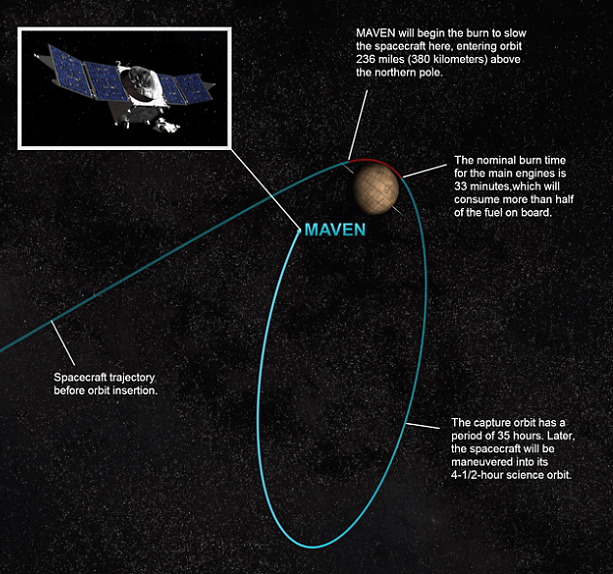
MAVEN performed an orbital insertion manoeuvre and was inserted into Mars orbit on 22nd September 2014 (see diagram below). Orbit insertion resulted in a highly elliptical orbit with an apoapsis of 6,200 km and a periapsis of 150 km. MAVEN’s orbit is inclined at 75° to the Martian equator and have an orbital period of 4.5 hours.
MAVEN will then gather detailed data on Mars’ atmosphere trying to discover what caused water in Mars’ atmosphere to be lost to space over the billions of years of the planet’s evolution. Formations on the Martian surface and the discovery on the surface of certain minerals that form in the presence of water suggest that Mars’ atmosphere, at one time, had to be much thicker than it currently is. This means that Mars, over the course of the last few millions of years, has lost nearly 99% of its atmosphere to space. Scientists think this is because of planetary core cooling which in turned caused the collapse of Mars’ protective magnetic field (like the one the protects Earth’s atmosphere). Without the presence of this protective magnetic field, Mars’ atmosphere was slowly stripped away by the solar wind. MAVEN should help answer the question of how this has and is happening.
Over the course of its one Earth year primary mission, MAVEN will take detailed measurements of Mars’ upper atmosphere to determine the rate at which the Martian atmosphere is currently escaping into space. These readings will be coupled with similar readings taken by the Curiosity rover on the surface of Mars for data comparison.
In all, MAVEN has four primary mission objectives:
The first observations of Mars’ upper atmosphere made by NASA’s MAVEN probe, which reached the Red Planet on 21st September 2014 [Laboratory for Atmospheric and Space Physics, University of Colorado; NASA].
Phobos–Grunt (Russian: Фобос–Грунт, literally “Phobos–Ground”) was an attempted Russian sample return mission to Phobos, one of the moons of Mars. The return vehicle was to have returned to Earth in August 2014, carrying up to 200 g of soil from Phobos. It also carried the Chinese Mars orbiter Yinghuo-1 and the tiny Living Interplanetary Flight Experiment funded by the Planetary Society.
The launch was on 9th November 2011 at 02:16 local time (8th November 2011, 20:16 UTC) from the Baikonur Cosmodrome (COSPAR ID: 2011-065A). Shortly after launch, Fobos-Grunt was expected to perform two burns to depart Earth orbit bound for Mars. However, these burns did not take place, leaving the probes stranded in orbit. Efforts to reactivate the rocket were unsuccessful, and it fell back to Earth in an uncontrolled destructive re-entry on 15th January 2012, over the Pacific Ocean west of Chile.
The 115 kg Chinese Yinghuo-1 orbiter, launched together with Fobos-Grunt, was intended by the CNSA to be the first Chinese spacecraft to explore Mars. In late 2012, after a 10–11.5-month cruise, Yinghuo-1 would have separated and entered a 800×80,000 km equatorial orbit (5° inclination) with a period of three days. The spacecraft was expected to remain on Martian orbit for one to two years, studying the planet’s surface, atmosphere, ionosphere and magnetic field. Space centre researchers expected to use photographs and data to study the magnetic field of Mars and the interaction between ionospheres, escape particles and solar wind.
A second Chinese payload, the Soil Offloading and Preparation System (SOPSYS), was integrated in the lander. SOPSYS was a microgravity grinding tool developed by the Hong Kong Polytechnic University.
Another payload was an experiment from the Planetary Society called Living Interplanetary Flight Experiment; its goal was to test whether selected organisms can survive a few years in deep space by flying them through interplanetary space. The experiment would have tested one aspect of transpermia, the hypothesis that life could survive space travel, if protected inside rocks blasted by impact off one planet to land on another. The Bulgarian Academy of Sciences contributed with a radiation measurement experiment.
The Indian Mars Orbiter Mission (also called “Mangalyaan”, मङ्गलयान Hindi for Mars Craft) was launched on 5th November 2013 (COSPAR ID: 2013-060A) using a Polar Satellite Launch Vehicle. Liftoff of the mission, which also marks India’s fortieth orbital launch and the twenty-fifth flight of the PSLV, was at 09:08 UTC (14:38 local), and was from the Indian Space Research Organisation’s Satish Dhawan Space Centre in Sriharikota.
India’s space agency has become the fourth in the world after those of the US, Russia and Europe to undertake a successful Mars mission. It arrived at the Red Planet on 23rd/24th September 2014.
The spacecraft carries a bipropellant engine to achieve insertion into orbit around Mars. It is fuelled by monomethylhydrazine, and oxidised by dinitrogen tetroxide. The propulsion system is derived from that used for several previous geostationary satellites as well as the Chandrayaan 1 mission; however it was modified to improve its reliability and ensure that it could still be operated after the ten-month coast to Mars. The main engine delivers 440 newtons (45 kgf or 99 lbf) of thrust and propelled the spacecraft out of Earth orbit and again for orbital insertion once the probe reached Mars. Eight smaller thrusters, delivering 22 newtons (2.2 kgf, 4.9 lbf) each, are used for attitude control.
MOM has a dry mass of 488 kg (1,080 lb). It carries 852 kg (1,880 lb) of propellant, giving it a mass at launch of 1,340 kg (2,950 lb). One solar array, consisting of three panels, are used to generate electrical power for the spacecraft; it is expected to produce around 840 watts. The solar array will charge a lithium-ion battery, with a capacity of 36 amp-hours.
As a fuel-saving measure, the spacecraft circled Earth in an elliptical orbit for nearly a month, building up the necessary velocity to break free from our planet’s gravitational pull. The formal name for the route MOM took to Mars is a Hohmann Transfer Orbit. The spacecraft took advantage of a favourable planetary alignment, carrying out six small engine burns during November to lift it to a higher orbit before a final burn (by 30th November) sent it off on an interplanetary trajectory.
The areocentric orbit (“areo-” means of the planet Mars) has a periareon of 365 km, an apoareon of 80,000 km (227 by 50,000 miles), an inclination of 150° and a period of 76.7 hours.
Areas of research include searching for the signature of methane (CH4) in the Martian atmosphere, which has previously been detected from Martian orbit and telescopes on Earth. However, NASA’s Curiosity rover recently failed to find the gas in its measurements of atmospheric gases. CH4 has a short lifetime in the Martian atmosphere, meaning that some source on the Red Planet must replenish it. Intriguingly, some 95% of atmospheric methane on Earth is produced by microbes, which has led some to propose the possibility of a biosphere deep beneath the Martian surface. But the gas can be produced by geological processes too, most notably by volcanism. Definitive conclusions are likely to be elusive, but the spacecraft’s Methane Sensor for Mars (MSM) instrument will aim to make measurements and map any potential sources of methane “plumes”. The spacecraft will also examine the rate of loss of atmospheric gases to outer space. This could provide insights into the planet’s history; billions of years ago, the envelope of gases around Mars is thought to have been more substantial.
Despite criticism of India for spending $73.5 million on the Mangalyaan spacecraft, this is just 0.30% of the total budget in the Indian space program. They even spent more money than this for fire crackers in the three-day Hindi Diwali celebration in India alone.

Mars Reconnaissance Orbiter (2005-029A) was launched on 12th August 2005 at 11:43:00 UTC; it is an orbiter, inserted into Mars orbit on 10th March 2006 at 21:24:00 UTC, successfully imaging and surveying the surface.