
Loading...
Loading...
See also Wikipedia, Sky and Telescope, Nine Planets, Space•About•Com, Windows2Universe•Org, Astrobob•Areavoices•Com
Dwarf planets are Ceres, Eris, Haumea, Makemake and Pluto; probable dwarf planets are (225088) 2007 OR10, Sedna, Quaoar, (55565) 2002 AW197, Orcus and 2012 VP113.
Ceres, with a diameter of 940 km, is the largest object in the main asteroid belt, located between Mars and Jupiter. This makes Ceres about 40% the size of Pluto, another dwarf planet, which NASA’s New Horizons mission flew by in August 2015. On 6th March 2015, Dawn made history as the first mission to reach a dwarf planet, and the first to orbit two distinct extraterrestrial targets, having conducted extensive observations of asteroid Vesta in 2011 and 2012.
Ceres, formally 1 Ceres (when it was simply considered as an asteroid), is the only dwarf planet in the inner Solar System, and the largest asteroid. It is a rock-ice body 950 km in diameter, and though the smallest identified dwarf planet, it constitutes a third of the mass of the asteroid belt. It was categorized as the “8th Planet” (in 1801), an Asteroid (in 1851), and a Dwarf planet (in 2006). Discovered on 1st January 1801 by Giuseppe Piazzi, it was the first asteroid to be identified, though it was classified as a planet at the time. It is named after “Ceres”, the Roman goddess of growing plants, the harvest, and motherly love.
The surface is probably a mixture of water ice and various hydrated minerals such as carbonates and clays. It appears to be differentiated into a rocky core and icy mantle, and may harbour an ocean of liquid water under its surface. From Earth, the apparent magnitude of Ceres ranges from 6.7 to 9.3, and hence even at its brightest it is still too dim to be seen with the naked eye. The unmanned Dawn spacecraft, launched on 27th September 2007 by NASA, is the first to explore Ceres after its scheduled arrival there on 6th March 2015. The spacecraft left asteroid 4 Vesta on about 5th September 2012, which it had been orbiting since July 2011.
The idea that an undiscovered planet could exist between the orbits of Mars and Jupiter was suggested by Johann Elert Bode in 1772. Previously, in 1596, Kepler had already noticed the gap between Mars and Jupiter. Bode’s considerations were based on the Titius-Bode law, now discredited, that there was a regular pattern in the semi-major axes of the known planets marred only by the large gap between Mars and Jupiter. The pattern predicted that the missing planet ought to have a semi-major axis near 2.8 AU. William Herschel’s discovery of Uranus in 1781 near the predicted distance for the next body beyond Saturn increased faith in the law; in 1800, requests were sent to twenty-four experienced astronomers, asking that they combine their efforts and begin a methodical search for the expected planet. While they did not discover Ceres, they later found several large asteroids.
One of the astronomers selected for the search was Giuseppe Piazzi. Before receiving his invitation to join the group, Piazzi discovered Ceres on 1st January 1801. He was searching for “the 87th [star] of the Catalogue of the Zodiacal stars of Mr la Caille”, but found that “it was preceded by another”. Instead of a star, Piazzi had found a moving star-like object, which he first thought was a comet. Piazzi observed Ceres a total of 24 times, the final time on 11th February 1801, when illness interrupted his observations. He announced his discovery on 24th January 1801 in letters to only two fellow astronomers. He reported it as a comet but “since its movement is so slow and rather uniform, it has occurred to me several times that it might be something better than a comet”. The information was published in the September 1801 issue of the Monatliche Correspondenz; Piazzi’s book Della scoperta del nuovo pianeta Cerere Ferdinandea outlined the discovery of Ceres.
By this time, the apparent position of Ceres had changed (mostly due to the Earth’s orbital motion), and was too close to the Sun’s glare for other astronomers to confirm Piazzi’s observations. Toward the end of the year, Ceres should have been visible again, but after such a long time it was difficult to predict its exact position. To recover Ceres, Carl Friedrich Gauss, then 24 years old, developed an efficient method of orbit determination. In only a few weeks, he predicted the path of Ceres. On 31st December 1801, Franz Xaver von Zach and Heinrich W M Olbers found Ceres near the predicted position and thus recovered it.
The early observers were only able to calculate the size of Ceres to within about an order of magnitude. Herschel underestimated its size as 260 km in 1802, while in 1811 Johann Hieronymus Schröter overestimated it as 2,613 km.
When Ceres has an opposition near the perihelion, it can reach a visual magnitude of +6.7. This is generally regarded as too dim to be seen with the naked eye. The only other asteroids that can reach a similarly bright magnitude are 4 Vesta, and, during rare oppositions near perihelion, 2 Pallas and 7 Iris. At a conjunction Ceres has a magnitude of around +9.3, the faintest objects visible with 10×50 binoculars.
Piazzi originally suggested the name “Cerere Ferdinandea” for his discovery, after both the mythological figure “Ceres” (Roman goddess of agriculture, Italian “Cerere”) and King Ferdinand III of Sicily. “Ferdinandea” was not acceptable to other nations of the world and was thus dropped. Ceres was also called “Hera” for a short time in Germany. In Greece, it is called “Demeter” (Δήμητρα), after the Greek equivalent of the Roman goddess “Cerēs”; in English, that name is used for the asteroid 1108 Demeter. (The element cerium, discovered in 1803, was named after the asteroid. In the same year, another element was also initially named after Ceres, but its discoverer changed its name to palladium after the second asteroid 2 Pallas when cerium was named.)
The classification of Ceres has changed more than once and has been the subject of some disagreement. Bode believed Ceres to be the “missing planet” he had proposed to exist between Mars and Jupiter, at a distance of 419 million km (2.8 AU) from the Sun. Ceres was assigned a planetary symbol, and remained listed as a ‘planet’ in astronomy books and tables (along with ‘2 Pallas’, ‘3 Juno’ and ‘4 Vesta’) for about half a century. As other objects were discovered in the area it was realised that Ceres represented the first of a class of many similar bodies. In 1802 Sir William Herschel coined the term asteroid (“star-like”) for such bodies, writing “they resemble small stars so much as hardly to be distinguished from them, even by very good telescopes”. As the first such body to be discovered, it was given the designation 1 Ceres under the modern system of asteroid numbering.
The 2006 debate surrounding Pluto and what constitutes a planet led to Ceres being considered for reclassification as a planet. This was not accepted, and Ceres is not a planet because it does not dominate its orbit, sharing it with the thousands of other asteroids in the asteroid belt and constituting only about a third of the total mass. It is instead now classified as a “dwarf planet”. In an IAU question-and-answer session, “Ceres is the largest asteroid”. The Minor Planet Center notes that some bodies may have dual designations.
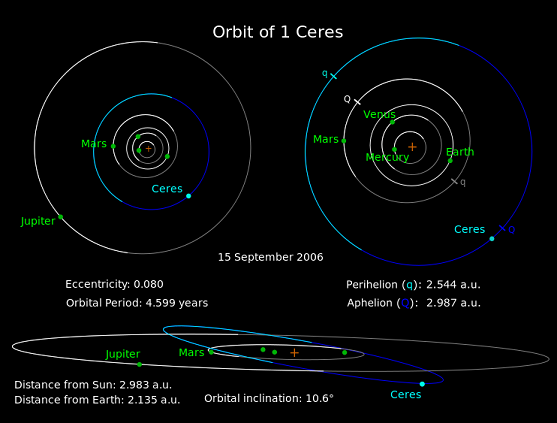
Ceres follows an orbit between Mars and Jupiter, within the asteroid belt, with a period of 4.6 Earth years. The orbit is moderately inclined (inclination 10.6° compared to 7° for Mercury and 17° for Pluto) and moderately eccentric (0.08 compared to 0.09 for Mars).
The diagram illustrates the orbits of Ceres (blue) and several planets (white and grey). The segments of orbits below the ecliptic are plotted in darker colours, and the orange plus sign is the Sun’s location. The top left diagram is a polar view that shows the location of Ceres in the gap between Mars and Jupiter. The top right is a close-up demonstrating the locations of the perihelia (q) and aphelia (Q) of Ceres and Mars. The perihelion of Mars is on the opposite side of the Sun from those of Ceres and several of the large main-belt asteroids, including 2 Pallas and 10 Hygiea. The bottom diagram is a side view showing the inclination of the orbit of Ceres compared to the orbits of Mars and Jupiter.
The mean orbital elements for Ceres are:
In the past, Ceres had been considered to be a member of an “asteroid family”, a grouping of asteroids sharing similar proper orbital elements, which may indicate a common origin through an asteroid collision some time in the past. Ceres was found to have spectral properties different from other members of the family, and so this grouping is now called the “Gefion family”, named after 1272 Gefion. Ceres appears to be merely an interloper in its own family, coincidentally having similar orbital elements but not a common origin.
Ceres is in a near-1:1 mean-motion orbital resonance with Pallas (their orbital periods differ by 0.3%). However, a true resonance between the two would be unlikely; due to their small masses relative to their large separations, such relationships among asteroids are very rare.
Before Dawn no space probe had visited Ceres. Radio signals from spacecraft in orbit around and on the surface of Mars had been used to estimate the mass of Ceres from its perturbations on the motion of Mars.
The Dawn spacecraft, launched by NASA in 2007 [COSPAR ID 2007-043A], orbited asteroid 4 Vesta from 15th July 2011 until 5th September 2012 and continued on to Ceres. It arrived there on 6th March 2015, five months before New Horizons reached Pluto. Dawn is thus the first mission to study a dwarf planet at close range.
Dawn entered orbit around Ceres at an altitude of 5,900 km. The spacecraft reduced its orbital distance to 1,300 km after five months of study, and then down to 700 km after another five months. The spacecraft instrumentation includes a framing camera, a visual and infrared spectrometer, and a gamma-ray and neutron detector. These instruments will be used to examine the dwarf planet’s shape and elemental composition.
On two occasions during the approach, Dawn took images and spectra throughout a complete Ceres rotation of slightly over nine hours, or one Cerean day. During that time, Dawn’s position did not change significantly, so it was almost as if the spacecraft hovered in place as the dwarf planet pirouetted beneath its watchful eye, exhibiting most of the surface. These rotation characterizations (known by the names RC1 and RC2) provided the first global perspectives. The first observational orbit is RC3.
Dawn’s chronology:
See NASA’s news sites: News article, information about Dawn, more here and here.
Ceres is the largest object in the asteroid belt between Mars and Jupiter. The mass of Ceres has been determined by analysis of the influence it exerts on smaller asteroids. Results differ slightly, the average of the three most precise values is 9.4×10²⁰ kg. So Ceres comprises about a third of the estimated total 3.0±0.2×10²¹ kg mass of the asteroid belt, which is in turn about 4% of the mass of the Moon. The surface area is approximately equal to the land area of India. The mass of Ceres is sufficient to give it a nearly spherical shape in hydrostatic equilibrium. In contrast, other large asteroids such as 2 Pallas, 3 Juno, and in particular 10 Hygiea are known to be somewhat irregular in shape.
Ceres’s oblateness is inconsistent with an undifferentiated body, which indicates that it consists of a rocky core overlaid with an icy mantle. This 100 km-thick mantle (23% – 28% of Ceres by mass, 50% by volume) contains 200 million cubic km of water, which is more than the amount of fresh water on the Earth. This result is supported by the observations made by the Keck telescope in 2002 and by evolutionary modelling. Also, some characteristics of its surface and history (such as its distance from the Sun, which weakened solar radiation enough to allow some fairly low-freezing-point components to be incorporated during its formation), point to the presence of volatile materials in the interior of Ceres.
Alternatively, the shape and dimensions of Ceres may be explained by an interior that is porous and either partially differentiated or completely undifferentiated. The presence of a layer of rock on top of ice would be gravitationally unstable. If any of the rock deposits sank into a layer of differentiated ice, salt deposits would be formed, which have not been detected. Thus it is possible that Ceres does not contain a large ice shell, but was instead formed from low-density asteroids with containing ice. The decay of radioactive isotopes may not have been sufficient to cause differentiation.
The surface of Ceres is broadly similar to that of C-type asteroids; some differences exist. The main features of the spectra are of hydrated materials, indicating significant amounts of water in the interior. Other possible surface constituents include iron-rich clays (cronstedtite) and carbonate minerals (dolomite and siderite), which are common minerals in carbonaceous chondrite meteorites. The spectral features of carbonates and clay are usually absent in the spectra of other C-type asteroids. Sometimes Ceres is classified as a G-type asteroid. The surface is relatively warm, with a maximum temperature estimated to be 235 K (about −38°C). (While not as actively discussed as a potential home for extraterrestrial life as Mars or Europa, the potential presence of water ice has led to speculation that life may exist there, and that evidence for this could be found in hypothesized ejecta that could have come from Ceres to Earth.)
Only a few surface features had been unambiguously detected before Dawn. High-resolution ultraviolet HST images taken in 1995 showed a dark spot on its surface which was nicknamed “Piazzi” and was thought to be a crater. Later near-infrared images with a higher resolution taken over a whole rotation with the Keck telescope using adaptive optics showed several bright and dark features moving with the dwarf planet’s rotation. Two dark features had circular shapes, presumably craters; one of them has a bright central region, while the other was identified as “Piazzi”. More recent visible-light HST images of a full rotation taken in 2003 and 2004 showed eleven recognizable surface features, the natures of which are currently unknown. (One of these corresponds to “Piazzi”.) These observations also found that the north pole of Ceres points in the direction of the constellation Draco. This means that Ceres’s axial tilt is very small – about 3°.
This animation shows a colour-coded map revealing the highs and lows of topography on the surface of Ceres. The colour scale extends 6 km below the mean surface in purple to 6 km above in brown. The brightest features (those appearing nearly white) – including the well-known bright spots within a crater in the northern hemisphere – are simply reflective areas, and do not represent elevation.
Colourful new maps of Ceres, based on data from NASA’s Dawn spacecraft, showcase a diverse topography, with height differences between crater bottoms and mountain peaks as great as 15 km. The colour scale extends about 7.5 km below the mean level in indigo to 7.5 km above in white. The topographic map was constructed by analysing images from Dawn’s framing camera taken from varying sun and viewing angles. The map was combined with an image mosaic of Ceres and projected orthographically. The elevation scale used for this topographic map is preliminary; the Dawn science team may revisit the data to standardize the scale at a later date. Some of these craters and other features now have official names, inspired by spirits and deities relating to agriculture from a variety of cultures. The IAU recently approved a batch of names for features on Ceres – see Ceres Nomenclature.
“The craters we find on Ceres, in terms of their depth and diameter, are very similar to what we see on Dione and Tethys, two icy satellites of Saturn that are about the same size and density as Ceres. The features are pretty consistent with an ice-rich crust”, said Dawn science team member Paul Schenk, a geologist at the Lunar and Planetary Institute, Houston.
The newly named features include Occator, the mysterious crater containing Ceres’ intriguing brightest spots, and named after the Roman agriculture deity of harrowing or levelling soil. They retain their bright appearance in this map, although they are colour-coded in the same green elevation of the crater floor in which they sit. Occator has a diameter of about 90 km and a depth of about 4 km.
A smaller crater with bright material, previously named Spot 1, is now identified as Haulani, after the Hawaiian plant goddess. Temperature data from Dawn’s visible and infrared mapping spectrometer show that this crater seems to be colder than most of the territory around it.
Ceres’ Haulani crater (diameter 34 km) shows evidence of landslides from its crater rim. Smooth material and a central ridge stand out on its floor. This enhanced colour view allows scientists to gain insight into materials and how they relate to surface morphology. Rays of bluish ejected material are prominent in this image. The colour blue in such views has been associated with young features on Ceres.
 Another video from NASA
Dantu crater, named after the Ghanaian god associated with the planting of corn, is about 120 km across and 5 km deep. A crater called Ezinu, after the Sumerian goddess of grain, is about the same size. Both are less than half the size of Kerwan, named after the Hopi spirit of sprouting maize, and Yalode, the African Dahomey goddess worshipped by women at harvest rites. “The impact craters Dantu and Ezinu are extremely deep, while the much larger impact basins Kerwan and Yalode exhibit much shallower depth, indicating increasing ice mobility with crater size and age”, said Ralf Jaumann, a Dawn science team member at the German Aerospace Centre (DLR) in Berlin.
Almost directly south of Occator is Urvara, a crater named after the Indian and Iranian deity of plants and fields. Urvara, about 160 km wide and 6 km deep, has a prominent central pointy peak that is 3 km high.
Dawn spiralled toward its third science orbit, less than 1,500 km above the surface, or three times closer to Ceres than its previous orbit and took images and other data.
Scientists have calculated that roughly ¼ of Ceres is water, which may lurk as an icy shell beneath the dwarf planet’s dark surface. The bright spots are the first direct glimpse of that underground ice. Dawn has catalogued more than 130 such spots, most of them within impact craters. The brightest lies in the 90.5-kilometre-wide Occator Crater, and the second-brightest is in the 10-kilometre-wide Oxo Crater. Dawn spotted haze only in Occator and Oxo. (Features on Ceres are named after agricultural deities.)
There was (in December 2015) an article in The Cosmos News (on YouTube), The secret of Ceres’ weird bright spots finally revealed, which referred to a report in Nature, Sublimation in bright spots on (1) Ceres. (The “1” indicates that Ceres was the first asteroid to be discovered, though it is now classified as a dwarf planet.)
The article indicates that the bright spots on Ceres appear to be due to magnesium sulphate, which shift toward less-hydrated kinds of magnesium sulphate at greater distances from the centre of the Occator spot. Latest information: Recent Hydrothermal Activity May Explain Ceres’ Brightest Area.
A second study suggests the detection of ammonia-rich clays, raising questions about how Ceres formed. So perhaps Ceres was born way out near Neptune and somehow zigzagged its way to its current location closer to the Sun. “Thus we think that ammonia was incorporated from material formed in the outer solar system where the temperatures are lower” says team leader Maria Christina De Sanctis, an astronomer at the Istituto di Astrofisica e Planetologia Spaziali in Rome. Since ammonia ice is only stable in the frigid reaches of the outer solar system, De Sanctis argues that Ceres either formed far away from the fledgling sun, or that pebbled-sized lumps from that region of space spiralled into the asteroid belt. “Comets are primitive objects, having original material that is only very, very slightly changed.” Based on the number of smaller craters inside Occator, the team estimate that the crater is about 78 million years old.
Ceres may have a weak atmosphere and water frost on the surface. Surface water ice is unstable at distances less than 5 AU from the Sun, so it is expected to sublime if exposed directly to solar radiation. Water ice can migrate from the deep layers of Ceres to the surface, but will escape in a very short time. As a result, it is difficult to detect water vaporization. Water escaping from polar regions of Ceres was possibly observed in the early 1990s but this has not been unambiguously shown. It may be possible to detect escaping water from the surroundings of a fresh impact crater or from cracks in the sub-surface layers of Ceres. Ultraviolet observations by the International Ultraviolet Explorer (IUE) spacecraft detected statistically significant amounts of hydroxide ion near the north pole; this is a product of water-vapour dissociation by ultraviolet solar radiation. (The IUE was primarily designed to take ultraviolet spectra; it was a collaborative project between NASA, the UK Science Research Council and the European Space Agency (ESA). The mission was launched on 26th January 1978 aboard a NASA Delta rocket [COSPAR ID: 1978-012A]; the mission lifetime was initially set for three years, but in the end it lasted almost 18 years, with the satellite being shut down in 1996 for financial reasons, while the telescope was still functioning at near original efficiency.)
Ceres is probably a surviving “protoplanet” (planetary embryo), which formed 4.57 billion years ago in the asteroid belt. While the majority of inner Solar System protoplanets (including all lunar- to Mars-sized bodies) either merged with other protoplanets to form terrestrial planets or were ejected from the Solar System by Jupiter, Ceres is believed to have survived relatively intact. An alternative theory proposes that Ceres formed in the Kuiper belt and later migrated to the asteroid belt. Another possible protoplanet, Vesta, is less than half the size of Ceres; it suffered a major impact after solidifying, losing about 1% of its mass.
The geological evolution of Ceres was dependent on the heat sources available during and after its formation: friction from planetesimal accretion, and decay of various radionuclides (possibly including short-lived elements like 26Al). These are thought to have been sufficient to allow Ceres to differentiate into a rocky core and icy mantle soon after its formation.
This process may have caused resurfacing by water volcanism and tectonics, erasing older geological features. Due to its small size, Ceres would have cooled early in its existence, causing all geological resurfacing processes to cease. Any ice on the surface would have gradually sublimated, leaving behind various hydrated minerals like clays and carbonates.
Today, Ceres appears to be a geologically inactive body, with a surface sculpted only by impacts. The presence of significant amounts of water ice in its composition raises the possibility that Ceres has or had a layer of liquid water in its interior. This hypothetical layer is often called an “ocean”. If such a layer of liquid water exists, it is believed to be located between the rocky core and ice mantle like that of the theorized ocean on Europa. The existence of an ocean is more likely if salts like ammonia, sulphuric acid or other antifreeze compounds are dissolved in the water.
[Below]: Artistic montage of Dawn firing its ion rocket engine,
with Vesta, Ceres (right), and numerous fictitious smaller asteroids.
In reality, only one asteroid would be visible at a time.
(It makes a pretty picture, though.)
[NASA/JPL-Caltech/UCLA/MPS/DLR/IDA]
NASA’s Jet Propulsion Laboratory has released these two videos of Ceres, constructed from the images received in late 2015 from Dawn.
Flight Over Dwarf Planet Ceres (3¾ minutes)
Unveiling Ceres (2½ minutes)
The first video is what it says on the label.
The second video briefly describes Ahuna Mons (the highest mountain on the dwarf planet, about 5 km tall), Ulvara crater (170 km in diameter with an unusual double central peak containing rough terrain including linear parallel grooves), Occator crater (the brightest crater with bright spots on its floor and flanks; it is believed to be young, some 80 millon years old; it is 92 km in diameter and 4 km deep), Haulani crater (another young crater 34 km in diameter containing a bright deposit, probably a salt), Oxo crater (10 km in diameter, bright, with a so-called “slump” of collapsed material).