
See also Wikipedia, Solar Views, Windows2universe•Org, National Geographic, Amazing-Space•Stsci•Edu and Caltech•Edu.
Dwarf planets are Ceres, Eris, Haumea, Makemake and Pluto; probable dwarf planets are (225088) 2007 OR10, Sedna, Quaoar, (55565) 2002 AW197, Orcus and 2012 VP113.
Artist’s impression of the dwarf planet Eris. This artistic representation is based on observations made at ESO’s La Silla Observatory
Eris (formal designation 136199 Eris, former designation 2003 UB313) is the most massive known dwarf planet in the Solar System and the ninth most massive body known to orbit the Sun directly. It is estimated to be 2326±12 km in diameter, and 27% more massive than Pluto, or about 0.27% of the Earth’s mass.
Eris was discovered in January 2005 by a Palomar Observatory-based team, and its identity was verified later that year. It is a trans-Neptunian objects (TNOs) and a member of a high-eccentricity population known as the scattered disc. It has one known moon, Dysnomia. As of 2011, its distance from the Sun is 96.6 AU, roughly three times that of Pluto. With the exception of some comets, Eris and Dysnomia are currently the most distant known natural objects in the Solar System.
Because Eris appeared to be larger than Pluto, its discoverers and NASA initially described it as the Solar System’s “tenth planet”. This, along with the prospect of other similarly sized objects being discovered in the future, motivated the International Astronomical Union (IAU) to define the term “planet” for the first time. Under the IAU definition approved on 24th August 2006, Eris is a “dwarf planet”, along with objects such as Pluto, Ceres, Haumea and Makemake.
In 2010, preliminary results from observations of a stellar occultation by Eris on 6th November suggested that its diameter may be only 2,326 km, which would make it essentially the same diameter as Pluto. Given the error bars in the different size estimates, it is currently uncertain whether Eris or Pluto has the larger diameter. Both Pluto and Eris are estimated to have solid-body diameters of about 2330 km.
Eris was discovered on 5th January 2005, from images taken on 21th October 2003. The discovery was announced on 29th July 2005, the same day as Makemake and two days after Haumea. The search team had been systematically scanning for large outer Solar System bodies for several years, and had been involved in the discovery of several other large TNOs, including Quaoar, Orcus, and Sedna.

Animation showing the movement of Eris on the images used to discover it. Eris is indicated by the arrow. The three frames were taken over a period of three hours.
Routine observations were taken by the team on 21st October 2003, using the 1200 mm Samuel Oschin Schmidt telescope at Mount Palomar Observatory, California, but the image of Eris was not discovered at that point due to its very slow motion across the sky: The team’s automatic image-searching software excluded all objects moving at less than 1.5 arcseconds per hour to reduce the number of false positives returned. When Sedna was discovered, it was moving at 1.75 arcsec/h, and in light of that the team reanalyzed their old data with a lower limit on the angular motion, sorting through the previously excluded images by eye. In January 2005, the re-analysis revealed Eris’s slow motion against the background stars.
Follow-up observations were then carried out to make a preliminary determination of Eris’s orbit, which allowed the object’s distance to be estimated. The team had planned to delay announcing their discovery until further observations allowed more accurate calculations of Eris’s orbit, but brought their announcement forward when the discovery of another large TNO they had been tracking, Haumea, was announced by a different team in Spain.
Observations of Dysnomia’s orbit permitted scientists to determine the mass of Eris, which in June 2007 they calculated to be 1.66±0.02×10²² kg, 27% greater than Pluto’s.
Eris is a plutoid, that is, a trans-Neptunian dwarf planet. Its orbital characteristics more specifically categorize it a scattered-disk object (SDO), or a TNO that is believed to have been “scattered” from the Kuiper belt into more distant and unusual orbits following gravitational interactions with Neptune as the Solar System was forming. Although its high orbital inclination is unusual among the known SDOs, theoretical models suggest that objects that were originally near the inner edge of the Kuiper belt were scattered into orbits with higher inclinations than objects from the outer belt. Inner-belt objects are expected to be generally more massive than outer-belt objects, and so astronomers expect to discover more large objects like Eris in high-inclination orbits, which have traditionally been neglected.
Because Eris may be larger than Pluto, it was initially described as the “tenth planet” by NASA and in media reports of its discovery. In response to the uncertainty over its status, and because of ongoing debate over whether Pluto should be classified as a planet, the IAU delegated a group of astronomers to develop a sufficiently precise definition of the term “planet” to decide the issue. This was announced as the IAU’s definition of a Planet in the Solar System, adopted on 24th August 2006. At this time, both Eris and Pluto were classified as dwarf planets, a category distinct from the new definition of planet. Brown has since stated his approval of Pluto losing its status as a planet. The IAU subsequently added Eris to its Minor Planet Catalogue, designating it (136199) Eris.
Eris has an orbital period of 557 years, and as of 2011 lies at 96.6 AUs from the Sun, almost its maximum possible distance (its aphelion is 97.5 AU). It came to perihelion between 1698 and 1699, to aphelion around 1977, and will return to perihelion around 2256 to 2258. Eris and its moon are currently the most distant known objects in the Solar System apart from long-period comets and space probes. However, approximately forty known TNOs, most notably 2006 SQ372, 2000 OO67 and Sedna, while currently closer to the Sun than Eris, have greater average orbital distances than Eris’s semimajor axis of 67.7 AU.
The orbit is highly eccentric, and brings Eris to within 37.9 AU of the Sun, a typical perihelion for scattered objects. This is within the orbit of Pluto, but still safe from direct interaction with Neptune (29.8–30.4 AU). Pluto, on the other hand, like other plutinos, follows a less inclined and less eccentric orbit and, protected by orbital resonance, can cross Neptune’s orbit. It is possible that Eris is in a 17:5 resonance with Neptune, though further observations will be required to check that hypothesis. Unlike the eight planets, whose orbits all lie roughly in the same plane as the Earth’s, Eris’ orbit is highly inclined: It is tilted at an angle of about 44 degrees to the ecliptic. In about 800 years, Eris will be closer to the Sun than Pluto for some time (see the graph below).

The distances of Eris and Pluto from the Sun in the next 1,000 years. The diagram shows how Eris can be closer to the Sun than Pluto. This occurs since Eris has a perihelion (closest distance to the Sun) of 38.3 AU and Pluto has an aphelion (furthest distance from the Sun) of 49.3 AU
Eris currently has an apparent magnitude of 18.7, making it bright enough to be detectable to some amateur telescopes. A 200 mm telescope with a CCD can detect Eris under favourable conditions. The reason it had not been noticed until now is its steep orbital inclination; most searches for large outer Solar System objects concentrate on the ecliptic plane, where most bodies are found.
Eris is now in the constellation Cetus. It was in Sculptor from 1876 until 1929 and Phoenix from roughly 1840 until 1875. In 2036 it will enter Pisces and stay there until 2065, when it will enter Aries. It will then move into the northern sky, entering Perseus in 2128 and Camelopardalis (where it will reach its northernmost declination) in 2173. Also, because of the high inclination of its orbit, Eris only passes through a few constellations of the traditional Zodiac.
Perihelion: 37.77 AU; Aphelion: 97.56 AU; Orbital period: 557 years; Eccentricity: 0.44; Inclination: 44°.
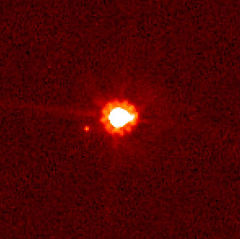
Dysnomia, officially (136199) Eris I Dysnomia (Greek: Δυσνομια), is the only known moon of the dwarf planet Eris (the most-massive known dwarf planet in the Solar System). It was discovered in 2005 by the laser guide star adaptive optics team at the Keck Observatory, and carried the provisional designation of S/2005 (2003 UB313) 1 until officially named Dysnomia (from the Ancient Greek word Δυσνομια meaning ‘lawlessness’) after the daughter of the Greek goddess Eris.
During 2005, the adaptive optics team at the Keck telescopes in Hawaii carried out observations of the four brightest Kuiper belt objects (Pluto, Makemake, Haumea, and Eris), using the newly commissioned laser guide star adaptive optics system. Observations taken on 10th September revealed a moon in orbit around Eris, provisionally designated S/2005 (2003 UB313) 1.
Dysnomia was found to be 4.43 magnitudes fainter than Eris, and its diameter is estimated to be between 350 and 490 km, though there are claims that it is 500 times fainter and between 100 and 250 km in diameter. It is 60 times fainter than Eris in the K‘ band and 480 times fainter in the V band, which means a very different, and quite redder, spectrum, indicating a significantly darker surface. Assuming its albedo is five times lower than Eris’s, its diameter would be 685±50 km.
Combining Keck and Hubble observations, the satellite was used to determine the mass of Eris, and orbital parameters were estimated. Its orbital period is calculated to be 15.774±0.002 days. These observations indicate that Dysnomia has a circular orbit around Eris, with a radius of 37,350±140 km. This suggests that the mass of Eris is approximately 1.27 times that of Pluto.
Astronomers now know that three of the four brightest Kuiper belt objects (KBOs) have satellites. Among the fainter members of the belt only about 10% are known to have satellites. This is believed to imply that collisions between large KBOs have been frequent in the past. Impacts between bodies of the order of 1000 km across would throw off large amounts of material which would coalesce into a moon. A similar mechanism is believed to have led to the formation of Earth’s own Moon when the Earth was struck by a giant impactor early in the history of the Solar System.
Size estimates of Eris: in 2005, radius 1,199 km, diameter 2,397 km by Hubble Space Telescope (HST); in 2007, radius 1,300 km, diameter 2,600 km by Spitzer; in 2011, radius 1,163 km, diameter 2,326 km by an occultation. The size of an object is determined from its absolute magnitude and the albedo (the amount of light it reflects). At a distance of 97 AU, an object with a diameter of 3,000 km would have an angular size of 40 milliarcseconds, which is directly measurable with the Hubble Space Telescope. Although resolving such small objects is at the very limit of the telescope’s capabilities, sophisticated image processing techniques such as deconvolution can be used to measure such angular sizes fairly accurately.
This makes Eris around the same size as Pluto, which is about 2,330 km across. It also indicates an albedo of 0.96, higher than that of any other large body in the Solar System except Saturn’s moon Enceladus. It is speculated that the high albedo is due to the surface ices being replenished because of temperature fluctuations as Eris’s eccentric orbit takes it closer and farther from the Sun.
In 2007, a series of observations of the largest trans-Neptunian objects with the Spitzer Space Telescope gave an estimate of Eris’s diameter of 2,600 +400 −200 km. The Spitzer and Hubble estimates overlap in the range of 2,400 – 2,500 km, 4 – 8% larger than Pluto. However, astronomers now suspect that Eris’s spin axis is pointing toward the sun at the moment – a possibility that would keep the sunlit hemisphere warmer than average and skew any infrared measurements toward higher values. So the outcome from the 2010 Chile occultation is actually more in line with the Hubble result from 2005.
In November 2010, Eris was the subject of one of the most distant stellar occultations yet achieved from Earth. Preliminary data from this event cast doubt on previous size estimates. The teams announced their final results from the occultation in October 2011, with an estimated diameter of 2,326±12 km. However, when using data from this event for comparison with Pluto, there is a range of figures available for Pluto’s radius/diameter that can be selected. This is due in part to Pluto’s atmosphere which interferes with making measurements of its solid surface (as opposed to gaseous haze). The mass of Eris can be calculated with much greater precision. Based on the currently accepted value for Dysnomia’s period (15.774 days) Eris is 27% more massive than Pluto. If the 2011 occultation results are used, then Eris has a density of 2.52±0.05 g cm-3; substantially denser than Pluto, and thus must be composed largely of rocky materials.
Eris is named after the goddess Eris (Greek Ερις), a personification of strife and discord. The name was assigned on 13th September 2006, following an unusually long period in which the object was known by the provisional designation 2003 UB313, which was granted automatically by the IAU under their naming protocols for minor planets.
Xena: Due to uncertainty over whether the object would be classified as a planet or a minor planet, as different nomenclature procedures apply to these different classes of objects, the decision on what to name the object had to wait until after the 24th August 2006, IAU ruling. As a result, for a time the object became known to the wider public as “Xena”. “Xena” was an informal name used internally by the discovery team. (“We chose it since it started with an “X” [planet “X”]”)
The infrared spectrum of Eris, compared to that of Pluto, shows the marked similarities between the two bodies.
The discovery team followed up their initial identification of Eris with spectroscopic observations made at the 8 m Gemini North Telescope in Hawaii on 25th January 2005. Infrared light from the object revealed the presence of methane ice, indicating that the surface may be similar to that of Pluto, which at the time was the only TNO known to have surface methane, and of Neptune’s moon Triton, which also has methane on its surface. Note that no surface details can be resolved from Earth or its orbit with any instrument currently available.
Due to Eris’s distant eccentric orbit, Eridian surface temperature is estimated to vary between about 30 and 56 kelvin (-243 and -217 degrees Celsius).
Unlike the somewhat reddish Pluto and Triton, however, Eris appears almost grey. Pluto’s reddish colour is believed to be due to deposits on its surface of tholins (heteropolymer molecules formed by solar ultraviolet irradiation of simple organic compounds such as methane or ethane; tholins do not form naturally on modern-day Earth, but are found in great abundance on the surface of icy bodies in the outer solar system; they usually have a reddish-brown appearance), and where these deposits darken the surface, the lower albedo leads to higher temperatures and the evaporation of methane deposits. In contrast, Eris is far enough away from the Sun that methane can condense onto its surface even where the albedo is low. The condensation of methane uniformly over the surface reduces any albedo contrasts and would cover up any deposits of red tholins.
Even though Eris can be up to three times further from the Sun than Pluto, it approaches close enough that some of the ices on the surface might warm enough to sublime. As methane is highly volatile, its presence shows either that Eris has always resided in the distant reaches of the Solar System where it is cold enough for methane ice to persist, or that it has an internal source of methane to replenish gas that escapes from its atmosphere. This contrasts with observations of another discovered TNO, Haumea, which reveal the presence of water ice but not methane.
