The Explorer Program
The Explorer program is a US space exploration program that provides flight opportunities for physics, geophysics, heliophysics, and astrophysics investigations from space. Over ninety space missions have been launched since 1958, and it is still active. Starting with Explorer 6, it has been a NASA program, and they have worked with a variety of other institutions and business, including many international partners.
The Explorer program was the United States’s first successful attempt to launch an artificial satellite. It began as a U.S. Army proposal (Project Orbiter) to place a scientific satellite into orbit during the International Geophysical Year; however, that proposal was rejected in favour of the U.S. Navy’s Project Vanguard. The Explorer program was later reestablished to catch up with the Soviet Union after their launch of Sputnik 1 on 4th October 1957. Explorer 1 was launched on 31st January 1958. Besides being the first US satellite, it is known for discovering the Van Allen radiation belt. The Explorer program was transferred to NASA, which continued to use the name for an ongoing series of relatively small space missions, typically an artificial satellite with a science focus. Over the years, NASA has launched a series of Explorer spacecraft carrying a wide variety of scientific investigations.
More information is here and at the Wikipedia site noted above.
The Discovery Program
The Discovery Program is a series of lower-cost, highly-focused American scientific space missions that are exploring the Solar System. It was founded in 1992 to implement the vision of “faster, better, cheaper” planetary missions. Discovery missions differ from traditional NASA missions where targets and objectives are pre-specified. Instead, these cost-capped missions are proposed and led by a scientist called the Principal Investigator. Proposing teams may include people from industry, small businesses, government laboratories, and universities. Proposals are selected through a competitive peer review process. All of the completed Discovery missions are accomplishing ground-breaking science and adding significantly to the body of knowledge about the Solar System.
NASA also accepts proposals for competitively selected Discovery Program Missions of Opportunity, providing opportunities to participate in non-NASA missions by funding a science instrument or hardware components of a science instrument or to re-purpose an existing NASA spacecraft. These opportunities are currently offered through NASA’s Stand Alone Mission of Opportunity program.
Standalone Missions
Missions of Opportunity
Failed Mission
Standalone Missions in Progress
Missions of Opportunity in Progress
Future Standalone Missions
- Interior Exploration using Seismic Investigations, Geodesy and Heat Transport (InSight – initially named Geophysical Monitoring Station or GEMS), to study the structure and composition of the interior of Mars
- Strofio, a unique mass spectrometer, part of the SERENA instrument package that will fly on board ESA’s BepiColombo/Mercury Planetary Orbiter spacecraft; it will study the atoms and molecules that compose Mercury’s atmosphere to reveal the composition of the planet’s surface
- Lander Radio-Science on ExoMars, or LaRa, will track part of ESA’s ExoMars mission, which will consist of a fixed lander and a rover that will roam Mars collecting soil samples for detailed analysis
Proposals
- Titan Mare Explorer (TiME) would provide the first direct exploration of an ocean environment beyond Earth by landing in, and floating on, a large methane-ethane sea on Saturn’s moon Titan.
- Comet Hopper (CHopper) would study cometary evolution by landing on a comet multiple times and observing its changes as it interacts with the Sun
The Flagship Program
The Flagship Program is a series of NASA missions to explore the Solar System. It is the largest and most expensive of the NASA Solar System Programs. According to NASA, the cost of Flagship Program missions ranges between $2 billion and $3 billion. These missions will be crucial in allowing humans to reach and explore high-priority targets. These critically important targets could help establish the limits of planetary habitability, not just for our Solar System, but for planetary systems in general. In particular, they potentially provide an opportunity to identify pre-biotic organic molecules or even extant life beyond Earth, should it exist, in the Solar System. The targets of Flagship Missions may include complex missions to the clouds and surface of Venus, the lower atmosphere and surface of Titan, the surface and subsurface of Europa, the deep atmosphere of Neptune, the surface of its moon Triton, and the surface of a comet nucleus in the form of cryogenically preserved samples.
The flagship program includes the Mars Science Laboratory, the Cassini spacecraft, the Galileo spacecraft, and the Voyager probes.
The highest priority flagship mission for development was a sample-caching rover, called the Mars Astrobiology Explorer-Cacher (MAX-C), as an American contribution to the ExoMars program with the European Space Agency (ESA) and as precursor to a proposed Mars sample return mission. (NASA subsequently terminated its participation in ExoMars due to budgetary cuts to pay for the cost overruns of the James Webb Space Telescope. In addition, all proposed NASA flagship planetary missions were put on hold indefinitely. There are no plans to develop more planetary flagships beyond the $2.5 billion Mars Science Laboratory (MSL).) The second highest priority mission was identified as the Jupiter Europa Orbiter, proposed to be part of the NASA-ESA EJSM/Laplace mission, and would have studied Europa in detail as a site of astrobiological interest.
The New Frontiers Program
The New Frontiers program is a series of missions to research several of the Sun’s planets including Jupiter, Venus, and the dwarf planet Pluto. It is designed for medium-class missions that cannot be accomplished within the cost and time constraints of Discovery, but are not as large as Flagship-class missions.
Missions in Progress
Future Committed Mission
Future Missions
New Frontiers 4
The next New Frontiers mission will be selected during the decade 2013–2022; there are five candidates:
- Venus In Situ Explorer, to study the composition and surface properties of Venus, primarily to examine the physics and chemistry of Venus’s atmosphere and crust, including the detailed composition of the lower atmosphere, and the elemental and mineralogical composition of surface materials
- Lunar South Pole–Aitken Basin Sample Return, which would return samples of the early Moon’s deep crust
- Trojan Tour and Rendezvous, which would fly by two or more Jupiter Trojans, asteroids that orbit around the L4 and L5 Lagrange points at the same distance from the Sun as Jupiter, and then settle into orbit around one of them – similar goals to the Dawn mission, though significantly further from the Sun
- Comet Surface Sample Return, to acquire and return to Earth a macroscopic sample from the surface of a comet nucleus using a sampling technique that preserves organic material in the sample
- Saturn Probe, to deploy a probe into Saturn’s atmosphere to determine the structure of the atmosphere as well as noble gas abundances and isotopic ratios of hydrogen, carbon, nitrogen, and oxygen. A carrier/relay craft with the probe would arrive at Saturn approximately seven years after launch. Thirty days or more before arrival, the probe would separate from the carrier/relay craft and enter the atmosphere, beginning measurements at 0.1 bars (a bar is the atmospheric pressure at sea level on Earth). At 1 bar, the probe would detach from its parachute for a more rapid descent to 5 bars and the end of the nominal mission after 55 minutes of data collection. The probe would be designed to survive to 10 bars, and the carrier/relay would continue to listen for as long as the entry site remains visible.
New Frontiers 5
As well as the five missions listed above, two additional candidates will be added to the list.
- Io Observer, to determine the internal structure of Io and to investigate the mechanisms that contribute to the satellite’s intense volcanic activity from a highly elliptical orbit around Jupiter, making multiple flybys of Io
- Lunar Geophysical Network, consisting of several identical landers distributed across the lunar surface, each carrying geophysical instrumentation. The primary science objectives are to characterize the Moon’s internal structure, seismic activity, global heat flow budget, bulk composition, and magnetic field

Edwin Hubble
NASA’s Great Observatories
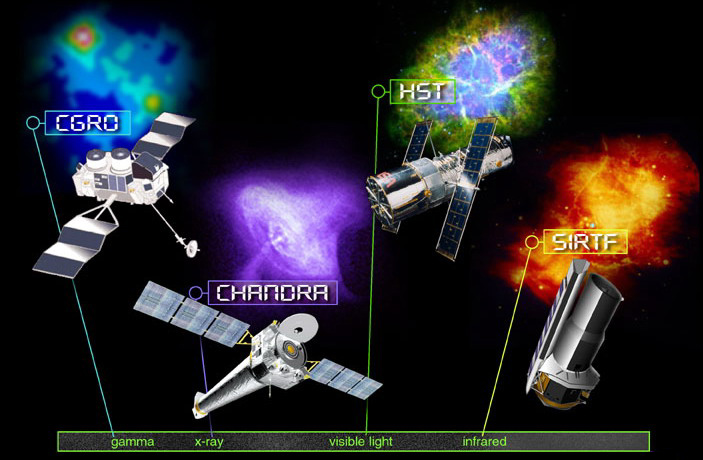
The Hubble Space Telescope (HST) is a space telescope that was carried into orbit by a Space Shuttle in 1990 and remains in operation. A 2.4-metre aperture telescope in low Earth orbit, Hubble’s four main instruments observe in the near ultraviolet, visible, and near infrared. The telescope is named after the astronomer Edwin Hubble.
The Compton Gamma Ray Observatory (CGRO) was a space observatory detecting light from 20 KeV to 30 GeV in Earth orbit from 5th April 1991 to 4th June 2000. It featured four main telescopes in one spacecraft covering x-rays and gamma-rays, including various specialized sub-instruments and detectors. It was one of NASA’s Great Observatories.
The Chandra X-ray Observatory is a space telescope launched into orbit by a Space Shuttle on 23rd July 1999. Chandra is sensitive to X-ray sources 100 times fainter than any previous X-ray telescope, enabled by the high angular resolution of its mirrors. Since the Earth’s atmosphere absorbs the vast majority of X-rays, they are not detectable from Earth-based telescopes; therefore space-based telescopes are required to make these observations. Chandra is an Earth satellite in a 64-hour orbit, and its mission is ongoing.
The Spitzer Space Telescope (SST), formerly the Space Infrared Telescope Facility (SIRTF), is an infrared space observatory launched in 2003. It is the fourth and final of the NASA Great Observatories program.
Spitzer Space Telescope (NASA/JPL/Caltech)
Spitzer Space Telescope in Earth trailing orbit
Spitzer (2003-038A) was launched on 25th August 2003 into an Earth-trailing heliocentric orbit. Spitzer is an infrared space observatory and is the fourth and final of NASA’s Great Observatories program.
The Great Observatories are: Compton Gamma Ray Observatory (CGRO) (gamma rays, hard x-rays; Chandra X-ray Observatory (CXO) (soft x-rays; initially the Advanced X-ray Astronomical Facility [AXAF]); Hubble Space Telescope (HST) (visible light, near-ultraviolet, near-infrared range); Spitzer Space Telescope (SST) (infrared; formerly the Space Infrared Telescope Facility [SIRTF])
The planned mission period was to be 2.5 years with a pre-launch expectation that the mission could extend to five or slightly more years until the onboard liquid helium supply was exhausted. This occurred on 15th May 2009. Without liquid helium to cool the telescope to the very cold temperatures needed to operate, most of the instruments are no longer usable. However, the two shortest wavelength modules of the IRAC camera are still operable with the same sensitivity as before the cryogen was exhausted, and will continue to be used in the Spitzer Warm Mission.
It follows a rather unusual orbit, heliocentric instead of geocentric, trailing and drifting away from Earth’s orbit at approximately 0.1 astronomical unit per year (a so-called “earth-trailing” orbit). The primary mirror is 85 cm in diameter, f/12 and made of beryllium and was cooled to 5.5 K. The satellite contains three instruments that allowed it to perform astronomical imaging and photometry from 3 to 180 μm, spectroscopy from 5 to 40 μm, and spectrophotometry from 5 to 100 μm.