
Loading...
Loading...
This page is devoted mostly to Comet 67P/“Churyumov–Gerasimenko” [let’s call it 67P for short] and the Rosetta mission with its lander Philae.
It also includes Other Comets and Their Visiting Spacecraft, in particular Comet Hale-Bopp, “Deep Impact” Mission: Comet “Tempel 1”, the “EPOXI” Mission: Comet “Hartley 2”, Comet Ison, and Halley’s Comet as depicted on the Bayeux Tapestry.
There is a section on Zodiacal Light (including that in other solar systems), and on Exocomets.
A comet is an object, believed to be from the Oort Cloud or the Scattered Disc, that approaches the inner part of the solar system. As it approaches the Sun, it normally produces a long tail, of ices and dust, which is blown away by the solar wind. The main Minor Planet Center web-site has data on all known minor planets (currently over 86 million) and comets (over half a million).
The Kuiper Belt was initially believed to be the main repository for periodic comets, those with orbits lasting less than 200 years. However, studies since the mid-1990s have shown that the classical belt is dynamically stable, and that comets’ true place of origin is the scattered disc, a dynamically active region created by the outward motion of Neptune 4.5 billion years ago; scattered disc objects such as Eris have extremely eccentric orbits that can take them as far as 100 AU from the Sun.
Chronological chart of great and major comets, 1670 to present. Great comets are marked with a yellow dot and all comets are displayed relative to their spheres of visibility – north, south or both.
On average, every 5 years, one can expect to see a major comet visible from the Earth. However, the variability around that average is also about 5 years (one standard deviation). This means that, on average, a major comet arrives every 5 to 10 years.
Sometimes the visitations are clustered. A prime example is the years 1910 and 1911, when four major comets crossed the sky.
The data also reveal that Great Comets arrive on average every 20 years. The variability is 10 years, as represented by a standard deviation around the average. So truly Great Comets may be visible from Earth every 20 to 30 years. Some centuries might have two or three (1800s) while others, four or more (1900s).
Comet 67P/Churyumov-Gerasimenko (комета Чурюмова – Герасименко) is being studied by the European Space Agency’s spacecraft Rosetta which is sending back data. It is planned to keep the European Space Agency’s Rosetta in orbit around 67P for at least a year, studying emissions from the comet as it approaches the Sun.
Since landing on the comet in August 2014, the Rosetta spacecraft has been studying the comet closely. The European Space Agency’s (ESA) probe has now discovered an unexpected process at work, which is causing molecules of carbon dioxide and water to rapidly spew from the comet’s surface.
There are 11 instruments aboard Rosetta for observing and studying the comet. One of these instruments is NASA’s Alice spectrograph, which has the purpose of examining the chemical composition of the comet’s atmosphere using far-ultraviolet wavelengths.
At these wavelengths, the instrument allows mission scientists to identify highly abundant elements like nitrogen, carbon, oxygen and hydrogen. By splitting the light produced by the comet into different colours, Alice is able to identify the chemical composition of its atmosphere.
Using Alice’s detections from Rosetta’s first four months on the comet, mission scientists have analysed carbon dioxide gas and water plumes coming off the surface as triggered by the sun’s warmth. They looked at emissions produced by oxygen and hydrogen atoms, which are a result of carbon dissociating from carbon dioxide molecules and water molecules breaking close to the nucleus of the comet.
The molecules appear to split via a two-step process, explained Paul Feldman, an astronomy and physics professor from the Johns Hopkins University lead author of the study. Analyzing relative intensities observed in atomic emissions allowed the team to ascertain that “parent” molecules are breaking up because of electrons being produced by the comet’s nucleus.
By comparison, space observatories on or in Earth’s orbit are only able to spot atomic components of comets after parent molecules have been disintegrated by sunlight, many hundreds of miles away from the comet’s nucleus.
The Alice spectrograph aboard the Rosetta space probe is one of two “Alices” currently in space. The other ultraviolet spectrograph is being used by New Horizons. Rosetta-Alice is operated by the Southwest Research Institute as part of a contract with NASA’s Jet Propulsion Laboratory.
Alice is in place to help mission scientists study the comet’s surface and atmosphere, providing insight into the formation and evolution of comets. It also permits scientists to closely observe the nature of comet activity. Understanding the comet’s surface and atmosphere will hopefully shed light on the role of the comet’s nucleus in changes within the comet’s tail and atmosphere, in addition to comet interaction with solar wind.
As Rosetta approached 67P from afar, ESA scientists were surprised to see that it had two distinct parts. Or maybe it was a binary comet! The shape became clearer and the comet was nicknamed the “rubber duck“. This shape made more complicated Rosetta’s job of finding a suitable landing place for Philae; it had been hoped that 67P was an irregular sphere.
Comet 67P/Churyumov-Gerasimenko was beginning to show a clearly visible increase in activity as Rosetta approached. While in the past months most of the dust emitted from the body’s surface seemed to originate from the neck region which connects the two lobes, images obtained by Rosetta’s scientific imaging system OSIRIS later showed jets of dust along almost the whole extent of the comet.
“At this point [early 2014], we believe that a large fraction of the illuminated comet’s surface is displaying some level of activity,” said OSIRIS scientist Jean-Baptiste Vincent from the Max Planck Institute for Solar System Research (MPS) in Germany. For several weeks, the OSIRIS team witnessed a gradual but qualitative change. “In the first images from this [2014] summer that showed distinct jets of dust leaving the comet, these jets were limited to the neck region,” said OSIRIS Principal Investigator Holger Sierks from the MPS. Now, jets appear also on the “body” and “head” of the comet.
By October 2014, still more than 450 million km were separating 67P from the Sun. Based on a rich history of ground-based observations scientists expected a comet’s activity to pick-up noticeably once it came within 300 million km from the Sun. “Being able to monitor these emissions from up close for the first time gives us much more detailed insights”, said Sierks. “From the OSIRIS images, the team now wants to derive a better understanding of the evolution of cometary activity and the physical processes driving it”.
There is a large library of images of Comet 67P on Flickr.
Rosetta’s Comet Meets Charlie Brown’s “Pig-Pen” is from Universe Today and relates to dust particles emanating from 67P.
A narrow-angle camera image showed part of a large fracture running across Comet 67P/Churyumov–Gerasimenko’s neck.
Close-ups of a curious surface texture on Comet 67P nicknamed “goosebumps”, all of them at a size of around 3 metres and spanning areas of more than 100 metres. They are textures on steep cliff faces, whose origin isn’t yet known.
The comet is 70–80% porous, the ESA said, “with the interior structure likely to be weakly bonded ice-dust clumps with small void spaces between them”.
Along with water, it releases gases such as carbon monoxide and carbon dioxide, at levels that vary daily and perhaps seasonally. The comet “was releasing the earthly equivalent of 1.2 litres of water into space every second at the end of August 2014”, says NASA, which is assisting the ESA.
A “remarkable array of surface features” are on the comet, in five main categories: “dust-covered; brittle materials with pits and circular structures; large-scale depressions; smooth terrains; and exposed more consolidated (‘rock-like’) surfaces”.
Its surface composition is “very homogenous”, scientists say, “dominated by dust and carbon-rich molecules, but largely devoid of ice”.
Scientists don’t know why the comet has a double-lobed shape that resembles a barbell. One theory is that it began as a single body and eroded in the middle. But it’s also possible that “two separate comets formed in the same part of the Solar System and then merged together at a later date”, the ESA says.
Researchers are hoping to learn new things about Comet 67P as it nears the sun. The comet will make its closest approach on 13th August, between the orbits of Earth and Mars.
“We have already learned a lot in the few months we have been alongside the comet”, says Matt Taylor, ESA’s Rosetta project scientist, “but as more and more data are collected and analysed from this close study of the comet we hope to answer many key questions about its origin and evolution”.
A handout photo released on 6th August 2014 by the European Space Agency showed a close-up of comet 67P/Churyumov-Gerasimenko. (AFP photo) The European Space Agency (ESA)’s Rosetta probe flew within just six km of the comet it had been tracking for months, taking detailed photos.
The spacecraft reached so close above the surface of comet 67P/Churyumov-Gerasimenko on Saturday. It is expected to send images by Monday. The achievement would not recur as the comet became increasingly active the nearer it got to the Sun and its tail increased in size.
Scientists at the ESA’s European Space Operations Centre in the German city of Darmstadt wanted to investigate how gas and dust escape from the comet’s surface. Rosetta had been flying alongside the comet since August.
It caught up with the comet in November 2014 after a 10-year flight. The same month saw the spacecraft release the Philae lander to the comet’s surface. Philae, however, ran out of charge and could not replenish its batteries as it was then placed in a dark spot on the comet.
[Right] A close-up of deep pit Seth_01, the most active pit on the surface of comet 67P/Churyumov-Gerasimenko, which is about 200 metres in diameter and 200 metres deep. The Rosetta spacecraft’s images of the comet suggest that the round pits on its surface form as sinkholes. [Vincent et al., Nature Publishing Group]
Close view of a 228×228 m region on Comet 67P/Churyumov-Gerasimenko, as seen by the OSIRIS narrow-angle camera during Rosetta’s flyby at 12:39 UT on 14th February 2015. The image was taken six kilometres above the comet’s surface, and the image resolution is just 11 cm/pixel. Rosetta’s fuzzy shadow, measuring approximately 20×50 metres, is seen at the bottom of the image, and is explained by the mock-up below. [ESA/Rosetta/MPS for OSIRIS Team]
The sharp-eyed science camera on Europe’s Rosetta comet orbiter caught a view of the probe’s fuzzy shadow when controllers guided the spacecraft just a few miles over its subject’s nucleus.
The OSIRIS camera was snapping away when spacecraft swooped in for the close brush with comet 67P/Churyumov-Gerasimenko, the tiny world being explored for the first time by the ESA’s Rosetta mission.
The solar-powered orbiter flew within about 6 km of the comet on 14th February 2015. The flyby was the closest Rosetta has come to comet 67P since it arrived there in August 2014.
The approach was timed when the Rosetta was positioned directly between the comet and the sun, giving the spacecraft’s camera and science instruments perfect lighting to study the textures of the boulders and dust grains dotting the nucleus.
“Images taken from this viewpoint are of high scientific value,” said Holger Sierks, OSIRIS principal investigator from the Max Planck Institute for Solar System Research in Germany. “This kind of view is key for the study of grain sizes.”
The geometry also yielded a view of Rosetta’s shadow on the comet, appearing as a diffuse darkening on the charcoal grey nucleus.
“The shadow is fuzzy and somewhat larger than Rosetta itself, measuring approximately 20×50 metres. If the sun were a point source, the shadow would be sharp and almost exactly the same size as Rosetta,” ESA wrote in a blog post. “However the sun appeared as a disc about 0.2° across (about 2.3 times smaller than on Earth), resulting in a fuzzy ‘penumbra’ around the spacecraft’s shadow on the surface.”
This graphic [right] illustrates how Rosetta’s shadow would appear from a point source of light, compared to the fuzzy shadow seen on the comet. Credits: Spacecraft: ESA/ATG medialab. Comet background: ESA/Rosetta/NAVCAM
ESA said Rosetta and comet 67P were travelling about 347 million km from the Sun during the 14th February encounter. That is about 2.3 times farther than Earth’s distance from the Sun.
The image of Rosetta’s shadow was the first from the flyby taken by the OSIRIS camera that scientists have shared. Rosetta’s less-capable navigation camera also took images as the probe glided by the comet, and ESA posted those images a few days later.
Scientists using the Rosetta spacecraft’s OSIRIS – its scientific imaging system – discovered what looks like a balancing rock (#3) on 67P.
Rosetta’s mission continues for the rest of 2015, and into 2016, to complete the most comprehensive survey ever made of a comet.
[Left] 67P on 25th March 2015 from a distance of 53 miles from the comet’s centre
[Right] 67P on 7th June 2015 from a distance of 126 miles from the comet’s centre
[Both photos: ESA/Max Planck Institute for Solar System Research]
Rosetta and Philae (its lander) (2004-006A) were launched on 2nd March 2004 at 07:17 UTC, and flew successfully by Earth three times for gravity assists en route to asteroid and comet encounters; they were on 4th March 2005, 13th November 2007, and 13th November 2009. Between the first and second Earth flybys, it also similarly flew past Mars on 25th February 2007. On 5th September 2008 (i.e. between the second and third Earth flybys) Rosetta flew by asteroid 2867 Šteins, and then on 11th July 2010 it passed asteroid 21 Lutetia en route to comet 67P/Churyumov-Gerasimenko which it reached in 2014.
Rosetta’s original goal was comet 46P/Wirtanen, but launch delays required a rerouting to comet 67P/Churyumov-Gerasimenko. The route was long, involving three Earth flybys (in 2005, 2007, and 2009) and one Mars flyby (on 25th February 2007). It flew by asteroid 2867 Šteins on 5th September 2008 and 21 Lutetia on 10th July 2010. Its long cruise took it nearly to Jupiter’s orbit before it travelled inward again to rendezvous with the comet. Since Rosetta is solar-powered, ESA had to place it into a state of deep hibernation for this most distant period of its cruise. Rosetta went to sleep on 8th June 2011 and woke up again on 20th January 2014, five months before its arrival at Churyumov-Gerasimenko in May 2014; its actual rendez-vous was on 6th August 2014, after which it started mapping the comet. In November 2014, it dropped, a small lander, Philae, to the surface of the comet. Philae bounced twice and landed in an awkward position where it received little sunlight to power it.
Rosetta will continue to accompany 67P round the sun until the end of its mission in December 2015. It may have more to do, however.
See these news bulletins: Rosetta wakes up, an excellent 3D animation from ESA about Rosetta [which you may need to zoom] and a blog of Rosetta’s and the comet’s progress since March 2014, and Satnews Daily for 11th June 2014, further stories, and an Imperial College video [scroll down for the video]. There’s an orbital computer simulation of Rosetta’s path on this Slovakian site.
Philae’s instruments are described in detail here.
© ESA
This animation tracks Rosetta’s journey through the Solar System, using gravity slingshots from Earth and Mars to reach its final destination, Comet 67P/Churyumov–Gerasimenko. Rosetta made three flybys of Earth, on 4th March 2005, 13th November 2007 and 13th November 2009, and one of Mars, on 25th February 2007. Rosetta has also visited two asteroids, taking extensive close-up images of 2867 Šteins on 5th September 2008 and 21 Lutetia on 10th July 2010. The spacecraft was woken up from deep space hibernation on 20th January 2014, it headed for rendezvous with the comet in May. In November the Philae probe will be deployed to the comet surface. Rosetta will follow the comet to its closest distance to the Sun on 13th August 2015 and as it moves back towards the outer Solar System. The nominal mission end is December 2015.
With just over a week to go before touchdown, the landing site for Rosetta’s Philae probe was named Agilkia, after an island on the Nile River in southern Egypt. Up until then the region of the smaller lobe of comet 67P/Churyumov–Gerasimenko was known simply as site J, the designation it was given during the landing selection process.
Agilkia Island is home to a complex of ancient Egyptian buildings, including the famous Temple of Isis, moved there when the island of Philae was flooded during the construction of the Aswan Dam. Of the thousands of entries to the competition to name the site, more than 150 people suggested the name Agilkia, making it one of the most popular choices. The comet’s odd shape prompted more tongue in cheek suggestions, many referring to it as rubber duck, a potato or Snoopy from the cartoon Peanuts.
Alexandre Brouste from France was selected as the overall winner of the completion and travelled to ESA’s Space Operations Control Centre in Darmstadt, Germany, to follow the landing live.
The Rosetta spacecraft met up with its target comet 67P/Churyumov-Gerasimenko on 6th August 2014. Rosetta flew in space for more than a decade to reach the comet.
According to the 23rd January 2015 issue of Science, scientists have defined 19 regions on Comet 67P/Churyumov-Gerasimenko’s nucleus according to terrain and named after Egyptian deities like Imhotep, Aten and Hathor. [Credits: ESA/Rosetta/MPS/OSIRIS Team/UPD/LAM/IAA/SSO /INTA/UPM/DASP/IDA]
Researchers with the European Space Agency may have discovered how comets can remain so cold with the revelation of molecular nitrogen being found on Comet 67P/Churyumov-Gerasimenko, but now they need to figure out their movements.
For the past few months [as of March 2015], Rosetta has been tailing 67P with many questions at the core of its research. While in orbit as the first spacecraft to ever successfully orbit a comet in our history, the mission has been able to gather an immense amount of data with its never-before-seen view of comets. But while orbiting the comet, researchers with the ESA have discovered a few inconsistencies that happen in the blink of an eye.
On average it takes the ball of ice and rock 12.4 hours to complete a full rotation around its axis. But it appears that as 67P becomes more active this rotation is extended by almost a second every day. And while it may not seem like much, these small variations indicate to astronomers that it’s gearing up for a new phase in its ‘life cycle’.
“The gas jets coming out of the comet – they are acting like thrusters and are slowing down the comet” ESA flight director for the Rosetta mission, Andrea Accomazzo says. Speaking at the Royal Aeronautical Society in London, Accomazzo revealed the dynamic comet’s behaviour, but also said that it won’t be anything drastic anytime soon. Rather, by being able to pinpoint that the rotation of the comet is not aligning with models, with a 33 millisecond delay per day, the researchers with the ESA are able to show just how committed they are in the record-breaking Rosetta mission, and just how accurate they can be.
“Okay, it’s not going to slow down completely, but this gives you an order of magnitude for the accuracy we’re now achieving with the navigation of the spacecraft around the comet” Accomazzo says.
Through methods of spectroscopy available on the Rosetta orbiter, researchers revealed the discovery of molecular nitrogen trapped within the ice on the surface of Comet 67P. While the ESA cannot gather immense amounts of data from the surface, since its Philae lander went dormant after a series of technical errors, the discovery of the essential element trapped within the ice allows researchers to reasonably suggest not only the origins of the comet, but also why it has been able to remain so cold.
“Its detection is particularly important since molecular nitrogen is thought to have been the most common type of nitrogen available when the solar system was forming” spokespersons with the ESA say. “In the colder outer regions, it is likely to have provided the main source of nitrogen that was incorporated into the gas planets”.
“It also dominates the dense atmosphere of Saturn’s moon Titan and is present in the atmospheres and surface ices on Pluto and on Neptune’s moon Triton”.
Publishing their results in the journal Science, the researchers say that the ice on 67P could have trapped the molecular nitrogen at a temperature of −253°C, which would not be too far-fetched considering that the comet formed in the same region of space as Triton and Pluto, but still would indicate that perhaps other planets formed under these below freezing temperatures as well.
Absolutely awesome images of comet lander Philae ESA hopes communications with the Philae comet lander can be regained by May or June. Wait you’re waiting, check out these stunning newly released images!
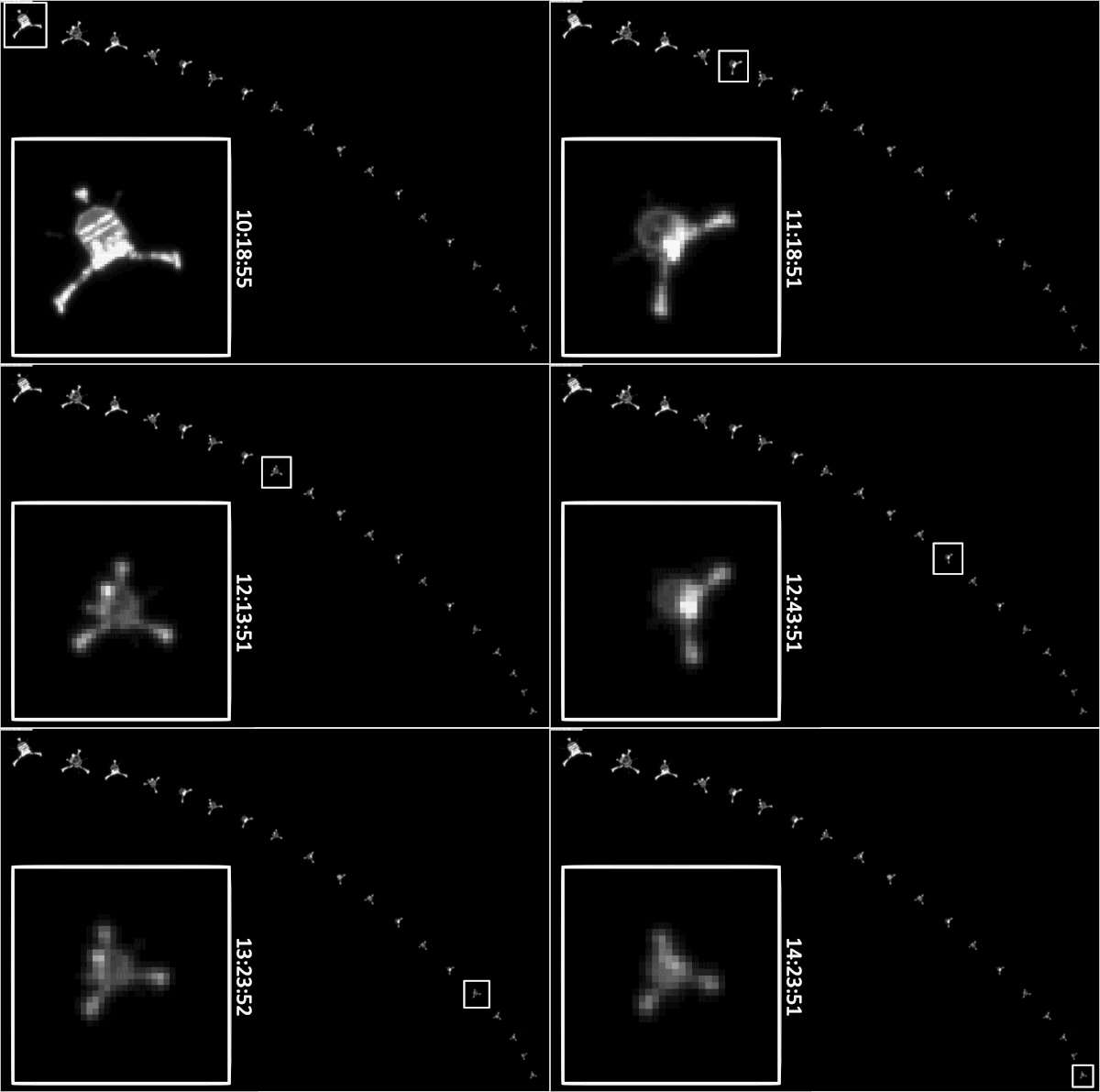
[Right] Series of 19 images captured by Rosetta’s OSIRIS camera as the Philae lander descended to the surface of Comet 67P/Churyumov–Gerasimenko on 12th November 2014. The timestamp marked on the images are in GMT (onboard spacecraft time). [Image: ESA for OSIRIS Team]
That was the day the Philae lander made history, becoming the first space probe to attempt a soft-landing on a comet. In the weak gravity of the 4-km-wide comet, the spacecraft bounced several times from its initial touchdown point, became lost and then went silent when its battery ran out. On 30th January ESA said it would call off further searches for the lander for the time being and wait for the lander to “call home.”
ESA had said in November it was likely the lander had finally touched down in the shadow of a cliff or other obstruction, somewhere it could not receive enough sunlight to re-power its battery. And yet all hope for the lander was not and is not lost. As the comet continues orbiting the sun, its seasons are subtly changing (much as Earth’s are), meaning the sun is continually shifting in the comet’s sky, eventually, hopefully, bringing more sunlight to the lander’s location.
ESA said it will begin listening in a few more weeks with the hope that communications with the lander can be re-established by May or June.
The left image is of the Philae lander, making its descent to Comet 67P/Churyumov–Gerasimenko above the Hatmehit crater on 12th November 2014.
Here the Philae Lander is seen against black space just off the comet’s surface (within the red crosshairs) during the first bounce after failing to land properly on the comet.
Philae Lander did eventually land in a still-unknown location on the comet after several bounces.
Philae, call home...
The European Space Agency identified where on the 4-kilometre-long comet Rosetta’s Philae space probe landed.
The Philae lander had a bumpy landing onto comet 67P/Churyumov-Gerasimenko on 12th November leaving space scientists scouring images of the surface by eye to find the precise landing spot.
After months of trawling through the data, the space agency identified a 350-metre by 30-metre landing strip where the probe was likely to be – a site called Abydos.
It’s tricky to spot the lander as that area of the comet is only illuminated for about 1.3 hours a day, and the Rosetta spacecraft had to be in the right position to capture it.
[Right] ESA narrowed the search down to this strip on 13th December 2014
“We’re looking – by eye – for a set of three spots that correspond to the lander,” says space scientist Holger Sierks. “The problem is that sets of three spots are very common all over the comet nucleus.”
A further issue about Philae’s landing spot was the lack of light – it was expected to get around 6.5 hours of sunlight per 12.4 hour comet day, which would mean that by March all of the electronic equipment would have fried under the intense heat.
However, with just 1.3 hours of light, the comet would need to be closer to the Sun in order to wake up – so the earliest it could wake up would be March, but it would take a while to generate enough power to re-establish a communications link with Rosetta.
The European Space Agency has decided to extend its Rosetta expedition to the Comet 67P/Churyumov-Gerasimenko by nine months, at which point the spacecraft will most likely be landed on the comet’s surface.
After a seven-month hibernation, the lander “woke up” on June 14.
Despite the hiccups, the mission has made a number of discoveries, including the revelation that most of Earth’s water likely came from asteroids and not comets.
Rosetta’s mission was due to end this December, but has now been extended until September 2016. The spacecraft and comet will make its closest approach to the Sun, known as its perihelion phase, around August 13 of the current year.
“This is fantastic news for science. We’ll be able to monitor the decline in the comet’s activity as we move away from the Sun again,” European Space Agency’s Matt Taylor said in a press statement. “By comparing detailed ‘before and after’ data, we’ll have a much better understanding of how comets evolve during their lifetimes.”
As the comet leaves the Sun, Rosetta will receive less and less solar energy for its electronics and its fuel propellant will start to peter out, making it harder to conduct experiments and control the spacecraft.
“The most logical way to end the mission is to set Rosetta down on the surface,” said Patrick Martin, Rosetta Mission Manager.
During its remaining time, the robotic explorer will conduct some riskier investigations, such as flying to the dark-side of the comet to observe its plasma, dust and gas interactions. Rosetta will also collect dust samples ejected near the centre of the comet.
“But there is still a lot to do to confirm that this end-of-mission scenario is possible,” Martin said. “We’ll first have to see what the status of the spacecraft is after perihelion and how well it is performing close to the comet, and later we will have to try and determine where on the surface we can have a touchdown.”
Scientists will need about three months to land the spacecraft. Once Rosetta lands on the comet, it is unlikely that Earth will ever hear from the spacecraft again, as the mechanical space cowboy rides the comet around the sun every six and half years.
And see this report of a sudden outburst from 69P just days before perihelion.
More photos from Rosetta (June 2015)
From the Daily Mail of 20th September 2015, Rosetta spacecraft captures dramatic changes happening on its comet’s surface and scientists are baffled.
Scientific American reported on 11th September 2015 that the Duck-Shaped Comet Confounds Astronomers, referring in detail to Comet 67P/Churyumov-Gerasimenko’s incongruous chemical composition and shape raising questions about the origin of our solar system.
The International Business Times reported on 30th October 2015 that Rosetta Detects Oxygen Older Than The Solar System At Comet 67P/Churyumov-Gerasimenko.
From Yahoo News, 3rd November 2015: Chances ‘fair’ for Philae contact: ground controllers.
This excellent summary of the status of Rosetta and comet 67P from Planetary.org is entitled A little science from Rosetta, beyond perihelion and was posted on 19th November 2015. It describes in detail much of what has been learned about the comet since it passed perihelion.
From Nature, 4th November 2015: Historic Rosetta mission to end with crash into comet in September 2016.
And from Spaceflight Now, 14th November 2015: ESA Plans for Rosetta’s Grand Finale on Comet 67P.
Comet 19P/Borrelly was discovered by Alphonse Borrelly during a routine search for comets at Marseilles, France on 28th December 1904. Spacecraft Deep Space 1 flew close by in 2001.
The Great Comet of 1861, also known as C/1861 J1 or Comet Tebbutt. Beyond this date, astrophotography began to capture great and major comets. [E. Weiß, Bilderatlas der Sternenwelt]
In 1973, skygazers were alerted to the early discovery of a comet called Kohoutek. At the distance at which it was discovered and its brightness, astronomers projected that this was going to be a “Comet of the Century”, perhaps a daylight comet, a once-in-a-lifetime event.
But Kohoutek fizzled. It really disappointed skygazers even though, for professional astronomers, the drawn-out observations of Kohoutek were quite valuable.
Because it came into the solar region on a hyperbolic orbit, it was thought to have been from the Oort cloud, its orbit perturbed by outer solar system objects. So this would have been its first encounter with the inner solar system, and therefore it should have been loaded with plenty of volatile material to give a fine display. But it became apparent that its orbit had been perturbed by one of the gas giant planets, and it was actually from the Kuiper Belt.
Astronomers thought they had learned a lesson from Kohoutek. Too many astronomers stood outdoors at public star parties that year, trying to show a disappointed public a difficult-to-see comet.
Unfortunately, the lesson learned from this comet led to astronomers to downplay the next contender for greatness, Comet West in 1976. That was too bad, because Comet West did not disappoint. It was a magnificent comet! Still, many average skygazers were left out because astronomers remained quiet and the media did not report. Comet West was not seen and appreciated as it should have been.
The years 1996–1997 were all about Hale–Bopp for comet fans. For weeks on end, Hale–Bopp was a fixture in the Northern Hemisphere western sky, and it probably became one of the most-viewed comets in history.
[Far left] An image was obtained on 27th February to 2nd March 2001 with the Wide-Field Imager (WFI) at the ESO La Silla Observatory. It shows that Comet Hale-Bopp is still active at a distance of about 2,000 million km from the Sun. It is also a very large object, measuring at least 2 million km across.
Nearly all comets have short periods of visibility. Hale–Bopp smashed the previous record for longevity in our skies, which had been held for nearly two centuries by the Great Comet of 1811. The 1811 comet remained visible to the unaided eye for 9 months. Hale–Bopp was visible for an historic 18 months.
Hale–Bopp was bright early on, nearly but not quite as bright as Venus. The size of its nucleus – the icy core of the comet, hurtling through space – was estimated to be 60 km±20 km. That makes Hale–Bopp’s nucleus some six times larger than the nucleus of Halley’s Comet and twenty times that of Rosetta’s comet, 67P/Churyumov–Gerasimenko.
Hale–Bopp had a long tail, up to 30° long, but what was visible and bright was relatively a short tail, less than 10° long, for nearly its entire period of visibility. Bright generally means as bright as Venus or brighter. Hale–Bopp was not quite that bright. Some great comets are visible in daylight, but Hale–Bopp was not.
Comet Hale–Bopp with its prominent dust (white) and plasma (blue) tails. Owing to its orbital inclination and modest perihelion, 0.95 AU, Hale–Bopp remained visible to the unaided eye for 18 months.
From Comet West, fast forward a full 31 years to 2007 and the next truly Great Comet (side-stepping Hale–Bopp). The comet hunter Robert H. McNaught – who has discovered more than 50 comets – discovered it. This 2007 comet is sometimes called the Great Comet of 2007. You’re in the Northern Hemisphere and don’t remember a Great Comet that year? That’s because, due to the inclination and high eccentricity of comet orbits, many are viewable from only one Earth hemisphere or the other. That was the case for Comet McNaught in 2007.
These two are easily confused because they have the same names (the same discoverer) and both appeared in the 2010s. Comet C/2011 W3 Lovejoy was described as the Great Comet of 2011, and Comet C/2014 Q2 Lovejoy was the rather spectacular recent comet of late 2014 and early 2015, made famous by the steady advances in digital astrophotography.
On the right Comet C/2014 Q2 Lovejoy streaks across the sky on 6th January 2015 in an image captured by photographer Alan Dyer. Photographs reveal a greenish glow to the comet’s coma, due to the presence of diatomic carbon and cyanogen. The comet was discovered the previous August by Australian amateur astronomer Terry Lovejoy.
Read about the close encounter between comet Siding Spring and the planet Mars.
Comet 26P/Grigg–Skjellerup is a periodic comet with a nucleus estimated to be 2.6 km in diameter.
It was discovered in 1902 by John Grigg of New Zealand, and rediscovered in its next appearance in 1922 by John Francis Skjellerup, an Australian then working in South Africa. In 1987, it was belatedly discovered by Ľubor Kresák that the comet had been observed in 1808 as well, by Jean-Louis Pons.
The comet has often suffered the gravitational influence of Jupiter, which has altered its orbit considerably. For instance, its perihelion distance has changed from 0.77 AU in 1725 to 0.89 AU in 1922 to 0.99 AU in 1977 and to 1.12 AU in 1999.
Having its recent perihelion so close to Earth’s orbit made it an easy target to reach for the Giotto mission in 1992, whose primary mission was to Halley’s Comet. It was visited by Giotto in July 1992 which came as close as 200 km, but could not take pictures because its camera was destroyed during the Comet Halley rendezvous in 1986.
In 1972 the comet was discovered to produce a meteor shower, the Pi Puppids, and its current orbit makes them peak around 23rd April for observers in the southern hemisphere, best seen when the comet is near perihelion. The 2002 return (expected perihelion around 8th October 2002) was very unfavourable and no observations were reported.
Comet Hartley 2 is a small comet with an orbital period of 6.46 years. It was discovered by Malcolm Hartley in 1986 at the Schmidt Telescope Unit, Siding Spring Observatory, Australia. Its perihelion (closest approach to the Sun) is near the Earth’s orbit at 1.05 AU from the Sun. After the 2010 perihelion passage, not accounting for nongravitational forces, Hartley 2 is expected to come back to perihelion around 20th April 2017.
Observation by the Spitzer Space Telescope in August 2008 showed the comet to have a low albedo (reflectiveness) of 0.028. The mass of the comet was estimated to be about 300 megatonnes (3.0×10¹¹ kg). Barring a catastrophic breakup, the comet should be able to survive up to 700 years at its current rate of mass loss.
The comet passed within 18 million km of Earth on 20th October 2010, only eight days before coming to perihelion. Radar observations by the Arecibo Observatory revealed that the nucleus is highly elongated and rotates over an 18-hour period. The project manager of the EPOXI mission described its shape as “a cross between a bowling pin and a pickle”. Hartley 2 is possibly a typical comet, not as well-known as Halley’s, for example. Usually it’s the big ones that we hear about, not the minnows like Hartley 2.
Hartley 2 was the target of a fly-by of the Deep Impact spacecraft on 4th November 2010, which was able to approach within 700 km. As of November 2010 Hartley 2 is the smallest comet which has been visited; it is the fifth comet visited by a spacecraft, and the second comet visited by the Deep Impact spacecraft, which first visited Comet Tempel 1.
The fly-by was able to show that the comet is 2.25 km long, and “peanut shaped”. Some jets of material are being ejected from the dark side of the comet, rather than the sunlit side. Scientists involved in the EPOXI mission describe the comet as being unusually active, with mission scientist Don Yeomans stating that “It’s hyperactive, small and feisty.”
Despite its current close passage by Earth’s orbit, the comet is not yet a known source of meteor showers. However, that could change. Dust trails from the recent returns of Hartley 2 move in and out of Earth’s orbit, and the 1979 dust trail is expected to hit in 2062 and 2068.
In 2011 the Herschel Space Observatory detected the signature of vaporized water in the comet’s coma (tail). Hartley 2 contains half as much heavy water (deuterium monoxide — water in which the hydrogen atoms have a neutron as well as a proton) as other comets analysed before, with the same ratio between heavy water and regular water as found in Earth’s oceans.
The EPOXI mission fly-by showed that the material being ejected from the comet is primarily composed of CO2 gas; the CO2 ice within the comet must be primordial, dating from the beginnings of the solar system. NASA’s scientists reported that the rays coming off the rough ends consist of hundreds of tons of fluffy ice and dust chunks — the largest particles are of golf ball to basketball-size — and they are ejected by jets of carbon dioxide. Michael A’Hearn, the science team leader for the EPOXI mission, stated “Early observations of the comet show that, for the first time, we may be able to connect activity to individual features on the nucleus”.
The key findings from the “EPOXI” mission include:
“Hartley 2 is a hyperactive little comet, spewing out more water than other comets its size. When warmed by the sun, dry ice (frozen carbon dioxide) deep in the comet’s body turns to gas jetting off the comet and dragging water ice with it”. It is now believed that some of the dust, icy chunks, and other material coming off the ends of the comet are moving slowly enough to be captured by even the weak gravity of the comet. This material then falls back into the lowest point — the middle.
C/2012 S1, also known as Comet ISON or Comet Nevski–Novichonok, is a sungrazing comet discovered on 21st September 2012. It had been forecast to be the “Comet of the Century” because of its brightness, but that turned out to be just press hype!
Ison’s nucleus was around 5 km (3 miles) in diameter. It came to perihelion (closest approach to the Sun) on 28th November 2013 at a distance of approximately 1,165,000 km (724,000 miles) above the Sun’s surface. Its trajectory was hyperbolic, suggesting that it was a dynamically new comet coming freshly from the Oort cloud. On its closest approach, the comet passed about 0.07248 AU (10,843,000 km, 6,737,000 miles) from Mars on 1st October 2013, and about 0.4292 AU (64,210,000 km, 39,900,000 miles) from Earth on 26th December 2013.
The heat and radiation of the Sun caused Ison to disintegrate, leaving a few small objects; Earth passed near the orbiting remnants of C/2012 S1 on 14th–15th January 2014, well after the comet has passed, at which time micron-sized dust particles blown by the Sun’s radiation may cause a meteor shower or noctilucent clouds. However, the chances that a meteor shower will occur are slim. The animation is of images from the SOHO (Solar and Heliospheric Observatory) spacecraft.
Comet Shoemaker–Levy 9 was a comet that broke apart and collided with Jupiter in July 1994, providing the first direct observation of an extraterrestrial collision of Solar System objects.
Comet Tempel 1 67 seconds after being hit by the Deep Impact probe in 2005.
In 2011 Tempel 1 was re-visited by the Stardust spacecraft.
Comet Encke (official designation: 2P/Encke) is a periodic comet that completes an orbit of the Sun once every 3.3 years, the shortest period of a reasonably bright comet. Encke was first recorded by Pierre Méchain in 1786, but it was not recognized as a periodic comet until 1819 when its orbit was computed by Johann Franz Encke; like Halley’s Comet, it is unusual in being named after the calculator of its orbit rather than its discoverer. Like most other comets, it has a very low albedo, reflecting only 4.6% of the light it receives. The diameter of its nucleus is 4.8 km.
Deep Impact observed Comet Garradd (C/2009 P1) from 20th February to 8th April 2012, using its Medium Resolution Instrument, through a variety of filters. The comet was 1.75–2.11 astronomical units (AU) (2.62–3.16×10⁸ km) from the Sun and 1.87–1.30 AU from the spacecraft. It was found that the outgassing from the comet varies with a period of 10.4 hours, which is presumed to be due to the rotation of its nucleus. The dry ice content of the comet was measured and found to be about ten percent of its water ice content by number of molecules.
The pattern of ten stars in the background of this photograph are called “The Coathanger”, because they look like an upside-down coat hanger. It’s in the faint constellation Vulpecula, the fox. For decades, astronomers thought those stars formed a cluster. A cluster’s stars are all the same age and the same distance, and they formed from the same ingredients. But some of the stars are small and light, while others are big and heavy. Seeing how the different weight classes have evolved helps astronomers understand how all stars age.
But a study in 1970 found that only a few of the Coathanger’s stars were related. And a later one, which used a satellite to plot the distances to stars with great precision, found that none of them were related – they just lined up in the same direction in the sky. So plotting the third dimension robbed the Coathanger of some of its scientific value – but none of its beauty.
Comet 81P/Wild, also known as Wild 2 (pronounced /'vɪlt/), is a comet named after Swiss astronomer Paul Wild, who discovered it on 6th January 1978, using a 40-cm Schmidt telescope at Zimmerwald. [The photograph was taken by K. Meech, 17th December 1990, at IFA University of Hawaii, using the 2.2m reflector telescope on Mauna Kea].
For most of its 4.5 billion-year lifetime, Wild 2 probably had a more distant and circular orbit. In September 1974, it passed within one million kilometres of the planet Jupiter, whose strong gravitational pull perturbed the comet’s orbit and brought it into the inner Solar System. Its orbital period changed from 43 years to about 6 years, and its perihelion is now about 1.59 AU.
Probably the most famous of all comets is Halley’s Comet, which appears in our skies roughly every 76 years.
The Halley Armada consisted of two Russian spacecraft (Vega 1 and 2), two Japanese spacecraft (Sakigake and Suisei), and the European Space Agency’s Giotto. The International Cometary Explorer observed Halley from a comfortable distance of more than 10 million kilometres, while the Japanese craft ventured within a million kms and the two Vega spacecraft came within 1000 km. Giotto came closest of all, so close that navigators were worried about damage to the spacecraft.
The probes involved (in order of closest approach) were:
Other space probes had their instruments examining Halley’s Comet:
Since the previous apparition, space travel has become a reality and solid-state electronics have revolutionized photography. Space probes have been sent to comets beginning with the European Space Agency Giotto spacecraft sweeping past Halley’s Comet in 1986, and, most recently, ESA’s Rosetta spacecraft at 67P/Churyumov–Gerasimenko.
And the transistor and sensitive solid-state detectors revolutionized astrophotography providing amateurs with observing capabilities far exceeding professionals prior to modern electronics.
Deep Impact (2005-001A) is a NASA space probe launched on 12th January 2005. It was designed to study the interior composition of the comet 9P/Tempel (“Tempel 1”), by releasing an impactor into the comet. At 5:52 UTC on 4th July 2005, the impactor successfully collided with the comet’s nucleus. The impact excavated debris from the interior of the nucleus, allowing photographs of the impact crater. The photographs showed the comet to be more dusty and less icy than had been expected. The impact generated a large and bright dust cloud, which unexpectedly obscured the view of the impact crater.
Deep Impact is now on an extended mission designated EPOXI (Extrasolar Planet Observation and Deep Impact Extended Investigation) to visit other comets, after being put to sleep in 2005 upon completion of the Tempel 1 mission.
[EPOXI is a hybrid acronym binding two science investigations: the Extrasolar Planet Observation and Characterization (EPOCh) and Deep Impact eXtended Investigation (DIXI). The spacecraft keeps its original name of Deep Impact, while the mission is called EPOXI.]
Deep Impact (2005-001A) was launched on 12th January 2005 at 18:47:08 UTC. On 4th July 2005 Deep Impact successfully flew by comet 9P/Tempel 1 and released its Impactor.
One day before to its fly-by of Tempel 1, Deep Impact released a 364-kilogram copper impactor onto a collision course with the comet. The impactor captured images all the way down to its 10.2 km/sec impact with Tempel 1. The fly-by spacecraft captured amazing views of the impact from a safe distance, and many large telescopes on Earth were also pointed at the comet.
Its mission was to continue, under the project name EPOXI to fly by comet 103P/Hartley 2. The fly-by of 103P/Hartley 2 was on 4th November 2010.
Since the end of its primary mission, Deep Impact’s blurred camera has been employed to study exoplanets (a project called the EPOXI mission), and the spacecraft has encountered its second comet, 103P/Hartley 2. The spacecraft is low on fuel but otherwise still functional and now being tested for future use as a deep-space astronomical observatory. It is currently targeted for a 2020 fly-by of asteroid (163249) 2002GT.
Earth fly-bys were on 31st December 2007 (gravity assist en route to encounter comet 103P/Hartley), December 2008 (gravity assist), June 2009 (distant fly-by), December 2009 (distant fly-by) and June 2010 (fly-by). On 25th November 2010 (redesignated EPOXI), it flew by comet 103P/Hartley, in a successful mission extension (the target having been changed from comet Boethin).
At the end of 2011, Deep Impact was redirected towards asteroid (163249) 2002GT which it would reach in January 2020. Whether or not a science mission will be carried out there will depend on the NASA budget and the health of the probe. A 71 sec. engine burn on 4th October 2012, changed the probe’s velocity by 2 m/s to keep the mission on track.
Deep Impact observed Comet Garradd (C/2009 P1) from 20th February to 8th April 2012 using its Medium Resolution Instrument, through a variety of filters. The comet was between 1.75 to 2.11 astronomical units (AU) from the sun and 1.87 to 1.30 AU from the spacecraft. It was found that the outgassing from the comet varies with a period of 10.4 hours, which is presumed to be due to the rotation of its nucleus. The dry ice content of the comet was measured and found to be about ten percent of its water ice content by number of molecules.
In February 2013, Deep Impact observed Comet C/2012 S1 (ISON) which will remain observable until March 2013.
Sakigake (1985-001A), launched on 7th January 1985 by the Institute of Space and Aeronautical Science (ISAS), flew by 1P/Halley (Halley’s comet) on 11th March 1986; it was a partially successful distant fly-by at a minimum distance of 6.99 million km. It then flew by the Earth three times, on 8th January 1992, 14th June 1993 and 28th October 1994 by which time it was out of fuel and telemetry contact was lost on 15th November 1995.
Sakigake (which means “Pioneer”) was a prototype spacecraft, equipped with instruments to measure plasma wave spectra, solar wind ions, and interplanetary magnetic fields. An extended mission was planned, including fly-bys of comet 45P/Honda-Mrkos-Pajdusakova in 1996 and comet 21P/Giacobini-Zinner in 1998.
Suisei (1985-073A), launched on 18th August 1985 by the Institute of Space and Aeronautical Science (ISAS), made a successful flyby of comet 1P/Halley (Halley’s comet) on 8th March 1986 at a distance of 151,000 km.
Suisei (which means “Comet”) was identical to Sakigake apart from its payload: an ultraviolet (UV) imaging system and a solar wind instrument. Suisei began UV observations in November 1985, generating up to 6 images per day. ISAS had decided during 1987 to guide Suisei to an encounter on 24th November 1998 with comet 21P/Giacobini-Zinner, but due to depletion of the hydrazine fuel by 22nd February 1991, this, as well as plans to fly within several million km of comet 55P/Tempel-Tuttle on 28th February 1998, were cancelled.
Giotto (1985-056A), launched on 2nd July 1985, flew by 1P/Halley (Halley’s comet) on 14th March 1986 at a minimum distance 596 km; it made a fly-by of the Earth on 2nd July 1990 en route to comet 26P/Grigg-Skjellerup which it flew by at a distance of 200 km on 10th July 1992. All experiments performed well and returned a wealth of new scientific results, of which perhaps the most important was the clear identification of the cometary nucleus. The mission ended on 23rd July 1992
CONTOUR (2002-034A) was launched on 3rd July 2002, at 6:47:41 UTC. It was launched into a high-apogee Earth orbit with a period of 5.5 days. Following a series of phasing orbits, the Star 30 solid rocket motor was used to perform an injection manoeuvre on 15th August 2002, to put CONTOUR into the proper trajectory for an Earth fly-by in August 2003 followed by an encounter with comet Encke on 12th November 2003, at a distance of 100 to 160 km and a flyby speed of 28.2 km/s, 1.07 AU from the Sun and 0.27 AU from Earth. During the August 2002 injection manoeuvre the probe was lost, when the spacecraft failed to contact Earth shortly after a scheduled firing of its main rocket motor. Investigation revealed that the spacecraft broke apart toward the end of the rocket motor firing.
It had as its primary objective close flybys of two comet nuclei with the possibility of a flyby of a third known comet or an as-yet-undiscovered comet. The three comets identified. The first was comet 2P/Encke in 2003. Three more Earth fly-bys would have been required, in August 2004, February 2005, and February 2006 before a rendezvous with comet 29P/Schwassmann-Wachmann-3 on 18th June 2006, at 14 km/s, 0.95 AU from the Sun and 0.33 AU from Earth. Two more Earth fly-bys were scheduled in February 2007 and 2008, and a fly-by of comet 6P/d’Arrest on 16th August 2008 at a relative velocity of 11.8 km/s, 1.35 AU from the Sun and 0.36 AU from Earth. It was hoped that a new comet would have been discovered in the inner solar system between 2006 and 2008, in which case the spacecraft trajectory would have been changed if possible to rendezvous with the new comet.
All comet fly-bys would have had a closest encounter distance of about 100 km and would have occurred near the period of maximum activity for each comet. After the comet Encke encounter, CONTOUR might have been redirected towards a new comet if one was discovered with the desired characteristics (e.g. active, brighter than absolute magnitude 10, perihelion within 1.5 AU).
Stardust (1999-003A), launched on 7th February 1999 flew by the Earth three times. The first, on 15th January 2001 was a gravity assist en route to a distant flyby of asteroid 5535 Annefrank (on 31st October 2002); it then continued on its main mission to comet 81P/Wild which it flew by on 2nd January 2004; it collected samples of dust and volatiles from the comet’s coma, and returned to the Earth for a second flyby and to drop-off the sample return capsule on 15th January 2006. The aerogel collector plates proved to be full of cometary material, surpassing the science team’s expectations. The third fly-by of the Earth on 14th January 2009, at a minimum distance of 9,200 km, sent it on a mission extension to Comet 9P/Tempel. The mission was redesignated NExT and flew by 9P/Tempel on 14th February 2011. Its propellant was exhausted by 24th March 2011.
As a public outreach effort, over 1 million names were collected and placed on the STARDUST spacecraft, which visited Comet Wild 2 in 2004. (See also here.)
What is the purpose of sending names into space?
Placing the names onto the STARDUST spacecraft was a public outreach effort. It allowed people to be personally involved with the STARDUST Mission and helps to promote public interest, awareness and support of the space program. It also provided a way to honour individuals by enabling them to be associated with mankind’s most advanced technological endeavour and to be part of the quest of the human species to reach for the stars.
Where are the microchips now?
The microchips are in outer space onboard the STARDUST spacecraft, and also back on Earth. STARDUST was launched on 7th February 1999 carrying the two sets of microchips. Two copies of each chip were installed on the spacecraft (for a total of four chips). One set of microchips is mounted inside the Sample Return Capsule, and was returned back to Earth with the capsule when it landed in Utah on 15th January 2006. The capsule along with the microchips have been transported to the curation facility at Johnson Space Center in Houston, Texas on 17th January 2006, where they currently reside. The other set of chips is mounted in the spacecraft body and will remain in space forever.
How were the names collected?
During the first name collection period in October-November 1997, the names were submitted to the Planetary Society who collected the names for us. The names were submitted by email, postcard or the Planetary Society home page. During the second name collection period, which ran from May 1998 to August 1998, the names were submitted via the Web on the STARDUST home page and the National Space Society home page.
How many names are on the microchips?
There are two microchips. The first one has 136,000 names and the second has over 1 million names.
Whose names are on the microchips?
The names on the microchips are from individuals who submitted their own names along with the names of friends and family if they chose to include them. Also, all members of the Planetary Society and the National Space Society current as of 1998 were included. In addition, as a special tribute, all names on the Vietnam War Memorial in Washington, DC were included. And finally, the names and selected photos of members of the STARDUST Mission team were also included.
Will the microchips remain in space or will they come back to Earth?
Both. Two copies of each microchip were made. One set will remain in space in the STARDUST spacecraft which will continue to orbit the Sun after the mission. The other set of chips will be returned to Earth in the Sample Return Capsule. Plans are to place the returned microchips in a major museum, most likely the Smithsonian Air & Space Museum in Washington, D.C.
How big are the microchips?
The names are electronically etched onto a fingernail-size silicon chip at JPL’s Micro Devices Lab. Writing on the microchip is so small that about 80 letters would equal the width of a human hair. Once inscribed, the names can be read with a strong optical microscope or an electron microscope.
Can you provide more details on how the names were engraved onto the microchips?
Sure. The process is rather technical, but we’ll give it a try. First, note that the microchip is not an a electronic part like a computer chip, but is actually a silicon wafer. The names are placed onto the wafer chip through a technique called Electron Beam Lithography. The wafer is 4 inches square initially and comes with a layer of silicon oxide on its surface. The wafer is coated with a thin photographic film of photo-resist PMMA (pexiglass). The names are stored on a VAX computer and converted into a format usable by the electron beam lithography tool. The data is read and fed into the electron beam tool which engraves the names into the PMMA surface of the wafer chip using a highly-focused electron beam. The names can be written multiple times to the wafer if we want to make multiple copies of the small microchip. The wafer then goes through a process similar to developing film, where the wafer is rinsed in a developer that removes exposed PMMA (or the area written on by the electron beam). The next step is to coat the wafer with a thin metal film (titanium & platinum). This is done by placing it in a vacuum chamber and heating a small amount of the metal, which evaporates and coats the wafer by condensing on it. The wafer chip is then placed in a solvent which dissolves away the remaining PPMA and any metal attached to it, leaving behind the letters of the names. Finally, the wafer is cut up into 1×1 centimetre-sized square chips.
Edward L. G. “Ted” Bowell, born in 1943 in London, is an American astronomer, educated at Emanuel School London, University College, London, and the Université de Paris. He was principal investigator of the Lowell Observatory Near-Earth-Object Search (LONEOS). He has discovered a large number of asteroids (572), both as part of LONEOS and in his own right before LONEOS began. Among the latter is the asteroid 3208 Lunn. He also co-discovered the periodic comet 140P/Bowell-Skiff and the non-periodic comet C/1980 E1.
As a public outreach effort, over 1 million names were collected and placed on the STARDUST spacecraft, which visited Comet Wild 2 in 2004.
Deep Space 1 (1998-061A) was launched on 24th October 1998 at 12:08:00 UTC; it was a demonstration probe designed to test new technologies such as ion propulsion. It flew within 15 km of asteroid 9969 Braille on 29th July 1999; it was only a partial success because there were no close-up images due to camera pointing error. The probe continued to a successful flyby of comet 19P/Borrelly on 22nd September 2001, flying within 2,200 km of the comet, providing the most detailed images of a comet’s nucleus yet seen. Its engine was shut down on 18th December 2001. However, the spacecraft could, in theory, be re-contacted and returned to service, as ICE was.
This artist’s impression shows exocomets orbiting the star Beta Pictoris. [Image: ESO/L. Calçada] More information from Astronomy Now
The HARPS instrument at ESO’s La Silla Observatory in Chile has been used to make the most complete census of comets around another star ever created. A French team of astronomers has studied nearly 500 individual comets orbiting the star Beta Pictoris and has discovered that they belong to two distinct families of exocomets: old exocomets that have made multiple passages near the star, and younger exocomets that probably came from the recent breakup of one or more larger objects.
Beta Pictoris is a young star located about 63 light-years from the Sun. It is only about 20 million years old and is surrounded by a huge disc of material – a very active young planetary system where gas and dust are produced by the evaporation of comets and the collisions of asteroids.
Flavien Kiefer (IAP/CNRS/UPMC), lead author of the new study sets the scene said “Beta Pictoris is a very exciting target! The detailed observations of its exocomets give us clues to help understand what processes occur in this kind of young planetary system.”
For almost 30 years astronomers have seen subtle changes in the light from Beta Pictoris that were thought to be caused by the passage of comets in front of the star itself. Comets are small bodies of a few kilometres in size, but they are rich in ices, which evaporate when they approach their star, producing gigantic tails of gas and dust that can absorb some of the light passing through them. The dim light from the exocomets is swamped by the light of the brilliant star so they cannot be imaged directly from Earth.
To study the Beta Pictoris exocomets, the team analysed more than 1000 observations obtained between 2003 and 2011 with the HARPS instrument on the ESO 3.6-metre telescope at the La Silla Observatory in Chile.
The researchers selected a sample of 493 different exocomets. Some exocomets were observed several times and for a few hours. Careful analysis provided measurements of the speed and the size of the gas clouds. Some of the orbital properties of each of these exocomets, such as the shape and the orientation of the orbit and the distance to the star, could also be deduced.
This analysis of several hundreds of exocomets in a single exo-planetary system is unique. It revealed the presence of two distinct families of exocomets: one family of old exocomets whose orbits are controlled by a massive planet, and another family, probably arising from the recent breakdown of one or a few bigger objects. Different families of comets also exist in the Solar System.
The exocomets of the first family have a variety of orbits and show a rather weak activity with low production rates of gas and dust. This suggests that these comets have exhausted their supplies of ices during their multiple passages close to Beta Pictoris.
The exocomets of the second family are much more active and are also on nearly identical orbits. This suggests that the members of the second family all arise from the same origin, probably the breakdown of a larger object whose fragments are on an orbit grazing the star Beta Pictoris.
Flavien Kiefer concludes: “For the first time a statistical study has determined the physics and orbits for a large number of exocomets. This work provides a remarkable look at the mechanisms that were at work in the Solar System just after its formation 4.5 billion years ago”.
From dark clear sites on Earth, zodiacal light looks like a faint diffuse white glow seen in the night sky after the end of twilight, or before dawn. It is created by sunlight reflected off tiny particles and appears to extend up from the vicinity of the Sun. This reflected light is not just observed from Earth but can be observed from everywhere in the Solar System.
Nesvorny and Jenniskens (2010 Astrophysical Journal) attributed 85% of the Zodiacal Light dust to fragmentations of Jupiter-family comets, rather than from comets and collisions between asteroids in the asteroid belt. It was once thought that collisions of asteroids produce a fine dust that forms a major component of the zodiacal light.
This artist’s view from an imagined planet around a nearby star shows the brilliant glow of exozodiacal light extending up into the sky and swamping the Milky Way.
[Image: ESO/L. Calçada] More from Astronomy Now
Using the Very Large Telescope Interferometer (VLTI) in near-infrared light, an international team of astronomers observed 92 nearby stars to probe exozodiacal light from hot dust close to their habitable zones and combined the new data with earlier observations. Bright exozodiacal light, created by the glowing grains of hot exozodiacal dust, or the reflection of starlight off these grains, was observed around nine of the targeted stars. This light is starlight reflected from dust created as the result of collisions between asteroids, and the evaporation of comets. The presence of such large amounts of dust in the inner regions around some stars may pose an obstacle to the direct imaging of Earth-like planets in the future.
The glow being observed in this new study is a much more extreme version of the phenomenon in the Solar system. While this exozodiacal light – zodiacal light around other star systems – had been previously detected, this is the first large systematic study of this phenomenon around nearby stars.
In contrast to earlier observations the team did not observe dust that will later form into planets, but dust created in collisions between small planets of a few kilometres in size – objects called planetesimals that are similar to the asteroids and comets of the Solar System. Dust of this kind is also the origin of the zodiacal light in the Solar System. “If we want to study the evolution of Earth-like planets close to the habitable zone, we need to observe the zodiacal dust in this region around other stars,” said Steve Ertel, lead author of the paper, from ESO and the University of Grenoble in France. “Detecting and characterising this kind of dust around other stars is a way to study the architecture and evolution of planetary systems.”
Detecting faint dust close to the dazzling central star requires high resolution observations with high contrast. Interferometry – combining light collected at the exact same time at several different telescopes – performed in infrared light is, so far, the only technique that allows this kind of system to be discovered and studied. By using the power of the VLTI and pushing the instrument to its limits in terms of accuracy and efficiency, the team was able to reach a performance level about ten times better than other available instruments in the world. For each of the stars the team used the 1.8-metre Auxiliary Telescopes to feed light to the VLTI. Where strong exozodiacal light was present they were able to fully resolve the extended discs of dust, and separate their faint glow from the dominant light of the star.
By analysing the properties of the stars surrounded by a disc of exozodiacal dust, the team found that most of the dust was detected around older stars. This result was very surprising and raises some questions for our understanding of planetary systems. Any known dust production caused by collisions of planetesimals should diminish over time, as the number of planetesimals is reduced as they are destroyed. The sample of observed objects also included 14 stars for which the detection of exoplanets has been reported. All of these planets are in the same region of the system as the dust in the systems showing exozodiacal light. The presence of exozodiacal light in systems with planets may create a problem for further astronomical studies of exoplanets.
Exozodiacal dust emission, even at low levels, makes it significantly harder to detect Earth-like planets with direct imaging. The exozodiacal light detected in this survey is a factor of 1000 times brighter than the zodiacal light seen around the Sun. The number of stars containing zodiacal light at the level of the Solar System is most likely much higher than the numbers found in the survey. These observations are therefore only a first step towards more detailed studies of exozodiacal light. “The high detection rate found at this bright level suggests that there must be a significant number of systems containing fainter dust, undetectable in our survey, but still much brighter than the Solar System’s zodiacal dust,” explains Olivier Absil, co-author of the paper, from the University of Liège.