
Loading...
Loading...
This page includes the Nice Model, the Late Heavy Bombardment, the Giant Impact Hypothesis, and the Accretion disc, and some forces – the Yarkovsky Effect, the Poynting-Robertson Effect and Scale Relativity.
Objects within the Solar System (Sun, Planets, Moons, etc.) are on separate pages (inner solar system and outer solar system), as are Stars, Nebulae and Galaxies.
Finally we take a look at some laboratory simulations that are looking for the precursors of life and the rôle of meteorites in the formation of the solar system.
The Nice model is a scenario for the dynamical evolution of the Solar System. It is named for the location of the Observatoire de la Côte d’Azur, where it was initially developed, in Nice, France. It proposes the migration of the giant planets from an initial compact configuration into their present positions, long after the dissipation of the initial protoplanetary gas disk. In this way, it differs from earlier models of the Solar System’s formation. This planetary migration is used in dynamical simulations of the Solar System to explain historical events including the Late Heavy Bombardment of the inner Solar System, the formation of the Oort cloud, and the existence of populations of small Solar System bodies including the Kuiper belt, the Neptune and Jupiter Trojans, and the numerous resonant trans-Neptunian objects dominated by Neptune. Its success at reproducing many of the observed features of the Solar System means that it is presently widely accepted as the current most realistic model of the Solar System’s early evolution, though it is not universally favoured among planetary scientists. One of its limitations is reproducing the outer-system satellites and the Kuiper belt (see below).
The original core of the Nice model is a triplet of papers published in the general science journal Nature in 2005 by an international collaboration of scientists: R Gomes, Hal Levison, Alessandro Morbidelli and Kleomenis Tsiganis. In these publications, the four authors proposed that after the dissipation of the gas and dust of the primordial Solar System disk, the four giant planets (Jupiter, Saturn, Uranus and Neptune) were originally found on near-circular orbits between about 5.5 and 17 astronomical units (AU), much more closely spaced and more compact than in the present. A large, dense disk of small, rock and ice planetesimals, their total about 35 Earth masses, extended from the orbit of the outermost giant planet to some 35 AU.
Scientists understand so little about the formation of Uranus and Neptune that Levison states, “...the possibilities concerning the formation of Uranus and Neptune are almost endless”. However, it is suggested that this planetary system evolved in the following manner. Planetesimals at the disk’s inner edge occasionally pass through gravitational encounters with the outermost giant planet, which change the planetesimals’ orbits. The planets scatter inwards the majority of the small icy bodies that they encounter, exchanging angular momentum with the scattered objects so that the planets move outwards in response, preserving the angular momentum of the system. These planetesimals then similarly scatter off the next planet they encounter, successively moving the orbits of Uranus, Neptune, and Saturn outwards. Despite the minute movement each exchange of momentum can produce, cumulatively these planetesimal encounters shift (migrate) the orbits of the planets by significant amounts. This process continues until the planetesimals interact with the inmost and most massive giant planet, Jupiter, whose immense gravity sends them into highly elliptical orbits or even ejects them outright from the Solar System. This, in contrast, causes Jupiter to move slightly inward.
The low rate of orbital encounters governs the rate at which planetesimals are lost from the disk, and the corresponding rate of migration. After several hundreds of millions of years of slow, gradual migration, Jupiter and Saturn, the two inmost giant planets, cross their mutual 1:2 mean-motion resonance. This resonance increases their orbital eccentricities, destabilizing the entire planetary system. The arrangement of the giant planets alters quickly and dramatically. Jupiter shifts Saturn out towards its present position, and this relocation causes mutual gravitational encounters between Saturn and the two ice giants, which propel Neptune and Uranus onto much more eccentric orbits. These ice giants then plough into the planetesimal disk, scattering tens of thousands of planetesimals from their formerly stable orbits in the outer Solar System. This disruption almost entirely scatters the primordial disk, removing 99% of its mass, a scenario which explains the modern-day absence of a dense trans-Neptunian population. Some of the planetesimals are thrown into the inner Solar System, producing a sudden influx of impacts on the terrestrial planets: the Late Heavy Bombardment.
Eventually, the giant planets reach their current orbital semi-major axes, and dynamical friction with the remaining planetesimal disc damps their eccentricities and makes the orbits of Uranus and Neptune circular again.
In some 50% of the initial models of Tsiganis et al., Neptune and Uranus also exchange places about a billion years (20%) into the life of the Solar System. However, the results only correspond to an even mass distribution in the protoplanetary disk, and match the masses of the planets, if the switch did take place.
Running dynamical models of the Solar System with different initial conditions for the simulated length of the history of the Solar System will produce the various populations of objects within the Solar System. As the initial conditions of the model are allowed to vary, each population will be more or less numerous, and will have particular orbital properties. Proving a model of the evolution of the early Solar System is difficult, since the evolution cannot be directly observed. However, the success of any dynamical model can be judged by comparing the population predictions from the simulations to astronomical observations of these populations. At the present time, computer models of the Solar System that are begun with the initial conditions of the Nice scenario best match many aspects of the observed Solar System.
The crater record on the Moon and on the terrestrial planets is part of the main evidence for the Late Heavy Bombardment (LHB): an intensification in the number of impactors, at about 600 million years after the Solar System’s formation. The number of planetesimals that would reach the Moon in the Nice model is consistent with the crater record from the LHB. See Late Heavy Bombardment.
During the period of orbital disruption following Jupiter and Saturn reaching the 2:1 resonance, the combined gravitational influence of the migrating giant planets would have quickly destabilized any pre-existing Trojan groups in the L4 and L5 Lagrange points of Jupiter and Neptune. During this time, the Trojan co-orbital region is termed “dynamically open”. Under the Nice model, the planetesimals leaving the disrupted disk cross this region in large numbers, temporarily inhabiting it. After the period of orbital instability ends, the Trojan region is “dynamically closed”, capturing planetesimals present at the time. The present Trojan populations are then these acquired scattered planetesimals of the primordial asteroid belt. This simulated population matches the libration angle, eccentricity and the large inclinations of the orbits of the Jupiter Trojans. Their inclinations had not previously been understood. See Lagrangian Points and Trojan Asteroids.
This mechanism of the Nice model similarly generates the Neptune trojans.
A large number of planetesimals would have also been captured in the outer asteroid belt, at distances greater than 2.6 AU, and in the region of the Hilda family. These captured objects would then have undergone collisional erosion, grinding the population away into smaller fragments that can then be acted on by the solar wind and YORP effect; removing more than 90% of them according to Bottke et al. The size frequency distribution of this simulated population following this erosion are in excellent agreement with observations. This suggests that the Jupiter Trojans, Hildas and some of the outer asteroid belt, all spectral D-type asteroids, are the remnant planetesimals from this capture and erosion process, possibly also including the dwarf planet Ceres.
Any original populations of irregular satellites captured by traditional mechanisms, such as drag or impacts from the accretion disks, would be lost during the interactions of the planets at the time of global system instability. In the Nice model, large numbers of planetesimals interact with the outer planets at this time, and some are captured during three-way interactions with those planets. The probability for any planetesimal to be captured by an ice giant is relatively high, a few times 10−7. These new satellites could be captured at almost any angle, so unlike the regular satellites of Saturn, Uranus and Neptune, they do not necessarily orbit in the planets’ equatorial planes. Triton, the largest moon of Neptune, can be explained if it was captured in a three-body interaction involving the disruption of a binary planetoid, of which Triton was the less massive member (Cuk and Gladman, 2005). However, such binary disruption would not in general have supplied the large number of small irregulars. Some irregulars may have even been exchanged between planets.
The resulting irregular orbits match well with the observed populations’ semimajor axes, inclinations and eccentricities, but not with their size distribution. Subsequent collisions between these captured satellites may have created the suspected collisional families seen today. These collisions are also required to erode the population to the present size distribution.
There would not have been enough interactions with Jupiter in the simulations to explain Jupiter’s retinue of irregulars, suggesting either that a second mechanism was at work for that planet, or that the parameters of the Nice model need to be revised.
The migration of the outer planets is also necessary to account for the existence and properties of the Solar System’s outermost regions. Originally, the Kuiper belt was much denser and closer to the Sun, with an outer edge at approximately 30 AU. Its inner edge would have been just beyond the orbits of Uranus and Neptune, which were in turn far closer to the Sun when they formed (most likely in the range of 15 to 20 AU), and in opposite locations, with Uranus farther from the Sun than Neptune.
Some of the scattered objects, including Pluto, became gravitationally tied to Neptune’s orbit, forcing them into mean-motion resonances. The Nice model is favoured for its ability to explain the occupancy of current orbital resonances in the Kuiper belt, particularly the 2:5 resonance. As Neptune migrated outward, it approached the objects in the proto-Kuiper belt, capturing some of them into resonances and sending others into chaotic orbits. The objects in the scattered disc are believed to have been placed in their current positions by interactions with Neptune’s migrating resonances.
However, the Nice model still fails to account for some of the characteristics of the distribution. While it is able to produce both the hot population objects in the Kuiper belt that have highly inclined orbits and the low-inclination cold population, it predicts a greater average eccentricity in classical Kuiper belt object orbits than is observed (0.10 to 0.13 versus 0.07).
The two populations not only possess different orbits, but different colours; the cold population is markedly redder than the hot, suggesting it has a different composition and formed in a different region. The hot population is believed to have formed nearer to Jupiter, and to have been ejected outward by movements among the gas giants. The cold population, on the other hand, has been proposed to have formed more or less in its current position, although the Nice model can also explain it being swept outwards later by Neptune during its migration, given that Neptune’s orbit would have temporarily become more eccentric. The Nice model can partially explain the colour difference in that the cold population would still have originated at a greater distance from the Sun than the hot population. However, it cannot explain the apparent complete absence of grey objects in the cold population; a suggestion that has been made is that colour differences may arise at least in part from surface evolution processes rather than entirely from differences in primordial composition.
It is also difficult for the model to explain the frequency of paired objects, many of which are far apart and loosely bound.
Those objects scattered by Jupiter into highly elliptical orbits formed the Oort cloud; those objects scattered to a lesser degree by the migrating Neptune formed the current Kuiper belt and scattered disc.
The giant impact hypothesis states that the Moon was formed out of the debris left over from a collision between the Earth and a body the size of Mars, approximately four and a half billion years ago. The colliding body is sometimes called Theia, after the mythical Greek Titan who was the mother of Selene, the goddess of the Moon.
The giant impact hypothesis is the currently-favoured scientific hypothesis for the formation of the Moon. Supporting evidence includes: the identical direction of the Earth’s spin and the Moon’s orbit, Moon samples that indicate the surface of the Moon was once molten, the Moon’s relatively small iron core, lower density compared to the Earth, evidence of similar collisions in other star systems (that result in debris disks), and that giant collisions are consistent with the leading theories of the formation of the solar system. Finally, the stable isotope ratios of lunar and terrestrial rock are identical, implying a common origin.
There remain several questions concerning the best current models of the giant impact hypothesis, however. The energy of such a giant impact is predicted to heat Earth to produce a global ‘ocean’ of magma; yet there is no evidence of the resultant planetary differentiation of the heavier material sinking into Earth’s mantle. At present, there is no self-consistent model that starts with the giant impact event and follows the evolution of the debris into a single moon. Other remaining questions include: when did the Moon lose its share of volatile elements; and why Venus, which also experienced giant impacts during its formation, does not host a similar moon.
In 1898, George Darwin made the suggestion that the Earth and Moon had once been one body. Darwin’s hypothesis was that a molten Moon had been spun from the Earth because of centrifugal forces, and this became the dominant academic explanation. Using Newtonian mechanics, he calculated that the Moon had orbited much more closely in the past and was drifting away from the Earth. This drifting was later confirmed by American and Soviet experiments, using laser ranging targets placed on the Moon.
Nonetheless, Darwin’s calculations could not resolve the mechanics required to trace the Moon backward to the surface of the Earth. In 1946, Reginald Aldworth Daly of Harvard University challenged Darwin’s explanation, adjusting it to postulate that the creation of the Moon was caused by an impact rather than centrifugal forces. Little attention was paid to Professor Daly’s challenge until a conference on satellites in 1974, during which the idea was reintroduced and later published and discussed in Icarus in 1975 by Drs William K Hartmann and Donald R Davis. Their models suggested that, at the end of the planet formation period, several satellite-sized bodies had formed that could collide with the planets or be captured. They proposed that one of these objects may have collided with the Earth, ejecting refractory, volatile-poor dust that could coalesce to form the Moon. This collision could potentially explain the unique geological and geochemical properties of the Moon.
A similar approach was taken by Canadian astronomer Alastair G W Cameron and American astronomer William R Ward, who suggested that the Moon was formed by the tangential impact upon Earth of a body the size of Mars. It is hypothesized that most of the outer silicates of the colliding body would be vapourized, whereas a metallic core would not. Hence, most of the collisional material sent into orbit would consist of silicates, leaving the coalescing Moon deficient in iron. The more volatile materials that were emitted during the collision probably would escape the Solar System, whereas, silicates would tend to coalesce.
Astronomers think the collision between Earth and Theia happened approximately 4.53 billion years ago, about 30 to 50 million years after the Solar System began to form. In astronomical terms, the impact would have been of moderate velocity. Theia is thought to have struck the Earth at an oblique angle when the latter was nearly fully formed. Computer simulations of this “late-impact” scenario suggest an impact angle of about 45° and an initial impactor velocity below 4 km/s. Theia’s iron core would have sunk into the young Earth’s core, and most of Theia’s mantle accreted onto the Earth’s mantle, however, a significant portion of the mantle material from both Theia and the Earth would have been ejected into orbit around the Earth. This material quickly coalesced into the Moon (possibly within less than a month, but in no more than a century). Estimates based on computer simulations of such an event suggest that some twenty percent of the original mass of Theia would have ended up as an orbiting ring of debris, and about half of this matter coalesced into the Moon.
The Earth would have gained significant amounts of angular momentum and mass from such a collision. Regardless of the speed and tilt of the Earth’s rotation before the impact, it would have experienced a day some five hours long after the impact, and the Earth’s equator and the Moon’s orbit would have become coplanar in the aftermath of the giant impact.
Not all of the ring material would have necessarily been swept up right away; the thickened crust of the far side of the Moon suggests that a second moon about 1,000 km in diameter formed at a Lagrange point of the Moon; after tens of millions of years, as the two moons migrated outward from the Earth, solar tidal effects would have made the Lagrange orbit unstable, resulting in a slow-velocity collision that would have ‘pancaked’ the smaller moon onto what is now the far side of the larger.
In 2001, a team at the Carnegie Institute of Washington reported the most precise measurement of the isotopic signatures of lunar rocks. To their surprise, the team found that the rocks from the Apollo program carried an isotopic signature that was identical with rocks from Earth, and were different from almost all other bodies in the Solar System. Since most of the material that went into orbit to form the Moon was thought to come from Theia, this observation was unexpected. In 2007, researchers from the California Institute of Technology showed that the likelihood of Theia having an identical isotopic signature as the Earth was very small (less than 1 percent). Instead, they proposed that in the aftermath of the giant impact, while the Earth and the proto-lunar disk were molten and vapourized, the two reservoirs were connected by a common silicate vapour atmosphere, and that the Earth–Moon system became homogenized by convective stirring while the system existed in the form of a continuous fluid. Such an “equilibration” between the post-impact Earth and the proto-lunar disk is the only scenario capable of explaining the isotopic similarities of the Apollo rocks with rocks from the Earth’s interior. For this scenario to be viable, however, the proto-lunar disk must have existed for a time period of about 100 years. Work is ongoing to determine whether or not this is possible.
Indirect evidence for the giant impact scenario comes from rocks collected during the Apollo Moon landings, which show oxygen isotope ratios identical to those of Earth, which can be explained if the Earth–Moon system experienced turbulent mixing in the aftermath of the giant impact, as discussed above. In addition, the highly anorthositic composition of the lunar crust, as well as the existence of KREEP-rich samples, gave rise to the idea that a large portion of the Moon once was molten, and a giant impact scenario could easily have supplied the energy needed to form such a magma ocean. (KREEP is an acronym: K (the atomic symbol for potassium), REE (Rare Earth Elements) and P (phosphorus) and is a geochemical component of some lunar impact breccia and basaltic rocks. Its most significant feature is somewhat enhanced concentration of a majority of so-called “incompatible” elements (those that are concentrated in the liquid phase during magma crystallization) and the heat-producing elements, namely radioactive uranium, thorium, and potassium (due to presence of the radioactive 40K).)
Thorium concentrations on the Moon, as mapped by Lunar Prospector. Thorium indicates the location of KREEP.
Several lines of evidence show that if the Moon has an iron-rich core, it must be a small one. In particular, the mean density, moment of inertia, rotational signature, and magnetic induction response all suggest that the radius of the core is less than about 25% the radius of the Moon, in contrast to about 50% for most of the other terrestrial bodies. Impact conditions can be found that give rise to a Moon that formed mostly from the mantles of the Earth and impactor, with the core of the impactor accreting to the Earth, and which satisfy the angular momentum constraints of the Earth–Moon system.
Comparison of the zinc isotopic composition of lunar samples with that of Earth and Mars rocks has provided further evidence for the impact hypothesis. Zinc is strongly fractionated when volatilized in planetary rocks, but not during normal igneous processes; so the zinc abundance and isotopic composition can distinguish the two geological processes. Moon rocks contain more heavy isotopes of zinc and overall less zinc than corresponding igneous Earth or Mars rocks: this is consistent with zinc being depleted from the Moon through evaporation, as expected for the giant impact origin.
Warm silica-rich dust and abundant SiO gas, products of high velocity (greater than 10 km/s) impacts between rocky bodies, have been detected around the nearby young (around 12 million-year-old) Beta Pictoris Moving Group star HD172555, (a white-hot A5V star located 95 light years from Earth in the direction of the constellation Pavo) by the Spitzer Space Telescope. A belt of warm dust in a zone between 0.25 AU and 2 AU from the young star HD23514 in the Pleiades cluster appears similar to the predicted results of Theia’s collision with the embryonic Earth, and has been interpreted as the result of planet-sized objects colliding with each other. This is similar to another belt of warm dust detected around the star, BD +20°307 (HIP 8920, SAO 75016).
This lunar origin hypothesis has some difficulties that have yet to be fully resolved. For example, the giant impact hypothesis implies that a surface magma ocean would have formed following the impact. Yet there is no evidence that the Earth ever had such a magma ocean and it is likely there exists material that has never been processed by a magma ocean.
There are a number of compositional inconsistencies that need to be addressed.
If Earth’s moon formed by such an impact, it is likely that other inner planets also would have been subjected to comparable impacts. A moon that formed around Venus by this process would have been unlikely to escape, so an explanation is needed to show why the planet does not have such a moon. One possibility is that a second collision occurred that countered the angular momentum from the first impact. Another is that the strong tidal forces from the Sun would tend to destabilize the orbits of moons around close-in planets. For this reason, if Venus’s slow rotation rate began early in its history, any satellites larger than a few kilometres in size would likely have spiralled into the planet.
Simulations of the chaotic period of terrestrial planet formation suggest that impacts, such as those hypothesized to form the Moon, are common. For typical terrestrial planets with a mass of 0.5 to 1 Earth masses, such an impact typically results in a single moon containing 4% of the host planet’s mass. The inclination of this moon’s orbit is random, but this tilt affects the subsequent dynamic evolution of the system. For example, some orbits may cause the moon to spiral back into the planet. Likewise, the proximity of the planet to the star also will affect the orbital evolution. The net effect is that it is more likely for impact-generated moons to survive when they orbit more distant terrestrial planets and to be aligned with the planetary orbit.
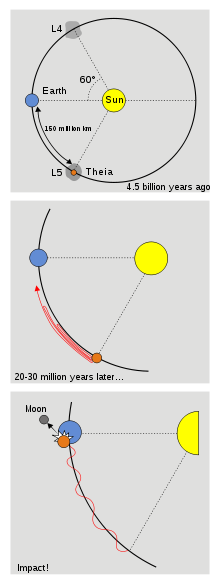
One suggested pathway for the Big Splash as viewed from the direction of the south pole
The Giant impact hypothesis does not explain well the similar composition of Earth and the Moon. Especially, the indistinguishable relation of oxygen isotopes cannot be explained by the classical form of this hypothesis. According to research on the subject that is based on new simulations at the ETH Zürich by physicist Andreas Reufer and his colleagues, Theia collided directly with Earth instead of barely swiping it. The collision speed may have been higher than originally assumed, and this higher velocity may have totally destroyed Theia. According to this modification, the composition of Theia is not so restricted, making also a composition of up to 50% water ice possible.
Other mechanisms that have been suggested at various times for the Moon’s origin are that the Moon was spun off from the Earth’s molten surface by centrifugal force; that it was formed elsewhere and was subsequently captured by the Earth’s gravitational field; or that the Earth and the Moon formed at the same time and place from the same accretion disk. None of these hypotheses can account for the high angular momentum of the Earth–Moon system.
Another hypothesis attributes the formation of the Moon to the impact of a large asteroid with the Earth much later than previously thought, creating the satellite primarily from debris from Earth. In this hypothesis, the formation of the Moon occurs 60 to 140 million years after the formation of the Solar System. Previously, the age of the Moon had been thought to be 4.527±0.010 billion years. The impact in this scenario would have created a magma ocean on Earth and the proto-Moon with both bodies sharing a common plasma metal vapour atmosphere. The shared metal vapour bridge would have allowed material from the Earth and proto-Moon to exchange and equilibrate into a more common composition.
Yet another hypothesis proposes that the Moon and the Earth were created together instead of separately like the Giant Impact hypothesis suggests. The new model, developed by Robin M Canup, suggests that the Moon and the Earth were created as a part of a massive collision of two planetary bodies, each larger than Mars, which then re-collided to form what we now call Earth. After the re-collision, Earth was surrounded by a disk of material, which combined to form the Moon. This hypothesis could explain facts which others do not.
Laboratory simulations of interstellar ices have revealed two sugar-like molecules that if found in comets, asteroids, even meteorites could support the theory that comets delivered the ingredients of life to primordial Earth. The European Space Agency’s Rosetta mission may have a new set of primordial chemicals to hunt for as the spacecraft scrutinizes comet 67P/Churyumov-Gerasimenko.
A team of chemists from France and Mexico has reported finding what it says is the first evidence for a range of organic molecules known as aldehydes in the residue of lab-made ices. These ices were designed to simulate those found in the clouds of gas, dust, and ices between stars. Of particular interest are a pair of sugar-like aldehydes found in some of the residue. These aldehydes are known to be important actors in the formation of DNA, which carries an organism’s genetic information, and of RNA. RNA plays a number of important biological roles, including servicing the production of proteins in cells.
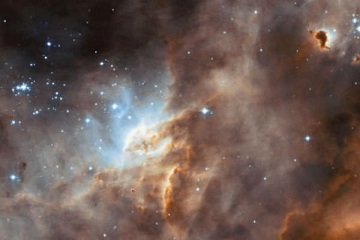
NASA’s Hubble Space Telescope captured the iridescent tapestry of star birth in a neighbouring galaxy in this panoramic view of glowing gas, dark dust clouds, and young, hot stars, in an image released in 2004
Six of the ten aldehydes the team found have been detected in space, including one of the two sugar-like aldehydes. But none of the sugar-like versions have been detected within the solar system, and one of the two has yet to be found at all in space. The team’s results imply that both of these “pre-biotic” molecules, as well as the rest of the aldehydes they produce, should be forming within interstellar ices. If the results hold up – and especially if Rosetta’s robotic lander Philae can detect them on comet 67P/Churyumov-Gerasimenko – the work would provide another piece of evidence pointing to comets and asteroids as the the mobile chemistry labs that deposited the building blocks for organic life on a young Earth.
In space, ices form in large molecular clouds from simple molecules – mainly water, with smatterings of carbon monoxide, carbon dioxide, methanol, ammonia, and methane. When the ices are subjected to ultraviolet radiation from young stars and from heat, these building blocks can combine to make biologically important compounds such as amino acids. The densest portions of these clouds collapse to form stars and planets, as well as the comets and asteroids that represent the leftovers from the era of planet-building.
For years, researchers have been conducting lab experiments that try to replicate the conditions in molecular clouds, bathing the ices in various levels of ultraviolet radiation or the lab equivalent of cosmic rays. The goal is to figure out how much of the pre-biotic chemistry on Earth was unique to the planet and how much “pre-processing” might have occurred in space.
In its experiment, a team led by Louis Le Sergeant d’Hendecourt of the Institut d’Astrophysique Spatiale at the Université Paris-Sud, and Uwe Meierhenrich of the Université Nice-Sophia Antipolis in Nice, France, started off with a mixture of 12 parts water, 3.5 parts methanol, and 1 part ammonia. The ice was cooled in a vacuum to −195°C and bathed in ultraviolet light. The experimental equipment had been carefully cleaned and sterilized to prevent contamination. After ice samples were warmed back to room temperature and the water extracted, the team found the ten aldehydes, including the two sugar-like versions: glycolaldehyde and glyceraldehyde. Glycolaldehyde has been detected outside the solar system, but not within it. Glyceraldehyde has yet to be seen at all in space, according to the researchers.
Although the team detected ten aldehydes, the number and type of aldehydes varied among the samples. Interestingly, the two sugar-like aldehydes were missing from the samples that also were missing ammonia. The aldehydes formed on the surface of ice samples, in a process that would make it easy to capture the aldehydes within a comet or meteoroid as these proto-planets scoop up material from the disc of dust and gas surrounding their parent stars.
The next step, the researchers say, is to hunt for the two sugar-based aldehydes in comets (are you listening, Philae?) and in certain forms of meteorites. If these efforts succeed, they would support “a scenario in which chemically evolved cosmic ices played a major role in the feeding of organic materials to the primitive solar nebula”, the team writes.
The team’s findings were published online in January 2015 in the Proceedings of the National Academy of Sciences.
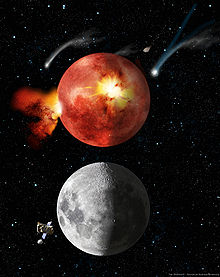
Artist’s impression of the moon during the Late Heavy Bombardment (Lunar Cataclysm) and today
The Late Heavy Bombardment (commonly referred to as the lunar cataclysm, or LHB) is a period of time approximately 4.1 to 3.8 billion years ago during which a large number of impact craters were formed on the Moon, and by inference on Earth, Mercury, Venus, and Mars as well. The LHB is ‘late’ only in relation to the main period of accretion, when the Earth and the other three rocky planets first formed and gained most of their mass; in relation to Earth or Solar System history as a whole, it is still a fairly early phase. The evidence for this event comes primarily from the dating of lunar samples, which indicates that most impact melt rocks formed in this rather narrow interval of time. While many hypotheses have been put forth to explain a spike in the flux of either asteroidal or cometary materials in the inner Solar System, no consensus yet exists as to its cause. The Nice model, popular among planetary scientists, postulates that the gas giant planets underwent orbital migration at this time, scattering objects in the asteroid belt and/or Kuiper belt on eccentric orbits that crossed those of the terrestrial planets. Nevertheless, some researchers argue that the lunar sample data do not require a cataclysmic cratering event near 3.9 billion years ago, and that the apparent clustering of impact melt ages near this time is an artifact of sampling material affected by a single large impact basin.
The main piece of evidence for a lunar cataclysm comes from the radiometric ages of impact melt rocks that were collected during the Apollo missions. The majority of these impact melts are believed to have formed during the collision of asteroids or comets tens of kilometers across, forming impact craters hundreds of kilometers in diameter. The Apollo 15, 16, and 17 landing sites were chosen as a result of their proximity to the Imbrium, Nectaris, and Serenitatis basins.
Under study on Earth, the ages of impact melts collected at these sites clustered between about 3.8 and 4.1 million years. The apparent clustering of ages of these was first noticed in the mid-1970s by Fouad Tera, Dimitri Papanastassiou, and Gerald Wasserburg who postulated that the ages record an intense bombardment of the Moon. They called it the “lunar cataclysm” and proposed that it represented a dramatic increase in the rate of bombardment of the Moon around 3.9 billion years ago. If these impact melts were derived from these three basins, then not only did these three prominent impact basins form within a short interval of time, but so did many others based on stratigraphic grounds. At the time, the conclusion was considered controversial.
As more data has become available, particularly from lunar meteorites, this theory, while still controversial, has gained in popularity. The lunar meteorites are believed to randomly sample the lunar surface, and at least some of these should have originated from regions far from the Apollo landing sites. Many of the feldspathic lunar meteorites probably originated from the lunar far side, and impact melts within these have recently been dated. Consistent with the cataclysm hypothesis, none of their ages was found to be older than about 3.9 billion years. Nevertheless, the ages do not “cluster” at this date, but span between 2.5 and 3.9 billion years ago.
Studies of the highland crater size distributions suggest that the same family of projectiles struck Mercury and the Moon during late heavy bombardment. If the history of decay of late heavy bombardment on Mercury also followed the history of late heavy bombardment on the Moon, the youngest large basin discovered, Caloris, is comparable in age to the youngest large lunar basins, Orientale and Imbrium, and all of the plains units are older than three billion years.
While the cataclysm hypothesis has recently gained in popularity, particularly among dynamicists who have identified possible causes for such a phenomenon, the cataclysm hypothesis is still controversial and based on debatable assumptions. Two criticisms are that (1) the “cluster” of impact ages could be an artifact of sampling a single basin’s ejecta, and (2) that the lack of impact melt rocks older than about 4.1 billion years is related to all such samples having been pulverized, or their ages being reset.
The first criticism concerns the origin of the impact melt rocks that were sampled at the Apollo landing sites. While these impact melts have been commonly attributed to having been derived from the closest basin, it has been argued that a large portion of these might instead be derived from the Imbrium basin. The Imbrium impact basin is the youngest and largest of the multi-ring basins found on the central nearside of the Moon, and quantitative modeling shows that significant amounts of ejecta from this event should be present at all of the Apollo landing sites. According to this alternative hypothesis, the cluster of impact melt ages near 3.9 billion years simply reflects material being collected from a single impact event, Imbrium, and not several.
A second criticism concerns the significance of the lack of impact melt rocks older than about 4.1 billion years. One hypothesis for this observation that does not involve a cataclysm is that old melt rocks did exist, but that their ages have all been reset by the continuous effects of impact cratering over the past 4 billion years. Furthermore, it is possible that these putative samples could all have been pulverized to such small sizes that it is impossible to obtain age determinations using standard radiometric methods.
If a lunar cataclysmic cratering event were truly to have occurred on the Moon, the Earth would have been affected as well. Extrapolating lunar cratering rates to Earth at this time suggest that the following number of craters would have formed:
22,000 or more impact craters with diameters greater than 20 km (12 miles),
about 40 impact basins with diameters about 1,000 km (620 miles),
several impact basins with diameter about 5,000 km (3,100 miles).
Serious environmental damage would occur about every 100 years, although life is not known to have existed on Earth at this time.
Prior to the introduction of the Late Heavy Bombardment theory, it was generally assumed that the Earth had remained molten until about 3.8 billion years ago. This date could be found in all of the oldest known rocks from around the world, and appeared to represent a strong “cutoff point” beyond which older rocks could not be found. These dates remained fairly constant even across various dating methods, including the system considered the most accurate and least affected by environment, uranium-lead dating of zircons. As no older rocks could be found, it was generally assumed that the Earth had remained molten until this point in time, which defined the boundary between the earlier Hadean and later Archean eons.
Older rocks could be found, however, in the form of chips off asteroids that fall to Earth as meteorites. Like the rocks on Earth, asteroids also show a strong cutoff point, at about 4.6 billion years, which is assumed to be the time when the first solids formed in the protoplanetary disk around the then-young Sun. The Hadean, then, was the period of time between the formation of these early rocks in space, and the eventual solidification of the Earth’s crust, some 700 million years later. This time would include the accretion of the planets from the disk and its slow cooling into a solid as the gravitational potential energy of this collapse was released.
Later calculations showed that the rate of collapse and cooling was dependent on the size of the body, and applying this to an Earth-sized mass suggested this should have happened quite quickly, as quickly as 100 million years. The difference between measurement and theory was something of a mystery at the time.
The Late Heavy Bombardment is now offered as an explanation of this oddity. Under this model, the rocks dating to 3.8 billion years represent those that were solidifying after much of the crust was destroyed by the Bombardment. The Acasta Gneiss in the North American cratonic shield and gneisses within the Jack Hills portion of the Narryer Gneiss Terrane in Western Australia are, collectively, the oldest continental fragments on Earth and do not predate the late heavy bombardment. The oldest mineral yet dated on Earth, a zircon from Jack Hills, predates this event but may simply be a fragment of crust left over from this event, contained within a much younger (about 3,800 million years old) rock.
This has led to something of a revolution in the understanding of the earliest stages of Earth’s history during the Hadean. Older references generally show the Hadean Earth having a molten surface with prominent volcanos. The name referred to the “hellish” conditions assumed on Earth for the time. It is now theorized (although still controversial) that the Hadean surface may have been solid, temperate, and water covered (albeit acidic). This is due to the presence of several particular isotopic ratios which suggest water-based chemistry took place at some point prior to the formation of the oldest rocks.
Of particular interest, Manfred Schidlowski argued in 1979 that the carbon isotopic ratios of some sedimentary rocks found in Greenland were a relic of organic matter. There was much debate over the precise dating of the rocks, with Schidlowski suggesting they were about 3,800 million years old, and others suggesting a more “modest” 3,600 million years. In either case it was a very short time for abiogenesis to have taken place, and if Schidlowski was correct, arguably too short a time. The Late Heavy Bombardment and the "re-melting" of the crust that it suggests provides a timeline under which this would be possible; life either formed immediately after the Late Heavy Bombardment, or more likely survived it, having arisen earlier during the Hadean. Recent studies suggest that the rocks Schidlowski found are indeed from the older end of the possible age range at about 3,850 million years, suggesting the latter possibility is the most likely answer.
More recently, a similar study of Jack Hills rocks shows traces of the same sort of potential organic indicators. Thorsten Geisler of the Institute for Mineralogy at the University of Münster studied traces of carbon trapped in small pieces of diamond and graphite within zircons dating to 4,250 million years. The ratio of carbon-12 to carbon-13 was unusually high, normally a sign of “processing” by life.
Three-dimensional computer models developed in May 2009 by a team at the University of Colorado at Boulder postulate that much of Earth’s crust, and the microbes living in it, could have survived the bombardment. Their models suggest that although the surface of the Earth would have been sterilized, hydrothermal vents below the Earth’s surface could have incubated life by providing a sanctuary for heat-loving microbes.
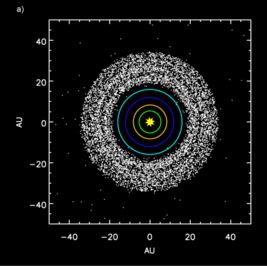
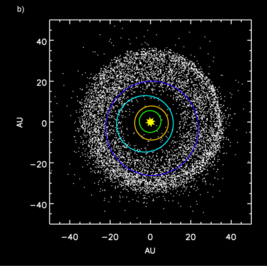

Simulation showing outer planets and planetesimal belt: (a) Early configuration, before Jupiter/Saturn reach 2:1 resonance (b) Scattering of planetesimals into the inner Solar System after the orbital shift of Neptune and Uranus (c) After ejection of planetesimals by planets. Planets shown are Jupiter (green circle), Saturn (orange circle), Uranus (light blue circle), and Neptune (dark blue circle). This simulation was created using data from the Nice Model.
A series of simulations by Gomes et al. start with a Solar System where the gas giant planets are in a tight orbital configuration. This configuration is in itself stable, but assuming a rich trans-Neptunian belt, stray transneptunians interacted with these planets, causing them to migrate slowly during a time of several hundred million years. Jupiter is predicted to migrate inward, whereas the other planets go outwards. By this migration, the Solar System became catastrophically unstable when Jupiter and Saturn reached a 2:1 orbital resonance, causing the outer Solar System to reconfigure rapidly to a wide jovian system. As these planets migrated, resonances would be “swept” through the asteroid belt and Kuiper belt. These resonances would increase the orbital eccentricity of the objects, allowing them to enter the inner Solar System and impact with the terrestrial planets. Recent work suggests that the impactors which caused the LHB were sourced from a now almost entirely depleted inner band of the asteroid belt, close to Mars.
According to one planetesimal simulation of the establishment of the planetary system, the outermost planets Uranus and Neptune formed very slowly, over a period of several billion years. Harold Levison and his team have also suggested that the relatively low density of material in the outer Solar System during planet formation would have greatly slowed their accretion. This “late appearance” of these planets has therefore been suggested as a different reason for the LHB. However, recent calculations of gas-flows combined with planetesimal runaway growth in the outer Solar System imply that Jovian planets formed extremely rapidly, on the order of 10 million years, which does not support this explanation for the LHB.
One such mechanism is presented by the Planet V simulations, that posits the former existence of a fifth planet, smaller than Mars, in the inner Solar System, outside the orbit of Mars but inside the asteroid belt. The orbit of this planet was theorized to be nearly circular but meta-stable, and was disrupted at the time of LHB, becoming eccentric, starting to sling asteroids about to collide with the inner planets before ultimately plunging into the Sun.
Another hypothesis has posited an additional Fifth Gas Giant in a trans-Saturnian orbit between Saturn and Uranus. The mooted ice giant is theorised to have been flung out of the Solar System after a close encounter with Jupiter, which lost angular momentum as a result and receded further away from the Sun, preserving the relative orbital stability of the inner Solar System.
Evidence has been found for Late Heavy Bombardment-like conditions around the star Eta Corvi.
An accretion disc is a structure formed by diffuse material in orbital motion around a central body. The central body is typically a star. Gravity causes material in the disc to spiral inward towards the central body. Gravitational forces compress the material causing the emission of electromagnetic radiation. The frequency range of that radiation depends on the central object. Accretion discs of young stars and protostars radiate in the infrared; those around neutron stars and black holes in the X-ray part of the spectrum.
The Yarkovsky effect is a force acting on a rotating body in space caused by the anisotropic emission of thermal photons, which carry momentum. It is usually considered in relation to meteoroids or small asteroids (about 10 cm to 10 km in diameter), as its influence is most significant for these bodies.
The effect was discovered by the Russian civil engineer Ivan Osipovich Yarkovsky (1844-1902), who worked on scientific problems in his spare time. Writing in a pamphlet around the year 1900, Yarkovsky noted that the diurnal heating of a rotating object in space would cause it to experience a force that, while tiny, could lead to large long-term effects in the orbits of small bodies, especially meteoroids and small asteroids. Yarkovsky’s insight would have been forgotten had it not been for the Estonian astronomer Ernst J. Öpik (1893-1985), who read Yarkovsky’s pamphlet sometime around 1909. Decades later, Öpik, recalling the pamphlet from memory, discussed the possible importance of the Yarkovsky effect on movement of meteoroids about the Solar System.
The Yarkovsky effect is a consequence of the fact that change in the temperature of an object warmed by radiation (and therefore the intensity of thermal radiation from the object) lags behind changes in the incoming radiation. That is, the surface of the object takes time to become warm when first illuminated; and takes time to cool down when illumination stops. In general there are two components to the effect:
Diurnal effect: On a rotating body (such as an asteroid) illuminated by the Sun, as on the Earth, the surface is warmed by solar radiation during the day, and cools at night. The surface gets continually warmer while illuminated, becoming hottest at the end of the day. It cools all night, and is coolest at dawn. Thus, at any given moment, the areas along the object’s dusk line are warmer than the corresponding areas along the dawn line, and emit more heat radiation. This produces a net radiation pressure thrust in the “dawn” direction. For a prograde rotator, this is in the direction of motion in its orbit, and causes the semi-major axis of the orbit to increase steadily; the object spirals away from the Sun. A retrograde rotator spirals inward. The diurnal effect is the dominant component for larger bodies greater than about 100 metres in diameter.
Seasonal effect: This is easiest to understand for the idealised case of a non-rotating body orbiting the Sun, for which each “year” consists of exactly one “day”. As it travels around its orbit, the “dusk” hemisphere which has been heated over a long preceding time period is invariably in the direction of orbital motion. The excess of thermal radiation in this direction causes a braking force which always causes spiraling inward toward the Sun. In practice, for rotating bodies, this seasonal effect increases along with the axial tilt. It dominates only if the diurnal effect is small enough. This may occur because of very rapid rotation (no time to cool off on the night side, hence an almost uniform longitudinal temperature distribution), small size (the whole body is heated throughout) or an axial tilt close to 90°. The seasonal effect is more important for smaller asteroid fragments (from a few metres up to about 100 metres), provided their surfaces are not covered by an insulating regolith layer (loose, heterogeneous material covering solid rock including dust, soil, broken rock, and other related materials) and they do not have exceedingly slow rotations. Additionally, on very long timescales over which the spin axis of the body may be repeatedly changed due to collisions (and hence also the direction of the diurnal effect changes), the seasonal effect will also tend to dominate.
The above details can become more complicated for bodies in strongly eccentric orbits.
The effect was first measured in 1991-2003 on the asteroid 6489 Golevka. The asteroid drifted 15 km from its predicted position over twelve years (the orbit was established with great precision by a series of radar observations in 1991, 1995 and 1999).
In general, the effect is size dependent, and will affect the semi-major axis of smaller asteroids, while leaving large asteroids practically unaffected. For kilometre-sized asteroids, the Yarkovsky effect is minuscule over short periods: the force on 6489 Golevka is estimated at about 0.25 newton, for a net acceleration of 10-10 m/s2. But it is steady; over millions of years an asteroid’s orbit can be perturbed enough to transport it from the asteroid belt to the inner Solar System.
For a specific asteroid, it is very hard to predict the exact impact of the Yarkovsky effect on its orbit. This is because its magnitude depends on many variables that are hard to determine from the limited observational information that is available. These include the exact shape of the asteroid, its orientation, and its albedo (reflecting power), along with its variations over the surface and with wavelength. Calculations are further complicated by the effects of shadowing and thermal “reillumination”, whether caused by local craters or a possible overall concave shape. The Yarkovsky effect also competes with radiation pressure. whose net effect may cause similar small long-term forces for bodies with albedo variations and/or non-spherical shapes.
As an example, even for the simple case of the pure seasonal Yarkovsky effect on a spherical body in a circular orbit with 90° obliquity, semi-major axis changes could differ by as much as a factor of two between the case of a uniform albedo and the case of a strong north/south albedo asymmetry. Depending on the object’s orbit and spin axis, the Yarkovsky change of the semi-major axis may be reversed simply by changing from a spherical to a non-spherical shape.
Despite these difficulties, utilizing the Yarkovsky effect is one scenario under investigation to alter the course of potentially Earth-impacting near-Earth asteroids. Possible asteroid deflection strategies include “painting” the surface of the asteroid or focusing solar radiation onto the asteroid to alter the intensity of the Yarkovsky effect and so alter the orbit of the asteroid away from a collision with Earth.
The Yarkovsky–O’Keefe–Radzievskii–Paddack effect, or YORP effect for short, is a second-order variation on the Yarkovsky effect which changes the rotation rate of a small body (such as an asteroid). The term was coined by David P Rubincam in 2000.
In the 19th century, Yarkovsky realised that the infrared radiation escaping from a body warmed by the Sun carries off momentum as well as heat. Translated into modern physics, each photon escaping carries away a momentum p = E/c where E (=hν) is its energy and c is the speed of light. Radzievskii applied the idea to rotation based on changes in albedo and Paddack and O’Keefe realised that shape was a much more effective means of altering a body’s spin rate. Paddack and Rhee suggested that the YORP effect may be the cause of rotational bursting and eventual elimination from the solar system of small asymmetric objects.
The Poynting–Robertson effect, also known as Poynting–Robertson drag, named after John Henry Poynting and Howard Percy Robertson, is a process by which solar radiation causes a dust grain in the Solar System to slowly spiral into the Sun. The drag is essentially a component of radiation pressure tangential to the grain’s motion. Poynting gave a description of the effect in 1903 based on the “luminiferous aether” theory, which was superseded by the theories of relativity in 1905 and 1915. In 1937 Robertson described the effect in terms of general relativity.
The effect can be understood in two ways, depending on the reference frame chosen.
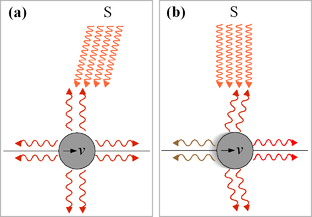
Radiation from the Sun (S) and thermal radiation from a particle seen (a) from an observer moving with the particle and (b) from an observer at rest with respect to the Sun
From the perspective of the grain of dust circling the Sun [panel (a) of the figure], the Sun’s radiation appears to be coming from a slightly forward direction (aberration of light). Therefore the absorption of this radiation leads to a force with a component against the direction of movement. (The angle of aberration is extremely small since the radiation is moving at the speed of light while the dust grain is moving many orders of magnitude slower than that.)
From the perspective of the Solar System as a whole [panel (b) of the figure], the dust grain absorbs sunlight entirely in a radial direction, thus the grain’s angular momentum remains unchanged. However, in absorbing photons, the dust acquires added mass via mass-energy equivalence. In order to conserve angular momentum (which is proportional to mass), the dust grain must drop into a lower orbit.
Note that the re-emission of photons, which is isotropic in the frame of the grain (a), does not affect the dust particle’s orbital motion. However, in the frame of the Solar System (b), the emission is beamed anisotropically, and hence the photons carry away angular momentum from the dust grain. It is somewhat counter-intuitive that angular momentum is lost while the orbital motion of the grain is unchanged, but this is an immediate consequence of the dust grain shedding mass during emission and that angular momentum is proportional to mass.
The Poynting–Robertson drag can be understood as an effective force opposite the direction of the dust grain’s orbital motion, leading to a drop in the grain’s angular momentum. It should be mentioned that while the dust grain thus spirals slowly into the Sun, its orbital speed increases continuously.
Scale relativity is a theory of space-time initially developed by Laurent Nottale, working at the French observatory of Meudon, near Paris. It is an extension of the concept of relativity found in special relativity and general relativity to physical scales (time, length, energy, or momentum scales). If scales in nature are always relative, an absolute scale cannot exist. As a consequence, fundamental physical laws need to be scale invariant. While differential trajectories found in standard physics are automatically scale invariant, it is the main insight of the theory that also certain non-differential trajectories (which explicitly depend on the scale of the observer) can be scale invariant and new tools are developed to treat such trajectories. It is one of the main successes of the theory that the laws of quantum mechanics, like the Schroedinger equation, can be derived directly from the assumption that space-time itself is non-differential and scale invariant. Scale invariance is closely related to the self-similarity observed in fractals.
A new study led by researchers at the Massachusetts Institute of Technology (MIT) challenges previous theories about our solar system formation. New evidence shows that meteorites are in fact by-products of planet formation, rather than the primordial building blocks.
MIT scientists analyzed the chondrules within meteors and performed a computer simulation of early solar system formation to learn which were formed first: the chondrules or the ancient planets called proto-planets. Chondrules are spherical grains resulting from molten material that has eventually cooled.
Past theories said that chondrules in meteors were the germs of the formation of early Earth-like planets. The idea was that at the beginning of solar systems, when everything was chaotic and full of gas and dust, the chondrules collided as molten droplets with this primordial material to form larger objects, the proto-planets. The same theory explained how Earth formed billions of years ago.
However, MIT researchers say that this story isn’t exactly accurate. Their computer simulations revealed that chondrules were a result of early planetary formation, not its cause.
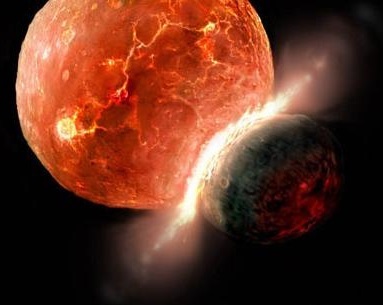
Researchers found that proto-planets, moon-sized embryos of the Earth-like planets, existed well before chondrules. The computer simulation showed that these protoplanets collided into each other with such violence (2.5 km/s) that a fraction of their material melted at incredibly high temperatures and got instantly ejected into space where it cooled down at a rate of 10 to 1,000 kelvins per hour. The particles resulting from this process were the chondrules, which in turn attached onto each other or other larger bodies and formed meteorites.
“This tells us that meteorites aren’t actually representative of the material that formed planets – they’re the smaller fractions of material that are the by-product of planet formation. But it also tells us the early solar system was more violent than we expected: You had these massive sprays of molten material getting ejected out from these really big impacts. It’s an extreme process”, said Brandon Johnson, co-author of the study and MIT scientist at the Department of Earth, Atmospheric and Planetary Sciences.
The new study was published in January 2015 in the journal Nature.
The findings showing that meteorites didn’t form our solar system may be a great deception for some. However, it is not the first time a theory about planetary formation gets invalidated.
In December 2014, ESA’s Rosetta mission revealed that comets did not bring water to Earth as previously thought. The Rosetta space probe took water samples from comet 67P/ Churyumov-Gerasimenko, performed some tests, and showed that the Deuterium – Hydrogen ratio in comet 67P’s water was three times higher than the D–H ratio of our oceans.