
Loading...
Loading...
This page has sections on:

[Above] Hill sphere and Lagrange points
[Right] Resonances in Jupiter’s atmosphere

Have you taken a look at the Universe yet?
[Richard Powell]
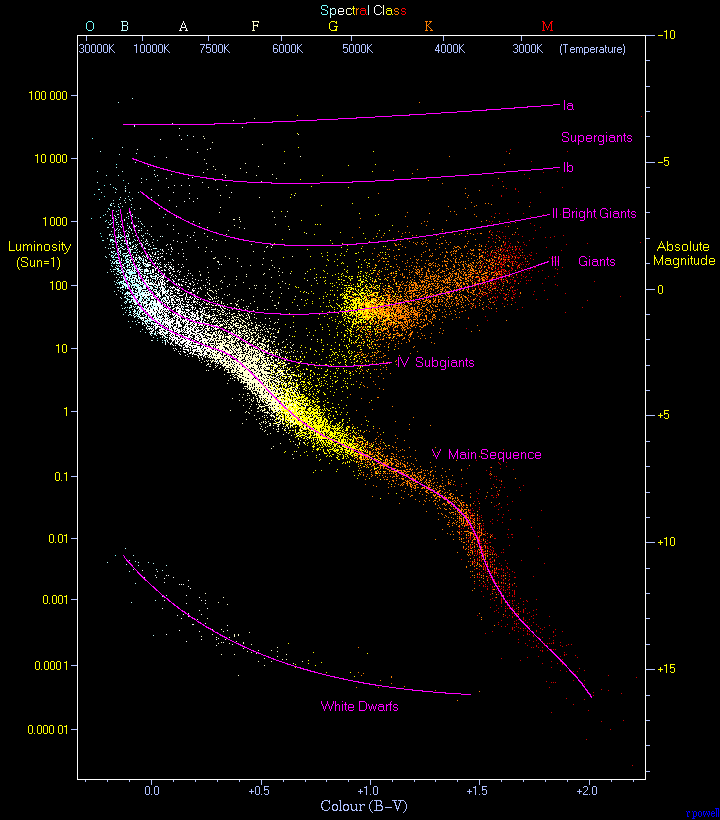
The Hertzsprung–Russell diagram is a plot of luminosity (absolute magnitude) against the colour of the stars ranging from the high-temperature blue-white stars on the left side of the diagram to the low temperature red stars on the right side.
The diagram is a way of classifying stars according to their absolute magnitude, which is the magnitude if the star was 10 parsecs from us, and their spectral type, which is determined by the elements (and compounds) in their spectra.
The more positive the absolute magnitude is, the dimmer the star is; a large negative magnitude indicates a very bright star.
The apparent magnitude is an indication of the brightness that we see; the apparent magnitude of the Sun is −26.74 but its absolute magnitude is 4.83. The brightest star in the sky (apart from the Sun) is Sirius with apparent magnitude −1.46 (absolute magnitude 1.42); it is 81.4 light years away.
The diagram on the left is a plot of 22,000 stars from the Hipparcos Catalogue together with 1000 low-luminosity stars (red and white dwarfs) from the Gliese Catalogue of Nearby Stars. The ordinary hydrogen-burning dwarf stars like the Sun are found in a band running from top-left to bottom-right called the Main Sequence. Giant stars form their own clump on the upper-right side of the diagram. Above them lie the much rarer bright giants and supergiants. At the lower-left is the band of white dwarfs – these are the dead cores of old stars which have no internal energy source and over billions of years slowly cool down towards the bottom-right of the diagram.
Hipparcos: The scientific goals of the mission (NSSDC/COSPAR ID: 1989-062B) were the accurate measurement of the trigonometric parallaxes, proper motions, and positions of 100,000 selected stars, mostly fainter than 10th magnitude.
The Gliese Catalogue of Nearby Stars is a frequently referenced, modern star catalogue of stars located within 25 parsecs (81.54 ly) of the Earth.
The Hertzsprung–Russell Diagram is a scatter plot where each star is plotted according to its absolute magnitude and surface temperature. The diagram illustrates that there is a relationship between temperature and luminosity, and between mass and luminosity. It shows that:
The Messier Catalogue (M) was first published by Charles Messier (1730 – 1817) in 1794 and lists 110 objects; the New General Catalogue (NGC) was first published by John Louis Emil Dreyer (1852 – 1926) in 1888 and lists 7840 objects; the Index Catalogue (IC) was first published by Dreyer in 1895 and lists 5386 objects in two sections, extending the NGC; and the Caldwell Catalogue (C) was first published by Sir Patrick Alfred Caldwell-Moore (1923 – 2012) and better known as Patrick Moore, in 1995 and lists 110 objects; there is also the Herschel 400 Catalogue, listing 400 objects selected from the catalogues of Sir Frederick William Herschel (1738 – 1822), and several other catalogues which are not so well-known.
Over 100 galaxies and nebulae are numbered with a prefixed letter M (like the photo below of M1). Charles Messier, a French astronomer started listing these astronomical objects in 1771. He was a comet hunter, and was frustrated by objects which resembled but were not comets, so he compiled a list of them, in collaboration with his assistant Pierre Méchain, to avoid wasting time on them. Others have been added since then, and the current total is 110.
The New General Catalogue of Nebulae and Clusters of Stars (abbreviated NGC) is a well-known catalogue of deep sky objects in astronomy compiled by John Louis Emil Dreyer in 1888, as a new version of John Herschel’s Catalogue of Nebulae and Clusters of Stars. The NGC contains 7,840 objects. It is one of the largest comprehensive catalogues, as it includes all types of deep space objects and is not confined to, for example, galaxies. Dreyer published two supplements to the NGC, known as the Index Catalogues (abbreviated IC). The first was published in 1895 and contained 1,520 objects, while the second was published in 1908 and contained 3,866 objects, a total of 5,386 IC objects.
The Caldwell Catalogue (C) is an astronomical catalogue of 109 bright star clusters, nebulae, and galaxies for observation by amateur astronomers. The list was compiled as a complement to the Messier Catalogue, with amateur astronomers in mind.
After Pluto’s place within the Kuiper belt was confirmed, its official status as a planet became controversial, with many questioning whether Pluto should be considered together with or separately from its surrounding population. Museum and planetarium directors occasionally created controversy by omitting Pluto from planetary models of the Solar System. The Hayden Planetarium reopened after renovation in 2000 with a model of only eight planets. The controversy made headlines at the time.
In 2002, the Kuiper Belt Object (KBO) 50000 Quaoar was discovered, with a diameter then thought to be roughly 1,280 km, about half that of Pluto. In 2004, the discoverers of 90377 Sedna placed an upper limit of 1,800 km on its diameter, nearer to Pluto’s diameter of 2320 km, although Sedna’s diameter was revised downward to less than 1,600 km by 2007. Just as Ceres, Pallas, Juno and Vesta eventually lost their planet status after the discovery of many other asteroids, so, it was argued, Pluto should be reclassified as one of the Kuiper belt objects.
On 29th July 2005, the discovery of a new trans-Neptunian object was announced. Named Eris, it is now known to be approximately the same size as Pluto. This was the largest object discovered in the Solar System since Triton in 1846. Its discoverers and the press initially called it the “tenth planet”, although there was no official consensus at the time on whether to call it a planet. Others in the astronomical community considered the discovery the strongest argument for reclassifying Pluto as a minor planet.
The debate came to a head in 2006 with an IAU resolution that created an official definition for the term planet. According to this resolution, there are three main conditions for an object to be considered a planet:
Pluto fails to meet the third condition, since its mass is only 0.07 times that of the mass of the other objects in its orbit (Earth’s mass, by contrast, is 1.7 million times the remaining mass in its own orbit). The IAU further resolved that Pluto be classified in the simultaneously created dwarf planet category, and that it act as the prototype for the plutoid category of trans-Neptunian objects, in which it would be separately, but concurrently, classified.
On 13th September 2006, the IAU included Pluto, Eris, and the Eridian moon Dysnomia in their Minor Planet Catalogue, giving them the official minor planet designations “(134340) Pluto”, “(136199) Eris”, and “(136199) Eris I Dysnomia”. If Pluto had been given a minor planet name upon its discovery, the number would have been about 1,164 rather than 134,340.
There has been some resistance within the astronomical community toward the reclassification. Alan Stern, principal investigator with NASA’s New Horizons mission to Pluto, has publicly derided the IAU resolution, stating that “the definition stinks, for technical reasons.” Stern’s contention is that by the terms of the new definition Earth, Mars, Jupiter, and Neptune, all of which share their orbits with asteroids, would be excluded. His other claim is that because fewer than 5% of astronomers voted for it, the decision was not representative of the entire astronomical community. Marc W Buie of the Lowell Observatory has voiced his opinion on the new definition on his website and is one of the petitioners against the definition. Others have supported the IAU. Mike Brown, the astronomer who discovered Eris, said “through this whole crazy circus-like procedure, somehow the right answer was stumbled on. It’s been a long time coming. Science is self-correcting eventually, even when strong emotions are involved.”
Researchers on both sides of the debate gathered on 14th to 16th August 2008, at The Johns Hopkins University Applied Physics Laboratory for a conference that included back-to-back talks on the current IAU definition of a planet. Entitled “The Great Planet Debate”, the conference published a post-conference press release indicating that scientists could not come to a consensus about the definition of a planet.
Reception to the IAU decision was mixed. While some accepted the reclassification, others seek to overturn the decision with online petitions urging the IAU to consider reinstatement. A resolution introduced by some members of the California State Assembly lightheartedly denounces the IAU for “scientific heresy”, among other crimes. The US state of New Mexico’s House of Representatives passed a resolution in honour of Clyde Tombaugh, the discoverer of Pluto and a longtime resident of that state, which declared that Pluto will always be considered a planet while in New Mexican skies and that 13th March 2007 was Pluto Planet Day. The Illinois State Senate passed a similar resolution in 2009, on the basis that Clyde Tombaugh was born in Illinois. The resolution asserted that Pluto was “unfairly downgraded to a dwarf planet” by the IAU.
Some members of the public have also rejected the change, citing the disagreement within the scientific community on the issue, or for sentimental reasons, maintaining that they have always known Pluto as a planet and will continue to do so regardless of the IAU decision.
A minor planet is an astronomical object in direct orbit around the Sun that is neither a dominant planet nor originally classified as a comet. Minor planets can be:
The first minor planet discovered was Ceres in 1801 (although from the time of its discovery until 1851 it was considered to be a planet). The orbits of more than 570,000 objects have been archived at the Minor Planet Center. The IAU states: “the term ‘minor planet’ may be used, but generally the term ‘small solar system body’ is preferred.” However, for purposes of numbering and naming, the traditional distinction between minor planet and comet is still followed.
The term quasi-satellite does not denote another type of object, but is used for objects sharing an orbit with a planet, but not as a moon.
See the latest lists of TNOs and Scattered Disk Objects as recorded by the Minor Planet Center.
A dwarf planet is a celestial body in direct orbit of the Sun that is massive enough that its shape is controlled by gravitational forces rather than mechanical forces (and is thus an ellipsoid), but has not cleared the neighbouring region of other objects. More explicitly, it is a planetary-mass object – it has sufficient mass to overcome its internal compressive strength and achieve hydrostatic equilibrium – but is neither a planet nor a satellite. It fails the third part of the definition of a planet.
The Dwarf Planets are: Ceres, Pluto, Eris, Haumea and Makemake.
Other Probable Dwarf Planets are: (225088) 2007 OR10, Sedna, Quaoar, (55565) 2002 AW197, Orcus, 2012 VP113. These are not yet officially dwarf planets, but are probable candidates in this category. It is suspected that another hundred or so known objects in the Solar System are dwarf planets. Estimates are that up to 200 dwarf planets may be found when the entire Kuiper belt is explored, and that the number may exceed 10,000 when objects scattered outside the belt are considered.
Space missions to the Dwarf Planets so far are: Dawn to Ceres via asteroid 4 Vesta and New Horizons to Pluto.
A Moon or Satellite is a celestial body that orbits a planet or smaller body, which is called its primary.
There is no established lower limit on what is considered a moon. Every natural celestial body with an identified orbit around a planet of the Solar System, some as small as a kilometre across, has been identified as a moon, though objects a tenth that size within Saturn’s rings, which have not been directly observed, have been called “moonlets”. Small asteroid moons (natural satellites of asteroids), such as Dactyl, have also been called moonlets.
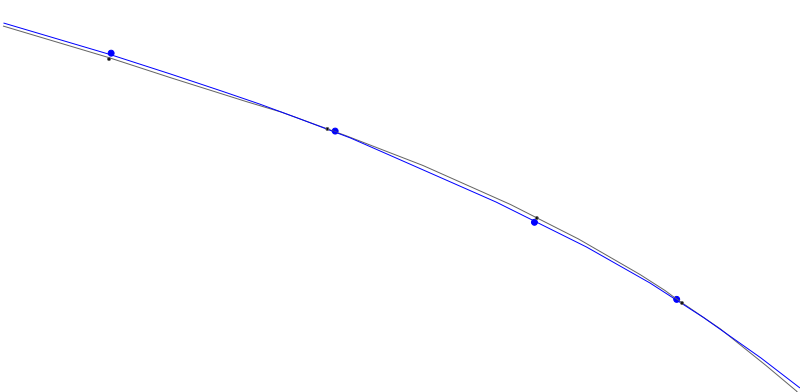
The upper limit is also vague. Two orbiting bodies are sometimes described as a double body rather than primary and satellite. Asteroids such as 90 Antiope are considered double asteroids, but they have not forced a clear definition of what constitutes a moon. Some authors consider the Pluto–Charon system to be a double (dwarf) planet. The Earth–Moon system is also considered by some to be a double or binary planet. The diagram shows that this is because the orbits of both objects are concave to the Sun, an idea first advanced by Isaac Azimov in 1950. The most common criterion is whether the barycentre is below the surface of the larger body, though this is somewhat arbitrary, as it relies on distance as well as relative mass.
A Planetary Ring is a ring of cosmic dust and other small particles orbiting around a planet in a flat disc-shaped region. The most notable planetary rings known in the Solar System are those around Saturn, but the other three gas giants of the Solar System (Jupiter, Uranus and Neptune) also possess ring systems of their own. The composition of ring particles varies; they may be silicate or icy dust. Larger rocks and boulders may also be present, and in 2007 tidal effects from eight “moonlets” only a few hundred metres across were detected within Saturn’s rings.
Sometimes rings have “shepherd” moons, small moons that orbit near the outer edges of rings or within gaps in the rings. The gravity of shepherd moons serves to maintain a sharply defined edge to the ring; material that drifts closer to the shepherd moon’s orbit is deflected back into the body of the ring, ejected from the system, or accreted onto the moon itself. Several of Jupiter’s small innermost moons, namely Metis and Adrastea, are within Jupiter’s ring system and are also within Jupiter’s Roche limit. It is possible that these rings are composed of material that is being pulled off these two bodies by Jupiter’s tidal forces, possibly facilitated by impacts of ring material on their surfaces. (The Roche limit is the distance within which a celestial body, held together only by its own gravity, will disintegrate due to a second celestial body’s tidal forces exceeding the first body’s gravitational self-attraction.)

There is an orbit viewer applet for asteroid 3208-lunn [originally written by Osamu Ajiki (AstroArts) and further modified by Ron Baalke (JPL)], which requires Java installed and enabled in your computer.
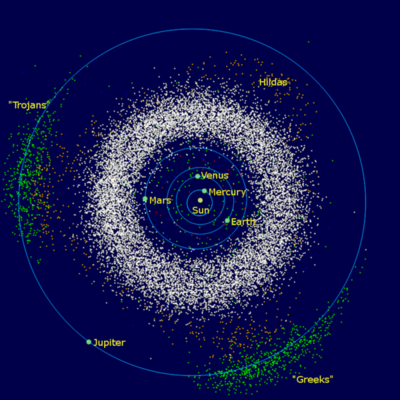
A Trojan is a minor planet or natural satellite (moon) that shares an orbit with a planet or larger moon, but does not collide with it because it orbits around one of the two Lagrangian points of stability, L4 and L5, which lie approximately 60° ahead of and behind the larger body, respectively. Trojan objects are one type of co-orbital object. In this arrangement, the massive star and the smaller planet orbit about their common barycentre — a location in space where the forces of their mutual gravitational attraction balance each other out. A much smaller mass located at one of the Lagrange points is subject to a combined gravitational force that acts through this barycentre. As a consequence, the mass can follow a circular orbit around this point with the same period as the planet, and the arrangement can remain stable over time.
The Italian-French mathematician and astronomer Joseph-Louis Lagrange discovered, in Essai sur le Problème des Trois Corps (1772), two constant-pattern solutions (collinear and equilateral) of the general three-body problem. In the restricted three-body problem, with one mass negligible (which Lagrange did not consider), the five possible positions of that mass are now termed Lagrange Points or Lagrangian Points. See Lagrangian Points.
By convention, the asteroids orbiting Jupiter’s L4 point are named after the heroes from the Greek side of the war, while those at L5 are from the Trojan side. The two exceptions, the Greek-themed 617 Patroclus and the Trojan-themed 624 Hektor, were actually assigned to the wrong sides. Astronomers estimate that the Jupiter trojans (of which there are 5692 recorded) are about as numerous as the asteroids of the asteroid belt. Lists here are of Trojans and Greeks; the official list is on the Minor Planet Center web site.
Saturn has the most known Trojan satellites: Saturn’s moon Tethys has two Trojan moons (Telesto and Calypso), and Dione also has two Trojan moons (Helene and Polydeuces).
Three Mars trojans are known: 5261 Eureka, (101429) 1998 VF31 and (121514) 1999 UJ7 (and 2007 NS2 is possibly one).
Eight Neptune trojans are known, but they have been estimated to outnumber the Jupiter Trojans by an order of magnitude. See this list.
2010 TK7 was confirmed as the first known Earth trojan in 2011. It is located at the L4 Lagrangian point, which lies ahead of Earth.
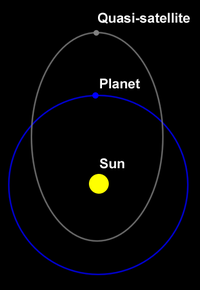
A quasi-satellite is an object in a specific type of co-orbital configuration (1:1 orbital resonance) with a planet where the object stays close to that planet over many orbital periods.
A quasi-satellite’s orbit around the Sun takes exactly the same time as the planet’s, but has a different eccentricity (usually greater), as shown in the diagram. When viewed from the perspective of the planet, the quasi-satellite will appear to travel in an oblong retrograde loop around the planet.
In contrast to true satellites, quasi-satellite orbits lie outside the planet’s Hill sphere, and are unstable. Over time they tend to evolve to other types of resonant motion, where they no longer remain in the planet’s neighbourhood, then possibly later move back to a quasi-satellite orbit, etc.
Other types of orbit in a 1:1 resonance with the planet, include horseshoe orbits and tadpole orbits around the Lagrangian points, but objects in these orbits do not stay near the planet’s longitude over many revolutions about the star. Objects in horseshoe orbits are known to sometimes periodically transfer to a relatively short-lived quasi-satellite orbit, and are sometimes confused with them. An example of such an object is 2002 AA29.
A halo orbit is a periodic, three-dimensional orbit near the L1, L2, or L3 Lagrange points; a spacecraft in a halo orbit does not technically orbit the Lagrange point itself, which is just an equilibrium point with no mass, but travels in a closed, repeating path near the Lagrange point. Halo orbits are the result of a complicated interaction between the gravitational pull of the two planetary bodies and the coriolis and centrifugal accelerations on a spacecraft. Halo orbits exist in many three-body systems, such as the Sun–Earth system and the Earth–Moon system. Continuous “families” of both Northern and Southern halo orbits exist at each Lagrange point. Because halo orbits tend to be unstable, station-keeping is required to keep a satellite in its orbit.
An astronomical body’s Hill sphere (not to be confused with the Hills Cloud) is the region in which it dominates the attraction of satellites. To be retained by a planet, a moon must have an orbit that lies within the planet’s Hill sphere. That moon would, in turn, have a Hill sphere of its own. Any object within that distance would tend to become a satellite of the moon, rather than of the planet itself.
In more precise terms, the Hill sphere approximates the gravitational sphere of influence of a smaller body in the face of perturbations from a more massive body. It was defined by the American astronomer George William Hill, based upon the work of the French astronomer Édouard Roche. For this reason, it is also known as the Roche sphere (not to be confused with the Roche limit!). The Hill sphere extends between the Lagrangian points L1 and L2, which lie along the line of centres of the two bodies. The region of influence of the second body is shortest in that direction, and so it acts as the limiting factor for the size of the Hill sphere. Beyond that distance, a third object (e.g. Phoebe) in orbit around the second (e.g. Saturn) would spend at least part of its orbit outside the Hill sphere, and would be progressively perturbed by the tidal forces of the central body (e.g. the Sun), eventually ending up orbiting the latter.
The Hill sphere is only an approximation, and other forces (such as radiation pressure) can eventually perturb an object out of the sphere. This third object should also be of small enough mass that it introduces no additional complications through its own gravity. Detailed numerical calculations show that orbits at or just within the Hill sphere are not stable in the long term; it appears that stable satellite orbits exist only inside ½ to ⅓ of the Hill radius. The region of stability for retrograde orbits at a large distance from the primary, is larger than the region for prograde orbits at a large distance from the primary. This was thought to explain the preponderance of retrograde moons around Jupiter, however Saturn has a more even mix of retrograde/prograde moons so the reasons are more complicated.
An astronaut could not orbit a Space Shuttle (with mass of 104 tonnes), where the orbit is 300 km above the Earth, since the Hill sphere of the shuttle is only 120 cm in radius, much smaller than the shuttle itself. In fact, in any low Earth orbit, a spherical body must be 800 times denser than lead in order to fit inside its own Hill sphere, or else it will be incapable of supporting an orbit. A spherical geostationary satellite would need to be more than five times denser than lead to support satellites of its own; such a satellite would be 2.5 times denser than osmium, the densest naturally-occurring material on Earth. Only at twice the geostationary distance could a lead sphere possibly support its own satellite; since the Moon is more than three times further than the 3-fold geostationary distance necessary, lunar orbits are possible.
Within the Solar System, the planet with the largest Hill radius is Neptune, at 116 million km, or 0.775 AU; its great distance from the Sun amply compensates for its small mass relative to Jupiter (whose own Hill radius measures 53 million km). An asteroid from the asteroid belt will have a Hill sphere that can reach 220,000 km (for Ceres), diminishing rapidly with its mass. The Hill sphere of (66391) 1999 KW4, a Mercury-crosser asteroid that has a moon (S/2001 (66391) 1), measures 22 km in radius.
A typical extrasolar “hot Jupiter”, HD 209458 b has a Hill sphere of radius (593,000 km) about eight times its physical radius (approx 71,000 km). Even the smallest close-in extrasolar planet, CoRoT-7b still has a Hill sphere radius (61,000 km) six times greater than its physical radius (approximately 10,000 km). Therefore these planets could have small moons close in.
The International Astronomical Union or “IAU” is a collection of professional astronomers, at the Ph.D. level and beyond, active in professional research and education in astronomy. It acts as the internationally recognized authority for assigning designations to celestial bodies (stars, planets, asteroids, etc.) and any surface features on them.
The IAU is a member of the International Council for Science (“ICSU”). Its main objective is to promote and safeguard the science of astronomy in all its aspects through international cooperation. The IAU maintains friendly relations with organizations that include amateur astronomers; its head office is in Paris. Working groups include the Working Group for Planetary System Nomenclature (“WGPSN”), which maintains the astronomical naming conventions and planetary nomenclature for planetary bodies. The IAU is also responsible for the system of astronomical telegrams which are produced and distributed on its behalf by the Central Bureau for Astronomical Telegrams (“CBAT”). The Minor Planet Center (“MPC”), a clearing-house for all non-planetary or non-moon bodies in the solar system, also operates under the IAU.
The CBAT collects and distributes information on comets, natural satellites, novae, supernovae and other transient astronomical events. The CBAT also establishes priority of discovery (who gets credit for it) and assigns initial designations and names to new objects. On behalf of the IAU, the CBAT distributes IAU Circulars (“IAUCs”). From the 1920s to 1992, the CBAT sent telegrams in urgent cases, although most circulars were sent by normal mail; when telegrams were dropped, the name “telegram” was kept for historical reasons, and they continued as the “Electronic Telegram” of the Central Bureau for Astronomical Telegrams (“CBET”s). Since the mid-1980s the IAUCs and the related MPC have been available electronically.
I want to look here at an important property of many objects in the Solar System, and presumably in other systems orbiting other stars. It is resonance. Resonance is more usually associated with sound, but here we are dealing with solid objects, planets, their natural satellites, and other small bodies in the solar system. Astronomical resonance is more common than you might think.
One immediately obvious example is the resonance between the orbit of the Moon around the Earth and the rotation of the Moon on its axis; the result is that the moon always presents the same face towards us (apart from a slight wobble due to the fact that the Moon’s orbit is not perfectly circular while its axial rotation is quite regular).
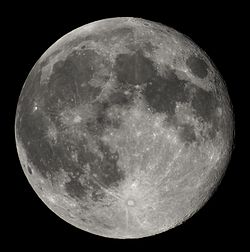
That sort of resonance is quite common, and is due to the objects involved not being perfectly spherical or having a denser lump off-centre within them. Consequently if the smaller object (the “secondary” object, a satellite, say) has a small bulge, this bulge will, early in the life-time of the system, sometimes be on the leading edge of the orbit causing the pull of gravity from the larger object (the “primary”) to pull it back slightly. At other times the bulge will be on the trailing side and will speed up the rotation. It’s important to remember that these effects take place over a very long time, perhaps hundreds of millions of years. Eventually, the effect of the bulge in the secondary object is that it comes synchronous with its orbit around the primary, so that it always presents the same face towards the primary.
I must point out that this description assumes that the orbit of the secondary is pretty circular. More eccentric orbits may also have similar consequences, and given a long enough time, the two periods (the spin of the secondary and the orbital period around the primary) may also come into synchronization.
Another kind of resonance involves the orbits of two astronomical objects, two planets say. Here, if the planet that is closest to the Sun orbits roughly twice for each orbit of a planet that is further out, a similar effect occurs, and the two come into, say, a 2:1 resonance, each pulling at the other whenever they are close together. Satellites orbiting the same planet can also resonate in the same way. (See also Haumea for a further discussion about resonances.)
Other resonances can occur, 3:1, 3:2 and so on.
Trojan asteroids (like those of Jupiter) have the same period as Jupiter for orbiting the Sun, so they are in a 1:1 resonance with the planet. This is a special case, as the Trojans and Greeks are at or near to Jupiter’s Lagrange points L4 and L5.
In some cases three bodies can be in resonance:
An orbital resonance occurs when two orbiting bodies exert a regular, periodic gravitational influence on each other, usually due to their orbital periods being related by a ratio of two small integers. The principle behind orbital resonance is similar in concept to pushing a child on a swing, where the orbit and the swing both have a natural frequency, and the other body doing the “pushing” will act in periodic repetition to have a cumulative effect on the motion. Orbital resonances greatly enhance the mutual gravitational influence of the bodies – their ability to alter or constrain each other’s orbits. In most cases, this results in an unstable interaction, in which the bodies exchange momentum and shift orbits until the resonance no longer exists. Under some circumstances, a resonant system can be stable and self-correcting, so that the bodies remain in resonance. Examples are the 1:2:4 resonance of Jupiter’s moons Ganymede, Europa and Io, and the 2:3 resonance between Pluto and Neptune. Unstable resonances with Saturn’s inner moons give rise to gaps in the rings of Saturn. The special case of 1:1 resonance (between bodies with similar orbital radii) causes large Solar System bodies to eject most other bodies sharing their orbits; this is part of the much more extensive process of clearing the neighbourhood, an effect that is used in the current definition of a planet.
A resonance ratio is the ratio of number of orbits completed in the same time interval, rather than the ratio of orbital periods (which would be the inverse ratio). The 2:3 ratio above means Pluto completes two orbits in the time it takes Neptune to complete three.
In general, an orbital resonance
A mean motion orbital resonance occurs when two bodies have periods of revolution that are a simple integer ratio of each other. Depending on the details, this can either stabilize or destabilize the orbit. Stabilization occurs when the two bodies move in such a synchronised fashion that they never closely approach. For instance the orbits of Pluto and the plutinos are stable, despite crossing that of the much larger Neptune, because they are in a 2:3 resonance with it. The resonance ensures that, when they approach perihelion and Neptune’s orbit, Neptune is consistently distant (averaging a quarter of its orbit away). Other (much more numerous) Neptune-crossing bodies that were not in resonance were ejected from that region by strong perturbations from Neptune. There are also smaller but significant groups of resonant trans-Neptunian objects occupying the 1:1 (Neptune trojans), 3:5, 4:7, 1:2 (twotinos) and 2:5 resonances, among others, with respect to Neptune.
In the asteroid belt beyond 3.5 AU from the Sun, the 3:2, 4:3 and 1:1 resonances with Jupiter are populated by clumps of asteroids (the Hilda family, 279 Thule, and the Trojan asteroids, respectively).
Orbital resonances can also destabilize one of the orbits. For small bodies, destabilization is actually far more likely. For instance in the asteroid belt within 3.5 AU from the Sun, the major mean-motion resonances with Jupiter are locations of gaps in the asteroid distribution, the Kirkwood gaps (most notably at the 3:1, 5:2, 7:3 and 2:1 resonances). Asteroids have been ejected from these almost empty lanes by repeated perturbations. However, there are still populations of asteroids temporarily present in or near these resonances. For example, asteroids of the Alinda family are in or close to the 3:1 resonance, with their orbital eccentricity steadily increased by interactions with Jupiter until they eventually have a close encounter with an inner planet that ejects them from the resonance.
In the rings of Saturn, the Cassini Division is a gap between the inner B Ring and the outer A Ring that has been cleared by a 2:1 resonance with the moon Mimas. (More specifically, the site of the resonance is the Huygens Gap, which bounds the outer edge of the B Ring.) The Encke and Keeler gaps within the A Ring are cleared by 1:1 resonances with the embedded moonlets Pan and Daphnis, respectively. The A Ring’s outer edge is maintained by a destabilizing 7:6 resonance with the moon Janus.
A Laplace resonance occurs when three or more orbiting bodies have a simple integer ratio between their orbital periods. For example, Jupiter’s moons Ganymede, Europa and Io are in a 1:2:4 orbital resonance. The extrasolar planets Gliese 876 e, b and c are also in a 1:2:4 orbital resonance.

A chart of the distribution of asteroid semimajor axes, showing the Kirkwood gaps where orbits are destabilized by resonances with Jupiter.
A relatively small number of asteroids have been found to possess high eccentricity orbits which do lie within the Kirkwood gaps. The 2.5 AU (3:1 resonance), is home to the Alinda family of asteroids, and the 3.27 AU (2:1 resonance), is home to the Griqua family.
A past resonance between Jupiter and Saturn may have played a dramatic role in early Solar System history. A 2004 computer model by Alessandro Morbidelli of the Observatoire de la Côte d’Azur in Nice suggested that the formation of a 1:2 resonance between Jupiter and Saturn (due to interactions with planetesimals that caused them to migrate inward and outward, respectively) created a gravitational push that propelled both Uranus and Neptune into higher orbits, and in some scenarios caused them to switch places, which would have doubled Neptune’s distance from the Sun. The resultant expulsion of objects from the “proto-Kuiper belt” as Neptune moved outwards could explain the Late Heavy Bombardment 600 million years after the Solar System’s formation and the origin of Jupiter’s trojan asteroids. An outward migration of Neptune could also explain the current occupancy of some of its resonances (particularly the 2:5 resonance) within the Kuiper belt.
While Saturn’s mid-sized moons Dione and Tethys are not close to an exact resonance now, they may have been in a 2:3 resonance early in the Solar System’s history. This would have led to orbital eccentricity and tidal heating that may have warmed Tethys’s interior enough to form a subsurface ocean. Subsequent freezing of the ocean after the moons escaped from the resonance may have generated the extensional stresses that created the enormous graben system of Ithaca Chasma on Tethys.
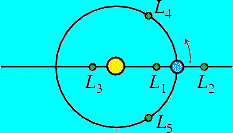
The Lagrangian (also known as Trojan) points are the five positions in an orbital configuration where a small object affected only by gravity can theoretically be stationary relative to two larger objects (such as a satellite with respect to the Earth and Moon). The Lagrange points mark positions where the combined gravitational pull of the two large masses provides precisely the centripetal force required to rotate with them. In the diagram, the large yellow blob could be the Sun, the blue one a planet, like Jupiter or even the Earth, and the green points are the five Lagrangian points. Objects (say, asteroids) at L4 and L5 are called Trojans, and in the case of Jupiter, those at L4 are typically named after typically named after ancient Greeks, those at L5 are from Troy. (However, the asteroid’s name from its classical origin is not necessarily an indication of which group it belongs to — some mistakes were made!)
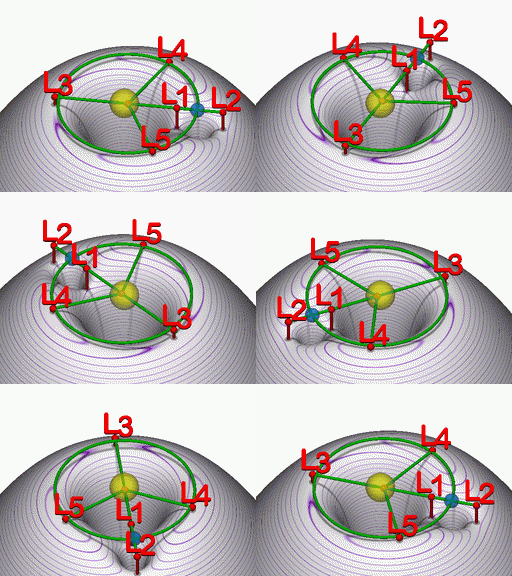
The Lagrange points are the five positions in an orbital configuration where a small object affected only by gravity can theoretically be part of a constant-shape pattern with two larger objects (such as a satellite with respect to the Earth and Moon). The Lagrange points mark positions where the combined gravitational pull of the two large masses provides precisely the centripetal force required to orbit with them. A satellite at L1 would have the same angular velocity of the earth with respect to the Sun and hence it would maintain the same position with respect to the Sun as seen from the Earth. A body at a Lagrange point orbits with the same period as the two massive bodies in the circular case, implying that it has the same ratio of gravitational force to radial distance as they do. This fact is independent of the circularity of the orbits, and it implies that the elliptical orbits traced by the Lagrangian points are solutions of the equation of motion of the third body. Without the earth’s gravitational influence, a satellite of the Sun, at the distance of L1, would have to move at a higher angular velocity than that of the Earth.
The L1 point lies on the line defined by the two large masses M1 (say, the Sun) and M2 (the Moon), and between them. It is the most intuitively understood of the Lagrange points: the one where the gravitational attraction of M2 partially cancels M1’s gravitational attraction.
For example, an object which orbits the Sun more closely than the Earth would normally have a shorter orbital period than the Earth, but that ignores the effect of the Earth’s own gravitational pull. If the object is directly between the Earth and the Sun, then the Earth’s gravity weakens the force pulling the object towards the Sun, and therefore increases the orbital period of the object. The closer to Earth the object is, the greater this effect is. At the L1 point, the orbital period of the object becomes exactly equal to the Earth’s orbital period. L1 is about 1.5 million km from the Earth.
The Sun–Earth L1 is suited for making observations of the Sun–Earth system. Objects here are never shadowed by the Earth or the Moon. The first mission of this type was the International Sun Earth Explorer 3 (ISEE3) mission used as an interplanetary early warning storm monitor for solar disturbances. Subsequently the Solar and Heliospheric Observatory (SOHO) was stationed in a Halo orbit at L1, and the Advanced Composition Explorer (ACE) in a Lissajous orbit, also at the L1 point. WIND is also at L1.
The Earth–Moon L1 allows comparatively easy access to lunar and earth orbits with minimal change in velocity and has this as an advantage to position a half-way manned space station intended to help transport cargo and personnel to the Moon and back.
The L2 point lies on the line through the two large masses, beyond the smaller of the two. Here, the gravitational forces of the two large masses balance the centrifugal effect on a body at L2.
For example, on the side of the Earth away from the Sun, the orbital period of an object would normally be greater than that of the Earth. The extra pull of the Earth’s gravity decreases the orbital period of the object, and at the L2 point that orbital period becomes equal to the Earth’s.
The Sun–Earth L2 is a good spot for space-based observatories. Because an object around L2 will maintain the same relative position with respect to the Sun and Earth, shielding and calibration are much simpler. It is, however, slightly beyond the reach of Earth’s umbra (shadow), so solar radiation is not completely blocked. Earth–Moon L2 would be a good location for a communications satellite covering the Moon’s far side, or “an ideal location” for a propellant depôt as part of the proposed depot-based space transportation architecture.
The Sun–Earth L2 is 1,500,000 km from the Earth;
The Earth–Moon L2 is 60,000 km from the Moon;
Spacecraft at the Sun–Earth L2 are in a Lissajous orbit until decommissioned, when they are sent into a ‘heliocentric graveyard’ orbit. They include: Wilkinson Microwave Anisotropy Probe (1st October 2001 to October 2010), Herschel Space Observatory (July 2009 to 29th April 2013), Planck Space Observatory (3rd July 2009 to 21st October 2013), Chang’e 2 (25th August 2011 to April 2012), from where it travelled to asteroid 4179 Toutatis and then into deep space, and the Gaia probe (January 2014 to 2018). The James Webb Space Telescope (2018) will use a Halo orbit.
Lyapunov orbits around a libration point are curved paths that lie entirely in the plane of the two primary bodies. In contrast, Lissajous orbits include components in this plane and perpendicular to it, and follow a Lissajous curve. Halo orbits also include components perpendicular to the plane, but they are periodic, while Lissajous orbits are not.
Gaia is in such an orbit, a figure-of-eight or a halo.
Click here to see  an animation of Gaia’s orbit which also shows all five Lagrange points.
And here is a representation of how a spacecraft can use a transfer orbit to reach L2.

The L3 point lies on the line defined by the two large masses, beyond the larger of the two.
For example, L3 in the Sun–Earth system exists on the opposite side of the Sun, a little outside the Earth’s orbit but slightly closer to the Sun than the Earth is. (This apparent contradiction is because the Sun is also affected by the Earth’s gravity, and so orbits around the two bodies’ barycentre, which is, however, well inside the body of the Sun.) At the L3 point, the combined pull of the Earth and Sun again causes the object to orbit with the same period as the Earth.
Scientists at the B612 Foundation are planning to use Venus’s L3 point to position their planned Sentinel telescope, which aims to look back towards Earth’s orbit and compile a catalogue of near-Earth asteroids.
One example of asteroids which visit an L3 point is the Hilda family whose orbit brings them to the Sun–Jupiter L3 point.
The L4 and L5 points lie at the third corners of the two equilateral triangles in the plane of orbit whose common base is the line between the centres of the two masses, such that the point lies behind (L5) or ahead (L4) of the smaller mass with regard to its orbit around the larger mass.
The reason these points are in balance is that, at L4 and L5, the distances to the two masses are equal. Accordingly, the gravitational forces from the two massive bodies are in the same ratio as the masses of the two bodies, and so the resultant force acts through the barycentre of the system; additionally, the geometry of the triangle ensures that the resultant acceleration is to the distance from the barycentre in the same ratio as for the two massive bodies. The barycentre being both the center of mass and center of rotation of the three-body system, this resultant force is exactly that required to keep the smaller body at the Lagrange point in orbital equilibrium with the other two larger bodies of system. (Indeed, the third body need not have negligible mass).
Early in the 20th century, “Trojan” asteroids were discovered at the L4 and L5 Lagrange points of the Sun–Jupiter system.
L4 and L5 are sometimes called triangular Lagrange points or Trojan points. The name “Trojan points” comes from these Trojan asteroids at the Sun–Jupiter L4 and L5 points, which themselves are named after characters from Homer’s Iliad (the legendary siege of Troy). Asteroids at the L4 point, which leads Jupiter, are referred to as the “Greek camp”, while those at the L5 point are referred to as the “Trojan camp”. These asteroids are (largely) named after characters from the respective sides of the Trojan War.
The Sun–Earth L4 and L5 points lie 60° ahead of and 60° behind the Earth as it orbits the Sun. The regions around these points contain interplanetary dust and at least one asteroid, 2010 TK7, detected in October 2010 by WISE and announced in July 2011.
The Earth–Moon L4 and L5 points lie 60° ahead of and 60° behind the Moon as it orbits the Earth. They may contain interplanetary dust in what is called Kordylewski clouds; however, the Hiten spacecraft’s Munich Dust Counter (MDC) detected no increase in dust during its passes through these points.
The region around the Sun–Jupiter L4 and L5 points are occupied by the Trojan asteroids. The region around the Sun–Neptune L4 and L5 points have trojan objects.
Saturn’s moon Tethys has two much smaller satellites at its L4 and L5 points named Telesto and Calypso, respectively.
Saturn’s moon Dione has smaller moons Helene and Polydeuces at its L4 and L5 points, respectively.
One version of the ‘giant impact hypothesis’ suggests that an object named “Theia” formed at the Sun–Earth L4 or L5 points and crashed into the Earth after its orbit destabilized, forming the Moon.
[Set to the tune of “Home on the Range”,
written in 1977 by William S. Higgins and Barry D. Gehm]
Oh, give me a locus where the gravitons focus
Where the three-body problem is solved,
Where the microwaves play down at three degrees K,
And the cold virus never evolved.
[chorus]
We eat algae pie, our vacuum is high,
Our ball bearings are perfectly round.
Our horizon is curved, our warheads are MIRVed*,
And a kilogram weighs half a pound.
[chorus]
If we run out of space for our burgeoning race
No more Lebensraum left for the Mensch
When we’re ready to start, we can take Mars apart,
If we just find a big enough wrench.
[chorus]
I’m sick of this place, it’s just McDonald’s in space,
And living up here is a bore.
Tell the shiggies**, “Don’t cry,” they can kiss me goodbye
’Cause I’m moving next week to L4! [chorus]
CHORUS: Home, home on LaGrange,
Where the space debris always collects,
We possess, so it seems, two of Man’s greatest dreams:
Solar power and zero-gee sex.
* MIRV: Multiple independently targetable reentry vehicle, a ballistic missile payload containing several warheads
** Shiggy: Stand on Zanzibar is a science fiction novel written by John Brunner and first published in 1968; it uses the word shiggy to mean a woman.
The Universe is a complex place, and without a full understanding of it, astronomers have given names and classified objects according to all sorts of “rules”. So, confusingly, you can often find the same object with two, three or more names. The IAU is supposed to sort all this out, putting objects into their appropriate categories, with appropriate names. However, it will be many years before Sirius or the Dog Star is always Alpha Canis Majoris (α CMa), or whatever the boffins decide.
At the IAU General Assembly in July 2004, the IAU’s Working Group for Planetary System Nomenclature (WGPSN) suggested it may become advisable to not name small satellites, as CCD technology makes it possible to discover satellites as small as 1 km in diameter. To date, however, names have eventually been applied to all moons discovered, regardless of size.
When satellites are first discovered, they are given provisional designations such as “S/2010 J 2” (the second new satellite of Jupiter discovered in 2010) or “S/2003 S 1” (the first new satellite of Saturn discovered in 2003). The initial “S/” stands for “satellite”, and distinguishes from such prefixes as “D/”, “C/”, and “P/“, used for comets. The designation “R/” is used for planetary rings. These designations are sometimes written as “S/2003 S1”, dropping the second space. The letter following the category and year identifies the planet (Jupiter, Saturn, Uranus, Neptune; although no occurrence of the other planets is expected, Mars and Mercury are provisionally disambiguated through the use of “Hermes” for the latter). Pluto was designated by “P” before its reclassification as a dwarf planet. When the object is found around a minor planet, the identifier used is the latter’s number in parentheses. Thus, Dactyl, the moon of 243 Ida, was at first designated “S/1993 (243) 1”. Once confirmed and named, it became “(243) Ida I Dactyl”. Similarly, the fourth satellite of Pluto, discovered after Pluto was categorized as a dwarf planet and assigned a minor planet number, is designated “S/2011 (134340) 1” rather than “S/2011 P 1“, though the New Horizons team, who disagree with the dwarf planet classification, use the latter. H = Mercury (Hermes), V = Venus, E = Earth, M = Mars, J = Jupiter, S = Saturn, U = Uranus and N = Neptune.
After a few months or years, when a newly discovered satellite’s existence has been confirmed and its orbit computed, a permanent name is chosen, which replaces the “S/” provisional designation. However, in the past, some satellites remained unnamed for surprisingly long periods after their discovery.
Minor planets (or asteroids) have various naming conventions. Initially, the names given came from Greek or Roman myths, with a preference for female names, preceded by a number in order of discovery. With the discovery in 1898 of the first body found to cross the orbit of Mars, a different choice was deemed appropriate, and 433 Eros was chosen. This started a pattern of female names for main-belt bodies and male names for those with unusual orbits.
As more and more discoveries were made, this system was recognized as being inadequate and a new one was devised. They now look like this: “(28978) 2001 KX76” or, if named by its discoverer, “(28978) Ixion”.
More details here.