My Favourite Authors
Before we start, here’s a real book enthusiast!
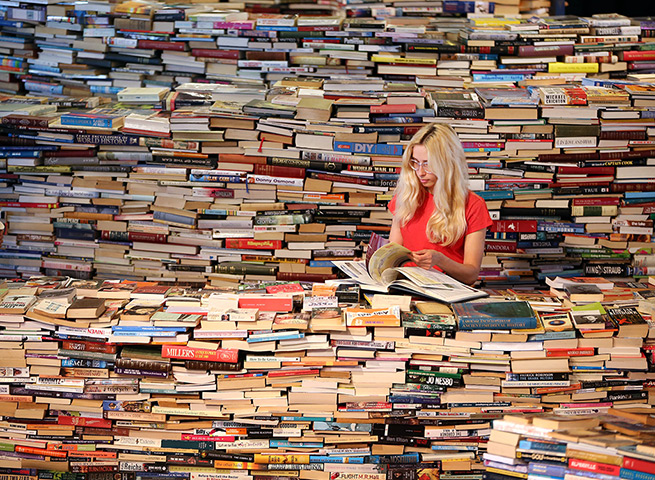
Tilly Shiner looks at a book in the aMAZE me labyrinth at the Southbank Centre, London
Before we start, here’s a real book enthusiast!
The Hitch-Hiker’s Guide to the Galaxy series, Dirk Gently, etc. He was a keen environmentalist; it’s a pity he died so young — he could have been entertaining us and making us think for many more years. See the H2G2 Web-site.
He was a staunch atheist, famously imagining a ‘sentient puddle’ who wakes up one morning and thinks “This is an interesting world I find myself in – an interesting hole I find myself in – fits me rather neatly, doesn’t it? In fact it fits me staggeringly well, must have been made to have me in it!” to demonstrate the fallacy of the fine-tuned Universe argument for God.
I enjoyed first reading his books many years ago, but now his Science Fiction stories, like The Foundation series seem a little dated. Not only has science moved in a different direction, but so have social attitudes, for example of men towards women: so sexist.
Born in Russia, he was one of the most prolific writers of all time, having written or edited more than 500 books and an estimated 90,000 letters and postcards. His works have been published in all ten major categories of the Dewey Decimal System (although his only work in the 100s, which covers philosophy and psychology, was a foreword for The Humanist Way).
See also his ideas on the orbits of the Sun and Moon.
I like especially and have read and reread the Spy novels featuring George Smiley (Tinker, Tailor, Soldier, Spy, Smiley’s People, etc.); The Tailor of Panama is one of my favourites. His novels about the Cold War are his best, but others like The Constant Gardener, Single and Single, The Little Drummer Girl and A Perfect Spy are excellent. The only one I’ve not really got into is A Naïve and Sentimental Lover. Many have been made into excellent films and television series; who could forget Sir Alec Guinness in Tinker, Tailor, Soldier, Spy?
For me, the Miss Marple and Hercule Poirot stories are like old friends — she is another ‘easy reader’ and her stories have transferred well to television.
According to the Guinness Book of World Records, she is the best-selling novelist of all time. Her novels have sold roughly four billion copies, and her estate claims that her works rank third, after those of William Shakespeare and the Bible, as the world’s most widely published books.
The author of Fanny Hill: or, the Memoirs of a Woman of Pleasure, written in the Fleet Prison where he served over a year for a debt — prosecuted and banned as pornography; he disowned Fanny Hill, and many pirated versions appeared, with different story-lines.
Cleland’s obituary in the Monthly Review said that he had been granted a government annuity of one hundred pounds to prevent his writing further obscenity for pay!
(This sounds like a lucrative scam to get into!)
The Bond stories — rather trashy novels, but easy to read; an English teacher I knew years ago said he preferred teenagers to read this sort of thing rather than read nothing at all.
Fleming was an English author, journalist and Naval Intelligence Officer from a wealthy family; he was educated at Eton, Sandhurst and the universities of Munich and Geneva. In May 1939 Fleming was recruited by Rear Admiral John Godfrey, Director of Naval Intelligence of the Royal Navy, to become his personal assistant. His wartime service and his career as a journalist provided much of the background, detail and depth of the James Bond novels.
His is an outstanding and quick mind;
his stories (like The Liar) and autobiographies (Moab is My Washpot) are full of humour, which also leaps from his television quiz programme QI. Just one thing — his ‘elves’ who delve into obscure sources and come up with gems aren’t always right!
The Wind in the Willows was given to me by my primary school teacher, Miss Mattey, many, many years ago. The tails of the river bank must be among the best children’s stories ever.
Another favourite writer of children’s stories was Captain Frederick Marryat. His book The Children of the New Forest was published in 1847 and set in the time of the English Civil War and the Commonwealth, in a part of the New Forest where my grandmother lived; so it had a special meaning for me. (The house in the story was called ‘Arnwood’ and my grandmother lived in Arnewood Bridge Road, Sway.)
A specialist in thrillers about U.S. lawyers, my favourites being The Partner, The Client and The Brethren.
The Partner is a fast-moving story with many threads, almost all of which come together at the end; I’ve re-read it several times.
Another good novel, again in the legal world, is The Pelican Brief which has been made into a successful film, as has The Client, the story of two young boys who witness a suicide.
“November 20. Bought a cheap address-book. I spent the evening copying in the names and addresses of my friends and acquaintances. Left out the Mutlars of course” – from Diary of a Nobody.
George Grossmith (1847 — 1912) [left] and his brother [Walter] Weedon Grossmith (1854 — 1919) [right] were English writers and actors, both involved with Gilbert and Sullivan’s comic operas. George was also a comedian, composer and singer who created a series of nine memorable characters from 1877 to 1889, including Sir Joseph Porter in HMS Pinafore (1878), the Major-General in The Pirates of Penzance (1880) and Ko-Ko in The Mikado (1885–87). Weedon was also a painter and playwright. Together they wrote the 1892 comic novel Diary of a Nobody, about the everyday life of a lower middle class clerk from Holloway, working in the City.
Tess of the d’Urbervilles,
Far from the Madding Crowd,
The Mayor of Casterbridge — his stories are steeped in the life and intrigue of his native Dorset, his ‘Wessex’; much of his work was initially published in serial form in magazines.
Like Charles Dickens (who is not really my cup of tea) he was highly critical of much in Victorian society, though Hardy focussed more on a declining rural society.
For Whom the Bell Tolls — in 1937 he started reporting on the Spanish Civil War; he won the Nobel Prize in Literature in 1954.
For successful writing “Use short sentences. Use short first paragraphs. Use vigorous English. Be positive, not negative”.
He committed suicide in summer 1961.
A Severed Head,
The Bell — she was born in Dublin, moved to London and became a Communist at Oxford University; she won the Booker Prize in 1978 for The Sea, the Sea; she died of Alzheimer’s disease.
She is best remembered for her novels about good and evil, sexual relationships, morality, and the power of the unconscious. Her novels, in their attention and generosity to the inner lives of individuals, follow the tradition of novelists like Dostoevsky, Tolstoy, George Eliot, and Proust, besides showing an abiding love of Shakespeare.
Animal Farm,
1984.
These are both strong political allegories, with messages that politicians should mull over.
1984 was published in 1949, and although he may have been a little early in his predictions, many of them seem to be coming to fruition in the early 21st century, with terms and concepts like ‘Big Brother’, ‘Newspeak’, ‘doublethink’ and ‘thoughtcrime’ having entered the English language. The proliferation of CCTVs makes his famous line “Big Brother is Watching You” seem ever truer.
In particular, his trilogy His Dark Materials: (Northern Lights [published as The Golden Compass in the USA and made into a film so called], The Subtle Knife and The Amber Spyglass). Although superficially stories for children (or at least young teenagers), they are very thought-provoking to me. Does that mean I’m a kid at heart, or the books can really be read on different levels? A bit of each, I suspect! When are the other two books to appear as films? The BBC apparently plans to dramatise the trilogy.
Portnoy’s Complaint — the humorous and sexually explicit psychoanalytical monologue of “a lust-ridden, mother-addicted young Jewish bachelor,” filled with “intimate, shameful detail, and coarse, abusive language”. Roth has been one of the most honoured authors of his generation: his books have twice been awarded the National Book Award, twice the National Book Critics Circle award, and three times the PEN/Faulkner Award. He received a Pulitzer Prize for his 1997 novel, American Pastoral. His 2000 novel The Human Stain was awarded the W H Smith Literary Award for the best book of the year. His fiction is known for its intensely autobiographical character, for philosophically and formally blurring the distinction between reality and fiction, for its “supple, ingenious style” and for its provocative explorations of Jewish and American identity. Roth is the winner of Spain’s 2012 Prince of Asturias Award for Literature in recognition of his formidable contribution to American literature.
The Catcher in the Rye — a depiction of adolescent alienation and loss of innocence; Salinger became a recluse after this novel; He last published an original work in 1965, and gave his last interview in 1980. The novel’s plot details a sixteen-year-old’s experiences in New York City following his expulsion from his current school and three previous schools. The book is more notable for the persona and testimonial voice of its first-person narrator who serves as an insightful but unreliable narrator expounding on the importance of loyalty, the “phoniness” of adulthood, and his own duplicity. Salinger admitted that the novel was “sort of” autobiographical, explaining that “My boyhood was very much the same as that of the boy in the book... It was a great relief telling people about it”.
Blott On the Landscape.
He also wrote the Wilt series and Porterhouse Blue; many became successful on film and television. Blott with David Suchet and Geraldine James was my favourite one. He died in Llafranc, Catalonia, where he wrote Wilt in Nowhere. Despite living in Spain he has not learned either Catalan or Spanish. “I don’t want to learn the language,” he says. “I don’t want to hear what the price of meat is.”
Frankenstein: or The Modern Prometheus.
She wrote this, her most famous novel in 1818. She also edited and promoted the works of her husband, the Romantic poet and philosopher Percy Bysshe Shelley. She was a prolific writer; in Valperga; or, The Life and Adventures of Castruccio, Prince of Lucca (1823) she writes:
“[Euthanasia] was never heard of more; even her name perished... The private chronicles, from which the foregoing relation has been collected, end with the death of Euthanasia. It is therefore in public histories alone that we find an account of the last years of the life of Castruccio.”
In The Last Man, she demonstrates the ultimate meaninglessness of the world. While earlier novels had shown how rational individuals could slowly improve society, The Last Man and Frankenstein demonstrate the individual’s lack of control over history.
A Town Like Alice,
On the Beach.
His novels were obligatory reading when I was young. Maybe they’ll enjoy a revival some day. His full name was Nevil Shute Norway; he was a popular British-Australian novelist and a successful aeronautical engineer. He used his full name in his engineering career, and Nevil Shute as his pen name, in order to protect his engineering career from any potential negative publicity in connection with his novels.
One Day in the Life of Ivan Denisovich — a story set in a gulag (prison camp) of Soviet Russia. It was published in November 1962 in the Soviet literary magazine Novy Mir (New World). The story describes a single day of an ordinary prisoner, Ivan Denisovich Shukhov. Its publication was an extraordinary event in Soviet literary history — never before had an account of Stalinist repression been openly distributed. The editor of Novy Mir, Aleksandr Tvardovsky, wrote a short introduction for the issue, titled “Instead of a Foreword”, to prepare the journal’s readers for what they were about to experience.
Dracula; handwritten on the typed title page of the first edition was “THE UN-DEAD”.
Abraham “Bram” Stoker was an Irish novelist and short story writer, best known today for his 1897 Gothic novel Dracula. During his lifetime, he was better known as personal assistant of actor Henry Irving and business manager of the Lyceum Theatre in London, which Irving owned. Before writing Dracula, Stoker spent several years researching European folklore and mythological stories of vampires. Dracula was written as a collection of realistic, but completely fictional, diary entries, telegrams, letters, ship’s logs, and newspaper clippings, all of which added a level of detailed realism to his story, a skill he developed as a newspaper writer on the Daily Telegraph.
The Hobbit,
The Lord of the Rings; has anyone ever read The Silmarillion, which was published by his son Christopher after J R R’s death?
Tolkien was Professor of Anglo-Saxon and English Language and Literature at Oxford University. The result was his world of ‘Middle Earth’.
The Adrian Mole series — The Secret Diary of Adrian Mole, Aged 13¾, The Growing Pains of Adrian Mole, The True Confessions of Adrian Albert Mole, Adrian Mole: The Wilderness Years, Adrian Mole: The Cappuccino Years and amusingly so on.
In 1992 she published The Queen and I, a story about the British royal family living a “normal” life on an urban housing estate following a republican revolution; I haven’t read it, but it sounds a very good idea to me!
A Boy’s Own Story,
The Beautiful Room Is Empty,
The Joy of Gay Sex
[co-author with Charles Silverstein].
The first two are novels with a gay theme. The third is more of a celebration of homosexuality, and also something of an encyclopedia on the subject.
The Day of the Triffids,
The Kraken Wakes,
The Chrysalids.
His real name was John Wyndham Parkes Lucas Beynon Harris; he is another science fiction writer on my list. He usually used the pen name John Wyndham, although he also used other combinations of his names, such as John Beynon and Lucas Parkes, though I have never encountered his works under those names. Many of his works were set in post-apocalyptic landscapes.
See this brief biography.
The authors named in this section are all writers of fiction, some also of nonfiction, some of fact-based fiction. Chaucer and Shakespeare are listed elsewhere.
One writer I’ve deliberately omitted is Ken Follett author of, among others, The Pillars of the Earth and World Without End, both majestic novels about life in mediæval England; however I found them truly gruesome in their explicit depictions of torture and execution. Not recommended for that reason (I’m too squeamish!).
Writers of true nonfiction are listed in the appropriate pages; for example, histories of London buses are in the London buses page.
Now try my stories: Millennium; Prokofiev; The Green Flash; The Plutonian.
There’s a long list somewhere of books that some people may think ought to be on my list. I must admit that many of them — Beowulf, say, I have never read and doubt if I ever will.
Others, like those of the Brontë sisters and Jane Austen, I have delved into at some time, but not been able to ‘get into’ them. I’m sure many of you will disagree. Charles Dickens isn’t there because I have found most of his stories too depressing, accurate though they may be in their accounts of life in Victorian London (like his exposure of prostitution in The Sale of Two Titties). The Sherlock Holmes tales by Sir Arthur Conan-Doyle might have made it, except that I find them rather too light; clever plots though, and they made amusing television when camped up. R D Blackmore (Lorna Doone), John Buchan (The Thirty-Nine Steps), Samuel Butler (Erewhon), George Eliot (Silas Marner), Franz Kafka (The Trial)...
I’m afraid life isn’t long enough.