Chaucer and Shakespeare are in a different league from all the other authors I’ve selected

Chaucer and Shakespeare are in a different league from all the other authors I’ve selected

The Canterbury Tales by Geoffrey Chaucer (1342 — 1400) edited by Sinan Kökbugur" (but beware of the ads!)
Geoffrey Chaucer, the ‘First English Poet’, was born in 1342. We are uncertain about his exact date of birth. His well-to-do parents, John Chaucer and Agnes Copton, possessed several buildings in the vintage quarter in London. Not much is known about Geoffrey’s school career. He must have had some education in Latin and Greek. Out of school he went on as a page in the household of the Countess of Ulster. Chaucer rose in royal employment and became a knight of the shire for Kent. As a member of the king’s household, Chaucer was sent on diplomatic errands throughout Europe. From all these activities, he gained the knowledge of society that made it possible to write The Canterbury Tales.
He was buried in Westminster Abbey in London. A tomb, erected by an admirer in the fifteenth century, marks his grave and his remains were subsequently moved. He was the first person to be buried in what we now know as the Poets Corner in Westminster Abbey.
Some time ago, I searched many bookshops in London, looking for a copy of The Canterbury Tales in Middle English, but in vain. Back in Spain, I went to a bookshop in Barcelona and found exactly what I was looking for in an inexpensive couple of paperbacks. The translation below into Modern English is that of Nevill Coghill.
Compare Chaucer’s English (here) with Shakespeare’s (below), 200-odd years later.
Whan that Aprill, with his shoures soote
The droghte of March hath perced to the roote,
And bathed every veyne in swich licour,
Of which vertu engendred is the flour;
Whan Zephirus eek with his sweete breeth
Inspired hath in every holt and heeth
The tendre croppes, and the yonge sonne
Hath in the Ram his halfe cours yronne,
And smale foweles maken melodye,
That slepen al the nyght with open eye —
So priketh hem nature in hir corages —
Thanne longen folk to goon on pilgrimages
And palmeres for to seken straunge strondes
To ferne halwes, kowthe in sondry londes;
And specially from every shires ende
Of Engelond to Caunterbury they wende,
The hooly blisful martir for to seke
That hem hath holpen, whan that they were seeke.
When in April the sweet showers fall
And pierce the drought of March to the root, and all
The veins are bathed in liquor of such power
As brings about the engendering of the flower,
When also Zephyrus with his sweet breath
Exhales an air in every grove and heath
Upon the tender shoots, and the young sun
His half-course in the sign of the Ram has run,
And the small fowl are making melody
That sleep away the night with open eye
(So nature pricks them and their heart engages)
Then people long to go on pilgrimages
And palmers long to seek the stranger strands
Of far-off saints, hallowed in sundry lands,
And specially, from every shire’s end
In England, down to Canterbury they wend
To seek the holy blissful martyr*, quick
To give his help to when they lay sick.
* Martyr: St Thomas à Becket of Canterbury
* his exact birth date is unknown, but is traditionally observed on 23rd April, St George's Day; his death is also recorded as 23rd April.
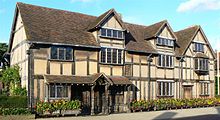
William Shakespeare’s birthplace in
Stratford-upon-Avon.
Miguel de Cervantes, the author of Don Quixote, also died on 23rd April 1616, but because Spain had already adopted the Gregorian calendar, the two authors actually died ten days apart.

Copper engraving of Shakespeare by Martin Droeshout from the title page of the First Folio, 1623
Try these puzzles including The Death of Macbeth, Glitter and The Ides of March.
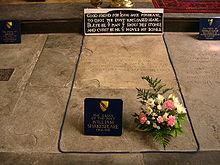
His grave at the Holy Trinity Church,
Stratford-upon-Avon, bearing these words:
Good frend for Iesvs sake forbeare,
To digg the dvst encloased heare.
Bleste be ye man yt spares thes stones,
And cvrst be he yt moves my bones.
(Good friend, for Jesus’ sake forbear,
To dig the dust enclosèd here.
Blessèd be the man that spares these stones,
And cursed be he who moves my bones.)
Few details of Shakespeare’s sexuality are known. At 18, he married 26-year-old Anne Hathaway, who was pregnant. However, over the centuries readers have pointed to Shakespeare’s sonnets as evidence of his love for a young man. Others read the same passages as the expression of intense friendship rather than sexual love. At the same time, the 26 so-called “Dark Lady” sonnets are taken as evidence of heterosexual liaisons; others have suggested that the Dark Lady was in fact a Dark Man.
Shall I compare thee to a Summers day?
Thou art more louely and more temperate:
Rough windes do ſhake the darling buds of Maie,
And Summers leaſe hath all too ſhort a date:
Sometime too hot the eye of heauen ſhines,
And often is his gold complexion dimm’d,
And euery faire from fair ſome-time declines,
By chance,or natures changing courſe vntrim’d:
But thy eternall Summer ſhall not fade,
Nor looſe poſſeſſion of that faire thou ow’ſt,
Nor ſhall death brag thou wandr’ſt in his ſhade,
When in eternall lines to time thou grow’ſt,
So long as men can breath or eyes can ſee,
So long liues this,and this giues life to thee,
Shall I compare thee to a summer’s day?
Thou art more lovely and more temperate:
Rough winds do shake the darling buds of May,
And summer’s lease hath all too short a date:
Sometime too hot the eye of heaven shines,
And often is his gold complexion dimm’d;
And every fair from fair sometime declines,
By chance or nature’s changing course ntrimm’d;
But thy eternal summer shall not fade
Nor lose possession of that fair thou owest;
Nor shall Death brag thou wander’st in his shade,
When in eternal lines to time thou growest:
So long as men can breathe or eyes can see,
So long lives this and this gives life to thee.
Skal jeg sammenligne deg med en sommers dag?
Veel zachter en veel zonniger ben jij
Der Sturm zerreißt des Maien Blüthen-Kränze,
Och sommarns fröjd hvad är så kort som den?
As vezes em calor e brilho o Sol se excede
Interdum, aut hebes est aureus ille color;
Toute beauté parfois diminue de beauté,
Sciupata dal caso o dal mutevole corso di natura;
Mas tu eterno estío no decaerá
Ty nikdy neztratíš nynejší jas své krásy,
Kuolemakaan ei kersku; vaikka vaellat sen varjossa,
Sen esitken ebedi misralarla zamana
Mentre els homes respirin i els ulls puguin mirar,
So long lives this and this gives life to thee.
The Art of Shakespeare’s Sonnets by Helen Vendler (Harvard University Press) gives an in-depth analysis of each of the 154 Sonnets; a highly recommended book
The Massachusetts Institute of Technology (MIT) has an accessible web-site devoted to
The Complete Works of William Shakespeare
The Globe held a multilingual sonnet reading on 21st April 2012 to mark Shakespeare’s birthday;
from The Guardian’s web [see above].