
Loading...
Loading...
Here are some puzzles and questions. They are a random selection of general knowledge things. Try to work out the answer and click on the link to see if you’re right.
There are puzzles on Flags, the English Language, Other Languages, What’s the Problem?, Transport, Crosswords, Connections, Calculations, Shakespeare and other things to tease your mind.
Here we go...
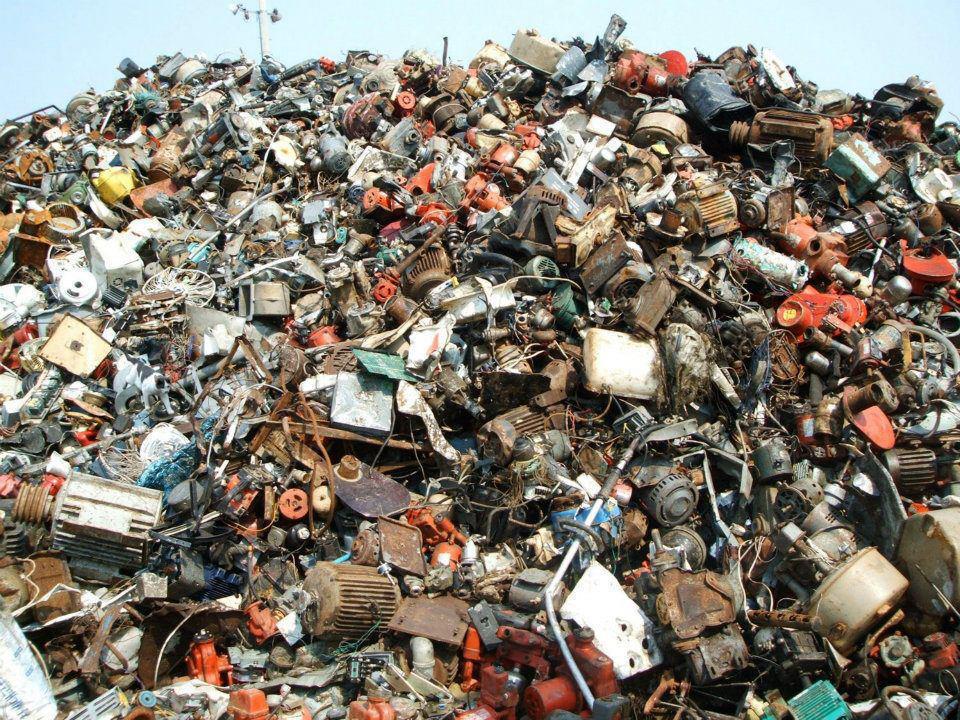
Where’s the Cat? Come on, Puss! Surely it can’t be fun messing about in that industrial rubbish heap.
The answer is to be found here.
And there’s another cat to be found in my Photo Gallery of Cats. Try finding that one too.
There are also amusing pictures of cats here.
Both the terms Union Jack and Union Flag are used for the flag of the United Kingdom of Great Britain and Northern Ireland despite some people insisting that ‘Jack’ is wrong except nautically. In Canada the flag is officially called the Royal Union Flag. In Hong Kong, the flag has the nickname “Rice-Character Flag” in Chinese, since the pattern looks like the Chinese character for “rice” (米). Among Irish republicans The Butcher’s Apron is a pejorative term for the flag. The flag appears in the upper left quadrant of many naval ensigns and national flags, British and Commonwealth. It is also present in the flags of some United States cities; Hawaii’s flag represents the only current use of the Union Jack in any American state flag. The flag of the Basque Country Autonomous Community of Spain is also loosely based on the Union Flag, reflecting the significant commercial ties between Bilbao and Britain at the time it was designed (1894). [The Hawaiian and Basque flags are shown if you click ‘Answer’ below – but wait for the question first!]
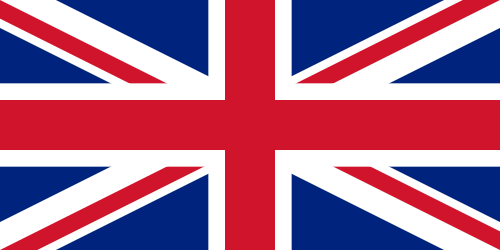
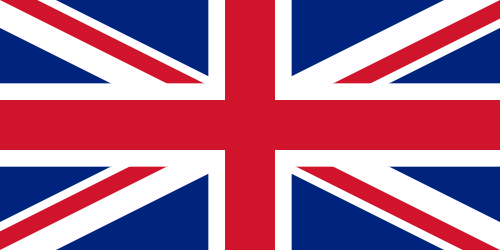
Many people are unaware that there is a right and a wrong way to hoist the flag, or they might know there is a difference, but not know what it is. Note that the red X is not centred in the larger white X.
Assuming the flag-pole is on the left, which of the two flags shown below is correctly orientated?
▲
▲
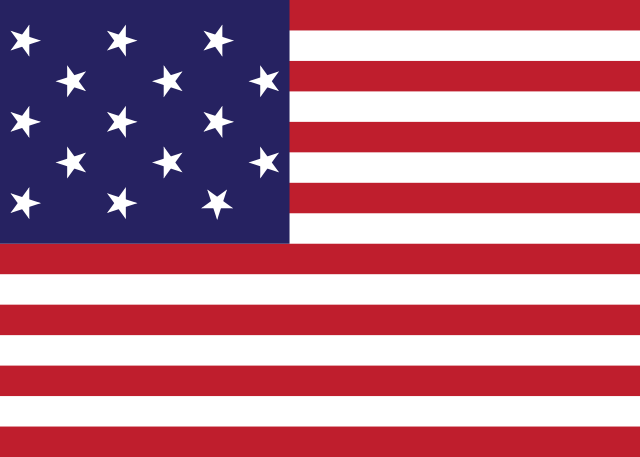
The American flag is always changing, whenever a new State enters the Union another star is added. But what is this? Be specific, do some counting, and then think musically.
The Commonwealth consists of 54 nations. The majority, from the United Kingdom through those that became self-governing, like Canada and Australia, to those that obtained their independence from Britain relatively recently, like Botswana and Malaysia, were at some time in their history colonies or protectorates of the British; they all had former colonial or constitutional links with the United Kingdom.
Some that had such links with Britain have severed them on independence, and are no longer member states of the Commonwealth, like the Irish Republic and Burma (Myanmar). Some, like Fiji, are currently “suspended” from membership.
Two countries never had any constitutional links with the UK. What countries are they? As a clue, they joined the Commonwealth in 1995 and 2009, and are both in Africa.
Do you think he will?
I don’t know. He might.
I suppose he ought to, but perhaps he feels he can’t.
Well, his brothers have. They perhaps think he needn’t.
Perhaps eventually he may. I think he should, and I very much hope he will.
This shows how it is possible to invent a series of sentences using only auxiliary verbs, with a few non-specific ones thrown in (know, suppose, feels, etc.); the sentence that was before all these contains the key that makes sense of it; this ‘key’ can be found here.
If you like playing about with the English language or seeing some of its quirks take a look at my Fun with English or Puns pages.

Ahora, para los que hablan el idioma español, para practicar su pronunciación en inglés.
El padre de la reina británica, Isabel II, fue el rey Jorge VI y tuvo un trono; en inglés:

Ara, per als que parlan l’idioma catalá, per practicar la seva pronunciació anglesa.
El pare de la reina britànica Isabel II estigué el rei Jordi VI i possessionà un tron; en anglès:

George the Sixth’s throne
/dʒɔːdʒ ðə sıksθs θrəʊn/
(in phonetic symbols)

French? After ‘George VI’s throne’ [for Spanish and Catalan readers], another pronunciation puzzle, this time for English(!) speakers: Say out loud: «Et l’eau, c’est l’heure»
There’s an English noun in the singular; if you add an ‘s’ you get a plural (that’s as usual so far); but if you add two ‘s’s, you get a singular noun. What am I talking about?
In a class, Jim had written an essay and in it had used the verb form “had had”; in Jane’s similar account, she had used just “had”. Now you punctuate this:
Jim whereas Jane had had had had had had had had had had had the teachers approval
And punctuate: That that is is that that is not is not is that it it is.
Check the answers to both punctuation problems.
Read more about playing with repeated words in my page on the English language.
There is, so far as I’m aware, only one word that can be inserted between any pairs of words, or at the start or end, of this sentence. Each variant gives a slightly different meaning to the sentence (except the last two which are the same). The starting sentence is:
So the variants are, with X being the word you have to find:
(If London buses are your interest, see here)
What is the only de jure [Latin for “according to law”] official language in any part of the United Kingdom?
What does this mean?
Iechyd da i chwi yn awr ac yn oesoedd.
What language is it in?
Where does it appear, specifically?
And where is it now?
“There’ll Be Bluebirds Over the White Cliffs of Dover” was a popular World War II song, made famous by Vera Lynn with her 1942 recording, one of her best known. What’s the problem?
What do you get if you put these together?
“Water water everywhere and not a drop to drink” from the Rhyme of the Ancient Mariner by Samuel Coleridge Taylor. What’s the problem?
What did Ilsa (Ingrid Bergman) NOT tell Sam (Dooley Wilson), the bar pianist, to do in the 1942 film Casablanca, which co-starred Humphrey Bogart as Rick?
“When all is said and done, at the end of the day the bottom line is that we must absolutely think outside the box. For, all things considered, we must draw our line in the sand and not give an inch. But reading between the lines we’re not reinventing the wheel — it’s not rocket science. Anyway, unless we’re making a mountain out of a mole-hill, come hell or high water we might have missed the boat.”
In which country is the practice of Swedish rounding most commonly done?
(Swedish rounding is rounding the basic cost of a purchase which is to be paid for in cash to the nearest multiple of the smallest denomination of currency.
So 1 or 2 units are treated as 0, while 3 or 4 are treated as 5, assuming that the smallest coin is 5 units.)
See also my page about Money.
How many lakes are there in the English Lake District National Park?
Distances along British Railways lines are usually measured in miles and chains from a defined point for each line (for main lines this is often the London terminus; for branch lines it is often the point where the branch leaves the main line).
How are distances on London Underground lines measured and determined?
The RAC (which used to be called the “Royal Automobile Club”) launched an advertising campaign that includes the words “Motorists, we salute you”.
What special significance does this slogan have?
Here are five questions about British Railway stations. Try them all before looking up the answers!
(Clue: its Station code is TEA)
Which Airport does it serve?
What train service does it provide?
How many passengers use it?
It’s not on my British Railway page – sorry!
We have all heard about the Malaysian Airways flight 370 from Kuala Lumpur International Airport, Malaysia (International Air Transport Association [IATA] code: KUL) to Beijing Capital International Airport, China (PEK), but I’d like you to tell me what airports the following IATA codes denote. I’ve added a clue to some of the more obscure ones.
Some easy ones
These are a bit harder so I’ve added some hints
See also the Aeroplanes and Airports page.
In Shakespeare’s Macbeth (Act 4, Scene 1) – the scene in which the three witches make their incantation “Double, double toil and trouble; Fire burn, and cauldron bubble” – three apparitions appear:
The first warning is quite clear – beware of Macduff, the thane of Fife.
But what do the second and third apparitions mean by:
“None of woman born shall harm Macbeth”?
and “Macbeth shall never vanquish’d be until Great Birnam wood to high Dunsinane hill shall come against him”?
“All that glitters is not gold” from Shakespeare’s The Merchant of Venice. Is anything wrong here?
In Shakespeare’s Julius Caesar (Act 1 Scene 2) this interchange appears:
What were the Ides of March?
The answer has thirteen letters making six words; what is the question? – Answer
Click on the photo above to see pictures supplied by my American school pen-pal from way, way back — thanks, DD!
Other quotations on my web site are by Spike Milligan, by Confucius (or rather things he didn’t say), on When Insults had Class, and a Miscellany of One-liners.
Or read about my views on Politics.
Who were these people:
(1) C.A.E., (2) H.D.S.-P., (3) R.B.T., (4) W.M.B., (5) R.P.A., (6) Ysobel, (7) Troyte, (8) W.N., (9) A.J.J., (10) Dorabella, (11) G.R.S., (12) B.G.N., (13) Romanza, and finally (14) E.D.U.?
I don’t expect you to identify them all individually.
But I would like to know who A.J.J. is better known as (I’ll even tell you his name was A.J.Jaeger);
and what’s odd about E.D.U.?
Where, apart from on ITV, would you find Coronation Street?
Clue: It’s near Cockle Street and Donkey Street; it’s only that one I’m asking about; I know there are many Coronation Streets all over the place.
This has to be one of the best ‘singles’ ads ever printed, though I can’t vouch for its authenticity. It is reported to have appeared in the

SINGLE BLACK FEMALE seeks male companionship, ethnicity unimportant. I’m a very good girl who LOVES to play. I love long walks in the woods, riding in your pickup truck, hunting, camping and fishing trips, cosy winter nights lying by the fire. Candlelight dinners will have me eating out of your hand. I’ll be at the front door when you get home from work, wearing only what nature gave me... Call 01637*** and ask for Annie, I’ll be waiting...
Connect: London, the sewing machine, a Kentish village, a powerful man, a hypocoristic suffix, and a town in Hertfordshire.
What is the next in this sequence?
And how does it relate to the first?
What dually connects a ballet dancer and an African religious leader? And what was singularly elementary? (What clues can I give? Dually is a pun; think of what ballet dancers wear; and how many African religious leaders do you know? The last part should be easy once you’ve got the first part, well maybe, but not W.)
Every year for the past umpteen, BBC Radio has broadcast a quiz programme that consists of questions rather more searching than those on The Weakest Link. It’s a contest between representatives of the various regions and countries making up the UK.
See also my thoughts on Radio.
I sent in a rather lengthy question, which was broadcast on 14/09/2009. The broadcast question was:
Can you relate: a nocturnal lemur, an island occupied by Circe, and a Jovian attendant — and which agriculturalist might be interested in all of them?
My original question included a Catalan grandma, but she was edited out.
What is the connection between a national rugby team, an exploiter of weaknesses, and a “Prime Minister”?
What are the final words in this sequence? And explain:
What happened in 1997?
And how did Kisho Kurokawa (1934–2007) get involved?
Imagine that you wanted for some reason (don’t ask why) to build a brick wall 3½ metres high around the equator of the Moon. You may assume that the equator is perfectly circular, with no awkward craters, mountains, canyons, etc. Each brick measures 30 centimetres in length and 10 centimetres in height, both measurements including the cement to attach the brick to its neighbours; the width is irrelevant. If you’re interested, the equatorial radius of the Moon is 1,738.14 kilometres; but, then, that may not interest you.
How many bricks more will be needed for the top row compared with the bottom row?
Assume that the value of π is 31/7 (or 22/7, to keep the arithmetic simple).
In a good day’s hunting, roughly how many penguins does a polar bear catch?
(No, it’s not a trick like Why did the Communist chicken cross the American road? – it was a Rhode Island Red.)
Clue: You can find the answer if you follow a link from my Astronomy page.
Three gun-slinging cowboys agree to have a three-way duel (is that a “truel”?), for reasons we’ll not go into. In other words, they will take it in turns to shoot, until only one survives.
Accurate Aaron is the best shot, and can guarantee 100% that he will kill his man.
Buffalo Bill isn’t quite as good; he is only 80% sure of getting his man.
Calamity Claude is the worst shot of the three, being accurate only 50% of the time.
They agree that Claude will have the first shot, then Bill (if he is still alive) and then Aaron, cycling in that order until the battle is over.
Who has the best chance of survival, assuming each adopts his best strategy?
And what are their strategies?
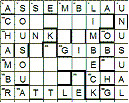
One of my hobbies is doing cryptic crosswords, especially the AZED crossword in The Observer.
I think it’s my supposed logical mind that attracts me to cryptic crosswords. Many of the workers at Bletchley Park who broke the German Enigma codes during World War II were also crossword fiends and/or mathematicians; see my write-up on Alan Turing.
