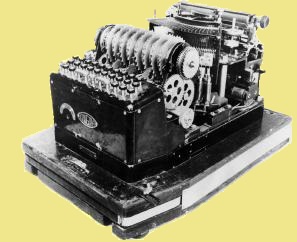
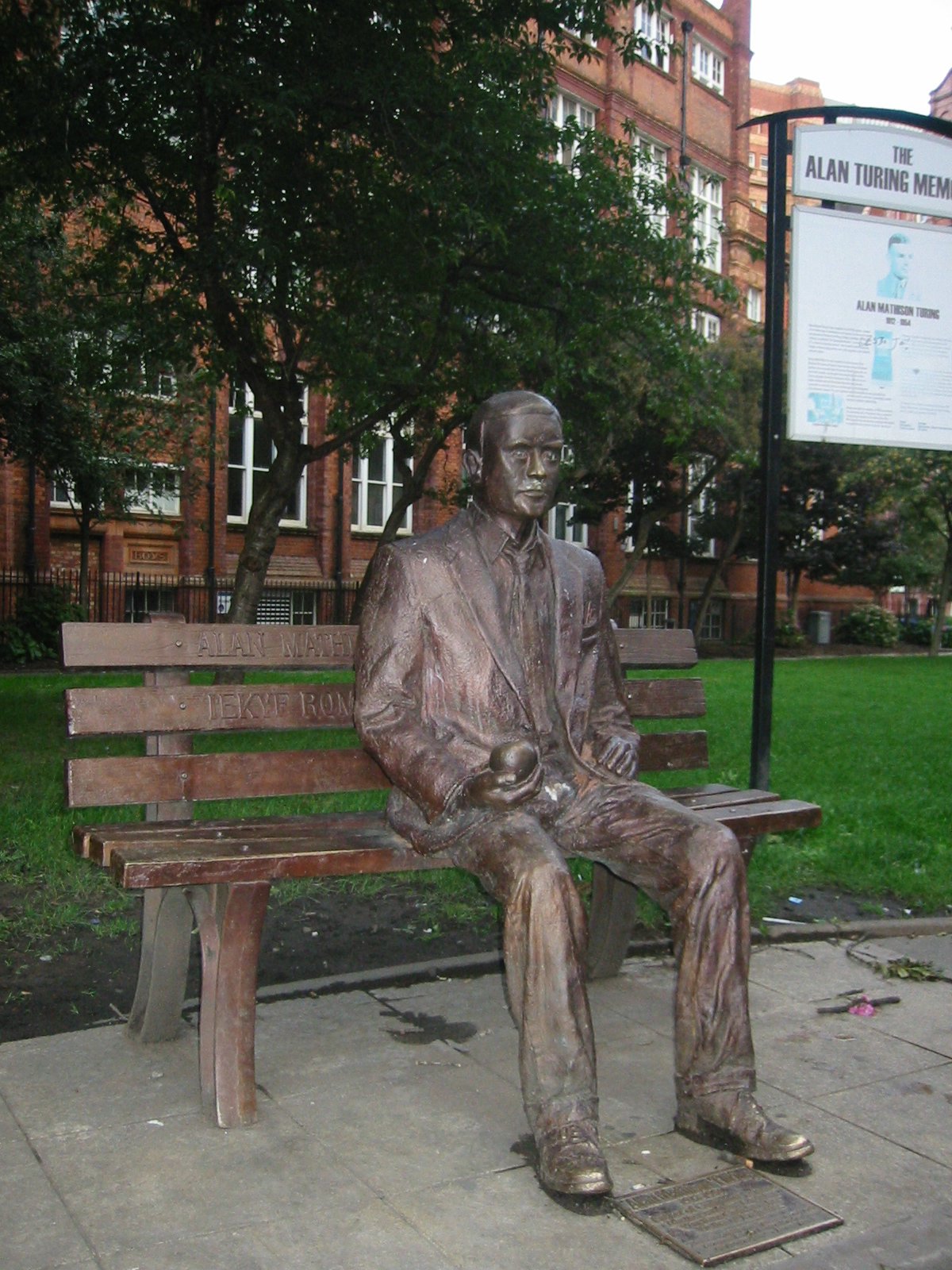
Alan Turing at Sherborne School
Education and Summary of Turing’s Early Career
Alan Turing was educated at Sherborne School, where, in the Science Sixth he met Christopher Morcom, another outstanding student and enthusiast for science.
Christopher Morcom suddenly died on 13 February 1930. Alan Turing came through the trauma. Somehow he found the strength and won a scholarship to King’s College, Cambridge. He was a Wrangler (that is, he was awarded a first-class degree in Mathematics) at King’s College, Cambridge in 1931, where he became a Fellow in 1935.
From September 1936 to July 1938 Turing worked mostly at the Institute for Advanced Study, Princeton, New Jersey, and gained his Ph.D. there, studying cryptology and he also built three of four stages of an electro-mechanical binary multiplier (an early digital computer).
Turing worked for the British Foreign Office at Bletchley Park during World War II (1939 — 1945) and was awarded the Order of the British Empire (OBE) in 1946. He worked at the National Physical Laboratory, 1945 — 1948 and at the University of Manchester from 1948 to 1954. He became a Fellow of the Royal Society in 1951.
A Summary of His Life
- 1912 (23rd June): Birth, Maida Vale, London
- 1926–31: Sherborne School
- 1930: Death of friend Christopher Morcom
- 1931–34: Undergraduate at King’s College, Cambridge University
- 1932–35: Quantum mechanics, probability, logic
- 1935: Elected fellow of King’s College, Cambridge
- 1936: The Turing machine, computability, universal machine
- 1936–38: Princeton University. Ph.D. Logic, algebra, number theory
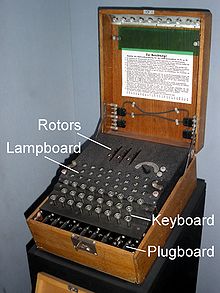
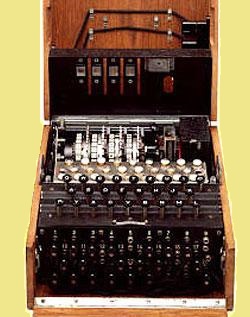
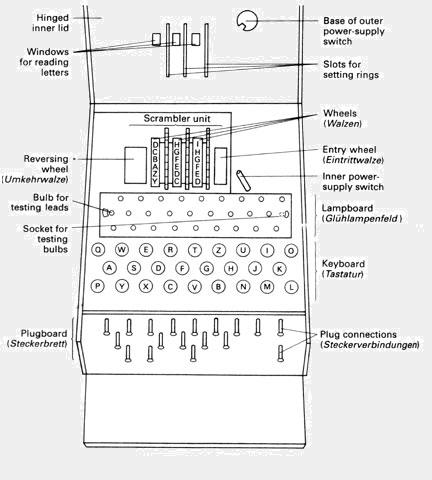
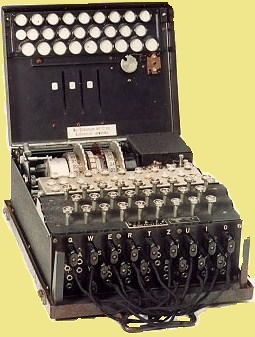
- 1938–39: Return to Cambridge. Introduced to German Enigma cipher machine
- 1939–40: The Bombe, machine for Enigma decryption
- 1939–42: Breaking of U-boat Enigma, saving battle of the Atlantic
- 1943–45: Chief Anglo-American crypto consultant. Electronic work
- 1945: National Physical Laboratory, London
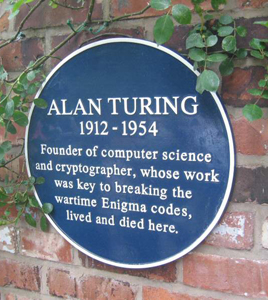
The official Blue Plaque on Alan Turing’s birthplace unveiled by Andrew Hodges
- 1946: Computer and software design leading the world
- 1947–48: Programming, neural nets, and artificial intelligence
- 1948: Manchester University
- 1949: First serious mathematical use of a computer
- 1950: The Turing Test (a test of a machine’s ability to exhibit intelligent behaviour equivalent to, or indistinguishable from, that of a human), in his paper Computing Machinery and Intelligence
- 1951: Elected FRS. Non-linear theory of biological growth
- 1952: Arrested as a homosexual, loss of security clearance
- 1953–54: Unfinished work in biology and physics, including Intelligent Machinery (published posthumously in 1969)
- 1954 (7th June): Death in Wilmslow, Cheshire from what the medical examiners described as “self-administered potassium cyanide while in a moment of mental imbalance”. Other reasons for his death have surfaced. His mother claimed that he used to experiment with household chemicals, trying to create new substances and became careless. Others claim he was homosexual and killed himself to prevent embarrassment.
Whatever the reason for his death, Turing was truly one of the great forerunners in the field of computers. Today’s computer scientists still refer to his papers. The concept of the algorithm lies at the heart of every computer program for any type of digital computer.
A biography Alan Turing: the enigma by Andrew Hodges was published by Vintage (now Random House) in 1983.
On 23rd June 1998, Andrew Hodges was asked by English Heritage to unveil the official Blue Plaque on Alan Turing’s birthplace. It would have been his 86th birthday.
Belatedly, eleven years later, in 2009, the Prime Minister, Gordon Brown, made a full personal statement of recognition, reflection and apology.
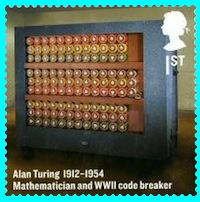
On 23rd February 2012 the Royal Mail released a stamp featuring Turing as part its “Britons of Distinction” series.
Very belatedly, in December 2013 he was granted a “royal pardon” for his conviction (which resulted in his suicide) for consenting homosexual activities.
Alan Turing: A Post Mortem
Foreknowledge of Turing’s Homosexuality
Anthony Cave Brown’s book, “C”: The Secret Life of Sir Stewart Menzies, Spymaster to Winston Churchill, states:
Menzies had known that Turing was a practicing and aggressive homosexual; this had emerged soon after his employment at Bletchley. But since he caused no offence to his colleagues at Bletchley, and since he was perhaps the only man in Menzies’s service who might have been called ‘indispensable,’ his services were retained... Early in 1944 a suspicion arose that he might have been the man responsible for molesting schoolboys at the main public library in Luton, a large industrial town not far from Bletchley. While no proceedings arose, it was decided that the need for good order and discipline required his removal — but not before he had done his finest work.
Gross Indecency
In January 1952, Turing met Arnold Murray outside a cinema in Manchester. After a lunch date, Turing invited Murray to spend the weekend with him at his house, an invitation which Murray accepted although he did not show up. The pair met again in Manchester the following Monday, when Murray agreed to accompany Turing to the latter’s house. A few weeks later Murray visited Turing’s house again, and apparently spent the night there.
After Murray helped an accomplice to break into his house, Turing reported the crime to the police. During the investigation, Turing acknowledged a sexual relationship with Murray. Homosexual acts were illegal in the United Kingdom at that time, and so both were charged with gross indecency under Section 11 of the Criminal Law Amendment Act 1885.
Turing was given a choice between imprisonment or probation conditional on his agreement to undergo hormonal treatment designed to reduce libido. He accepted chemical castration via oestrogen hormone injections.
Turing’s conviction led to the removal of his security clearance, and barred him from continuing with his cryptographic consultancy for GCHQ. At the time, there was acute public anxiety about spies and homosexual entrapment by Soviet agents, because of the recent exposure of the first two members of the Cambridge Five, Guy Burgess and Donald Maclean, as KGB double agents. Turing was never accused of espionage but, as with all who had worked at Bletchley Park, was prevented from discussing his war work.