Four Playwrights, Some Films, ‘Stars’ and Radio

[Remember Lily Tomlin as ‘Ernestine’ in Rowan and Martin’s Laugh-In?]
[Remember Lily Tomlin as ‘Ernestine’ in Rowan and Martin’s Laugh-In?]
One Way Pendulum is a farce that follows the eccentric misadventures of a family who have their own rather unusual way of doing things. Mr. Groomkirby is redecorating his living room to resemble the courtrooms at Old Bailey, with a mind toward staging mock trials for fun. His wife hates to see leftovers go to waste, so she hires a woman to eat them. Their daughter is fascinated by primates and spends much of her time at the zoo, and the son believes that scales can have uses other than just weighing things — they can be used to make music, too!
Another great success for him was A Resounding Tinkle.
Often considered his greatest single work, Under Milk Wood, a radio play featuring the characters of ‘Llareggub’, is set in a fictional Welsh fishing village (‘Llareggub’ looks Welsh, but is ‘Bugger All’ backwards, implying that there is absolutely nothing to do there). The BBC credited their producer Stella Hillier with ensuring the play actually materialised. Assigned “some of the more wayward characters who were then writing for the BBC”, she dragged the notoriously unreliable Thomas out of the pub and back to her office to finish the work.
In this classic version, the narrator is Richard Burton.
Part 1 Part 2 Part 3 Part 4 Part 5 Part 6 Part 7 Part 8 Part 9 Part 10 Part 11 Part 12
I’m not really much of a film aficionado. Most of the stuff made today seems like expensive rubbish to me, the ‘action movies’ especially — what Chambers Dictionary might say is for ‘kidults’ (adults who enjoy entertainment intended for children). I think the last films I saw were the Lord of the Rings trilogy. (Wasn’t it good of J R R Tolkein to have written a ‘prequel’, The Hobbit, for them to film.) I haven’t seen, nor do I intend to see, any of the Harry Potter ones; why do I want to refer here to ‘J R R Rowling’?
The last film I saw on television, and enjoyed, was Gods and Monsters, a fictionalized story of the suicide of James Whale, the producer of the 1930s Frankenstein films, who was openly gay way back then.
They don’t make ’em like they used to.
Rarely do we see a jewel like this. Legendary British film director Sir Ridley Scott launched a global film making contest for aspiring directors. It’s entitled Tell It Your Way. There were over six hundred entries. The film could be no longer than three minutes, contain only six lines of narrative, and be a compelling story.
The winner was  Porcelain Unicorn from American director Keegan Wilcox. It’s a story of the lifetimes of two people who are totally opposite, yet, very much the same — all told in less than three minutes.
You can understand why it won.
Bette Midler and Lily Tomlin are two of my favourite American comics; Bette has a good singing voice, too; my favourite song is The Rose from the film of the same name. They have both made some enjoyable films, especially Big Business with both Bette Midler and Lily Tomlin in which they played two pairs of identical twins who were switched at birth.
Lily Tomlin also featured in Rowan & Martin’s Laugh-In as Ernestine, a nosy, condescending telephone operator who generally treated customers with little sympathy. Ernestine often snorted when she let loose a barbed response or heard something salacious; she also wore her hair in a 1940s hairstyle with a hair net, although the character was contemporary. Ernestine was almost always at her switchboard taking calls in the sketches. She occasionally called her boyfriend, Vito, a telephone repair man, or her pal Phoenicia, another operator.
Lily also co-starred with Maggie Smith, Judi Dench, Joan Plowright and Cher in the acclaimed Franco Zeffirelli film Tea With Mussolini (1999).
They must be the best ever; if I had to take one DVD to that desert island, it would have to be a compilation of theirs.
How many other comedy double acts have based themselves on dear old Stan and Olly? But they are head and shoulders above the rest.
Apart from actors who are or were specifically known for their film rôles, there are many stage actors who have appeared in films and television dramas. Among them (and please excuse any omissions) are Patrick Stewart, Alec Guinness, and even Richard Attenborough (brother of David). I mustn’t forget Alastair Sims or Margaret Rutherford.
Most of the “good” ones have retired or died now. Or perhaps it’s simply that I don’t visit the cinema or watch TV drama much now.
(There’s a crater called Disney on Mercury.)
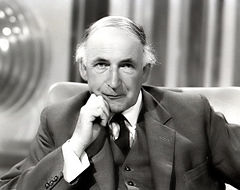
Professor Sir Bernard Lovell

Jodrell Bank Radio Telescope
One of my all-time favourites is Round Britain Quiz which first hit the airwaves in 1947 and is still going quite healthily.
In the realm of comedy, many of the most successful, like Little Britain have emigrated to television, where alas a lot have been failures, not that one though. (Remember Hancock’s Half-Hour?) I also used to like Sunday Format which was a spoof Sunday newspaper supplement, where the subjects were interlaced with one another, as if corrected by The Grauniad’s worst sub-editor; unfortunately it only ran for a short time, but that may have been for the better as many long-running radio and TV series seem to lose their way eventually. The famous, brilliant Fawlty Towers only ran for a dozen shows.
In non-fiction, I liked the Reith Lectures, where an expert (a professor or other academic) gave a series of lectures on a serious topic. I recall Sir Bernard Lovell’s series on The Individual and the Universe, in which he examined the history of inquiry into the solar system and the origin of the universe. I was only a teenager at the time; my father jokingly called him ‘Sir Jodrell Bank’, of which he was director at the time, and the name seemed quite apt for him. Sadly, Sir Bernard died in August 2012 aged 98.
This is just one reason, but I think it exemplifies the difference between the two media.
One night, over our evening meal, we tuned in to the BBC News television channel; it was showing the funeral ceremony for a multi-millionaire American pop singer. Sky News had exactly the same pictures. We tried Euronews; it wasn’t showing the ceremony live, but we caught it broadcasting a summary report of the same thing.
So we went to the BBC World Service radio channel. That was broadcasting a report from Syria from its correspondent there, giving his personal account of the ‘war’ there. The contrast was unbelievable.
What is more important news? The religious clap-trap for a drug-laden alcohol-ridden ex-pop-star, or a personal account of the conflict in a war in the Middle East? I rest my case.
See also Classical Music Radio Stations.
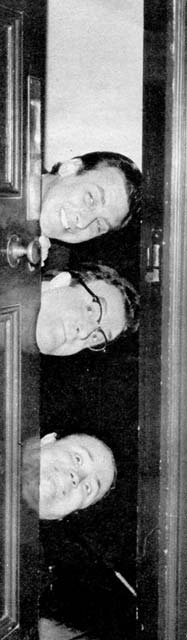
Then there was always The Goon Show. Here are Spike Milligan, Peter Sellers and Harry Secombe. The ‘official’ web site is http://www.thegoonshow.net.
Loads of Spike Milligan [the Goon at the top in the photo] on YouTube. I especially like Pakistani Daleks.