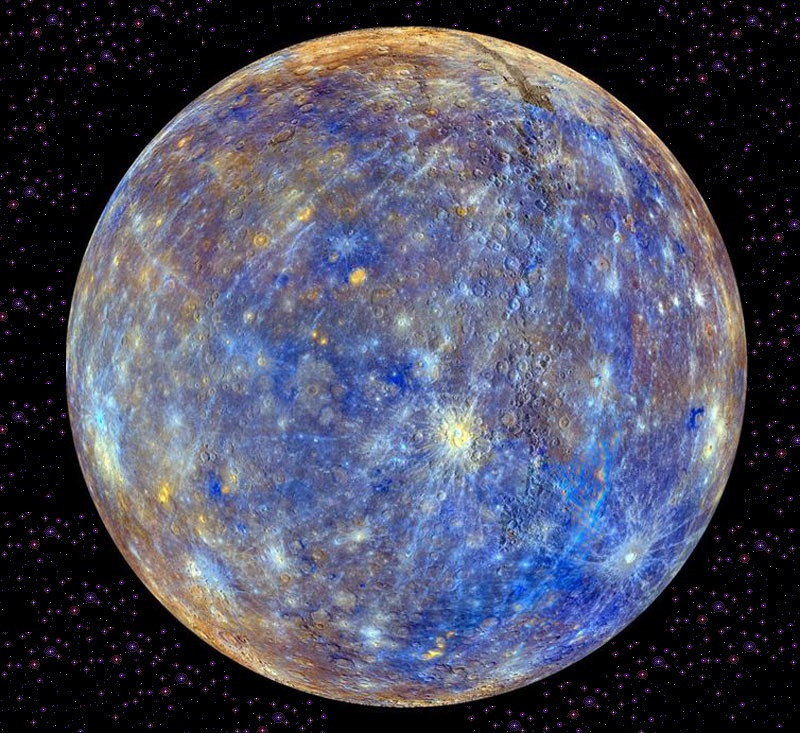
Mercury, the clearest photo ever taken
From NASA: More about Mercury, Mariner 10, and MESSENGER. The National Geographic also has a photo gallery devoted to Mercury.
See also Space Facts (and many other web sites) for information about Mercury.
Mariner 10, and MESSENGER are the only spacecraft to have visited Mercury; another, Bepicolombo is planned.
This page also has a brief mention of Vulcan and the Vulcanoids.
Thumbnail pictures – click on the picture to see an enlargement.
Mercury, the clearest photo ever taken
A section of Mercury’s Shakespeare Quadrangle showing remarkably Moon-like craters. These pictures were taken by Mariner 10. Since then, the MESSENGER spacecraft has also visited the planet and sent back many interesting photographs and measurements.
Mercury, the innermost planet in the Solar System, is also the smallest, and its orbit is the most eccentric (0.2056) of the eight planets. It has no known natural satellites [but see here] or rings.
It orbits the Sun once in 87.9691 Earth days, completing three rotations about its axis for every two orbits. So its ‘day’, 58 days 15 hours 30 minutes in Earth time is in a simple 2:3 resonance with its ‘year’. The slowness of its rotation around the Sun means that its surface temperature can vary between −210° C and +510° C.
Mercury’s average distance from the Sun is 57,910,000 km though because of its high eccentricity this can vary between 69,816,900 km and 46,001,200 km. It has the smallest tilt of all the planets, 3.38° to the Sun’s equator.
Its radius is 2,440 km, giving it a surface area of 74,800,000 km2. Its mass is 3.3022×10²³ kg (0.055 of the Earth’s mass).
Mercury’s surface is covered by a dusty layer of minerals (silicates), made up of plains, cliffs, and craters. It has a very thin atmosphere of 95% helium and a small amount of hydrogen. The thin atmosphere is made up of atoms blasted off the surface by the solar wind and micrometeoroid impacts. Because of solar radiation pressure, the atoms quickly escape into space and form a tail of neutral particles.
This image was taken during MESSENGER’s third fly-by of Mercury. Both a previously released image and this one show large areas of Mercury’s surface that appear to have been flooded by lava. In this view, craters are visible that have been nearly filled with lava, leaving only traces of their circular rims. MESSENGER images have revealed that the smooth plains in this region of Mercury’s surface are quite extensive, and MESSENGER Science Team members are currently updating maps of the smooth plains created after the mission’s second Mercury fly-by to include these new views obtained from Mercury fly-by 3. After the Mariner 10 mission, there was some controversy concerning the extent to which volcanism had modified Mercury’s surface. Now MESSENGER results, including colour composite images, evidence for pyroclastic eruptions, and images of vast lava plains (such as shown here) have demonstrated that Mercury was indeed volcanically active in the past.
For many years, it was suspected that another planet lay between the Sun and Mercury; it was even given a name, “Planet X” (for ‘unknown’) or Vulcan. It was postulated to explain a deviation in Mercury’s orbit. However, eventually it was found that the deviations in Mercury’s orbit were correctly explained by Einstein’s Theory of Relativity and that no other planet was needed to explain the orbit. A belt of asteroids (‘Vulcanoids’) has also been proposed, orbiting inside Mercury’s orbit.
Most of the Mariner craft went to Mars, with a few exceptions. See the description of the Mariner program.
Mariner 10 (1973-085A) was launched on 3rd November 1973 at 0545:00 UTC; it made a successful fly-by of Venus at a minimum distance of 5,768 km, en route to Mercury; this was the first use of gravity assist by an interplanetary spacecraft; it then made three fly-bys of Mercury on 29th March 1974 at a minimum distance of 704 km, on 21st September 1974 at 48,069 km, and on 16th March 1975 at 327 km.
With its maneouvring fuel just about exhausted, Mariner 10 started another orbit of the Sun. Engineering tests were continued until 24th March 1975, when final depletion of the nitrogen supply was signalled by the onset of an un-programmed pitch turn. Commands were sent immediately to the spacecraft to turn off its transmitter, and radio signals to Earth ceased. It is believed to still be orbiting the Sun, although its electronics have probably been damaged by the Sun’s radiation.
Bepicolombo is Europe’s first mission to Mercury. It is intended to be launched in 2018. When it arrives at Mercury in late 2024, it will endure temperatures in excess of 350°C and gather data during its one-year nominal mission, with a possible one-year extension. The mission consists of two spacecraft: the Mercury Planetary Orbiter (MPO) and the Mercury Magnetospheric Orbiter (MMO). BepiColombo is a joint mission between ESA and the Japan Aerospace Exploration Agency (JAXA), executed under ESA leadership.
The spacecraft will have a six-year interplanetary cruise to Mercury using solar-electric propulsion (ion thrusters) and gravity assists from Earth, Venus and eventual gravity capture at Mercury.
Most of Mercury’s craters are named after famous writers and artists. According to International Astronomical Union (IAU) rules, all new craters must be named after an artist who was famous for more than fifty years, and dead for more than three years, before the date they are named. Craters larger than 250 km in diameter are referred to as basins.
Do Disney’s copyright lawyers know there’s a Mickey Mouse image on the surface of Mercury? The chance arrangement of craters was imaged by NASA’s MESSENGER space probe, while it was creating a ‘high-incidence-angle base map’ of the planet. This took advantage of the shadows created when the sun is low on the horizon to accentuate geological detail. (Incidentally, a crater was officially named Disney on 19th December 2012. It’s 113 km in diameter, at 68° S, 100° E, and officially named after “Walter Elias Disney, American film director, screenwriter, and animator (1901-1966)”.)
Michelangelo is a 216 km diameter impact basin on Mercury. It is located at 45.0°S, 109.1°W.
Beethoven is a crater at latitude 20°S, longitude 124°W on Mercury. It is 643 km in diameter and was named after the famous composer.[Some sources give slightly smaller diameter, 625 km] It is the eleventh largest named impact crater in the Solar System and the third largest on Mercury. Unlike many basins of similar size on the Moon, Beethoven is not multi-ringed. Remnant ejecta blankets around parts of Beethoven are subdued in appearance and their margins poorly defined in places. The crater wall (rim) is buried by its ejecta blanket and by plains materials and is barely visible. The floor of the basin is covered with intermediate smooth plains material, which has the same reflectance as the exterior intermediate terrain. However there are no wrinkle ridges or graben inside the basin like those in Caloris Basin.
Beethoven may possibly be late c3 in age or as old as early c2, which means that it is older than the Caloris Basin. [c1 through c5 are categories indicating the ages of craters, c1 being the oldest]
The depth of Beethoven is estimated to be 2.5±0.7 km from the stereo derived digital elevation models based on Mariner 10 images of the planet. This is significantly less than the depth of lunar basins of the similar size indicating that Beethoven probably has relaxed from its post impact shape. There is also a broad topographic rise in the north-west margin of Beethoven.
This rightmost view of Mercury’s southern polar region was captured by MESSENGER. Strange patterns of huge cliffs and ridges (visible here near the centre) have raised a new mystery about Mercury for scientists.
NASA scientists have discovered that Mercury has ice and frozen organic materials inside permanently shadowed craters. NASA’s MESSENGER spacecraft (described along with other probes to that planet), the first probe to orbit the closest planet to the sun, discovered the ice at Mercury’s north pole.
A Mariner 10 photomosaic of Mercury’s Caloris Basin, 1,550 km in diameter
Caloris Basin is the largest known crater. The impact that created it was so powerful that it caused lava eruptions and left a concentric ring over 2 km tall surrounding the impact crater. At the antipode of the Caloris Basin is a large region of unusual, hilly terrain known as the “Weird Terrain”. One hypothesis for its origin is that shock waves generated during the Caloris impact travelled around the planet, converging at the basin’s antipode (180° away). The resulting high stresses fractured the surface. Alternatively, it has been suggested that this terrain formed as a result of the convergence of ejecta at this basin’s antipode.
MESSENGER (an acronym of MErcury Surface, Space ENvironment, GEochemistry, and Ranging) (2004-030A) was launched on 3rd August 2004. It successfully went into orbit around Mercury on 18th March 2011. To attain that orbit, it made fly-bys of the Earth on 2nd August 2005, Venus on 24th October 2006 (gravity assist only) at a minimum distance of 2990 km and on 5th June 2007 at a minimum distance of 300 km; it made three fly-bys of Mercury on 14th January 2008, 6th October 2008 and 29th September 2009, all at a minimum distance of 200 km. Its mission has been extended and having used the last of its manoeuvring propellant it was disposed as planned, by impacting the surface of Mercury on 30th April 2015; see NASA’s web-site.
Further MESSENGER images can be found here (including an April Fool’s Day image of an active volcano on Mercury).
