
Loading...
Loading...
(Well, that may be an overestimate of what I’m going to write about, but it’ll give you a general idea of some of the principles involved.)
It starts from when I was a teenager, and I had a friend called Alan, who was interested in “space”, and in particular on what it would take to build a spacecraft – one that could be launched and go into orbit. It was just before the time the Russians put Sputnik 1 into orbit, so we had to work on everything from first principles.
We started by making some guesses about what a useful payload would weigh. Then we looked up the escape velocity of rockets from the Earth in some reference book [see the table].
All this was theoretical, of course. We didn’t even think of actually building one.
Our maths and physics were highly suspect, as we had no idea of what to take into account, like the difference between a parabolic launch (like a tank shell) and an object that would go round the Earth in a circular orbit.
We knew nothing of the power that could be generated by different fuels, and started thinking about petrol engines, as in a car. Then we learnt that jet aircraft used kerosene, which sounded a bit like paraffin – how wimpish!
Eventually, with so many unknowns we reluctantly gave up, and I doubt if our final effort would have flown over the rooftop of a house.
First, let’s look at some realistic data that is essential if we are planning to leave the Earth’s surface.
An early “thought experiment” was Newton’s cannonball. In this experiment Newton visualizes a cannon on top of a very high mountain. If there were no forces of gravitation or air resistance, then the cannonball should follow a straight line away from the Earth, in the direction that it was fired. If a gravitational force acts on the cannon ball, it will follow a different path depending on its initial velocity. If the speed is low, for example a horizontal speed of 0 to 7,000 m/s, it will simply fall back on Earth.
If the speed is the orbital speed at that altitude (for example, a horizontal speed of about 7,300 m/s) it will go on circling around the Earth along a fixed circular orbit just as the Moon does.
If the speed is higher than the orbital velocity (for example, a horizontal speed of 7,300 to about 10,000 m/s), but not high enough to leave Earth altogether (lower than the escape velocity) it will continue revolving around Earth along an elliptical orbit.
If the speed is very high (for example, a horizontal speed greater than 10,000 m/s), it will leave Earth.
In 1903 a Russian scientist, Konstantin Tsiolkovsky (1857–1935), published the first academic treatise on the use of rocketry to launch spacecraft. He calculated the orbital speed required for a minimal orbit around the Earth at 8 km/s, and that a multi-stage rocket fuelled by liquid propellants could be used to achieve this. He proposed the use of liquid hydrogen and liquid oxygen, though other combinations could be used.
In 1928 a Slovenian Herman Potočnik (1892–1929) published a plan for a breakthrough into space and a permanent human presence there. He conceived of a space station in detail and calculated its geostationary orbit. He described the use of orbiting spacecraft for detailed peaceful and military observation of the ground and described how the special conditions of space could be useful for scientific experiments. The book described geostationary satellites (first put forward by Tsiolkovsky) and discussed communication between them and the ground using radio, but fell short of the idea of using satellites for mass broadcasting and as telecommunications relays.
In 1945 the English science fiction writer Arthur C. Clarke (1917–2008) described in detail the possible use of communications satellites for mass communications. Clarke examined the logistics of satellite launch, possible orbits and other aspects of the creation of a network of world-circling satellites, pointing to the benefits of high-speed global communications. He also suggested that three geostationary satellites would provide coverage over the entire planet.
Early satellites were constructed as “one-off” designs. With growth in geosynchronous (GEO) satellite communication, multiple satellites began to be built on single model platforms called satellite buses. The first standardized satellite bus design was the HS-333 GEO commsat, launched in 1972.
The largest artificial satellite currently orbiting the Earth is the International Space Station.
We have seen how Newton’s “thought experiments” provided the theory of how we might launch an Earth satellite. Clearly the use of a gun would be rather impractical, but a rocket could. Rockets for military and recreational uses date back to at least 13th century China. Rocket engine exhaust is formed entirely from propellants carried within the rocket before use. Rocket engines work by action and reaction (Newton’s Third Law of Motion). Rocket engines push rockets forward simply by throwing their exhaust backwards extremely fast.
So given a suitable rocket we can place our satellite into orbit around the Earth. A low Earth orbit is an orbit around Earth with an altitude between 160 km (with an orbital period of about 88 minutes) and 2,000 km (127 minutes). Objects below 160 km will experience very rapid orbital decay and altitude loss. Objects in low Earth orbits encounter atmospheric drag in the form of gases in the thermosphere (approximately 80 to 500 km up) or exosphere (500 km and up), depending on orbit height. They orbit the Earth between the atmosphere and the inner Van Allen radiation belt, usually not less than 300 km, as that would be impractical due to atmospheric drag.
Some examples of low Earth orbiters are Sputnik 1 (perigee 215 km, apogee 939 km, orbital period 96.20 minutes), the International Space Station (418 km to 423 km, period 92.85 minutes) and the Hubble Space Telescope(559 km, period 96 to 97 minutes).
Higher up are the Global Positioning Satellites; global coverage for each system is generally achieved by a satellite group of 20 to 30 medium Earth orbit satellites spread between several orbital planes (the actual systems vary, but use orbital inclinations of >50° and orbital periods of roughly twelve hours at an altitude of about 20,000 km.)
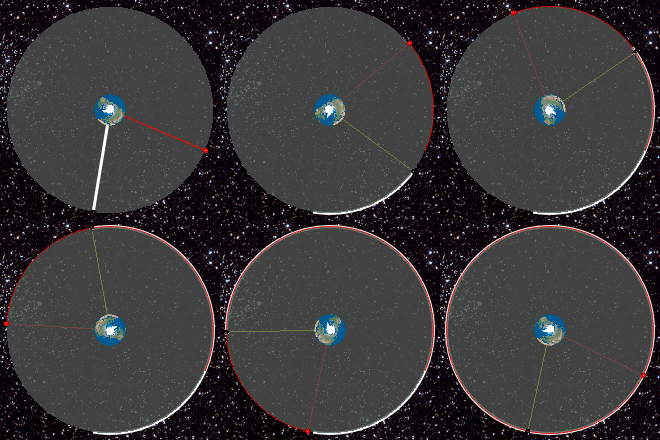
A geostationary orbit; to an observer on the rotating Earth, both satellites appear stationary in the sky at their respective locations.
Beyond these are the geostationary equatorial orbits, circular orbits 35,786 km above the Earth’s equator and following the direction of the Earth’s rotation. An object in such an orbit has an orbital period of one day, and thus appears at a fixed position in the sky to ground observers.
Communications satellites and weather satellites are usually in geostationary orbits, so that the antennas that communicate with them do not have to move to track them, but can be pointed permanently at the position in the sky where they stay.
A Soyuz-TMA-04M launch vehicle enjoys a successful launch from the Baikonur complex in Kazakhstan, carrying a three-strong crew of astronauts to the International Space Station. Baikonur is the world’s largest space centre.
So far we’ve achieved an orbit round the Earth, essentially by following the Newton’s cannonball strategy. Of course we use a rocket not a high explosive, but we can imagine we are in a fairly low circular orbit.
If our payload is very heavy, we can use a multi-stage rocket. The first stage is a powerful thruster which gives us the initial impetus. It is big and powerful, but becomes useless mass once its fuel is spent. So the first stage is jettisoned and the second stage ignites, to send our now smaller load further. In theory there is no real limit to the number of stages that a rocket may have, but for practical reasons, two or perhaps three are normal.
Often a third stage is used when the first two are exhausted, and is able to make adjustments to the orbit.
A Bi-Elliptic Transfer Orbit
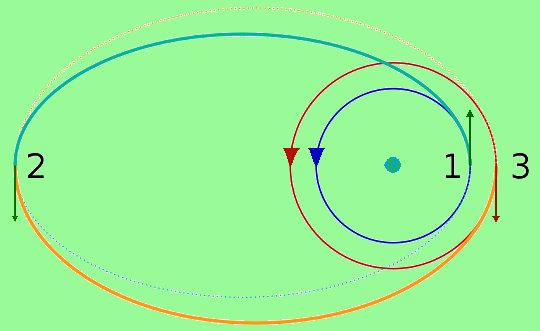
In this diagram, the blue circle represents the spacecraft’s initial low Earth orbit. At point ❶, the rocket is fired (green arrow), sending the craft into an elliptical orbit (the light blue upper arc and the broken white lower arc. Point ❶ is the perigee (closest point to Earth) and ❷ is the apogee (furthest point for this orbit).
At the apogee, the rocket is fired again sending it into a higher (yellow and upper broken white) elliptical orbit. At the perigee (❸) of this higher orbit, the rocket is fired in the reverse direction, putting the craft into the higher circular orbit (in red). The white parts of the ellipses are simply there to show the complete elliptical orbits; the three rocket firings can be made at any convenient times.
Of course, not all orbits are circular, but similar methods can be used for them.
So we can get our spacecraft into any orbit around the Earth. But there are many occasions, like taking supplies or changing the crew of the International Space Station, when we want to achieve a rendezvous with another craft.
The first attempt at rendezvous was made on 3rd June 1965, when US astronaut Jim McDivitt tried to manoeuvre his Gemini 4 craft to meet back up with its spent Titan II launch vehicle’s upper stage. McDivitt was unable to get close enough to achieve station-keeping, due to depth-perception problems, and stage propellant venting which kept moving it around. However, the Gemini 4 attempts at rendezvous were unsuccessful largely because NASA engineers had yet to learn the orbital mechanics involved in the process. Simply pointing the active vehicle’s nose at the target and thrusting won’t do. If the target is ahead in the orbit and the tracking vehicle increases speed, its altitude also increases, actually moving it away from the target. The higher altitude then decreases velocity, putting the tracker above and behind the target. The proper technique requires changing the tracking vehicle’s orbit to allow the rendezvous target to either catch up or be caught up with, and then at the correct moment change to the same orbit as the target with no relative motion between the vehicles.
A variety of spacecraft control techniques may be used to effect the translational and rotational manoeuvres necessary for proximity operations and docking.
The two most common methods of approach for proximity operations are in-line with the flight path of the spacecraft (called V-bar) and perpendicular to the flight path along the line of the radius of the orbit (called R-bar).
Kepler’s laws of planetary motion hold strictly only in describing the motion of two gravitating bodies, in the absence of non-gravitational forces, or approximately when the gravity of a single massive body like the Sun dominates other effects.
Orbits are usually elliptical, with the heavier body at one focus of the ellipse. A special case of this is a circular orbit with the planet at the centre.
A line drawn from the planet to the satellite sweeps out equal areas in equal times no matter which portion of the orbit is measured.
The square of a satellite’s orbital period is proportional to the cube of its average distance from the planet.
Without applying thrust (such as firing a rocket engine), the height and shape of the satellite’s orbit won’t change, and it will maintain the same orientation with respect to the fixed stars.
A satellite in a low orbit (or low part of an elliptical orbit) moves more quickly with respect to the surface of the planet than a satellite in a higher orbit (or a high part of an elliptical orbit), due to the stronger gravitational attraction closer to the planet.
If thrust is applied at only one point in the satellite’s orbit, it will return to that same point on each subsequent orbit, though the rest of its path will change. Thus to move from one circular orbit to another, at least two brief applications of thrust are needed.
From a circular orbit, thrust in a direction which slows the satellite down will create an elliptical orbit with a lower periapse (lowest orbital point) at 180° away from the firing point. If thrust is applied to speed the satellite, it will create an elliptical orbit with a higher apoapse 180° away from the firing point.
The consequences of the rules of orbital mechanics are sometimes counter-intuitive. For example, if two spacecraft are in the same circular orbit and wish to dock, unless they are very close, the trailing craft cannot simply fire its engines to go faster. This will change the shape of its orbit, causing it to gain altitude and miss its target. One approach is to thrust retrograde, or opposite to the direction of motion, and then thrust again to re-circularize the orbit at a lower altitude. Because lower orbits are faster than higher orbits, the trailing craft will begin to catch up. A third firing at the right time will put the trailing craft in an elliptical orbit which will intersect the path of the leading craft, approaching from below.
To the degree that the standard assumptions of astrodynamics do not hold, actual trajectories will vary from those calculated. For example, simple atmospheric drag is another complicating factor for objects in Earth orbit. These rules of thumb are decidedly inaccurate when describing two or more bodies of similar mass, such as a binary star system. (Celestial mechanics uses more general rules applicable to a wider variety of situations.) The differences between classical mechanics and general relativity can also become important for large objects like planets.
Let’s take a look at some spacecraft that have taken giant steps. The first was Luna 1, the first object to get away from the pull of the Earth. The remainder were (or are) craft that have had the power (or used the power of the gravity of planets [see gravity-assist]) to escape entirely from the Solar system or are well on the way to doing so.
The Oberth effect is where the use of a rocket engine when travelling at high speed generates more useful energy than one at low speed. This occurs because the propellant has more usable energy due to its kinetic energy on top of its chemical potential energy. The vehicle is able to employ this kinetic energy to generate more mechanical power.
The Oberth effect is used in a powered flyby or Oberth manoeuvre where the application of an impulse from a rocket engine, close to a gravitational body (where the gravity potential is low, and the speed is high) can result in a higher change in kinetic energy and final speed (a higher specific energy) than the same impulse applied farther from the body for the same initial orbit. For it to be most effective, the vehicle must be able to generate as much impulse as possible at the lowest possible altitude; thus the Oberth effect is often far less useful for low-thrust reaction engines such as ion drives, which are limited in their ability to generate a large amount of impulse in a small amount of time.
The Oberth effect also can be used to understand the behaviour of multi-stage rockets; the upper stage can generate much more usable kinetic energy than might be expected from simply considering the chemical energy of the propellants it carries.
Historically, a lack of understanding of this effect led early investigators to conclude that interplanetary travel would require completely impractical amounts of propellant, as without it, enormous amounts of energy would be needed.
In physics, the escape velocity is the speed at which the kinetic energy plus the gravitational potential energy of an object is zero. The gravitational potential energy is negative since gravity is an attractive force and the potential energy has been defined for this purpose to be zero at an infinite distance from the centre of gravity. Escape velocity is the speed needed to “break free” from the gravitational attraction of a massive body, without further propulsion.
For a spherically symmetric body (which most stars, planets and moons are), the escape velocity at a given distance is calculated by the formula
Ve = √ ( 2 × G × M / r ),
where G is the universal gravitational constant ( G = 6.67 × 10⁻¹¹ m3 kg−1 s−2 ),
M is the mass of the planet, star or other body,
and r is the distance from the centre of gravity.
The value G×M is called the standard gravitational parameter, or μ, and is often known more accurately than either G or M separately.
In this equation atmospheric friction (air drag) is not taken into account. A rocket moving out of a gravity well does not actually need to attain escape velocity to do so, but could achieve the same result at any speed with a suitable mode of propulsion and sufficient fuel.
Escape velocity only applies to ballistic trajectories. It is independent of direction, assumes a non-rotating planet and ignores atmospheric friction.
| Location | With respect to | Ve (km/s) | Location | With respect to | Ve (km/s) |
|---|---|---|---|---|---|
| on the Sun | the Sun’s gravity | 617.5 | |||
| on Mercury | Mercury’s gravity | 4.3 | at Mercury | the Sun’s gravity | 67.7 |
| on Venus | Venus’s gravity | 10.3 | at Venus | the Sun’s gravity | 49.5 |
| on Earth | Earth’s gravity | 11.2 | at the Earth/Moon | the Sun’s gravity | 42.1 |
| (So to leave planet Earth, an escape velocity of 11.2 km/s (about 40,320 kph, or 25,000 mph) is required; however, a speed of 42.1 km/s is needed to escape the Sun’s gravity and exit the Solar System from the same position. That assumes no gravitational assistance from other planets.) | |||||
| on the Moon | the Moon’s gravity | 2.4 | at the Moon | the Earth’s gravity | 1.4 |
| on Mars | Mars’ gravity | 5.0 | at Mars | the Sun’s gravity | 34.1 |
| on Jupiter | Jupiter’s gravity | 59.6 | at Jupiter | the Sun’s gravity | 18.5 |
| on Ganymede | Ganymede’s gravity | 2.7 | |||
| on Saturn | Saturn’s gravity | 35.6 | at Saturn | the Sun’s gravity | 13.6 |
| on Uranus | Uranus’ gravity | 21.3 | at Uranus | the Sun’s gravity | 9.6 |
| on Neptune | Neptune’s gravity | 23.8 | at Neptune | the Sun’s gravity | 7.7 |
| on Pluto | Pluto’s gravity | 1.2 | |||
| at Solar System galactic radius |
the Milky Way’s gravity |
492–594 | on the event horizon |
a black hole’s gravity |
≥299,792 (speed of light) |
A gravitational sling-shot, gravity assist manoeuvre, or swing-by is the use of the relative movement (such as orbit around the sun) and the gravity of a planet or other astronomical object to alter the path and speed of a spacecraft, typically in order to save propellant, time, and expense. Gravity assistance can be used to accelerate (both positively and negatively) and/or re-direct the path of a spacecraft.
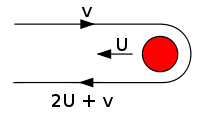
The “assist” is provided by the motion of the gravitating body as it pulls on the spacecraft. The technique was first proposed as a mid-course manoeuvre in 1961, and used by interplanetary probes from Mariner 10 onwards, including the two Voyager probes’ notable fly-bys of Jupiter and Saturn.
The diagram shows, in a very simplified form, how a spacecraft with speed v moving towards a planet with speed U in the opposite direction, achieves a speed 2U+v and changes its direction (in this hypothetical case by 180°). Note that the mass of the spacecraft is very small compared with that of the planet; nevertheless the total energy and momentum of the system is conserved, so the planet itself is displaced by a tiny amount.
An animated explanation of how sling shots work (New Horizons is especially good).
A spacecraft travelling from Earth to an inner planet will accelerate because it is falling toward the Sun, and a spacecraft travelling from Earth to an outer planet will decelerate because it is leaving the vicinity of the Sun.
Although the orbital speed of an inner planet is greater than that of the Earth, a spacecraft travelling to an inner planet, even at the minimum speed needed to reach it, is still accelerated by the Sun’s gravity to a speed notably greater than the orbital speed of that destination planet. If the spacecraft’s purpose is only to fly by the inner planet, then there is probably no need to slow the spacecraft. However, if the spacecraft is to be inserted into orbit about that inner planet, then there must be some way to slow the spacecraft.
Similarly, while the orbital speed of an outer planet is less than that of the Earth, a spacecraft leaving the Earth at the minimum speed needed to travel to that outer planet is decelerated by the Sun’s gravity to a speed far less than the orbital speed of that planet. Thus, there must be some way to accelerate the spacecraft when it reaches that outer planet if it is to enter orbit about it. However, if the spacecraft is accelerated to more than the minimum required, less total propellant will be needed to enter orbit about the target planet. In addition, accelerating the spacecraft early in the flight will reduce the travel time.

Plot of Voyager 2’s heliocentric velocity against its distance from the sun, illustrating the use of gravity assist to accelerate the spacecraft by Jupiter, Saturn and Uranus. To observe Triton, Voyager 2 passed over Neptune’s north pole resulting in an acceleration out of the plane of the ecliptic and reduced velocity away from the sun.
Aerobraking is a spaceflight manoeuvre that reduces the high point of an elliptical orbit (apoapsis) by flying the vehicle through the atmosphere at the low point of the orbit (periapsis). The resulting drag slows the spacecraft. Aerobraking is used when a spacecraft requires a low orbit after arriving at a body with an atmosphere, and it requires less fuel than does the direct use of a rocket engine.
The main practical limit to the use of a gravity assist manoeuvre is that planets and other large masses are seldom in the right places to enable a voyage to a particular destination. For example the Voyager missions which started in the late 1970s were made possible by the “Grand Tour” alignment of Jupiter, Saturn, Uranus and Neptune. A similar alignment will not occur again until the middle of the 22nd century. That is an extreme case, but even for less ambitious missions there are years when the planets are scattered in unsuitable parts of their orbits.
Another limitation is the atmosphere, if any, of the available planet. The closer the spacecraft can approach, the more boost it gets, because gravity falls off with the square of distance from a planet’s centre. If a spacecraft gets too far into the atmosphere, the energy lost to drag can exceed that gained from the planet’s gravity. On the other hand, the atmosphere can be used to accomplish aerobraking. There have also been theoretical proposals to use aerodynamic lift as the spacecraft flies through the atmosphere. This manoeuvre, called an aerogravity assist, could bend the trajectory through a larger angle than gravity alone, and hence increase the gain in energy.
Interanetary slingshots using the Sun itself are not possible because the Sun is at rest relative to the Solar System as a whole. However, thrusting when near the Sun has the same effect as the powered slingshot. This has the potential to magnify a spacecraft’s thrusting power enormously, but is limited by the spacecraft’s ability to resist the heat.
An interstellar slingshot using the Sun is conceivable, involving for example an object coming from elsewhere in our galaxy and swinging past the Sun to boost its galactic travel. The energy and angular momentum would then come from the Sun’s orbit around the Milky Way. This concept features prominently in Arthur C. Clarke’s 1972 award-winning novel Rendezvous With Rama; his story concerns an interstellar spacecraft that uses the Sun to perform this sort of manoeuvre, and in the process unnecessarily alarms many nervous humans.
Another theoretical limit is based on general relativity. The deepest gravity wells are those found around black holes, but if a spacecraft gets close to the Schwarzschild radius of a black hole, space becomes so curved that slingshot orbits require more energy to escape than the energy that could be added by the black hole’s motion.
A rotating black hole might provide additional assistance, if its spin axis is aligned the right way. General relativity predicts that a large spinning mass-produces frame-dragging – close to the object, space itself is dragged around in the direction of the spin. Any ordinary rotating object produces this effect. While attempts to measure frame dragging about the Sun have produced no clear evidence, experiments performed by Gravity Probe B have detected frame-dragging effects caused by the Earth. General relativity predicts that a spinning black hole is surrounded by a region of space, called the ergosphere, within which standing still (with respect to the black hole’s spin) is impossible, because space itself is dragged at the speed of light in the same direction as the black hole’s spin. The Penrose process may offer a way to gain energy from the ergosphere, although it would require the spaceship to dump some “ballast” into the black hole, and the spaceship would have had to expend energy to carry the “ballast” to the black hole.
The Mariner 10 probe was the first spacecraft to use the gravitational slingshot effect to reach another planet, passing by Venus on 5th February 1974, on its way to becoming the first spacecraft to explore Mercury.
As of 19th September 2014, Voyager 1 is over 128.9 AU (19.3 billion km) from the Sun, and is in interstellar space. It gained the energy to escape the Sun’s gravity completely by performing slingshot manoeuvres around Jupiter and Saturn. [17.4 hours for light signals to arrive from the Sun.]
The Galileo spacecraft was launched by NASA in 1989 aboard Space Shuttle Atlantis. Its original mission was designed to use a direct Hohmann transfer. However, Galileo’s intended booster, the cryogenically fuelled (hydrogen/hxygen) Centaur booster rocket was prohibited as a shuttle “cargo” for safety considerations following the loss of Space Shuttle Challenger. With its substituted solid rocket upperstage, the IUS, which could not provide as much Δv, Galileo did not ascend directly to Jupiter, but flew by Venus once and Earth twice in order to reach Jupiter in December 1995.
The Galileo engineering review speculated (but was never able to prove conclusively) that this longer flight time coupled with the stronger sunlight near Venus caused lubricant in Galileo’s main antenna to fail, forcing the use of a much smaller backup antenna with a consequent lowering of data rate from the spacecraft.
Its subsequent tour of the Jovian moons also used numerous slingshot manoeuvres with those moons to conserve fuel and maximize the number of encounters.
In 1990, NASA launched the ESA spacecraft Ulysses to study the polar regions of the Sun. All the planets orbit approximately in a plane aligned with the equator of the Sun. Thus, to enter an orbit passing over the poles of the Sun, the spacecraft would have to eliminate the 30 km/s speed it inherited from the Earth’s orbit around the Sun and gain the speed needed to orbit the Sun in the pole-to-pole plane – tasks that are impossible with current spacecraft propulsion systems alone, making gravity assist manoeuvres essential.
Accordingly, Ulysses was first sent towards Jupiter, aimed to arrive at a point in space just “in front of” and “below” the planet. As it passed Jupiter, the probe ’fell’ through the planet’s gravity field, exchanging momentum with the planet; this gravity assist manoeuvre bent the probe’s trajectory up out of the planetary plane into an orbit that passed over the poles of the Sun. By using this manoeuvre, Ulysses needed only enough propellant to send it to a point near Jupiter, which is well within current capability.
The Messenger mission (launched in August 2004) made extensive use of gravity assists to slow its speed before orbiting Mercury. This included one flyby of Earth, two flybys of Venus, and three flybys of Mercury before finally arriving at Mercury in March 2011 with a velocity low enough to permit orbit insertion with available fuel. Although the flybys are primarily orbital manoeuvres, each provided an opportunity for significant scientific observations.
The Cassini probe to Saturn used several gravity assists to get it there. See the diagram in the Cassini–Huygens section.
The NASA Solar Probe+ mission, scheduled for launch in 2018, will use multiple gravity assists at Venus to remove the Earth’s angular momentum from the orbit, in order to drop down to a distance of 9.5 solar radii from the Sun. This will be the closest approach to the Sun of any space mission.
Rocket engines can certainly be used to accelerate and decelerate a spacecraft. However, rocket thrust takes propellant, propellant has mass, and even a small increment Δv (delta-v) in velocity translates to far larger requirement for propellant needed to escape Earth’s gravity well. This is because not only must the primary stage engines lift that extra propellant, they must also lift more propellant still, to lift that additional propellant. Thus the liftoff mass requirement increases exponentially with an increase in the required Δv of the spacecraft.
Since a gravity assist manoeuvre can change the speed of a spacecraft without expending propellant, if and when possible, combined with aerobraking, it can save significant amounts of propellant.
As an example, the Messenger mission used gravity-assist manoeuvring to slow the spacecraft on its way to Mercury; however, since Mercury has almost no atmosphere, aerobraking could not be used for insertion into orbit around it.

Journeys to the nearest planets, Mars and Venus, use a Hohmann transfer orbit, an elliptical path which starts as a tangent to one planet’s orbit round the Sun and finishes as a tangent to the other. This method uses very nearly the smallest possible amount of fuel, but is very slow – it can take over a year to travel from Earth to Mars (fuzzy orbits use even less fuel, but are even slower).
Similarly it might take decades for a spaceship to travel to the outer planets (Jupiter, Saturn, Uranus, etc.) using a Hohmann transfer orbit, and it would still require far too much propellant, because the spacecraft would have to travel for 800 million km or more against the force of the Sun’s gravity. As gravitational-assist manoeuvres offer the only way to gain speed without using propellant, all missions to the outer planets have used it.
A well-established way to get more energy from a gravity assist is to fire a rocket engine at periapsis where a spacecraft is at its maximum velocity.
Rocket engines produce the same force regardless of their initial velocity. The force applied by the rocket during any time interval acts through the distance the rocket and payload move during that time. Force acting through a distance is the definition of mechanical energy or work. The farther the rocket and payload move during any given interval, (i.e., the faster they move), the greater the kinetic energy imparted to the payload by the rocket. (This is why rockets are seldom used on slow-moving vehicles; they are simply too inefficient when used in this manner.)
Energy is still conserved, however. The additional energy imparted to the payload is exactly matched by a decrease in energy imparted to the propellant being expelled behind the rocket. This is because the velocity of the rocket is being subtracted from the propellant exhaust velocity. Since the ultimate fate of the propellant is not a concern, the fastest possible burn is usually the optimal procedure.
To impart the most kinetic energy to a spacecraft whose free-fall velocity varies with time, the burn must occur when the spacecraft is moving fastest, which usually occurs at periapsis (the point of closest approach).