
Loading...
Loading...
As well as the Moon, below is some information about Other “Moons” of Earth, and asteroids, Cruithne and 2010 TK7.
After the description and photos of the Moon thre is a fairly comprehensive list (with their own descriptions) of spacecraft that have visited the moon,
from the early Luna and Ranger probes, via Apollo to the latest Chinese moon rover. (Full details of all lunar missions are here.)
[Immediately below] The full moon (“supermoon” or more correctly a perigee-syzygy) on 10th August 2014 at 18:09 UTC, at its closest approach to the Earth (its perigee), making it the year’s biggest.
The time of full moon fell within the same hour as the time of perigee. Here it is seen through the Four Towers (Cuatro Torres Business Area) in Madrid [AP Photo/Daniel Ochoa de Olza]
Below that is the moon in its waning crescent phase (when more than a half is illuminated it is “gibbous”).


I have included the photograph immediately above as it shows the many different types and sizes of craters, the ranges of mountains and the flat “seas” (maria, singular mare). The wealth of detail here is truly amazing; most features are best observed when they are on the terminator, the line separating night from day.
The far side of the moon is the half (actually about 59%) that cannot be seen from the Earth; it is often wrongly called the dark side of the moon.
It is well known that the Moon (and the Sun) produce tides on the Earth. The lunar surface also experiences tides of amplitude ~10 cm over 27 days, with two components: a fixed one due to the Earth, because they are in synchronous rotation, and a varying component from the Sun. The Earth-induced component arises from libration, a result of the Moon’s orbital eccentricity; if the Moon’s orbit were perfectly circular, there would only be solar tides. The cumulative effects of stress built up by these tidal forces produces moonquakes.
The apparent size of the Moon in the sky is almost exactly the same as that of the Sun, leading to beautiful eclipses. This coincidence is unknown anywhere else.
Although the Moon is officially described as the Earth’s only natural satellite, it and the Earth are in my opinion a pair of planets in the same orbit round the Sun, as the path of the Moon is always concave with respect to the Sun. Most satellites of other planets really do orbit their hosts. The official definition of a “moon” requires that the common centre of gravity of the object and its “primary” lies inside the primary, so my opinion is regretably wrong!
[Left] A composite image of the moon’s north polar region captured by Nasa’s Lunar Reconnaissance Orbiter Camera, or LROC. The image is a mosaic composed of 983 pictures taken over a one-month period during the moon’s northern summer. One of LROC’s objectives is to map areas of permanent light and shadow on the moon’s surface.
[Right]: To the naked eye the moon appears in monochrome shades of grey, but different distributions of minerals in the lunar rock and soil give it very subtle colour variations that have been enhanced to make them visible in this unusual image.
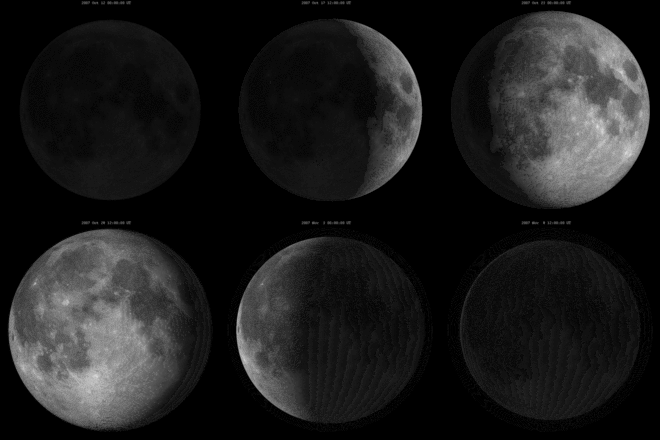
[Left] The Moon always presents the same face towards the Earth; so, allowing for the ‘wiggle’ in its orbit, we never see more than 59% of its surface. The far side wasn’t observed before spacecraft orbited the moon, when it was discovered that it is almost devoid of maria (‘seas’ or dark areas), and is more mountainous than the near side.
Moon Revolving [nothing to do with the animation on the left]: NASA created an  animation of the moon rotating. You can see the familiar face that is always presented towards us, and the ‘far side’ which was totally unknown until Luna 3 sent back its fuzzy pictures back in 1959. (I was so impressed by that scientific feat that I bought a copy of a book containing the photographs, which I still have; how we’ve advanced since then!)
Another NASA animation is Evolution of the Moon and a Tour of the Moon [Ogg multiplexed audio/video file, Theora/Vorbis, length 7 min 6 s, 640 × 360 pixels, 1.61 Mbps overall].
[Left] This image shows the variations in the lunar gravity field as measured by the Gravity Recovery and Interior Laboratory (GRAIL) during the primary mapping mission from March to May 2012. Very precise microwave measurements between two spacecraft, named Ebb and Flow, were used to map gravity with high precision and high spatial resolution. One property that was first discovered in 1968 was that areas that are topographically lower than their surroundings have higher gravity fields, the opposite to what one might expect. These anomalies are called mascons (mass concentrations) and are very consistent in occurrence.
[Right] Topography (top) and corresponding gravity (bottom) models of the Mare Smythii containing a significant mascon.
On 14th September 2006, an object estimated at 5 m in diameter was discovered in near-polar orbit around Earth. Originally thought to be a third stage Saturn S-IVB booster from Apollo 12, it was later determined to be an asteroid and designated as 2006 RH120. The asteroid re-entered solar orbit after 13 months and is expected to return to Earth orbit in 21 years.
Computer models by astrophysicists Mikael Granvik, Jeremie Vaubaillon, and Robert Jedicke of Cornell University suggest that these “temporary satellites” should be quite common; and that “At any given time, there should be at least one natural Earth satellite of 1-metre diameter or more orbiting the Earth.” Such objects would remain in orbit for ten months on average, before returning to solar orbit once again, and so would make relatively easy targets for manned space exploration. “Mini-moons” were further examined in a study published in the March 2012 issue of Icarus.
The earliest known mention in the scientific literature of a temporarily-captured orbiter is by Clarence Chant about the Meteor procession of 9th February 1913: “It would seem that the bodies had been travelling through space, probably in an orbit about the Sun, and that on coming near the Earth they were promptly captured by it and caused to move about it as a satellite.”
And later in 1916, William Frederick Denning surmised: “The large meteors which passed over Northern America on 9th February 1913, presented some unique features. The length of their observed flight was about 2,600 miles, and they must have been moving in paths concentric, or nearly concentric, with the earth’s surface, so that they temporarily formed new terrestrial satellites.”
Claims have existed for many decades that the Earth might possess other natural satellites besides the Moon. Several candidates have been proposed, but all such claims have proven false; the Moon is Earth’s only known natural satellite.
While several genuine scientific searches for “second moons” were undertaken in the 19th and 20th centuries, the field has also been the subject of several non-scientific proposals and possible hoaxes. These possible hoaxes, which were about objects of specific size and orbits, were poorly founded and all have been disproven.
Although the Moon is Earth’s only known natural satellite, there are a number of near-Earth objects (actually asteroids) with orbits that are in resonance with Earth. These can be mistaken for natural satellites and are sometimes glibly referred to as “second moons”. Quasi-satellites, such as (3753) Cruithne, orbit the Sun in 1:1 resonance with Earth and allegedly appear to orbit Earth from a corotating reference frame. Earth trojans, such as 2010 TK7, follow the same orbital path as Earth, either trailing or following, in the vicinity of the Earth-Sun Lagrangian points. Small objects in orbit around the Sun can also temporarily fall into orbit about the Earth, becoming “temporary satellites”.
There have been large generic searches for small moons, actual proposals or claimed sightings of specific objects in orbit, and finally, analysis and searches for those proposed objects. All of these have failed to confirm a permanent natural satellite.
Petit’s moon: The first major claim of another moon of Earth was made by French astronomer Frédéric Petit, director of the Toulouse Observatory, who in 1846 announced that he had discovered a second moon in an elliptical orbit around the Earth. It was claimed to be reported by Lebon and Dassier also at Toulouse, and Lariviere at Artenac Observatory, during the early evening of 21st March 1846. Petit proposed that this second moon had an elliptical orbit, a period of 2 hours 44 minutes, with 3,570 km apogee and 11.4 km perigee. This claim was soon dismissed by his peers. The 11.4 km perigee is similar to the cruising altitude of most modern airliners. Petit published another paper on his 1846 observations 15 years later (1861), basing the second moon’s existence on perturbations in movements of the existing moon. This second moon hypothesis was not confirmed either.
Waltemath’s moons: In 1898 Hamburg scientist Dr Georg Waltemath announced that he had located a system of tiny moons orbiting the Earth. He had begun his search for secondary moons based on the hypothesis that something was gravitationally affecting the Moon’s orbit.
Waltemath described one of the proposed moons as being 1,030,000 km from Earth, with a diameter of 700 km, a 119-day orbital period, and a 177-day synodic period. He also said it did not reflect enough sunlight to be observed without a telescope, unless viewed at certain times, and made several predictions as to when it would appear. “Sometimes, it shines at night like the sun but only for an hour or so”. However, after the failure of a corroborating observation of Waltemath’s moons by the scientific community, these objects were discredited. Especially problematic was a failed prediction that they would be observable in February 1898. Waltemath proposed more moons, according to a mention in August 1898 issue of Science. The third moon was closer than the first, 746 km (464 miles) in diameter, and he called it “Wahrhafter Wetter-und Magnet Mond” (meaning “True weather and magnetic Moon”?). “Perhaps it is also the moon presiding over lunacy”—Science on Waltemath’s Wahrhafter Wetter-und Magnet Mond in 1898.
In 1918, astrologer [yes, an astrologer] Walter Gornold, also known as Sepharial, claimed to have confirmed the existence of Waltemath’s moon. He named it Lilith. Sepharial claimed that Lilith was a ‘dark’ moon invisible for most of the time, but he claimed to have viewed it as it crossed the sun.
In 1926 the science journal Die Sterne published the findings of amateur German astronomer W Spill, who claimed to have successfully viewed a second moon orbiting the Earth.
In the late 1960s John Bargby claimed to have observed over ten small natural satellites of the Earth, but this was not confirmed.
In 2011, planetary scientists Erik Asphaug and Martin Jutzi proposed a model in which a second moon would have existed 4.5 billion years ago, and later impacted the Moon, as a part of the accretion process in the formation of the Moon.
Although no other moons of Earth have been found to date, there are various types of near-Earth object in 1:1 resonance with it, which are known as Quasi-satellites. These orbit the Sun from the same distance as a planet, rather than orbiting the planet itself. Their orbits are unstable, and will fall into other resonances or be kicked into other orbits over thousands of years. Quasi-satellites of Earth include 2010 SO16, (164207) 2004 GU9, (277810) 2006 FV35, 2002 AA29 and (3753) Cruithne. Cruithne, discovered in 1986, orbits the Sun in an elliptical orbit but appears to have a horseshoe orbit when viewed from Earth; it has been nicknamed “Earth’s second moon”.
The key difference between a satellite and a quasi-satellite is that a natural Earth satellite’s orbit fundamentally depends upon the gravity of the Earth–Moon system whereas the orbit of a quasi-satellite would negligibly change if the Earth and Moon were suddenly removed since a quasi-satellite is orbiting the Sun on an Earth-like orbit in the vicinity of the Earth.
Earth possesses one known Trojan asteroid, a small Solar System body caught in the planet’s gravitationally stable L4 Lagrangian point. The object, 2010 TK7 is roughly 300 m long. Like the quasi-satellites, it orbits the Sun in a 1:1 resonance with Earth, rather than orbiting Earth itself.
2010 TK7 has a diameter of about 300 metres. Its path oscillates about the Sun-Earth L4 Lagrangian point (60 degrees ahead of Earth), shuttling between its closest approach to Earth and its closest approach to the L3 point (180 degrees from Earth) about every 400 years. If the current orbital pattern holds, over the next 200 years, 2010 TK7 will accelerate ahead of Earth until it reaches L3, slows, and eventually returns to L4 over the second 200 years of its 400 year cycle. Due to the gravitational influence of other planets and the significant contribution of chaos to an asteroid’s orbit, it is impossible to accurately predict 2010 TK7’s behaviour over more than a 250 year span, so it may not continue this cycle – it could break its pattern at L3 and begin to oscillate between L3 and L5 rather than L3 and L4. The asteroid was discovered in October 2010 by the NEOWISE team of astronomers using NASA’s Wide-field Infrared Survey Explorer (WISE). It is the first Earth trojan asteroid to be discovered. Such objects had previously been observed only in the orbits of Mars, Jupiter, Neptune and several moons of Saturn.
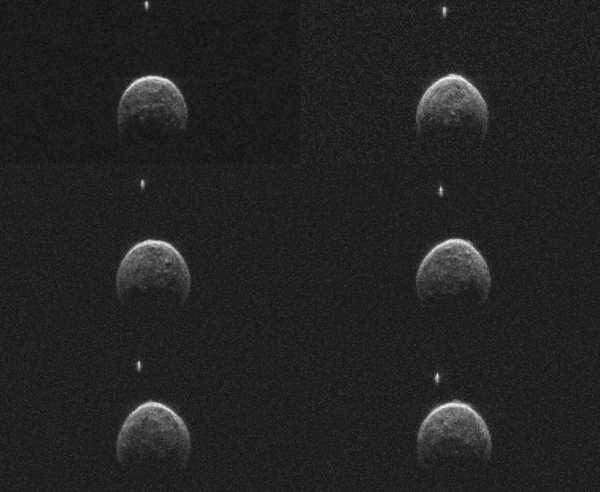
Scientists working with NASA’s 70-metre Deep Space Network antenna at Goldstone, California, have released the first radar images of asteroid (357439) 2004 BL86. The images show the asteroid, which made its closest recent approach on 26th January 2015 at a distance of about 1.2 million kilometres, or 3.1 times the distance from Earth to the moon), has its own small moon, S/2015 (357439) 1. The main asteroid is about 325 metres across, and its moon 70 metres.

The name “Cruithne” refers to one of the earliest Celtic tribes known to have inhabited Britain and Ireland. They may have been the first Celtic tribe to migrate from the mainland, or they may have been descendents of prehistoric tribes indigenous to the British Isles since the stone age. It is pronounced /'krinjə/ (from Old Irish /'kriθnε/, modern /'krihnjε/ or /'krinjε/)

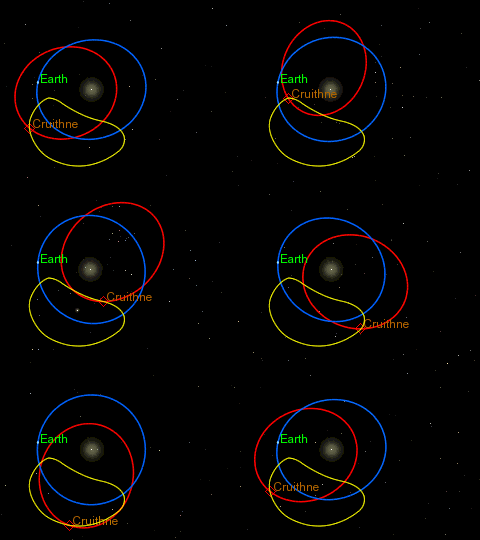
Cruithne is an asteroid with a bizarre orbit when viewed from the Earth – it describes a series of bean shapes. Over the course of 770 years the series completes a horseshoe-shaped movement, with the Earth in the gap of the horseshoe. It approaches the Earth from one direction, then it moves away and makes more bean shapes as it moves around the Sun, until it approaches Earth from the other side, and then moves away again.
Studying the animation will show you that Cruithne never really goes around Earth. (The yellow dot is the Sun, the small blob at the right is the Earth–Moon system, and the moving green bean is the orbit of Cruithne.) At times the orbit brings Cruithne underneath the south pole of the Earth (40 times farther away than the Moon), and at other times it is at the other side of the Sun.
Cruithne is at a balance point where its average orbital period around the Sun is the same as Earth – One Earth Year! Cruithne’s orbit takes it inwards towards the orbit of Mercury, and out to the orbit of Mars. Cruinthe’s fast motion when it is close to Mercury’s orbit is compensated by its slow motion when it lies near the orbit of Mars.
The Earth helps maintain the orbit of Cruithne by shepherding it, a process that is fairly common in the outer planets (for example, Saturn’s rings are often maintained in position by moons of Saturn, and many asteroids are kept in their places by Jupiter’s gravity). At a slow point, the Earth’s gravity gives it a pull and speeds it up. At a fast point, the Earth’s gravity slows it down.
Because the asteroid and the Earth do not go around the Sun in exactly the same amount of time every year, (the asteroid is currently going around slightly faster than the Earth), the position of the bean-shaped loop relative to the Earth varies over time. If the asteroid and the Earth were not in a special arrangement, the Earth would face potential danger as the asteroid would eventually drift towards our planet. However, in their current relationship, the direction of drift is reversed every time it approaches the Earth. It is as if the Earth uses gravity in a clever way to regulate the asteroid and keep it at a safe distance.
Cruithne is about 5 km in diameter and was discovered by Duncan Waldron in 1986. It cannot be seen by the naked eye. The odd orbit was discovered in 1997. Astronomers working at Queen Mary and Westfield College in London came up with mathematical models to describe its path.
We all know and love the moon. We’re so assured that we only have one that we don’t even give it a specific name. It is the brightest object in the night sky, and amateur astronomers take great delight in mapping its craters and seas. To date, it is the only other heavenly body with human footprints. What you might not know is that the moon is not the Earth’s only natural satellite. As recently as 1997, we discovered that another body, 3753 Cruithne, is what’s called a quasi-orbital satellite of Earth. This simply means that Cruithne doesn’t loop around the Earth in a nice ellipse in the same way as the moon, or indeed the artificial satellites we put into orbit. Instead, Cruithne scuttles around the inner solar system in what’s called a "horseshoe" orbit. To help understand why it’s called a horseshoe orbit, let’s imagine we’re looking down at the solar system, rotating at the same rate as the Earth goes round the sun. From our viewpoint, the Earth looks stationary. A body on a simple horseshoe orbit around the Earth moves toward it, then turns round and moves away. Once it’s moved so far away it’s approaching Earth from the other side, it turns around and moves away again. Horseshoe orbits are actually quite common for moons in the solar system. Saturn has a couple of moons in this configuration, for instance.
What’s unique about Cruithne is how it wobbles and sways along its horseshoe. If you look at Cruithne’s motion in the solar system, it makes a messy ring around Earth’s orbit, swinging so wide that it comes into the neighbourhood of both Venus and Mars. Cruithne orbits the sun about once a year, but it takes nearly 800 years to complete this messy ring shape around the Earth’s orbit.
So Cruithne is our second moon. What’s it like there? Well, we don’t really know. It’s only about five kilometres across, which is not dissimilar to the dimensions of the comet 67P/Churyumov-Gerasimenko, which is currently playing host to the Rosetta orbiter and the Philae lander. The surface gravity of 67P is very weak – walking at a spirited pace is probably enough to send you strolling into the wider cosmos. This is why it was so crucial that Philae was able to use its harpoons to tether itself to the surface, and why their failure meant that the lander bounced so far away from its landing site. Given that Cruithne isn’t much more to us at this point than a few blurry pixels on an image, it’s safe to say that it sits firmly in the middling size range for non-planetary bodies in the solar system, and any human or machine explorers would face similar challenges as Rosetta and Philae did on 67P. If Cruithne struck the Earth, though, that would be an extinction-level event, similar to what is believed to have occurred at the end of the Cretaceous period. Luckily it’s not going to hit us anytime soon – its orbit is tilted out of the plane of the solar system, and astrophysicists have shown using simulations that while it can come quite close, it is extremely unlikely to hit us. The point where it is predicted to get closest is about 2,750 years away.
Cruithne is expected to undergo a rather close encounter with Venus in about 8,000 years, however. There’s a good chance that that will put paid to our erstwhile spare moon, flinging it out of harm’s way, and out of the Terran family.
It’s not just Cruithne – the story doesn’t end there. Like a good foster home, the Earth plays host to many wayward lumps of rock looking for a gravitational well to hang around near. Astronomers have actually detected several other quasi-orbital satellites that belong to the Earth, all here for a little while before caroming on to pastures new.
So what can we learn about the solar system from Cruithne? Quite a lot. Like the many other asteroids and comets, it contains forensic evidence about how the planets were assembled. Its kooky orbit is an ideal testing ground for our understanding of how the solar system evolves under gravity. Earth’s other ‘moon’ and its crazy orbit could reveal mysteries of the solar system. It wasn’t until the end of the 20th century that we even realised that bodies would enter such weird horseshoe orbits and stay there for such a long time. The fact they do shows us that such interactions will have occurred while the solar system was forming. Because we think terrestrial planets grow via collisions of bodies of Cruithne-size and above, this is a big new variable.
One day, Cruithne could be a practice site for landing humans on asteroids, and perhaps even mining them for the rare-earth metals our new technologies desperately crave. Most importantly of all, Cruithne teaches us that the solar system isn’t eternal – and by extension, neither are we. Earth’s other ‘moon’ and its crazy orbit could reveal mysteries of the solar system.
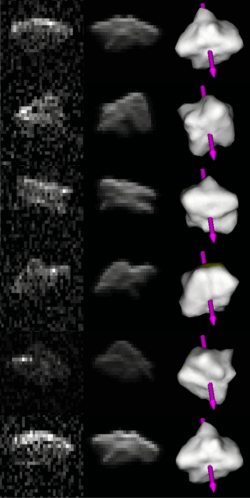
Other asteroids have been discovered which travel in a similar way to Cruithne: (85770) 1998 UP1 and (54509) YORP (2000 PH5). More information with technical animations is at the University of Western Ontario web site, which has some interesting related links. Also Wikipedia has some good material, including links to other asteroids with strange orbits like 2002 AA29 in resonant orbits similar to Cruithne’s. 2010 TK7 is the first and so far only identified Earth trojan.
NASA/JPL-Caltech has announced that a new companion to the Earth has been found.
Asteroid 2016 HO3 has an orbit around the sun that keeps it as a constant companion of Earth, and it will remain so for centuries to come.
As it orbits the sun, this newly discovered asteroid appears to circle around Earth as well. It is too distant to be considered a true satellite of our planet, but it is the best and most stable example to date of a near-Earth companion.
“Since 2016 HO3 loops around our planet, but never ventures very far away as we both go around the sun, we refer to it as a quasi-satellite of Earth”, said Paul Chodas, manager of NASA’s Center for Near-Earth Object (NEO) Studies at the Jet Propulsion Laboratory. “One other asteroid, 2003 YN107, followed a similar orbital pattern for a while over 10 years ago, but it has since departed our vicinity. This new asteroid is much more locked onto us. Our calculations indicate 2016 HO3 has been a stable quasi-satellite of Earth for almost a century, and it will continue to follow this pattern as Earth’s companion for centuries to come“.
In its yearly trek around the sun, asteroid 2016 HO3 spends about half the time closer to the sun than Earth and passes ahead of our planet, and about half farther away, causing it to fall behind. Its orbit is also tilted a little, causing it to bob up and then down once each year through Earth’s orbital plane. In effect, this small asteroid is caught in a game of leap frog with Earth that will last for hundreds of years.
The asteroid’s orbit also undergoes a slow, back-and-forth twist over multiple decades. “The asteroid’s loops around Earth drift a little ahead or behind from year to year, but when they drift too far forward or backward, Earth’s gravity is just strong enough to reverse the drift and hold onto the asteroid so that it never wanders farther away than about 100 times the distance of the moon”, said Chodas. “The same effect also prevents the asteroid from approaching much closer than about 38 times the distance of the moon. In effect, this small asteroid is caught in a little dance with Earth”.
Asteroid 2016 HO3 was first spotted on 27th April 2016, by the Pan-STARRS 1 asteroid survey telescope on Haleakala, Hawaii, operated by the University of Hawaii’s Institute for Astronomy and funded by NASA’s Planetary Defense Coordination Office. The size of this object has not yet been firmly established, but it is likely to be larger than 40 metres and smaller than 100 metres).
The Center for NEO Studies website has a complete list of recent and upcoming close approaches, as well as all other data on the orbits of known NEOs, so scientists and members of the media and public can track information on known objects.
The Luna programme (from the Russian word Луна “Luna” meaning “Moon”), occasionally called Lunik or Lunnik, was a series of robotic spacecraft missions sent to the Moon by the Soviet Union between 1959 and 1976. Fifteen were successful, each designed as either an orbiter or lander, and accomplished many firsts in space exploration. They also performed many experiments, studying the Moon’s chemical composition, gravity, temperature, and radiation. Twenty-four spacecraft were formally given the Luna designation, although more were launched. Those that failed to reach orbit were not publicly acknowledged at the time, and not assigned a Luna number. Those that failed in low Earth orbit were usually given Cosmos designations. The estimated cost of Luna Program was about $4.5 billion.
One of the many major achievements of the Luna programme, with the Luna 16, Luna 20 and Luna 24 spacecraft, was the ability to collect samples of lunar soil and return them to Earth, by 1970. The program returned 0.326 kg of lunar samples. The Luna missions were the first space-exploration sample return missions to rely solely on advanced robotics.
While the programme was active, it was Soviet practice not to release any details of missions which had failed to achieve orbit. This resulted in Western observers assigning their own designations to the missions, for example Luna E-1 No.1, the first failure of 1958 which NASA believed was associated with the Luna programme was known as Luna 1958A.
NASA identified three spacecraft which it referred to as Luna 1966A, Luna 1969B and Luna 1970B as having launched on 30th April 1966, 15th April 1969, and 19th February 1970. When details of Soviet launches were later disclosed, no launches of Luna spacecraft were found to have occurred on those dates.
The Luna 8K72 vehicles were carrier rockets used by the Soviet Union for nine space probe launch attempts in the Luna programme between 23rd September 1958 and 16th April 1960. Like many other Soviet launchers of that era the Luna 8K72 vehicles were derived from the R-7 Semyorka design, which is also the basis for the modern Soyuz rocket. Other than Lunas 1, 2 and 3, none of the other launch attempts using Luna 8K72 vehicles succeeded in placing probes into orbit. Less than a month after the final Luna 8K72 failure, Sputnik 4 (Korabl-Sputnik 1) was successfully launched 15th May 1960 using a Vostok 8K72 vehicle.
Lunar Prospector (1998-001A) was launched on 7th January 1998 at 02:28:44 UTC and entered lunar orbit on 11th January 1998 at 10:28 UTC. It was designed for a low polar orbit investigation of the Moon, including mapping of surface composition and possible polar ice deposits, measurements of magnetic and gravity fields, and study of lunar outgassing events. The mission ended on 31st July 1999 at 9:52:02 UTC, when it was deliberately crashed into a crater near the lunar south pole (coordinates 87.7°S 42.1°E) after the presence of water ice was successfully detected. Data from the mission allowed the construction of a detailed map of the surface composition of the Moon, and helped to improve understanding of the origin, evolution, current state, and resources of the Moon. The mission lasted 570 days.
PAS-22 (1997-086A), previously known as AsiaSat 3 and then HGS-1, was a geosynchronous communications satellite which was salvaged from an unusable geosynchronous transfer orbit by means of the Moon’s gravity. AsiaSat 3 was launched by AsiaSat Ltd of Hong Kong to provide communications and television services in Asia on 24th December 1997, destined for an orbit slot at 105.5° E. However, a failure of the left it in a highly inclined (51°) and elliptical orbit, although still fully functional; it was declared a total loss by its insurers; the satellite was transferred to Hughes Global Services, Inc., with an agreement to share any profits with the insurers.
A manoeuvre removed 40° of orbital inclination and left the satellite in a geosynchronous orbit rather than a geostationary orbit; it flew within 6,200 km of the Moon in May 1998 during orbit correction manoeuvres, becoming in a sense the first commercial lunar spacecraft. Another lunar fly-by later that month at a distance of 34,300 km further improved the orbital inclination. The satellite was then manoeuvred to geosynchronous orbit at 150 to 154° W. After the satellite was in a stable orbit, the satellite was commanded to release its solar panels, stowed during takeoff and manoeuvring. Of the satellite’s two solar panels only one released, because a tether was not operating correctly on board, which scientists attributed to heating and cooling cycles during the satellites operating in ranges not designed to while travelling to orbit.
In 1999, HGS-1 was acquired by PanAmSat, renamed to PAS 22, and moved to 60° W. It was deactivated in July 2002, and moved to a graveyard orbit. Its transponders were in the 28 G/H band (IEEE C band) and 16 J band (IEEE Ku band).
SMART-1 (Small Missions for Advanced Research in Technology-1) (2003-043C) was launched on 27th September 2003 at 23:14 UTC. After 42 minutes it was released into a geostationary transfer orbit of 7,035×42,223 km. From there it used its Solar Electric Primary Propulsion (SEPP) to gradually spiral out during thirteen months. By 26th October 2004 the orbit was 179,718×305,214 km and after the 289th engine pulse, the SEPP had accumulated a total on-time of nearly 3,648 hours out of a total flight time of 8,000 hours, a little less than half its total mission; it consumed about 58.8 kg of xenon and produced a velocity change of 2,737 m/s (46.5 m/s per kg xenon, 0.75 m/s per hour on-time). It was powered on again on 15th November 2004 for a planned burn of 4.5 days to enter fully into lunar orbit. It took until February 2005 using the electric thruster to decelerate into the final orbit 300 to 3,000 km above the Moon’s surface. After its last perigee on 2nd November 2004, on 11th November 2004 it passed through the L1 Lagrangian Point and into the area dominated by the Moon’s gravitational influence, and at 1748 UT on 15th November 2004 passed the first periselene of its lunar orbit. The osculating orbit (the orbit that would be travelled by the spacecraft if at that instant all perturbations, including thrust, ceased) on that date was 6,704×53,208 km, with an orbital period of 129 hours, although the actual orbit was accomplished in only 89 hours. This illustrates the significant impact that the engine burns have on the orbit and marks the meaning of the osculating orbit. The spacecraft was a technology testbed and made lunar geological studies; it was intentionally impacted at the end of its mission on 3rd September 2006 at 05:42 UTC; it was the first European probe to orbit the Moon.
The THEMIS (Time History of Events and Macroscale Interactions during Substorms) mission was originally a constellation of five NASA satellites (THEMIS A through THEMIS E) to study energy releases from Earth’s magnetosphere known as substorms, magnetic phenomena that intensify auroras near Earth’s poles. Three of the satellites remain in the magnetosphere, while two have been moved into orbit near the Moon; those have been renamed ARTEMIS (Acceleration, Reconnection, Turbulence and Electrodynamics of the Moon’s Interaction with the Sun). THEMIS B became ARTEMIS P1 and THEMIS C became ARTEMIS P2.
The THEMIS satellites were launched on 15th February 2007 at 23:01:00 UTC (2007-004). Each satellite carries identical instrumentation, including a fluxgate magnetometer (FGM), an electrostatic analyzer (ESA), a solid state telescope (SST), a search-coil magnetometer (SCM) and an electric field instrument (EFI). Each has a mass of 126 kg, including 49 kg of fuel.
From 15th February 2007 until 15th September 2007 the five THEMIS satellites coasted in a string-of-pearls orbital configuration. From 15th September 2007 until 4th December 2007 the satellites were moved to more distant orbits in preparation for data collection in the magnetotail. This phase of the mission was called the “Dawn Phase” because the satellites’ orbits were in apogee on the dawn side of the magnetosphere. On 4th December 2007 the first tail science phase of the mission began. In this segment of the mission scientists collect data from the magnetotail of the Earth’s magnetosphere. During this phase the satellites’ orbits are in apogee inside the magnetotail. The scientists hope to observe substorms and magnetic reconnection events. During these events charged particles stored in the Earth’s magnetosphere are discharged to form the aurora borealis. Tail science is performed in the winter of the northern hemisphere because the ground magnetometers that Themis scientists correlate the satellite data with have relatively longer periods of night. During the night, observations are not interrupted by charged particles from the Sun.
On 19th May 2008 the Space Sciences Laboratory (SSL) at Berkeley announced NASA had extended the THEMIS mission to the year 2012. NASA officially approved the movement of THEMIS B (ARTHEMIS P1) and THEMIS C (ARTHEMIS P2) into lunar orbit under the mission name ARTEMIS. As of 2nd July 12:30 p.m. EDT, ARTEMIS P1 has achieved lunar orbit. The second spacecraft, ARTEMIS P2, moved into lunar orbit as of 17th July 2011. Along the way, the two spacecraft were the first to ever achieve orbit around the moon’s Lagrangian points.
SELENE (Selenological and Engineering Explorer, also known by its nickname of Kaguya) was launched on 14th September 2007 at 01:31:01 UTC (2007-039A) into a 281.55-km by 232,960-km geocentric parking orbit. After successfully orbiting the moon for a year and eight months, the main orbiter was instructed to impact on the lunar surface near the crater Gill at 18:25 UTC on 10th June 2009. On 3rd October 2009, it entered an initial 101 by 11,741 km polar lunar orbit. On 9th October 2009, Okina (a small relay satellite) was released into a 100 by 2,400 km orbit, while on October 12 Ouna (a Very Long Baseline Interferometry [VLBI] satellite) was released into a 100 by 800 km orbit. Finally, by 19th October 2009, the orbiter was in a circular 100-km orbit. The nominal mission duration was one year plus possible extensions. On 31st October 2007, Kaguya deployed its Lunar Magnetometer, Lunar Radar Sounder, Earth-looking Upper Atmosphere and Plasma Imager. On 21st December 2007, Kaguya began regular operations after all fifteen observation experiments had been satisfactorily verified. Kaguya completed the planned operation by the end of October 2008 and began extended operations planned to continue through March 2009. It would then be sent into a circular 50-km orbit, and finally to an elliptical 20 by 100-km one, with a controlled impact occurring by August 2009. Because of a degraded reaction wheel, the plan was changed so that on 1st February 2009, the orbit was lowered to 50 km±20 km, and impact occurred at 18:25 UTC on 10th June 2009.
GRAIL was an American lunar science mission in NASA’s Discovery Program which used high-quality gravitational field mapping of the Moon to determine its interior structure. The two small spacecraft GRAIL A (“Ebb”, 2011-046A) and GRAIL B (“Flow”, 2011-046A) were launched on 10th September 2011 at 13:08:52.775 UTC aboard a single launch vehicle: the most-powerful configuration of a Delta II, the 7920H-10. GRAIL A separated from the rocket about nine minutes after launch, GRAIL B followed about eight minutes later. They arrived at their orbits around the Moon 25 hours apart. The first probe entered orbit on 31st December 2011 and the second followed on 1st January 2012. The two spacecraft impacted the Lunar surface on 17th December 2012.
Lunar Reconnaissance Orbiter (LRO) is a NASA robotic spacecraft currently orbiting the Moon on a low 50 km polar mapping orbit and is a precursor to future manned missions to the Moon. To this end a detailed mapping program will identify safe landing sites, locate potential resources on the Moon, characterize the radiation environment, and demonstrate new technology. The probe will make a 3D map of the Moon’s surface and has provided some of the first images of Apollo equipment left on the Moon. The first images from LRO were published on 2nd July 2009, showing a region in the lunar highlands south of Mare Nubium (Sea of Clouds). It was launched on 18th June 2009 at 21:32:00 UTC (2009-031A), in conjunction with the Lunar Crater Observation and Sensing Satellite (LCROSS) (2009-031B), as the vanguard of NASA’s Lunar Precursor Robotic Program. This is the first United States mission to the Moon in over ten years. LRO achieved orbit on 23rd June 2009. LRO is still in orbit surveying lunar resources and identification of possible landing sites. LCROSS impacted on 9th October 2009 and analyzed upper-stage impact plume for traces of water liberated from the Moon’s surface.
The Surveyor Program was a NASA program that, from 1966 through 1968, sent seven robotic spacecraft to the surface of the Moon. Its primary goal was to demonstrate the feasibility of soft landings on the Moon. The mission called for the craft to travel directly to the Moon on an impact trajectory, on a journey that lasted 63 to 65 hours, and ended with a deceleration of just over three minutes to a soft-landing. The program was implemented by NASA’s Jet Propulsion Laboratory (JPL) to prepare for the Apollo program. The total cost of the Surveyor program was officially $469 million dollars.
Five of the Surveyor craft successfully soft-landed on the moon, including the first one. The other two failed: Surveyor 2 crashed at high velocity after a failed mid-course correction, and Surveyor 4 was lost to contact (possibly exploding) 2.5 minutes before its scheduled touch-down.
Surveyor 6 was the first spacecraft planned to liftoff from the Moon’s surface. Surveyor 3 was the first spacecraft to unintentionally liftoff from the Moon’s surface, which it did twice, due to an anomaly with Surveyor’s Landing Radar which did not shut off the vernier engines but kept them firing throughout the first touchdown, and after it. Apollo 12’s Lunar Module Intrepid landed 600 feet from Surveyor 3, as planned. Surveyor 3’s TV and telemetry systems were found to have been damaged by its unplanned landings and liftoffs.
All seven spacecraft are still on the Moon; none of the missions included returning them to Earth.
The Lunar Orbiter program was a series of five unmanned lunar orbiter missions launched by the United States from 1966 through 1967. Intended to help select Apollo landing sites by mapping the Moon’s surface, they provided the first photographs from lunar orbit.
All five missions were successful, and 99% of the Moon was mapped (near and far side) from photographs taken with a resolution of 60 metres or better, even down to 1 metre. The first three missions were dedicated to imaging 20 potential manned lunar landing sites, selected based on Earth-based observations. These were flown at low inclination orbits. The fourth and fifth missions were devoted to broader scientific objectives and were flown in high-altitude polar orbits. Lunar Orbiter 4 photographed the entire nearside and 9% of the far side, and Lunar Orbiter 5 completed the far side coverage and acquired medium (20 m) and high (2 m) resolution images of 36 pre-selected areas. All Lunar Orbiter craft were launched by Atlas-Agena D launch vehicles.
Altogether the Orbiters returned 2180 high resolution and 882 medium resolution frames. The micro-meteoroid experiments recorded 22 impacts showing the average micro-meteoroid flux near the Moon was about two orders of magnitude greater than in interplanetary space, but slightly less than the near-Earth environment. The radiation experiments confirmed that the design of Apollo hardware would protect the astronauts from average and greater than average short term exposure to solar particle events. The use of Lunar Orbiters for tracking to evaluate the Manned Space Flight Network tracking stations and the Apollo Orbit Determination Program was successful, with three Lunar Orbiters (2, 3, and 5) being tracked simultaneously from August to October 1967. The Lunar Orbiters were all eventually commanded to crash on the Moon before their attitude control fuel ran out so they would not present navigational or communications hazards to later Apollo flights. The Lunar Orbiter program was managed by NASA Langley Research Center at a total cost of roughly $200 million.
The Lunar Orbiters had an ingenious imaging system, which consisted of a dual-lens camera, a film processing unit, a readout scanner, and a film handling apparatus. Both lenses, a 610 mm narrow angle high resolution (HR) lens and an 80 mm wide angle medium resolution (MR) lens, placed their frame exposures on a single roll of 70 mm film. The axes of the two cameras were coincident so the area imaged in the HR frames were centered within the MR frame areas. The film was moved during exposure to compensate for the spacecraft velocity, which was estimated by an electro-optical sensor. The film was then processed, scanned, and the images transmitted back to Earth.
During the Lunar Orbiter missions, the first pictures of Earth as a whole were taken, beginning with Earth-rise over the lunar surface by Lunar Orbiter 1 in August 1966. The first full picture of the whole Earth was taken by Lunar Orbiter 5 in August, 1967. The second photo of the whole Earth was taken by Lunar Orbiter V on November 10, 1967. This photo was published by Stewart Brand in the first Whole Earth Catalog in the autumn of 1968.
Below is the flight log information of the five Lunar Orbiter photographic missions:
See First Photo of Whole Earth and Symbolizing the Green Movement.
The Hiten (1990-007A) spacecraft (previous to launch known as MUSES-A (Mu Space Engineering Spacecraft A) was launched on 24th January 1990. It was Japan’s first lunar probe, the first robotic lunar probe since the Soviet Union’s Luna 24 in 1976, and the first lunar probe launched by a country other than the Soviet Union or the United States. It was to have been placed into a highly-elliptical Earth orbit with an apogee of 476,000 km, to swing past the moon; however, the apogee was only 290,000 km; this was corrected and the probe continued on its mission.
On the first lunar flyby, Hiten released a small orbiter, Hagoromo into lunar orbit; its transmitter on Hagoromo failed, but its orbit was visually confirmed from Earth. After the eighth flyby, Hiten successfully demonstrated the aerobraking technique on 19th March 1991, the first aerobraking manoeuvre by a deep space probe. After the ninth lunar flyby and second aero-braking manoeuvre on 30th March 1991, the primary mission of the probe was concluded, and Hiten was intentionally impacted onto the Moon in October 1991.
The Clementine (1994-004A) spacecraft was launched on 25th January 1994, the objective of the mission being to test sensors and spacecraft components under extended exposure to the space environment and to make scientific observations of the Moon and the near-Earth asteroid 1620 Geographos.
The lunar observations made included imaging at various wavelengths in the visible as well as in ultraviolet and infrared, laser ranging altimetry, gravimetry, and charged particle measurements. These observations were for the purposes of obtaining multi-spectral imaging of the entire lunar surface, assessing the surface mineralogy of the Moon, obtaining altimetry from 60°N to 60°S latitude, and obtaining gravity data for the near side. There were also plans to image and determine the size, shape, rotational characteristics, surface properties, and cratering statistics of Geographos.
On 7th May 1994 Clementine experienced a computer failure after it left lunar orbit. The failure caused it to use up its remaining propellant, spinning the spacecraft up to 80 rotations per minute. It was utilized in a geocentric orbit until the end of its mission, but the asteroid trip was aborted. See also Clementine and asteroid.
Chang’e 1 (2007-051A) was launched on 24th October 2007. It left lunar transfer orbit on 31st October 2007 and entered lunar orbit on 5th November 2007. The first picture of the Moon was relayed on 26th November 2007. On 12th November 2008, a map of the entire lunar surface was released, produced from data collected by Chang’e 1 between November 2007 and July 2008. The mission was scheduled to continue for a year, but was later extended and the spacecraft operated until 1st March 2009, when it was taken out of orbit; it impacted the surface of the Moon at 08:13 UTC. Data gathered by Chang'e 1 created the most accurate and highest resolution 3-D map ever created of the lunar surface. Moreover, Chang’e 1 is the first lunar probe to conduct passive, multi-channel, microwave remote sensing of the moon by using microwave radiator.
Chang’e 2 (2010-050A) was launched on 1st October 2010 and conducted research, measuring and analyzing the content of the surface and capturing high resolution images, from a 100-km-high lunar orbit in preparation for a 2013 soft landing by the Chang’e 3 lander and rover. It left lunar orbit for the Earth–Sun L2 Lagrangian point and entered orbit around L2 on 25th August 2011; it left the point on 15th April 2012, heading for asteroid 4179 Toutatis which it successfully flew by on 13th December 2012.
Chang’e 3 (2013-070A) was launched on 1st December 2013 at 17:30 UTC by a Long March 3B rocket from the Xichang launch site. It entered lunar orbit on 6th December 2013 at 09:53 UTC. The lunar rover, “Yutu” landed in the moon’s Sinus Iridum (lunar coordinates 44.1°N 31.05°W) on 14th December 2013 at 13:11 UTC. As well as being the first Chinese moon landing, this was the first lunar landing since Luna 24 in 1976. The scientific objectives of Chang’e 3 include a lunar surface topography and geology survey, a lunar surface material composition and resource survey, Sun–Earth–Moon space environment detection and lunar-based astronomical observation. Chang’e 3 will attempt to perform the first direct measurement of the structure and depth of the lunar soil down to a depth of 30 m (98 ft), and investigate the lunar crust structure down to several hundred metres deep.
China’s Yutu rover revealed a different side of the moon. Newly published results from China’s first lunar rover suggest that the moon’s past was livelier and more complex than previously thought. The rover found evidence of at least nine distinct rock layers deep beneath its wheels, indicating that the area has been surprisingly geologically active over the past 3.3 billion years.
“Two things are most interesting”, said Long Xiao, a researcher at the China University of Geosciences in Wuhan, who is the lead author of the study detailing the new findings. “One is more volcanic events have been defined in the late volcanism history of the moon. Another is the lunar mare [volcanic plain] area is not only composed of basaltic lavas, but also explosive eruption-formed pyroclastic rocks”, Xiao added. “The latter finding may shed light on ... the volatile contents in the lunar mantle”.
Yutu (whose name means “jade rabbit”) is part of China’s Chang’e 3 moon mission. Chang’e 3 delivered Yutu and a stationary lander to the lunar surface on 14th December 2013 – the first soft touchdown on the moon since the Soviet Union’s Luna 24 mission in 1976. Yutu travelled 114 metres on the moon in a zigzag fashion before a glitch ended its travels in January 2014.
The rover was equipped with cameras and three main scientific instruments – the Lunar Penetrating Radar, the Visible Near-Infrared Spectrometer and the Active Particle-Induced X-ray Spectrometer. The new study, which was published online in the journal Science, reports results from the camera and the radar instrument, which can probe about 400 metres beneath the moon’s surface.
The rover’s observations suggest that the composition of its landing site is different from that of the places visited by NASA’s Apollo missions and the Soviet Union’s Luna program. While Yutu isn’t beaming home any new data these days, the scientific community can expect to hear about more discoveries from the mission shortly, Xiao said.
Chang’e 5-T1 (2014-065A) was launched on 23rd October 2014 at 18:00 UTC. It is a Chinese precursor mission for the Chang’e 5 lunar sample return mission. It is to validate the technology for the reentry vehicle.
Chang’e 5-T1 consists of a Chang’e 2 type spacecraft featuring the Chang’e 5 return capsule. It was launched by a CZ-3C/G2 rocket into type lunar free-return orbit and loop behind the Moon once to test the high speed atmospheric reentry of a capsule returning from the moon. The capsule also carries experiments to expose bacteria and plants to the radiation environment beyond the low earth orbit.
The planned landing was nine days later in Inner Mongolia. However, the bus performed a divert manoeuvre to avoid re-entry and to put it on the way to the Earth–Moon L2 (EML2) point, where it remained until 4th January 2015; then it conducted a departure manoeuvre to leave EML2 and begin a transition into a Lunar Orbit. It arrived on 11th January 2015 in a 200 km × 5300km lunar orbit. The probe will lower its orbit to about 100 km to perform two Virtual Target Rendezvous exercises to demonstrate the Autonomous Lunar Orbit Rendezvous for the Chang’e-5 mission in February and March 2015. Then it will conduct imaging operations of the target landing zone for Chang’e-5 which has not yet been disclosed.
Chandrayaan-1, India’s first unmanned lunar probe was launched on 22nd October 2008 at 00:52 UTC (2008-052A). The mission included a lunar orbiter and an impactor. The vehicle was successfully inserted into lunar orbit on 8th November 2008. On 14th November 2008, the Moon Impact Probe separated from the Chandrayaan orbiter at 20:06 and struck the south pole in a controlled manner, making India the fourth country to place its flag on the Moon; the probe impacted near the crater Shackleton at 20:31 ejecting underground soil that could be analysed for the presence of lunar water ice. The remote sensing lunar satellite carried high resolution remote sensing equipment for visible, near infrared, and soft and hard X-ray frequencies. Over a two-year period, it was intended to survey the lunar surface to produce a complete map of its chemical characteristics and three-dimensional topography. The polar regions are of special interest as they might contain ice. The lunar mission carried five ISRO payloads and six payloads from other space agencies including NASA, ESA, and the Bulgarian Aerospace Agency, which were carried free of cost. After suffering from several technical issues including failure of the star sensors and poor thermal shielding, Chandrayaan stopped sending radio signals at 1:30 AM IST on 29th August 2009 shortly after which, the ISRO officially declared the mission over; it is still in orbit. Chandrayaan operated for 312 days as opposed to the intended two years but the mission achieved 95 percent of its planned objectives. Among its many achievements was the discovery of the widespread presence of water molecules in lunar soil.
Chandrayaan-2, a joint lunar exploration mission was proposed by ISRO for launch in 2014.
The Lunar Atmosphere and Dust Environment Explorer (LADEE) is a NASA lunar exploration mission, launched on a Minotaur V from the Mid-Atlantic Regional Spaceport on 7th September 2013, at 03:27 UTC (COSPAR ID: 2013-047A). During its nominal 100-day scientific mission, LADEE will orbit around the Moon’s equator, and use instruments aboard the spacecraft to study the lunar exosphere and dust in the Moon’s vicinity. Instruments include a dust detector, a neutral mass spectrometer, and an ultraviolet-visible spectrometer, as well as a technology demonstration consisting of a laser communications terminal.
Its orbit was geocentric (until 6th October 2013 at 10:57 UTC, when it entered a selenocentric orbit with a periselene of 20 km (12 miles) and an aposelene of 60 km (37 miles) during the science phase; the orbital period was about 114 minutes.
At 10:59 p.m. PDT on 17th April 2014 Ground controllers at NASA’s Ames Research Center in Moffett Field, California, confirmed that the LADEE spacecraft had impacted the surface of the moon as planned.
More details at the project’s web site.
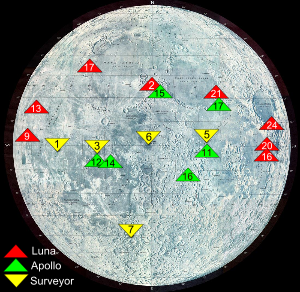
Moon Landing Map showing Luna (Soviet Union),
Surveyor and Apollo (both United States)

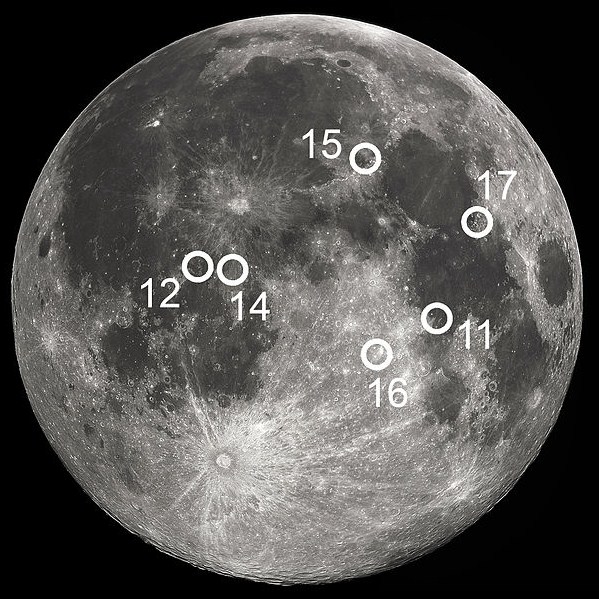
Apollo Lunar Landing Sites
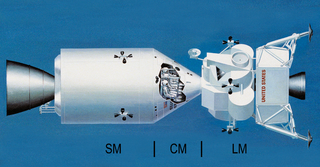
The first seven Apollos were not strictly lunar missions, in that they were all confined to the immediate vicinity of the Earth.
Apollo spacecraft –
SM: Service Module;
CM: Command Module;
LM: Lunar Module
(“CSM” refers to the Command and Service Modules)
On 27th January 1967 at 6:31 p.m. EST, tragedy struck the Apollo program when a flash fire occurred in Command Module 012 during a launch pad test of the Apollo/Saturn space vehicle being prepared for the first piloted flight, the AS-204 mission. The three astronauts died in this tragic accident.
Crew: Lt. Col. Virgil I. Grissom, a veteran of Mercury and Gemini missions, Lt. Col. Edward H. White, the astronaut who had performed the first United States extravehicular activity during the Gemini program, and Lt. Cmdr. Roger B. Chaffee, an astronaut preparing for his first space flight
For more information see the NASA Apollo 1 web page.
For information see the appropriate NASA web page:
Apollo 2, Apollo 3, Apollo 4, Apollo 5, Apollo 6 and Apollo 7.
Apollo 8 was the first human lunar orbit mission. It was the first manned flight using a Saturn V launch vehicle. Its crew became the first humans to see the far side of the Moon.
Crew: Frank Borman, James Lovell, Jr., William Anders
Lift Off: Saturn V, 21st December 1968 at 7:51 a.m. EST, Kennedy Space Center, Florida, Complex 39-A
Splashdown: 27th December 1968 at 10:51 a.m. EST in the Pacific Ocean
Duration: 6 days, 3 hours, 0 min., 42 seconds
COSPAR ID: 1968-118A
NASA recreated the view of the moon’s surface from the orbiting Apollo 8 capsule in 1968 as its crew became the first humans ever to witness Earthrise. An animator drew upon the detailed, modern maps of the moon’s surface from NASA’s Lunar Reconnaissance Orbiter.
For more information see the NASA Apollo 8 web page.
The Apollo 9 space vehicle was the first crewed flight of the Lunar Module and was conducted to qualify the module for lunar operations. Approximately 70 hours into the 10-day mission in Earth orbit, the Lunar Module, Spider, separated, rendezvoused and docked with the Command Module. As a result of unfavourable weather in the planned landing area, Apollo 9 completed an additional orbit before returning to Earth.
Crew: James McDivitt, David Scott, Russell Schweickart
Lift Off: Saturn V, 3rd March 1969 at 11:00 a.m. EST, Kennedy Space Center, Florida, Complex 39-A
Splashdown: 13th March 1969 at 12:00 p.m. EST in the Atlantic Ocean
Duration: 10 days, 1 hour
COSPAR ID: 1969-018A
For more information see the NASA Apollo 9 web page.
This spacecraft was the second Apollo mission to orbit the Moon, and the first to travel to the Moon with the full Apollo spacecraft, consisting of the Command and Service Module, named Charlie Brown, and the Lunar Module, named Snoopy. The primary objectives of the mission were to demonstrate crew, space vehicle and mission support facilities during a human lunar mission and to evaluate Lunar Module performance in cislunar and lunar environment. The mission was a full “dry run” for the Apollo 11 mission, in which all operations except the actual lunar landing were performed.
Crew: Eugene Cernan, John Young, Thomas Stafford
Lift Off: Saturn V, 18th May 1969 at 12:49 a.m. EDT, Kennedy Space Center, Florida, Complex 39-B
Splashdown: 26th May 1969 at 12:52 p.m. EDT in the Pacific Ocean
Duration: 8 days, 0 hours, 3 min., 23 seconds
COSPAR ID: 1969-043A
For more information see the NASA Apollo 10 web page.
The purpose of the Apollo 11 mission was to land men on the lunar surface and to return them safely to Earth.
After launch, the spacecraft was inserted into lunar orbit about 76 hours into the mission. After a rest period, Armstrong and Aldrin entered the Lunar Module preparing for descent to the lunar surface. The two spacecraft were undocked at about 100 hours, when the Command and Service Modules separated from the Lunar Module.
The spacecraft landed in the Sea of Tranquillity at 4:18 p.m. EDT. Afterwards, they ate their first meal on the Moon and decided to begin the surface operations earlier than planned.
Crew: Neil Armstrong, commander, Michael Collins, Command Module pilot, Edwin Aldrin Jr., Lunar Module pilot
Lift Off: Saturn V, 16th July 1969 at 9:32 a.m. EDT, Kennedy Space Center, Florida, Complex 39-A
Lunar Landing: 20th July 1969 at 4:18 p.m. EDT in the Sea of Tranquillity
Lunar Lift Off: 21st July 1969 at 1:54 p.m. EDT
Splashdown: 24th July 1969 at 12:50 p.m. EDT in the Pacific Ocean
Duration: 8 days, 3 hours, 18 minutes
COSPAR ID: 1969-059A (CSM), 1969-059C (LM)
Neil Armstrong, the first man to set foot on the moon (from Apollo 11 in July 1969), died in August 2012.
For more information see the NASA Apollo 11 web page.
The Apollo 12 mission was the first opportunity in the scientific exploration of the Moon to sample extensively the rocks within half a kilometre of the landing site.
The Command Module Pilot remained in lunar orbit as the Lunar Module landed on the northwest rim of the Surveyor Crater in the Ocean of Storms. The landing site was at 23 degrees 4 minutes west longitude and 3 degrees 2 minutes south latitude, approximately 120 kilometers (75 miles) southeast of Lansberg Crater and due north of the centre of Mare Cognitum. The landing site is near a ray associated with the Copernicus Crater, which is approximately 370 km (230 miles) to the north, and is characterized by a distinctive cluster of craters ranging from 50 to 400 metres in diameter.
Crew: Charles Conrad, Jr., Richard Gordon, Jr., Command Module Pilot, Alan Bean
Lift Off: Saturn V, 14th November 1969 at 11:22 a.m. EST, Kennedy Space Center, Florida, Complex 39-A
Lunar Landing: 19th November 1969 at 1:54 p.m. EST in the Ocean of Storms
Lunar Lift Off: 20th November 1969 at 9:25 p.m. EST
Splashdown: 24th November 1969 at 3:58 p.m. EST in the Pacific Ocean
Duration: 10 days, 4 hours, 36 minutes
COSPAR ID: 1969-099A (CSM), 1969-099C (LM)
For more information see the NASA Apollo 12 web page.
Apollo 13 was supposed to land in the lunar region of Fra Mauro, but this landing site was later reassigned to Apollo 14.
At 46 hours, 43 minutes mission elapsed time, Joe Kerwin, the CAPCOM on duty, said, “The spacecraft is in real good shape as far as we are concerned. We’re bored to tears down here”. Nine hours, 12 minutes later, a Service Module oxygen tank blew up aboard Apollo 13. The Command Module’s normal supply of electricity, light and water was lost, and they were about 321,869 km (200,000 miles) from Earth.
Crew: James Lovell Jr., John Swigert Jr., Fred Haise Jr.
Lift Off: Saturn V, 11th April 1970 at 2:13 p.m. EST, Kennedy Space Center, Florida, Complex 39-A
Tank Rupture: 13th April 1970 at 9:08 p.m. EST
Lunar Landing: Aborted
Splashdown: 17th April 1970 at 1:07 p.m. EST in the Pacific Ocean
Duration: 5 days, 22 hours, 54 minutes
COSPAR ID: 1970-029A (CSM)
For more information see the NASA Apollo 13 web page.
The planned landing site for the Apollo 13 mission, Fra Mauro, contains some of the most clearly exposed geological formations that are characteristic of the Fra Mauro Formation. The formation is an extensive geological unit that is distributed – in an approximately radially symmetric fashion around the Mare Imbrium – over much of the nearside of the Moon.
After the Apollo 13 mission failed to achieve a lunar landing, the importance of the Fra Mauro landing site led to a decision to attempt a landing in the same area during the Apollo 14 mission. The final landing site was very close to that chosen for the Apollo 13 mission.
Crew: Alan B. Shepard, Jr., Stuart A. Roosa, Edgar D. Mitchell
Lift Off: Saturn V, 31st January 1971 at 4:03 p.m. EST, Kennedy Space Center, Florida, Complex 39
Lunar Landing: 5th February 1971 at 4:18 a.m. EST at Fra Mauro
Lunar Lift Off: 6th February 1971 at 1:48 p.m. EST
Splashdown: 9th February 1971 at 4:05 p.m. EST in the Pacific Ocean
Duration: 9 days, 1 minute, 58 seconds
COSPAR ID: 1971-008A (CSM), 1971-008C (LM)
For more information see the NASA Apollo 14 web page.
The Apollo 15 mission was the first mission designed to explore the Moon over longer periods, greater ranges and with more instruments for the collection of scientific data than on previous missions. The mission included the introduction of a $40,000,000 lunar roving vehicle that reached a top speed of 16 kph (10 mph) across the Moon’s surface.
The successful Apollo 15 lunar landing mission was the first in a series of three advanced missions planned for the Apollo program. The primary scientific objectives were to observe the lunar surface, survey and sample material and surface features in a preselected area of the Hadley-Apennine region, setup and activate surface experiments and conduct in-flight experiments and photographic tasks from lunar orbit.
Crew: David R. Scott, James B. Irwin, Alfred M. Worden
Lift Off: Saturn V, 26th July 1971 at 9:34 a.m. EDT, Kennedy Space Center, Florida, Complex 39
Lunar Landing: 30th July 1971 at 6:16 p.m. EDT at Hadley-Apennine
Lunar Lift Off: 2nd August 1971 at 1:11 p.m. EDT
Splashdown: 7th August 1971 at 4:45 p.m. EDT in the Pacific Ocean
Duration: 12 days, 7 hours, 12 minutes
COSPAR ID: 1971-063A (CSM), 1971-063C (LM)
For more information see the NASA Apollo 15 web page.
A number of experiments were deployed and two impressive landmarks, Stone Mountain and the North Ray crater, visited. Samples taken from the rim of North Ray crater later proved to be bedrock thrown up from the meteorite impact that had created it. Three moon walks with lunar surface activities totaling 20 hours and 17 minutes were accomplished by Young and Duke. The crew remained on the lunar surface for a total of about 71 hours. After lunar liftoff, the Lunar Module rendezvoused with the Command Module and Mattingly.
Crew: Capt. John Young, commander, Commander Thomas Mattingly II, Command Module pilot, Lt. Colonel Charles Duke, Jr., Lunar Module pilot
Lift Off: Saturn V, 16th April 1972 at 12:54 p.m. EST, Kennedy Space Center, Florida, Complex 39-A
Lunar Landing: 20th April 1972 at 9:23 p.m. EST in the Plain of Descartes
Lunar Lift Off: 23rd April 1972 at 8:25 p.m. EST
Splashdown: 27th April 1972 at 2:45 p.m. EST in the Pacific Ocean
Duration: 11 days, 1 hour, 51 minutes
COSPAR ID: 1972-031A (CSM), 1972-031C (LM)
For more information see the NASA Apollo 16 web page.
The first phase of man’s active exploration of the Moon came to an end with the Apollo 17 mission. Many questions about lunar science were answered during the intensive activity of the Apollo missions, but many more remain to be answered. Some of the unanswered questions will be answered in the future from data already returned but as yet not fully analyzed, and some will have to wait for data yet to be returned from instruments already in place on the lunar surface. Still other questions must await further exploration.
Crew: Eugene Cernan, Ronald Evans, Harrison Schmitt
Lift Off: Saturn V, 7th December 1972 at 12:33 a.m. EST, Kennedy Space Center, Florida, Complex 39
Lunar Landing: 11th December 1972 at 2:54 p.m. EST at Taurus-Littrow
Lunar Lift Off: 14th December 1972 at 5:54 p.m. EST
Splashdown: 19th December 1972 at 2:24 p.m. EST in the Pacific Ocean
Duration: 12 days, 13 hours, 52 minutes
COSPAR ID: 1972-096A (CSM), 1972-096C (LM)
For more information see the NASA Apollo 17 web page.