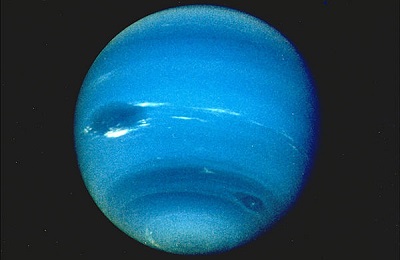
Some Basic Facts about Neptune
Neptune showing some spots probably in its atmosphere
Neptune is the eighth planet from the Sun in the Solar System, and never known to the ancients. Its discovery in 1846 is clothed in controversy, though Galileo is reported to have seen it in 1612 and 1613, not recognising its significance. It has 13 known satellites, named after lesser sea gods than Neptune. The satellites are Triton, Nereid, and several other small objects first seen in recent years. It has a ring system, exhibiting significant differences from those of other ringed planets.
Neptune orbits the Sun once in 60,190.03 Earth days (164.79 years, or 89,666 Neptune solar days). Neptune’s average distance from the Sun is 4,503,443,661 km (30.10366151 AU) though this can vary between 4,452,940,833 km (29.76607095 AU) and 4,553,946,490 km (30.44125206 AU), an eccentricity of 0.011214269.
Its equatorial radius is 24,764±15 km (3.883 Earths) and its polar radius is 24,341±30 km (3.829 Earths), a flattening of 0.0171±0.0013. The surface area is 7.6183×10⁹ km2 (14.98 Earths), and the volume is 6.254×10¹³ km3 (57.74 Earths). Its mass is 1.0243×1026 kg (17.147 Earths or 5.15×10⁻⁵ Suns). Its mean density is 1.638 g/cm3, so, although almost a twin of Uranus in size it is denser.
The sidereal rotational period of Neptune is 16 hours, 6 minutes, 36 seconds.
Voyager 2 is the only spacecraft to have visited Neptune, and it continued on into the outer reaches of the solar system. So far as I know, no other plans exist for another visitor.
See Wikipedia for more information about Neptune.
More about the moons of Neptune in Wikipedia and Seasky•Org.
Two asteroids share the same names as moons of Neptune: 74 Galatea and 1162 Larissa.
Neptune’s Magnetosphere
Neptune resembles Uranus in its magnetosphere, with a magnetic field strongly tilted relative to its rotational axis at 47° and offset at least 0.55 radii, or about 13,500 km from the planet’s physical centre. Before Voyager 2’s arrival at Neptune, it was hypothesised that Uranus’s tilted magnetosphere was the result of its sideways rotation. In comparing the magnetic fields of the two planets, scientists now think the extreme orientation may be characteristic of flows in the planets’ interiors. This field may be generated by convective fluid motions in a thin spherical shell of electrically conducting liquids (probably a combination of ammonia, methane and water) resulting in a dynamo action.
Rings of Neptune
[Right] This 591-second exposure of the rings of Neptune was taken with the clear filter by the Voyager 2 wide-angle camera. The two main rings are clearly visible and appear complete over the region imaged. Also visible in this image is the inner faint ring and the faint band which extends smoothly from the ring roughly halfway between the two bright rings. Both of these newly discovered rings are broad and much fainter than the two narrow rings. The bright glare is due to over-exposure of the crescent on Neptune. Numerous bright stars are evident in the background. Both bright rings have material throughout their entire orbit, and are therefore continuous.
At their densest, the rings are comparable to the less dense portions of Saturn’s main rings such as the C ring and the Cassini Division, but much of Neptune’s ring system is quite tenuous, faint and dusty, more closely resembling the rings of Jupiter. The three main rings are the narrow Adams Ring, 63,000 km from the centre of Neptune, the Le Verrier Ring, at 53,000 km, and the broader, fainter Galle Ring, at 42,000 km. A faint outward extension to the Le Verrier Ring has been named Lassell; it is bounded at its outer edge by the Arago Ring at 57,000 km. These rings have a clumpy structure, the cause of which is not currently understood but which may be due to the gravitational interaction with small moons in orbit near them. The outermost ring, Adams, contains five prominent arcs now named Courage, Liberté, Egalité 1, Egalité 2 and Fraternité (Courage, Liberty, Equality and Fraternity). The existence of arcs was difficult to explain because the laws of motion would predict that arcs would spread out into a uniform ring over very short timescales. How the arcs are stabilized is still under debate, though Astronomers now believe that the arcs are corralled into their current form by the gravitational effects of Galatea, a moon just inward from the ring. The arcs occupy a narrow range of orbital longitudes and are remarkably stable, having changed only slightly since their initial detection in 1980.
The rings of Neptune are made of extremely dark material, likely organic compounds processed by radiation, similar to that found in the rings of Uranus. The proportion of dust in the rings (between 20% and 70%) is high, while their optical depth is low to moderate, at less than 0.1.
Neptune Trojans
Neptune trojans are bodies in orbit around the Sun, that have the same orbital period as Neptune, and follow roughly the same orbital path. Nine are currently known, of which six orbit near the Sun–Neptune L4 Lagrangian point 60° ahead of Neptune and three orbit near Neptune’s L5 region 60° behind Neptune. The Neptune trojans are so termed by analogy with Jupiter’s trojan asteroids; it is speculated that there may be ten times as many Neptune trojans as Jupiter trojans.
The first Neptune trojan was discovered in 2001, the fifth known populated stable grouping of small bodies in the Solar System after the asteroid belt, the Jupiter trojans, the trans-Neptunian objects and the Mars trojans.
The known Neptune trojans in the L4 zone are:
2001 QR322, 2004 UP10, 2005 TN53, 2005 TO74, 2006 RJ103 and 2007 VL305;
those at L5 are:
2004 KV18, 2008 LC18 and 2011 HM102.
In addition 2005 TN74 and (309239) 2007 RW10 were believed to be Neptune trojans at the time of their discovery, but further observations have found that they are not.
2005 TN74 is currently thought to be in a 3:5 resonance with Neptune.
(309239) 2007 RW10 is currently following a quasi-satellite loop around Neptune.
Neptune’s Moon Triton
Triton is the largest moon of Neptune; it is the only large moon in the Solar System with a retrograde orbit (in the opposite direction to its planet’s rotation). At 2,700 km in diameter, it is the seventh-largest moon in the Solar System. Because of its retrograde orbit and composition similar to that of Pluto, Triton is thought to have been captured from the Kuiper belt. Triton has a surface of mostly frozen nitrogen, a mostly water-ice crust, an icy mantle and a substantial core of rock and metal. The core makes up two-thirds of its total mass. Triton has a mean density of 2.061 g/cm3 and is composed of approximately 15 to 35% water ice.
Neptune’s largest moon Triton has plumes of gas coming from inside
Here’s more information about Triton, especially its orbital characteristics and surface features.
[Left] A Voyager 2 photomosaic of Triton’s sub-Neptunian hemisphere. The bright, slightly pinkish, south polar cap at bottom is composed of nitrogen and methane ice and is streaked by dust deposits left by nitrogen gas geysers. The mostly darker region above it includes Triton’s “cantaloupe terrain” and cryovolcanic and tectonic features. Near the lower right limb are several dark maculae (“strange spots”)
Triton’s Geysers
[Right] Triton is one of the few moons in the Solar System known to be geologically active. As a consequence, its surface is relatively young, with a complex geological history revealed in intricate and mysterious cryovolcanic and tectonic terrains. Part of its crust is dotted with geysers thought to erupt nitrogen. Triton has a tenuous nitrogen atmosphere less than 1/70,000 the pressure of Earth’s atmosphere at sea level.
Neptune’s Moon Proteus
Proteus is the second largest moon of Neptune after the mysterious Triton. Proteus was discovered only in 1989 by the Voyager 2 spacecraft. This is unusual since Neptune has a smaller moon – Nereid – which was discovered 33 years earlier from Earth. The reason Proteus was not discovered sooner is that its surface is very dark and it orbits much closer to Neptune. Proteus has an odd box-like shape and were it even slightly more massive, its own gravity would cause it to reform itself into a sphere.
Proteus, despite being more than 400 km in diameter has a somewhat irregular shape with several slightly concave facets and relief as high as 20 km. Its surface is dark, neutral in colour and heavily cratered. The largest crater is more than 200 km in diameter. There are also a number of scarps, grooves and valleys related to large craters. Proteus is probably not an original body that formed with Neptune; it may have accreted later from the debris created when the largest Neptunian satellite Triton was captured.
Neptune’s Moon Nereid
Nereid, the third-largest moon of Neptune, has one of the most eccentric orbits of any satellite in the solar system.
The eccentricity of 0.7512 gives it an apoapsis of 9,655,000 km that is seven times its periapsis distance (1,372,000 km) from Neptune. It is about 340 km in diameter.
Other Moons of Neptune
Neptune’s innermost four moons – Naiad, Thalassa, Despina and Galatea – orbit close enough to be within Neptune’s rings.
In order of their distances from Neptune, the regular Neptunian moons are:
Naiad: 33±3 km in radius, Thalassa: 41±3 km, Despina: 75±3 km (which may be a shepherd moon of the LeVerrier Ring, as its orbit lies just inside this ring), Galatea: 88±4 km (apparently a shepherd moon of the Adams Ring), Larissa: 97±3 km, and Proteus: 210±7 km.
Again, in order of distance from Neptune are the irregular moons, a group that includes both prograde and retrograde objects:
Triton: 1,353.4±0.9 km (0.2122 Earths), Nereid: 170±25 km, Halimede*: about 62 km, eccentricity 0.2646, Sao: about 22 km, eccentricity 0.1365, Laomedeia: about 21 km, Neso*: about 30 km and Psamathe*: about 19 km.
‘*’ indicates an orbit around Neptune opposite to the planet’s rotation, and suggests that these moons and other small ones are captured asteroids.
- Despina is irregularly shaped and shows no sign of any geological modification. It is likely that Despina, Galatea and Larissa are rubble piles re-accreted from fragments of Neptune’s original satellites, which were smashed up by perturbations from Triton soon after that moon’s capture into a very eccentric initial orbit. Despina’s orbit lies close to but outside of the orbit of Thalassa and just inside the Le Verrier ring. The orbits of Despina, Galatea and Larissa all lie below Neptune’s synchronous orbit radius. They are slowly spiralling inward due to tidal decceleration and may eventually impact Neptune’s atmosphere, or break up into planetary rings upon passing its Roche limit due to tidal stretching.
- Larissa is the fourth-largest satellite of Neptune, is irregular (non-spherical) in shape and appears to be heavily cratered, with no sign of any geological modification. Little else is known about it. Larissa’s orbit is circular but not perfectly so.
- Halimede has the second most eccentric and third most inclined orbit around Neptune.
- Sao orbits Neptune at a distance of about 22.4 million km and is about 44 km in diameter (assuming an albedo of 0.04). It follows an exceptionally inclined and moderately eccentric orbit. The satellite is in so-called Kozai resonance, i.e. its inclination and eccentricity are coupled (the inclination of the orbit decreases while eccentricity increases and vice versa).
- Laomedeia orbits Neptune at a distance of about 23,571,000 km and is about 42 km in diameter (assuming albedo of 0.04).
- Neso orbits Neptune at a distance of more than 48 Gm (million km), making it the most distant known moon of any planet. Such distances are of the order of magnitude of heliocentric distances of inner planets rather than moons; at apocentre the satellite is more than 72 Gm (72 million km) from the planet to compare with Mercury’s aphelion of about 70 Gm! It follows a highly inclined and highly eccentric orbit.
- Psamathe orbits Neptune at a distance of about 46,695,000 km and requires almost 25 Earth years to make one orbit. The orbit of this satellite is close to the theoretical stable separation from Neptune for a body in a retrograde orbit. Given the similarity of this moon’s orbital parameters with Neso, it was suggested that both irregular satellites could have a common origin in the break-up of a larger moon. Both are further from their primary than any other known moon in the Solar System.

 video is here.