
See Wikipedia and Nine Planets for more about Uranus, and Voyager 2 for the only spacecraft that has visited the planet.
Uranus is the seventh planet from the Sun, the first planet in the Solar System not known to the ancients, and was discovered by William Herschel on 13th March 1781, the first planet found using a telescope. It has 27 known satellites whose names are taken from characters from the works of Shakespeare and Alexander Pope. The five main satellites are Miranda, Ariel, Umbriel, Titania and Oberon. It has 13 known rings, all of which are narrow and feint.
It orbits the Sun once in 30,799.095 Earth days (84.323326 years, or 42,718 Uranus solar days). Uranus’s average distance from the Sun is 2,876,679,082 km (19.22941195 AU) though this can vary between 2,748,938,461 km (18.37551863 AU) and 3,004,419,704 km (20.08330526 AU), an eccentricity of 0.044405586. The intensity of sunlight on Uranus is about 1/400 that on Earth.
Its equatorial radius is 25,559±4 km (4.007 Earths) and its polar radius is 24,973±20 km (3.929 Earths), a flattening of 0.0229±0.0008. The circumference is 159,354.1 km, the surface area is 8.1156×10⁹ km2 (15.91 Earths), and the volume is 6.833×10¹³ km3 (63.086 Earths). Its mass is (8.6810±0.0013)×1025 kg (14.536 Earths).
The rotational period of the interior of Uranus is 17 hours, 14 minutes, clockwise (retrograde). As on all giant planets, its upper atmosphere experiences very strong winds in the direction of rotation. At some latitudes, such as about two-thirds of the way from the equator to the south pole, visible features of the atmosphere move much faster, making a full rotation in as little as 14 hours. Its surface temperature at the 1-bar level (the depth in its atmosphere where the pressure is similar to the Earth’s at sea level) is 76 K, and at the 0.1-bar (tropopause) level varies between 49 K and 57 K.
Uranus has an axial tilt of 97.77°, so its axis of rotation is approximately parallel to the plane of the Solar System. This gives it seasonal changes completely unlike those of the other major planets. Other planets can be visualized to rotate like tilted spinning tops on the plane of the Solar System, while Uranus rotates more like a tilted rolling ball. Near the time of Uranian solstices, one pole faces the Sun continuously while the other pole faces away. Only a narrow strip around the equator experiences a rapid day-night cycle, but with the Sun very low over the horizon as in the Earth’s polar regions. At the other side of Uranus’s orbit the orientation of the poles towards the Sun is reversed. Each pole gets around 42 years of continuous sunlight, followed by 42 years of darkness. Near the time of the equinoxes, the Sun faces the equator of Uranus giving a period of day-night cycles similar to those seen on most of the other planets. Uranus reached its most recent equinox on 7th December 2007.
The planet has the third-largest planetary radius and fourth-largest planetary mass in the Solar System. Uranus is similar in composition to Neptune, and both are of different chemical composition than the larger gas giants Jupiter and Saturn. For this reason, astronomers sometimes place them in a separate category called “ice giants”. Uranus’s atmosphere, while similar to Jupiter’s and Saturn’s in its primary composition of hydrogen and helium, contains more “ices” such as water, ammonia, and methane, along with traces of hydrocarbons. It is the coldest planetary atmosphere in the Solar System, with a minimum temperature of 49 K (−224°C). It has a complex, layered cloud structure, with water thought to make up the lowest clouds, and methane thought to make up the uppermost layer of clouds. In contrast, the interior of Uranus is mainly composed of ices and rock.
Like the other gas giants, Uranus has a ring system, a magnetosphere, and numerous moons. The Uranian system has a unique configuration among the planets because its axis of rotation is tilted sideways, nearly into the plane of its revolution about the Sun. Its north and south poles therefore lie where most other planets have their equators. In 1986, images from Voyager 2 showed Uranus as a virtually featureless planet in visible light without the cloud bands or storms associated with the other giants. Terrestrial observers have seen signs of seasonal change and increased weather activity in recent years as Uranus approached its equinox. The wind speeds on Uranus can reach 250 metres per second (900 km/h, 560 mph).
Titania is the largest of the moons of Uranus and the eighth largest moon in the Solar System with a diameter of 1,578 km. Discovered by William Herschel in 1787, Titania has an orbit that lies inside Uranus’s magnetosphere. Titania has a small eccentricity and is inclined very little relative to the equator of Uranus. Its orbital period, 8.7 days, is also coincident with its rotational period. This means that Titania is a synchronous (or tidally-locked) satellite, with one face pointing towards Uranus at all times.
Scientists believe Titania is composed of equal parts rock (which may include carbonaceous materials and organic compounds) and ice. This is supported by examinations that indicate that Titania has an unusually high-density for a Uranian satellite (1.71 g/cm³). The presence of water ice is supported by infrared spectroscopic observations made in 2001–2005, which have revealed crystalline water ice on the surface of the moon.
Oberon (diameter 1,523 km) is characterized by an old, heavily cratered, and icy surface. This surface shows little evidence of internal activity other than some unknown dark material that apparently covers the floors of many craters. The above photograph shows several large impact craters towards the centre of the image. On the limb, a high mountain rises 6 km above its surroundings. There are bright rays similar to those seen on Jupiter’s moon Callisto. See  Oberon rotating.
Umbriel was discovered by the British astronomer William Lassell in 1851. It has a diameter of 1,170 km. Its heavily cratered surface has probably been stable since its formation. It has far more and larger craters than Ariel and Titania. Its surface is very dark and reflects only about half as much light as Ariel, Uranus’s brightest satellite.
Umbriel and Oberon appear quite similar though Oberon is 35% larger. All of Uranus’s large moons are a mixture of about 40 to 50% water ice with the rest rock, a somewhat larger fraction of rock than Saturn’s large moons such as Rhea.
Ariel is the twelfth of Uranus’s moons and is the fourth largest (diameter 1,158 km). It was discovered in 1851 by the British astronomer, William Lassell. Nearly everything we now know about this moon was discovered by the Voyager 2 spacecraft in 1986.
[Left] Uranus’s moon Ariel (the white dot) and its shadow (the black one) crossing the face of Uranus in this Hubble Space Telescope image. [Right] Photograph by Voyager 2 of Ariel.
Miranda is the smallest of Uranus’ major moons (diameter 470 km). It has a surface with patchwork regions of broken terrain indicating intense geological activity in the past, and is criss-crossed by huge canyons. Miranda’s past geological activity was probably driven by tidal heating at a time when its orbit was more eccentric than now.
This ball of ice and rock possesses one of the oddest and most varied landscapes known among extraterrestrial bodies, including giant canyons up to 12 times deeper than the Grand Canyon.
Miranda has three giant features known as coronae that are unique among known objects in the solar system. They are shaped crudely, either like ovals or trapezoids, and each is least 200 km wide. The coronae are separated from their more heavily cratered surroundings by belts of concentric ridges and troughs, making them look like mismatched patches on a moth-eaten coat.
The first two Uranian moons, discovered in 1787, did not receive names until 1852, a year after two more moons had been discovered. The responsibility for naming was taken by John Herschel, son of the discoverer of Uranus. Herschel, instead of assigning names from Greek mythology, named the moons after magical spirits in English literature: the fairies Oberon and Titania from Shakespeare’s A Midsummer Night’s Dream, and the sylphs Ariel and Umbriel from Pope’s The Rape of the Lock (Ariel is also a sprite in Shakespeare’s The Tempest). The reasoning was presumably that Uranus, as god of the sky and air, would be attended by spirits of the air.
Subsequent names, rather than continuing the airy spirits theme (only Puck and Mab continued the trend), have focused on Herschel’s source material. In 1949, the fifth moon, Miranda, was named by its discoverer Gerard Kuiper after a thoroughly mortal character in Shakespeare’s The Tempest. The current IAU practice is to name moons after characters from Shakespeare’s plays and The Rape of the Lock (although at present only Ariel, Umbriel, and Belinda have names drawn from the latter; all the rest are from Shakespeare). At first, the outermost moons were all named after characters from one play, The Tempest; but with Margaret being named from Much Ado About Nothing that trend has ended.
Some asteroids share names with moons of Uranus: 171 Ophelia, 218 Bianca, 593 Titania, 666 Desdemona, 763 Cupido, and 2758 Cordelia.
The Near Infrared Camera and Multi-Object Spectrometer (NICMOS) of the Hubble Space Telescope took the two images below on 28th July 1997. The image on the right, taken 90 minutes after the left-hand image, shows the planet’s rotation. Each image is a composite of three near-infrared images. They are called false-colour images because the human eye cannot detect infrared light; so colours corresponding to visible light were assigned to the images. (The wavelengths for the ‘blue’, ‘green’, and ‘red’ exposures are 1.1, 1.6, and 1.9 micrometres, respectively.) At visible and near-infrared light, sunlight is reflected from hazes and clouds in the atmosphere of Uranus. However, at near-infrared light, absorption by gases in the Uranian atmosphere limits the view to different altitudes, causing intense contrasts and colours.
Because Uranus orbits the Sun on its side, and its moons orbit in the planet’s equatorial plane, they are all subject to an extreme seasonal cycle, where the northern and southern poles experience 42 years of either complete darkness or complete sunlight.
In these images, the blue exposure probes the deepest atmospheric levels – a blue colour indicates clear atmospheric conditions, prevalent at mid-latitudes near the centre of the disk. The green exposure is sensitive to absorption by methane gas, indicating a clear atmosphere; but in hazy atmospheric regions, the green colour is seen because sunlight is reflected back before it is absorbed. The green color around the south pole (marked by ‘+’) shows a strong local haze. The red exposure reveals absorption by hydrogen, the most abundant gas in the atmosphere of Uranus. Most sunlight shows patches of haze high in the atmosphere. A red colour near the limb (edge) of the disk indicates the presence of a high-altitude haze. The purple colour to the right of the equator also suggests haze high in the atmosphere with a clear atmosphere below.
The five clouds visible near the right limb rotated counterclockwise during the time between both images. They reach high into the atmosphere, as indicated by their red colour. Features of such high contrast had never been seen before on Uranus. The clouds are almost as large as continents on Earth, like Europe. Another cloud (which barely can be seen) rotated along the path shown by the black arrow. It is located at lower altitudes, as indicated by its green colour. The rings of Uranus are extremely faint in visible light, but quite prominent in the near infrared. The brightest ring, the epsilon ring, has a variable width around its circumference. Its widest and brightest part is at the top in this image. Two fainter, inner rings are visible next to the epsilon ring.
Eight of the 10 small Uranian satellites, discovered by Voyager 2, can be seen in both images. Their sizes range from about 40 km for Bianca to 150 km for Puck. The smallest of these satellites have not since been detected since the departure of Voyager 2 from Uranus in 1986. These eight satellites revolve around Uranus in less than a day. The inner ones are faster than the outer ones. Their motion in the 90 minutes between both images is marked in the right panel. The area outside the rings was slightly enhanced in brightness to improve the visibility of these faint satellites.
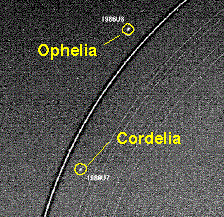
The brightest of Uranus’s rings, the ε ring, is shepherded by the two innermost moons of the planet, Cordelia and Ophelia.
In order of their distances from Uranus, the Uranian moons (which are mostly named from Shakespeare with a few from Pope) and their diameters are:
‘*’ indicates a retrograde orbit around Uranus (opposite to the planet’s rotation) and suggests that these moons and other small ones are captured asteroids.
See Wikipedia for fuller details.
The rings of Uranus were discovered in 1977. More than 200 years ago, in 1789, William Herschel also reported observing rings though some modern astronomers are sceptical that he could have actually seen them. By 1978, nine distinct rings were identified. Two additional rings were discovered in 1986 in images taken by Voyager 2, and two outer rings were found in 2003–2005 in Hubble Space Telescope photos.
In order of increasing distance from the planet the 13 known rings are designated 1986U2R/ζ, 6, 5, 4, α, β, η, γ, δ, λ, ε, ν and μ. Their radii range from about 38,000 km for the 1986U2R/ζ ring to about 98,000 km for the μ ring. Additional faint dust bands and incomplete arcs may exist between the main rings. The rings are extremely dark – the Bond albedo of the rings’ particles does not exceed 2%. They are probably composed of water ice with the addition of some dark radiation-processed organic materials.
The majority of Uranus’s rings are opaque and only a few kilometres wide. The ring system contains little dust overall; it consists mostly of large bodies 0.2 to 20 m in diameter. However, some rings are optically thin: the broad and faint 1986U2R/ζ, μ and ν rings are made of small dust particles, while the narrow and faint λ ring also contains larger bodies. The relative lack of dust in the ring system is due to aerodynamic drag from the extended Uranian exosphere-corona (outermost layers of the atmosphere).
See Wikipedia for fuller details.