
Loading...
Loading...
This page has sections on Space Science and Space Research:
Space research with anything more than the unassisted eye began in 1610 with Galileo Galilei’s discovery of the four largest moons of Jupiter using a telescope. (I don’t mean by this to underestimate the contribution of Greek, Arab and other astronomers from hundreds and thousands of years previously; their contributions were often more philosophical than scientific, however.)
Since Galileo, the telescope has been developed remarkably, and a brief section on modern Earth-bound telescopes appears elsewhere. It was with the launch of the artificial satellite that telescopes were able to escape the blocking and distortion of light caused by the atmosphere. Though modern scientific advances have given us amazing insights into the universe without the need to escape into space.
It’s hard to believe that over fifty years have passed since, during the Cold War when a nuclear war appeared a real threat, the Soviet Union shocked us all by launching the first artificial satellite into Earth orbit – Sputnik 1 on 4th October 1957. We’ve come a long way since then, with American space probes Voyagers 1 and 2 and Pioneers 10 and 11 now leaving the Solar System, and others like New Horizons on the way.
Only three nations have flown manned spacecraft: USSR/Russia, USA, and China. India, Japan, Europe/ESA, Iran, South Korea, North Korea, Denmark, and Romania have plans for manned spacecraft (for manned suborbital rockets). Of course nationals of many countries have served aboard the International Space Station, for which the Soyuz rocket is at present the only means of getting there.
The Soviet Union was the first country to put a human into orbit. Since then, the United States and several other countries have achieved this feat. My main interest is in astronomy so I’ve included only flights that left the immediate vicinity of the Earth (e.g. Apollo and unmanned missions). Below left is a list of manned exploits; below right is the present situation.
Vostok (Востόк)
Mercury
Voskhod (Восхόд)
Gemini
Soyuz (Союз)
Apollo
Space shuttle (Space Transportation System)
Shenzhou (China National Space Administration)
See the full
Index to Interplanetary Programmes including Lunar Missions
Read also about the major programs of NASA:
Explorer, Discovery, Flagship, New Frontiers and the Great Observatories;
the NASA Heliophysics Flight Program;
and NASA’s
Weekly News Update.
There have been over 6000 satellites and probes launched into space in the last fifty-odd years. (For example, Russia launched Kosmos 2512 on 5th December 2015.) It is not my intention to cover all 6000-odd! I have chosen some that I think are more interesting, and have concentrated on those which have left the vicinity of the Earth. That covers the early lunar impactors to the five American craft which are now well on their way to leaving the solar system. This section includes only a very small selection of Earth-orbiting satellites. Wikipedia has a comprehensive description of the various types of artificial satellite, and other lists, for example of satellites in geosynchronous orbits and interplanetary voyages.
There are some satellites that are in solar orbits simply because that’s where they’ve ended up after completing, for example, a successful fly-by of Venus. Others are in solar orbit because that is what they were designed for.
The first artificial satellites were launched in 1957 (Sputnik 1, illustrated above). I have chosen a few of the thousands of Earth satellites launched since then:

When you were a kid, or maybe you still are one after half a century of Sputniks, Apollos and Rosettas, did you read about heroic spaceflight captains like Dan Dare?
Here’s how to fly a spacecraft.
The first spacecraft to escape the Earth’s gravity came about a year after Sputnik 1. Within months the Moon’s far side had been photographed by Luna (or Lunik) 3.
You can find a Map of the Moon that shows where all the Luna, Surveyor and Apollo spacecraft landed or crashed.
And see also Wikipedia’s List of Solar System Probes and their List of Lunar Probes; there’s also the WikiProject Spaceflight portal. Comprehensive up-to-date information on all known spacecraft launches, successful or failure, is in this mammoth list of launches and payloads. Or try this Canadian site in “franglais” by a journalist from Québec. Lots of detail, and it now seems to be pretty up-to-date.
Exploration of the outer planets requires extreme patience. Our launch vehicles are not powerful enough to send massive spacecraft directly to the giant planets, so they must take circuitous paths returning to Earth or even travelling inward to Venus for gravity assists (sling-shots) to boost momentum enough to send them beyond the asteroid belt. Rendezvousing with asteroids and comets can be even more challenging; these small objects lack sufficient mass to brake fast-moving spacecraft into orbit, so the craft must perform years of orbit adjustment to match their positions and velocities with the tiniest worlds.
Power is also a problem. Located very far from the Sun, comets, outer planets, and most asteroids receive very little solar energy. Solar arrays must be very large to gather the little sunlight, like those of Rosetta, Dawn, and Juno; or else spacecraft must carry radioisotope thermoelectric generators. The successes of missions like Voyager, Pioneer, Galileo, Cassini-Huygens, and New Horizons require these nuclear power supplies; but Earth has run short of refined plutonium-238, preventing us from planning many future missions.
Exceptions are the missions to near-Earth asteroids, which, by definition, have orbits very similar to our own planet’s, permitting them to be explored relatively cheaply and quickly by solar-powered spacecraft like Hayabusa and NEAR. And some small craft like Deep Impact, Stardust and Rosetta can catch comets as they speed across the inner solar system.
Beginning in 1962, the name Kosmos was given to Soviet spacecraft which remained in Earth orbit, regardless of whether that was their intended final destination. The designation of some missions as intended planetary probes is based on evidence from Soviet and non-Soviet sources and historical documents. Typically Soviet planetary missions were initially put into an Earth parking orbit as a launch platform with a rocket engine and attached probe. The probes were then launched toward their targets with an engine burn with a duration of roughly 4 minutes. If the engine misfired or the burn was not completed, the probes would be left in Earth orbit and given a Kosmos designation.
So Venera 1VA No.1, the first Soviet attempt at a fly-by probe to Venus, failed to leave Earth orbit. In keeping with this Soviet policy of not announcing details on failed missions, the launch was announced under the name Tyazhely Sputnik (Cyrillic: Тяжелый Спутник) (“Heavy Satellite”). Tyazhely Sputnik was known in the West as Sputnik 7.
Wikipedia has listed all known spacecraft that went (or attempted to go) beyond the Earth; what’s more the lists are constantly being updated.
There is a selection of Earth satellites (i.e. not to the moon or beyond) in my web pages. See also this compendious external file, a master list of launches and payloads; this http://www.zarya.info/Diaries/Launches/Launches.php?year=2015 site lists all launches (to date) in 2015, and a tweaking of the URL should guide you to those in other years.
This chart includes every probe that left geocentric orbit, and does not include missions which failed at launch. This update is from 3rd December 2014. The latest version is at Wikimedia Commons.
Click the diagram and then Zoom inwards (considerably to be able to read the chart).

This image was created during “DensityDesign Integrated Course Final Synthesis Studio” at the Polytechnic University of Milan, organized by DensityDesign Research Lab.
The image is released under CC-BY-SA licence. Attribution goes to “Francesco Padovani, DensityDesign Research Lab”. – Own work. Licensed under CC BY-SA 4.0 via Wikimedia Commons.
Position of Pioneer 11 spacecraft from above the solar system on 8th February 2012
Pioneer 10, launched on 2nd March 1972 became the first spacecraft to traverse the asteroid belt. The closest approach to Jupiter was on 4th December 1973. Communication was lost on 23rd January 2003, due to power constraints, with the probe at a distance of 12 billion km (80 AU) from Earth. In January 2015 is was believed to be 111.930 AU (16,744,000,000 km) from Earth.
Pioneer 11, launched on 6th April 1973 to study the asteroid belt, the environment around Jupiter and Saturn, solar wind, cosmic rays, and eventually the far reaches of the solar system and heliosphere. It was the first probe to encounter Saturn. Due to power constraints and the vast distance to the probe, communication has been lost since 30th November 1995. In January 2015 it was believed to be 91.424 AU (13,677,000,000 km) from Earth.
Voyager 2 (which was launched just before Voyager 1) flew by Jupiter on 9th July 1979, Saturn on 5th August 1981, Uranus on 24th January 1986, and Neptune on 25th August 1989. It is still in regular contact and transmitting scientific data. Contact is hoped to be maintained until at least 2020. In November 2015 it is believed to be 109.814 AU (16,428,000,000 km) from Earth.
Voyager 1 flew by Jupiter on 5th March 1979, and Saturn on 12th November 1980. It is still in regular contact and transmitting scientific data. In August 2012 it left the solar system and is now into interstellar space. Contact is hoped to be maintained until at least 2020. In November 2015 it is believed to be 133.768 AU (20,012,000,000 km) from Earth.
New Horizons flew distantly by asteroid 132524 APL in June 2006, and Jupiter for gravity assist on 28th February 2007. It reached Pluto in July 2015, studying the planet and its satellites. Fly-bys of other Kuiper Belt objects may follow; the targets are yet to be decided.
Pioneer 10 has now been overtaken by the two Voyager probes, launched in 1977, and Voyager 1 is now the most distant object built by humans.
See Where are the Voyagers? and Where is New Horizons? and Where is Pioneer 11? You can use this last link to find many objects in the sky: asteroids, comets, spacecraft...
The Voyager program is an American scientific program that launched two unmanned space missions, the probes Voyager 1 and Voyager 2. These were launched in 1977 to take advantage of a favourable alignment of the planets during the late 1970s. Although they were designated officially to study just the planetary systems of Jupiter and Saturn, the space probes were able to continue their mission into the outer solar system, and they are expected to push through the heliosheath in deep space.
These two space probes were built at the Jet Propulsion Laboratory in Southern California, and they were paid for by the National Aeronautics and Space Administration (NASA), which also paid for their launchings from Cape Canaveral, Florida, their tracking, and everything else concerning the space probes.
As of 2012, Voyager 1 is the farthest manmade object that has ever been sent from the Earth. On 15th June 2012, scientists at NASA reported that Voyager 1 might be very close to entering interstellar space and becoming the first manmade object to leave the Solar System.
Both of these scientific missions into outer space have gathered large amounts of data about the gas giants of the solar system, and their orbiting satellites, about which little had been previously known. In addition, the trajectories of the two spacecraft have been used to place limits on the existence of any hypothetical trans-Neptunian planets.
The Voyager space probes were originally conceived as part of the Mariner program, and they were thus named Mariner 11 and Mariner 12 respectively. They were then moved into a separate program named Mariner Jupiter–Saturn, later renamed the Voyager Program because it was thought that the design of the two space probes had progressed sufficiently above those of the Mariner family that they merited a separate name.
The Voyager Program is essentially a scaled-back version of the program “Grand Tour” of the Outer Planets planned during the late 1960s and early 70s. Gary Flandro, an aerospace engineer at the Jet Propulsion Laboratory on the study team, discovered that the alignment of the outer planets would make it possible to use gravitational assists from Jupiter to go to Saturn, and thence and on to Uranus and Neptune. The plan of the “Grand Tour” was to send several pairs of probes to fly by all the outer planets, including Pluto, along various trajectories, including Jupiter – Saturn – Pluto and Jupiter – Uranus – Neptune.
The major plans for the “Grand Tour” were dramatically scaled back because of lack of money appropriated by Congress. In the end, the Voyager Program fulfilled many of the flyby objectives of the “Grand Tour” excepting any mission to Pluto, and dual missions to Uranus and Neptune.
Of the two space probes of the Voyager Program, Voyager 2 was launched first. Its trajectory was designed to take advantage of an unusual alignment of the planets (that occurs once every 177 years) that allowed one space probe to fly by Jupiter, Saturn, Uranus, and Neptune, if everything went well. Of course, in case of a serious malfunction, such as in all of the space probe’s radio transmitters or receivers, then that would have been the end of the long mission (to four planets), since there was not a second space probe to fill the gap. That was the gamble that NASA and the JPL were forced to take.
Voyager 1 was launched after its sister probe, but along a shorter and faster trajectory that sent it to Jupiter and Saturn sooner, but at the cost of not visiting any more of the outer planets. Voyager 1 also had the high-priority mission of making a close fly-by of the Saturnian moon Titan, which was known to be quite large and to possess a dense atmosphere very much worth studying.
During the 1990s, Voyager 1 overtook the slower deep-space probes Pioneer 10 and Pioneer 11 to become the most distant manmade object from Earth, a record that it will keep for the foreseeable future. Even the faster (at its launch) New Horizons space probe will not pass it, since the final speed of New Horizons (after maneuvering within the solar system) will be less than the current speed of Voyager 1. Voyager 1 and Pioneer 10 are the most widely separated man-made objects anywhere, since they are travelling in roughly opposite directions from the Solar System.
Periodic contact has been maintained with Voyager 1 and Voyager 2 to monitor conditions in the outer expanses of the Solar System. The radioactive power sources of both spacecraft were still producing significant amounts of electric power as of 2012, keeping them operational, and it is hoped that this will allow the heliopause of the Solar System to be located and investigated. In late 2003 Voyager 1 began sending data that seemed to indicate it had crossed the termination shock, but interpretations of these data are in dispute, and it was later believed that the termination shock was crossed in December 2004. The heliopause remained an unknown distance ahead.
On 10th December 2007, instruments on board Voyager 2 sent data back to Earth indicating that the solar system is asymmetrical. It has also reached the termination shock, about 10 billion miles from where Voyager 1 first crossed it, and is travelling outward at roughly 3.3 AU per year.
In August 2009 Voyager 1 was over 16.5 terametres (16.5×10¹² metres, 110.7 AU) from the Sun, and thus had entered the heliosheath region between the solar wind’s termination shock and the heliopause (the limit of the solar wind). Beyond the heliopause is the bow shock of the interstellar medium, beyond which the probes enter interstellar space and the Sun’s gravitational influence on them is exceeded by that of the Milky Way galaxy in general. At the heliopause, light from the Sun takes over 16 hours to reach the probe.
By December 2010 Voyager 1 had reached a region of space where there was no net velocity of the solar wind. At this point, the wind from the Sun may be cancelled out by the interstellar wind. It does not appear that the spacecraft has yet crossed the heliosheath into interstellar space.
On 10th June 2011, scientists studying the Voyager data noticed what may be giant magnetic bubbles located in the heliosphere, the region of our solar system that separates us from the violent solar winds of interstellar space. The bubbles, scientists theorize, form when the magnetic field of the Sun becomes warped at the edge of our Solar System. In August 2012 Voyager 1 was believed to have crossed into interstellar space.
The Voyager spacecraft weighs 773 kilograms. Of this, 105 kilograms are scientific instruments. The identical Voyager spacecraft use three-axis-stabilized guidance systems that use gyroscopic and accelerometer inputs to their attitude control computers to point their high-gain antennas towards the Earth and their scientific instruments pointed towards their targets, sometimes with the help of a movable instrument platform for the smaller instruments and the electronic photography system.
They have a high-gain antenna with a 3.66 metre diameter attached to the hollow decagonal electronics container. There is also a spherical tank that contains hydrazine monopropellant fuel.
The Voyager Golden Record is attached to one of the bus sides.
Two 10-metre whip antennas, which study planetary radio astronomy and plasma waves, extend from the spacecraft’s body diagonally below the magnetometer boom. The 13-metre long Astromast tri-axial boom extends diagonally downwards left and holds the two low-field magnetometers, and the high-field magnetometers remain close to the main antenna.
The instrument boom extending upwards holds, from bottom to top: the cosmic ray subsystem, and Low-Energy Charged Particle detector, the Plasma Spectrometer, and the scan platform that rotates about a vertical axis. The scan platform comprises: the Infrared Interferometer Spectrometer, the Ultraviolet Spectrometer, the two Imaging Science Subsystem, vidicon cameras, and the Photopolarimeter System.
Only five investigation teams are still supported, though data is collected for two additional instruments. The Flight Data Subsystem and a single eight-track digital tape recorder provide the data handling functions. The FDS configures each instrument and controls instrument operations. It also collects engineering and science data and formats the data for transmission. The DTR is used to record high-rate Plasma Wave Subsystem data. The data is played back every six months.
The Imaging Science Subsystem, made up of a wide angle and a narrow angle camera, is a modified version of the slow scan vidicon camera designs that were used in the earlier Mariner flights. The Imaging Science Subsystem consists of two television-type cameras, each with eight filters in a commandable Filter Wheel mounted in front of the vidicons. One has a low resolution 200 millimetre wide-angle lens with an aperture of f/3 (the wide angle camera), while the other uses a higher resolution 1.500 meter narrow-angle f/8.5 lens (the narrow angle camera).
Unlike the other onboard instruments, the operation of the cameras for visible light is not autonomous, but rather it is controlled by an imaging parameter table contained in one of the on-board digital computers, the Flight Data Subsystem. More recent space probes, since about 1990, usually have completely autonomous cameras.
The computer command subsystem controls the cameras. The CCS contains fixed computer programs such as command decoding, fault detection, and correction routines, antenna pointing routines, and spacecraft sequencing routines. This computer is an improved version of the one that was used in the Viking orbiter. The hardware in both custom-built CCS subsystems in the Voyagers is identical. There is only a minor software modification for one of them that has a scientific subsystem that the one other lacks.
The Attitude and Articulation Control Subsystem controls the spacecraft orientation (its attitude). It keeps the high-gain antenna pointing towards the Earth, controls attitude changes, and points the scan platform. The custom-built AACS systems on both craft are identical.
The digital control electronics of the Voyagers were based on RCA CD4000 radiation-hardened, silicon-on-sapphire custom-made integrated circuit chips, combined with standard transistor-transistor logic integrated circuits.
The uplink communications are executed via S-band microwave communications. The downlink communications are carried out by an X-band microwave transmitter on board the spacecraft, with an S-band transmitter as a back-up. All long-range communications to and from the two Voyagers have been carried out using their 3.67-metre high-gain antennas.
Because of the inverse-square law in radio communications, the digital data rates used in the downlinks from the Voyagers has been continually decreasing the farther that they get from the Earth. For example, the data rate used from Jupiter was about 115,000 bits per second. That was halved at the distance of Saturn, and it has gone down continually since then. Some measures were taken on the ground along the way to reduce the effects of the inverse-square law. In between 1982 and 1985, the diameters of the three main parabolic dish antennas of the Deep Space Network was increased from 240 feet to 270 feet, dramatically increasing their areas for gathering weak microwave signals.
Then between 1986 and 1989, new techniques were brought into play to combine the signals from multiple antennas on the ground into one, more powerful signal, in a kind of an antenna array. This was done at Goldstone, California, Canberra, and Madrid using the additional dish antennas available there. Also, in Australia, the Parkes Radio Telescope was brought into the array in time for the fly-by of Neptune in 1989. In the United States, the Very Large Array in New Mexico was brought into temporary use along with the antennas of the Deep Space Network at Goldstone. Using this new technology of antenna arrays helped to fight back against the immense radio distance from Neptune to the Earth.
Electrical power is supplied by three MHW-RTG radioisotope thermoelectric generators (RTGs). They are powered by plutonium-238 (distinct from the Pu-239 isotope used in nuclear weapons) and provided approximately 470 W at 30 volts DC when the spacecraft was launched. Plutonium-238 decays with a half-life of 87.74 years, so RTGs using Pu-238 will lose a factor of 0.79% of their power output per year.
In 2011, 34 years after launch, such an RTG would inherently produce 359 W, about 76% of its initial power. Additionally, the thermocouples that convert heat into electricity also degrade, reducing available power below this calculated level.
By 7th October 2011 the power generated by Voyager 1 and Voyager 2 had dropped to 267.9 W and 269.2 W respectively, about 57% of the power at launch. The level of power output was better than pre-launch predictions based on a conservative thermocouple degradation model. As the electrical power decreases, spacecraft loads must be turned off, eliminating some capabilities.
The Voyager primary mission was completed in 1989, with the close flyby of Neptune by Voyager 2. The Voyager Interstellar Mission (VIM) is a mission extension, which began when the two spacecraft had already been in flight for over 12 years. The Heliophysics Division of the NASA Science Mission Directorate conducted a Heliophysics Senior Review in 2008. The panel found that the VIM “is a mission that is absolutely imperative to continue” and that VIM “funding near the optimal level and increased DSN (Deep Space Network) support is warranted”.
As of the present date, the Voyager 2 and Voyager 1 scan platforms, including all of the platform instruments, have been powered down. The ultraviolet spectrometer (UVS) on Voyager 1 was active until 2003, when it too was deactivated. Gyro operations will end in 2015 for Voyager 2 and 2016 for Voyager 1. Gyro operations are used to rotate the probe 360 degrees six times per year to measure the magnetic field of the spacecraft, which is then subtracted from the magnetometer science data.
The two Voyager spacecraft continue to operate, with some loss in subsystem redundancy, but retain the capability of returning scientific data from a full complement of Voyager Interstellar Mission (VIM) science instruments.
Both spacecraft also have adequate electrical power and attitude control propellant to continue operating until around 2025, after which there may not be available electrical power to support science instrument operation. At that time, science data return and spacecraft operations will cease.
The telemetry comes to the telemetry modulation unit (TMU) separately as a “low-rate” 40-bit-per-second (bit/s) channel and a “high-rate” channel. Low rate telemetry is routed through the TMU such that it can only be downlinked as uncoded bits (in other words there is no error correction). At high rate, one of a set of rates between 10 bit/s and 115.2 kbit/s is downlinked as coded symbols. The TMU encodes the high rate data stream with a convolutional code having constraint length of 7 with a symbol rate equal to twice the bit rate (k=7, r=1/2)
Voyager telemetry operates at these transmission rates:
7200, 1400 bit/s tape recorder playbacks
600 bit/s real-time fields, particles, and waves; full UVS; engineering
160 bit/s real-time fields, particles, and waves; UVS subset; engineering
40 bit/s real-time engineering data, no science data.
Note: At 160 and 600 bit/s different data types are interleaved.
The Voyager craft have three different telemetry formats: High rate, which can contain some engineering data; FD-12 higher accuracy (and time resolution), which may also encode some science data; Low rate, which can contain some science data, but not all systems represented (This is an abbreviated format, with data truncation for some subsystems.)
It is understood that there is substantial overlap of EL-40 and CR-5T (ISA 35395) telemetry, but the simpler EL-40 data does not have the resolution of the CR-5T telemetry. At least when it comes to representing available electricity to subsystems, EL-40 only transmits in integer increments – so similar behaviours are expected elsewhere.
Memory dumps are available in both engineering formats. These routine diagnostic procedures have detected and corrected intermittent memory bit flip problems, as well as detecting the permanent bit flip problem that caused a two-week data loss event in mid-2010.
Voyager 1 and 2 both carry with them a golden record that contains pictures and sounds of Earth, along with symbolic directions for playing the record and data detailing the location of Earth. The record is intended as a combination time capsule and interstellar message to any civilization, alien or far-future human, that may recover either of the Voyager craft. The contents of this record were selected by a committee that included Timothy Ferris and was chaired by Carl Sagan.
Portion of the famous solar system portrait taken on 14th February 1990 by Voyager 1. The Earth appears as a “pale blue dot“ (the blueish-white speck approximately halfway down the brown band to the right) and lies in one of the scattered light rays that resulted from taking the image with a small angle between the Sun and the Earth. The image, transmitted at the speed of light from a distance of 6 billion kilometres, took nearly 5 hours and 30 minutes to reach Earth. The image was taken with the camera’s darkest filter (a methane absorption band), and the shortest possible exposure (0.5 milliseconds) to avoid saturating the camera’s vidicon tube with scattered sunlight.
[Credit: NASA/JPL-Caltech]
Here’s that Pale Blue Dot, this time for all the visible planets.
The Voyager program’s discoveries during the primary phase of its mission, including never-before-seen close-up colour photos of the major planets, were regularly documented by both print and electronic media outlets. Among the best-known of these is this image on the left of the Earth as a pale blue dot, popularised by Carl Sagan.
These six narrow-angle colour images were made from the first ever “portrait” of the solar system taken by Voyager 1 on 14th February 1990, when the probe was about 6.4 billion kilometres) from Earth.
Voyager 1 (1977-084A) was launched on 5th September 1977 at 12:56:00 UTC; it made successful fly-bys of Jupiter (4th January to 13th April 1979) and Saturn (23rd August to 15th December 1980).
Launched 16 days after Voyager 2, Voyager 1 was on the fast track to Jupiter and actually arrived four months ahead of the other spacecraft. Voyager 1 flew by Jupiter on 5th March 1979, taking more than 18,000 images of planet and its moons. The spacecraft flew by Saturn on 12th November 1980, coming within 64,200 km of the planet’s cloud tops. During the fly-by, the spacecraft took almost 16,000 images of Saturn, its moons, and ring system. Voyager 1’s path past Saturn and Titan directed it up and out of the plane of the ecliptic, allowing scientists to get an overhead view of the planet and rings. Voyager 1 is currently on an Interstellar Mission and is the most distant man-made object ever launched, taking that title from Pioneer 10 on 17th February 1998. It is now probing the boundaries of the heliosphere, where the solar system gives way to the interstellar medium.
Voyager 2 (1977-076A) was launched on 20th August 1977 at 14:29:00 UTC; it made successful fly-bys of Jupiter (25th April to 5th August 1979), Saturn (5th June to 5th September 1981), Uranus (4th November 1985 to 25th February 1986) and Neptune (5th June to 2nd October 1989). This sequence of planetary fly-bys (known as the “Grand Tour”) is only possible on the rare occasions when the planets are suitably aligned; such an alignment was possible with the 1977 launches.
Ten months into the flight, well before the spacecraft reached Jupiter, Voyager 2’s primary radio receiver failed. The backup receiver kicked in, but it proved to be somewhat unreliable. Controllers tried to revive the primary receiver, without any luck. They were forced to continue with the backup. Despite its irregularities, the backup receiver worked admirably during the Jupiter fly by.
Voyager 2 flew by Jupiter on 9th July 1979, taking about the same number of images as Voyager 1 (18,000 images of Jupiter and its moons). Between the two spacecraft, three new moons were discovered as well as a thin, dark ring around Jupiter. Voyager images of Jupiter’s moon Io revealed active volcanoes, the first ever discovered on another body besides Earth. Voyager 2 passed by the ringed planet Saturn on 26th August 1981. It flew within 41,000 km of the planet’s cloud tops and provided scientists with almost 16,000 images of the planet, its moons and rings. While at Saturn, the two Voyager spacecraft discovered three new moons, the intricate structure and spoke-like features of the ring system, and information about the planet’s atmosphere and magnetic field. Voyager 2 flew by Uranus on 24th January 1986, coming within 81,500 km of the planet. The spacecraft took almost 8,000 images of the planet, its moons and its dark ring system. The planet itself appeared as a vague, nearly featureless ball covered by a greenish blue methane haze. Although Voyager 2 performed a survey of Uranus’ moons, it passed by when tilted Uranus was at the height of southern summer, meaning that only the moons’ southern hemispheres were visible. Voyager 2 had to pass very close to Uranus to get the gravity assist necessary to send it on to Neptune. The close flyby altitude, combined with the vertical, “bull’s-eye” pattern of Uranus’ tilted system of rings and moons, meant that Voyager 2 saw only Miranda close-up; the rest of the moons were seen only distantly. The Voyager 2 images yielded the discoveries of 10 new moons. Voyager 2 flew by Neptune on 25th August 1989. Since Neptune was the final target for the spacecraft, scientists decided they could take risks they had avoided during previous planetary encounters. They programmed Voyager 2 to fly within 5,000 km of the planet, closer than it had come to Jupiter, Saturn, or Uranus. The results were impressive. Even at such a great distance from the Sun, the 4-hour time lag in communications and low lighting conditions, the spacecraft returned 10,000 images of Neptune, its moons, and ring system. Voyager 2 discovered interesting cloud features on the planet and recorded some of the fastest winds in the solar system. The spacecraft also discovered the clumpiness of Neptune’s rings, as well as six new moons. The close approach to Neptune actually slowed Voyager 2’s speed with respect to the Sun, and sent the spacecraft on a trajectory diving below the plane of the solar system. Like Voyager 1, it is now probing the boundaries of the heliosphere, where the solar system gives way to the interstellar medium.
Terms like “heliosphere” are explained in the section on the solar system.
Since its planetary mission is over, Voyager 2 is now described as working on an interstellar mission, which NASA is using to find out what the Solar System is like beyond the heliosphere. On 30th August 2007, Voyager 2 passed the termination shock into the heliosheath, approximately 1.6 billion km closer to the Sun than Voyager 1 did. This is due to the interstellar magnetic field of deep space. The southern hemisphere of the Solar System’s heliosphere is being pushed in.
Voyager 2 is not headed toward any particular star. If left alone, it should pass by star Sirius, which is currently about 2.6 parsecs from the Sun and moving diagonally towards the Sun, at a distance of 1.32 parsecs (4.3 ly) in about 296,000 years. It is expected to keep transmitting weak radio messages until at least 2025, over 48 years after it was launched. Voyager 2 is currently transmitting scientific data at about 160 bits per second. Information about continuing telemetry exchanges with both Voyagers is available from NASA’s Voyager Weekly Reports.
On 30th November 2006, a telemetered command to Voyager 2 was incorrectly decoded by its on-board computer – in a random error – as a command to turn on the electrical heaters of the spacecraft’s magnetometer. These heaters remained turned on until 4th December 2006, and during that time, there was a resulting high temperature above 130 °C, significantly higher than the magnetometers were designed to endure, and a sensor rotated away from the correct orientation. It has not been possible to fully diagnose and correct for the damage caused to the Voyager 2’s magnetometer, although efforts to do so are proceeding.
On 22nd April 2010, Voyager 2 encountered scientific data format problems as reported by the Associated Press on 6th May 2010. On 17th May 2010, JPL engineers revealed that a flipped bit in an on-board computer had caused the issue, and scheduled a bit reset for 19th May. On 23rd May 2010, Voyager 2 resumed sending science data from deep space after engineers fixed the flipped bit. Currently research is being made into marking the area of memory with the flipped bit off limits or disallowing its use. The Low-Energy Charged Particle Instrument is currently operational, and data from this instrument concerning charged particles is being transmitted to Earth. This data permits measurements of the heliosheath and termination shock. There has also been a modification to the on-board flight software to delay turning off the AP Branch 2 backup heater for 1 year. It was scheduled to go off 2nd February 2011 (DOY 033, 2011–033).
On 25th July 2012, Voyager 2 was travelling at 15.447 km/s relative to the Sun at about 99.13 astronomical units (1.4830×10¹⁰ km) from the Sun, at −55.29° declination and 19.888 h right ascension, and also at an ecliptic latitude of −34.0 degrees, placing it in the constellation Telescopium as observed from Earth. This location places it deep in the scattered disc, and travelling outward at roughly 3.264 AU per year. It is more than twice as far from the Sun as Pluto, and far beyond the perihelion of 90377 Sedna, but not yet beyond the outer limits of the orbit of the dwarf planet Eris.
On 9th September 2012, Voyager 2 was 99.077 AU (1.48217×10¹⁰ km) from the Earth and 99.504 AU (1.48856×10¹⁰ km) from the Sun; and travelling at 15.436 km/s (relative to the Sun) and travelling outward at about 3.256 AU per year. Sunlight takes 13.73 hours to get to Voyager 2. The brightness of the Sun from the spacecraft is magnitude −16.7. Voyager 2 is heading in the direction of the constellation Telescopium. (To compare, Proxima Centauri, the closest star to our Sun, is about 4.2 light-years (or 2.65×10⁵ AU) distant. Voyager 2’s current relative velocity to the Sun is 15.436 km/s (55,570 km/h). This calculates as 3.254 AU per year, about 10% slower than Voyager 1. At this velocity, 81,438 years would pass before reaching the nearest star, Proxima Centauri, were the spacecraft travelling in the direction of that star. Voyager 2 will need about 19,390 years at its current velocity to travel a complete light year.)
On 7th November 2012, Voyager 2 reached 100 AU from the sun, making it the third human made object to reach 100 AU. Voyager 1 was 122 AU from the Sun, and Pioneer 10 is presumed to be at 107 AU. Both of the Voyager Spacecraft are performing well and are still communicating with the Earth, while Pioneer has ceased communications. Both Voyagers are healthy and well, as they continue to study the Heliosheath and look for the Heliopause, where the solar wind ends and Interstellar space begins.
There are regular posts to Twitter of the current distance of Voyager 2 from Earth in light-travel time.
A launch vehicle, like this Russian Proton (Протон) rocket, is typically used to take a spacecraft to orbit.
Almost since the beginning of the United States’ space ventures, Delta rockets have been used to launch Earth satellites and some interplanetary craft. The lower photo is the GEM-60 solid booster of a Delta IV rocket. More powerful rockets are planned.
Preparing for the first launching of the huge Saturn V rocket on 9th November 1967
The April 1981 launch at Pad 39A of STS-1 (Space Transportation System-1) carries astronauts John Young and Robert Crippen into an Earth orbital mission scheduled to last for 54 hours, ending with unpowered landing at Edwards Air Force Base in California. The two Solid Rocket Boosters (SRBs), provided 80 percent of launch thrust and the huge rust-coloured External Tank (ET), fed fuel to three Space Shuttle Main Engines (SSMEs) during launch
With the retirement of all the Space Shuttles, NASA depends on Russia to transport its astronauts to and from the International Space Station. Boeing is one of three companies competing to build the successor to the Space Shuttle with its CST-100 capsule. A competing design looks a lot like the space shuttle. It’s the “Dream Chaser” and is built by Sierra Nevada. The company has made parts for probes and satellites, but this is the company’s first manned spacecraft. But the front-runner may be the SpaceX Dragon 2. SpaceX has already made four trips unmanned cargo missions to the space station.
Elon Musk of SpaceX demonstrated the new Dragon V 2, based around the same design as V1; this version can hold seven crew members.
A major shift in the use of Radioisotope Power Systems (RPSs) came with NASA’s decision to pursue outer-planet exploration. This initiative was driven by the discovery of “Grand Tour” trajectories that could enable relatively short missions to the planets of the outer solar system by using multiple planetary gravity assists. (A gravity assist is used to speed up or slow down the speed of a spacecraft by a close fly-by of a planet that exchanges momentum between the spacecraft and the planet. Prograde approaches to planets in the outer solar system increase spacecraft speed, enabling them to reach planets farther from the Sun faster than they could otherwise.) This planetary configuration is rare, occurring only about every 176 years, but it was due to occur in the late 1970s and led to one of the most significant space exploration efforts undertaken by the United States.
The nearly identical Pioneer 10 and 11 spacecraft were launched in 1972 and 1973, respectively, to make the first trips through the asteroid belt to Jupiter and beyond. Both relied on RPSs to provide power far from the Sun. Pioneer 10 flew past Jupiter in late 1973. It transmitted data about the planet and continued on its way out of the solar system. Pioneer 11 provided scientists with an even closer view of Jupiter, whose gravity was used to send Pioneer 11 to Saturn before it, too, departed the solar system. Pioneer 11 ended its mission in 1995, when the last transmission from the spacecraft was received. NASA continued to receive signals from Pioneer 10 until 2003, when the spacecraft was 7.6 billion miles from Earth. The success of the Pioneer missions would not have been possible without the four SNAP-19 RTGs that each spacecraft carried as their sole source of power. Each Pioneer spacecraft also had a dozen radioisotope heater units (RHUs), each generating 1 W of thermal energy, to heat selected components.
After the success of the Pioneer missions, two Voyager spacecraft were built to conduct intensive flyby studies of Jupiter and Saturn, in effect repeating on a more elaborate scale the flights of the two Pioneers. These spacecraft were scaled back versions of the proposed “Grand Tour” spacecraft, which was rejected at the time for budgetary reasons. Voyager 1 and 2 were launched in 1977, each with three Multi-Hundred Watt (MHW) RTGs. With the successful fly-by of Saturn’s moon Titan by Voyager 1 in November 1980, Voyager 2 was targeted for one of the grand-tour trajectories. (As the backup for Voyager 1, Voyager 2 would have been targeted to Titan if Voyager 1 had failed.) Voyager 2 subsequently had close fly-bys of Saturn (August 1981), Uranus (January 1986), and Neptune (August 1989), providing the bulk of all human knowledge about the latter two “ice giant” planets.
Voyager 1, which is travelling faster than Voyager 2, is now farther from Earth than any other human-made object. Now travelling out of the solar system, both Voyager 1 and Voyager 2 have passed the termination shock of the solar wind and continue to send back the first information ever received from the outer boundary of our solar neighbourhood. The Voyagers are expected to return scientific data until the RPSs can no longer supply enough electrical energy to power critical systems. With the adoption of power sharing among the still-operating instruments, the final transmission is expected to occur in about 2020. Whether Voyager 1 will reach the heliopause, the “boundary” between the shocked solar wind and interstellar plasma, by then is unknown.
NASA has continued to use RPSs on missions to the outer planets and on selected long-term missions closer to the Sun when necessary to enable the mission. In 1989, NASA deployed the Galileo spacecraft from a space shuttle and sent it on a 6-year, gravity-assisted journey to Jupiter, where it became the first spacecraft to orbit the giant planet. The flight team for Galileo ceased operations in 2003, and the spacecraft was deorbited by command into Jupiter’s atmosphere to guard against any potential future contamination of Jupiter’s moon Europa by an uncontrolled spacecraft impact.
Galileo carried two newly developed general purpose heat source (GPHS) RTGs. These units produced 300 W of electricity at beginning of life and had a total mass of 55.9 kg, giving these devices the highest specific power of any RPS the United States had ever flown.
The Ulysses spacecraft was also launched from a space shuttle in 1990 with one GPHS RTG to undertake a sustained exploration of the Sun. To enable a trajectory nearly over the Sun’s poles, the spacecraft was sent to Jupiter to use a gravity assist to rotate the heliocentric orbital plane of the spacecraft by almost 90°. Ulysses made the first and only observations of fields and particles in interplanetary space out of the ecliptic plane. It recently fell silent because of problems with its telecommunications system.
Cassini became the first mission to orbit Saturn. It is an international program involving the United States, the Italian Space Agency, and the European Space Agency. Conceived in 1982, Cassini was launched in October 1997 with three modified GPHS RTGs and multiple RHUs. Cassini arrived at Saturn and began orbiting the planet in July 2004. It also sent a probe (Huygens) to the surface of Saturn’s moon Titan early in 2005. Huygens is the first outer-planet mission built by the European Space Agency. Now in extended mission, Cassini continues to make fundamental discoveries in the Saturn system.
New Horizons is the most recent mission to employ RPS generators. It will be the first spacecraft to visit Pluto and the Kuiper Belt. Launched in January 2006, New Horizons conducted a Jupiter flyby 13 months later to increase speed. New Horizons will make its closest approach to Pluto on 14th July 2015.
[adapted from an article by Dallas Campbell and Christopher Riley in The Observer, Sunday 21st October 2012]
Fashioned from copper rather than vinyl, and plated with gold for longevity, The Sounds Of Earth was compiled by the American astronomer Carl Sagan. It was a broader range of music than most of the other albums released that year, aiming to encapsulate 5,000 years of human culture; from an Australian Aborigine song and an Indian raga to Azerbaijani bagpipes, bamboo flutes, Bach, Beethoven and Chuck Berry. Like any compilation album, each piece was carefully selected and its merit, to make the cut, hotly debated. But unlike most other records, only two copies were made. They were placed inside their aluminium album covers, complete with artwork in the form of a “clear”, universally understandable, pictorial depiction of what they were and instructions for how to play them. A stylus was also included, to help any creatures that might chance upon them in the future to hear the music and other recordings. They were then carefully bolted to the outside of the two Voyager spacecraft, by the last human beings ever to touch them. The records sit on one face of each craft’s 10-sided “chassis” or “bus”, above which sits the large, white 3.7-metre wide communications dish, which dominates the structure. Protruding, insect-like, from the craft are “limbs” and antennae. The radioisotope thermoelectric generators, which power the Voyagers in the darkest reaches of the outer solar system, stretch out to one side, just below a proboscis-like, 13 m-long magnetometer boom. Across the other side of the craft, another broad arm juts out. It carries Voyager’s “eyes” – an array of cameras, spectrometers, particle detectors and other equipment.
The challenge for NASA’s Jet Propulsion Laboratory, which designed and constructed the Voyagers, was to build a craft that could survive in space for years. In the early 1970s, when the JPL team began the project, they’d never built a craft rated for longer than a few months of interplanetary travel. It was a big jump to create something that would reach the outer planets, and perhaps even farther. “At that point in time, that was a mind-blowing thought,” says Voyager systems engineer John Casani. “How you build a spacecraft that can survive failures and still keep on chugging. We thought we could do it. Nobody else did!”
Half a decade of back-breaking building and testing followed, to create a craft which was up to the job. As the build was nearing completion Casani decided to do something unique, to celebrate the sacrifices of his 2,000-strong engineering team and their families had made. During an open house party held to mark the end of Voyager’s design phase, he invited everyone there to sign their names on large sheets of paper. He then had these papers reduced and reproduced onto six small metal plaques, still large enough to read the individual names. These were then stitched into the thermal blankets inside the main spacecraft bus, as a memorial to those whose ingenuity, skill and support had made these unique machines possible. With these signatures and their golden records on board, the twin spacecraft were launched in late summer of 1977 from Cape Canaveral and placed on a “grand tour” trajectory that would carry them on fleeting, but historic fly-bys of Jupiter and its moons, and then on to Saturn and its rings. Deflected towards Saturn’s moon Titan, Voyager 1 would head out of the plane of the solar system and off in the direction of the northern constellation of Camelopardalis.
The two Voyager spacecraft used planets and moons to sling-shot them into a different path. Slingshot paths are also called “Gravity Assist Trajectories”. They use the gravity and motion of planets to pull a spacecraft into a new path.
How does this work? Consider Voyager 2, which toured the planets from Jupiter and beyond. The spacecraft was launched on a standard transfer orbit to Jupiter. Had Jupiter not been there at the time of the spacecraft’s arrival, the spacecraft would have fallen back toward the Sun, and would have remained in an irregular orbit as long as no other forces acted upon it. Perihelion, or the low point of the orbit would have been near Earth, and aphelion or the high point of the orbit at Jupiter’s distance of about 5 AU.
However, the spacecraft’s arrival was carefully timed so that it would pass behind Jupiter in its orbit around the Sun. As the spacecraft came into Jupiter’s gravitational influence, it fell toward Jupiter, increasing its speed toward maximum at closest approach to Jupiter. Since all masses in the universe attract each other, Jupiter sped up the spacecraft substantially, and the spacecraft slowed down Jupiter in its orbit by a tiny amount, since the spacecraft approached from behind. At this point, Voyager 2 had been sped up enough by Jupiter’s gravity to get a speed greater than Jupiter’s escape velocity. As it left, it slowed down again, but it never slowed all the way to the speed it was before getting to Jupiter. It left the area near Jupiter faster and in a different trajectory. This technique was repeated at Saturn and Uranus.
Gravity assists can be also used to decelerate a spacecraft, by flying in front of a body in its orbit. When the Galileo spacecraft arrived at Jupiter, passing close in front of Io in its orbit, Galileo experienced deceleration, helping it go into orbit around Jupiter.
Voyager 2 passed Jupiter in 1979, carried on towards an encounter with Uranus in 1986 and Neptune in 1989, which would accelerate it to more than 50,000 mph and hurl it in the direction of the brightest star in our sky – Sirius.
On the course of this journey past the giant planets, the craft returned more than 67,000 photographs – among them stunning images of worlds we hadn’t even dreamt of. As Voyager’s chief scientist Ed Stone put it as they flew past Saturn: “Our imaginations were not nearly up to what nature provided.” The pictures have challenged our understanding of meteorology and geology – redefining our understanding of the solar system and of planetary science as a discipline.
These were places that we had only known as fuzzy pinpricks of light seen through telescopes from Earth before Voyager. These two spacecraft on the grandest of grand tours have taught us more about the outer solar system in the last 35 years than in all of human history. It was, and still is mankind’s greatest voyage of discovery. But it is perhaps appropriate that the final image captured by Voyager 1, the image for which the mission is best remembered, was of ourselves.
On 14th February 1990 Voyager 1 was instructed to turn its cameras around to snap a final family portrait of as many of the planets as possible, seen uniquely from 6 billion km above the solar system. The imaging team knew that, from this distance, each planet would occupy less than a pixel. It would be the farthest picture ever taken of home, capturing us as a single speck – an almost invisible point in the black ocean of space. At first when the photograph was printed, Earth was mistaken as a speck of dust which Voyager scientists initially tried to brush off the glossy print! But this visually underwhelming image of Earth – a “pale blue dot” as Sagan described it – was as profound as the spectacular whole Earth images captured by the Apollo astronauts some 20 years before.
Not long after taking this final picture, Voyager 1 passed the orbit of Pluto, and by the end of 2004 had entered the realm of the Kuiper belt – a band of dark, Pluto-like worlds of rock and ice orbiting the Sun, almost imperceptibly far away. Voyager 2 reached this domain shortly afterwards. Today the two spacecraft still continue to hurtle away from us at 16 km per second.
Thirty five years after leaving Earth, and now 18 billion km from home, Voyager 1 is entering the “bow shock” – a region of space marking the boundary between the solar and the galactic winds – the edge of the Sun’s influence. Voyager 2 has also encountered this frontier, as each craft prepares to enter the region astronomers call “interstellar space”.
Five instruments on each craft are still functioning, reporting back the nature of this new environment into which we have extended our senses; characterising the new magnetic fields and galactic particles they are now in contact with.
Their public voice also continues to reach us from this distance. Despite being technologically frozen in the 1970s, the Voyagers have managed to embrace the digital age – now harnessing Twitter to communicate their story. When a Twitter follower asked ‘what could Voyager 2 see?’ it replied in fitting Sagan-esque prose: “I can sense stars and their whispers amid the roaring of our own sun”. Although they don’t tweet every day, both craft still maintain daily contact with the Earth. Even travelling at the speed of light their messages take quite a long time to reach home. “The journey time is now about 15 hours each way,“ says Voyager’s current manager Suzanne Dodd. “We sent a command Saturday morning and it came back Sunday afternoon.” Dodd has been with Voyager since the mid-1980s, and likens keeping in touch with the spacecraft to the nurturing of an elderly senior citizen. “Sometimes they need a bit of tuning on their hearing!”
It’s not just the Voyagers that are ageing. Everyone on the team has lived out their lives against the backdrop of their mission. “When I started on Voyager my two daughters were young,” says Ed Stone, who has been on board since day one. “By the time they were in college we had passed Saturn and were on our way to Uranus. They got married and the Voyagers just kept going, and we had grandchildren and Voyager just kept going and our grandchildren are now aware of what’s happening to the Voyagers just like our children were.”
Barring any serious engineering failures, the Voyagers will both continue to report from interstellar space until around 2025, when declining power and propellant required to point their communication dishes towards Earth will gradually prevent them from calling home. Were it not for these diminishing consumables, and the risk of losing their lock on the increasingly dim and distant Sun, NASA could track them for another century or two.
But even without power the two Voyagers will continue to serve us. In the largely empty, benign environment of interstellar space, these craft are likely to last for millions of years. They will outlive the pyramids, they’re likely to outlive us, and perhaps even the Earth itself; the only record of our existence, circling the galaxy for ever. If other intelligent, technological creatures ever find them, as they drift for eons in deep space, the craft will reveal something about the beings that built them. Our size and dexterity can be inferred from their scale. Their engineering sophistication will tell these creatures something about our technological and mathematical abilities, at least as they were in the 1970s. But the Voyagers’ design alone will tell them nothing about what kind of creatures we really were.
So while the team at the Jet Propulsion Lab put the finishing touches to the Voyagers in early 1977, spacecraft engineer John Casani suggested to Carl Sagan that they include something on board each craft that would address this. Sagan reasoned that music might be the best way of communicating to other creatures something more about us. “Could the meaning of music be understood by something else,” Sagan wondered. “The soaring emotions from music might be a mystery to them, but if we were to convey something of what humans were about then music has to be a part of it,” he later recalled in an interview with BBC Radio 4. Sagan quickly pitched the idea for the golden records, estimating it would cost $25,000 to make them. Casani agreed and Sagan and team member Ann Druyan set about choosing the music. They had just six weeks to assemble the album, the most symbolic music compilation project in history. It was an almost impossible task, by Sagan’s own admission. A frantic consultation with musicologists around the world ensued, as Druyan, who later became Sagan’s wife, battled to track down 26 specific recordings, which reflected something of the emergence and evolution of music on Earth. When the physician and biology writer Lewis Thomas was asked which tracks he would send he quickly replied ‘the complete works of JS Bach...’ before adding, after a pause ‘...But that would be boasting!’ But The Sounds of Earth does carry more from Bach than any other single composer, with three pieces chosen to reflect the evolution of his style. As with any mixtape project, particularly one intended to represent something of our diversity as a species and what it means to be a human, there are going to be some obvious omissions; not least the Beatles. Druyan was hoping for Here Comes the Sun but the request was turned down by the band’s record company, as they presumably couldn’t agree to clearance for the rights “in perpetuity, across the known Universe”. But the most striking story from this effort to compile the golden record concerns the closing piece for the album; Beethoven’s Cavatina from the String Quartet No. 13 in B flat, Op 130. Whilst researching an article about the project for the New York Times, Druyan had looked at Beethoven’s diaries, and: “in his own hand he’d written: ‘will they like my music on Venus? What will they think of it on Uranus...” At last, a way to respond to that impulse, that question that Beethoven asked so long ago, she felt.
Despite its ambition, and the epic time scales over which the Voyagers are likely to survive, given the vastness of space, these two tiny craft and their golden records are unlikely ever to be found. But Sagan was clever enough to realise this. For him it wasn’t so much what the records said to other civilisations that mattered, but more significant was what they said about our own. Like the pale blue dot photograph captured by Voyager 1, the compilation record was a mirror to hold up to ourselves.
“Here is a moment when we have to suddenly think what is it about our culture we’d want others to know about, that we’d be proud of,” Sagan reflected in a 1982 interview. “The record should represent the human species as an entirety. We are a single species on the planet Earth. The unity of the species seen down here is a fact that is essential for the human future.”
As our first interstellar ambassadors set sail on this new sea, it’s worth reflecting once more on this unique vantage point which such exploration, far beyond our “pale blue dot” offers us. From such a perspective national boundaries melt away and ethnic, religious or ideological differences seem an irrelevant way to define our identity.
In the summer of 1977 the launching of our collective message in a bottle into the cosmic ocean was a highly optimistic gesture, which briefly put all our tribal differences aside. This optimism is perhaps best summed up by one of the voice recordings it carries. “This is a present from a small, distant world, a token of our sounds, our science, our images, our music, our thoughts and our feelings. We are attempting to survive our time so we may live into yours.”
Hear the Voyager golden discs’ playlist (if you can find it, but to get the full picture follow the links to #discus-aureus. [It doesn’t seem to play correctly on my Safari browser.]).
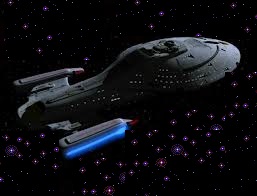
Oops! Wrong Voyager
An International gathering of world leaders in Science met in Geneva to discuss their latest findings. Each nation took a turn sharing its latest developments. The leader of one nation stood before the group and declared that they had devised a spacecraft which would allow their astronauts to fly directly to the Sun. He was met with boisterous laughter from the audience, to which he boldly replied, “I know what you’re thinking, but we have a plan. We’re going to fly the ship at night!”


