Loading...
Loading...
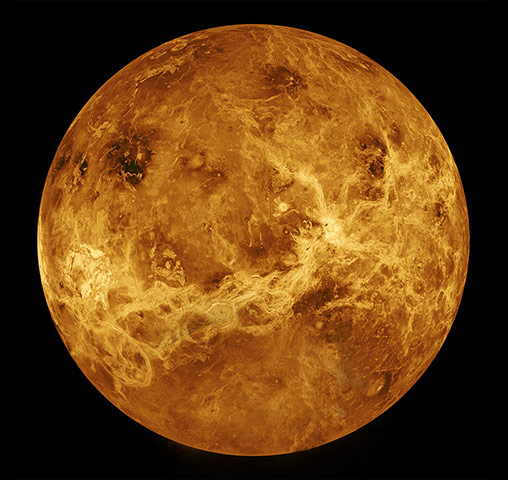
Venus taken from the Magellan spacecraft in 1991.
Stripping away the clouds from its hot, thick, corrosive atmosphere, the surface of Venus is
revealed to be a tortured volcanic landscape scarred by vast forces from the planet’s interior.
This false-colour image of Venus was created by bouncing radio signals off the planet’s surface.
Unlike visible light, radio waves can penetrate the thick layers of cloud, allowing us to map the planet in detail.
After the description of Venus there are details of the spacecraft that have visited the planet, landers, orbiters and fly-bys.
Venus, the second planet in the Solar System from the Sun, has no known natural satellites (but see below) or rings.
It orbits the Sun once in 224.698 Earth days. All the planets of the Solar System orbit the Sun in a counter-clockwise direction as viewed from above the Sun’s north pole. Most planets also rotate on their axis in a counter-clockwise direction, but Venus rotates clockwise (retrograde) once every 243 Earth days, the slowest rotation period of any planet. Its surface temperature averages 462° C.
Its semi-major axis is 108,208,000 km, with its distance from the Sun ranging from 107,477,000 km to 108,939,000 km; its orbital eccentricity is 0.006 756, the smallest (most circular) of all the planets.
Its radius is 6,051.8±1.0 km, almost the same as the Earth’s, giving it a surface area of 4.60×10⁸ km2. Its mass is 4.8685×1024 kg (0.815 of the Earth’s mass).
Venus’s atmospheric surface pressure is 92 bar (i.e. 92 times the Earth’s) and its atmosphere is made up of about 96.5% carbon dioxide, 3.5% nitrogen, and traces of sulphur dioxide, argon, water vapour, carbon monoxide, helium, neon, carbonyl sulphide, hydrogen chloride and hydrogen fluoride.
More about Venus from NASA; also see spacecraft that have visited the planet.
Venus is shrouded by an opaque layer of highly reflective clouds of sulphuric acid, preventing its surface from being seen from space in visible light. It has the densest atmosphere of the four terrestrial planets (Mercury, Venus, Earth and Mars), consisting mostly of carbon dioxide. With a mean surface temperature of 735 K, Venus is by far the hottest planet in the Solar System. It has no carbon cycle to lock carbon back into rocks and surface features, nor does it seem to have any organic life to absorb it in biomass. Venus may have possessed oceans in the past, but these would have vapourized as the temperature rose due to the runaway greenhouse effect. The water has most probably photodissociated, and, because of the lack of a planetary magnetic field, the free hydrogen has been swept into interplanetary space by the solar wind. Venus’s surface is a dry desertscape interspersed with slab-like rocks and periodically refreshed by volcanism. Not the place for a holiday!
Clementine startracker image of the Moon obscuring the Sun, with Venus at the top.
Computer generated 3-dimensional perspective view of the “crater farm” on Venus, consisting of the 37.3 km diameter Saskia in the foreground (28.6° S, 337.1° E), 47.6 km Danilova (26.35° S, 337.25° E) to the left, and 62.7 km Aglaonice to the right (26.5° S, 340° E). The image was created by superimposing Magellan images in topography data, and colouring is based on Venera 13 and 14 Lander images.
A coronal mass ejection approaches Venus in this still from Dynamic Earth: Exploring Earth’s Climate Engine, a high-resolution movie made by NASA playing at planetariums around the world. This section of the film explores the power of the sun and how its energy drives the climate on Earth, and was created by NASA’s Goddard Scientific Visualization Studio
Transits of Venus (when Venus passes directly in front of the Sun) occur in cycles of 243 years with the current pattern of transits being pairs separated by eight years, at intervals of about 105.5 years or 121.5 years
In these photos, Venus is a small black dot on the surface of the Sun. The violent turbulence of the Sun’s surface can be seen; especially in the right-hand photograph you can see the lines of magnetic force causing solar flares.
On 5th and 6th June 2012, was the last Venus transit of the 21st century. The previous pair of transits were in December 1874 and December 1882. The next transits of Venus will be on 10th and 11th December, 2117, and in December 2125.
[Centre] An ultra-high definition view of the transit of Venus on 6th June 2012 captured by NASA’s Solar Dynamics Observatory
See this report that Venus orbits the Sun within a huge band of dust.
Venus has no natural satellite, though the asteroid 2002 VE68 which has a diameter of about 200 m currently maintains a quasi-orbital relationship with it; from the point of view of Venus, it appears to travel around it during one Venusian year but it actually orbits the Sun, not Venus. It seems to have been co-orbital with Venus for only the last 7,000 years, and is destined to be ejected from this orbital arrangement about 500 years from now. This is an example showing how dynamic the structure of the Solar System really is.
2002 VE68 is included in the Minor Planet Center list of Potentially Hazardous Asteroids (PHAs) as it comes to within 0.05 AU of the Earth relatively frequently. Approaches as close as 0.04 AU occur with a periodicity of 8 years due to its near 8:13 resonance with the Earth. It was discovered during one of these close approaches (11th November 2002). During the last close encounter on 7th November 2010, 2002 VE68 approached Earth within 0.035 AU (13.6 lunar distances), brightening below 15th magnitude. Its next fly-by with the Earth will take place on 4th November 2018 at 0.038 AU (5,700,000 km). Numerical simulations indicate that an actual collision with Earth during the next 10,000 years is not likely, although dangerously close approaches to about 0.002 AU are possible.
In the 17th century, Giovanni Cassini reported a moon orbiting Venus, which was named Neith and numerous sightings were reported over the following 200 years, but most were determined to be stars in the vicinity. A study of models of the early Solar System (at the California Institute of Technology) shows Venus probably had at least one moon created by a huge impact billions of years ago. About 10 million years later, according to the study, another impact reversed the planet’s spin direction and caused the Venusian moon gradually to spiral inward until it collided and merged with Venus. If later impacts created moons, these also were absorbed in the same way.
| Spacecraft | Launch date | Operator | Mission | Outcome | Remarks |
|---|---|---|---|---|---|
| Sputnik 7 (Tyazhely Sputnik, Venera 1VA No.1) | 4 February 1961 | USSR | Lander | Failure | Intended Venus flyby; Failed to escape from Earth orbit |
| Venera 1 | 12 February 1961 | USSR | Flyby | Failure | Contact lost 7 days after launch on 12 February 1961; first spacecraft to fly by another planet, 19 – 20 May 1961 |
| Mariner 1 | 22 July 1962 | NASA (United States) | Flyby | Failure | Guidance failure shortly after launch |
| Sputnik 19 (Venera 2MV-1 No.1) | 25 August 1962 | USSR | Lander | Failure | Failed to escape from Earth orbit |
| Sputnik 20 (Venera 2MV-1 No.2) | 1 September 1962 | USSR | Lander | Failure | Failed to escape from Earth orbit |
| Sputnik 21 (Venera 2MV-2 No.1) | 12 September 1962 | USSR | Flyby | Failure | Third stage exploded |
| Mariner 2 | 14 December 1962 | NASA (United States) | Flyby | Successful | 19 December 1962 flew by Venus; first successful Venus flyby; minimum distance 34,773 km |
| Cosmos 21 (Venera 3MV-1 No.1; tentatively identified) | 11 November 1963 | USSR | Flyby | Failure | Third stage exploded; orbit decayed 14 November 1963 |
| Venera 1964A (Venera 3MV-1 No.2, tentatively identified) | 19 February 1964 | USSR | Flyby | Failure | Failed to reach Earth orbit |
| Venera 1964B (tentatively identified) | 1 March 1964 | USSR | Flyby | Failure | Failed to reach Earth orbit |
| Cosmos 27 (Zond 3MV-1 No.3) | 27 March 1964 | USSR | Flyby | Failure | Failed to escape Earth orbit |
| Zond 1 (tentatively identified) | 2 April 1964 | USSR | Flyby and possible Lander | Failure | Communications lost 14 May 1964 en route; Venus fly-by 14 July 1964 |
| Cosmos 96 (Venera-3MV-4 No.6) | 23 November 1965 | USSR | Flyby or Lander | Failure | Exploded? Low Earth orbit until 9 December 1965 |
| Venera 1965A (tentatively identified) | 26 November 1965 | USSR | Flyby | Failure | Launch vehicle failure? |
| Venera 2 | 12 November 1965 | USSR | Flyby | Failure | Ceased to operate en route; closest approach to Venus (24,000 km) on 27 February 1966 |
| Venera 3 | 16 November 1965 | USSR | Lander | Failure | Contact lost before arrival; first spacecraft to impact on the surface of another planet; possibly crashed on 1 March 1966 |
| Kosmos 167 (Venera-4V-1 No.311) | 17 June 1967 | USSR | Lander | Failure | Failed to escape Earth orbit; re-entry on 25 June 1967 |
| Venera 4 | 12 June 1967 | USSR | Atmospheric probe | Successful | 18 October 1967 arrived at Venus; continued to transmit to an altitude of 25 km |
| Mariner 5 | 14 June 1967 | NASA (United States) | Flyby | Successful | 14 October 1967 flew by at minimum distance 5,000 km |
| Venera 5 | 5 January 1969 | USSR | Atmospheric probe | Successful | 16 May 1969, transmitted atmospheric data for 53 minutes, to an altitude of about 26 km |
| Venera 6 | 10 January 1969 | USSR | Atmospheric probe | Successful | 17 May 1969, transmitted atmospheric data for 51 minutes, to an altitude of perhaps 10–12 km |
| Cosmos 359 (Venera-4V-1 No.631) | 22 August 1970 | USSR | Lander? | Failure | Failed to escape elliptical Earth orbit |
| Venera 7 | 17 August 1970 | USSR | Lander | Successful | 15 December 1970, first successful landing on another planet; signals returned from surface for 23 minutes |
| Cosmos 482 | 31 March 1972 | USSR | Lander? | Failure | Failed to escape Earth orbit; 3 April 1972 parts crashed in New Zealand |
| Venera 8 | 27 March 1972 | USSR | Lander | Successful | 22 July 1972, signals returned from surface for 50 minutes |
| Mariner 10 | 3 November 1973 | NASA (United States) | Flyby | Successful | On 5 February 1974 flew by at minimum distance 5768 km, en route to Mercury; first use of gravity assist by an interplanetary spacecraft |
| Venera 9 Orbiter | 1975 | USSR | Orbiter | Successful | First spacecraft to orbit Venus; communications relay for Lander; atmospheric and magnetic studies |
| Venera 9 Lander | 22 October 1975 | USSR | Lander | Successful | First images from the surface; operated on surface for 53 minutes |
| Venera 10 Orbiter | 1975 | USSR | Orbiter | Successful | Communications relay for Lander; atmospheric and magnetic studies |
| Venera 10 Lander | 23 October 1975 | USSR | Lander | Successful | Transmitted from surface for 65 minutes |
| Pioneer Venus Orbiter | NASA (United States) | Orbiter | Successful | Atmospheric and magnetic studies, 4 December 1978 – 1992 | |
| Pioneer Venus Multiprobe bus | 9 December 1978 | NASA (United States) | Probe transporter | Successful | Deployed four Atmospheric probes, then burnt up in Venusian atmosphere, continuing to transmit to 110 km altitude |
| Pioneer Venus Multiprobe large probe | 9 December 1978 | NASA (United States) | Atmospheric probe | Successful | Deployed four Atmospheric probes, then burnt up in Venusian atmosphere, continuing to transmit to 110 km altitude |
| Pioneer Venus Multiprobe north probe | 9 December 1978 | NASA (United States) | Atmospheric probe | Successful | |
| Pioneer Venus Multiprobe day probe | 9 December 1978 | NASA (United States) | Atmospheric probe | Successful | Survived impact and continued to transmit from surface for over an hour |
| Pioneer Venus Multiprobe night probe | 9 December 1978 | NASA (United States) | Atmospheric probe | Successful | |
| Venera 12 flight platform | 21 December 1978 | SAS (USSR) | Flyby | Successful | Minimum distance 34,000 km; deployed Lander and then acted as communications relay |
| Venera 12 descent craft | 21 December 1978 | SAS (USSR) | Lander | Partial success | Soft landing; transmissions returned for 110 minutes; failure of some instruments |
| Venera 11 flight platform (identical to Venera 12) | 25 December 1978 | SAS (USSR) | Flyby | Successful | Minimum distance 34,000 km; deployed Lander and then acted as communications relay |
| Venera 11 descent craft | 25 December 1978 | SAS (USSR) | Lander | Partial success | Soft landing; transmissions returned for 95 minutes; failure of some instruments |
| Venera 13 bus | 1 March 1982 | SAS (USSR) | Flyby | Successful | Deployed Lander and then acted as communications relay |
| Venera 13 descent craft | 1 March 1982 | SAS (USSR) | Lander | Successful | Survived on surface for 127 minutes |
| Venera 14 bus (identical to Venera 13) | 5 March 1982 | SAS (USSR) | Flyby | Successful | Deployed Lander and then acted as communications relay |
| Venera 14 descent craft | 5 March 1982 | SAS (USSR) | Lander | Successful | Survived on surface for 57 minutes |
| Venera 15 | 1983–1984 | SAS (USSR) | Orbiter | Successful | Radar mapping |
| Venera 16 (identical to Venera 15) | 1983–1984 | SAS (USSR) | Orbiter | Successful | Radar mapping |
| Vega 1 | 11 June 1985 | SAS (USSR) | Flyby | Successful | Went on to fly by Halley’s comet |
| Vega 1 lander | 11 June 1985 | SAS (USSR) | Lander | Failure | Instruments deployed prematurely |
| Vega 1 atmospheric balloon | 11 June 1985 | SAS (USSR) | Atmospheric balloon | Successful | Floated at an altitude of about 54 km and transmitted for around 46 hours |
| Vega 2 | 15 June 1985 | SAS (USSR) | Flyby | Successful | Went on to fly by Halley’s comet |
| Vega 2 lander | 11 June 1985 | SAS (USSR) | Lander | Successful | Transmitted from surface for 56 minutes |
| Vega 2 atmospheric balloon | 11 June 1985 | SAS (USSR) | Atmospheric balloon | Successful | Floated at an altitude of about 54 km and transmitted for around 46 hours |
| Galileo | 10 February 1990 | NASA (United States) | Flyby | Successful | Gravity assist en route to Jupiter; minimum distance 16,000 km |
| Magellan | 10 August 1990 – 12 October 1994 | NASA (United States) | Orbiter | Successful | Global radar mapping |
| Cassini | NASA (United States) /ESA (Europe)/ ASI (Italy) |
Flyby | Successful | 26 April 1998 and 24 June 1999: gravity assists en route to Saturn | |
| Venus Express | 11 April 2006 – 18 January 2015 | ESA (Europe) | Orbiter | Successful | Atmospheric studies; planetary imaging; magnetic observations |
| MESSENGER | 24 October 2006 and 6 June 2007 | NASA (United States) | Flybys | Both Successful | Gravity assists only; minimum distances 2990 km and 300 km, en route to Mercury |
| Akatsuki (PLANET-C) | 7 December 2010 (Venus Flyby) | JAXA (Japan) | Orbiter | Failed to attain Venus orbit in 2010 | In Venus orbit (orbit insertion on 7 December 2015); payload may be functional |
| IKAROS | 8 December 2010 | JAXA (Japan) | Flyby | Successful | Solar sail technology development / interplanetary space exploration |
| Shin’en (UNITEC-1) | December 2010? | UNISEC (Japan) | Flyby | Failure | Contact lost shortly after launch |
Proposed Spacecraft
The Venera (Cyrillic: Венера) series probes were developed by the Soviet Union between 1961 and 1984 to gather data from Venus, Venera being the Russian name for Venus. As with some of the Soviet Union’s other planetary probes, the later versions were launched in pairs with a second vehicle being launched soon after the first of the pair.
Ten probes from the Venera series successfully landed on Venus and transmitted data from the surface, including the two Vega program probes. In addition, thirteen Venera probes successfully transmitted data from the atmosphere of Venus.
The entire series could be considered highly successful. Unfortunately the surface conditions on Venus are extreme, which meant that the probes only survived on the surface for a duration of 23 minutes (initial probes) up to about two hours (final probes).
The 3MV-4 No.6 spacecraft was originally built for a mission to Mars, with launch scheduled for late 1964, however it was not launched by the end of the launch window, and was consequently repurposed, along with the spacecraft which were launched as Venera 2 and Venera 3, to explore Venus. Had it departed Earth orbit it would have received the next designation in the Venera series, at the time Venera 4.
The Venera-D (Cyrillic: Венера–Д) probe is a proposed Russian space probe to Venus, to be launched around 2024. Venera-D’s prime purpose is to make radar remote-sensing observations around the planet Venus in a manner similar to that of the Venera 15 and Venera 16 probes in the 1980s or the U.S. Magellan in the 1990s, but with the use of more powerful radar. Venera-D is also intended to map future landing sites. A lander, based on the Venera design, is also planned, capable of surviving for a long duration on the planet’s surface.
Venera-D will be the first Venus probe launched by the Russian Federation (the earlier Venera probes were launched by the former Soviet Union). Venera-D will serve as the flagship for a new generation of Russian-built Venus probes, culminating with a lander capable of withstanding the harsh Venusian environment for more than the 1½ hours logged by the Soviet-era probes. In order to keep research and development costs down, the new Venera-D probe will most likely resemble the Soviet-era probes, but will rely on new technologies developed by Russia since its last Venus missions (Vega 1 and Vega 2 in 1985). Venera-D will most likely be launched on the Proton booster, but may be designed to be launched on the more powerful Angara rocket instead.
Pioneer Venus Orbiter (1978-051A) or Pioneer Venus 1 or Pioneer 12 was launched on 20th May 1978. It orbited Venus and made atmospheric and magnetic studies from 4th December 1978 until August 1992 when its orbit decayed.
Shin’en (2010-020F) was launched on 20th May 2010 with IKAROS and several other Japanese satellites. Shin’en, known before launch as UNITEC-1 or UNISEC Technology Experiment Carrier 1, is a Japanese student spacecraft which was intended to make a flyby of Venus in order to study the effects of interplanetary spaceflight on spacecraft computers. In doing so, it was intended to become the first student-built spacecraft to operate beyond geocentric orbit. It was operated by UNISEC, a collaboration between several Japanese universities. Contact was lost shortly after launch.
The Vega program was a series of Venus missions which also took advantage of the appearance of Comet 1P/Halley in 1986. Vega 1 and Vega 2 were unmanned spacecraft launched in a cooperative effort among the Soviet Union (who provided the spacecraft and launch vehicle) and Austria, Bulgaria, Hungary, the German Democratic Republic, Poland, Czechoslovakia, France, and the Federal Republic of Germany in December 1984. They had a two-part mission to investigate Venus and also flyby Halley’s Comet. The craft were designated Vega, a contraction of “Venera” and “Gallei” (Russian words for “Venus” and “Halley”, respectively). The spacecraft design was based on the previous Venera 9 and Venera 10 missions.
The surface landers of Vega 1 and Vega 2 were identical to those of the previous five Venera missions. The objective of the Vega probes was the study of the atmosphere and the exposed surface of the planet. The scientific payload included a UV spectrometer, temperature and pressure sensors, a water concentration meter, a gas-phase chromatograph, an X-ray spectrometer, a mass spectrometer, and a surface sampling device. Several of these scientific tools (the UV spectrometer, the mass spectrograph, and the devices to measure pressure and temperature) were developed in collaboration with French scientists.
Vega 1 (1984-125A) was launched on 15th December 1984. It made a successful Venus fly-by on 11th June 1985, and released a lander and balloon. Its Venus lander (1984-125E) failed because its instruments were deployed prematurely. Its atmospheric balloon (1984-125F) floated at an altitude of about 54 km and transmitted for around 46 hours.
The Vega 1 Lander/Balloon capsule entered the Venus atmosphere (125 km altitude) on 11th June 1985 at roughly 11 km/s. The parachute attached to the landing craft cap opened at an altitude of 64 km. The cap and parachute were released 15 seconds later at 63 km altitude. The balloon package was pulled out of its compartment by parachute 40 seconds later at 61 km altitude, at 8.1° N, 176.9°E. A second parachute opened at an altitude of 55 km, 200 seconds after entry, extracting the furled balloon. The balloon was inflated 100 seconds later at 54 km and the parachute and inflation system were jettisoned. The ballast was jettisoned when the balloon reached roughly 50 km and the balloon floated back to a stable height between 53 and 54 km some 15 to 25 minutes after entry. The mean stable height was 53.6 km, with a pressure of 535 mbar and a temperature of 300 to 310 K in the middle, most active layer of the Venus three-tiered cloud system. The balloon drifted westward in the zonal wind flow with an average speed of about 69 m/s at nearly constant latitude. The probe crossed the terminator from night to day at 12:20 UT on 12th June after traversing 8,500 km. The probe continued to operate in the daytime until the final transmission was received at 00:38 UT on 13th June from 8.1° N, 68.8° E after a total traverse distance of 11,600 km. It is not known how much farther the balloon travelled after the final communication.
Vega 2 (1984-128A) was launched on 21st December 1984. It made a successful Venus fly-by on 15th June 1985, and went on to fly by Halley’s comet. Its lander (1984-128E) was a success and it transmitted from the surface for 56 minutes. Its atmospheric balloon (1984-128F) floated at an altitude of about 54 km and transmitted for around 46 hours.
The Vega 2 lander touched down on 15th June 1985 at around 7.14°S 177.67°E, in the northern region of Aphrodite Terra. The altitude of the touchdown site was 0.1 km above the planetary mean radius. The measured pressure at the landing site was 91 atm and the temperature was 736 K. The surface sample was found to be an anorthosite-troctolite rock, rarely found on Earth, but present in the lunar highlands, leading to the conclusion that the area was probably the oldest explored by any Venera vehicle.
The Vega 2 Lander/Balloon capsule entered the Venus atmosphere (125 km altitude) on 15th June 1985 at roughly 11 km/s. The parachute attached to the landing craft cap opened at an altitude of 64 km. The cap and parachute were released 15 seconds later at 63 km altitude. The balloon package was pulled out of its compartment by parachute 40 seconds later at 61 km altitude, at 7.45 degrees S, 179.8 degrees east. A second parachute opened at an altitude of 55 km, 200 seconds after entry, extracting the furled balloon. The balloon was inflated 100 seconds later at 54 km and the parachute and inflation system were jettisoned. The ballast was jettisoned when the balloon reached roughly 50 km and the balloon floated back to a stable height between 53 and 54 km some 15 to 25 minutes after entry. The mean stable height was 53.6 km, with a pressure of 535 mbar and a temperature of 308 to 316 K in the middle, most active layer of the Venus three-tiered cloud system. The balloon drifted westward in the zonal wind flow with an average speed of about 66 m/s at nearly constant latitude. The probe crossed the terminator from night to day at 9:10 UT on 16th June after traversing 7,400 km. The probe continued to operate in the daytime until the final transmission was received at 00:38 UT on 17th June from 7.5° S, 76.3° E after a total traverse distance of 11,100 km. It is not known how much further the balloon travelled after the final communication.
After their encounters with Venus, the Vegas’ motherships were redirected by Venus’ gravity to intercept Halley’s Comet (officially designated 1P/Halley). Sling-shot manoeuvres sent them on to fly by Halley’s comet.
Images started to be returned from Vega 1 on 4th March 1986, and were used to help pinpoint Giotto’s close flyby of the comet. The early images from Vega showed two bright areas on the comet, which were initially interpreted as a double nucleus. The bright areas would later turn out to be two jets emitting from the comet. The images also showed the nucleus to be dark, and the infrared spectrometer readings measured a nucleus temperature of 300 K to 400 K, much warmer than expected for an ice body. The conclusion was that the comet had a thin layer on its surface covering an icy body.
Vega 1 made its closest approach to the nucleus on 6th March at around 8,889 km (at 07:20:06 UT). It took more than 500 pictures via different filters as it flew through the gas cloud around the coma. Although the spacecraft was battered by dust, none of the instruments were disabled during the encounter.
The data intensive examination of the comet covered only the three hours around closest approach. They were intended to measure the physical parameters of the nucleus, such as dimensions, shape, temperature and surface properties, as well as to study the structure and dynamics of the coma, the gas composition close to the nucleus, the dust particles’ composition and mass distribution as functions of distance to the nucleus and the cometary-solar wind interaction.
The Vega images showed the nucleus to be about 14 km long with a rotation period of about 53 hours. The dust mass spectrometer detected material similar to the composition of carbonaceous chondrites meteorites and also detected clathrate ice.
After subsequent imaging sessions on 7th and 8th March 1986, Vega 1 headed out to deep space.
Vega 2 (1984-128A), launched on 21st December 1984, initiated its encounter on 7th March 1986 by taking 100 photos of the comet from a distance of 14 million km. It made its closest approach at 07:20 UT on 9th March 1986 at 8,030 km. The data intensive examination of the comet covered only the three hours around closest approach. They were intended to measure the physical parameters of the nucleus, such as dimensions, shape, temperature and surface properties, as well as to study the structure and dynamics of the coma, the gas composition close to the nucleus, the dust particles’ composition and mass distribution as functions of distance to the nucleus and the cometary–solar wind interaction.
During the encounter, Vega 2 took 700 images of the comet, with better resolution than those from the twin Vega 1, partly due to the presence of less dust outside of the coma at the time. Yet Vega 2 recorded an 80% power loss during the encounter as compared to Vega 1’s 40%.
After further imaging sessions on 10th and 11th March 1986, Vega 2 finished its primary mission.
In total Vega 1 and Vega 2 returned about 1500 images of Comet Halley. Vega 1 ran out of attitude control propellant on 30th January 1987, and contact with Vega 2 continued until 24th March 1987.
Vega 1 and Vega 2 are now in heliocentric orbits.
Magellan (1989-033B) was the first interplanetary mission to be launched from the Space Shuttle (Atlantis, STS-30); Atlantis was launched from the Kennedy Space Center on 4th May 1989 and Magellan was deployed from the shuttle’s payload bay 6 hours 14 minutes into the mission. Two successive Inertial Upper Stage (IUS) propulsion burns placed the spacecraft on its trajectory to Venus about an hour later. Magellan arrived at Venus on 10th August 1990 and was inserted into orbit around Venus at 17:00:00 UTC. It performed until 12th October 1994, a 243-day mission of mapping the planet’s surface with radar.
The Magellan spacecraft, also referred to as the Venus Radar Mapper, was a 1,035-kg robotic space probe, to map the surface of Venus using Synthetic Aperture Radar and measure the planetary gravity. It was the first to use an inertial upper stage booster and was the first spacecraft to test aerobraking as a method for circularizing an orbit. Magellan was the fourth successful, NASA funded mission to Venus and ended an eleven-year U.S. interplanetary exploration hiatus.
NASA has two web-sites about Magellan, for the Jet Propulsion Laboratory (JPL) and the Goddard Space Flight Center (GSFC).
IKAROS (2010-020E) (Interplanetary Kite-craft Accelerated by Radiation Of the Sun) is a Japan Aerospace Exploration Agency (JAXA) experimental spacecraft. The spacecraft was launched on 20th May 2010 together with the Akatsuki (Venus Climate Orbiter) probe and four other small spacecraft into an Earth–Venus transfer heliocentric orbit. IKAROS is the first spacecraft to successfully demonstrate solar-sail technology in interplanetary space. IKAROS flew by Venus on 8th December 2010 at about 80,800 km distance, completing the planned mission successfully, and entered its extended operation phase, for solar sail technology development and interplanetary space exploration.
Akatsuki (2010-020D) was supposed to spend two years orbiting Venus, studying the hot planet’s clouds, atmosphere and weather. It was due to enter orbit around Venus on 6th December 2010, but its engine failed during a crucial orbit-insertion burn, and the probe went off into space. However, officials from JAXA haven’t given up and want the probe to take another shot at Venus during the next available opportunity, which could come as soon as 2015. So they’ve been testing the probe’s main engine, called the “orbit maneouvre engine”.
Pioneer Venus Multiprobe (1978-078A) or Pioneer Venus 2 (Pioneer 13) was launched on 8th August 1978. It was a probe transporter bus that carried one large (1978-078D) and three small atmospheric probes, then burnt up in the Venusian atmosphere, continuing to transmit to 110 km altitude on 9th December 1978 until 1992. Its four probes (large probe, north probe, day probe and night probe) were all successful atmospheric probes, and the day probe survived impact and continued to transmit from surface for over an hour. The large probe was released on 16th November 1978, and the three small probes on 20th November. All four probes entered the Venusian atmosphere on 9th December, followed by the bus.
Venus Express (2005-045A) was the first Venus exploration mission of the European Space Agency. It was launched by a Soyuz-FG/Fregat rocket from the Baikonur Cosmodrome in Kazakhstan on 9th November 2005 at 03:33:34 UTC. Venus Express has orbited Venus since 11th April 2006, and performed atmospheric studies, planetary imaging and magnetic observations. It finally ran out of power and full contact was lost on 28th November 2014. More detail here.
Most of the Mariner craft went to Mars, with a few exceptions. See the description of the Mariner program.
The Mariner 2 craft (1962-041A) was launched on 27th August 1962 to Venus; the mission made the first successful Venus fly-by at a minimum distance of 34,773 km on 19th December 1962.
Mariner 5 (or Mariner Venus 1967) (1967-060A), launched on 14th June 1967, made a successful Venus fly-by at a minimum distance of 5,000 km on 14th October 1967.
Mariner 10 (1973-085A) was launched on 3rd November 1973 at 0545:00 UTC; it made a successful fly-by of Venus at a minimum distance of 5,768 km, en route to Mercury; this was the first use of gravity assist by an interplanetary spacecraft; it then made three fly-bys of Mercury on 29th March 1974 at a minimum distance of 704 km, on 21st September 1974 at 48,069 km, and on 16th March 1975 at 327 km.