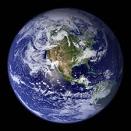
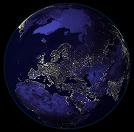
Earth, the third planet from the Sun in the Solar System is ours, so you probably know more about it than I do. It has one satellite, the Moon, several quasi-satellites, but no known ring system. It spins in one day and orbits the Sun in one year (though there are several definitions of these terms). Anything else you want to know is in a myriad of other places, so I’ll not waste your time! However it is interesting to know that other solar system objects (like Io and Europa) exhibit volcanic activity and plate tectonics, rather like the Earth, and are not the inert objects they were thought to be.
Other Earth-related parts of my web site are:
A set of photos of satellites looking down on us, the Northern and Southern Lights (aurorae), some time-lapse images of the sky.
Some essays and pictures about typical Communication Satellite Orbits, an animation of a geostationary satellite orbit, the Iridium satellite constellation, Telstar, pictures of the Hubble Space Telescope and the International Space Station in orbit, the UK’s Ariel satellites, spacecraft being launched and re-entering the atmosphere, and several other space satellites including the Space Shuttles, Alphasat and SABRE.
Two Close Encounters on the Same Day
There are millions of large and small rocks orbiting mostly between Mars and Jupiter. But some of them stray well outside this “asteroid belt”, some crossing the orbit of the Earth; some of these collide with our planet; most are small and burn up in the atmosphere (meteors or shooting stars). A few reach the ground, where they are known as meteorites; when they are found they tell us a lot about the early solar system, because they are the debris left over when the planets formed — so they are older than our planet! Every so often, a large asteroid hits the Earth, like the one that is supposed to have caused the extinction of the dinosaurs 65 million years ago. Fortunately they are rare, but a group of astronomers is constantly watching out for dangerous near-Earth objects; none is expected within at least a few decades. The one described here, 2012 DA14, though close, was never a threat to us. Some of them have orbits that are synchronized with the orbits of Jupiter and other planets, including the Earth! More about these in the sections on Trojans, Greeks and Hildas. And Wikipedia has more about the many different sorts of Asteroids, with lists, photographs and many more references.
Mind you, one day somebody will be topped by a man-made bit of débris which will come back to Earth to haunt us. Our planet is the only one in the Universe known to support life. Each dot in this picture is a piece of débris: defunct satellites, bits of rocket casings, garbage from manned satellites, and so on. We are a dirty lot, us Earthlings!
Duende and Chelyabinsk
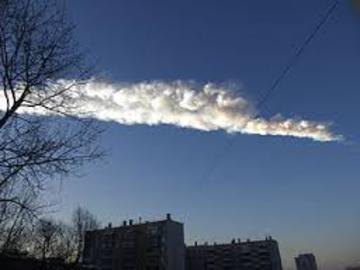
The two close encounters on the same day, 15th February 2013, were an asteroid, 2012 DA14, and a meteorite that fell to earth near Chelyabinsk (Челябинск) in Russia.
2012 DA14
Asteroid 2012 DA14 is now known as “(367943) Duende”.
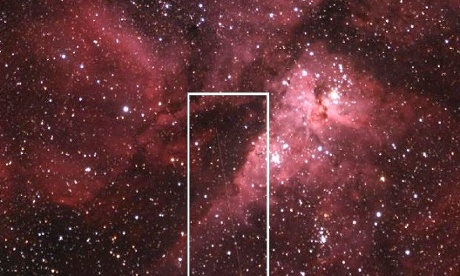
Near-Earth asteroid 2012 DA14 backed by the glorious Eta Carinae nebula, its path highlighted by a rectangle
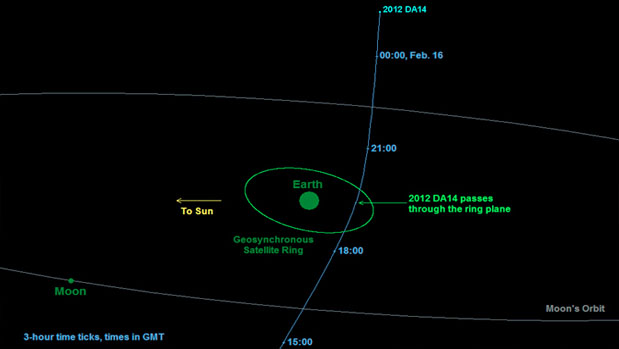
The asteroid passed 27,700 km from the surface of Earth (a record known close approach for an object of this size) has an estimated diameter of 30 m and an estimated mass of 40,000 metric tons. It passed well inside the ring of orbits of geosynchronous communications and global navigation satellites. During its approach to Earth, the orbital period of the asteroid was reduced from 366 days to 317 days. Its aphelion was reduced from 1.110 to 0.9917 AU, leaving it almost entirely inside the Earth’s orbit.
The Russian meteor event occurred about 16 hours before the passing of 2012 DA14, but is unrelated, with a significantly different orbit. This one was not foreseen.
The Guardian reported in May 2014 that an analysis of fragments after the explosion that injured 1,000 people (mostly by windows smashing as the sonic boom reached the town) showed that the Chelyabinsk asteroid had collided with another asteroid at 3,000 mph about 290 million years ago.
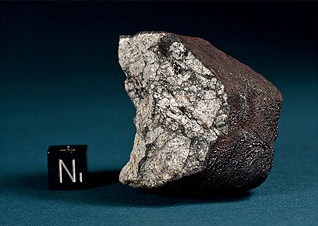
[Right] 112.2 g fragment of the Chelyabinsk (Cherbakul) meteorite. This specimen was found in a field between the villages of Deputatsky and Emanzhelinsk on 18th February 2013. The broken fragment displays thick primary fusion crust with flow lines and a heavily shocked matrix with melt veins and planar fractures. The scale cube is 1 cm
The Russian meteor explosion over the city of Chelyabinsk, on Friday, 15th February 2013 injured more than 1,000 people, none fatally, and blew out windows across the region in a massive blast captured on cameras by frightened witnesses. NASA scientists estimated the meteor sparked a blast equivalent of a 500-kiloton explosion.
The mass of the Chelyabinsk object was about 11,000 tonnes, and it measured about 17 to 20 metres across; it was travelling at about 40,000 mph when it exploded. It is the largest object to have entered Earth’s atmosphere since the 1908 Tunguska event and it is the only one known to have resulted in many injuries.
Authorities in the Chelyabinsk Region have announced plans to launch a new perfume with the scent of the celestial body, which brought the Urals city to international fame. The new fragrance will be named “Chebarkul Meteorite”, after the lake where the meteorite’s fragments were found, the administration of the town of Chebarkul said on its website.
Web sites worth checking out regarding the Chelyabinsk event are:
Artist’s impression of an asteroid approaching Earth
The Chelyabinsk meteor exploded at a height of 12 miles (20 km) above Earth, releasing 500 kilotons of energy, approximately 30 times the yield of the nuclear bomb over Hiroshima. It caused a shock wave that broke windows in six Russian cities and caused some 1,500 people to seek treatment for injuries, mainly from flying glass. Later, about five tons of meteoritic material reached the ground, including a 1,400-pound (650-kg) meteorite that was recovered by divers from the bottom of Russia’s Lake Chebarkul. Three years later – after more than 200 scientific studies – scientists say they’re still looking for the origin the Chelyabinsk superbolide.
They continue to confirm that it was not related to asteroid 2012 DA14. But, since asteroids in space are known to travel in pairs or groups, they want to know if the Russian meteor had a parent body, and if that body is a known object in space.
To figure it out, they first have to determine the orbit of the Chelyabinsk meteor. Among the published studies is a catalog of 960 video recordings, much of it captured by security cameras, traffic cameras, dash cams – which are popular in Russia – as well as manual recordings made with the video cameras and webcams of those who saw it.
These images and diverse scientific data compiled during the event have let scientists calculate the trajectory of meteoroid after it entered Earth’s atmosphere.
And that information helps scientists calculate possible initial orbits for the 19-metre-wide (about 20 yards wide) space rock around the sun, before it struck Earth’s atmosphere.
On same day as the Chelyabinsk meteor – 15th February 2013 – the asteroid 2012 DA14 was still approaching Earth. It ultimately passed about 27,700 km above the Earth’s surface, 16 hours after the Chelyabinsk superbolide explosion and the fall of the large meteorite on the Russian Lake Chebarkul.
Where in space did the Chelyabinsk superbolide come from? Did it have a parent body, and was that body a known object in space? The answer is that we don’t yet know for certain, but scientists are still trying to figure it out.
One possibility is the asteroid 2011 EO40, which is known to have frequent close encounters with Venus, the Earth and moon, and Mars. Scientists said in their statement:
“The common origin of both celestial objects is a possibility that cannot be discarded using the currently available evidence.”
In the course of these studies, the scientists have realized that the Chelyabinsk impactor likely passed a gravitational keyhole on 15th February 1982 during a close encounter with our planet. At the time, the closest distance was about 224,000 km.
As a result of this close encounter, the initial trajectory of the Chelyabinsk meteoroid was changed into the one that drove the meteoroid to strike the Earth over three decades later.
The similarity between the two 15th February 2013 objects shows the blurring of the definitional boundaries between meteors, meteorites and small asteroids. They are all lumps of rock and ice. See the description of some of the smaller moons of Neptune which, though larger, are of a similar type.
The Russian meteorite came right out of the blue and had not been predicted by scientists. Fortunately nobody was killed, and the injuries and damage came from the sonic shock-wave hitting Chelyabinsk minutes after the exploding meteorite had passed, and causing windows to break. See the NASA animation which shows the first satellite to “see” the object, and gives an excellent account of the spread of the debris after the event.
For comparison, the 150-km-wide crater that lies just off the Yucatán peninsula in Mexico is calculated to have been caused by a 10-km-wide asteroid or comet travelling at 30 km/second, and is believed by many to have given rise to the extinction of the dinosaurs.
Four days after the Chelyabinsk meteor exploded in the atmosphere over Russia, fast-moving dust particles in higher altitudes of the atmosphere, shown in red, had circled the globe. [Image via NASA Goddard’s Scientific Visualization Studio]
Orbits of Duende and the Chelyabinsk Meteorite Compared
Comparison of the former orbit of the Chelyabinsk meteor (larger elliptical blue orbit) and asteroid 2012 DA14 (smaller circular blue orbit), showing that they are dissimilar
Near-Earth Asteroid (66391) 1999 KW4
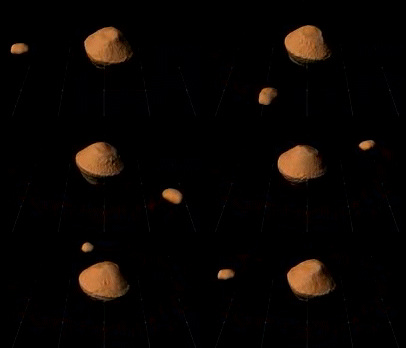
Simulated animation of 1999 KW4’s rotation and moon built from the estimations from radar observations. Since revolutions and librations of the bodies have different periods, a jerk appears at each cycle
Asteroid (66391) 1999 KW4 was discovered by LINEAR (Lincoln Near-Earth Asteroid Research) on 20th May 1999. The LINEAR project is a collaboration of the United States Air Force, NASA, and the Massachusetts Institute of Technology’s Lincoln Laboratory for the systematic discovery and tracking of near-Earth asteroids.
1999 KW4 is an Aten asteroid, a Mercury-crosser asteroid, a Venus-crosser asteroid and a near-Earth asteroid. Its orbital characteristics are aphelion 1.084 AU (162.228 Gm), perihelion 0.200 AU (29.943 Gm), semi-major axis 0.642 AU (96.085 Gm), eccentricity 0.688, orbital period 188.017 days (0.51 year), average orbital speed 37.16 km/s, and inclination 38.890°.
Its dimensions are 1.5×1.5×1.34 km (primary). Its mass is 2.4×10¹² kg. Its mean density is 2.0 g/cm3, its equatorial surface gravity is 0 – 0.00036 m/s2 (variable) and its escape velocity is 0.00072 km/s. The rotation period is 0.1152 day. Its albedo is 0.15, its absolute magnitude is 16.5, and its temperature varies between 250 and 600 K.
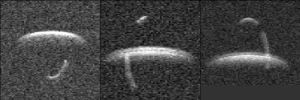
Images of asteroid 1999 KW4 and its moon. The streaks on the image are its moon’s trail as it moved while the images were created (using NASA’s Goldstone radar telescope)
Images of the asteroid show a trail of a smaller component orbiting a larger object. This system was the third binary near-Earth asteroid pair revealed by radar, but it was the first time scientists captured the complete orbit of one component around the other. The image was taken when the asteroid came within five million kilometres of Earth in 2001. It is classified as a Potentially Hazardous Asteroid, because eventually its path through space could intersect Earth. However, the radar measurements, which are accurate to 15 m, indicate there is no significant chance of 1999 KW4 colliding with Earth for at least a thousand years.
1999 KW4’s moon, designated S/2001 (66391) 1 or 1999 KW4 Beta is about 360 m in diameter, and orbits 1999 KW4 Alpha (the primary) in 0.758 day (about 16 hours) at a distance of 2.6 km. The presence of a companion was suggested by photometric observations made in 2000 at Ondřejov Observatory and was confirmed by radar observations from Arecibo Observatory in May 2001.
The shapes of the two bodies and their dynamics are complex. Among other bizarre properties, the equatorial regions of Alpha are very close to breaking up: raising a particle a metre above the surface would put it into orbit around the object.
Scientists working with NASA’s 70-metre Deep Space Network antenna at Goldstone, California, have released the first radar images of asteroid 2004 BL86. The images show the asteroid, which made its closest recent approach on 26th January 2015 at a distance of about 1.2 million kilometres, or 3.1 times the distance from Earth to the moon), has its own small moon. The main asteroid is about 325 metres across, and its moon 70 metres.
Near-Earth Objects
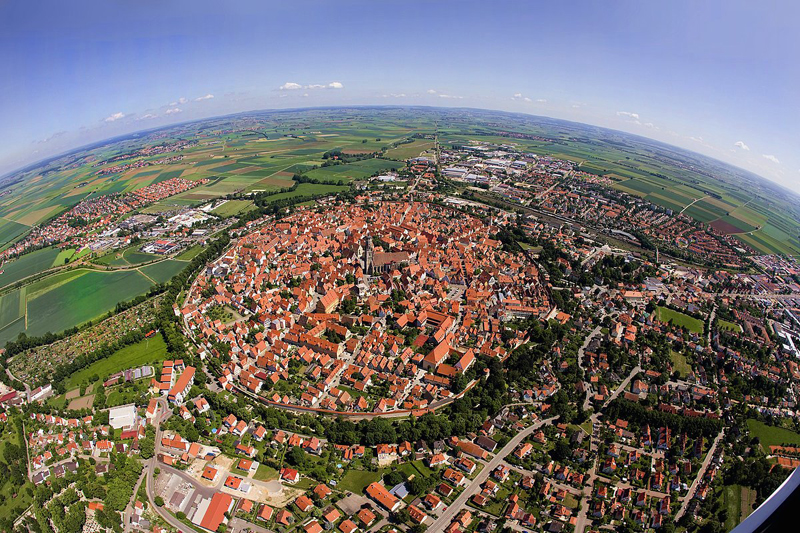
The Bavarian town of Nordlingen built in a 14 million year old meteor impact crater
A near-Earth object (NEO) (9,354 recorded) is a Solar System object whose orbit brings it into close proximity with the Earth. All NEOs have a closest approach to the Sun (perihelion) of less than 1.3 AU. They include a few thousand near-Earth asteroids (NEAs), near-Earth comets, a number of solar-orbiting spacecraft, and meteoroids large enough to be tracked in space before striking the Earth. It is now widely accepted that collisions in the past have had a significant role in shaping the geological and biological history of the planet. NEOs have become of increased interest since the 1980s because of increased awareness of the potential danger some of the asteroids or comets pose to the Earth, and active mitigations are being researched.
Potentially Hazardous Asteroids
Those NEOs that are asteroids (NEA) (1,350 recorded) have orbits that lie partly between 0.983 and 1.3 astronomical units away from the Sun. When an NEA is detected it is submitted to the IAU’s Minor Planet Center (located at the Harvard-Smithsonian Center for Astrophysics) for cataloging. Some near-Earth asteroids’ orbits intersect that of Earth’s so they pose a collision danger. The United States, European Union and other nations are currently scanning for NEOs in an effort called Spaceguard.
1+ Km Near-Earth Objects
In the United States, NASA has a congressional mandate to catalogue all NEOs (1259 recorded) that are at least 1 kilometre wide, as the impact of such an object would be catastrophic. As of August 2012, there had been 848 near-Earth asteroids larger than 1 km discovered, but only 154 are potentially hazardous asteroids (PHAs). It was estimated in 2006 that 20% of the mandated objects have not yet been found. As a result of NEOWISE in 2011, it is estimated that 93% of the NEAs larger than 1 km have been found and that only about 70 remain to be discovered.
2002 VE68
2002 VE68 is a quasi-satellite of Venus that also approaches the Earth quite closely fairly frequently.
2006 RH120
2006 RH120 is a tiny near-Earth asteroid which can occasionally become a satellite of the Earth (another “moon”).
(419624) 2010 SO16
(419624) 2010 SO16 is a near-Earth asteroid discovered by the Wide-field Infrared Survey Explorer space telescope. The orbit was described by Christou Apostolos and David Asher at the Armagh Observatory in Northern Ireland. The object has a magnitude of 20.7 and is several hundred metres in diameter.