
Loading...
Loading...
Decades ago astronomers used the term nebula for any fuzzy object in the sky. It was assumed that they were all the same sort of thing, not stars, and not the comets they were looking for.
We now reserve the term nebula for clouds of dust and gas; it is from these clouds that stars are made, and planets and all the other objects making up stellar systems.
Other ‘fuzzy’ things are galaxies (or clusters of galaxies), globular clusters, slow-moving comets, and other objects that don’t appear in our earth-based telescopes as pin-points of light. (There are also the planets and asteroids, none of which ever received the label “nebula” so far as I am aware.)
Catalogues were made of these objects and were initially compiled by comet-hunters, as objects to avoid.
Planetary Nebula is a misleading term in that no planets are implied by its meaning. In about 5 billion years, when the sun explodes and loses its outer layers, it will create a beautiful shell of diffuse gas known as a “planetary nebula”. About 10,000 of these short-lived, glowing objects are estimated to exist in the Milky Way, although only about 1,500 have been detected; the unseen rest hide behind interstellar dust.
Constellation charts are in the constellations page.
A star’s spectacular death in the constellation Taurus was observed on Earth as the supernova of 1054 CE. Now, almost a thousand years later, a super dense object – called a neutron star – left behind by the explosion is seen spewing out a blizzard of high-energy particles into the expanding debris field known as the Crab Nebula (also identified as NGC 1952 or M1). X-ray data from Chandra provide significant clues to the workings of this mighty cosmic “generator”, which is producing energy at the rate of 100,000 Suns. This composite image [right] uses data from three of NASA’s Great Observatories. The Chandra X-ray image is shown in blue, the Hubble Space Telescope optical image is in red and yellow, and the Spitzer Space Telescope’s infrared image is in purple. The X-ray image is smaller than the others because extremely energetic electrons emitting X-rays radiate away their energy more quickly than the lower-energy electrons emitting optical and infrared light. Along with many other telescopes, Chandra has repeatedly observed the Crab Nebula over the course of the mission’s lifetime. The Crab Nebula is one of the most studied objects in the sky, truly making it a cosmic icon.
The Crab Nebula was photographed [left] in various wavelengths of light by the Hubble Space Telescope in 2005. Stars such as our Sun die slowly, gently expelling their outer layers over millions of years. But for stars more than 10 times as massive as the Sun, the end is extremely violent. When its nuclear fuel runs out, the core of the star collapses, triggering a huge explosion that rips the outer layers of the star apart, blasting them outwards. The Crab Nebula is the debris from one of these “supernova” explosions.
Saul Perlmutter, Adam Riess and Brian Schmidt won the 2011 Nobel Prize in Physics for their research on supernovae. The Nobel jury said: ‘They have studied several dozen exploding stars, called “supernovae”, and discovered that the universe is expanding at an ever-accelerating rate.’ They added that the discovery had changed mankind’s understanding of the universe. The Crab Nebula is a supernova remnant.
Lagoon Nebula (M 8), a giant interstellar cloud in Sagittarius, classified as an emission nebula and as a H II region.
The Lagoon Nebula (catalogued as Messier 8 [M8], and as NGC 6523) is a giant interstellar cloud in the constellation Sagittarius. It is classified as an emission nebula and as an H II region.
The Lagoon Nebula was discovered by Guillaume Le Gentil in 1747 and is one of only two star-forming nebulae faintly visible to the naked eye from mid-northern latitudes. Seen with binoculars, it appears as a distinct oval cloudlike patch with a definite core. A fragile star cluster appears superimposed on it.
An emission nebula is a cloud of ionized gas emitting light of various colours. The most common source of ionization is high-energy photons emitted from a nearby hot star. Among the several different types of emission nebulae are H II regions, in which star formation is taking place and young, massive stars are the source of the ionizing photons; and planetary nebulae, in which a dying star has thrown off its outer layers, with the exposed hot core then ionizing them.
The Lagoon Nebula is estimated to be between 4,000 and 6,000 light years from the Earth. In the sky of Earth, it spans 90 by 40 minutes, corresponding to an actual dimension of 110 by 50 light years.
The cometary globule CG4 glows menacingly in an image from the European Southern Observatory’s Very Large Telescope, released on 28th January 2015. Although it looks huge and bright in this image, the nebula is actually faint and not easy to observe. The exact nature of CG4 remains a mystery. It is possibly a nebula cometary globule.
It is about 1,300 light-years from Earth in the constellation Puppis, and the dusty cloud contains enough material to form several Sun-like stars and probably has stars forming inside.
The Egg Nebula – a star going through the “preplanetary nebula stage” as it runs out of fuel at the end of its life. Hubble captured this brief but dramatic phase in a star’s life.
A planetary nebula is an emission nebula consisting of an expanding glowing shell of ionized gas ejected during a phase of certain types of stars late in their life. The term for this class of objects is a partial misnomer that originated (1784 or 1785) with astronomer William Herschel, because when viewed through his telescope, these objects appeared to be clouds (nebulae) that were similar in appearance to Uranus, the planet that had been discovered telescopically by Herschel. Herschel’s name for these objects was adopted by astronomers and has not been changed, even though planetary nebulae are now known to be completely unrelated to the planets. They often contain stars, but not visible planets. They are relatively short-lived, lasting a few tens of thousands of years, compared to a typical stellar lifetime of several billion years.
The Egg Nebula is a bipolar protoplanetary (axially symmetric bi-lobed) nebula approximately 3,000 light-years away from Earth. Its peculiar properties were first described in 1975 using data from the 11 μm survey obtained with sounding rocket by Air Force Geophysical Laboratory in 1971 to 1974. (Previously, the object was catalogued by Fritz Zwicky as a pair of galaxies.)
The Egg Nebula’s defining feature is the series of bright arcs and circles surrounding the central star. A dense layer of gas and dust enshrouds the central star, blocking its direct light from our view. However, the light from the central star penetrates the thinner regions of this dusty enclosure, illuminating the outer layers of gas to create the arcs seen in this image.
The dusty enclosure around the central star is very likely a disc. The bipolar outflows in the image indicate that the system has angular momentum, which is very likely generated by an accretion disc. In addition, a disc geometry would account for the varying thickness of the enclosure that allows light to escape along the disc’s axis and illuminate the outer layers of gas, but still blocks it from our direct view along the disc edge. Although dusty discs have been confirmed around several objects, a disc around the Egg Nebula is yet to be confirmed.
Many planetary nebulae exhibit an observed bipolar structure; it may be that the two types are directly related, one preceding or superseding the other in the evolution of the nebula.
The Egg Nebula is just one of several Searchlight Nebulae. This one is about half-way between λ and υ Cygni in the Cygnus chart and is known as RAFGL 2688 or CRL 2688.
IC 1396, also known as the Elephant’s Trunk Nebula, a giant cloud of gas and dust 2,400 light years from Earth. It is illuminated by a massive star in the centre. Radiation and winds from this hot star are thought to compress parts of the cloud and trigger star formation. The image was captured by the Isaac Newton Telescope, which is perched on a volcano in the Canary Islands. It lies close to μ Cephei in the Cepheus chart.
This image from the Wide Field Imager on the MPG/ESO 2.2-metre telescope (at the European Southern Observatory in La Silla, Chile) shows the Running Chicken Nebula (IC 2944), a cloud of gas and newborn stars around 6,500 light years away in the constellation of Centaurus. The nebula (see the Centaurus chart) is near to λ Centauri, which is not far from the Southern Cross (Crux). It is an open cluster with emission nebula.
Ultraviolet jellyfish: Wispy tendrils of hot dust and gas glow brightly in this ultraviolet image of the Cygnus Loop nebula (or the Veil, Cirrus or Filamentary nebula), taken by NASA’s Galaxy Evolution Explorer [see NGC 6960, NGC 6992 and NGC 6995 in the chart]. The nebula lies about 1,500 light-years away, and is a remnant from a supernova that occurred between 5,000 and 8,000 years ago.
This Hubble Space Telescope image shows the planetary nebula IC 289, located in the northern constellation of Cassiopeia. Formerly a star like our sun, it is now just a cloud of ionised gas being pushed out into space by the remnants of the star’s core, visible as a small bright dot in the middle of the cloud. Stars shine as a result of nuclear fusion reactions in their cores, converting hydrogen to helium. All stars are stable, balancing the inward push caused by their gravity with the outwards thrust from the inner fusion reactions in their cores. When all the hydrogen is consumed the equilibrium is broken; the gravitational forces become more powerful than the outward pressure from the fusion process and the core starts to collapse, heating up as it does so. When the hot, shrinking core gets hot enough, the helium nuclei begin to fuse into carbon and oxygen and the collapse stops. However, this helium-burning phase is highly unstable and huge pulsations build up, eventually becoming large enough to blow the whole star’s atmosphere away. A version of this image was entered into the Hubble’s Hidden Treasures image processing competition by contestant Serge Meunier.
This photograph shows the area surrounding the stellar cluster NGC 2467, the “Skull & Cross-bones” nebula located in the southern constellation of Puppis (“The Stern”). With an age of a few million years at most, it is a very active stellar nursery, where new stars are born continuously from large clouds of dust and gas.
Eskimo (NGC 2392) is a bipolar double-shell planetary nebula.
Another planetary nebula which forms when a star such as the sun uses up the hydrogen in its core. It begins to cool and expand, and eventually the outer layers are swept away, leaving a hot core. Radiation from the star and interaction with this wind creates a complex, filamentary shell. This composite image [above] of NGC 2392, the “Eskimo Nebula” contains data from the Chandra x-ray observatory, in pink, showing the location of million-degree gas near the centre. Data from the Hubble Space Telescope – red, green and blue – shows the intricate pattern of the outer layers that have been ejected.
The Eskimo Nebula (NGC 2392), also known as the Clownface Nebula or C 39, is a bipolar double-shell planetary nebula. It was discovered by astronomer William Herschel in 1787 in Slough. The formation resembles a person’s head surrounded by a parka hood. It is surrounded by gas that composed the outer layers of a Sun-like star. The visible inner filaments are ejected by a strong wind of particles from the central star. The outer disk contains unusual light-year long filaments.
Herschel described it as “A star 9th magnitude with a pretty bright middle, nebulosity equally dispersed all around. A very remarkable phenomenon.”
NGC 2392 lies more than 2,870 light-years away and is visible with a small telescope in the constellation of Gemini.
NGC 6302, the Bug or Butterfly nebula, is a bipolar planetary nebula in the constellation Scorpius, though it is not marked on the Scorpius chart. The structure in the nebula is among the most complex ever observed in planetary nebulae; its central star is one of the hottest stars in the galaxy, with a surface temperature in excess of 200,000 K. (A planetary nebula is an emission nebula consisting of an expanding glowing shell of ionized gas ejected during the asymptotic giant branch phase of certain types of stars late in their life.) The star from which it formed must have been very large but is now a white dwarf, only recently discovered (2009), using the upgraded Wide Field Camera 3 on board the Hubble Space Telescope. The star has a current mass of around 0.64 solar masses.
Thor’s Helmet (NGC 2359) is an emission nebula. The central star is a Wolf-Rayet star in a brief pre-supernova stage of evolution.
This image of the Thor’s Helmet nebula [above left of γ in the constellation chart, about the same distance as ι is below right of γ] was captured by the Isaac Newton Telescope on La Palma in the Canary Islands. It is a composite of data collected using three filters to isolate the light emitted by hydrogen (red), oxygen (green) and sulphur atoms (blue). Thor’s Helmet (NGC 2359) is like an interstellar bubble blown by wind from the extremely hot giant star at its centre. The nebula is about 15,000 light years from Earth in the constellation Canis Major.
The star cluster Pismis 24 lies in the core of the large emission nebula NGC 6357 that extends one degree in the sky in the constellation Scorpius. Part of the nebula is ionised by the youngest (bluest) heavy stars in Pismis 24. The intense ultraviolet radiation from the blazing stars heats the gas surrounding the cluster and creates a bubble in NGC 6357. The presence of these surrounding gas clouds makes probing into the region even harder.
NGC 5189 is a symmetrical spiral planetary nebula at 1,780 light years.
A nearby planetary nebula called NGC 5189 is a dying star in Musca that is expelling a large portion of its outer envelope. This material becomes heated by the radiation from the stellar remnant and radiates, producing glowing clouds of gas.
A planetary nebula, or ‘planetary’ is formed at the end of a star’s evolution. The remnant central stellar core, known as a planetary nebula nucleus or PNN, is destined to become a white dwarf star. The observed glow of the central star is so energetic that it causes the previously expelled gases to brightly fluoresce.
The Helix Nebula was the first planetary nebula discovered to contain cometary knots. Its main ring contains knots of nebulosity, which have now been detected in many nearby planetaries. These knots are highly radially symmetric (from the PNN) and are described as “cometary”, each containing bright cusps (local photoionization fronts) and tails. All extend away from the PNN in a radial direction. There are estimated to be more than 20,000 cometary knots in the Helix Nebula. Excluding the tails, they are (very approximately) the size of the Solar system, while each of the cusp knots are optically thick due to Lyc photons from the PNN.
A Lyc photon or Ly continuum photon or Lyman continuum photon is a kind of photon emitted from stars. Hydrogen is ionized by absorption of Lyc photons. Lyc photons are in the ultraviolet portion of the electromagnetic spectrum of the hydrogen atom and immediately next to the limit of the Lyman series of the spectrum with wavelengths that are shorter than 91.1267 nanometres and with energy above 13.6 eV.
The Flame Nebula, designated as NGC 2024 and Sh2-277, is an emission nebula and star-forming region in the constellation Orion. It is about 900 to 1,500 light-years away.
The bright star Alnitak (ζ Ori), the easternmost star in the Belt of Orion, shines energetic ultraviolet light into the Flame and this knocks electrons away from the great clouds of hydrogen gas that reside there. Much of the glow results when the electrons and ionized hydrogen recombine. Additional dark gas and dust lies in front of the bright part of the nebula and this is what causes the dark network that appears in the centre of the glowing gas. The Flame Nebula is part of the Orion Molecular Cloud Complex, a star-forming region that includes the famous Horsehead Nebula (above).
Don’t miss this spectacular video on space.com from the Atacama Pathfinder Experiment (APEX) telescope in Chile.
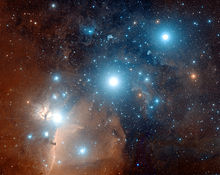
Left-to-right:
ζ (Alnitak), ε (Alnilam) and δ (Mintaka).
Alnitak is a triple star some 736 light years distant. It is part of Orion’s Belt along with Alnilam (ε Orionis) and Mintaka (δ Orionis).
Alnitak’s primary star is a hot blue supergiant with an absolute magnitude of −5.25, and is the brightest class O star in the night sky with a visual magnitude of +2.04. It has two bluish 4th magnitude companions, producing a combined magnitude for the trio of +1.72. The stars are members of the Orion OB1 association and the Collinder 70 association.
The Trifid Nebula (catalogued as Messier 20 [M20] and as NGC 6514) is an H II region located in Sagittarius. Its name means ‘divided into three lobes’. The object is an unusual combination of an open cluster of stars, an emission nebula (the lower, red portion), a reflection nebula (the upper, blue portion) and a dark nebula (the apparent gaps within the emission nebula that cause the trifid appearance; these are also designated Barnard 85). Viewed through a small telescope, the Trifid Nebula is a bright and peculiar object, and is thus a perennial favourite of amateur astronomers.
The Trifid Nebula was the subject of an investigation by astronomers using the Hubble Space Telescope in 1997, using filters that isolate emission from hydrogen atoms, ionized sulphur atoms, and doubly ionized oxygen atoms. The images were combined into a false-colour composite picture to suggest how the nebula might look to the eye.
The close-up images show a dense cloud of dust and gas, which is a stellar nursery full of embryonic stars. This cloud is about 8 light years away from the nebula’s central star. A stellar jet protrudes from the head of the cloud and is about 0.75 light-years long. The jet’s source is a young stellar object deep within the cloud. Jets are the exhaust gasses of star formation. Radiation from the nebula’s central star makes the jet glow.
The images also showed a finger-like stalk to the right of the jet. It points from the head of the dense cloud directly toward the star that powers the Trifid nebula. This stalk is a prominent example of evaporating gaseous globules, or ‘EGGs’. The stalk has survived because its tip is a knot of gas that is dense enough to resist being eaten away by the powerful radiation from the star.
In January, 2005, NASA’s Spitzer Space Telescope discovered 30 embryonic stars and 120 newborn stars not seen in visible light images.
The nebula is approximately 5,200 light years away and has a magnitude of 6.3.
A dying star throws a cosmic tantrum in this combined image from NASA’s Spitzer Space Telescope and the Galaxy Evolution Explorer. The star’s dusty outer layers are unravelling into space, glowing from the intense ultraviolet radiation being pumped out by the hot stellar core. This object, called the Helix nebula, lies 650 light years away in the constellation of Aquarius.
The Helix Nebula (also known as The Helix, NGC 7293, or C 63) is a large planetary nebula discovered by Karl Ludwig Harding, probably before 1824, this object is one of the closest to the Earth of all the bright planetary nebulae. The estimated distance is about 215 parsecs or 700 light-years. It is similar in appearance to the Ring Nebula (M57), whose size, age, and physical characteristics are similar to the Dumbbell Nebula (M27), varying only in its relative proximity and the appearance from the equatorial viewing angle. The Helix Nebula has sometimes been referred to as the “Eye of God” in pop culture.
The nebula spans about 0.8 parsec or 2.5 light-years. Currently, the age is estimated to be 12,900 to 9,100 years, based solely upon a measured expansion rate of 31 km/s.
It is thought to be shaped like a prolate spheroid with strong density concentrations toward the filled disk along the equatorial plane, whose major axis is inclined about 21° to 37° from our vantage point. The size of the inner disk is 8×19 arcmin in diameter (0.52 pc); the outer torus is 12×22 arcmin in diameter (0.77 pc); and the outer-most ring is about 25 arcmin in diameter (1.76 pc). We see the outer-most ring as flattened on one side due to its colliding with the ambient interstellar medium.
Expansion of the whole planetary nebula structure is estimated to have occurred in the last 6,560 years, and 12,100 years for the inner disk. Spectroscopically, the outer ring’s expansion rate is 40 km/s, and about 32 km/s for the inner disk.
The Eagle Nebula (catalogued as Messier 16 or M16, and as NGC 6611) is in the constellation Serpens Cauda and was discovered by Jean-Philippe de Cheseaux in 1745–46. Its name derives from its shape that is thought to resemble an eagle. It is the subject of the famous “Pillars of Creation” photograph [above] by the Hubble Space Telescope that shows pillars of star-forming gas and dust within the nebula.
The Nebula (M 16) is a young open cluster containing active star-forming gas and dust regions, including the famous “Pillars of Creation”. Visible-light pictures capture the multicoloured glow of gas clouds, wispy tendrils of dark cosmic dust, and the rust-coloured elephant trunks of the nebula’s famous pillars. Near-infrared light transforms the pillars into eerie, wispy silhouettes, seen against a starry background.
The Eagle Nebula is part of a diffuse emission nebula, or H II region, which is catalogued as IC 4703. This region of active current star formation is about 6,500 light-years distant. The tower of gas that can be seen coming off the nebula is approximately 9.5 light-years or about 90 trillion kilometres high.
The brightest star in the nebula (HD 168076) has an apparent magnitude of +8.24, easily visible with good binoculars. It’s actually a binary star formed of an O3.5V star plus an O7.5V companion.
The cluster associated with the nebula has approximately 460 stars, the brightest of spectral class O, a mass of roughly 80 solar masses, and a luminosity up to 1 million times that of the Sun. Its age has been estimated to be 1 to 2 million years.
Serpens is unique among the modern constellations in being split into two non-contiguous parts, Serpens Caput (Serpent’s Head) to the west and Serpens Cauda (Serpent’s Tail) to the east. Between these two halves lies the constellation of Ophiuchus, the Serpent Bearer. M 16 lies in the Serpent’s Tail.
Pillars of Creation is a photo [leftmost of the four] taken in April 1995 by the Hubble Space Telescope of ‘elephant trunks’ of interstellar gas and dust in the Eagle Nebula, 7,000 light years from Earth. The astronomers responsible for the photo above were Jeff Hester and Paul Scowen
The pillars are so named because the gas and dust are in the process of forming, or creating, new stars, while also being eroded by the light from nearby stars that have recently formed. It was named one of the top ten photographs from the HST by Space.com.
[Second left] In 2011, the region was revisited by ESA’s Herschel Space Observatory; and [rightmost] Hubble made another observation of the area in 2014.
Photos [below], in both visible and near infra-red light, released on 6th January 2015 show one of the most iconic Hubble Space Telescope images revisited: the Eagle Nebula’s Pillars of Creation.
The visible-light picture on the left captures the multicoloured glow of gas clouds, wispy tendrils of dark cosmic dust, and the rust-coloured elephant trunks of the nebula’s famous pillars.
On the right, near-infrared light transforms the pillars into eerie, wispy silhouettes, seen against a starry background. These new images provide a clearer view for astronomers who are studying how the structure of the pillars is changing over time.
[“NGC 3372d” – originally from en.wikipedia; description page is/was here. Licensed under Public Domain via Wikimedia Commons.]
NGC 3372 is such a large complex structure that it merits several photos. It is a fertile area for Herbig-Haro Objects and T Tauri Stars.
See also Eta Carinae and its “Homunculus Nebula”, the Mystic Mountain and the Keyhole Nebula.
The Carina Nebula is also known as the Great Nebula in Carina, the Eta Carina Nebula, or NGC 3372. There is also a small Homunculus Nebula.
The nebula lies an estimated distance between 6,500 and 10,000 light years from Earth. It is located in the Carina–Sagittarius Arm of the Milky Way galaxy. The nebula contains many O-type stars.
The nebula is one of the largest diffuse nebulae in our skies. Although it is some four times as large and even brighter than the famous Orion Nebula, the Carina Nebula is much less well known, due to its location far in the Southern Hemisphere. It was discovered by Nicolas Louis de Lacaille in 1751 – 1752 from the Cape of Good Hope.
This nebula is a complex region of bright and dark clouds, containing two of the brightest stars in the sky, η (Eta) Carinae and WR 25 (HD 93162) which is a Wolf-Rayet star in the turbulent star forming region, about 7,500 light-years from Earth. It is a Wolf-Rayet star with an unidentified companion and resides in the Trumpler 16 cluster.
WR 25 is notable for being the most luminous known star in the Milky Way Galaxy, substantially brighter than its nearby neighbour Eta Carinae, although it is unclear what contribution is from the invisible companion. It is approximately 6.3 million times brighter than the Sun and illuminates the far southern end of the Trumpler 16 cluster.
The Mystic Mountain is a dust–gas pillar in the Carina Nebula photographed by Hubble Space Telescope on its 20th anniversary. The area was observed by Hubble’s Wide Field Camera 3 on 1st–2nd February 2010. The pillar measures three light years in height; nascent stars inside the pillar fire off gas jets, that stream from towering peaks. The Mystic Mountain is shown in the two photographs below.
A portion of the Carina Nebula is known as the Keyhole Nebula, a name given to it by John Herschel in the 19th century. The Keyhole Nebula is actually a much smaller and darker cloud of cold molecules and dust, containing bright filaments of hot, fluorescing gas, silhouetted against the much brighter background nebula. The diameter of the Keyhole structure is approximately 7 light years. NGC 3324 is its designation.
The nebula has pillars of dust emerging from a huge cloud [right]. The dust pillars have a star at their tips. At the top is the star Herbig Haro-901 shining from the end of a dust column. Two knotted jets emerge from this star with bow shocks at their ends. (HH-902 is spewing a knotted, double stream of gas below and to the left of HH-901). We see stars ejecting streams of dust that are clearly forming the dusty nebula. As the stars spread out, they form pillars of dust around the edges of the nebula.
Herbig–Haro (HH) objects are small patches of nebulosity associated with newborn stars, and are formed when the narrow jets of gas ejected by young stars collide with nearby clouds of gas and dust at speeds of several hundred kilometres per second. Herbig-Haro objects are ubiquitous in star-forming regions, and some are often around a single star, aligned with its axis of rotation.
HH objects are transient phenomena, lasting no more than a few thousand years. They can evolve visibly over quite short astronomical terms as the mother star quickly moves away from the clouds of gas, the interstellar space medium). Hubble Space Telescope observations have revealed the complex evolution of HH objects in the period one a few years as parts of the nebula vanish while others light up to hit the clumpy interstellar material.
The objects were first observed in the 19th century by Sherburne Wesley Burnham, when he used the refractor telescope at the Lick Observatory and pointed to a small patch of nebulosity nearby. However it was simply categorized as an emission nebula, later becoming known as Burnham’s Nebula and was not recognized as a distinct object class. That had to wait until the 1940s. Early astronomers to study in detail were George Herbig and Guillermo Haro, after whom they are named. Herbig and Haro were working independently studying star formation when they first analyzed these objects and recognized that they were a by-product of star formation.
T Tauri is a very young and variable star, and is the prototype of the class of stars that have not yet reached a state of hydrostatic equilibrium between gravitational collapse and the generation of energy through nuclear fusion in their centres – they are just past the proto-star stage.
Just 30 arcseconds west of the brightest point in Hind’s nebula (NGC 1555), near T Tauri is another interesting object: a filament or jet, a Herbig-Haro object. Jets of such type are commonly linked with young, mass-ejecting stars. Although they are mainly detectable in the infrared, those from which visible spectra can be obtained suggest that the source star could be a very active T Tauri star.
Fifty years after Burnham’s discovery, several similar nebulae were found that were so small as to be almost star-like in appearance. Both Haro and Herbig made independent observations of several of these objects during the 1940s. Herbig also observed that Burnham’s Nebula shows an unusual electromagnetic spectrum, with prominent emission lines of hydrogen, sulphur and oxygen. Haro found that all objects of this type were invisible in infrared light.
The Armenian astronomer Viktor Hambardzumyan, based on their occurrence near young stars (a few hundred thousand years old) suggested that might represent an early stage in the formation of T Tauri stars.
Studies showed HH objects were highly ionised, and early theorists speculated that they might contain low luminosity hot stars. However, the absence of infrared radiation from the nebula meant they could not have stars in them, as these would have emitted abundant infrared light. Subsequent studies suggested the nebula may contain protostars, but eventually HH objects came to be understood as having been expelled from nearby young stars colliding at supersonic speeds with the interstellar medium, with the resulting shock waves generating visible light.
In the 1980s, observations revealed the nature of the jets and most HH objects. This led to the realization that the material ejected to form HH objects is highly concentrated into narrow jets. A star in the making is often surrounded by an accretion disc in his first few hundred thousand years of existence. As gas falls on them, the rapid rotation of the inner portions of these discs leads to the emission of narrow jets of partially ionized gas (plasma) perpendicular to the disk and known as polar jets. When these jets collide with the interstellar medium they lead to small patches of bright emission which are HH objects.
Electromagnetic emissions from HH objects is caused when the shock waves collide with the interstellar medium, but their movements are complicated. Spectroscopic observations of their Doppler shifts indicate velocities of several hundred kilometres per second, but the emission lines in the spectra are very weak. This suggests that some of the materials that are colliding with also moving along the beam, but at a slower rate.
The total mass being ejected to form HH typical objects is estimated to the order of 1 to 20 Earth masses, very little material compared with the mass of the stars themselves. The temperatures observed in HH objects are typically about 8000 to 12,000 K, similar to those found in other ionized nebulae such as H II regions and planetary nebulae. They tend to be very dense, ranging from a few thousand to a few tens of thousands of particles per c3 compared with typically less than 1.000 per c3 in H II regions and planetary nebulae. HH objects consist mainly of hydrogen and helium, which represent about 75% and 25%, respectively, of their mass. Less than 1% of the mass of HH objects are composed of heavier elements, and the abundances of these are generally similar to those measured in nearby young stars.
Near the source star, about 20 to 30% of the gas in HH objects is ionised, but this proportion decreases at increasing distances. This implies that the material is ionized in the polar jet, and as it moves away from the star, instead of being ionized by collisions subsequently recombines. At the end of the jet some material can re-ionize, resulting in bright caps at the ends of the jets.
Over 400 individual HH objects or groups are now known. They are ubiquitous in star-forming H II regions, and are often found in large groups. They are typically observed near Bok globules (dark nebulae which contain very young stars) and often emanate from them. Often several HH objects are observed near a single power source, forming a series of objects along the line of the polar axis of the parent star. The number of known HH objects has increased rapidly in recent years, but scientists think this is a very small proportion of the estimated 150,000.
Spectroscopic observations of HH objects show that the stars are moving away from home, at speeds of 100 to 1000 km/s. In recent years, the high optical resolution Hubble Space Telescope has revealed the proper motion of objects in many observations several years apart. These observations have also allowed estimates of the distances of objects HH some through expansion parallax method.
Away from the parent star, the HH objects evolve significantly, varying in brightness on time-scales of a few years. Individual nodes within an object can brighten and fade or disappear altogether, while new knots appear. As well as changes caused by interactions with the interstellar medium, interactions between the jets moving at different speeds within the HH objects also cause variations.
The jets of stars occurs in pulses rather than as a steady stream. The pulses can produce gas jets moving in the same direction but at different speeds, and interactions between different jets create so-called “working surfaces”, where gas streams collide and shock waves are generated.
The stars that cause the creation of HH objects are very young stars, the youngest of which are still protostars in the process of forming its surrounding gases. Astronomers divide these stars into classes 0, I, II and III, according to the amount of infrared radiation from stars emit. A greater amount of infrared radiation involves a greater amount of cooler material surrounding the star, indicating that coalescence is still occurring. (The numbering of the classes is that class 0 objects (the youngest) were not discovered until classes I, II and III had already been defined.)
Class 0 objects are only a few thousand years old, youngsters who are not undergoing nuclear fusion reactions in their centres. Instead, they are fed only by the gravitational potential energy released as material falls on them. Nuclear fusion has begun in the nuclei of Class I, but gas and dust are still falling on the surfaces of the surrounding nebula. They are generally still shrouded in dense clouds of dust and gas that obscure all their visible light and as a result can only be observed at infrared and radio wavelengths. The infall of gas and dust is over largely on objects of class II, but are still surrounded by disks of dust and gas, while objects of class III have only trace remnants of their initial accretion.
Studies have shown that approximately 80% of the stars that give rise to HH objects are binary or multiple systems (two or more stars orbiting each other), a much higher proportion than that found for low stars mass on the main sequence. This may indicate that binary systems are more likely to generate the jets that give rise to HH objects, and evidence suggests the largest HH outflows can be formed when multiple star systems disintegrate. It is believed that most stars form as multiple systems, but that a considerable part is interrupted before they reach the main sequence, by gravitational interactions with nearby stars and dense clouds of gas.
HH objects associated with very young stars or massive protostars are often hidden from view at optical wavelengths by the cloud of gas and dust from which they form. This surrounding native material may produce decreased visual magnitudes of tens or even hundreds in optical wavelengths. Such deeply embedded objects can only be observed at infrared wavelengths or radio, typically at frequencies of molecular hydrogen or warm hot carbon monoxide emission.
In recent years, infrared images have revealed dozens of examples of “infrared HH objects”. Most seem like bow waves (similar to the waves at the head of a ship), and so are generally known as molecular “bow shocks”. Like HH objects, these supersonic shocks are driven by collimated jets of opposite poles of a protostar. They bar or “drag” the surrounding dense molecular gas to form a continuous flow of material, a bipolar flow. Infrared shock waves travelling at hundreds of miles per second heat gas to hundreds or even thousands K. Because they are associated with younger stars, where accumulation is particularly strong, the infrared shock is usually associated with the most powerful optical HH jets.
Arc physics infrared shocks can be understood in the same way as that of the HH objects, as these objects are essentially the same – it’s just the conditions in the jet and the surrounding cloud that are different, causing the infrared emission to come from molecules rather than the optical emission of atoms and ions.
In 2009, the acronym “MHO” (Molecular hydrogen emission line objects) was approved for these items by the International Astronomical Union Working Group on the subject, and has entered its Reference Dictionary online naming celestial objects. The MHO catalog contains more than 1,000 objects.
A deep image of part of the constellation of Orion showing swirling diffuse pink clouds of hydrogen and dark clumps of interstellar dust. on the left side of the photograph are the bright stars of Orion’s Belt; the nebula is situated south of Orion’s Belt. Also visible is the tiny silhouette of the Horsehead Nebula, against the pink hydrogen clouds, centre left.
The Orion Nebula (M 42 or NGC 1976) is the bright patch of light to the right: one of the brightest nebulae in the sky, it is clearly visible to the naked eye on winter nights and lies 1,344 ± 20 light years from Earth, and is shown in the photograph below.
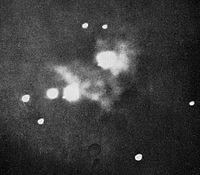
It is the closest region of massive star formation to Earth and is estimated to be 24 light years across. It has a mass of about 2000 times the mass of the Sun. Older texts frequently refer to the Orion Nebula as the Great Nebula in Orion or the Great Orion Nebula.
The Orion Nebula is one of the most scrutinized and photographed objects in the night sky, and is among the most intensely studied celestial features. The nebula has revealed much about the process of how stars and planetary systems are formed from collapsing clouds of gas and dust. Astronomers have directly observed protoplanetary disks, brown dwarfs, intense and turbulent motions of the gas, and the photo-ionizing effects of massive nearby stars in the nebula. There are also supersonic “bullets” of gas piercing the hydrogen clouds of the Orion Nebula. Each bullet is ten times the diameter of Pluto’s orbit and tipped with iron atoms glowing bright blue. They were probably formed one thousand years ago from an unknown violent event.
The Horsehead Nebula (or Barnard 33) is a dark nebula in Orion. It is just to the south of the star Alnitak, which is farthest east on Orion’s Belt, and is part of the much larger Orion Molecular Cloud Complex. The nebula was first recorded in 1888 by Scottish astronomer Williamina Fleming on a photographic plate taken at the Harvard College Observatory. The Horsehead Nebula is approximately 1500 light years from Earth. It is one of the most identifiable nebulae because of the shape of its swirling cloud of dark dust and gases, which bears some resemblance to a horse’s head when viewed from Earth.
Eta Carinae (η Carinae or η Car) is a stellar system in the constellation Carina, about 7,500 to 8,000 light-years from the Sun. The system contains at least two stars, one of which is a Luminous Blue Variable (LBV), which during the early stages of its life had a mass of around 150 solar masses, of which it has lost at least 30 since. It is thought that a hot supergiant of approximately 30 solar masses exists in orbit around its larger companion star, although an enormous thick red nebula surrounding Eta Carinae makes it impossible to see optically. Eta Carinae is enclosed in the Homunculus Nebula, itself part of the much larger Carina Nebula. Its combined luminosity is about five million times that of the Sun and has an estimated system mass in excess of 100 solar masses. It is not visible north of latitude 30°N and is circumpolar south of latitude 30°S. Because of its mass and the stage of life, it is expected to explode in a supernova or even hypernova in the astronomically near future.
Immediately surrounding the star Eta Carinae is a small nebula is known as the Homunculus Nebula (from the Latin meaning Little Man), and is believed to have been ejected in an enormous outburst in 1841 which briefly made Eta Carinae the second-brightest star in the sky after Sirius. The massive – near supernova – explosion produced two polar lobes, and a large but thin equatorial disk, all moving outward at 670 km/s (1,500,000 mph).
This wide-field view shows a region of sky in the southern constellation of Norma (The Carpenter's Square). At the centre lies the massive star-forming region SDC 335.579-0.292, but this is too obscured by dust to be visible. This is also true for the filamentary network of dust and gas. The star cluster NGC 6134 appears at the lower right and at the upper left the very hot blue star HD 147937 and its surrounding ejected clouds can be seen. This view was created from images forming part of the Digitized Sky Survey 2.
Observations of the dark cloud SDC 335.579-0.292 using the Atacama Large Millimeter/submillimeter array (Alma) in Chile have given astronomers the best view yet of a monster star in the making, in the southern constellation of Norma (The Carpenter's Square), near γ2 in the direction of ε. The cloud – a stellar ‘womb’ over 500 times the mass of the sun – is the largest ever seen in the Milky Way. Material is raining down on the embryonic star, which will eventually be up to 100 times the mass of the sun.
The Omega Nebula, also known as the Swan Nebula, Checkmark Nebula, Lobster Nebula, and the Horseshoe Nebula (catalogued as Messier 17 [M17] and as NGC 6618) is an H II region in the constellation Sagittarius. It was discovered by Philippe Loys de Chéseaux in 1745. Charles Messier catalogued it in 1764. It is located in the rich starfields of the Sagittarius area of the Milky Way. This photograph was taken by the VLT Survey Telescope.
The Omega Nebula is between 5,000 and 6,000 light-years from Earth and it spans some 15 light-years in diameter. The cloud of interstellar matter of which this nebula is a part is roughly 40 light-years in diameter and has a mass 30,000 times that of the Sun. The total mass of the Omega Nebula is an estimated 800 solar masses.
It is considered one of the brightest and most massive star-forming regions of our galaxy. Its local geometry is similar to the Orion Nebula except that it is viewed edge-on rather than face-on.
An open cluster of 35 stars lies embedded in the nebulosity and causes the gases of the nebula to shine due to radiation from these hot, young stars; however the actual number of stars in the nebula is much higher – up to 800, 100 of spectral type earlier than B9, and 9 of spectral type O, plus more than 1000 stars in formation on its outer regions. It’s also one of the youngest clusters known, with an age of just 1 million years.
The Swan portion of M17, the Omega Nebula in the Sagittarius nebulosity is said to resemble a barber’s pole.

