Words and Dictionaries
CHAMBERS English Dictionary
Some of my Favourite Definitions (all genuine, in the 2008 Edition)
- aris
- (Cockney slang, noun) arse. (Short for Aristotle, rhyming slang for bottle, which is in turn short for bottle and glass, rhyming slang for arse) — I particularly like this one because it involves two examples of rhyming slang, and then almost returns to where it started. There’s a lot more about ‘Chitty Chitty’ ([...‘Bang Bang’] rhyming slang for rhyming slang!) on Wikipedia.
- astraphobia or astrapophobia
- (noun) a morbid fear of (thunder and) lightning. (Greek astrape lightning, and phobos fear) — So it’s got nothing to do with stars or cars.
- batology
- the study of brambles [— for me, it just has the right ring to it]
- Cadmean letters
- (noun) sixteen simple letters that formed the original Greek alphabet (according to legend introduced by Cadmus)
- Cadmean victory
- (noun) one very costly to both sides (from the story that Cadmus sowed a dragon’s teeth from which sprang an army of soldiers who fought amongst themselves until only five were left)
- comfort food
- (noun) mood-enhancing food that meets the approval of one’s taste buds but not of one’s doctor — drawn to my attention by Jeremy Paxman’s Foreword to the dictionary.
- crwth
- /krooth/ (noun) the crowd, an old Welsh stringed instrument, four of its six strings played with a bow, two plucked by the thumb. (Welsh crwth a hollow protuberance, a fiddle; Gaelic Irish cruit). (See also Scrabble Words.)
- Dalek
- (noun) a mobile mechanical creature with a harsh staccato voice. (Created for the BBC television series Dr Who).
- dvandva
- (grammar noun) a compound word, each element being equal in status, (e.g. tragicomedy, bitter-sweet) (Sanskrit dvaṁdva, a pair)
- Dvorak keyboard
- (noun) (computing) a typewriter, etc. keyboard laid out so as to minimize finger movement (After its US inventor August Dvorak (1894 — 1975)), [pronounced like the composer but without the diacritics]
- éclair
- (noun) a cake, long in shape but short in duration, with cream filling and usually chocolate icing. (French éclair lightning).
- friendly numbers
- (noun plural, maths) pairs of numbers each of which is the sum of the factors of the other, including unity (also called amicable numbers). — I like numbers with attitude.
- kenophobia
- (noun) a morbid fear of empty spaces. (Greek kenos empty, and phobia). — Nothing to do with me!
- lurgy or lurgi
- (especially facetious, noun) a non-specific disease (popularized by BBC Radio’s The Goon Show [1949 — 1960]).
- McJob
- (slang, noun) an unskilled low-paid job. (McDonald’s, a chain of fast-food restaurants).
- mullet
- (noun) a hairstyle that is short at the front, long at the back, and ridiculous all round. (perhaps from dialect mullethead a fool).
- panties
- see under pants. [ — sic, as they say].
- pica
- an unnatural craving for unsuitable food (medical) [Latin pica, magpie]
- pond
- (noun) a unit of measurement equal to the gravitational force on a mass of one gram. (Latin pondus, ponderis a weight) — It makes you wonder how ducks can swim.
- taghairm
- (noun, in the Scottish Highlands) divination; especially inspiration sought by lying in a bullock’s hide behind a waterfall. (Gaelic).
- terebra
- (noun) (plural terebras or terebrae) a Roman contrivance for boring walls (historical) (Latin terebra) — aren’t all walls boring?
And just for Old Fogies
Who still remembers these relics from the past?
- cross
- the obverse of a coin, formerly often stamped with a cross (obsolete); hence, a coin (archaic)
- farthing; penny-farthing
- (noun) one-fourth of a pre-1971 penny; (noun) an ‘ordinary’, an old-fashioned bicycle with a big wheel at the front and a little one at the back
- ha’penny, ha’pence, ha’porth, penn’orth, tuppence, thruppence
- short forms of halfpenny, halfpennyworth, etc.
- Joe
- a fourpenny bit (obs) (Joseph Hume MP, 1836); (sometimes without capital) a threepenny bit
- mail or maile
- (obsolete) a halfpenny
- rap
- an 18th Century Irish counterfeit halfpenny; as a type of worthlessness, a whit, esp. in not worth a rap
- win, winn or wing
- (obsolete slang) a penny
And there are lots more obsolete names for money, like angel, groat and royal, not all in Chambers. Some day I’ll compile a list of them, given time so don’t hold your breath! Meanwhile, take a look at Money.
A pair of Neologisms (not in Chambers Dictionary)
- charisn’tma
- (noun) a personal characteristic that is completely unimpressive.
- embuggerance
- (noun) a minor inconvenience with no lasting effect, a temporary annoyance (from the expletive bugger, likely to be said as a result of encountering or experiencing one).
Words Not to be SNeezed at!
Have you ever noticed how many words to do with the NoSe contain both the letters N and S (mostly SN...)? (Look up the ones you haven’t yet encountered.)
- NaSal
- NoSe
- NoStril
- SNarl (and Spenser’s spelling SNar)
- SNeer which includes nasal movements
- SNeeze
- SNiff
- SNigger which includes nasal movements
- SNitch
- SNivel
- SNook, SNoke or SNowk (Scottish variants)
- SNore
- SNorkel
- SNort
- SNot
- SNout
- SNub (meaning a snub nose)
- SNuff (and Scots SNeesh), associated words SNeeshin(g) and SNeeshan (a pinch of snuff) and SNeechin-mull (a snuff box)
- SNush
Sorting Out The Meaning
Rose rose to put rose roes on her rows of roses — Robert J. Baran.
[Rose (a girl) rose (stood) to put rose (pink-coloured) roes (fish eggs as fertilizer) on her rows (lines) of roses (flowers).] That one is relatively simple, because of the several ways of spelling words pronounced /roʊz/.
Then there was the shopkeeper, Mr Smith, who with his sons asked a sign-writer to paint Smith and Sons over his shop-front. When it was done, he complained that the painter had not left enough space between Smith and and and and and Sons.
Martin Gardner (in Aha! Gotcha, p.141, Mathematical Association of America 2006) improved on this with his question:
Wouldn’t the sentence ‘I want to put a hyphen between the words Fish and And and And and Chips in my Fish-And-Chips sign’ have been clearer if quotation marks had been placed before Fish, and between Fish and and, and and and And, and And and and, and and and And, and And and and, and and and Chips, as well as after Chips?
There are a couple for you to solve.
Words Containing OUGH
A tough, dough-faced ploughman, thoughtfully strode through the streets of Scarborough, coughing and hiccoughing.
For foreigners learning English (and for some native speakers, too), the letter combination OUGH is a real challenge. Here are a few examples:
- though
- /oʊ/, rhyming with ‘so’ and ‘oh!’
- through
- /uː/, rhyming with ‘who’ and ‘coo!’
- cough
- /ɒf/, rhyming with ‘off’ and ‘Chekov’
- thorough
- /ə/, rhyming with ‘number’ and ‘carer’
- hiccough
- /ʌp/, rhyming with ‘up’ and ‘cup’
- bough
- /aʊ/, rhyming with ‘cow’ and ‘Slough’ (!) west of London
- tough
- /ʌf/, rhyming with ‘cuff’ and ‘stuff’
- lough
- /ɒx/, the Irish version of the Scottish ‘loch’ and pronounced the same
And you thOUGHt English was easy! (/ɔ/ rhyming with ‘sort’ and ‘caught’ — AUGH is another bag of worms, along with EIGH and others I’m not delving into)
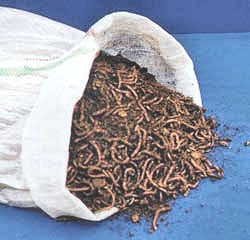
A Bag of Worms
Problems With Prepositions
There is a rule in English about not ending a sentence with a preposition. This prohibition is attributed to John Dryden, from 1672, and is based on the misconception that English grammar is from Latin. It isn’t; Latin is just one of the sources. If you want an example, look at the conjugation of verbs in English compared with Latin (or any of its modern derivatives). The verb with the most forms in English is to be, with just eight (be, being, been, am, is, are, was and were). (Please let’s not get embroiled in the argument as to whether the to is or is not a part of the infinitive!). In contrast, Spanish has hundreds of forms of a simple regular verb like hablar (to speak).
As Winston Churchill is said, probably wrongly, to have opined: “That is a rule up with which I will not put”.
Here’s another example of the sin: The father of a small boy goes upstairs after supper to read to his son, but he brings the wrong book. The boy says, ‘What did you bring the book that I don’t want to be read to out of up for?’
A lengthier version involves the book being about Australia, and the boy asks: ‘What did you bring the book that I don’t want to be read to about Down Under out of up for?’ But I think that really is cheating.
Some Amusing English and Welsh Place-Names
- Green Street Green
- believe it or not, there are two villages with this name in Kent and south-east London (one near Dartford, the other near Orpington).
- Pratt’s Bottom
- also near Orpington.
- Faccombe
- in Hampshire; I won’t tell you how the locals pronounce it.
- Pease Pottage
- in Sussex, south of Crawley.
- Over Wallop, Middle Wallop and Nether Wallop
- in Hampshire, collectively known as The Wallops.
- Melcombe Bingham and the nearby Bingham’s Melcombe
- in Dorset, north-east of Dorchester.
- Toller Porcorum and the nearby Toller Fratrum
- also in Dorset, north-west of Dorchester.
- Piddletrenthide, Piddlehinton, Puddletown, Affpuddle, Briantspuddle, Tolpuddle (of the martyrs’ fame), and Turners Puddle
- all in Dorset on the River Piddle, Puddle or Trent; the river just can’t seem to make up its mind what it wants to be called.
- Nempnett Thrubwell
- my personal favourite place-name of all those in England; it’s in the Mendip Hills in Somerset.
- Llanfairpwllgwyngyllgogerychwyrndrobwllllantysiliogogogoch
- the longest of all, in Anglesey (Ynys Mon) in north Wales, more conveniently called ‘Llanfair P.G.’. It means Saint Mary’s Church in the hollow of the white hazel near a rapid whirlpool and the Church of Saint Tysilio of the red cave (see here). Actually, by adding the Welsh word for higher or upper gives Llanfairpwllgwyngyllgogerychwyrndrobwllllantysiliogogogochuchaf which is just a bit longer (63 characters – the world’s longest domain name [with .co.uk added] – try typing that into your browser and getting it right first time!). It refers to the upper or old part of the village. There’s a limerick about it and a photo of its railway station sign below.
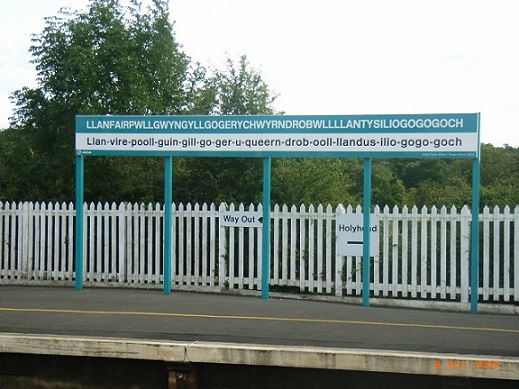
And in the south of France there’s a village called Condom. I’m sure there are many more amusing ones all over the world. In County Limerick, Ireland is a village called Effin, which Facebook have banned as ‘obscene’! (There’s a protest campaign at this by local people claiming “I’m an Effin man/woman”).
See also this silly article from The Guardian and here for Dull and other funny signs.
Words With Opposite Meanings
- Aloha
- The Hawaiian word means goodbye and hello. One can also have the spirit of aloha, meaning love, generosity and the like. Aloha!
- Cleave
- To stick together or to split apart.
- Draw the curtains
- Can be understood as to open or to close them.
- Fast
- Can mean speedy, or not moving at all, as in stuck fast.
- Fuse
- In addition to several other meanings, can mean either solidify or melt.
- Quite
- Can mean totally or partly.
- Raze
- When you raze a city you are doing the opposite of raising it.
(It sounds better than it looks.)
- Refrain
- When we want people to sing a chorus we ask them to join in a refrain, but when we don’t want them to join in we ask them to refrain.
- Seeded
- Seeds have been put in, taken out, or left in (as in grapes). Stoned (of fruit not alcohol) has similar ambiguity — that raises another problem: ‘ambiguity’ strictly involves two (Latin ambo = both, two); what’s the equivalent word for three?
- Vault
- It is either directly under the roof or under the floor.
Ageism
A young person falls over; an elderly person has a fall.
Spoonerisms and Other Linguistic Bawdiness
Professor William Archibald Spooner (1844 — 1930) was an Oxford don, allegedly prone to muddling parts of words, such as his loyal toast ‘God bless the queer old dean’ (for ‘God bless the dear old Queen’); its authenticity is, however, dubious.
Nevertheless, this genre of humour is amusing, because it goes one step beyond the simple use of swear words to produce a sense of pleasure in the listener. (Swear words, oaths that once had great seriousness with their breaking being the cause of legal and spiritual scandal, since taking the name of the Lord thy God in vain breaks the Second Commandment, have changed through common usage into meaning any vulgarism related to breaking wind, sexual matters or defecation.)
There was allegedly a Morecambe and Wise sketch where reference was made to an MP from a rural constituency, ‘I’m a country Member’, with the reply being ‘yes, I remember’. There is also an Australian version that refers to the right-wing Country Party.
And on 6th June 2011 (at 6.30 pm on BBC Radio 4), Sandi Toksvig said on The News Quiz that “the Tories put the n into cuts”, causing much ire from ‘Disgusted of Tunbridge Wells’ and The Daily Telegraph.
Several Stephen Fry and Hugh Laurie sketches about Language are on YouTube — this is just one of them
Back to Professor Spooner; look up ‘Spoonerism’ in Google or Wikipedia to get a good sample of them.
Among my favourite Spoonerisms are:
- ‘You have hissed all my mystery lectures, and were caught fighting a liar in the quad. Having tasted two worms, you will leave by the next town drain’ — You have missed all my history lectures, and were caught lighting a fire in the quad. Having wasted two terms, you will leave by the next down train.
- ‘It is kisstomary to cuss the bride’ — It is customary to kiss the bride.
- ‘Mardon me padam, this pie is occupewed. Can I sew you to another sheet?’ — Pardon me, madam, this pew is occupied. Can I show you to another seat?
- ‘He was killed by a blushing crow’ — He was killed by a crushing blow.
‘Pheasant pluckers’ also lend themselves to spoonerisms.
Garden-Path Sentences
These are sentences that lead you in one direction; then you have to backtrack and re-parse the sentence to get its true meaning. Here’s a simple one:
The old man the boats.
Your first impression is that old is an adjective that qualifies the noun man; in fact old is a noun and man is the verb.
Now try to sort these out:
- The horse raced past the barn fell.
- The man who hunts ducks out at weekends.
- The cotton clothing is usually made of grows in Mississippi.
- The prime number few.
- Fat people eat accumulates.
- The tycoon sold the offshore oil tracts for a lot of money wanted to kill JR.
- The psychologist told the wife that he was having trouble with to leave.
- Time flies like an arrow, but...
- ...Fruit flies like a banana.
The Quick Brown Fox Jumps over a Lazy Dog
This (above) is a well-known pangram, a sentence containing all the letters of the alphabet. It is used to test typewriters and computer keyboards, and as sample text dates back to 1888. It is often misquoted as “jumped” making it no longer a pangram (no ‘s’), and “over the lazy dog” making it slightly longer.
The famous pangram above uses 33 letters, but others, containing just 26 are possible, though they use some pretty obscure words. However, all the words are claimed to be in one English dictionary or another. Have a look at these:
- Veldt jynx grimps waqf zho buck
- A grasslands wryneck woodpecker climbs onto a male bovine on Muslim land held in trust
- Cwm fjord bank glyphs vext quiz
- Carved symbols in a mountain hollow on the bank of an inlet irritated an eccentric person
- Squdgy fez, blank jimp crwth vox!
- A short brimless felt hat barely blocks out the sound of a Celtic violin
- Jink cwm, zag veldt, fob qursh pyx
- Cross valley and plain to steal coins from Saudi mint
- Junky qoph-flags vext crwd zimb
- An Abyssinian fly playing a Celtic violin was annoyed by trashy flags on which were the Hebrew letter qoph
- Cwm fjord veg balks nth pyx quiz
- Relaxing in basins at the end of inlets terminates the endless tests from the box
- XV quick nymphs beg fjord waltz
- If you’ll allow Roman Numbers!
English Phonetic Pangrams
Here are some pangrams which use all the phonemes of English (rather than alphabetic characters):
- Are those shy Eurasian footwear, cowboy chaps, or jolly earthmoving headgear?
- The hungry purple dinosaur ate the kind, zingy fox, the jabbering crab, and the mad whale and started vending and quacking.
- With tenure, Suzie’d have all the more leisure for yachting, but her publications are no good. [for certain US accents and phonological analyses]
Catalan and Spanish Pangrams

Catalan Pangrams
- Jove xef, porti whisky amb quinze glaçons d’hidrogen, coi!
- Young chef, bring whisky with fifteen hydrogen ice cubes, darn! (with ç)
- Aqueix betzol, Jan, comprava whisky de figa
- That idiot, Jan, was buying fig whisky
- Zel de grum: quetxup, whisky, cafè, bon vi; ja!
- Heat of the rut: ketchup, whisky, coffee, good wine; of course!
- Coi! quinze jans golafres de Xàtiva, beuen whisky a pams
- Darn! Fifteen insatiable common men from Xàtiva, drink whisky inch-by-inch

Spanish Pangrams
- El veloz murciélago hindú comía feliz cardillo y kiwi. La cigüeña tocaba el saxofón detrás del palenque de paja
- The quick Hindu bat was happily eating golden thistle and kiwi. The stork was playing the saxophone behind the straw arena (this pangram has ‘ñ’ and diacritics, and is used in Windows as sample text)
- El pingüino Wenceslao hizo kilómetros bajo exhaustiva lluvia y frío; añoraba a su querido cachorro
- The penguin Wenceslao did kilometres in exhausting rain and cold; he longed for his dear puppy (with ‘ch’, ‘ñ’ and ‘ll’)
- Jovencillo emponzoñado de whisky: ¡qué figurota exhibe!
- Whisky-intoxicated youngster — what a figure he’s showing!
- Ese libro explica en su epígrafe las hazañas y aventuras de Don Quijote de la Mancha en Kuwait
- That book explains in its epigraph the deeds and adventures of Don Quijote de la Mancha in Kuwait
- Queda gazpacho, fibra, látex, jamón, kiwi y viñas
- There are still gazpacho, fibre, latex, ham, kiwi and vineyards
- Whisky bueno: ¡excitad mi frágil pequeña vejez!
- Good whisky, excite my frail, little old age!
- Es extraño mojar queso en la cerveza o probar whisky de garrafa
- It is strange dipping cheese in the beer or tasting cheap whisky
Tenses of Verbs
Most foreign languages have a large number of forms for each verb, representing the person (I, you) and importantly, the tense (future, past).
We usually assume that the same types of forms exist in English and are used similarly. They aren’t. Look at these examples:
- “I live [‘present’] in London but this week I’m in Southampton.” [So live doesn’t refer to the present! It refers to my usual arrangements.]
- “I’d prefer you came [‘past’] tomorrow.” [So came refers to the future!]
These are lots more I could quote. The point is that most verbs in English need some sort of ‘time-indicator’ (like now or next Tuesday) to establish when they are referring to.
The present tense normally refers to something close to the subject, while the past tense is really a remote tense. To help tell more about the time or other property of the verb, we use auxiliaries (may, can...).
Mrs. Byrne’s Dictionary
Strange though it may seem, I am an avid browser of dictionaries; words and their meanings, and etymology and linguistics too. One of my favourites is
Mrs. Byrne’s Dictionary of Unusual, Obscure, and Preposterous Words.
The author, Josefa Heifetz Byrne, daughter of the famous violinist Jascha Heifetz, defines 6,000 of what she describes on the cover as ‘the Weirdest, Funniest, Most Useful Words in the English Language’, for ‘Scrabble, Crossword, Double-Crostic Fans — and All People Who Love Words (even mugwumps [chiefs], nilins [very soft creatures] and momes [critics])’.
Mrs. Byrne defines everything from ‘aa (noun) rough, crumbling lava (Hawaiian)’ to ‘zzxjoanw /zıks dʒouən/ (noun) a Maori drum’, via a 1913-letter word
If you see a copy, buy it!
See 30 bizarre phrases in the English language
I’m Sorry I Haven’t a Clue
See also The Officially Unofficial I’m Sorry I Haven’t A Clue Web Site
"Uxbridge English Dictionary"
These are typical of some definitions featured in this game in the BBC Radio 4 programme I’m Sorry I Haven’t a Clue.
- Assassination
- An arrangement to meet a donkey.
- Cabbage
- A vegetable, as large and as wise as a man’s head.
- Cashtration
- The act of buying a house, which renders the subject financially impotent for an indefinite period of time.
- Doppler Effect
- The tendency of stupid ideas to seem smarter when they come at you rapidly.
- Hosepipe
- Dance done by sailors in socks.
- Lampoon
- A device for whaling at night.
- Legend
- That part of the leg which is not in the middle.
- Minuscule
- A small educational establishment in Liverpool.
- Omelette
- Prince of Denmark.
- Sarcasm
- The gulf between the author of sarcastic wit and the person who doesn’t get it.
Mornington Crescent
I’m Sorry I Haven’t a Clue also features a game called “Mornington Crescent” (named after a little-known and, as far as I am aware, little-used station on the Northern Line of the London Underground). It is literally impossible to describe the rules of the game, but once you’re hooked on it, it’s hilarious.
Scrabble Words Without Vowels (or ‘Y’)
BRR, BRRR, CRWTH, CRWTHS, CWM, CWMS, HM, HMM, MM, NTH, PFFT, PHPHT, PHT, PSST, SH, SHH, TSK, TSKS, TSKTSK, TSKTSKS
or so this web-site claims; or try this Scrabble-cheat site.
In Flames
Flammable and inflammable are synonyms and mean “easily set on fire”. Inflammable comes from the Latin inflammare which means to set fire to where the prefix in- means in as in inside, rather than not as in invisible and ineligible.
Nevertheless, inflammable is often erroneously thought to mean non-flammable. This safety hazard is typically avoided by use of flammable (despite its not being a proper Latin-derived term) on warning labels referring to physical combustibility. The antonym of flammable and inflammable is non-inflammable, incombustible or non-combustible.
More Synonyms
Two other words which are synonyms, and which I thought were of a common origin are isle and island. It turns out that I was quite mistaken.
Isle is from the Middle English word ile or yle, which is from the Old French isle (modern île, latinized but obsolete isle). This ultimately is derived from the Latin word insula through a normal phonetic descendance. I didn’t find anything odd about that.
Island, I thought, had a similar origin, with the word land getting involved somewhere along the way. I was quite wrong; island is from the Middle English iland, with the ‘s’ getting in due to confusion with isle in the 16th century. Further back than that, we find the Old English (Anglian) īeġland, (West Saxon) īeġland, īgland, later īland (equivalent to Old Frisian and modern Dutch eiland, Middle Dutch and Middle Low German eilant, Old Norse eyland and Icelandic cy plus land. The Old English words īeġ or īġ mean ‘water’ or ‘sea’ plus land (‘land’). This old root word is still evident in place-names like Anglesey, Alderney and Ely.
Nonsense!
You may have seen some nonsense verse in Jabberwocky. Here are two grammatically correct, but nonsense sentences from Noam Chomsky: Colorless green ideas sleep furiously; and Stephen Fry: Hold the newsreader’s nose squarely, waiter, or friendly milk will countermand my trousers. And from Groucho Marx: I once shot an elephant in my pajamas. How he got into my pajamas, I’ll never know.
Hippopotomonstrosesquipedalian* Words
And Other Miscellanea
The 1992 Guinness Book of World Records calls the 29-letter floccinaucinihilipilification “the longest real word in the Oxford English Dictionary”, dismissing the 45-letter pneumonoultramicroscopicsilicovolcanoconiosis as “the longest made-up word in the OED”.
Mind you, these have got absolutely nothing on the following word in Mrs Byrne’s Dictionary:
methionylglutaminylarginyltyrosylglutamylserylleucylphenylalanylalanylglutaminylleucyl-
lysylglutamylarginyllysylglutamylglycylalanylphenylalanylvalylprolylphenylalanylvalylthreonyl-
leucylglycylaspartylprolylglycylisoleucylglutamylglutaminylserylleucyllysylisoleucyl-
aspartylthreonylleucylisoleucylglutamylalanylglycylalanylaspartylalanylleucyl-
glutamylleucylglycylisoleucylprolylphenylalanylserylaspartylprolylleucylalanylaspartyl-
glycylprolylthreonylisoleucylglutaminylasparaginylalanylthreonylleucylarginyl-
alanylphenylalanylalanylalanylglycylvalylthreonylprolylalanylglutaminylcysteinyl-
phenylalanylglutamylmethionylleucylalanylleucylisoleucylarginylglutaminyllysylhistidyl-
prolylthreonylisoleucylprolylisoleucylglycylleucylleucylmethionyltyrosylalanylasparaginy-
lleucylvalylphenylalanylasparaginyllysylglycylisoleucylaspartylglutamylphenylalanyltyrosyl-
alanylglutaminylcysteinylglutamyllysylvalylglycylvalylaspartylserylvalylleucylvalylalanyl-
aspartylvalylprolylvalylglutaminylglutamylserylalanylprolylphenylalanylarginylglutaminyl-
alanylalanylleucylarginylhistidylasparaginylvalylalanylprolylisoleucylphenylalanylisoleucyl-
cysteinylprolylprolylaspartylalanylaspartylaspartylaspartylleucylleucylarginylglutaminyl-
isoleucylalanylseryltyrosylglycylarginylglycyltyrosylthreonyltyrosylleucylleucylserylarginyl-
alanylglycylvalylthreonylglycylalanylglutamylasparaginylarginylalanylalanylleucylprolyl-
leucylasparaginylhistidylleucylvalylalanyllysylleucyllysylglutamyltyrosylasparaginylalanyl-
alanylprolylprolylleucylglutaminylglycylphenylalanylglycylisoleucylserylalanylprolyl-
aspartylglutaminylvalyllysylalanylalanylisoleucylaspartylalanylglycylalanylalanylglycylalanyl-
isoleucylserylglycylserylalanylisoleucylvalyllysylisoleucylisoleucylglutamylglutaminylhistidyl-
asparaginylisoleucylglutamylprolylglutamyllysylmethionylleucylalanylalanylleucylly-
sylvalylphenylalanylvalylglutaminylprolylmethionyllysylalanylalanylthreonylarginylserine
which she defines as ‘the chemical name for tryptophan synthetase A protein, a 1913-letter enzyme with 267 amino acids.’ [Don’t worry, I didn’t type all that in; copy-and-paste is a wonderful tool.] It is said that there is no theoretical limit to the length of possible legitimate chemical terms. A DNA molecule could have a name of over 1,000,000,000 letters if it was written out in full.
* pertaining to a very long word
Some Things I Find Annoying
(and I hope they annoy you too)
- Absolutely
- when the speaker means “Yes” or “I agree”.
- Brit
- when the speaker is trying to be with it and means “Shit”, sorry “British” (in use the two are often synonymous). See also Here’s a Moan.
- Hopefully
- when the speaker means “I hope that...”.
- Literally
- when the speaker means simply to emphasize the point.
(One of the few people who could claim to have been “literally over the moon” was Neil Armstrong). See also Reddit and The Guardian.
- Quantitative Easing
- for “printing or minting more money”.
- “Smileys”
- and other silly abbreviations like “;)” or “(:o” or “LOL” or “IMHO” — whatever they mean. Can’t TXTers (or whatever they call themselves) cope with our language? (SLLY BGGRS) – see here.
- TLAs (that is, Three-Letter Abbreviations or Acronyms)
- which are frequently used in technical and financial circles; they are part of a jargon that excludes those ‘not in the know’; the term also encompasses four- or more-letter horrors. They are a curtain behind which the ignorant can hide. They are annoying to those who haven’t been let in on the jargon. Here’s an example from a report into an incident [sic — it was nearly an accident] on the London Underground:
“Witness and email evidence shows that some people involved in the RGU approval process were using the term OSP when they meant OSP&I. It is uncertain whether this confusion misled anyone involved with approving the RGU.”
(Just in case you haven’t fallen asleep yet, the TLAs’ meanings are: ‘OSP&I’ = Operational Safety Plan & Instructions, ‘OSP’ = Operational Safety Plan and ‘RGU’ = Rail Grinding Unit). All clear now?
And for that matter, beware of most Americanisms:
- Obama met with Cameron...
- ...met with is correct English only when a third party is included, such as Obama met Cameron with Clegg; the example quoted should be Obama met Cameron.
See also Why do some Americanisms irritate people?
(And beware of words ending in -ification).
Or this Newspeak:
Heard on a news report: The term ‘custody suite’, which sounds as if it should be some type of dessert. However, it is more likely to be where someone is kept if they are to get their just deserts! It’s newspeak for a prison cell.
Clichés
- At the end of the day... – ...we all go to bed?
- At this point in time... – ...do you mean “now”?
- Collateral damage... – ...innocents killed.
- Friendly fire... – ...someone is killed by his/her own side.
(Can fire with this meaning ever be ‘friendly’?)
- The bottom line is... – ...the last thing on the page?
- It never did that before – [as the man said when his donkey died]
- Untimely death... – ...is death ever “timely”?
Peter Piper and Friends
Peter Piper picked a peck of pickled peppers.
Did Peter Piper pick a peck of pickled peppers?
If Peter Piper picked a peck of pickled peppers,
Where’s the peck of pickled peppers Peter Piper picked?
Perspicacious Polly Perkins purchased Peter’s product
And peddled pickles to produce a pretty profit!
I am not the pheasant plucker,
I’m the pheasant plucker’s mate.
I am only plucking pheasants
Because the pheasant plucker’s late.
I slit the sheet, the sheet I slit;
and on the slitted sheet I sit.
One smart fellow; he felt smart.
Two smart fellows; they felt smart.
Three smart fellows; they all felt smart.
She sells seashells by the seashore.
The shells she sells are surely seashells.
So if she sells shells on the seashore,
I’m sure she sells seashore shells.
“Madam, I’m Adam” and Other Palindromes
Do geese see God?
Was it Eliot’s toilet I saw?
Murder for a jar of red rum.
Some men interpret nine memos.
Never odd or even.
Aibohphobia:
an irrational fear of palindromes.
[As it’s irrational I’ve separated it from its enemies!]
More at the Fun with Words web-site
Did You Know...? (Vauxhall — Вокэал)
- Вокэал (pronounced /vokzal/)
- Russian for a main railway station. There are several theories as to why this word is like ‘Vauxhall’ in London. A Russian team inspected the construction of the London and South Western Railway in 1840, and mistook the name of the station for the word for ‘station’ (Vauxhall was then the London terminus of the LSWR).
Another explanation is that the first Russian railway, constructed in 1837, ran to Pavlovsk Palace, where extensive Pleasure Gardens had been established. In 1838 an entertainment pavilion was constructed at the railway terminus and was called the Вокэал after the Vauxhall Pleasure Gardens in London; the name was soon applied to the station itself. It later came to mean any substantial railway station building.
(A different Russian word, Станция (stantsiya), is used for minor stations). The Russian word Вокэал meaning ‘amusement park’ was current before the 1840s.
Simpsonian and Other Neologisms
Embiggen and Cromulent
The Simpsons episode “Lisa the Iconoclast” features two neologisms: embiggen and cromulent. The show runners asked the writers if they could come up with two words which sounded like real words, and these were what they came up with. The Springfield town motto is A noble spirit embiggens the smallest man. Schoolteacher Edna Krabappel comments that she never heard the word ‘embiggens’ until she moved to Springfield. Miss Hoover, another teacher, replies, “I don’t know why; it’s a perfectly cromulent word.” Later in the episode, while talking about Homer’s audition for the role of town crier, Principal Skinner states: “He’s embiggened that role with his cromulent performance”. Embiggen – in the context it is used in the episode – is a verb that was coined by Dan Greaney in 1996.
The verb previously occurred in an 1884 edition of the British journal Notes and Queries: A Medium of Intercommunication for Literary Men, General Readers, Etc. by C A Ward, in the sentence “but the people magnified them, to make great or embiggen, if we may invent an English parallel as ugly. After all, use is nearly everything”. The literal meaning of embiggen is to make something larger. The word has made its way to common use and was included in Mark Peters’ Yada, Yada, Do’h!, 111 Television Words That Made the Leap From the Screen to Society. In particular, embiggen can be found in string theory. The first occurrence of the word was in the journal High Energy Physics in the article “Gauge/gravity duality and meta-stable dynamical supersymmetry breaking”, which was published on 23rd January 2007. For example, the article says: “For large P, the three-form fluxes are dilute, and the gradient of the Myers potential encouraging an anti-D3 to embiggen is very mild.” Later this usage was noted in the journal Nature, which explained that in this context, it means to grow or expand.
Cromulent is an adjective that was coined by David S Cohen. Since it was coined it has appeared in Dictionary.com’s 21st Century Lexicon. The meaning of cromulent is inferred only from its usage, which indicates that it is a positive attribute. Dictionary.com defines it as meaning fine or acceptable. Ben Macintyre has written that it means ‘valid or acceptable’.
Here are the ‘Dictionary Definitions’ of these words:
- embiggen
- English verb.
Etymology: em- + big + -en. Ad-hoc coinage, created independently twice, see above.
Pronunciation: /əmbɪgən/
(nonce word, ergative) To enlarge or grow; to make or become bigger.
Synonyms: (make or become bigger): enlarge, expand, increase, magnify; swell, aggrandize, bigger
Antonyms: (make or become bigger): ensmallen, shrink, diminish, contract, debigulate
- cromulent
- English adjective.
Etymology: a humorous neologism coined by television writer David Cohen, see above.
Pronunciation: /krɔmjʊlənt/
cromulent (not comparable):Fine, acceptable or normal; excellent, realistic, legitimate or authentic.
And another from the Simpsons:
- d’oh or doh
- English interjection.
Alternative form: doh
Etymology: Imitative. Later popularised by the cartoon character Homer Simpson in The Simpsons. Voice actor Dan Castellaneta has said he modelled his version on the drawn-out "do-o-o-o" sound made by Jimmy Finlayson in the films of Laurel and Hardy.
Pronunciation: (US): /doʊ/, /doʊʔ/; (UK): /dəʊ/, /dəʊʔ/
Homophones: doe, doh, dough, do (music), d’oh
Expresses frustration or anger, especially at one’s own stupidity. (“I just paid for our food.” “You didn’t have to. It’s free.” “D’oh!”
expression of frustration)
Anagram: hod
Some Foreign Words with no English Equivalent
- Angst:
- A general feeling of anxiety produced by the awareness of the uncertainties and paradoxes inherent in the state of being human — German.
- Age-otori:
- To look worse after a haircut — Japanese (there MUST be a Korean equivalent).
- Chutzpah:
- Cheek but with extremely self-confident audacity — Yiddish.
- Esprit de l’escalier:
- The brilliantly witty response you didn’t think of until too late — French.
- Fremdschämen:
- Being embarrassed for someone else, often someone who has done something embarrassing but isn’t ashamed of themselves — German.
- Pesmenteiro:
- One who shows up to a funeral for the food — Portuguese.
- Prozvonit:
- To call a mobile phone to have it ring once so that the other person calls back, saving the first caller money — Czech and Slovak (allegedly).
- Schadenfreude:
- Joy in the misfortune of others — German.
- Stramash:
- To strike, beat, or bang; to break; to destroy — Scottish and northern English.
- Wei-wu-wei:
- Deliberate decision not to do something — Chinese.
- Zeg:
- The day after tomorrow — Georgian.
Lipograms
These are like pangrams, but are much longer, and omit one letter, not an easy one like ‘Q’, ‘J’ or ‘Z’, but, in this case ‘E’.
In March 2002, a group of authors and critics told Book mag that lit’s top fictional dog, post-1900, was good old Jay Gadsby, from that status-conscious Ivy chap’s 1925 book. Not a big shock to most; but lipogram aficionados — folks who lash words and (alas!) brains so as to omit particular symbols — did in fact gasp, saying, “Hold that ringing communication tool for a bit! What about J. Gadsby?”
John Gadsby, “Youth’s champion,” is the hero of Ernest Vincent Wright’s 1939 Gadsby, fearlessly subtitled A Novel of Over 50,000 Words Without Using the Letter “E”. Like the paragraph above, the book eschews our tongue’s bedrock letter. The absence creates a tone alternately lofty (“It is an odd kink of humanity which cannot find any valuation in spots of natural glory”) and rambunctious (“Books!! Pooh! Maps! BAH!!”), and demands comical circumlocutions for the simplest things — a turkey dubbed the “Thanksgiving National Bird,” a wedding cake rechristened “an astonishing loaf of culinary art.” The languorous tale shows how Gadsby harnesses the energy and ideas of young people to turn the backwater of Branton Hills into a bustling city. Children stump for civic projects, such as the establishment of a park and a library, and Gadsby soon becomes mayor.
Wikipedia on pangrams, lipograms and Gadsby
Did You Know...?
...that cartophilia means a love of cigarette cards
...and that gynotikolobomassophilia means a love of biting a female’s earlobes?
No? Shame on you!
Some of the Problems Foreigners have with English
- In a Belgrade lift:
- To move the cabin, push button for wishing floor. If the cabin should enter more persons, each one should press a number of wishing floor. Driving is then going alphabetically by national order.
- A doctor’s office in Rome:
- Specialist in women and other diseases.
- In a Rome laundry:
- Ladies, leave your clothes here & spend the afternoon having a good time.
[Which reminds me of a laundry in London, which carried the slogan: Don’t Kill Your Wife! Let Us Do It!]
- On a menu of a Polish hotel:
- Salad a firm’s own make; limpid red beer soup with cheesy dumplings in the form of a finger; roasted duck let loose; beef rashers beaten up in the country people’s fashion.
- A Finnish hotel’s instructions in case of fire:
- If you are unable to leave your room, expose yourself in the window.
- Ad for donkey rides in Thailand:
- Would you like to ride your own ass?
- In a Czech tourist agency:
- Take one of our horse driven tours — we guarantee no miscarriages.
- Car rental brochure in Tokyo:
- When passenger of foot heave in sight, tootle the horn. Trumpet him melodiously at first, but if he still obstacles your passage then tootle him with vigour.
- A temple in Bangkok:
- It is forbidden to enter a woman even a foreigner if dressed like a man.
- In a Bangkok cleaners:
- Drop your trousers here for best results.
- In a hotel in Yugoslavia:
- The flattening of underwear with pleasure is the job of the chambermaid.
- In a Paris hotel elevator:
- Please leave your values at the front desk.
Problems with Worms
One of Ronnie Barker’s more memorable monologues involved a multitude of plays on worms (words) in his Mispronunciation Sketch; this and many others are on YouTube. Listen for his Siamese Notional Anthem to the tune of God Save the Queer:
Owa tana Siam
Owa tana Siam
I yamut wit
Owa Taphoo Lamai
Owa Taphoo Lamai
Owa tana Siam
Owa tanit
Major Dilemmas
I stumbled upon this document serendipitously from the following quote:
For the longest time, I suffered through life with a tang that often got tungled. In these pages, I’ve done it a number of times.
It’s in two formats: HTML [1.49 MB] and Microsoft Word [2.10 MB]
It’s entitled Major Dilemmas by Aaron Rath, and starts with this, from Conversations with Dalí, pp. 79-80:
- ALAIN BOSQUET:
- Do you ever laugh at Dalí when you are in the bathroom?
- SALVADOR DALí:
- How can I? Do I ever joke seriously? Do I tell extraordinary truths? Do jokes turn into truths? Aren't truths dreadfully childish? My zaniness can be substantial and the most profound substantiality can be pure humbug.
And finally...
John Humphreys (he of BBC Radio 4’s Today programme and chair of the Mastermind quiz) has some very strong views on the proper use of English. He’s not a purist, and allows clichés when they help and are not abundant. One of his main gripes is the obfuscation of meaning by excessive use of jargon and pretentious phrases. He quotes a writer in the Health Service Journal who described himself as the associate director of the NHS clinical governance support team’s performance development team. As Humphrys adds: “I wonder how many nurses you could pay with the money that that little lot costs”.
See his book Lost for Words: The Mangling and Manipulating of the English Language; and his latest Beyond Words: How Language Reveals the Way We Live Now (which I haven’t read yet, but if it’s half as good as Lost for Words I won’t be disappointed).
