
Loading...
Loading...
In this section is information about: Una Pesseta from El Vendrell in the Spanish Civil War, Penny & Pound, Guinea, Penny, ½ & ¼, Sovereigns, Noble, Rose Noble & Ryal, Angel & ½ Angel, Sceat, Testoon & Shilling, Crown, Farthing & 3-farthing, Bullion Coinage, Slang and “Chiie”.
Try these web sites for more information:
Commemorative Coins of the United Kingdom —
Commemorative Coins of Spain
Euro Coins —
Euro Gold and Silver Commemorative Coins —
Euro Coins: Commemorative Issues —
Euro Coins: National Side —
Euro Coins: Identifying Marks
But most of this page is about...
But most of this page is about...
Click on any of the thumb-nail pictures to enlarge them.
I recently came across this picture of a one-peseta note issued during the Spanish Civil War by the municipality of El Vendrell, which is where I live. The wording is in Catalan; under the fascist rule of “Generalísimo Francisco Franco”, the Catalan language was forbidden for any official matters. Needless to point out that most if not all of Catalonia was anti-Franco. (Mind you, one still hears a few old people praising Franco for “making the trains run on time”!) It was not until after his death that Catalan became recognized as a legitimate language for use in this region.
But I’m straying from the point I want to make. (I’ve strayed so far that you’d better skip to the next section to read what I’m rattling on about!)
One further diversion is that, despite the euro having been our currency for a dozen years, many Spanish people still think in terms of the old one. We are all too conservative to want to change our mind-set, and it’s cheering to think that when we first moved to Spain we were millionaires! Because then 1,000,000 pesetas were worth about £5,000.
The peseta was the currency of Spain between 1869 and 2002. (Along with the French franc, it was also a de facto currency used in Andorra which had no national currency with legal tender.) The name of the currency comes from pesseta, the diminutive form of the word peça, a Catalan word that means “piece” or “fraction”. The first non-official coins which contained the word “peseta” were made in 1808 in Barcelona.
The peseta was subdivided into 100 céntimos or, informally, 4 reales. The last coin of any value under one peseta was a 50-céntimo coin in 1980, made to celebrate that Spain would host the 1982 FIFA World Cup. The last 25-céntimos coin (or real) was dated 1959, the ten céntimos also dated 1959, both coins bearing the portrait of Franco. The 1-céntimo coin was last minted in 1913 and featured King Alfonso XIII. The half-céntimo was last minted in 1868 and featured Queen Isabel II.
The peseta was also a unit of currency in Catalonia until 1850, when the whole of Spain decimalized. It was also a name used throughout Spain for an amount of 4 reales de vellón (a vellón was 5 céntimos). In Catalonia, the peseta was subdivided into 6 sueldo, each of 4 quartos (also spelled cuartos), 8 ochavos or 12 dineros (many currencies bearing a denomination derived from the Latin denarius, including the “d” of “£sd”). Five pesetas were equal to one duro, which was equal to the Spanish 8 reales de plata fuerte (Spanish dollar). In the new, decimal currency, the peseta was worth 4 reales. The name peseta reappeared in 1868 for the new Spanish currency. Its value was equivalent to that of the earlier peseta. The word duro is still used to denote something worthless, like the French sou.
Gold has been coveted for millennia, for its beauty, malleability and rarity. According to the World Gold Council, there are currently around 184,000 tonnes sitting in bank vaults, government reserves and personal collections. That sounds like an awful lot, until you realise that just one cubic metre of the stuff weighs over 19 tonnes. Thus, all the world’s known gold reserves could be laid out on a football pitch in a layer only a metre or so high. Or to put it another way, it could fill 3.42 Olympic-sized swimming pools.
But this is only the gold that has been successfully mined and documented. Estimating how much actually exists on the planet is much trickier. Chemical analysis of rock samples suggests gold makes up on average a few parts per billion of the total mass of the Earth’s crust. That means the top kilometre or so has around a million tonnes of the stuff still waiting to be dug up. Chances are it never will be, though, because most of it will be hopelessly uneconomic to extract.
Having started this section of my web with a (very) brief history of the Spanish coinage, I’m moving on to the British, or strictly, English currency. Since 1971 the pound sterling has been divided into 100 pence. From the 16th century until decimalisation it was worth 20 shillings, each of which was worth 12 pence. Thus the confusion for which only the British are capable, the new currency had to be marked NEW, now dropped. Note that 100 new pence were equivalent to 240 old pence; it didn’t half confuse my grandmother!
The first decimal coins were circulated in 1968. These were the five pence (5p) and ten pence (10p), and had values of one shilling (1/-) and two shillings (2/-), respectively, under the pre-decimal £sd system. The decimal coins are minted in copper-plated steel (previously bronze), cupro-nickel and nickel-brass. The £2 coin is bimetallic. The coins are discs, except for the 25p and 50p pieces, both of which are heptagons of constant curvature — this means that they can be used in slot machines with no problem. All the circulating coins have an effigy of Queen Elizabeth II on the obverse, and various national and regional designs and the denomination, on the reverse. In addition to the circulating coinage, the UK also mints commemorative decimal coins (crowns) in the denomination of five pounds (previously 25 pence). Ceremonial Maundy money and bullion coinage of gold sovereigns, half sovereigns, and gold and silver Britannia coins are also produced. Some territories outside the United Kingdom, that use the pound sterling, produce their own coinage, with the same denominations and specifications as the UK coinage but local designs.
In the years just prior to decimalisation, the circulating British coins were the half-crown (2/6), two shillings or florin (2/–), shilling (1/–), sixpence (6d), threepence [left] (3d), penny (1d) and halfpenny (½d). The farthing (¼d) was withdrawn in 1960.
All modern coins feature a profile of the current monarch’s head. The direction in which they face changes with each successive monarch, a pattern that began with the Stuarts. For the Tudors and pre-Restoration Stuarts, both left and right-facing portrait images were minted within the reign of a single monarch. Medieval portrait images tended to be full face.
From a very early date, British coins have been inscribed with the name of the ruler of the kingdom in which they were produced, and a longer or shorter title, always in Latin; among the earliest distinctive English coins are the silver pennies of Offa of Mercia, an 8th century contemporary of Charlemagne, which were inscribed with the legend OFFA REX (King Offa). The English silver penny was derived from another silver coin, the sceat, of 20 troy grains weight, which was in general circulation in Europe during the Middle Ages. The weight of the English penny was fixed at 22.5 troy grains (about 1.46 grams) by Offa. The coin’s designated value, however, was that of 24 troy grains of silver (one pennyweight, or 1/240 of a troy pound, or about 1.56 grams), with the difference being a premium attached by virtue of the minting into coins. Thus 240 pennyweights made one troy pound of silver in weight, and the monetary value of 240 pennies also became known as a pound. (240 actual pennies, however, weighed only 5400 troy grains, known as a tower pound, a unit used only by mints. The tower pound was abolished in the 16th century.) The silver penny remained the primary unit of coinage for about 500 years. The coinage reform of 1816 set up a weight/value ratio and physical sizes for silver coins. Silver was eliminated in 1947, except for Maundy coinage.
Historically Scotland and England had separate coinage; the last Scottish coins were struck in 1709 shortly after union with England. Coins were originally hand-hammered – an ancient technique in which two dies are struck together with a blank coin between them. This was the traditional method of manufacturing coins in the Western world from the pre-Hellenic Greek era onwards, in comparison to Asia where coins were traditionally cast. The first milled (that is, machine-made) coins were produced during the reign of Elizabeth I (1558 – 1603) and periodically during the subsequent reigns of James I and Charles I, but there was initially opposition to mechanisation from the moneyers who ensured that most coins continued to be produced by hammering. All British coins produced since 1662 have been milled.
The purity of 92.5% silver and 7.5% copper (i.e., sterling silver) was instituted by Henry II in 1158 with the “Tealby Penny”, a hammered coin. Unfortunately there were drawbacks to minting currency of fine silver, notably the level of wear it suffered, and the ease with which coins could be “clipped”, or trimmed, by those dealing in the currency. It went some way towards discouraging clipping, though this practice was further discouraged and largely eliminated with the introduction of the milled edge we see on coins today. Over the years the penny was gradually debased until by the 16th century it contained about a third the silver content of a proper troy 24 grain pennyweight.
The medieval penny would have been the equivalent of around 1/6 in value in 1915. British government sources suggest that prices have risen over 61-fold since 1914, so a medieval sterling silver penny might have the equivalent purchasing power of around £4.50 today, and a farthing (a quarter penny) would have the value of slightly more than today’s pound (about £1.125).
By 1696 the currency had been seriously weakened by an increase in clipping during the Nine Years’ War to the extent that it was decided to recall and replace all hammered silver coinage in circulation. The exercise came close to disaster due to fraud and mismanagement, but was saved by the personal intervention of Isaac Newton after his appointment as Warden of the Mint, a post which was intended to be a sinecure, but which he took seriously. Newton was subsequently given the post of Master of the Mint in 1699. Following the 1707 union between the Kingdom of England and the Kingdom of Scotland, Newton used his previous experience to direct the 1707 – 1710 Scottish recoinage, resulting in a common currency for the new Kingdom of Great Britain. After 15th September 1709 no further silver coins were ever struck in Scotland.
As a result of a report written by Newton on 21st September 1717 to the Lords Commissioners of His Majesty’s Treasury the bimetallic relationship between gold coins and silver coins was changed by Royal proclamation on 22nd December 1717, forbidding the exchange of gold guineas for more than 21 silver shillings. Due to differing valuations in other European countries this inadvertently resulted in a silver shortage as silver coins were used to pay for imports, while exports were paid for in gold, effectively moving Britain from the silver standard to its first gold standard, rather than the bimetallic standard implied by the proclamation.
The coinage reform of 1816 set up a weight/value ratio and physical sizes for silver coins.
In 1920, the silver content of all British coins was reduced from 92.5% to 50%, with a portion of the remainder consisting of manganese, which caused the coins to tarnish to a very dark colour after they had been in circulation for a significant period. Silver was eliminated altogether in 1947, except for Maundy coinage, which returned to the pre-1920 92.5% silver composition. The 1816 weight/value ratio and size system survived the debasement of silver in 1920, and the adoption of token coins of cupro-nickel in 1947. It even persisted after decimalisation for those coins which had equivalents and continued to be minted with their values in new pence. The UK finally abandoned it in the 1990s when smaller, more convenient, “silver” coins were introduced.
All coins since the 17th century have featured a profile of the current monarch’s head. The direction in which they face changes with each successive monarch, a pattern that began with the Stuarts. For the Tudors and pre-Restoration Stuarts, both left- and right-facing portrait images were minted within the reign of a single monarch (left-facing images were more common). Medieval portrait images tended to be full face.
There was a small quirk in this alternating pattern when Edward VIII ascended to the throne and was portrayed facing left, the same as his predecessor George V. This was because Edward thought that to be his best side. However, Edward VIII abdicated a short while later and his coins were never put into general circulation. When George VI came to the throne, he had his coins struck with him facing the left, as if Edward VIII’s coins had faced right (as they should have done according to tradition). Thus, in a timeline of circulating British coins, George V and VI’s coins both feature left-facing portraits, although they follow directly chronologically.
As of March 2007, the total value of coinage in circulation is estimated at three and a half billion pounds, of which the £1 and £2 coins account for over two billion pounds. The 1p and 2p coins from 1971 are the oldest standard-issue coins still in circulation.
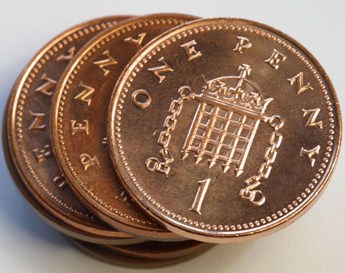
Since decimalisation on 15th February 1971 the pound (symbol "£") has been divided into 100 pence. (Prior to decimalisation the pound was divided into 20 shillings, each of 12 (old) pence; thus there were 240 (old) pence to the pound. The value of the pound itself was unchanged by decimalisation.) The first decimal coins — the five pence (5p) and ten pence (10p) — were introduced in 1968 in the run-up to decimalisation in order to familiarise the public with the new system. These initially circulated alongside the pre-decimal coinage and had the same size and value as the existing one shilling and two shilling coins respectively. The fifty pence (50p) coin followed in 1969, replacing the old ten shilling note. The remaining decimal coins — at the time, the half penny (½p), penny (1p) and two pence (2p) — were issued in 1971 at decimalisation. A quarter-penny coin, to be struck in aluminium, was proposed at the time decimalisation was planned, but was never minted. The new coins were initially marked with the wording NEW PENNY (singular) or NEW PENCE (plural). The word “new” was dropped in 1982. The symbol “p” was adopted to distinguish the new pennies from the old, which used the symbol “d” (from the Latin denarius, a coin used in the Roman Empire).
In the years since decimalisation a number of changes have been made to the coinage. The twenty pence (20p) coin was introduced in 1982 to fill the gap between the 10p and 50p coins. The pound coin (£1) was introduced in 1983 to replace the Bank of England £1 banknote which was discontinued in 1984 (although the Scottish banks continued producing them for some time afterwards; the last of them, the Royal Bank of Scotland £1 note, was still in production as of early 2006). The designs on the one pound coin change annually in a largely five-year cycle. The decimal half penny coin was demonetised in 1984 as its value was by then too small to be useful. The pre-decimal sixpence, shilling and two shilling coins, which had continued to circulate alongside the decimal coinage with values of 2½p, 5p and 10p respectively, were finally withdrawn in 1980, 1990 and 1993 respectively. In the 1990s the Royal Mint reduced the sizes of the 5p, 10p and 50p coins. As a consequence, the oldest 5p coins in circulation date from 1990, the oldest 10p coins from 1992 and the oldest 50p coins come from 1997. Since 1997, many special commemorative designs of 50p have been issued. Some of these are found fairly frequently in circulation and some are rare. They are all legal tender. A circulating bimetallic two pound (£2) coin was introduced in 1998 (first minted in, and dated, 1997). There had previously been unimetallic commemorative £2 coins which did not normally circulate. This tendency to use the two pound coin for commemorative issues has continued since the introduction of the bimetallic coin, and a few of the older unimetallic coins have since entered circulation. There are also commemorative issues of crowns. Before 1990 these had a face value of twenty-five pence (25p), equivalent to the five shilling crown used in pre-decimal Britain. However, in 1990 crowns were redenominated with a face value of five pounds (£5) as the previous value was considered not sufficient for such a high-status coin. The size and weight of the coin remained exactly the same. Decimal crowns are generally not found in circulation as their market value is likely to be higher than their face value, but they remain legal tender.
In 2008, UK coins underwent an extensive redesign, which changed the reverse designs, and some other details, of all coins except the £2. The original intention was to exclude both the £1 and £2 coins from the redesign because they were “relatively new additions” to the coinage, but it was later decided to include the £1 coin. This was the first wholesale change to British coinage since the first decimal coins were introduced in April 1968, in keeping with an unwritten convention that the coin designs should be changed every 40 years to keep the coinage fresh. The major design feature was the introduction of a reverse design shared across six coins (1p, 2p, 5p, 10p, 20p, 50p), that can be pieced together to form an image of the Royal Shield. This was the first time a coin design had been featured across multiple coins in this way. Completing the set, the new £1 reverse features the Shield in its entirety. The effigy of the Queen, by Ian Rank-Broadley, continues to appear on the obverse of all the coins.
On all coins, the beading (ring of small dots) around the edge of the obverses has been removed. The obverse of the 20p coin has also been amended to incorporate the year, which had been on the reverse of the coin since its introduction in 1982 (giving rise to an unusual issue of a ‘mule’ version without a date at all). The orientation of both sides of the 50p coin has been rotated through 180 degrees, meaning the “bottom” of the coin is now a corner rather than a flat edge. The numerals showing the decimal value of each coin, previously present on all coins except £2 and £1, have been removed, leaving the values spelled out in words only.
With their high copper content (97%), the intrinsic value of pre-1992 1p and 2p coins increased with the surge in metal prices of the mid-2000s, until by 2006 the coins, would, if melted down, have been worth about 50% more than their face value. (To do this, however, would be illegal, and they would have had to be melted in huge quantities to achieve significant gain.) In subsequent years the price of copper fell considerably from these peaks.
Three commemorative designs were issued of the large version of the 50p: in 1973 (the EEC), 1992–3 (EC presidency) and 1994 (D-Day anniversary). Commemorative designs of the smaller 50p coin have been issued (alongside the Britannia standard issue) in 1998 (two designs), 2000, and from 2003 to 2007 yearly (two designs in 2006).
In England, during the reign of Henry VII, the forerunner of the shilling, the testoon, was introduced. This was produced in extremely small quantities, probably around 1489, and the coins were not made for general circulation. In Scotland, during the reign of Mary I, Queen of Scots, the testoon and half-testoon were introduced to the Scottish coinage in 1553 and 1555 respectively. The testoon was struck in quantity during the last part of the reign of Henry VIII in 1544 – 1551. These testoons were made in the very poor base silver, as were all coins of this period. The obverse shows a facing bust of Henry VIII and the reverse side a crowned rose.
The English shilling was first introduced known as the testoon. It remained in circulation until it became the British shilling as the result of the Union of England and Scotland in 1707. There were twenty shillings to the pound sterling and twelve pence to the shilling, and thus 240 pence to the pound. The word shilling originates in the schilling, an accounting term dating back to Anglo-Saxon times, when it was deemed to be the value of a cow in Kent or a sheep elsewhere. Edward VI continued the issues of base testoons. In his reign the testoons were called “shillings” for the first time. These coins are the first English ones to carry the date, which is in Roman numerals.
In 1551 the silver standard was restored from about 0.250 silver to the normal 0.925 “sterling” silver. This issue has a stunning facing bust of the king and was struck in large quantities but is normally found fairly worn and sometimes holed.
Under Mary, no shillings were struck in England until Mary I of England was married in 1554 to Philip of Spain, though Irish shillings with Mary’s portrait were struck in 1553 and 1554 before her marriage. After Mary’s marriage some shillings were coined. To boost Philip’s popularity his bust was placed on these coins, facing Mary’s. There are two main varieties: Spanish titles (which adds on “Prince and Princess of Spain”) and English titles.
One of the first events of Elizabeth I’s reign was the counter-marking of the Edward VI shillings to revalue them to their true worth. These coins have the counter-mark of a portcullis or greyhound, those with the portcullis were revalued at fourpence halfpenny, and with the greyhound were revalued at twopence farthing.
A major recoinage was then embarked upon, with thousands of silver coins being produced. No shillings were produced between 1562 and 1582, but the next issue was also very large. During the reign of James I, coinage continued in much the same way as in Elizabeth’s but the coins have a mark of value (XII) in front of the bust.
Shillings were minted in every subsequent reign as well as during the Commonwealth period. The Broad was a British coin worth 20 shillings (20/-) issued by the Commonwealth of England in 1656. It was a milled gold coin weighing 9.0 – 9.1 grams, with a diameter of 29 or 30–millimetres. The obverse of the coin depicts the Lord Protector Oliver Cromwell as a laureated Roman emperor. A piedfort version of the coin with an edge inscription is known as a Fifty shilling piece. This is extremely rare, and there are very few examples as it is probably a pattern.
From 1707, as the result of the Union of England and Scotland to form the Kingdom of Great Britain, the English shilling was converted into the British shilling. For the Great Recoinage of 1816, the mint was instructed to coin one troy pound (weighing 5760 grains) of standard (0.925 fine) silver into 66 shillings, or its equivalent in other denominations. This effectively set the weight of the shilling, and its subsequent decimal replacement 5 new pence coin, at 87.2727 grains (or 5.655 grams) with a diameter of 24 mm from 1816 to 1990, when the new smaller 5p coin was introduced.
In 1920, along with other national coins, the silver content was reduced from 92.5% (sterling) to 50%, and in 1947 to pure cupro-nickel. The shilling coin issued in most of the 20thcentury was virtually identical in size and weight to the German 1 Deutsche Mark coin (sufficiently similar to be interchangeable in coin-operated machines). This reflected the pre-First World War exchange rate of 20 marks to one pound; by the end of the shilling’s circulation, the mark was worth six times as much.
Two coins denominated in multiple shillings were also in existence at this time. They were the florin (two shillings), which was in general circulation and adopted the value of ten new pence (10p) in 1971, and the crown (five shillings), the highest denominated non-bullion UK coin at decimalisation. The crown was not in general circulation at the time, however, being minted infrequently to commemorate important occasions (e.g. the coronation of a new monarch).
The last shillings issued for circulation were dated 1967. In 1968, the new decimal five-pence coin (initially called “five new pence”), with the same weight and specifications, started to replace the shilling. It initially inherited the shilling's slang name of a bob. Shillings and florins (two-shilling coins) remained in circulation alongside the 5p and 10p coins until 1990, when smaller 5p and 10p coins were introduced. The Shilling was finally withdrawn on 1st January 1991.
In Popular Culture a slang name for a shilling was a “bob” (which was invariant in the plural, as in “that cost me two bob”). In The Gambia, white people are called toubabs, which some claim derives from the fact that the price of a slave was two shillings, or from the colonial practice of paying locals two shillings for running errands – though some consider this explanation implausible.
To “take the King’s shilling” was to enlist in the army or navy, a phrase dating back to the early 19th century.
To “cut someone off without a shilling” (or “with a shilling”, that is, with no more than a shilling) means to disinherit.
A farthing (derived from the Anglo-Saxon feorthing, a fourthling or fourth part) was a coin worth one quarter of a penny, 1/960th of a pound sterling. Such coins were first minted in England in the 13th century, and continued to be used until 31st December 1960, when they ceased to be legal tender.
Early farthings were silver, but surviving examples are rare. The first copper farthings were issued during the reign of King James I and VI.
Little is known of the medieval silver farthing, for few remain. As the smallest denomination, it was rarely hoarded and as it contained a quarter-penny’s worth of silver it was also extremely small, and therefore easily lost. Besides, farthings were not produced in anything like the quantities of the penny and halfpenny because, although they were useful to ordinary people, they were not so much used by the wealthy and powerful.
Until the 13th century, requirements for small change were often met by “cut coinage” that is, pennies cut into halves or quarters, usually along the cross which formed a prominent part of the reverse of the coin. It was long considered that the first silver farthings were produced in the reign of King Edward I (1272 – 1307). However in recent years five examples have been discovered dating from the reign of King Henry III (1216 – 1272). All are in the short-cross style of that period, produced between 1216 and 1247, and are similar in design to the pennies, but only a quarter the size. Due to the lack of known examples and documentary evidence, these coins are thought to be trials rather than circulating coins.
Contemporary records show that over four million farthings were produced during the reign of King Edward I, (1272 – 1307). The weight and fineness of Edward’s farthings varies – the first three issues from the London mint weigh 6.85 grains (0.44 grams), while the later issues weigh 5.5 grains (0.36 grams), but the value of the coins remained the same as the heavier coins had a lower fineness or silver content than the lighter coins; it is thought that the coins were made larger in order to make them easier to strike and handle, but coins of low fineness have never been popular in England and the population preferred the inconvenience of a smaller coin with higher silver content.
It was during the reign of King James I (1603 – 1625) that copper coinage was introduced. From his previous experience as King of Scotland James realised that small denomination copper coins would be acceptable, as they had been in use in Scotland and on the European mainland for some time. However the English seemed to have an obsession with gold and silver, requiring that coins had their proper values’ worth of metal.
Under the Commonwealth of England no farthings were issued by the government, although huge quantities of private tokens were issued in this period by small traders or towns to satisfy demand. In the early years of the reign of King Charles II (1660 – 1685) there was a clear need for low denomination coins to fund day-to-day purchases, witnessed by the large number of farthing tokens in circulation in the 1660s. The Mint produced copper coins in 1672. The new coins were legal tender up to a total value of six pence, and depicted Britannia on the reverse. It was soon discovered that the Mint was incapable of producing the copper blanks needed for the new coins, and these eventually were imported from Sweden. The copper farthings were produced in 1672 – 1675 and 1679, weighed 5.2 to 6.4 grams, and had a diameter of 22 to 23 millimetres.
In 1684 and 1685 farthings made of tin with a small central copper plug were produced – they weighed 5.4 – 6.0 grams and had a diameter of 23 – 24 millimetres, and had the same inscriptions as the copper farthings. For the reign of King James II, the copper-plugged tin farthings continued to be produced. Tin farthings continued to be produced for the first few years of the joint reign of William and Mary, being dated 1689 to 1692, but the coins were rapidly becoming unpopular as the problems of the corrosion of tin became apparent. In 1693 and 1694 copper farthings were produced again, weighing 4.7 to 6.2 grams and with a diameter of 22 to 25 millimetres. The death of Queen Anne thwarted attempts to issue her farthing, but the need for a copper coinage was no less after the accession of King George I (1714 – 1727). The price of copper had risen, so the new farthings were lighter than the previous issue, at 4.5 – 5.3 grams. The farthings struck in 1717 looked slightly odd as they were smaller, and thicker than the previous issues, with a diameter of 20 – 21 millimetres, and they are known as “dump farthings”. Farthings of 1719 – 1724 are slightly larger, at 22 to 23 millimetres, but are of the same weight.
The farthings of Queen Victoria’s long reign (1837 – 1901) can be basically divided into the copper issue of 1838 – 1860, where the coins were 4.5 – 4.9 grams in weight and 22 millimetres in diameter, and which were very similar to the farthings of her two predecessors, and the bronze issue of 1860 – 1901 (which itself is split between 1894 and 1895 into coins displaying the “young head” and the “old head” of the Queen). The bronze coins weighed 2.8 – 3.0 grams, were 20 millimetres in diameter, and the metal content was 95% copper, 4% tin, 1% zinc.
There were also fractional farthings. The first of the fractional farthings to be issued was the third-farthing, which throughout the period of issue from 1827 to 1913 was minted solely for use in Malta. The island used British coins, but the grano, dating from before British rule, was valued at a twelfth of a penny. As a result the decision was made to coin the equivalent in a British denomination. Half-farthings and even quarter-farthings were also issued for colonial use. From 1844 to 1869 the half farthing was legal tender in Britain.
In 1953 a correspondent wrote to The Times that a bus conductor refused to accept eight farthings for a two-penny bus fare, and that a newspaper vendor had become abusive when offered six farthings for a newspaper; although a subsequent letter pointed out that the farthing was still legal tender in sums up to one shilling, by 1956 it was apparent that due to inflation the farthing had outlived its usefulness, and minting ceased after that year. The farthing ceased to be legal tender after 31 December 1960.
The current (new) penny coin, which was introduced when decimalisation of British coinage took effect in 1971, is almost the same size as the last minted farthings, but at a hundred to the pound is nominally worth 9.6 times as much. However (as of 2010), inflation has given the new penny a purchasing power of less than half that of a farthing as it was on the eve of the latter’s withdrawal in 1960.
The silver Three Farthings (¾d) coin was introduced in Queen Elizabeth I’s third and fourth coinages (1561 – 1582), as part of a plan to produce large quantities of coins of varying denominations and high metal content. The three-farthings coin closely resembles the three-halfpence coin, differing only in the diameter, which is 14 millimetres for an unclipped coin, compared to 16 mm for the three-halfpence. All the coins are hammered, except for the extremely rare milled three-farthings of 1563, of which only three examples are known to exist.
Early in 2010, Gregorio Iniguez, managing director of the Chilean Mint, was sacked after he authorised the production of 1.5 million 50-peso coins that misspelled the country’s name. By the time he was kicked out it was too late; the coins remain in circulation to this day.
What is Swedish rounding?
The guinea is a coin that was minted between 1663 and 1813. The first guinea was produced on 6th February 1663, and was made legal currency by a Proclamation of 27 March 1663. 44½ guineas would be made from one Troy pound of 11/12 finest gold, each weighing 129.4 grains. It was the first English machine-struck gold coin, originally worth one pound sterling, equal to twenty shillings; but rises in the price of gold caused the value of the guinea to increase, at times to as high as thirty shillings; from 1717 till 1816, its value was officially fixed at twenty-one shillings. Following that, Great Britain adopted the gold standard and “guinea” became a colloquial term.
The name came from the Guinea region in West Africa, where much of the gold used to make the coins originated.
The denomination was originally worth one pound, or twenty shillings, but an increase in the price of gold during the reign of Charles II led to its being traded at a premium. In 1670 the weight of the coin was reduced from 8.4 – 8.5 g to 8.3 – 8.4 g, but the price of gold continued to increase, and by the 1680s the coin was worth 22 shillings. The diameter of the coin was 25 millimetres throughout Charles II’s reign, and the average gold content (from an assay done in 1773) was 0.9100.
With the Acts of Union 1707 creating a unified Kingdom of Great Britain through the union of the Parliament of Scotland with the Parliament of England, the design of the reverse of the first truly British guinea was changed. Until the Union, the cruciform shields on the reverse showed the arms of England, Scotland, France, and Ireland in order, separated by sceptres and with a central rose, and the legend MAG BRI FR ET HIB REG date (“Of Great Britain, France, and Ireland Queen”). With the Act of Union, the English and Scottish arms appear conjoined on one shield, with the left half being the English arms and the right half being the Scottish arms, and the order of arms appearing on the shields becomes England and Scotland, France, England and Scotland, Ireland.
The coins weighed 8.3 g, were 25 mm in diameter, and had a gold content of 0.9134. The edge of the coin is milled diagonally. In 1717, Great Britain adopted the gold standard, at a rate of one guinea to 129.438 grains (8.38 g) of crown gold, which was 22 carat gold. George I’s guinea coins were struck in all years between 1714 and 1727, with the elephant and castle sometimes appearing in 1721, 1722, and 1726. His guineas are notable for using five different portraits of the king, and the 1714 coin is notable for declaring him to be Prince Elector of the Holy Roman Empire. The coins weighed 8.3 – 8.4 grams, were 25 – 26 millimetres in diameter, and the average gold content was 0.9135. The value of the guinea had fluctuated over the years from twenty to thirty shillings, and back down to twenty-one shillings and sixpence by the start of George’s reign. A Royal Proclamation of December 1717 fixed the value of the guinea at twenty-one shillings.
George II’s guinea pieces are a complex issue. The coins weighed 8.3 – 8.4 g, and were 25 – 26 mm in diameter except for some of the 1727 coins which were 24 – 25 mm. The average gold content was 0.9140. Unlike the two-guinea and five-guinea coins, production of the guinea continued through much of the long reign of King George III. The guineas of George III weighed 8.4 g and were 24 mm in diameter, with an average gold content (at the time of the 1773 assay) of 0.9146.
In 1774 almost 20 million worn guineas of William III and Queen Anne were melted down and recoined as guineas and half-guineas. Towards the end of the century gold began to become scarce and rise in value. The French Revolution and the subsequent French Revolutionary Wars had drained gold reserves and people started hoarding coins. Parliament passed a law making banknotes legal tender in any amount, and in 1799 the production of guineas was halted, although half and third-guineas continued to be struck. In 1801 the king relinquished his claim on the French throne, and the legend on the reverse was altered to reflect this, and the Hanoverian arms were removed from the coat of arms.
In 1813 it was necessary to strike 80,000 guineas to pay the Duke of Wellington’s army in the Pyrenees, as the local people would accept only gold in payment. This issue has become known as the Military Guinea. At this time, gold was still scarce and the guinea was trading on the open market for 27 shillings in paper money, so the coining of this issue for the army’s special needs was a poor deal for the government, and this was the last issue of guineas to be minted.
In the Great Recoinage of 1816, the guinea was replaced as the major unit of currency by the pound and in coinage with a sovereign. Even after the coin ceased to circulate, the name ‘guinea’ was long used to indicate the amount of 21 shillings (£1.05 in decimalised currency). The guinea had an aristocratic overtone; professional fees and payment for land, horses, art, bespoke tailoring, furniture and other luxury items were often quoted in guineas until decimalisation in 1971.
It is still quoted in the pricing and sale of livestock at auction and racehorses, where the purchaser will pay in guineas but the seller will receive payment in an equal number of pounds. The difference (5p in each guinea) is traditionally the auctioneer s commission. Many major horse races in Great Britain, Ireland, Canada, and Australia bear names ending in “1,000 Guineas” or “2,000 Guineas”, even though the nominal values of their purses today are much higher than the £1,050 or £2,100 suggested by their names.
The Half Guinea gold coin of the Kingdom of England and later of Great Britain was first produced in 1669, some years after the Guinea entered circulation. It was officially eliminated in the Great Recoinage of 1816, although, like the guinea, it was used in quoting prices until decimalisation.
The value of the guinea had fluctuated over the years from twenty to thirty shillings, and back down to twenty-one shillings and sixpence by the start of George’s reign. A Royal Proclamation of December 1717 fixed the value of the guinea at twenty-one shillings. The value of the half-guinea was thus fixed at ten shillings and sixpence (10s 6d), or “10/6”, in which form it appears on the hat of the Hatter in the story Alice’s Adventures in Wonderland. The coin weighed 4.2 grams and was 20 millimetres in diameter. By the early part of William and Mary’s reign the value of the guinea had increased to nearly thirty shillings. The half-guineas of this reign weighed 4.2 grams, were 20 millimetres in diameter.
The reign of Queen Anne (1702 – 1714) produced pre-Union half-guineas that weighed 4.2 grams and were 20 millimetres in diameter. The edge of the coin is milled diagonally. George I’s half-guinea coins weighed 4.2 grams, were 20 millimetres in diameter, with a diagonally milled edge.
The half-guinea was minted in nearly all the years of the long reign of King George III (1760 – 1820). The Half-Guineas of George III weighed 4.2 grams and were 20 millimetres in diameter except from 1787 when they were 20 – 21 millimetres in diameter.
The half sovereign is a gold coin with a face value half that of a sovereign, equivalent to half a pound sterling, ten shillings, or 120 old pence. Since the end of the gold standard, it has been issued only in limited quantities as a commemorative coin with a sale price and resale value far in excess of its face value.
The half sovereign was first introduced in 1544 under Henry VIII. After 1604, the issue of half sovereigns, and gold sovereigns, was discontinued until 1817, following a major revision of British coinage. Production continued until 1926 and, apart from special coronation issues, was not restarted until 1980.
Modern half sovereigns, from 1817 onwards, have a diameter of 19.30 mm, a weight of 3.99 g, are made of 22 carat (91? %) gold alloy, and contain 0.1177 troy ounces (3.7 g) of gold. The reverse side, featuring St. George slaying a dragon.
In 1843, while performing a conjuring trick for the amusement of his children, Isambard Kingdom Brunel accidentally inhaled a half-sovereign coin, which became lodged in his windpipe. A special pair of forceps failed to remove it, as did a machine devised by Brunel himself to shake it loose. Brunel eventually coughed up the coin.
It was preceded by the Half Pound, 1544 – 1926, and succeeded by the Ten shilling note.
In January 2009, the Royal Mint announced that a new coin, the quarter sovereign, would be introduced. Being made of 2 grams of 22 carat gold, the quarter sovereign is the smallest modern legal tender British gold coin.
The Noble was the first English gold coin produced in quantity, having been preceded by the Gold penny and the Florin earlier in the reigns of King Henry III and King Edward III, and which saw little circulation. The derivatives of the Noble, the Half Noble and Quarter Noble, on the other hand were produced in quantity and were very popular.
The value of the Noble was six shillings and eight pence (6/8) that is eighty (old) pence or one-third of a pound sterling. The weight was changed from issue to issue to maintain this value until 1464 when the value was increased. Throughout the history of this denomination there are many varieties of inscriptions, mintmarks, and to some extent, design.
The coin was introduced by King Edward III, when the coin weighed 138.5 grains (9.0 grams); in 1346 – 1351 the weight of the coin was reduced to 128.5 grains (8.3 grams), while in 1351 – 1377 it became even lighter, at 120 grains (7.8 grams). The diameter of the Noble was 33 – 35 mm, Half Noble 25 – 26 mm and Quarter Noble 19 – 21 mm. Nobles produced during the reign of King Henry IV (1399 – 1413) are divided into the heavy coinage of 120 grains (7.8 grams) produced until 1412, and the light coinage of 108 grains (7.0 grams) produced in 1412 – 1413. Henrician Nobles are a little difficult to distinguish because King Henry V and King Henry VI also produced Nobles and at first glance they look very similar, but variations particularly in mintmarks can tell them apart — consult a good coin catalogue.
Nobles were struck throughout Henry VI’s first reign (1422 – 1461), but a shortage of gold resulted in fewer coins being struck. The gold Noble which had hardly changed in style, value, or quality since the reign of Edward III was minted for the last time during the first reign of King Edward IV (1461 – 1470). The price of gold rose from the 1430s onward, and this meant that gold coins were worth more in Europe than in England, which resulted in a gold shortage in England as coins were exported for profit. Only a small quantity of Nobles were minted during Edward IV’s Heavy Coinage period (1461 – 1464), at London. Finally, in 1464 in an attempt to stop the coins drifting over to the continent, the value of all gold Nobles was raised from six shillings and eight pence (6/8), 80 pence to eight shillings and four pence (8/4), 100 pence and a new coin, the Rose Noble, or Ryal worth ten shillings and weighing 120 grains (7.8 grams) was introduced — however it was unpopular and was discontinued after 1470. In contrast, a new coin, the Angel, worth six shillings and eight pence (the same as the original Noble) was introduced in 1464 and soon became a popular and important coin.
The noble is present in Shakespeare’s theatre:
An Angel is a gold coin, first used in France (where it was also known as an Angelot and an Ange) in 1340, and introduced into England by Edward IV in 1465 as a new issue of the “noble” and so at first called the “angel-noble”. It varied in value between that period and the time of Charles I, when it was last coined (1642) from 6s. 8d. to 11s. The name was derived from the representation it bore of St. Michael and the dragon. In 1472 the Half Angel was introduced with a similar design. It weighed 40 grains (2.6 grams) and had a diameter of 20 – 21 mm.
The value fluctuated over time:
Eventually in 1663 during the reign of Charles II, coinage was replaced with entirely new designs and struck by machine (milled). The standard gold coin became the Guinea. The Angel was such an iconic coin that many English pubs were named after it. The Angel Islington is one of these; and the Angel tube station station was named after the pub. The angel was the coin given to those who came to be touched for the disease known as king’s evil; after it was no longer coined, medals, called touch-pieces, with the same device, were given instead.
Sceattas (singular sceat) were small, thick silver coins minted in England, Frisia and Jutland during the Anglo-Saxon period.
Their name derives from an Old English word meaning ‘wealth’, which has been applied to these coins since the seventh century, based on interpretations of the law-code of King Ethelbert of Kent and Beowulf. It is likely, however, that the coins were known to contemporaries as pennies, much like later Anglo-Saxon silver coins. They are very diverse, organised into over a hundred numbered types derived from the British Museum Catalogue of the 1890s.
The huge volume of finds made in the last thirty years using metal detectors has radically altered understanding of this coinage, and it is now clear that these coins were in everyday use across eastern and southern England in the early eighth century.
Sceattas rarely carry legends of any kind, though a small number do name the mint of London and others carry short runic legends such as ‘Aethiliraed’ and ‘Efe’, which probably refer to moneyers rather than kings. The chronology of the sceattas is also very hard to unravel. Some of the earliest series use the same designs as pale gold thrymsas (Latin tremissis, one third of a gold solidus) and by analogy with coins from the better-understood Frankish material can be dated to the 680s. It is known that these coins were minted in the Frisian town of Dorestad (just south of Utrecht in the Netherlands, they were a commonly circulating currency in the Frankian realm until the monetary reform of Pepin the Short (institution of Ver in 755).
The thirty or forty years after 680 saw the production and circulation of the ‘primary series’ of sceattas, which were generally of good metal quality and weight (about 1 to 1.3 grams). They were largely restricted to Kent and the Thames Estuary, though a few were produced in Northumbria bearing the name of King Aldfrith (685 – 704). The ‘secondary series’, struck from about 710 to about 750, saw a massive expansion of minting all over southern and eastern England to every major Anglo-Saxon kingdom: one or more types can be attributed with more or less confidence to Wessex, Mercia, Sussex, Essex, Kent, Northumbria and East Anglia.
There was much copying and debasement, and weight could fluctuate considerably (about 0.8 – 1.3 grams). There are relatively few hoards from this period with which to construct even a relative chronology, and any new discovery could radically alter our current understanding. The end of the sceattas is especially difficult to pinpoint, and it is likely that there was a period of some decades in the middle of the eighth century when very few if any coins were being produced in England.
Although sceattas present many problems of organisation, attribution and dating, they also carry a breathtaking variety of designs indicating extensive Celtic, classical and Germanic influences. These designs include human figures, animals, birds, crosses, plants and monsters.
The crown, originally known as the “crown of the double rose”, was an English coin introduced as part of King Henry VIII’s monetary reform of 1526 with the value of 5 shillings. The first coins were minted in 22-carat crown gold, and the first silver crowns were produced in 1551. The crown is one of many silver coins that appeared in various countries from the 16th century onwards (the most famous example perhaps being “pieces of eight”), all of which were of a similar size and weight (approx 38 mm diameter and containing approx 25 grams of fine silver) and thus interchangeable in international trade.
The crown was a large coin, and did not circulate well. However, crowns were generally struck in a new monarch’s coronation year (true of each monarch since George IV and up until the present monarch in 1953, with the exception of George V). The crown was worth 5 shillings (or 60 pre-decimal pence) until decimalisation in February 1971, and was also the basis of other denominations such as the half crown and double crown. The last five shilling piece was minted in 1965. The crown coin was nicknamed the “dollar”, but is not to be confused with the British trade dollar that circulated in the Orient.
After decimalisation on 15th February 1971 a new coin known as a 25p (25 pence) piece was introduced. Whilst being legal tender and having the same decimal value as a crown, the 25p pieces were issued to commemorate events. Further issues continue to be minted to the present day, initially with a value of twenty-five pence, and then, from 1990, with a value of five pounds.
The face or denominational value of the crown remained as five shillings from 1544 to 1965. For most of this period there was no mark of value on the coin. From 1927 to 1937 the word CROWN appears, and from 1951 to 1960 this was changed to FIVE SHILLINGS. After decimalisation in 1971, the face value kept its five shillings equivalent at 25 new pence, later simply 25 pence, although the face value is not shown on any of these issues.
From 1990, the crown was re-tariffed at five pounds (£5), probably in view of its relatively large size compared with its face value, and taking into consideration its production costs, and the Royal Mint’s profits on sales of commemorative coins. While this change was understandable, it has brought with it a slight confusion, and the popular misbelief that all crowns have a five pound face value, including the pre-1990 ones. However, these five pound coins are all inscribed with their value.
Although all “normal” issues since 1951 have been composed of cupro-nickel, special proof versions have been produced for sale to collectors, and as gift items, in silver, gold, and occasionally platinum. The fact that gold £5 crowns are now produced means that there are two different strains of five pound gold coins, namely crowns and what are now termed “quintuple sovereigns” for want of a more concise term. Numismatically, the term “crown-sized” is used generically to describe large silver or cupro-nickel coins of about 40 mm in diameter. Most Commonwealth countries still issue crown-sized coins for sale to collectors.
The first crowns were minted in 22-carat crown gold, and the first silver crowns were produced from the reign of King Edward VI. Until the time of the Commonwealth of England it was usual practice for crowns to be minted in gold to some extent. Silver as well as gold coins were minted in the reigns of Elizabeth I, James I, and Charles I.
For silver crowns, the composition adhered to the long-standing standard (established in the 12th century by Henry II) — the Sterling Silver standard of 92.5% silver and 7.5% copper. This was a harder-wearing alloy, yet it was still a rather high grade of silver. It went some way towards discouraging the practice of clipping, though this practice was further discouraged and largely eliminated with the introduction of the milled edge we see on coins today.
In a debasement process which took effect in 1920, the silver content of all British coins was reduced from 92.5% to 50%, with a portion of the remainder consisting of manganese, which caused the coins to tarnish to a very dark colour after they had been in circulation for a significant period. Silver was eliminated altogether in 1947, with the move to a composition of cupro-nickel — except for proof issues, which returned to the pre-1920 92.5% silver composition.
Since standardisation of the UK’s silver coinage in 1816 (UK Coinage Reform 1816), a crown has, as a general rule, had a diameter of 38.61 mm, and weighed 28.276 g.
A Crown of the Rose is an extremely rare gold coin of the Kingdom of England introduced in 1526 during the reign of Henry VIII, in an attempt to compete with the French ecu au soleil. The coin was not a success and just a few months later it was replaced by the Crown of the Double-Rose. The Crown of the Rose coin was valued at four shillings and sixpence (4s/6d), weighed 3.5 grammes and had a gold content of 23 ct. It was only struck for a few months. Due to its very short circulation, there are currently only two known specimens.
The Crown of the Double-Rose was valued at 5 shillings (5s), weighed 57.5 grains (3.73 grammes), and had a diameter of 26 mm, but with a lower gold content of 22 ct. This was the first time gold had been minted below the standard of 23 ct. This coin proved to be more popular than its predecessor and was struck until Henry’s death in 1547, although it continued to be minted until 1551 during the reign of Edward VI as “posthumous coinage”.
There was also a Half-crown struck, based on the design of the Crown of the Double-Rose. It was valued at two shillings and six pence (2s/6d), weighed 1.85 grammes and had a diameter of 20 mm. It was struck during the same period as the Crown of the Double-Rose.
The Petition Crown is a crown coin created in 1663 by Thomas Simon master of the Royal Mint, an English engraver. The coin was submitted directly to Charles II, King of England as Simon’s personal ‘petition’ that only his coin should be considered as the new format for all future British coinage. The portrait of King Charles II even shows the shadows of the King’s veins on his neck. The coin had the famous petition in two lines around the edge; it was concave on one side and convex on the other allowing the engraver to highlight the King’s head in medallic relief. His petition engraved in 200 letters in two lines around the coin’s rim (which is only 3.5 mm in depth) read: THOMAS SIMON MOST HVMBLY PRAYS YOVR MAJESTY TO COMPARE THIS HIS TRYALL PIECE WITH THE DVTCH AND IF MORE TRVLY DRAWN & EMBOSS’D MORE GRACE; FVLLY ORDER’D AND MORE ACCURATELY ENGRAVEN TO RELIEVE HIM. A sale of this coin was recorded for £12 in 1775, since then this coin’s rarity has seen it become one of the most valuable British coins. In 2003 a sale of the coin for £138,000 set a new record for a British silver coin at auction. Its diameter is 40 mm, and its weight 33.1 g.
In 1981 a commemorative twenty-five pence coin, celebrating the marriage of Prince Charles and Lady Diana Spencer was issued. These coins are in practice very rarely found in circulation. Although they are for convenience described with the circulating coins, above.
Maundy money is a ceremonial coinage traditionally given to the poor, and nowadays awarded annually to deserving senior citizens. There are Maundy coins in denominations of one, two, three and four pence. They bear dates from 1822 to the present and are minted in very small quantities. Though they are legal tender in the UK, they are never encountered in circulation. The pre-decimal Maundy pieces have the same legal tender status and value as post-decimal ones, and effectively increased in face value by 140% upon decimalisation. Their numismatic value is much greater. Maundy coins still bear the original portrait of the Queen as used in the circulating coins of the first years of her reign.
The traditional bullion coin issued by Britain is the gold sovereign, formerly a circulating coin with a face value of one pound. The Royal Mint continues to produce gold sovereigns and half sovereigns, with 2008 list prices of, respectively, £215 and £110.
Since 1987 a series of bullion coins, the Britannia, has been issued, containing 1-troy-ounce (31 g), 1/2-troy-ounce (16 g), 1/4-troy-ounce (7.8 g), and 1/10-troy-ounce (3.1 g) of fine gold at a millesimal fineness of 917 (22 carat) and with face values of £100, £50, £25, and £10.
Since 1997 silver bullion coins have also been produced under the name “Britannias”. The alloy used is Britannia silver (millesimal fineness 958). The silver coins are available in 1-troy-ounce (31 g), 1/2-troy-ounce (16 g), 1/4-troy-ounce (7.8 g), and 1/10-troy-ounce (3.1 g) sizes.
Some pre-decimalisation coins or denominations became commonly known by colloquial and slang terms, perhaps the most well known being bob for a shilling, and quid for a pound. A farthing was a mag, a silver threepence was a joey and the later nickel-brass threepence was called a threepenny bit (pronounced /'θrʊpni/ or /'θrɛpni/ bit, i.e. thrup’ny or threp’ny bit — the apostrophe was pronounced on a scale from full “e” down to complete omission); a sixpence was a tanner, the two-shilling coin or florin was a two-bob bit. Bob is still used in phrases such as “earn/worth a bob or two”, and “bob-a-job week”. The two shillings and sixpence coin or half-crown was a half dollar, also sometimes referred to as two and a kick. A value of two pence was universally pronounced /'tʌpəns/ tuppence, a usage which is still heard today, especially among older people. The unaccented suffix “-pence”, pronounced /pəns/, was similarly appended to the other numbers up to twelve; thus “fourpence”, “sixpence-three-farthings”, “twelvepence-ha’penny”, but “eighteen pence” (another way of saying “one-and-six”).
Quid remains as popular slang for one or more pounds to this day in Britain in the form “a quid” and then “two quid”, and so on. Similarly, in some parts of the country, bob continued to represent one-twentieth of a pound, that is five new pence, and two bob is 10p.
The introduction of decimal currency caused a new casual usage to emerge, where any value in pence is spoken using the suffix pee: e.g. “twenty-three pee” or, in the early years, “two-and-a-half pee” rather than the previous “tuppence-ha’penny”. Amounts over a pound are normally spoken thus: “five pounds forty”. A value with less than ten pence over the pound is sometimes spoken like this: “one pound and a penny”, “three pounds and fourpence”. The slang term bit has almost disappeared from use completely, although in Scotland a fifty pence is sometimes referred to as a ten bob bit. Decimal denomination coins are generally described using the terms piece or coin, for example “a fifty-pee piece”, a “ten-pence coin“.