Aeroplanes, Airports, Accidents and a more Peaceful Way of Travelling by Air

This page has sections on:


Ballooning in Burma

Ballooning in Turkey

Loganair Islander

Click on any of the small pictures to see the pictures full-size (if available).


See also my pages devoted to London Buses, the Green Line, Trams and Trolleybuses, and others on Railways in Britain, London Underground (including some foreign metro systems), Railways Abroad and Railway disasters; and try this Airport Codes puzzle.

United we fly, divided we sit: You heard about the man who was so [what’s the politically correct way of saying ‘fat’; Oh yes, I know:] obese, that he was told he would have to buy a ticket for two seats, which he reluctantly did. When he checked in he found that he had been allocated two adjacent seats, separated by the plane’s aisle.

The World’s Shortest and Longest Non-Stop Scheduled Air Flights


Location (shortest flight)

Shortest Flight

The world’s shortest scheduled flight is between the islands of Westray (west of Papa Sound in this map) and Papa Westray (east of the Sound); the two airfields (shown as Airfields on the map, believe it or not[!]) are on the centre horizontal line of the map (which, like the Ebbsfleet maps, uses a one-kilometre grid).


Shortest flight

Loganair operates Flight 322/327/328/342/347/377 (the flight number depends on the day or the direction of travel), taking only two minutes to hop between Westray Airfield and Papa Westray Airfield — 2.7 km (1.7 miles) — at the far north of the Orkney Islands in Scotland. It uses a Britten-Norman Islander plane, and it’s claimed it has been done in only 55 seconds! (I’ve just noticed that Westray Airfield appears to have THREE runways, and they are still arguing about constructing a third at London Heathrow!)

The large map locates the two islands served; it also includes the Shetland and Orkney Islands and the northernmost part of mainland Great Britain (where John O’Groats is to be found). By the way, Mainland on the big map refers to the largest of the Orkney Islands, not to mainland Britain.

See Flights with Loganair.


Longest Non-Stop Flight

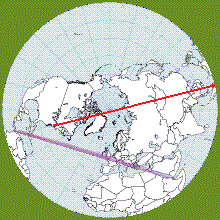
Northern hemisphere
Northern hemisphere (Singapore flight in red, Emirates in indigo)

A non-stop flight means any flight by an aircraft which does not involve any intermediate stops. The ultra long-haul non-stop flights operate a great circle route, often above polar regions. The two longest ultra long-haul flights as of July 2010 were operated between Singapore and North America.

Singapore Airlines operated the longest flight, Flight SQ 21, 15,343 km (9,534 miles, 8,285 nautical miles) between Newark Liberty International Airport and Singapore Changi Airport, and taking 18 hr 55 min (on the summer schedule in the northern hemisphere) or 18 hr 40 min (in the winter). It used an Airbus A340-500; the first flight was on 29th June 2004.

However the airline scrapped this route in 2013 as it began to move away from the four-engine aircraft needed to fly such a long distance. Australia’s Qantas currently operates the world’s longest flight (QF7 and QF8 according to the direction), from Dallas/Fort Worth International Airport to Sydney, which takes just under 17 hours. They are currently the longest regularly scheduled non-stop commercial flights in the world as measured by distance – 13,804 km, which is over one third of the distance around Earth. Both flights are operated with Airbus A380 aircraft. [Information from The Guardian.]

In February 2016, Emirates plans to start a 17 hr 35 min shuttle from Dubai to a new Central American gateway at Panama City. The daily service will operate using Boeing 777-200LR aircraft; flight EK251 Dubai to Panama City will depart at 08:05 arriving at 16:40, while the return flight EK252 Panama City to Dubai will depart at 22:10 and arrive at 22:55 (next day). The distance covered will be 13,821 km. So although Singapore Airlines no longer operates the longest route, its record remains.

And see this from The Independent.

(By the way, the Loganair flight above is also non-stop! And presumably is infra short-haul.)

Airports: Gibraltar


Gibraltar map

Gibraltar map

Gibraltar Airport is one of the most extraordinary airports around the world, with the runway crossing a main road.

I once drove along the Costa del Sol towards ‘The Rock’, and, although it was obvious from many kilometres away, there were no signposts to ‘Gibraltar’ until I reached the outskirts of La Línea de la Concepción, the border Spanish town at the top of the map. It was the Spanish way of denying Gibraltar’s foreign identity. We waited in a long queue until several people told us it would be hours before we crossed the border (so we turned back). The airport runway was one reason for the hold-up, the other was that the Spanish border guards were “working to rule”; such is international cooperation!

There’s a similar form of denial in Catalonia, where I have lived for 20 years and have yet to see a road sign to ‘Madrid’ — it’s not Catalan and Catalonia isn’t, in its local government’s opinion, part of Spain. (However in the Barcelona area there are big signs to ‘França’.) It’s equivalent to having a big signpost in Glasgow on the M 74 pointing to ‘Gretna Green’ and nothing much else.

You might also enjoy these most dangerous and strangest airports in the world: Video Part 1 and Video Part 2.

Airports: the Maldives and Nice


Maldives airport

Nice airport

The Malé International Airport (Ibrahim Nasir International Airport), on Hulhulé Island in the Maldives [left] is located on an artificial island in the middle of the Indian Ocean.

It reminds me a bit of the Aéroport Nice Côte d’Azur (Nice Airport) [right] in France, where planes take off and land over the sea.

Beware! Low-flying Aircraft


A British Airways Embraer landing, almost touching the raised arms of holidaymakers on St Maho beach

The island of Saint Martin (French) or Sint Maarten (Dutch) is in the Leeward Islands of the Caribbean Sea. It is famous for the airport on the Dutch side of the island, where the runway starts right by the beach.


Map of the beach and the end of the runway (the darker grey on the right side of the map)

Arriving aircraft must touch down as close as possible to the beginning of the runway due to its short length of 2,300 metres, resulting in aircraft on their final approach flying over the beach at minimal altitude.

There is a danger of people standing on the beach being blown into the water because of the jet blast from aircraft taking off. The local government warns that closely approaching and departing aircraft can “result in serious injury and/or death”. An additional fence has been added recently behind the runway, to prevent people from hanging onto the main fence surrounding the runway to experience being blasted by the jet flow.

The beach itself is white sand and has little or no vegetation because of jet blast erosion.

Balloons in Cappadocia


Ballooning in Turkey

[Left] Cappadocia (a Roman province, from Turkish Kapadokya, Greek Kappadokía, Armenian Kapadovkia, Persian Kāpādōkiyeh) is a historical region in Central Anatolia, largely in Nevşehir Province.

In the time of Herodotus (5th century BCE), the Cappadocians were reported as occupying the whole region from Mount Taurus to the vicinity of the Euxine (Black Sea).

Cappadocia, in this sense, was bounded in the south by the chain of the Taurus Mountains that separate it from Cilicia, to the east by the upper Euphrates and the Armenian Highland, to the north by Pontus, and to the west by Lycaonia and eastern Galatia.

The name was traditionally used in Christian sources throughout history and is still widely used as an international tourism concept to define a region of exceptional natural wonders, in particular characterized by fairy chimneys and a unique historical and cultural heritage.


Burmese Ballooning

The term, as used in tourism, roughly corresponds to present-day Nevşehir Province.

Asian Aviation

[Right] Hot air balloons provide a view of the temples as they hover over Bagan in Myanmar.

World’s Worst Air Disaster:
Pan Am 1736 and KLM 4805, Tenerife, 1977

Tenerife is one of the Spanish Canary Islands a few hundred miles off the coast of Morocco. The big town on Tenerife is Santa Cruz, and its airport, beneath a set of cascading hillsides, is called Los Rodeos. There, on 27th March 1977, two Boeing 747s, one belonging to KLM, the other to Pan Am, collided on a foggy runway. 583 people were killed in what remains the biggest air disaster in history.

Setting the Scene

Both of the 747s at Tenerife were charters. Pan Am 1736 came from Los Angeles, after a stopover in New York, KLM 4805 from its home base in Amsterdam. As it happens, neither plane was supposed to be on Tenerife. They were scheduled to land at Las Palmas, on the nearby island of Gran Canaria, where many of the passengers were on their way to meet cruise ships. After a bomb planted by Canary Island separatists exploded in the Las Palmas airport flower shop, they were diverted to Los Rodeos, along with several other flights, arriving around 2 pm. The normally lazy Los Rodeos was packed with diversions. The two 747s were adjacent to each other at the southeast corner of the apron, their wingtips almost touching. Finally at around four o’clock, Las Palmas began accepting traffic again. The Pan Am was quickly ready for departure, but the lack of room and the angle at which the jets faced each other required the KLM to begin to taxi first.

Pan Am logo
KLM logo

Pan American World Airways
Koninklijke Luchtvaart Maatschappij N.V. (Royal Dutch Airlines)

The weather was fine until just before the accident, and if the KLM had not requested extra fuel at the last minute, both would have been on their way sooner. During the delay, a heavy blanket of fog swept down from the hills and enveloped the airport. That fuel also meant extra weight, affecting how quickly the 747 was able to become airborne. That was critical.

Because of the tarmac congestion, the normal route to runway 30 was blocked. Departing planes needed to taxi down on the runway itself. Reaching the end, they made a 180° turn before taking off in the opposite direction. This procedure, rare at commercial airports, is called a “back-taxi”. At Tenerife in 1977, it put two 747s on the same runway at the same time, invisible not only to each other, but to the control tower as well. The airport had no ground tracking radar.

Plan of Los Rodeos airport

Plan of Los Rodeos airport, Tenerife

KLM and Pan Am Aircraft Taxi and KLM Begins its Take-off

The KLM captain was Jacob Van Zanten, the airline’s top 747 instructor pilot and a KLM celebrity. The KLM flight taxied ahead and onto the runway, with the Pan Am ambling several hundred yards behind. Captain Van Zanten steered to the end, turned round, then held in position until authorized for takeoff. Pan Am’s instructions were to turn clear along a left-side taxiway to allow the other plane to depart. Once safely off the runway, they would report so to the tower. Unable to differentiate the taxiways in the low visibility, the Pan Am pilots missed their assigned turnoff. Continuing to the next one was no big problem, but now they were on the runway for several additional seconds.


Plan showing congestion before take-off

At the same time, having wheeled into position at the end, Van Zanten came to a stop. His first officer, Klaas Meurs, took the radio and received the ATC route clearance. This is not a takeoff clearance, but rather a procedure outlining turns, altitudes, and frequencies for use once airborne. Normally it is received well before an aircraft takes the runway, but the pilots had been too busy with checklists and taxi instructions until then. They were tired, annoyed, and anxious to get going. The irritability in the pilots’ voices, Van Zanten’s in particular, had been duly noted by the control tower and other pilots.

Mistaken Instructions and Heterodynes

There were still a couple of dominos yet to fall, but now the final act was in motion – literally. Because the route clearance came where and when it did, it was mistaken for a takeoff clearance as well. First officer Meurs, sitting to Van Zanten’s right, acknowledged the altitudes, headings and fixes, then finished off with an unusual, somewhat hesitant phrase, backdropped by the sound of accelerating engines. “We are now, uh, at takeoff”. Van Zanten released the brakes. “We gaan” he was heard saying on the cockpit voice recorder. “Let’s go”. And with that, his mammoth machine began trundling down the fog-shrouded runway, completely without permission. “At takeoff” is not standard phraseology among pilots. But it was explicit enough to grab the attention of the Pan Am crew and the control tower. It was hard for either party to believe the KLM was actually moving, but both reached for their microphones to make sure. “And we’re still taxiing down the runway” relayed Bob Bragg, the Pan Am first officer.

At the same instant, the tower radioed a message to KLM. “Okay” said the controller. “Standby for takeoff. I will call you”. There was no reply. This silence was taken as a tacit, if not exactly proper, acknowledgment. Either of these transmissions would be, should have been, enough to stop Van Zanten cold in his tracks. He still had time to discontinue the roll. The problem was, because they occurred simultaneously, they overlapped.

Pilots and controllers communicate via two-way VHF radios. The process is similar to speaking over a walkie-talkie: a person activates a microphone, speaks, then releases the button and waits for an acknowledgment. It differs from using a telephone, for example, as only one party can speak at a time, and has no idea what his message actually sounds like over the air. If two or more microphones are clicked at the same instant, the transmissions cancel each other out, delivering a noisy occlusion of static or a high-pitched squeal called a heterodyne. Rarely are heterodynes dangerous. But at Tenerife this was the last straw.

Van Zanten heard only the word “Okay” followed by a five-second squeal. He kept going. Ten seconds later there was one final exchange, clearly and maddeningly audible on the post-crash tapes. “Report when runway clear”, the tower said to Pan Am. “We’ll report when we’re clear” acknowledged Bob Bragg. Focused on the takeoff, Van Zanten and his first officer apparently missed this. But the second officer, sitting behind them, did not. Alarmed, with their plane now racing forward at a hundred knots, he leant forward. “Is he not clear?” he asked. “That Pan American?” “Oh, yes” Van Zanten answered emphatically.


Artist’s impression of the impact

In the Pan Am cockpit, nose-to-nose with the still unseen, rapidly approaching interloper, there was a growing sense that something wasn’t right. “Let’s get the fuck out of here” Captain Victor Grubbs said nervously. A few moments later, the lights of the KLM 747 emerged out of the greyness, dead ahead, 2,000 feet away and closing fast. “There he is!” cried Grubbs, shoving the thrust levers to full power. “Look at him! Goddam, that son of a bitch is coming!” He yanked the plane’s steering tiller, turning left as hard as he could, toward the grass at the edge of the runway. “Get off! Get off! Get off!” shouted Bob Bragg.

A Laden 747 Can’t Do Leapfrogs

Van Zanten saw them, but too late. Attempting to leapfrog, he pulled back on the elevators, dragging his tail along the tarmac for 70 feet in a hail of sparks. He almost made it, but just as his plane broke ground, its undercarriage and engines sliced into the ceiling of the Pan Am plane, instantly demolishing its midsection and setting off a series of explosions. Badly damaged, the KLM settled back to the runway, skidded hard on its belly for another thousand feet, and was consumed by fire before a single one of its 248 occupants could escape.


Plan of the debris

Remarkably, of 396 passengers and crew aboard the Pan Am jumbo, 61 of them survived, including all five people in the cockpit – the three-man crew and two off-duty employees riding in the jumpseats. Once on the ground, the survivors of the Pan Am plane faced a deafening roar. The plane had pancaked into the grass, but because the cockpit control lines were severed, the engines were still running at full power. It took several moments before the motors began coming apart. One of the engines’ huge forward turbofans detached from its shaft, falling forward onto the ground with a thud. The fuselage was engulfed by fire. A number of passengers, most of them seated in forward portions of the cabin, had made it onto the craft’s left wing, and were standing at the leading edge, about 20 feet off the ground. Bragg ran over, encouraging them to jump. A few minutes later, the plane’s centre fuel tank exploded, propelling a plume of flames and smoke a thousand feet into the sky.


Photo of burning remains

The airport’s ill-equipped rescue team, meanwhile, was over at the KLM site, the first wreckage they’d come to after learning there’d been a crash. They hadn’t yet realized that two planes were involved, one of them with survivors. Eventually, authorities opened the airport perimeter gates, urging anybody with a vehicle to drive toward the crash scene to help. Bob Bragg tells the cracked story of standing there in fog, surrounded by stunned and bleeding survivors, watching his plane burn, when suddenly a taxicab pulled up out of nowhere.

The new Tenerife South airport, opened in 1978, is now used for most international flights.