
Loading...
Loading...
This page has sections on:
This page deals with the London Omnibus, from the early Horse Bus up to the present day “New London Bus”. I have given fairly detailed accounts of the London General Omnibus Company and the associated Thomas Tilling company. You’ll also find a detailed list of most of the bus types operated, from the X, B, K, S, NS, C, CR, Q, LT, ST, STL, TF, RF and GS classes, and a bit about the “Bendy Buses”. There’s the RT family — London Transport’s standard post-war bus — and the follow-on Routemaster buses and coaches. Details of each bus and coach type are to be found in the books and web sites noted, and my lists of recommended Books and Web Sites. This page does not describe individual bus types in detail. Some of them, which I happen to find quite interesting, are on other pages of this site or other sites I’ve linked to.
If you search, you’ll find a rather interesting picture of Buses in Piccadilly Circus in 1949 before they moved Eros. I have included sections on London Transport Route Numbering and British Road Numbering. There’s also a real-time map of where each London bus is and a section on London Bus and Coach Garages.
See also my pages devoted to the Green Line, Trams and Trolleybuses, Railways in Britain, the London Underground, Foreign Railways and Railway Disasters, another on Aircraft and Airports, one on transport problems, another on my London Transport diorama of model buses, etc., and finally a bit of frivolity with some silliness.
The first records of a vehicle resembling a bus date to the middle of the seventeenth century when Blaise Pascal, a French inventor, came up with the idea of providing facilities for public travel within Paris. His idea was taken up and subsequently financed by the Governor of Poitou, the Duc de Ronanes, who authorised the construction of seven ‘carriages’ capable of carrying eight passengers each. After an elaborate opening ceremony the first of the ‘Carosses a Cinq Sous’, as the carriages were called, began work on the 18th March 1662, charging a small fare. Initially they became extremely popular but, since people were riding for amusement only, after a few weeks their popularity waned and the carriages soon faded into oblivion.
It is often quoted that the first successful bus operation was introduced by Jacques Lafitte, a banker, in 1819; however, this is disputed by current research. This ‘fact’ would appear to come from an interview with an aging Mr Shillibeer sometime in the latter part of the century, and was printed in the Omnibus and Cabs book dating from the 1880s. Shillibeer says that Lafitte started running omnibus coaches in Paris in 1819 and that he produced some of the coaches before he returned to London in 1829. However, there is no proof that there were any omnibus routes running at all inside the city of Paris at this time. French sources state that during the period 1819 — 1827 several applications seeking to establish such routes inside the city were turned down because of worries that the large coaches would block the narrow streets. In addition, there is no mention of Jacques Lafitte as a concessionaire of transport firms at all. He was a banker; but his brother, Jean Lafitte, was one of the co-owners of the firm Messageries Générale de France, Lafitte & Caillard which, during the 1820s, built up a large stagecoach network in northern France (including many routes from Paris). It is probable that Shillibeer really meant that he built some of the stagecoaches for this firm. It is doubtful that ‘in Paris’ meant local routes inside the city. Short stagecoach routes, using vehicles very much like a horsebus (Gondoles, Accélérées) had been running from Paris to the surrounding areas from the beginning of the 19th century, and vehicles of this type were also used in Nantes. (The Pendleton — Manchester route was running in 1824 and the ‘Caledonian Basket’ an omnibus-like vehicle was also running in Glasgow in the mid-1820s).
When Stanislas Baudry opened a steam flour mill in Richebourg, outside Nantes, in 1823, he came up with the idea of using the surplus heat for a public bath. Consequently he introduced a vehicle (of ‘normal’ appearance) from Nantes Central Square to Richebourg for bathing guests (there was already another running to a factory in Salorges for the workers).
The service started on the Place du Commerce, outside the hat shop of a M. Omnès, who displayed the motto Omnès Omnibus (Latin for “everything for everybody” or “all for all”) on his shop front. When Baudry discovered that passengers were just as interested in getting off at intermediate points as in patronizing his baths, he changed the route’s focus. As a result, in August 1826, he abandoned the public bath and started running two 16-seat covered vehicles on a route from Salorges to Richebourg via Nantes, purely as a transport service. His new voiture omnibus (“carriage for all” — presumably inspired by M. Omnès’ slogan) combined the functions of the hired hackney carriage with a stagecoach that travelled a predetermined route from inn to inn, carrying passengers and mail. His omnibus featured wooden benches that ran down the sides of the vehicle; passengers entered from the rear.
In 1827 competition arrived, in the form of ‘Dame Blanche’ (White Lady), another company running inside Nantes. In the same year Baudry commenced omnibus operations in Bordeaux, and it seems likely that he must have been one of those refused Parisian applications during this time. In January 1828, however, the Paris authorities had a change of heart and accepted Baudry’s (with associates) new application for running 100 ‘Omnibuses’ on 18 routes inside Paris. 10 routes were opened in April 1828, the first omnibuses to run in the French capital. The ‘Dame Blanche’ entrepreneur — Edmée Fouquet — in Nantes followed suit and in May 1828 (also with associates) obtained permission to start running in Paris as well. Their first route commenced in August 1828 and over the next few years, many more companies followed. The vehicles that Baudry and Fouquet first used in Paris were three-horse (note Shillibeer’s model) coaches with three compartments (normal at that time, all large stagecoaches in France had ‘coupé’ at the front, ‘berline’ in the middle and ‘rotonde’ at the back) with different classes. In August 1828 it is noted that the first omnibus vehicles with just one class and one compartment with longitudinal seats and rear entrance appeared in Paris, and in 1830, the three-horse coaches were changed for a more economical two-horse version.
In the USA, the first vehicle called an ‘omnibus’ was introduced in New York in 1830, probably as an import of London and Paris influence. However, by 1816, short stagecoaches were already running locally in Manhattan, between New York and Harlem, and in 1827 Adam Brower started a purely local route on Broadway using his vehicle called ‘Accommodation’. Note that this is before anything like this ran inside any of the big European cities.
Back in England — the name ‘Omnibus’ was certainly familiar to George Shillibeer. He had returned from France and set up in Bury Street, Bloomsbury, where he built two 22-seat three-horse coaches. Staffed by ex-naval men they began to work from the ‘Yorkshire Stingo’ on Marylebone Street to the Bank of England, travelling via Kings Cross, on 4th July 1829. The fleetname used by Shillibeer was Omnibus and it was London’s first true omnibus service. The fare charged (one shilling) was almost a third of that charged by the stage coaches and within a few months the service was well established and successful.
Although Shillibeer established the first omnibus service in London, it was probably not the first in the country. John Greenwood is said to have commenced a daily service between Salford and Manchester on 1st January 1824 (although there are no contemporary records that confirm the actual date, there is sufficient evidence to suggest this may be correct), the first instance of a regular omnibus service in Britain. Greenwood had been the keeper of the tollgates on the turnpike road between Manchester and Bolton at a time when the new ‘middle-classes’ were beginning to reside in the suburbs and had seen the need for some sort of regular local service to connect the two areas. He purchased a vehicle and experimented by putting it into service between Pendleton (in Salford) and Manchester city centre, running several times daily. The experiment proved a success and within a short time he was running services throughout the surrounding districts.
The difference between Greenwood’s vehicle and Shillibeer’s vehicle was notable. Greenwood’s ‘omnibus’ was described in contemporary records as “...little more than a box on wheels...” whereas Shillibeer’s omnibus was “...a handsome machine, in the shape of a van with windows on each side, and one at the end...”
Meanwhile, Shillibeer’s success in London, where his weekly takings were in excess of £100, had prompted others to enter the business. Many adopted the name ‘Shillibeer’ as a description of their service and for a while it seemed that this name would pass into the English language in preference to the name ‘omnibus’, but circumstances dictated otherwise. In 1832, Shillibeer entered into a partnership with William Morton, which lasted only until 1834, Morton taking with him the buses on the original route when the partnership broke up. Shillibeer decided on a fresh start and opened up a new route between London and Greenwich with 20 buses. However, in 1836, the opening of the London and Greenwich Railway decimated his business and he was unable to recover. He subsequently set up as an undertaker in City Road and became so well known that the use of ‘shillibeer’ was swiftly dropped and replaced with ‘omnibus’, which has endured to this day, albeit shortened to bus (or sometimes by the really pedantic to ’bus).
The first recorded use of the word ‘omnibus’ as a designation of a vehicle occurred in a printed memorandum dated 3rd April 1829. Written by George Shillibeer (1797 — 1866) to John Thornton, the Chairman of the Board of Stamps (from whom a licence to operate in London was required), it announced that Shillibeer was engaged “...in building two vehicles after the manner of the recently established French omnibus...”.
Shillibeer’s service, between Paddington Green and the Bank, commenced on 4th July 1829 and introduced a new type of vehicle to the roads of Britain. This date is generally regarded as the start of omnibus history in Great Britain.
The carriage of passengers for short distances was not new; several short-stage carriages (which ran from point to point) had operated in London for many years. What was new, and which constituted an omnibus service, was that it plied for hire along the route, picking up and setting down passengers in the street. This removed the need to book in advance, as had been the practice with stagecoaches, or wait for long periods at various boarding points. The venture was an immediate success and although the legality of it was challenged, the Stage Carriage Act of 1832 permitted the practice.
Shillibeer’s first vehicles were box-like structures pulled by three horses abreast, with a rear entrance on which the conductor stood. Seating was on longitudinal benches with passengers facing each other. Later vehicles, including those of other operators, were generally smaller, pulled by just two horses.
For a number of years, the omnibus remained a single-deck vehicle, the process of accommodating passengers outside being gradual. Initially seats for two or three extra passengers were provided alongside the driver, but later a second row of seats was arranged behind the driver. By 1845, the curved roofs of many of the newer vehicles provided additional accommodation for male passengers, who sat back to back.
In 1847, Adams & Co., of Fairfield Works, Bow, produced a vehicle with a clerestory roof and a built-in longitudinal seat, which was put into service by the Economic Conveyance Company of London. To encourage use of the extra seating, the cost of travelling outside was made half that of travelling inside. Proprietors, however, did not initially favour this type of vehicle, as it was more costly and heavier than existing types and it was more than ten years before the design gained popularity.
In 1851, London staged the Great Exhibition and horse bus proprietors were not slow in catering for the massive influx of visitors by bolting a simple plank longitudinally along the curved roofs of their vehicles. This was the first ‘knifeboard’ seating, a term (first used in Punch of 15th May 1862) that continued to be used to describe back-to-back seating well into the next century. Following the end of the Great Exhibition the decline in profitable traffic caused a minor slump in the bus trade with fares being reduced. The lack of trade meant that improvements in the design of the horse bus suffered as a result, and the horse bus in London evolved little over the next few years.
In Manchester, however, Greenwood’s initial service had caused a great number of others to follow him into the omnibus business. By 1850 there were over 60 other horse buses working on the routes into the city. As in London, they were small single-deck vehicles with seating for around 12 passengers, but in 1852 John Greenwood introduced a much larger vehicle. It was a three-horse double-deck vehicle accommodating 42 passengers. An unusual feature for the period was the provision of brakes on the wheels, applied by a treadle on the driver’s footboard. Up until this time the only retarder was the skid, applied by hand on steep gradients. Another novelty introduced was the use of a bell situated under the driver’s seat, by which the conductor at the rear of the vehicle communicated with the driver.
In 1855, the Compagnie Générale des Omnibus de Londres (London General Omnibus Company) was incorporated in Paris with the intention of purchasing as many of the small independent operators of London horse buses as possible. Eventually around 75% of the total horse buses operating in London was acquired, and the company set about reorganizing the services. At the same time it held a competition for the design of a new omnibus that would afford “...increased space, accommodation and comfort to the public...” Although a great many designs were submitted, the Company felt that there was not one overall design that they could recommend for adoption in its entirety but suggested that “...a light, commodious and well-ventilated omnibus...” could be produced by combining the best of the designs.The new buses produced were generally of the pattern submitted by R. F. Miller, of Hammersmith, with back-to-back knifeboard seating for 10 plus 2 on either side of the driver, making a total top-deck accommodation of 14. The inside seating was for 12, a grand total of 26 seats, which became the seating standard for the double-deck horse-drawn bus to the end. This type of bus was generally unchanged until the 1880s, although the design became more curved than rectangular as time passed.
Covered top-decks on horse-drawn double-deck vehicles were never used in Great Britain, although experiments were made. In France, however, a double-deck horse-drawn bus with coach-built top cover was introduced at Le Havre in 1858, but its principle drawback was its great weight, which put an undue strain on the horses. The idea does not appear to have been copied in Britain.
In 1860, trams were introduced to Britain as an experiment and by 1870 were a feature of urban transport, but did not have an immediate effect on horse-drawn transport.
In 1863 the City of London Regulation Act vested powers to regulate the routes of buses and to restrict the use of large vehicles to the City authorities, but was replaced on 20th August 1867 by the Metropolitan Streets Act. The new Act required buses to stop on the nearside of the road, whereas previously they had pulled over to the side on which passengers wished to alight. This had an effect on later designs of horse buses, requiring only access and a platform on the nearside.
The newly formed London Road Car Co. Ltd., introduced a novel design in 1881, when a number of horse-drawn vehicles with front entrance and staircase immediately behind the driver were built. Later in the year the company introduced similar vehicles with flat roofs and garden seats, which had been in use on the continent for some 30 years. Until this time it was unusual for women to ride on the top-deck because of access difficulties, but with the introduction of the staircase instead of the ladder, along with garden seating, ladies began to avail themselves of the facility. By 1890 the older knifeboard seating was gradually replaced by garden seating on vehicles that still had a useful life.
By the turn of the century, the number of London horse-buses peaked at 3736. Most were two-horse vehicles, although the large red ‘Favourites’ with 48-seats ran in the morning from Highgate and Islington into the City, but were excluded after 10 am because of their size. Express journeys with four-horse teams pulling ordinary garden-seat buses ran from some of the suburban points into the City, the last such bus, operated by Thomas Tilling, ran on 16th March 1912 from the foot of Balham Hill to Gracechurch Street. The last LGOC horse-buses had already run on 22nd December 1907 and by 4th August 1914, when Thomas Tilling ceased to run on the Peckham Rye to Honor Oak route, the horse bus had disappeared from the streets of London. By this time the tram and the train were serving most parts of the country, offering cheap workman’s and return fares, which were not available on the horse bus.
Outside London, however, the horse bus continued to run, particularly in rural areas. What is generally regarded as the last urban horse bus service in the country was that of Howe & Co., between Newcastle-upon-Tyne and Gateshead, which made its final run on Saturday 13th June 1931, marking the end of the horse bus as a means of urban transport. However, the last regular horse bus service in Great Britain continued to run between Wickhambrook and Newmarket, in Suffolk, on market days only, until 1932. The horse bus had been, in general, the transport of the middle classes and did not derive much revenue from the poorer classes, who walked to work until the advent of the cheaper fares on the trams and trains of the late 1800s. The splendid colours of some of the vehicles can be attributed to the fact that literacy, even amongst the middle classes, could not be assumed, so passengers identified their bus, not by the wording it bore, but by the colour and appearance. When vehicles altered routes, it was usually necessary to repaint them and alter their appearance. In general there were no destination boards, and no indication of the direction of travel, except the wording on the side panel, which was usually a description of the area served.
The London General Omnibus Company (LGOC) was formed on 1st January 1859. It replaced a joint Anglo-French company called the Compagnie Générale des Omnibus de Londres, founded in 1855. This began operating horse bus services in London in 1856. By the end of that year it was the largest bus operator in the capital, owning 600 buses — 75% of the total.
The LGOC, under the fleet name General, remained the principal bus company in London throughout the 19th century.
The opening of the Central London Railway (now the Central line) in 1900 and the electrification of many tramlines meant that the LGOC had to compete for passengers. It started to experiment with a new technology, motorbuses. It ordered 50 motorbus chassis from Sidney Straker & Squire Limited and another 54 from De Dion-Bouton in 1905. Accidents were frequent, since the buses were unreliable and the drivers had little training.
Horse buses had been painted a variety of colours for different routes. From 1907 all LGOC motorbuses were painted red and numbers differentiated routes. The Metropolitan Police also insisted that every bus display route and destination boards clearly front and back.
The B-type was the first successful bus to be manufactured by the LGOC. The first 60, made in 1910, quickly proved themselves better and more reliable than any other contemporary London bus. By 1913 2,500 had been produced. The secret of their success was their standardisation: the fact that they were built of interchangeable parts. This new bus heralded the end of the horse buses. The last LGOC horse bus ran on 25 October 1911.
The Underground Electric Railways of London Limited (UERL) took control of the LGOC from 1912, although it survived as a separate company. The UERL ran all the Underground lines apart from the Metropolitan Railway. This led to increased transport coordination between Underground and buses.
By 1913 the LGOC had become one of two major bus companies in London. It had bought up all its rivals including the London Road Car Company, the Vanguard Motor Bus Company, the Great Eastern Motor Omnibus Company and the New Central Motor Omnibus Company. The only other bus company that was nominally independent was Tilling’s. By 1914, LGOC buses were carrying 756 million passengers a year.
During the war, the War Office requisitioned many of the LGOC’s vehicles. Over a third of the fleet, 1,319 buses, were sent overseas to the battlefront, where LGOC volunteer drivers drove them. Over 10,000 members of staff joined the Armed Forces. From 1916, women were employed for the first time, as conductors, clerks and cleaners. Over 4,600 women worked for the LGOC, keeping London’s buses running in wartime. They were dismissed at the end of the war, since the jobs had been kept open for the returning soldiers.
Shortly after the end of the war, the LGOC introduced new K- and S-type buses. Both of these had a larger seating capacity than the previous models. The S-type was the first British bus to be built on a production line. In the early 1920s, independent operators or ‘pirate’ buses started to work on some of the LGOC’s busiest and most profitable routes. However the London and Home Counties Traffic Act of 1924 helped regulate the bus industry, protecting the LGOC from competition by limiting the number of buses allowed on each route.
In the 1920s the LGOC started operating further afield to countryside and towns around London. These subsidiaries were called the East Surrey Traction Co. from 1929 (renamed London General Country Services Ltd in 1932). Green Line Coaches formed in 1930. In 1933 the LGOC, together with the rest of the U.E.R.L, became part of the London Passenger Transport Board, under which the same company ran all transport in London.
Craftsmen at work on an STL at Chiswick Works
In 1921, the company opened its Central Overhaul Works at Chiswick. Bus overhaul time was drastically reduced, increasing the numbers of buses on the road at any one time.
Tilt testing on STL 34; notice how the body tilts more than the chassis
If you are interested in British Roads (their numbering schemes), Major roads (including exit diagrams) and lots more, this web-site should answer at least some of your questions. It also has a section about Spanish roads and their quirks.
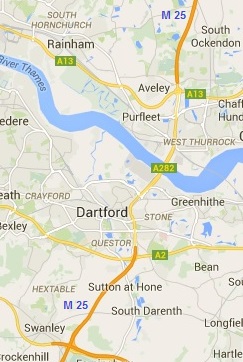
Roger and Philip Tagg’s A-Roads Index also gives the routes of all A roads, though I can’t vouch for its accuracy — the A282 is not what they say it is! (The M25 has a gap, the A282, Dartford Crossing, between its exits for the A13 in Essex and the A2 in Kent; I guess they reused an obsolete number.)
Wikipedia has an interesting section on the proposed London Ringways. And many of the road problems are detailed in the Society for All British Road Enthusiasts web site.
This list concentrates on the General and London Transport companies, including London Buses; others are only considered when they were brought into their fleets. Dates shown are from new to withdrawal from London service. Many went to other users or became service vehicles (breakdown lorries, tree-loppers, etc) in London or elsewhere. Some are preserved and are still running or are in museums. This list starts with the X-type, built a year after the General, Vanguard and Road Car bus fleets were amalgamated. For further information about most of these buses and coaches see Buses of London by Colin H Curtis and, for earlier times London General Buses by D E Brewster.
General first introduced a numbering system for its buses (other than the registration number) in 1906. Each make of buses received a block of numbers: 101– were Straker-Bussings, 201– were de Dion Boutons, etc. 01–19 were early experimental buses. This system worked until various mergers overloaded it. So it was replaced by a new system with letters and numbers; the first series was as follows (an asterisk [*] indicates that the exact number is not known):
[Note: The abbreviation “LT” from here refers to the London Transport company, not to the LT-type bus]
[The problem with London buses after the RM family is that so many experimental groups of buses came along that the whole network seemed to lack any real identity. But if the proliferation of all letters of the alphabet is to your liking, here are a couple of fairly recent scenes from the city centre]
[Note: The abbreviation “LC” from here refers to the London Country company and its components, not to the LC-type bus; similarly “LB” refers to London Buses and its successors]
[Note: in 1986 LC was split into four component companies, covering the NE, NW, SW and SE areas; these were further split from 1989 and privatized; some of the resulting fragmented companies were able to bid for routes in the Central area, alongside the fragmented components of London Buses, the service provider in central London. As a result, the ownership of many buses changed and individual buses were renumbered extensively; later many of the smaller companies were taken into ownership by large national companies (like Arriva and the First group). See Ian’s Bus Stop for the most extensive coverage.]
[During the period from 1989 to the present, the organization of bus services in and around London has become more and more confusing for all but the most ardent follower; with only a small anorak, I can only do my best to unravel any of it. Outside London, bus services were deregulated and became simply a commercial operation by whatever companies obtained the necessary licences; in some cases well-meaning local authorities (County Councils in the main) subsidized loss-making services, especially evening and late-night journeys and Sunday services. In London, control eventually ended in the hands of the Mayor, whose department Transport for London (TfL) tendered out tranches of routes, usually for five years. Naturally, with most services provided by commercial companies, there was a lot of swapping around of buses between London and regional operations; this has made the task of recording which buses are being used in London much more complicated. One thing which has remained constant is the edict that at least 80% of the bodywork (excluding the roof which may be white) must be in the familiar red colour; and all buses must carry the official roundel to identify them as being part of the TfL organisation. Exceptions are made for buses with all-over advertising.]
New ‘Routemaster’ bus for London (or the Boris Bus, after the dishevelled former Mayor of London; at least it’s got a smoother top than he has!)
The original ides of this bus was to allow people to ‘hop on’ or ‘hop off’, for example at traffic lights. That has meant that the policy of one-person operation has had to be abandoned, with a second crew member checking that it’s safe to get on or off the bus and also that the passenger boarding has ‘swiped in’ with their Oyster card.
They are very expensive to build (each bus costing £355,000) and to operate (£62,000 a year per bus for a conductor). Boris’s vanity project!
Here are three reports on the disaster these buses are:
Boris buses risk causing fatal accidents
The single object that sums up Boris Johnson’s disastrous mayoralty
Boris bus manufacturers [Wrightbus] try to block critical new book
In summary:
See
Central Bus Garages
and
Country Bus Garages .
London’s oldest bus company was started as family business by Thomas Tilling in 1846, and continued by his sons and grandsons. In the first half of the 20th century, it grew into one of the two most important national transport groups, and had interests in all the other major bus operating companies.
Thomas Tilling was born in 1825 at Gutter’s Hedge Farm, Hendon, Middlesex. In 1846, he set up as a ‘jobmaster’ in Walworth with one horse and carriage. This was the Victorian equivalent of ‘a man with a van’. He was 21 years old. By 1850, Tilling operated buses between Rye Lane, Peckham and the north side of Oxford Circus. He was one operating company of many.
Tilling decided his buses should stop at predetermined points and run to a fixed timetable, making them more punctual and orderly than the other operators’ buses. This was one of the reasons for his success with customers. Because his buses operated on time, they earned the nickname of “Times” buses, and this became the fleet name painted on the side. Before long, Tilling became the biggest supplier of horsepower and vehicles in London.
Thomas Tilling died in 1893 and was buried at Nunhead cemetery. His two sons, Richard and Edward, continued the family business. In 1897, the family business was incorporated into a public company, Thomas Tilling Limited.
The company began the switch to motorbuses in 1904. It chose 24-horsepower Milnes-Daimler buses, which remained the motorbus standard for many years. The 34-seaters were the first double-decker motorbuses built for public service in London.
Tilling increased its number of motorbuses to 20 in 1905. By this time, motorbuses were a booming industry and shareholders diverted their investments from horses into motorbuses. Despite this, the company owned 7,000 horses based in 500 different stables. Half of these horses worked with the 250 Tilling horse buses; the rest were hired out to private individuals or companies for use with cabs and goods vehicles. These diverse concerns helped the company continue when motorbuses took over, since people still needed horse transport.
In 1907, Tilling began the first long-distance motorbus service, running 13 buses between Oxford Circus and Sidcup in Kent. Tilling remained independent from the London General Omnibus Company (LGOC), which led an amalgamation of most of the other London bus companies. A pooling agreement with the LGOC in 1909 protected Tilling’s position but restricted the company’s operations to south London. The LGOC and Tilling did join forces to operate a combined route from Peckham to Turnham Green via Oxford Circus. The LGOC had introduced numbers on all its routes, and this was route number 12. This service between Peckham and Oxford Circus still operates and is still called the number 12. It may be the oldest operating bus route in London.
In 1914, just before the outbreak of the First World War, the last horse bus operated on the Tilling Honor Oak — Peckham Rye Station route. The government wanted the horses for war service. From then on, because of the dominance of the LGOC, Tilling started to seek new markets in the provinces. The company began operating in Folkestone in 1914, Brighton in 1916, and Ipswich in 1919. In 1915, the first woman bus conductor in London worked on Tilling route No 37. Women were recruited to replace men who had joined the Armed Forces.
During the 1920s, various agreements were made with the LGOC concerning how to share the operation of London’s bus services. In 1928, Tilling and the British Automobile Traction Company created TBAT for the purpose of buying shares in other omnibus companies of significant size all over Britain.
In 1933, the new London Passenger Transport Board compulsorily acquired the 328 buses that made up Tilling’s south London services. However the TBAT operations expand all over Britain.
Thomas Tilling Limited became state-owned in 1948 when the British Transport Commission bought the company. The resulting services, which ran nationwide, became the National Bus Company in 1969 and, after 122 years as a major transport company, the Tilling name was lost. From 1973, the National Bus Company’s name changed again to the National Express Company.
W A Stevens was established in Maidstone, Kent in 1897 and had by 1906 built its first petrol-electric vehicle using designs patented by Percival (Percy) Frost-Smith. A petrol engine was connected to an electrical generator and the current produced passed to a traction motor which drove the rear wheels. According to the website of the Birmingham and Midland Motor Omnibus Trust the simpler-to-operate petrol-electric transmission was popular among bus drivers rather than the conventional crash gearbox (in the days before synchromesh) as few bus staff had previously driven motor vehicles.
Tilling-Stevens’ factory was situated in St Peter’s St, Maidstone. The factory buildings, built in the 1920s in the Daylight style, survive as of 2012; they were Listed as Grade II in July 2011. It is described as one few buildings of this style not to have undergone significant alteration from the original.
In 1911 the prototype TTA1 petrol-electric bus was launched; it used a four-cylinder engine. In 1913 the company introduced a 40 horse-power version, the TTA2.
The petrol-electric transmission was fitted to chassis built by J E Hall and Co, of Dartford, (who used the trade name “Hallford”, so these were known as “Hallford-Stevens”) and Dennis Bros, of Guildford (as “Dennis-Stevens”), until an arrangement was agreed with a large bus operator, Thomas Tilling, who wanted to produce their own vehicles which were named “Tilling-Stevens”. The ease of driving and soundness of construction of these vehicles soon led to the company supplying chassis to many bus operators in the UK, and several abroad as well.
See Ian’s Bus Stop, Tilling “O”-class for details of the O-class Tilling-Stevens Petrol-Electric Buses operated by Tilling in conjunction with the LGOC (and the LPTB) during the period 1923 to 1934.
London has had three main phases of route numbering, of which the third allocated the 200-series numbers to single-deck routes in 1934. If you are curious about route numbering, read on...
Route numbers are such an obvious and integral part of the bus scene that it is hard to imagine a network without them. Yet London’s extensive horse bus network in the 19th Century used colour-coded liveries to distinguish routes, and numbering only arrived after motor-buses, in 1906.
RF 525 passes Totteridge Station on 3rd January 1977, in the last month of RF operation of the 251 across quieter parts of north London. Note the blind display with its nearside number, suggesting that new blinds had been produced for the BLs that were to enter service later in the month. This was also the bus’s last month with London Transport, being sold to Meopham School in February.
It was Vanguard, a competitor to the London General Omnibus Company (LGOC or the “General”), that introduced numbers to its routes in April of that year, to enable motor buses to be used on more than one route. There were 12 routes by the time Vanguard merged with the General in 1908; several of today’s routes have a direct lineage from those original Vanguard numbers, including route 2.
The network expanded dramatically and there were over 100 routes by 1914. The first use of a letter suffix was on the 35A in 1912, indicating an offshoot to a different destination. Much use was made of letter suffixes throughout the 20th century — the last was the 77A that was renumbered 87 on 6th June 2006. Suffixes were to achieve a particular importance in 1924.
Bus destination and route displays were controlled by Metropolitan Police regulations from 1910. In 1924, the London Traffic Act was introduced, primarily to control the independent ‘pirate’ operators, but also imposed a numbering scheme on London’s buses. In what became known as the Bassom Scheme, after the acting chief constable of the Metropolitan Police, the full length of a route was allocated the main number, whilst short workings used letter suffixes and variations were given related numbers (so 153 was a variant of the 53).
This scheme led to some bizarre consequences. The famous route 11 from Shepherds Bush to Liverpool Street ran (up to every 1¾ minutes) for nearly 10 years as the 11E, after the route was extended to the British Empire Exhibition at Wembley and therefore only Wembley services could be numbered 11. The Epping variation of the 10 to Ongar changed from the 10A to the 100. Another well known pair, which continue to share roads today, is the 59 and its variant the 159, the latter winning everlasting fame on 9th December 2005 when the last Routemaster bus on regular duty was withdrawn from service.
Numbers 1 to 199 were reserved for General routes and 201 to 299 and 509 to 599 for authorised independent routes. An example is the 202, introduced by G H Allitt and Nil Desperandum in 1929, which lasted unchanged into the third generation of route numbers. Country routes entering the Metropolitan Police area were allocated numbers in the 3xx series (routes from the north) or 4xx series (routes from the south), leading in due course to these series applying to Country Area operations. The range 601 to 699 was introduced in 1927 for additional LGOC routes. From 1926, the LGOC acquired independent operators and retained their routes, so the distinction in route numbering was not maintained.
All through this period, bus usage was such that routes were operated by double-deckers wherever physically possible, except in certain cases of experimental or very rural routes. Before the second world war, small one-man buses operated the latter routes, whilst some with physical restrictions were very busy and required high capacity, crew-operated single-deckers. The differentiation was enshrined in the numbering system in the next change, in 1934, a decision which seems rather curious from the perspective of the travelling public.
After acquisition by the LGOC, the Nil Desperandum name was retained for a while but buses were fitted with garage and running number plates
The nationalisation of the Underground Group, including the General, on 1st July 1933 led to the third and final numbering system, after the police no longer had responsibility. The revised system has undergone development since then, but is still broadly in use today. This was introduced on 3rd October 1934, and allocated specific blocks of numbers as follows:
Short workings no longer took a suffix and variations were usually identified by letter suffixes.
It is immediately obvious that some groups of routes are missing from the list. Tram routes used their own numbers from 1 upwards, often duplicating bus route numbers. Several were renumbered on 3rd October 1934, but still in the 1 to 99 series. An interesting feature of the tram numbering was the propensity to use pairs of even numbers for the same circular route running in opposite directions — such as Embankment routes 6/8, 16/18 and 36/38. Trolleybus routes were not renumbered until summer 1935 when they started the 6xx series (routes 1 to 5 becoming 601 to 605), and subsequently the 5xx series was added. Following the tram format, a few routes worked loops in pairs, such as the 513/613 round the Holborn Circus loop.
Green Line services before the war used letters and during the war numbers from 1 upwards; when reintroduced after the war, the range 701 upwards was used. Over the years, additional numbers were required for night routes, and these were allocated backwards, reaching 284 in 1959. Meanwhile, the Country Area had run out of numbers with the growth of new towns after the war, and from the early 1950s new sequences were started, with 800 to 849 in the northern area and 850 upwards south of the river. The latter were never as numerous and only reached 854.
45 routes operated by single-deckers were renumbered on 3rd October 1934, representing all but about a dozen that already had numbers in the 200 series. Among them were a series of routes in the Romford area that had used the old ‘outer area’ letter prefixes — routes G2 to G7 were renumbered in the range 247 to 252.
As routes were double-decked, they were initially renumbered out of the 2xx series. The last to be thus renumbered was Kingston’s 214 which was double-decked as the 131 on 29th October 1941. Maybe it was felt that renumbering was wasteful in a time of austerity? So on 25th February 1942, when the Pinner to Uxbridge 220 was double-decked, it became the first double-deck route in that sequence. Many more followed as new routes opened up, but it was not until October 1965 that a single-deck route was given a number outside the 200 series, when the 20B was introduced.
When the trams were replaced by buses, the route numbers were accommodated in the existing series, but this could not be achieved for the trolleybus conversions ten years later, so in October 1960 the night routes were renumbered with N prefixes in place of the 2, allowing (for example) trolleybus 605 to become Routemaster route 285.
The next new sequence started with the Red Arrows in April 1966 when the first standee Red Arrow service 500 was introduced. The two remaining Red Arrow routes still have 500-series numbers.
The final significant introduction came as a result of the infamous Bus Reshaping Plan, which started in 1968 in Wood Green and Walthamstow with major upheavals to the pattern of service and the widespread use in those areas of ‘flat-fare’ routes (now that all London bus journeys cost the same, it is easy to forget that crews used to have to cope with complex fare charts for each route). These were numbered with a letter prefix based on the area, thus starting with the W series and moving on to include Peckham (unless it’s P for Old Kent Road — for the conversion of the 202, where the conversion to One-Man-Operation involved a complex transition to the P1 and P2), Ealing and so on.
After the Country Area passed to the National Bus Company, the former standardisation began to fragment. This also meant that the numbers 300 to 499 were no longer off limits to London Transport, and from about 1990, use of former ‘country’ numbers started in earnest on central routes.
Some of the more recent numbers bear shades of the Bassom Scheme. An early example is the 412, used for the southern section of route 12 when that route was shortened in 1990. Another is the 329, established in 1992 to cover the former northern part of the 29. This latter, like several others, betrays its roots by the working over the same roads of the night service of the old route, in this case the N29, where the modern preference for 24-hour services is not practical.
Also widespread are letter-prefixed routes, which unlike suffixed routes have not been outlawed. Whilst their flat-fare origins are long gone, most but not all reflect local networks. Special cases include the T-routes at Addington, which complement Tramlink services, and X-routes for express services.
Express services themselves are of course not new. Several were operated in the 1950s and 60s, including the 93 and 212. These used blue blinds, a practice which was continued on the Red Arrow services. Present-day X-prefix routes include the X68 which has operated since the 1980s and the X26, final remains of the 726/725 from the old Green Line network.
Various interesting variants occurred in the 1970s, such as the Express Merlin route 615 between Poplar and St Pauls (its numbering derived from the 15), a failed experiment.
Additional sequences introduced in more recent years include the 900-series mobility services, generally operating a few journeys a week, and 600-series school routes. And happily for those who don t like too much uniformity, there are all sorts of exceptions — the 607 express version of the 207, the 805, a privately-registered route for workers at Heathrow now adopted by TfL and renumbered 435, the PR2 for Park Royal and the RV1 Riverside tourist route. But no suffix letters, as these would confuse the travelling public.
Here’s an interesting blog with a reply from TfL.
The X type was the first bus built by the London General Omnibus Company Limited (LGOC). The manufacturing part of LGOC became the Associated Equipment Company (AEC) in June 1912.
In 1908 LGOC merged with its two main rivals, the London Motor Omnibus Company Limited (trading as “Vanguard”), and the London Road Car Company Limited (using the “Union Jack” fleetname). The combined company, using the “General” fleetname, had 885 motor buses, although horse-buses remained common. The Chief Motor Engineer, Frank Searle, proposed that the LGOC build its own vehicles in premises at Blackhorse Road, Walthamstow, and designs for an initial 20 were put underway.
The prototype vehicle was completed on 12 August 1909 and received its police licence just before Christmas. It was of normal control layout, with the driver behind the engine. The bodywork resembled that of the last horse-bus designs, with an open-top deck and seats that ran longitudinally along the sides.
A total of 60 X type buses were built, together with one lorry. Production ended in December 1909, and was followed by the B type.
B type buses were also built in Walthamstow and replaced the X type bus. B type buses were an improvement on the X type. The B type had a 34-seat capacity and is often considered to be the first mass-produced bus. The first bus began carrying passengers in 1911. By 1913 around 2500 had entered service.
The B type was designed by Frank Searle. It had a wooden frame, steel wheels, a worm drive and chain gearbox. Its top speed was 16 miles per hour, which was above the legal speed limit at that time of 12 mph; however some B types could reach 30 to 35 mph under the right conditions.
B types carried 16 passengers inside and had seats for 18 on the uncovered top deck. These outside seats were fitted with wet-weather canvas covers. Electric lighting was introduced from 1912, and headlights in 1913. (Before this, it was thought that interior lighting would render the bus sufficiently visible at night.)
Over 3,000 B types were built, mostly double-decker buses, but also some single-deckers and some lorries. However the bonnet numbers went as high as B 6889. Many went to continental Europe during World War I, primarily to be used to transport troops, but others, such as the one depicted above, were put to other uses, above as a pigeon loft! (World Wide Wings?)
B-43 was built in 1911. The War Office bought it in 1914 and it served as a troop carrier in France and Belgium; it was nicknamed Old Bill or Ole Bill after a cartoon character of the time. It returned to the General in 1919 and retired from active service in the early 1920s. B-43 has been owned by the Imperial War Museum since 1970. Its small side windows are painted with the names of some of the places where it and other B-types did duty.
This replica 1910 bus is at the Transport Museum at Beamish, County Durham.
B 340 posing for the photographer; route 11 has run between Liverpool Street and Shepherd’s Bush for many years, some journeys going to Wormwood Scrubs during World War II; however it has gradually lost its western end, first being cut short to Hammersmith and currently terminating at Fulham Broadway.
K 424 is now preserved in the London Transport Museum
K 502 (registration number XC 8117, Metropolitan Police licence number 1732) is photographed here at a bus rally in Brighton (possibly one of the annual London to Brighton runs), many years after it was built; note the solid tyres.
The K type was introduced in 1919 and by 1926 1,132 had been built for the London General Omnibus Company Limited (LGOC or the General). Twenty-four were single-deckers and these were the first General buses to have pneumatic tyres. Later, many more were fitted with single-decker bodies, some of them with pneumatic tyres. Note also the ‘cow-catchers’, which were fitted to the sides of many buses and trams, allegedly to stop people falling under or being run over by the rear wheels. Also, the driver was completely exposed to the weather, as were the upper-deck passengers. In 1923 a few had 16-inch windscreens attached to the front upper deck, but they were soon removed.
S 742 (on route 36) and K 424 (route 37A), buses dating from 1919 and 1920 — note the solid tyres.
All K types were withdrawn from service by 1931 except ten that were needed until 22nd June 1932 for use on route 90 which crossed the weak Chertsey Bridge.
The K type, together with the larger S type and more advanced NS type, remained the standard London bus until 1930, when the introduction of the LT and ST types began.
[Reference K502 above] Route 53A (later renumbered 53) was a long-serving route from Plumstead Common, initially in 1916 to Ladbrooke Grove and to West Hampstead (from 1913 as the 53) or Camden Town (from 1947), and the 53 still operates on more-or-less the same roads between Plumstead Station and Whitehall. It was even extended to Erith on Sundays (over the 122A route) between 1956 and 1966, making it one of London’s longest routes.
More at Wikipedia.
A 1936 Leyland Cub 20-seater, C 94, for use on routes with narrow lanes; this is an early example of a bus built with a diesel engine, and the door was pneumatically powered, providing a draught-free journey for the passengers.
The bus in the background is Q 55, a class of AEC-built single- and double-deck buses that were launched in 1932. More about the Q type in Wikipedia.
On the extreme right of the photograph on the left appears to be a 9T9 coach (T 219?).
[Upper and lower left] There was also a rear-engined version of the Leyland Cub, the CR, both photos on the left showing CR 16, in green livery on a red-bus route (25B)!
Also [upper left] is Q 83 again; route 447 was a green-bus route. Confused? (You’ll certainly have to click on these photos to see the full detail of what I mean.)
[Upper right] Q 83 bearing the correct livery (red) for a single-decker route (2xx) in the central area.
[Lower right] Q 5, one of the few Q-type double-deckers, from 1934.
[Left] The LT was probably what Flanders and Swann were thinking of when they wrote their song A Transport of Delight. The give-away is that it’s a six-wheeler (though the ‘limited edition’ “London Six” LS-type would also fit). The single-decker LTs were nicknamed “Scooters”.
The newer STL class was beginning to look a bit more like a modern London bus, with no open staircases and with other improvements.
The box on the front of the roof was originally intended to carry the route number. On both these STLs the aperture for the destination and route number has been made smaller by masking.
[Right] ST 821 in the London Transport Museum; the green single-deckers on the left of the photo appear to be T 219 and Q 55 [see the photograph taken at the Acton Overhaul Works], and the red bus on the right is probably S 742.
ST 127: entered service in May 1930 at Hammersmith garage, used on route 11; transferred to LPTB July 1933 and used from Upton Park until withdrawn in June 1949 and sold for scrap.
Thomas Tilling ST 922 (GJ 2098) AEC Regent-1 in the London Bus Museum at Cobham, Surrey, in October 1997.
RF 679 entered service at Crawley in October 1953. The RF type was used mainly on rural bus services and as Green Line coaches. 700 were built between 1951 and 1954, plus 15 wider coaches (the RFW type) for private hire work.
The pre-war Green Line routes all carried letters, ‘X’ serving the East End of London from Aldgate to Romford. During the war, all routes were withdrawn, but some were reinstated with ‘ordinary’ numbers like 5 and 23, which caused much confusion with the ‘proper’ routes bearing those numbers. Route ‘X’ became ‘54’. In 1946, the pre-war routes were reinstated, more or less unchanged, except that the route numbers were all in the 700s.
Nostalgia freaks may like some 1950s Flanders and Swann songs about buses, trams and trains.
There are no fewer than fifteen buses in this view of Piccadilly Circus.
The Second World War had only been over for four years and very few people could afford to own a private car; most of the vehicles that aren’t buses seem to be taxis or commercial vans.
London Transport’s policy of standardisation of its bus stock is evident here. Most of the double-deckers are RT or RTL types, with the occasional pre-war STL remnant of the days of the 1930s. The magnificent Green Line coach in the foreground will soon be replaced by a modern RF.
The RT was London Transport’s standard double-decker bus, designed in the 1930s, and although a small number entered service before the war, production more-or-less stopped until after ceasefire. It was intended that the bodies and the chassis would be completely interchangeable, speeding up maintenance work, but variations crept in and the aim was not achieved completely. The original chassis was built by AEC (one of the component companies of the same organization that ran The General (LGOC) and the bodies by Park Royal, but the workload was too great for any one supplier, so Leyland and Weymann Bodies and others entered the scene.
The prototype RT chassis was numbered ST 1140 (registration number EYK 396) for trials in 1938. It carried an outside staircase body dating from 1928.
Variants of the basic AEC RT (of which 4825 were built) were RTL (Leyland, 1631 built), RTW (Leyland, wide-bodied, 500 built), and one RT was converted to a coach and classified RTC 1. Also, 160 buses were classified as SRTs; they were new RT bodies fitted to old STL chassis in the late 1940s as insufficient new chassis were being built; they were unsatisfactory due mainly to underpowered engines, and were all withdrawn by 1956.
In December 1952, the Tower Bridge opened while a number 78 double-decker bus (RT 793, registration JXC 156) was on it. At that time, the gateman would ring a warning bell and close the gates when the bridge was clear before the watchman ordered the lift. The process failed while a relief watchman was on duty. The bus was near the edge of the south bascule when it started to rise; driver Albert Gunter (or Gunton) made a split-second decision to accelerate the bus, clearing a three-foot gap to drop six feet onto the north bascule, which had not yet started to rise. There were no serious injuries.
Some low bridges meant that the RT was unsuitable for all double-decker services, so 76 RLH (‘RT Low Height’) buses were constructed to serve the affected routes
This wreck of a bus has the body of an RT, possibly an RT8-type. I base this conjecture on the window arrangements and general shape. The only thing that suggests its origin is the 54 panel in the lower nearside bulkhead. No route blinds or other information can be discerned and all paintwork has succumbed to the weather!
It’s almost impossible to further identify this bus, as literally thousands like it were built. As an example (from Ian’s Bus Stop) here’s the life history of just one of them, RT 2706, registration number LYR 690, with an AEC Regent III engine (first introduced in 1947) with 16ft 4in wheel-base, and a 6-cylinder 9.6 litre diesel engine (classified 3RT), and a 56-seater (26 down, 30 up) Park Royal or Weymann body with metal frames and 4 bays (classified RT8):
For many years route 54 ran between Plumstead Common (“The Woodman”) to Selsdon (Farley Road). From at least 1934 it was operated by STs (until 1936) and STLs from Elmers End garage (ED); Elmers End provided some LTs for Sunday work at the beginning of World War II, and Croydon garage (TC) replaced Elmers End at around that time. Some STs were brought in towards the end of the War, but all the old STs and STLs gave way to RTs in May 1950 until April 1978 (though a few RMs crept into the service from 1973).
The RTs were mostly from Catford garage (TL), with some from Elmers End. In the 1960s there were changes at both ends of the route, with the Woolwich – Plumstead Common section being withdrawn, but with some journeys extended from Woolwich to Woolwich Industrial Estate. The Selsdon end was extended at peak hours to Riddlesdown, but later truncated at West Croydon. So when the last RTs ran on the 54, the route was reduced to Woolwich Arsenal station – West Croydon. It is now operated by Stagecoach between Woolwich and Elmers End only using their Catford garage, but the days of the RTs are long forgotten.
[Left] A Routemaster Bus operating on a normal service before they were withdrawn and relegated to “Heritage” duties.
[Right] A stamp commemorating the Routemaster bus.
The iconic London bus. The Routemaster bus (and coach) has been on London’s roads for some fifty years, although it currently runs only on “Heritage” routes. There is much information on the web, so I’ll just make a few observations and show some photographs. Some 2760 buses came into service over the years. Many variations existed, such as the RML (‘L’ for ‘lengthened’), the RMC and RCL (‘C’ for ‘coach’ for use on Green Line and Country area services) and RMF and FRM (‘F’ for ‘front entrance’).
In this short video a  bus practises push-ups for the London Olympic Games
RM 1562 (registration number 562 CLT) standing in Piccadilly near Green Park Station/Berkeley Street at stop J. This is on “Heritage” route 9 which ran as a tourist attraction along part of the normal route 9 through central London after the last normal-service Routemasters had been withdrawn.
Route 9 was at the time operated by the First Group, but its heritage buses have now been withdrawn; they operated between Kensington and Trafalgar Square. The route 9 fleet consisted of RM 1204 (204 CLT), RM 1218 (218 CLT), RM 1562 (562 CLT), RM 1627 (627 DYE), RM 1640 (640 DYE), SRM 3 (650 DYE, painted silver), RM 1735 (735 DYE), RM 1776 (776 DYE) and RM 1913 (ALD 913B).
The other “Heritage” route is the 15, run by Stagecoach between Tower Hill and Trafalgar Square using RM324 (WLT 324), RM 652 (WLT 652 in LT red with a white band, white numbers and roundel), RM 871 (WLT 871), RM 1933 (ALD 933B in red/white/black/silver 1930s livery), RM 1941 (ALD 941B in LT red with white band, white numbers and roundel), RM 1968 (ALD 968B in LT red with white band, white numbers and roundel), RM 2050 (ALM 50B), RM 2060 (ALM 60B in LT red with white band, white numbers and roundel), RM 2071 (ALM 71B) and RM 2089 (ALM 89B).
It is a short working of the standard route 15 and is now the only preserved Routemaster route, the 9 having ceased operating in 2014.
GS 17 in 2006; the Guy Special, an attractive little 26-seater vehicle, was London Transport’s solution to providing a bus service in narrow country lanes. 84 were built. I think these little country buses were most elegant.
For all the problems bendy buses have had, like catching fire, or colliding with cyclists on the near side, let’s not forget double deckers have been involved in far more serious accidents. Granted it’s probably the fault of the driver, but a bendy bus is never going to get into this situation above, is it? It might run a few cyclists over as it rounds a blind bend, and that’s one of the reasons they were withdrawn, apart from Boris’s vanity project, the “New Routemaster”. And cyclists are constantly at peril from lorries.
Two electric buses are now running in London as part of a trial to see if the technology is suitable for shorter routes around the capital. The 12-metre single deck buses service Victoria, Waterloo and London Bridge stations running on routes 507 and 521. According to the Chinese manufacturer BYD Auto, the zero-emission buses should reduce running costs by about three quarters compared to a diesel bus and can travel up to 250 km on a single four- or five-hour charge – sufficient to operate for a full day without the need to recharge. Six further electric buses are to be introduced to the TfL fleet in early 2014. Electric hybrid buses are also hitting the streets.
This site gives you information about where bus stops are and where each bus is for a particular route. This is the link for route 1; change the number in the bottom left corner for any other route. [I noticed that buses on route RV1 happily swim southwards across the river next to Waterloo Bridge – that must be why it’s numbered RV1!]
I have quite a large collection of bus books, and can recommend some of them to you:
These are a few of the web sites about London Transport that I’ve found interesting: