St Hilary, Glamorgan
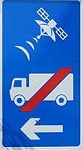
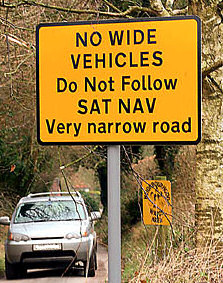
The Vale of Glamorgan council is pioneering a new road sign, which is designed to stop lorry drivers with Satellite Navigation from getting stuck in its country lanes. The new Sat Nav road sign features a lorry with a red line through it, a familiar no-entry convention. What’s new is that there is a picture of a satellite hovering above the vehicle. It should not take long for drivers to understand the sign, especially as lorry drivers have the world’s best grape-vine for traffic news.
Residents in the area called for more signs, saying it was the third time that roads leading to St Hilary had been blocked in recent months. Although marked on the satellite maps as roads, the routes are little more than lanes. A related problem is that these lanes may meander through steep-sided cuttings, and a lorry cannot force its way through. More foolishness is that the Sat Nav tries to direct 32-ton lorries through narrow roads with 90-degree bends flanked with stone walls.
Bill Clay of Coed Hills farm, St Hilary said, “I feel very sorry for them because they just don’t understand the signs.” Hopefully, publicity such as this will enlighten the lorry drivers. He added, “There was a Spanish chap who had driven from Poland who was stuck in the lane near our home for over two hours once.”
The signs will be monitored and maintained for a year, and there a plans to erect more Sat Nav signs in other locations in Wales. If the Welsh Assembly know about the problem, why cannot they liaise with suppliers and ask the programmers to change a few lines of code? — e.g. if vehicle width is wider than two metres don’t go through St Hilary; or if road has a Sat Nav sign then take route B.
River Severn, Shropshire
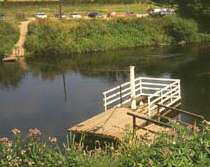
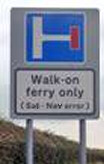
Another sat-nav blunder is pointing hundreds of drivers to a bridge that has never existed. According to the dashboard devices, it is possible to drive down a country lane to cross the River Severn at Hampton Loade, Shropshire. At the end of the road, however, there was only a ferry for foot passengers — as a sign at the top of the lane has warned drivers for years. The foot passenger ferry has been closed since May 2007.
Ivybridge, Devon
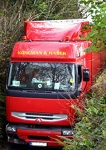
A lorry driver who was led off-course by his Sat Nav got his HGV so tightly wedged in a narrow country lane he had to spend three nights sleeping in his cab before being rescued.
Residents living near the scene in Ivybridge, near Plymouth, Devon, were astonished when the HGV became wedged in the wooded lane. The Czech driver, who was in his forties and called Yuri, was on his way to pick up a consignment of TVs from a depot at nearby Lee Moor and was led up the lane which runs between the A379 and the A38 by his Sat Nav. Unfortunately Yuri, who was driving a Köhlman and Hašek articulated lorry, was unable to speak enough English to ask directions when he suspected he was being led into difficulty.
Mat Auburn, 19, whose family live within yards of the scene said that there had been similar Sat Nav blunders in the past with delivery lorries — but nothing on this scale. Mat said, “What happened was he came up to one of the lanes leading off the A379. He said the Sat Nav told him to come up the lane and he actually stopped near a house to ask directions but the woman couldn’t understand him so he carried on along the lane... But you wouldn’t drive any sort of lorry up there — it’s got a 90 degree turn. The lorry was stopped in its tracks by an overhead pipe but could not back up. When he tried to reverse the wheels just skidded — he just couldn’t get any grip”.
It was a lucky coincidence that Yuri’s truck had got stuck right in front of the Auburn family house as Mat’s mother Marina is Croatian and could speak enough Croat and other Slavic-based languages to understand him. Over the course of the two days Mrs Auburn and husband, Tim, a university lecturer, hosted Yuri for breakfast, lunch and dinner and struck up a friendship, which they plan to continue. However, Yuri, who has a wife and two children in the Czech Republic, slept in his cab, as it had a bed.
“The nearest village is about a mile away and there were no B&Bs close,” Mat said. “He slept in his cab. It had a bed in it so it made sense. We looked after him for the rest of the time. He came in to eat.” Mat said the Czech haulage company decided to wait until a weekday rather than attempting an expensive weekend rescue. Eventually a tractor was hired to pull the lorry out of the lane, with the help of a tree surgeon, who made sure minimal damage was done to vegetation.
Mat added “The lorry was a nuisance while it was there because locals do use it a lot. The diversion put a few miles on people’s journeys.”
Gibraltar (Lincolnshire or Iberia?)
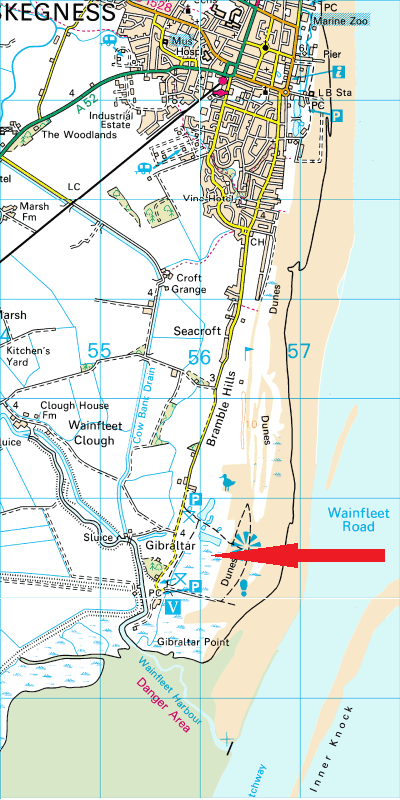
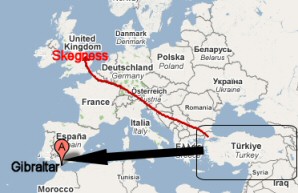
This tale is almost impossible to believe, reported in the Daily Telegraph, the story of a lorry driver who, after trying to drive from Turkey to Gibraltar using Sat Nav, found himself some 1600 miles off course. Necdet Bakimci was driving his 32-tonne lorry, carrying expensive cars, from Turkey to Gibraltar when he fetched up, lost, in Skegness, Lincolnshire. Apparently, there is a Gibraltar just south of Skegness (see map on the left, one-kilometre grid). Eventually, Mr Bakimci arranged for his firm in Antakya, Turkey, to ship the cars to the correct destination from Birmingham and he began his journey home.
Luckington, Wiltshire
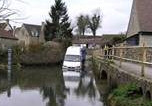
Drivers visiting Luckington, Wiltshire, have been getting that sinking feeling after trying to find a detour around a road closure in Sherston. Satellite navigation systems, together with misleading signs have been blamed after dozens of motorists tried to drive through a ford at Brookend in Luckington. Several lorries and vans have got stuck in up to three feet of water. Enterprising farmers have been towing out stricken vehicles at £25 a time.
One local resident has been helping stranded drivers to dry out. One lady said: “The other day my husband came home and I had to explain why there was a van driver’s trousers in our tumble dryer. He was sitting in his cab, shivering in his boxer shorts.”