
Loading...
Loading...
A dip into some typical railways from various countries, conventional, unusual, historial, bizarre – take your pick.
See also London Underground (including some foreign metro systems), Railways in Britain and Railway Disasters across the world.
See also my pages devoted to London buses, Trams and Trolleybuses, Green Line Coaches and another on Aircraft and Airports.
Try these puzzles about Underground Distances, The XYZ of British Railways, and the Least-Used Public Railway Station Open in Great Britain.
Click on any of the thumbnail images to see the pictures full-size. Links to video clips, of which there are quite a lot, are words in the text (blue), just like links to other web information but preceded by this  icon.
icon.
This page has sections on:
The Viaduc de Cize–Bolozon is a combination rail and vehicular viaduct crossing the Ain gorge in France connecting the communes of Cize and Bolozon.
An original span built in the same location in 1875 was destroyed in World War II. Reconstructed as an urgent post-war project due to its position on a main line to Paris, the new viaduct reopened in May 1950.
It carries road and rail traffic at different levels: the railway, which was closed for reinforcement and restoration in 2005, occupies the upper level. Part of the Ligne du Haut-Bugey, it reopened in December 2010 as part of the international Paris–Geneva line. The local road from Poncin to Thoirette uses the lower level. Its total length is 273 m, and its height is 73 m. It has 11 spans.
The initial batch of class 373 trains for the Eurostar services from London St Pancras to Paris Nord and Brussels Midi were constructed by Alsthom and entered service from 1992.
For tips on travelling abroad see this site (which was even recommended to me by the French Tourist Office in London! They say that if you live in the USA or Canada, you should give Afghanistan as your location, otherwise you get directed by other web-sites to expensive sites for purchasing tickets!) For information about European rail travel, the best source is Deutsche Bahn (in English) as they give useful connections; the Spanish web-site is awful – they only give direct trains (so if you want to go by high-speed train from Barcelona to Seville, they don’t even mention that you can get there by changing at Madrid).
When will this carriage go for scrap?
Just in case your locomotive becomes derailed – whether it’s OO-, O-. HO-. N-, or 4-ft 8½-in gauge – here’s how NOT to get it back on track. (Don’t do this at home!). Watch the action in the distance.
I have no idea where these stations are except Japan, so here’s another whose location is also unknown, except Japan...
This funicular railway is in San Carlos de Bariloche in the Patagonian region of Argentina. It was built entirely in San Carlos, costing $1.5 million, and opened in 2007.
The Bernina Express connects Chur in Switzerland with Poschiavo and Tirano in Italy, crossing the Swiss Engadin Alps. It is operated by the Rhaetian Railway. When the Bernina Express was planned, the engineers who built it were faced with a difficult challenge. The train needed to bridge a considerable difference in altitude in a very short distance. The ride began in St. Moritz (altitude 1,775 m), crossed the Bernina Pass (altitude 2,253 m) and ended in Tirano (429 m). And since it was a train built specifically for tourists who wanted to see the lovely landscape, the train had to go through as few tunnels as possible. But the solution they came up with was quite ingenious: rather than use switchback tunnels, the train used switchback viaducts that have have a diameter of 100 meters. Train passengers are usually in awe over this engineering feat.
In 1853, the Aragonese asked the Spanish government to create a station to connect Spain and France through the Aragonese Pyrenees. In 1928, after years of tense negotiations, agreements and treaties, the international station of Canfranc was opened. The largest in Europe at that time, a monumental station “Bigger even than the Titanic”" read the news at that time, but with an equally tragic future.
Rooted in the most turbulent of times in Europe, and because of its strategic location it had to face the worst adversities – an international crisis, world wars and a civil war dictated its sentence: decommissioning, abandonment, oblivion.
Today, more than thirty years after the end of the line, Canfranc station expected, with majestic and imperturbable serenity, to return to its glory days. But it has a darker future – the search for dark matter.
Web sites: Canfranc (in Spanish), The recent past (in French), The Pau To Canfranc Line (in English)
Two videos: a look at Canfranc station (42½ minutes, in Spanish); “El Canfrancero” – a special train that ran into Canfranc on 27th July 2013.
El Vendrell station is at the top of the map and Sant Vicenç de Calders is at the bottom. Just clipping the top left corner is the new high-speed train (AVE) line from Barcelona to Madrid.
The station is named Sant Vicenç de Calders rather than Coma-Ruga because the latter was just a few villas along the shore when the station was built. It is now a major terminus for Barcelona suburban services (via Vilafranca del Pendès and via Vilanova i la Geltrú), and a through route for services further east to Tarragona, Reus, València and even as far south as Alicante.
AVE direct from Barcelona to Madrid in 2013 (2½ hours) [at 24 mins 30 secs it passes over our main town, El Vendrell, and immediately afterwards passes through the hills (captioned Sant Vicenç de Calders) behind our home]. It’s interesting to see that when the train enters Madrid Atocha station, there is already another train at the buffer end of ‘our’ platform, which promptly departs for Valencia via a scissors cross-over, and allows us to come up to the buffers.
Semi-fast train from Barcelona to Puigcerdà in 2014 (3 hours) [sorry about the “music”]
Express train direct from València to Barcelona in 2014 (2¾ hours) [at 1 h 53 m it passes through our local station, called Sant Vicenç de Calders but which is actually in Coma-Ruga; at 2 h 05 m it passes through Sitges and at 2 h 21 m Prat de Llobregat (which must be the dreariest station on the planet to change trains at for the branch to a world-class airport – Barcelona); at 2 h 22 m 22 s it passes a double-decker suburban train and there’s another on the left as it enters the terminus at Barcelona Estaciò de França; at 2 h 26 m just before entering Barcelona Sants you can hear the train announcement given in Castilian Spanish and Catalan]
[Right]: Just to put you in the right mood here’s the Lillooet line near Vancouver, Canada; the area is prone to land-slips.
Be it America, Germany, Thailand or India, these countries have the worst tracks in the world that will blow your mind. (Actually, the Indian train throwing water aside has been happening every monsoon season for a hundred years, so it’s quite normal; and the snow-plough is doing its usual and proper job.) Watch how trains crawl on these tracks extremely slowly due to the bad conditions of the track.
And here is a slide show showing the ten most dangerous train journeys that you could ever make.
Just in case those are not knuckle-whitening enough for you, here are more, each containing “25 Most Dangerous and Extreme Railways in the World” – Part 1 and Part 2.
Help please – I found the photograph captioned “Loco 53” [below] but I know nothing more about it. Can anyone help?
The locomotive looks rather British, but the setting doesn’t. It’s a pretty picture though.
Any information about these or any of the other vaguely labelled “scenic” pictures would be welcome.

This railway station is one of the busiest in India, serving as a terminal for both long-distance trains and commuter trains of the Mumbai Suburban Railway. The station’s name was changed to its present one from Victoria Terminus in March 1996 and it is now known simply as CST. It was featured in a recent series of BBC documentaries, and also in the film Slumdog Millionaire.
CST has 18 platforms – seven for local and 11 for long distance trains. Platforms 1 and 2 handle 9-coach Harbour line trains, platforms 3 to 6 handle 12-coach Main line trains and platform 7 handles both 12- and 15-coach trains. All suburban platforms are aligned in such a manner that each local train discharges passengers on either side. Plans to extend the Harbour line platforms to accommodate 12-coach trains have been sanctioned though actual work has not yet begun.
Platforms 8 to 16 handles out-station trains, platforms 8/9 handle 17-coach trains; platforms 10/11 and 12/ 13 handle 19-coach trains; platforms 14/15, 16/17 and 18 handle 24-coach trains. The railway ministry has sanctioned the extension of Platforms 10/11 and 12/13 to accommodate 24-coach trains in its 2015 railway budget. CST services 636,000 commuters daily.
The station, a UNESCO World Heritage Site is named after the 17th-Century Indian leader, Shivaji Bhonsle, also known as Chhatrapati Shivaji Maharaj. He established a competent and progressive civil rule with the help of a disciplined military and well-structured administrative organisations from the declining Adilshahi sultanate of Bijapur that formed the genesis of the Maratha Empire. In 1674, he was formally crowned as the Chhatrapati (Monarch). He used new military tactics, pioneering guerrilla warfare, using geography, speed, and surprise and focused pinpoint attacks to defeat his larger and more powerful enemies. From a small contingent of 2,000 soldiers inherited from his father, Shivaji created a force of 100,000 soldiers; he built and restored strategically located forts both inland and coastal to safeguard his territory. He revived ancient Hindu political traditions and court conventions and promoted the usage of Marathi and Sanskrit, rather than Persian, in court and administration.


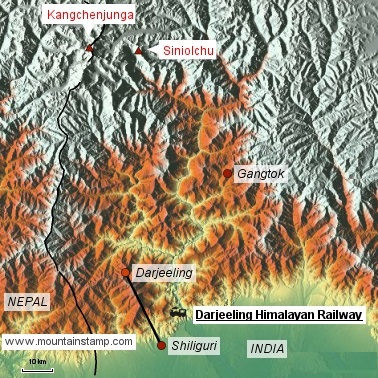
Famous for its twists and turns, loops and zigzags, and steep inclines, the Darjeeling Himalayan Railway runs between New Jalpaiguri (altitude 328 ft) and Darjeeling (7,218 ft) in the Indian state of West Bengal. Siliguri, the first station after New Jalpaiguri lies 398 ft above sea-level.
The summit at Ghoom (or Ghum), forty-seven miles from Siliguri, has an altitude of 7,407 ft, that of Darjeeling being 6,812 ft.
As the line had to rise over 7,000 ft in less than fifty miles, steep gradients and sharp curves were unavoidable. The surveyors plotted banks ranging from 1 in 19 to 1 in 36¾, and curves of 50 ft radius. Later, however, these were eased, the sharpest curve being 69½ ft, the steepest short gradient being 1 in 23, and the steepest average gradient about 1 in 29. Built between 1879 and 1881, the railway has a gauge of 2 ft.
Web sites worth checking out are: the Darjeeling Himalayan Railway Society; the Official Indian Railways site; and A Himalayan Loop Line – Remarkable Engineering Devices on an Indian Mountain Railway
It’s not only British trains that have trouble with floods. Here are some pictures from the Toronto (Canada) GO system from July 2013. Note that the loading gauge is greater than in Britain, hence the trains are double-deckers. Compare with the British experiment documented above.
An intermodal container (also known as a container, freight container, ISO container, shipping container, hi-cube container, box or a sea container) is a reusable steel box.
Such units have standardised dimensions so that they can be transferred from ship to lorry to train (or whatever) with the minimum of effort. Container trains like the one shown are often very long, especially in north America. Frequently several locomotives are required to draw the trains scattered along its length; the drivers keep in radio contact to coordinate their control of the various sections of the train.
A cattle passenger train in New Delhi, India
(or at least somewhere in Southern Asia)
The Alaska Railroad connects the year-round deep-sea port of Seward with Fairbanks, Alaska’s second largest city.
Juneau is Alaska’s capital and third largest city.
The University of Southern California also has an informative item about the railroad.
Keddie Wye is the only railroad ‘Y’ in the world with two legs on bridges and a closing track in a tunnel. The trestle is located high above Spanish Creek and was the location of the last spike ceremony in 1909 at the completion of the track through the Feather River Canyon.
Keddie Wye is in Plumas County, northern California; they publish a leaflet of Plumas County’s Seven Wonders of the Railroad World [PDF file].
Southern 630 moving northbound through Williamstown Kentucky on 18th May 2014 with 14 passenger cars and some freight (1½ minutes)
Southern Railway 630 (commonly referred to as Southern 630) is a 2-8-0 Consolidation type steam locomotive built in 1904 by the Richmond Works of the American Locomotive Company for the Southern Railway as a member of the Ks-1 Consolidation class. After being retired from revenue freight service in 1952, 630 served as member of the Southern Railway’s excursion program from 1967 to 1983. Today it is owned and operated by the Tennessee Valley Railroad Museum, where it operates as part of Norfolk Southern’s 21st Century Steam excursion program.
At the end of 1970 Southern operated 9,698 km of railroad, not including its Class I subsidiaries AGS (850 km) CofG (2783 km) S&A (269 km) CNOTP (668 km) GS&F (731 km) and twelve Class II subsidiaries. That year Southern itself reported 26111 million net ton-miles of revenue freight and 110 million passenger-miles; AGS reported 3854 and 11, CofG 3595 and 17, S&A 140 and 0, CNO&TP 4906 and 0.3, and GS&F 1431 and 0.3.
It merged with the Norfolk and Western Railway (N&W) in 1982, forming the Norfolk Southern Corporation. The Southern Railway was renamed Norfolk Southern Railway in 1990 and continued under that name ever since. Seven years later in 1997 the railroad absorbed the Norfolk and Western Railway, ending the latter’s existence as an independent railroad.
The “Golden Spike” (also known as “The Last Spike”) is the ceremonial final spike driven by Leland Stanford to join the rails of the first transcontinental railroad across the United States, connecting the Central Pacific and Union Pacific railroads on 10th May 1869 at Promontory Summit, Utah Territory.
The Jupiter (“Central Pacific Railroad number 60”) was a 4-4-0 steam locomotive. It was built in September 1868 by the Schenectady Locomotive Works of New York, along with three other engines, 61 Storm, 62 Whirlwind, and 63 Leviathan. These four engines were then dismantled and sailed to San Francisco where they were loaded onto a river barge and sent to the Central Pacific headquarters in Sacramento, reassembled and commissioned into service on 20th March 1869.
Union Pacific No. 119 was also a 4-4-0 steam locomotive, the other of the two locomotives to meet at Promontory Summit. “No. 119” was built by Rogers Locomotive and Machine Works of Paterson, New Jersey in 1868 along with numbers 116, 117, 118 and 120. This engine was scrapped in 1903, and a replica was built in 1979, shown here.
Locomotive No. 484 and several others are owned by the Cumbres and Toltec Scenic Railroad; 484 is in the K-36 class. The “K” represents the nickname “Mikado”, describing a locomotive with two non-powered, pivoting wheels in front of eight driving wheels, which are connected to driving rods powered by the engine’s pistons, and finally two non-powered trailer wheels located under the cab (in British terms, a 2–8–2); the name comes from the fact that the first significant use of the type was a series built by Baldwin Locomotive Works for the Japanese Railways in 1887. The number 36 designates the tractive effort (pulling force) of the locomotives in thousands of pounds. The tractive effort of a K-36 is rated at 36,200 pounds-force (161.026 kN). The weight of a K-36 with a full tender is 286,600 pounds (130,000 kg).
The Durango and Silverton Railroad is a scenic historic train on 45 miles of rails originally laid in 1882 between the mining town of Silverton and the railroad-built town of Durango, Colorado, along the Animas River through wilderness unaccessible by any road!
When arriving from the south at Chicago Union station you pass through the Amtrak & Metra 14th Street Coach Yard & Maintenance facility; this is the view from the Willis/Sears Tower. “Metra” is the Chicago commuter train company.