
Loading...
Loading...
Dark Matter is a type of matter hypothesized in astronomy and cosmology to account for effects that appear to be the result of mass where no such mass can be seen. Dark matter cannot be seen directly with telescopes; evidently it neither emits nor absorbs light or other electromagnetic radiation at any significant level. It is otherwise hypothesized to simply be matter that is not reactant to light. Instead, the existence and properties of dark matter are inferred from its gravitational effects on visible matter, radiation, and the large-scale structure of the universe.
See Dark matter may have been detected – streaming from the sun’s core.
Dark energy is a hypothetical form of energy that permeates all of space and tends to accelerate the expansion of the universe. It is a smooth, persistent component of invisible energy, and doesn’t accumulate preferentially in galaxies and clusters of galaxies. Again on a mass-energy equivalence basis, the density of dark energy (1.67 × 10⁻²⁷ kg/m3) is very low: in the solar system, there are believed to be only 6 tons of dark energy within the radius of Pluto’s orbit. However, it dominates the mass-energy of the universe because it is uniform across space. Dark energy is the most accepted hypothesis to explain observations since the 1990s that indicate that the universe is expanding at an accelerating rate.
According to the Planck satellite mission team, and based on the standard model of cosmology, and bearing in mind that mass and energy are equivalent (E = mc2), the universe contains 26.8% dark matter and 68.3% dark energy (for a total of 95.1%) and 4.9% ordinary matter; dark matter is estimated to constitute 84.5% of the total matter in the universe.
Astrophysicists hypothesized dark matter due to discrepancies between the mass of large astronomical objects determined from their gravitational effects and the mass calculated from the “luminous matter” they contain: stars, gas, and dust. It was first postulated by Jan Oort in 1932 to account for the orbital velocities of stars in the Milky Way and by Fritz Zwicky in 1933 to account for evidence of “missing mass” in the orbital velocities of galaxies in clusters. Subsequently, many other observations have indicated the presence of dark matter in the universe, including the rotational speeds of galaxies by Vera Rubin, in the 1960s and 1970s, gravitational lensing of background objects by galaxy clusters such as the Bullet Cluster (1E 0657-558, consisting of two colliding clusters of galaxies), the temperature distribution of hot gas in galaxies and clusters of galaxies, and more recently the pattern of anisotropies in the cosmic microwave background. According to consensus among cosmologists, dark matter is composed primarily of a not yet characterized type of subatomic particle. The search for this particle, by a variety of means, is one of the major efforts in particle physics today.
Although the existence of dark matter is generally accepted by the mainstream scientific community, some alternative theories of gravity have been proposed, such as Modified Newtonian dynamics (MOND) [this link is to an 800 KB PDF] and Tensor-vector-scalar gravity (TeVeS), which try to account for the anomalous observations without requiring additional matter.
The most widely accepted explanation for the reduced observed mass is that dark matter exists and that it is most probably composed of weakly interacting massive particles (WIMPs) that interact only through gravity and the weak force. Alternative explanations have been proposed, and there is not yet sufficient experimental evidence to determine which is correct. Many experiments to detect proposed dark matter particles through non-gravitational means are under way.
Dark matter plays a central role in state-of-the-art modelling of cosmic structure formation and Galaxy formation and evolution and has measurable effects on the anisotropies observed in the cosmic microwave background. All these lines of evidence suggest that galaxies, clusters of galaxies, and the universe as a whole contain far more matter than that which interacts with electromagnetic radiation.
Important as dark matter is thought to be in the cosmos, direct evidence of its existence and a concrete understanding of its nature have remained elusive. Though the theory of dark matter remains the most widely accepted theory to explain the anomalies in observed galactic rotation, some alternative theoretical approaches have been developed which broadly fall into the categories of modified gravitational laws and quantum gravitational laws.
There are three separate lines of evidence that the majority of dark matter is not made of baryons (ordinary matter including protons and neutrons):
A small proportion of dark matter may be baryonic dark matter: astronomical bodies, such as massive compact halo objects, that are composed of ordinary matter but which emit little or no electromagnetic radiation. Study of nucleosynthesis in the Big Bang produces an upper bound on the amount of baryonic matter in the universe, which indicates that the vast majority of dark matter in the universe cannot be baryons, and thus does not form atoms. It also cannot interact with ordinary matter via electromagnetic forces; in particular, dark matter particles do not carry any electric charge.
Candidates for nonbaryonic dark matter are hypothetical particles such as axions (a hypothetical elementary particle postulated to resolve the strong Charge Parity (CP) problem in quantum chromodynamics (QCD)), or supersymmetric particles; neutrinos can only form a small fraction of the dark matter, due to limits from large-scale structure and high redshift galaxies. Unlike baryonic dark matter, nonbaryonic dark matter does not contribute to the formation of the elements in the early universe and so its presence is revealed only via its gravitational attraction. In addition, if the particles of which it is composed are supersymmetric, they can undergo annihilation interactions with themselves, possibly resulting in observable by-products such as gamma rays and neutrinos (“indirect detection”).
Nonbaryonic dark matter is classified in terms of the mass of the particles that are assumed to make it up, and/or the typical velocity dispersion of those particles (since more massive particles move more slowly). There are three prominent hypotheses on nonbaryonic dark matter – cold dark matter (CDM), warm dark matter (WDM), and hot dark matter (HDM); some combination of these is also possible. The most widely discussed models for nonbaryonic dark matter are based on the cold dark matter hypothesis, and the corresponding particle is most commonly assumed to be a weakly interacting massive particle (WIMP). Hot dark matter may include (massive) neutrinos, but observations imply that only a small fraction of dark matter can be hot. Cold dark matter leads to a “bottom-up” formation of structure in the universe while hot dark matter would result in a “top-down” formation scenario; since the late 1990s, the latter has been ruled out by observations of high redshift galaxies such as the Hubble Ultra-Deep Field (an image of a small region of space in the constellation Fornax, from data accumulated over a period of four months; looking back approximately 13 billion years (between 400 and 800 million years after the Big Bang) it is being used to search for galaxies that existed at that time. The image was taken in a section of the sky with a low density of bright stars in the near-field, allowing much better viewing of dimmer, more distant objects, and contains an estimated 10,000 galaxies).
The first person to interpret evidence and infer the presence of dark matter was Dutch astronomer Jan Oort, a pioneer in radio astronomy, in 1932. Oort was studying stellar motions in the local galactic neighbourhood and found that the mass in the galactic plane must be more than the material that could be seen, but this measurement was later determined to be essentially erroneous. In 1933 the Swiss astrophysicist Fritz Zwicky, who studied clusters of galaxies while working at the California Institute of Technology, made a similar inference. Zwicky applied the virial theorem (which allows the average total kinetic energy to be calculated even for very complicated systems that defy an exact solution; this average total kinetic energy is related to the temperature of the system) to the Coma cluster of galaxies and obtained evidence of unseen mass. Zwicky estimated the cluster’s total mass based on the motions of galaxies near its edge and compared that estimate to one based on the number of galaxies and total brightness of the cluster. He found that there was about 400 times more estimated mass than was visually observable. The gravity of the visible galaxies in the cluster would be far too small for such fast orbits, so something extra was required. This is known as the “missing mass problem”. Based on these conclusions, Zwicky inferred that there must be some non-visible form of matter which would provide enough of the mass and gravity to hold the cluster together.
Much of the evidence for dark matter comes from the study of the motions of galaxies. Many of these appear to be fairly uniform, so by the virial theorem, the total kinetic energy should be half the total gravitational binding energy of the galaxies. Experimentally, however, the total kinetic energy is found to be much greater: in particular, assuming the gravitational mass is due to only the visible matter of the galaxy, stars far from the centre of galaxies have much higher velocities than predicted by the virial theorem. Galactic rotation curves, which illustrate the velocity of rotation versus the distance from the galactic centre, cannot be explained by only the visible matter. Assuming that the visible material makes up only a small part of the cluster is the most straightforward way of accounting for this. Galaxies show signs of being composed largely of a roughly spherically symmetric, centrally concentrated halo of dark matter with the visible matter concentrated in a disc at the centre. Low surface brightness dwarf galaxies are important sources of information for studying dark matter, as they have an uncommonly low ratio of visible matter to dark matter, and have few bright stars at the centre which would otherwise impair observations of the rotation curve of outlying stars.
Gravitational lensing observations of galaxy clusters allow direct estimates of the gravitational mass based on its effect on light from background galaxies, since large collections of matter (dark or otherwise) will gravitationally deflect light. In clusters such as Abell 1689, lensing observations confirm the presence of considerably more mass than is indicated by the clusters’ light alone. In the Bullet Cluster, lensing observations show that much of the lensing mass is separated from the X-ray-emitting baryonic mass. In July 2012, lensing observations were used to identify a “filament” of dark matter between two clusters of galaxies, as cosmological simulations have predicted.
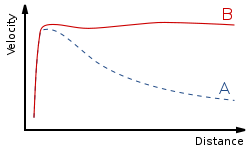
Rotation curve of a typical spiral galaxy: predicted (A) and observed (B). Dark matter can explain the ’flat’ appearance of the velocity curve out to a large radius
After Zwicky’s initial observations, the first indication that the mass to light ratio was anything other than 1 came from measurements made by Horace W. Babcock. In 1939, Babcock reported measurements of the rotation curve for the Andromeda nebula which suggested that the mass-to-luminosity ratio increases radially. He attributed it to either absorption of light within the galaxy or modified dynamics in the outer portions of the spiral and not to any form of missing matter. In the late 1960s and early 1970s, Vera Rubin worked with a new sensitive spectrograph that could measure the velocity curve of edge-on spiral galaxies to a greater degree of accuracy than had ever before been achieved. Rubin announced in 1975 the discovery that most stars in spiral galaxies orbit at roughly the same speed, which implied that the mass densities of the galaxies were uniform well beyond the regions containing most of the stars (the galactic bulge), a result independently found in 1978.
Rubin’s observations and calculations showed that most galaxies must contain about six times as much “dark” mass as can be accounted for by the visible stars. Eventually other astronomers began to corroborate her work and it soon became well-established that most galaxies were dominated by “dark matter”:
Simulated dark matter haloes have significantly steeper density profiles (having central cusps) than are inferred from observations, which is a problem for cosmological models with dark matter at the smallest scale of galaxies. This may only be a problem of resolution: star-forming regions which might alter the dark matter distribution via outflows of gas have been too small to resolve and model simultaneously with larger dark matter clumps. A recent simulation of a dwarf galaxy resolving these star-forming regions reported that strong outflows from supernovae remove low-angular-momentum gas, which inhibits the formation of a galactic bulge and decreases the dark matter density to less than half of what it would have been in the central kiloparsec. These simulation predictions – bulgeless and with shallow central dark matter profiles – correspond closely to observations of actual dwarf galaxies. There are no such discrepancies at the larger scales of clusters of galaxies and above, or in the outer regions of haloes of galaxies.
Exceptions to this general picture of dark matter haloes for galaxies appear to be galaxies with mass-to-light ratios close to that of stars. Subsequent to this, numerous observations have been made that do indicate the presence of dark matter in various parts of the cosmos, such as observations of the cosmic microwave background, of supernovas used as distance measures, of gravitational lensing at various scales, and many types of sky survey. Together with Rubin’s findings for spiral galaxies and Zwicky’s work on galaxy clusters, the observational evidence for dark matter has been collecting over the decades to the point that by the 1980s most astrophysicists accepted its existence. As a unifying concept, dark matter is one of the dominant features considered in the analysis of structures on the order of galactic scale and larger.
The velocity dispersion σ, is the range of velocities about the mean velocity for a group of objects, such as a cluster of stars about a galaxy.
Rubin’s pioneering work has stood the test of time. Measurements of velocity curves in spiral galaxies were soon followed up with velocity dispersions of elliptical galaxies. While sometimes appearing with lower mass-to-light ratios, measurements of ellipticals still indicate a relatively high dark matter content. Likewise, measurements of the diffuse interstellar gas found at the edge of galaxies indicate not only dark matter distributions that extend beyond the visible limit of the galaxies, but also that the galaxies are virialised (i.e. gravitationally bound with velocities corresponding to predicted orbital velocities of general relativity) up to ten times their visible radii. This has the effect of pushing up the dark matter as a fraction of the total amount of gravitating matter from 50% measured by Rubin to the now accepted value of nearly 95%.
There are places where dark matter seems to be a small component or totally absent. Globular clusters show little evidence that they contain dark matter, though their orbital interactions with galaxies do show evidence for galactic dark matter. For some time, measurements of the velocity profile of stars seemed to indicate concentration of dark matter in the disk of the Milky Way galaxy. It now appears, however, that the high concentration of baryonic matter in the disk of the galaxy (especially in the interstellar medium) can account for this motion. Galaxy mass profiles are thought to look very different from the light profiles. The typical model for dark matter galaxies is a smooth, spherical distribution in virialised halos. Such would have to be the case to avoid small-scale (stellar) dynamical effects. Recent research reported in January 2006 from the University of Massachusetts Amherst would explain the previously mysterious warp in the disk of the Milky Way by the interaction of the Large and Small Magellanic Clouds and the predicted 20 fold increase in mass of the Milky Way taking into account dark matter.
In 2005, astronomers from Cardiff University claimed to have discovered a galaxy made almost entirely of dark matter, 50 million light years away in the Virgo Cluster, which was named VIRGOHI21. Unusually, VIRGOHI21 does not appear to contain any visible stars: it was seen with radio frequency observations of hydrogen. Based on rotation profiles, the scientists estimate that this object contains approximately 1000 times more dark matter than hydrogen and has a total mass of about 1/10 that of the Milky Way Galaxy we live in. For comparison, the Milky Way is estimated to have roughly 10 times as much dark matter as ordinary matter. Models of the Big Bang and structure formation have suggested that such dark galaxies should be very common in the universe, but none had previously been detected. If the existence of this dark galaxy is confirmed, it provides strong evidence for the theory of galaxy formation and poses problems for alternative explanations of dark matter.
There are some galaxies whose velocity profile indicates an absence of dark matter, such as NGC 3379.
Strong gravitational lensing can indicate the presence of dark matter.
Galaxy clusters are especially important for dark matter studies since their masses can be estimated in three independent ways:
Generally these three methods are in reasonable agreement, that clusters contain much more matter than the visible galaxies and gas.
A gravitational lens is formed when the light from a more distant source (such as a quasar) is “bent” around a massive object (such as a cluster of galaxies) between the source object and the observer. The process is known as gravitational lensing.
The galaxy cluster Abell 2029 is composed of thousands of galaxies enveloped in a cloud of hot gas, and an amount of dark matter equivalent to more than 1014 Suns. At the centre of this cluster is an enormous, elliptically shaped galaxy that is thought to have been formed from the mergers of many smaller galaxies. The measured orbital velocities of galaxies within galactic clusters have been found to be consistent with dark matter observations.
Another important tool for future dark matter observations is gravitational lensing. Lensing relies on the effects of general relativity to predict masses without relying on dynamics, and so is a completely independent means of measuring the dark matter. Strong lensing, the observed distortion of background galaxies into arcs when the light passes through a gravitational lens, has been observed around a few distant clusters including Abell 1689 (pictured above). By measuring the distortion geometry, the mass of the cluster causing the phenomena can be obtained. In the dozens of cases where this has been done, the mass-to-light ratios obtained correspond to the dynamical dark matter measurements of clusters.
Weak gravitational lensing looks at minute distortions of galaxies observed in vast galaxy surveys due to foreground objects through statistical analyses. By examining the apparent shear deformation of the adjacent background galaxies, astrophysicists can characterize the mean distribution of dark matter by statistical means and have found mass-to-light ratios that correspond to dark matter densities predicted by other large-scale structure measurements. The correspondence of the two gravitational lens techniques to other dark matter measurements has convinced almost all astrophysicists that dark matter actually exists as a major component of the universe’s composition.
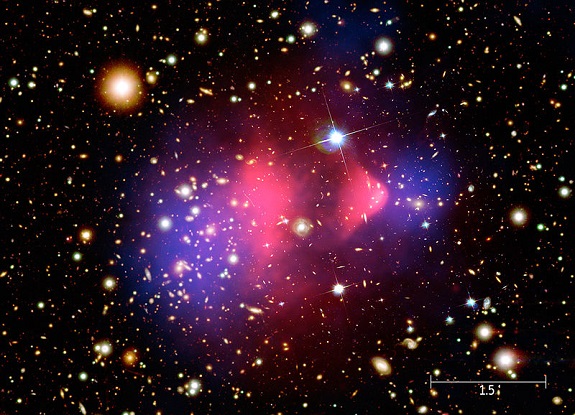
The image in the background showing the visible spectrum of light stems is from Magellan and Hubble Space Telescope images. The pink overlay shows the x-ray emission from hot gas (recorded by the Chandra telescope) of the colliding clusters, the blue one representing the mass distribution of the clusters calculated from gravitational lensing effects.
[Scale: Full image is 7.5 arcmin wide, 5.4 arcmin high]
The most direct observational evidence to date for dark matter is in a system known as the “Bullet Cluster”. In most regions of the universe, dark matter and visible material are found together, as expected because of their mutual gravitational attraction. In the Bullet Cluster, a collision between two galaxy clusters appears to have caused a separation of dark matter and baryonic matter. X-ray observations show that much of the baryonic matter (in the form of 107 – 108 Kelvin gas, or plasma) in the system is concentrated in the centre of the system.
Electromagnetic interactions between passing gas particles caused them to slow down and settle near the point of impact. However, weak gravitational lensing observations of the same system show that much of the mass resides outside of the central region of baryonic gas. Because dark matter does not interact by electromagnetic forces, it would not have been slowed in the same way as the X-ray visible gas, so the dark matter components of the two clusters passed through each other without slowing down substantially. This accounts for the separation. Unlike the galactic rotation curves, this evidence for dark matter is independent of the details of Newtonian gravity, so it is claimed to be direct evidence of the existence of dark matter. Another galaxy cluster, known as the “Train Wreck Cluster”/Abell 520, appears to have an unusually massive and dark core containing few of the cluster’s galaxies, which presents problems for standard dark matter models. This may be explained by the dark core actually being a long, low-density dark matter filament (containing few galaxies) along the line of sight, projected onto the cluster core.
The observed behaviour of dark matter in clusters constrains whether and how much dark matter scatters off other dark matter particles, quantified as its self-interaction cross section. More simply, the question is whether the dark matter has pressure, and thus can be described as a perfect fluid. The distribution of mass (and thus dark matter) in galaxy clusters has been used to argue both for and against the existence of significant self-interaction in dark matter. Specifically, the distribution of dark matter in merging clusters such as the Bullet Cluster shows that dark matter scatters off other dark matter particles only very weakly if at all.
Angular fluctuations in the cosmic microwave background (CMB) spectrum provide evidence for dark matter. Since the 1964 discovery and confirmation of the CMB radiation, many measurements of the CMB have supported and constrained this theory. The NASA Cosmic Background Explorer (COBE) found that the CMB spectrum is a blackbody spectrum with a temperature of 2.726 K. In 1992, COBE detected fluctuations (anisotropies) in the CMB spectrum, at a level of about one part in 105. During the following decade, CMB anisotropies were further investigated by a large number of ground-based and balloon experiments. The primary goal of these experiments was to measure the angular scale of the first acoustic peak of the power spectrum of the anisotropies, for which COBE did not have sufficient resolution. In 2000 – 2001, several experiments, most notably BOOMERanG (Balloon Observations Of Millimetric Extragalactic Radiation ANd Geophysics) found the Universe to be almost spatially flat by measuring the typical angular size (the size on the sky) of the anisotropies. During the 1990s, the first peak was measured with increasing sensitivity and by 2000 the BOOMERanG experiment reported that the highest power fluctuations occur at scales of approximately one degree. These measurements were able to rule out cosmic strings as the leading theory of cosmic structure formation, and suggested cosmic inflation was the right theory.
A number of ground-based interferometers provided measurements of the fluctuations with higher accuracy over the next three years, including the Very Small Array, the Degree Angular Scale Interferometer (DASI) and the Cosmic Background Imager (CBI). DASI made the first detection of the polarization of the CMB, and the CBI provided the first E-mode polarization spectrum with compelling evidence that it is out of phase with the T-mode spectrum. COBE’s successor, the Wilkinson Microwave Anisotropy Probe (WMAP) has provided the most detailed measurements of (large-scale) anisotropies in the CMB as of 2009 with ESA’s Planck spacecraft returning more detailed results in 2012 – 2014. WMAP’s measurements played the key role in establishing the current Standard Model of Cosmology, namely the Lambda-CDM model, a flat universe dominated by dark energy, supplemented by dark matter and atoms with density fluctuations seeded by a Gaussian, adiabatic, nearly scale invariant process. The basic properties of this universe are determined by five numbers: the density of matter, the density of atoms, the age of the universe (or equivalently, the Hubble constant today), the amplitude of the initial fluctuations, and their scale dependence.
A successful Big Bang cosmology theory must fit with all available astronomical observations, including the CMB. In cosmology, the CMB is explained as relic radiation from shortly after the big bang. The anisotropies in the CMB are explained as acoustic oscillations in the photon-baryon plasma (prior to the emission of the CMB after the photons decouple from the baryons at 379,000 years after the Big Bang) whose restoring force is gravity. Ordinary (baryonic) matter interacts strongly with radiation whereas, by definition, dark matter does not. Both affect the oscillations by their gravity, so the two forms of matter will have different effects. The typical angular scales of the oscillations in the CMB, measured as the power spectrum of the CMB anisotropies, thus reveal the different effects of baryonic matter and dark matter. The CMB power spectrum shows a large first peak and smaller successive peaks, with three peaks resolved as of 2009. The first peak tells mostly about the density of baryonic matter and the third peak mostly about the density of dark matter, measuring the density of matter and the density of atoms in the universe.
The acoustic oscillations in the early universe leave their imprint in the visible matter by Baryon Acoustic Oscillation (BAO) clustering, in a way that can be measured with sky surveys such as the Sloan Digital Sky Survey and the 2dF Galaxy Redshift Survey. These measurements are consistent with those of the CMB derived from the WMAP spacecraft and further constrain the Lambda CDM model and dark matter. Note that the CMB data and the BAO data measure the acoustic oscillations at very different distance scales.
Type Ia supernovae can be used as “standard candles” to measure extragalactic distances, and extensive data sets of these supernovae can be used to constrain cosmological models. They constrain the dark energy density ΩΛ ≅ 0.713 for a flat, Lambda CDM Universe and the parameter w for a quintessence model. Once again, the values obtained are roughly consistent with those derived from the WMAP observations and further constrain the Lambda CDM model and (indirectly) dark matter.
The Lyman-alpha forest is the sum of absorption lines arising from the Lyman-alpha transition of the neutral hydrogen in the spectra of distant galaxies and quasars. Observations of the Lyman-alpha forest can also be used to constrain cosmological models. These constraints are again in agreement with those obtained from WMAP data.

This three-dimensional map offers a first look at the web-like large-scale distribution of dark matter, reconstructed from measurements of weak gravitational lensing with the Hubble Space Telescope (the COSMOS survey). The map reveals a loose network of dark matter filaments, gradually collapsing under the relentless pull of gravity, and growing clumpier over time
The three axes of the box correspond to sky position (in right ascension and declination), and distance from the Earth increasing from left to right (as measured by cosmological redshift). Note how the clumping of the dark matter becomes more pronounced, moving right to left across the volume map, from the early Universe to the more recent Universe
The field of view covers about nine times the size of the full moon, and the third dimension stretches from redshift z=0 to z=1. The figure shows one isosurface of the gravitational potential
Dark matter is crucial to the Big Bang model of cosmology as a component which corresponds directly to measurements of the parameters associated with Friedmann cosmology solutions to general relativity. In particular, measurements of the cosmic microwave background anisotropies correspond to a cosmology where much of the matter interacts with photons more weakly than the known forces that couple light interactions to baryonic matter. Likewise, a significant amount of non-baryonic, cold matter is necessary to explain the large-scale structure of the universe.
Observations suggest that structure formation in the universe proceeds hierarchically, with the smallest structures collapsing first and followed by galaxies and then clusters of galaxies. As the structures collapse in the evolving universe, they begin to “light up” as the baryonic matter heats up through gravitational contraction and the object approaches hydrostatic pressure balance. Ordinary baryonic matter had too high a temperature, and too much pressure left over from the Big Bang to collapse and form smaller structures, such as stars, via the Jeans instability. Dark matter acts as a compactor of structure. This model not only corresponds with statistical surveying of the visible structure in the universe but also corresponds precisely to the dark matter predictions of the cosmic microwave background.
This bottom up model of structure formation requires something like cold dark matter to succeed. Large computer simulations of billions of dark matter particles have been used to confirm that the cold dark matter model of structure formation is consistent with the structures observed in the universe through galaxy surveys, such as the Sloan Digital Sky Survey and 2dF Galaxy Redshift Survey, as well as observations of the Lyman-alpha forest. These studies have been crucial in constructing the Lambda-CDM model which measures the cosmological parameters, including the fraction of the universe made up of baryons and dark matter.
There are, however, several points of tension between observation and simulations of structure formation driven by dark matter. There is evidence that there are 10 to 100 times fewer small galaxies than permitted by what the dark matter theory of galaxy formation predicts. This is known as the dwarf galaxy problem. In addition, the simulations predict dark matter distributions with a very dense cusp near the centres of galaxies, but the observed halos are smoother than predicted.
If the dark matter within our galaxy is made up of Weakly Interacting Massive Particles (WIMPs), then thousands of WIMPs must pass through every square centimetre of the Earth each second. There are many experiments currently running, or planned, aiming to test this hypothesis by searching for WIMPs. Although WIMPs are the historically more popular dark matter candidate for searches, there are experiments searching for other particle candidates; the Axion Dark Matter eXperiment (ADMX) is currently searching for the dark matter axion, a well-motivated and constrained dark matter source. It is also possible that dark matter consists of very heavy hidden sector particles which only interact with ordinary matter via gravity.
These experiments can be divided into two classes: direct detection experiments, which search for the scattering of dark matter particles off atomic nuclei within a detector; and indirect detection, which look for the products of WIMP annihilations.
An alternative approach to the detection of WIMPs in nature is to produce them in the laboratory. Experiments with the Large Hadron Collider (LHC) may be able to detect WIMPs produced in collisions of the LHC proton beams. Because a WIMP has negligible interactions with matter, it may be detected indirectly as (large amounts of) missing energy and momentum which escape the LHC detectors, provided all the other (non-negligible) collision products are detected. These experiments could show that WIMPs can be created, but it would still require a direct detection experiment to show that they exist in sufficient numbers in the galaxy to account for dark matter.
Direct detection experiments typically operate in deep underground laboratories to reduce the background from cosmic rays. These include: the Soudan mine; the SNOLAB underground laboratory at Sudbury, Ontario (Canada); the Gran Sasso National Laboratory (Italy); the Canfranc Underground Laboratory (Spain); the Boulby Underground Laboratory (UK); and the Deep Underground Science and Engineering Laboratory, South Dakota (US).
The majority of present experiments use one of two detector technologies: cryogenic detectors, operating at temperatures below 100mK, detect the heat produced when a particle hits an atom in a crystal absorber such as germanium. Noble liquid detectors detect the flash of scintillation light produced by a particle collision in liquid xenon or argon. Cryogenic detector experiments include: CDMS, CRESST, EDELWEISS, EURECA. Noble liquid experiments include ZEPLIN, XENON, DEAP, ArDM, WARP, DarkSide and LUX, the Large Underground Xenon Detector. Both of these detector techniques are capable of distinguishing background particles which scatter off electrons, from dark matter particles which scatter off nuclei. Other experiments include SIMPLE and PICASSO.
The DAMA/NaI, DAMA/LIBRA experiments have detected an annual modulation in the event rate, which they claim is due to dark matter particles. (As the Earth orbits the Sun, the velocity of the detector relative to the dark matter halo will vary by a small amount depending on the time of year). This claim is so far unconfirmed and difficult to reconcile with the negative results of other experiments assuming that the WIMP scenario is correct.
Directional detection of dark matter is a search strategy based on the motion of the Solar System around the galactic centre.
By using a low pressure TPC, it is possible to access information on recoiling tracks (3D reconstruction if possible) and to constrain the WIMP-nucleus kinematics. WIMPs coming from the direction in which the Sun is travelling (roughly in the direction of the Cygnus constellation) may then be separated from background noise, which should be isotropic. Directional dark matter experiments include DMTPC, DRIFT, Newage and MIMAC.
On 17th December 2009 CDMS researchers reported two possible WIMP candidate events. They estimate that the probability that these events are due to a known background (neutrons or misidentified beta or gamma events) is 23%, and conclude “this analysis cannot be interpreted as significant evidence for WIMP interactions, but we cannot reject either event as signal.”
More recently, on 4th September 2011, researchers using the CRESST detectors presented evidence of 67 collisions occurring in detector crystals from sub-atomic particles, calculating there is a less than 1 in 10,000 chance that all were caused by known sources of interference or contamination. It is quite possible then that many of these collisions were caused by WIMPs, and/or other unknown particles.
Indirect detection experiments search for the products of WIMP annihilation or decay. If WIMPs are Majorana particles (WIMPs are their own antiparticle) then two WIMPs could annihilate to produce gamma rays or Standard Model particle-antiparticle pairs. Additionally, if the WIMP is unstable, WIMPs could decay into standard model particles. These processes could be detected indirectly through an excess of gamma rays, antiprotons or positrons emanating from regions of high dark matter density. The detection of such a signal is not conclusive evidence for dark matter, as the production of gamma rays from other sources is not fully understood.
The EGRET gamma ray telescope observed more gamma rays than expected from the Milky Way, but scientists concluded that this was most likely due to a mis-estimation of the telescope’s sensitivity.
The Fermi Gamma-ray Space Telescope, launched on 11th June 2008, is searching for gamma rays from dark matter annihilation and decay. In April 2012, an analysis of previously available data from its Large Area Telescope instrument produced strong statistical evidence of a 130 GeV line in the gamma radiation coming from the centre of the Milky Way. At the time, WIMP annihilation was the most probable explanation for that line.
At higher energies, ground-based gamma-ray telescopes have set limits on the annihilation of dark matter in dwarf spheroidal galaxies and in clusters of galaxies.
The PAMELA experiment (launched in 2006) has detected a larger number of positrons than expected. These extra positrons could be produced by dark matter annihilation, but may also come from pulsars. No excess of anti-protons has been observed. The Alpha Magnetic Spectrometer on the International Space Station is designed to directly measure the fraction of cosmic rays which are positrons. The first results, published in April 2013, indicate an excess of high-energy cosmic rays which could potentially be due to annihilation of dark matter.
A few of the WIMPs passing through the Sun or Earth may scatter off atoms and lose energy. This way a large population of WIMPs may accumulate at the centre of these bodies, increasing the chance that two will collide and annihilate. This could produce a distinctive signal in the form of high-energy neutrinos originating from the centre of the Sun or Earth. It is generally considered that the detection of such a signal would be the strongest indirect proof of WIMP dark matter. High-energy neutrino telescopes such as AMANDA, IceCube and ANTARES are searching for this signal.
WIMP annihilation from the Milky Way Galaxy as a whole may also be detected in the form of various annihilation products. The Galactic centre is a particularly good place to look because the density of dark matter may be very high there.
In 2014, two independent and separate groups, one led by the Leiden astrophysicist Alexey Boyarsky and another from Harvard reported an unidentified X-ray emission line around 3.5 keV in the spectra of clusters of galaxies; it is possible this could an indirect signal from dark matter and that it could be a new particle, a sterile neutrino which has mass.
Although dark matter had historically been inferred by many astronomical observations, its composition long remained speculative. Early theories of dark matter concentrated on hidden heavy normal objects, such as black holes, neutron stars, faint old white dwarfs, brown dwarfs, as the possible candidates for dark matter, collectively known as massive compact halo objects or MACHOs. Astronomical surveys for gravitational microlensing, including the MACHO, EROS and OGLE projects, along with Hubble telescope searches for ultra-faint stars, have not found enough of these hidden MACHOs. Some hard-to-detect baryonic matter, such as MACHOs and some forms of gas, were additionally speculated to make a contribution to the overall dark matter content, but evidence indicated such would constitute only a small portion.
Furthermore, data from a number of lines of other evidence, including galaxy rotation curves, gravitational lensing, structure formation, and the fraction of baryons in clusters and the cluster abundance combined with independent evidence for the baryon density, indicated that 85 – 90% of the mass in the universe does not interact with the electromagnetic force. This “nonbaryonic dark matter” is evident through its gravitational effect. Consequently, the most commonly held view was that dark matter is primarily non-baryonic, made of one or more elementary particles other than the usual electrons, protons, neutrons, and known neutrinos. The most commonly proposed particles then became WIMPs (Weakly Interacting Massive Particles, including neutralinos), or axions, or sterile neutrinos, though many other possible candidates have been proposed.
The dark matter component has much more mass than the “visible” component of the universe. Only about 4.6% of the mass-energy of the Universe is ordinary matter. About 23% is thought to be composed of dark matter. The remaining 72% is thought to consist of dark energy, an even stranger component, distributed almost uniformly in space and with energy density non-evolving or slowly evolving with time. Determining the nature of this dark matter is one of the most important problems in modern cosmology and particle physics. It has been noted that the names “dark matter” and “dark energy” serve mainly as expressions of human ignorance, much like the marking of early maps with “terra incognita”.
Dark matter candidates can be approximately divided into three classes, called cold, warm and hot dark matter.
These categories do not correspond to an actual temperature, but instead refer to how fast the particles were moving, thus how far they moved due to random motions in the early universe, before they slowed down due to the expansion of the Universe – this is an important distance called the “free streaming length”. Primordial density fluctuations smaller than this free-streaming length get washed out as particles move from overdense to underdense regions, while fluctuations larger than the free-streaming length are unaffected; therefore this free-streaming length sets a minimum scale for structure formation.
Though a fourth category had been considered early on, called mixed dark matter, it was quickly eliminated in the 1990s since the discovery of dark energy.
As an example, Davis et al. wrote in 1985:
Candidate particles can be grouped into three categories on the basis of their effect on the fluctuation spectrum. If the dark matter is composed of abundant light particles which remain relativistic until shortly before recombination, then it may be termed “hot”. The best candidate for hot dark matter is a neutrino...
A second possibility is for the dark matter particles to interact more weakly than neutrinos, to be less abundant, and to have a mass of order 1 keV. Such particles are termed “warm dark matter”, because they have lower thermal velocities than massive neutrinos ... there are at present few candidate particles which fit this description. Gravitinos and photinos have been suggested...
Any particles which became nonrelativistic very early, and so were able to diffuse a negligible distance, are termed “cold” dark matter (CDM). There are many candidates for CDM including supersymmetric particles.
The full calculations are quite technical, but an approximate dividing line is that “warm” dark matter particles became non-relativistic when the universe was approximately 1 year old and 1 millionth of its present size; standard hot big bang theory implies the universe was then in the radiation-dominated era (photons and neutrinos), with a photon temperature 2.7 million K. Standard physical cosmology gives the particle horizon size as 2ct in the radiation-dominated era, thus 2 light-years, and a region of this size would expand to 2 million light years today (if there were no structure formation). The actual free-streaming length is roughly 5 times larger than the above length, since the free-streaming length continues to grow slowly as particle velocities decrease inversely with the scale factor after they become non-relativistic; therefore, in this example the free-streaming length would correspond to 10 million light-years or 3 megaparsecs today, which is around the size containing on average the mass of a large galaxy.
The above temperature 2.7 million K which gives a typical photon energy of 250 electron-volts, so this sets a typical mass scale for “warm” dark matter: particles much more massive than this, such as GeV TeV mass WIMPs, would become non-relativistic much earlier than 1 year after the Big Bang, thus have a free-streaming length which is much smaller than a proto-galaxy and effectively negligible (thus cold dark matter). Conversely, much lighter particles (e.g. neutrinos of mass of a few eV) have a free-streaming length much larger than a proto-galaxy (thus hot dark matter).
Today, cold dark matter is the simplest explanation for most cosmological observations. “Cold” dark matter is dark matter composed of constituents with a free-streaming length much smaller than the ancestor of a galaxy-scale perturbation. This is currently the area of greatest interest for dark matter research, as hot dark matter does not seem to be viable for galaxy and galaxy cluster formation, and most particle candidates become non-relativistic at very early times, hence are classified as cold.
The composition of the constituents of cold dark matter is currently unknown. Possibilities range from large objects like MACHOs (such as black holes) or RAMBOs, to new particles like WIMPs and axions. Possibilities involving normal baryonic matter include brown dwarfs, other stellar remnants such as white dwarfs, or perhaps small, dense chunks of heavy elements.
Studies of big bang nucleosynthesis and gravitational lensing have convinced most scientists that MACHOs of any type cannot be more than a small fraction of the total dark matter. Black holes of nearly any mass are ruled out as a primary dark matter constituent by a variety of searches and constraints. According to A. Peter: “...the only really plausible dark-matter candidates are new particles.“
The DAMA/NaI experiment and its successor DAMA/LIBRA have claimed to directly detect dark matter particles passing through the Earth, but many scientists remain skeptical, as negative results from similar experiments seem incompatible with the DAMA results.
Many supersymmetric models naturally give rise to stable dark matter candidates in the form of the Lightest Supersymmetric Particle (LSP). Separately, heavy sterile neutrinos exist in non-supersymmetric extensions to the standard model that explain the small neutrino mass through the seesaw mechanism.
Warm dark matter refers to particles with a free-streaming length comparable to the size of a region which subsequently evolved into a dwarf galaxy. This leads to predictions which are very similar to cold dark matter on large scales, including the CMB, galaxy clustering and large galaxy rotation curves, but with less small-scale density perturbations. This reduces the predicted abundance of dwarf galaxies and may lead to lower density of dark matter in the central parts of large galaxies; some researchers consider this may be a better fit to observations. A challenge for this model is that there are no very well-motivated particle physics candidates with the required mass from 300 eV to 3000 eV.
There have been no particles discovered so far that can be categorized as warm dark matter. There is a postulated candidate for the warm dark matter category, which is the sterile neutrino: a heavier, slower form of neutrino which does not even interact through the Weak force unlike regular neutrinos. Interestingly, some modified gravity theories, such as Scalar – tensor – vector gravity, also require that a warm dark matter exist to make their equations work out.
Hot dark matter are particles that have a free-streaming length much larger than a proto-galaxy size.
An example of hot dark matter is already known: the neutrino. Neutrinos were discovered quite separately from the search for dark matter, and long before it seriously began: they were first postulated in 1930, and first detected in 1956. Neutrinos have a very small mass: at least 100,000 times less massive than an electron. Other than gravity, neutrinos only interact with normal matter via the weak force making them very difficult to detect (the weak force only works over a small distance, thus a neutrino will only trigger a weak force event if it hits a nucleus directly head-on). This would classify them as Weakly Interacting Light Particles, or WILPs, as opposed to cold dark matter’s theoretical candidates, the WIMPs.
There are three different known flavours of neutrinos (the electron-, muon-, and tau-neutrinos), and their masses are slightly different. The resolution to the solar neutrino problem demonstrated that these three types of neutrinos actually change and oscillate from one flavour to the others and back as they are in-flight. It’s hard to determine an exact upper bound on the collective average mass of the three neutrinos (let alone a mass for any of the three individually). For example, if the average neutrino mass were chosen to be over 50 eV/c2 (which is still less than 1/10,000th of the mass of an electron), just by the sheer number of them in the universe, the universe would collapse due to their mass. So other observations have served to estimate an upper-bound for the neutrino mass. Using cosmic microwave background data and other methods, the current conclusion is that their average mass probably does not exceed 0.3 eV/c2. Thus, the normal forms of neutrinos cannot be responsible for the measured dark matter component from cosmology.
Hot dark matter was popular for a time in the early 1980s, but it suffers from a severe problem: since all galaxy-size density fluctuations get washed out by free-streaming, the first objects which can form are huge supercluster-size pancakes, which then were theorised somehow to fragment into galaxies. Deep-field observations clearly show that galaxies formed at early times, with clusters and superclusters forming later as galaxies clump together, so any model dominated by hot dark matter is seriously in conflict with observations.
Mixed dark matter is a now obsolete model, with a specifically chosen mass ratio of 80% cold dark matter and 20% hot dark matter (neutrinos) content. Though it is presumable that hot dark matter coexists with cold dark matter in any case, there was a very specific reason for choosing this particular ratio of hot to cold dark matter in this model. During the early 1990s it became steadily clear that a Universe with critical density of cold dark matter did not fit the COBE and large-scale galaxy clustering observations; either the 80/20 mixed dark matter model, or LambdaCDM, were able to reconcile these. With the discovery of the accelerating universe from supernovae, and more accurate measurements of CMB anisotropy and galaxy clustering, the mixed dark matter model was essentially ruled out while the concordance LambdaCDM model remained a good fit.
Numerous alternatives have been proposed to explain these observations without the need for a large amount of undetected matter. Most of these modify the laws of gravity established by Newton and Einstein in some way.
The earliest modified gravity model to emerge was Mordehai Milgrom’s Modified Newtonian Dynamics (MOND) in 1983, which adjusts Newton’s laws to create a stronger gravitational field when gravitational acceleration levels become tiny (such as near the rim of a galaxy). It had some success explaining galactic scale features, such as rotational velocity curves of elliptical galaxies, and dwarf elliptical galaxies, but did not successfully explain galaxy cluster gravitational lensing. However, MOND was not relativistic, since it was just a straight adjustment of the older Newtonian account of gravitation, not of the newer account in Einstein’s general relativity. Soon after 1983, attempts were made to bring MOND into conformity with General Relativity; this is an ongoing process, and many competing hypotheses have emerged based around the original MOND model – including TeVeS, MOG or STV gravity, and phenomenological covariant approach, among others.
In 2007, John W. Moffat proposed a modified gravity hypothesis based on the Nonsymmetric Gravitational Theory (NGT) that claims to account for the behaviour of colliding galaxies. This model requires the presence of non-relativistic neutrinos, or other candidates for (cold) dark matter, to work.
Another proposal uses a gravitational backreaction in an emerging theoretical field that seeks to explain gravity between objects as an action, a reaction, and then a back-reaction. Simply, an object A affects an object B, and the object B then re-affects object A, and so on: creating a sort of feedback loop that strengthens gravity.
Recently, another group has proposed a modification of large scale gravity in a hypothesis named “dark fluid”. In this formulation, the attractive gravitational effects attributed to dark matter are instead a side-effect of dark energy. Dark fluid combines dark matter and dark energy in a single energy field that produces different effects at different scales. This treatment is a simplified approach to a previous fluid-like model called the Generalized Chaplygin gas model where the whole of spacetime is a compressible gas. Dark fluid can be compared to an atmospheric system. Atmospheric pressure causes air to expand, but part of the air can collapse to form clouds. In the same way, the dark fluid might generally expand, but it also could collect around galaxies to help hold them together.
Another set of proposals is based on the possibility of a double metric tensor for space-time. It has been argued that time-reversed solutions in general relativity require such double metric for consistency, and that both Dark Matter and Dark Energy can be understood in terms of time-reversed solutions of general relativity.
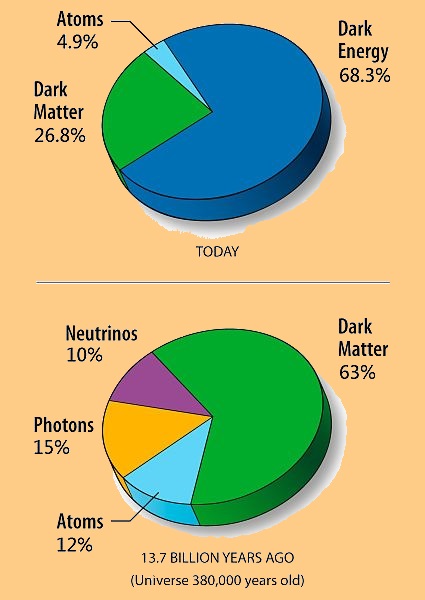
Estimated distribution of matter and energy in the universe, today (top) and when the cosmic microwave background (CMB) was released (bottom)
The standard model of Big Bang cosmology is the simplest model that provides a reasonably good account of the following properties of the cosmos:
The standard model assumes that general relativity is the correct theory of gravity on cosmological scales. The theory emerged in the late 1990s after a period when disparate observed properties of the universe appeared mutually inconsistent, and there was no consensus on the makeup of the energy density of the universe.
Many things about the nature of dark energy remain matters of speculation. The evidence for dark energy is indirect but comes from three independent sources:
Dark energy is thought to be very homogeneous, not very dense and is not known to interact through any of the fundamental forces other than gravity. Since it is quite rarefied – roughly 10−29 g/m3 – it is unlikely to be detectable in laboratory experiments. Dark energy can have such a profound effect on the universe, making up 68% of universal density, only because it uniformly fills otherwise empty space. The two leading explanations are a cosmological constant and quintessence.
The cosmological constant is a constant energy density filling space homogeneously. Contributions from scalar fields that are constant in space are usually also included in the cosmological constant. The cosmological constant can be formulated to be equivalent to vacuum energy. Quintessence or moduli are dynamic quantities whose energy density can vary in time and space. Scalar fields which do change in space can be difficult to distinguish from a cosmological constant because the change may be extremely slow. Both models include the common characteristic that dark energy must have a small constant negative pressure of vacuum.
High-precision measurements of the expansion of the universe are required to understand how the expansion rate changes over time. In general relativity, the evolution of the expansion rate is governed by the relationship between temperature, pressure, and combined matter, energy, and vacuum energy density for any region of space. Measuring dark energy is one of the biggest efforts in observational cosmology today.
Adding the cosmological constant to cosmology’s standard model leads to a new “standard model” of cosmology because of its precise agreement with observations. Dark energy has been used as a crucial ingredient in a recent attempt to formulate a cyclic model for the universe.
Independently of its actual nature, dark energy would need to have a strong negative pressure (acting repulsively) in order to explain the observed acceleration of the expansion of the universe.
According to General Relativity, the pressure within a substance contributes to its gravitational attraction for other things just as its mass density does. This happens because the physical quantity that causes matter to generate gravitational effects contains both the energy (or matter) density of a substance and its pressure and viscosity.
A strong constant negative pressure in all the universe causes an acceleration in universe expansion if the universe is already expanding, or a deceleration in universe contraction if the universe is already contracting. This accelerating expansion effect is sometimes called “gravitational repulsion”, which is a colourful but possibly confusing expression. In fact a negative pressure does not influence the gravitational interaction between masses – which remains attractive – but rather alters the overall evolution of the universe at the cosmological scale, typically resulting in the accelerating expansion of the universe despite the attraction among the masses present in the universe.
The acceleration is simply a function of dark energy density. Dark energy is persistent: its density remains constant (experimentally, within a factor of 1:10), i.e. it does not get diluted when space expands.
The simplest explanation for dark energy is that it is simply the “cost of having space”; that is, a volume of space has some intrinsic, fundamental energy. This is the cosmological constant, Λ (the Greek letter Lambda), the symbol used to represent this quantity mathematically. Since energy and mass are related by E = mc2, Einstein’s theory of general relativity predicts that this energy will have a gravitational effect. It is sometimes called a vacuum energy because it is the energy density of empty vacuum. In fact, most theories of particle physics predict vacuum fluctuations that would give the vacuum this sort of energy. The cosmological constant is estimated to be of the order of 10−29 g/cm3, or about 10−120 in reduced Planck units. Particle physics predicts a natural value of 1 in reduced Planck units, leading to a large discrepancy.
The cosmological constant has negative pressure equal to its energy density and so causes the expansion of the universe to accelerate. The reason why a cosmological constant has negative pressure can be seen from classical thermodynamics; energy must be lost from inside a container to do work on the container. A change in volume dV requires work done equal to a change of energy -P dV, where P is the pressure. But the amount of energy in a container full of vacuum actually increases when the volume increases (dV is positive), because the energy is equal to ρV, where ρ (Greek letter rho) is the energy density of the cosmological constant. Therefore, P is negative and, in fact, P = −ρ.
A major outstanding problem is that most quantum field theories predict a huge cosmological constant from the energy of the quantum vacuum, more than 100 orders of magnitude too large. This would need to be cancelled almost, but not exactly, by an equally large term of the opposite sign. Some supersymmetric theories require a cosmological constant that is exactly zero, which does not help because supersymmetry must be broken. The present scientific consensus amounts to extrapolating the empirical evidence where it is relevant to predictions, and fine-tuning theories until a more elegant solution is found. Technically, this amounts to checking theories against macroscopic observations. Unfortunately, as the known error-margin in the constant predicts the fate of the universe more than its present state, many such “deeper” questions remain unknown.
In spite of its problems, the cosmological constant is in many respects the most economical solution to the problem of cosmic acceleration. One number successfully explains a multitude of observations. Thus, the current standard model of cosmology includes the cosmological constant as an essential feature.
In quintessence models of dark energy, the observed acceleration of the scale factor is caused by the potential energy of a dynamical field, referred to as quintessence field. Quintessence differs from the cosmological constant in that it can vary in space and time. In order for it not to clump and form structure like matter, the field must be very light so that it has a large Compton wavelength.
No evidence of quintessence is yet available, but it has not been ruled out either. It generally predicts a slightly slower acceleration of the expansion of the universe than the cosmological constant. Some scientists think that the best evidence for quintessence would come from violations of Einstein’s equivalence principle and variation of the fundamental constants in space or time. Scalar fields are predicted by the standard model and string theory, but an analogous problem to the cosmological constant problem (or the problem of constructing models of cosmic inflation) occurs: renormalization theory predicts that scalar fields should acquire large masses.
The cosmic coincidence problem asks why the cosmic acceleration began when it did. If cosmic acceleration began earlier in the universe, structures such as galaxies would never have had time to form and life, at least as we know it, would never have had a chance to exist. Proponents of the anthropic principle view this as support for their arguments. However, many models of quintessence have a so-called tracker behaviour, which solves this problem. In these models, the quintessence field has a density which closely tracks (but is less than) the radiation density until matter-radiation equality, which triggers quintessence to start behaving as dark energy, eventually dominating the universe. This naturally sets the low energy scale of the dark energy.
Some alternatives to dark energy aim to explain the observational data by a more refined use of established theories, focusing, for example, on the gravitational effects of density inhomogeneities, or on consequences of electroweak symmetry breaking in the early universe. If we are located in an emptier-than-average region of space, the observed cosmic expansion rate could be mistaken for a variation in time, or acceleration. A different approach uses a cosmological extension of the equivalence principle to show how space might appear to be expanding more rapidly in the voids surrounding our local cluster. While weak, such effects considered cumulatively over billions of years could become significant, creating the illusion of cosmic acceleration, and making it appear as if we live in a Hubble bubble.
Another class of theories attempts to come up with an all-encompassing theory of both dark matter and dark energy as a single phenomenon that modifies the laws of gravity at various scales. An example of this type of theory is the theory of dark fluid. Another class of theories that unifies dark matter and dark energy are suggested to be covariant theories of modified gravities. These theories alter the dynamics of the space-time such that the modified dynamic stems what have been assigned to the presence of dark energy and dark matter.
A 2011 paper argued that it is likely that the accelerated expansion of the universe is an illusion caused by the relative motion of us to the rest of the universe. The paper cites data showing that the 2.5 billion light-year-wide region of space we are inside is moving very quickly relative to everything around it. If the theory is confirmed, then dark energy would not exist (but the “dark flow” still might).
Some theorists think that dark energy and cosmic acceleration are a failure of general relativity on very large scales, larger than superclusters. However most attempts at modifying general relativity have turned out to be either equivalent to theories of quintessence, or inconsistent with observations. Other ideas for dark energy have come from string theory, brane cosmology and the holographic principle, but have not yet proved as compellingly as quintessence and the cosmological constant.
On string theory, an article in the journal Nature described “String theories, popular with many particle physicists, make it possible, even desirable, to think that the observable universe is just one of 10,500 universes in a grander multiverse”, says Leonard Susskind, a cosmologist at Stanford University in California. “The vacuum energy will have different values in different universes, and in many or most it might indeed be vast. But it must be small in ours because it is only in such a universe that observers such as ourselves can evolve.” Paul Steinhardt in the same article criticizes string theory’s explanation of dark energy stating “...Anthropics and randomness don’t explain anything... I am disappointed with what most theorists are willing to accept”.
Another set of proposals is based on the possibility of a double metric tensor for space-time. It has been argued that time reversed solutions in general relativity require such double metric for consistency, and that both dark matter and dark energy can be understood in terms of time reversed solutions of general relativity.
Cosmologists estimate that the acceleration began roughly 5 billion years ago. Before that, it is thought that the expansion was decelerating, due to the attractive influence of dark matter and baryons. The density of dark matter in an expanding universe decreases more quickly than dark energy, and eventually the dark energy dominates. Specifically, when the volume of the universe doubles, the density of dark matter is halved, but the density of dark energy is nearly unchanged (it is exactly constant in the case of a cosmological constant).
If the acceleration continues indefinitely, the ultimate result will be that galaxies outside the local supercluster will have a line-of-sight velocity that continually increases with time, eventually far exceeding the speed of light. This is not a violation of special relativity because the notion of “velocity” used here is different from that of velocity in a local inertial frame of reference, which is still constrained to be less than the speed of light for any massive object. Because the Hubble parameter is decreasing with time, there can actually be cases where a galaxy that is receding from us faster than light does manage to emit a signal which reaches us eventually. However, because of the accelerating expansion, it is projected that most galaxies will eventually cross a type of cosmological event horizon where any light they emit past that point will never be able to reach us at any time in the infinite future because the light never reaches a point where its “peculiar velocity” toward us exceeds the expansion velocity away from us. Assuming the dark energy is constant (a cosmological constant), the current distance to this cosmological event horizon is about 16 billion light years, meaning that a signal from an event happening at present would eventually be able to reach us in the future if the event were less than 16 billion light years away, but the signal would never reach us if the event were more than 16 billion light years away.
As galaxies approach the point of crossing this cosmological event horizon, the light from them will become more and more red-shifted, to the point where the wavelength becomes too large to detect in practice and the galaxies appear to disappear completely. The Earth, the Milky Way, and the Virgo Supercluster, however, would remain virtually undisturbed while the rest of the universe recedes and disappears from view. In this scenario, the local supercluster would ultimately suffer heat death, just as was thought for the flat, matter-dominated universe before measurements of cosmic acceleration.
There are some very speculative ideas about the future of the universe. One suggests that phantom energy causes divergent expansion, which would imply that the effective force of dark energy continues growing until it dominates all other forces in the universe. Under this scenario, dark energy would ultimately tear apart all gravitationally bound structures, including galaxies and solar systems, and eventually overcome the electrical and nuclear forces to tear apart atoms themselves, ending the universe in a “Big Rip”. On the other hand, dark energy might dissipate with time or even become attractive. Such uncertainties leave open the possibility that gravity might yet rule the day and lead to a universe that contracts in on itself in a “Big Crunch”. Some scenarios, such as the cyclic model, suggest this could be the case. It is also possible the universe may never have an end and continue in its present state forever. While these ideas are not supported by observations, they are not ruled out.
In 1998, published observations of Type Ia supernovae (“one-A”) by the High-Z Supernova Search Team followed in 1999 by the Supernova Cosmology Project suggested that the expansion of the universe is accelerating. The 2011 Nobel Prize in Physics was awarded to Saul Perlmutter, Brian P. Schmidt and Adam G. Riess for this work.
Since then, these observations have been corroborated by several independent sources. Measurements of the cosmic microwave background, gravitational lensing, and the large-scale structure of the cosmos as well as improved measurements of supernovae have been consistent with the Lambda-CDM model. Some people argue that the only indication for the existence of dark energy is observations of distance measurements and associated redshifts. Cosmic microwave background anisotropies and baryon acoustic oscillations are only observations that redshifts are larger than expected from a “dusty” Friedmann – Lemaître universe and the local measured Hubble constant.
Supernovae are useful for cosmology because they are excellent standard candles across cosmological distances. They allow the expansion history of the Universe to be measured by looking at the relationship between the distance to an object and its redshift, which gives how fast it is receding from us. The relationship is roughly linear, according to Hubble’s law. It is relatively easy to measure redshift, but finding the distance to an object is more difficult. Usually, astronomers use standard candles: objects for which the intrinsic brightness, the absolute magnitude, is known. This allows the object’s distance to be measured from its actual observed brightness, or apparent magnitude. Type Ia supernovae are the best-known standard candles across cosmological distances because of their extreme and extremely consistent luminosity.
Recent observations of supernovae are consistent with a universe made up 71.3% of dark energy and 27.4% of a combination of dark matter and baryonic matter.
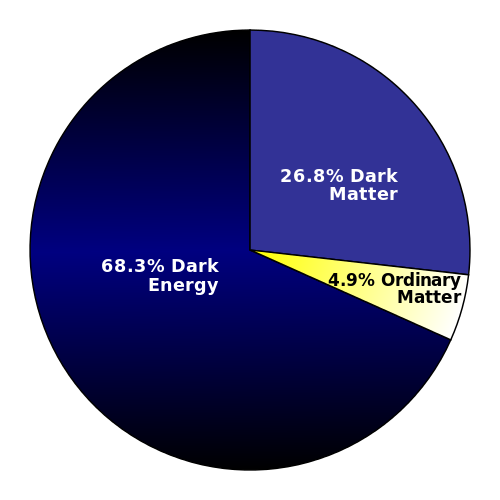
Estimated distribution of matter and energy in the universe
The existence of dark energy, in whatever form, is needed to reconcile the measured geometry of space with the total amount of matter in the universe. Measurements of cosmic microwave background (CMB) anisotropies indicate that the universe is close to flat. For the shape of the universe to be flat, the mass/energy density of the universe must be equal to the critical density. The total amount of matter in the universe (including baryons and dark matter), as measured from the CMB spectrum, accounts for only about 30% of the critical density. This implies the existence of an additional form of energy to account for the remaining 70%. The Wilkinson Microwave Anisotropy Probe (WMAP) spacecraft seven-year analysis estimated a universe made up of 72.8% dark energy, 22.7% dark matter and 4.5% ordinary matter. Work done in 2013 based on the Planck spacecraft observations of the CMB gave a more accurate estimate of 68.3% of dark energy, 26.8% of dark matter and 4.9% of ordinary matter.
The theory of large-scale structure, which governs the formation of structures in the universe (stars, quasars, galaxies and galaxy groups and clusters), also suggests that the density of matter in the universe is only 30% of the critical density.
A 2011 survey, the WiggleZ galaxy survey of more than 200,000 galaxies, provided further evidence towards the existence of dark energy, although the exact physics behind it remains unknown. The WiggleZ survey from Australian Astronomical Observatory scanned the galaxies to determine their redshift. Then, by exploiting the fact that baryon acoustic oscillations have left voids regularly of about 150 megaparsec diameter, surrounded by the galaxies, the voids were used as standard rulers to determine distances to galaxies as far as 2,000 Mpc (redshift 0.6), which allowed astronomers to determine more accurately the speeds of the galaxies from their redshift and distance. The data confirmed cosmic acceleration up to half of the age of the universe (7 billion years) and constrain its inhomogeneity to 1 part in 10. This provides a confirmation to cosmic acceleration independent of supernovae.
Accelerated cosmic expansion causes gravitational potential wells and hills to flatten as photons pass through them, producing cold spots and hot spots on the CMB aligned with vast supervoids and superclusters. This so-called late-time Integrated Sachs – Wolfe effect (ISW) is a direct signal of dark energy in a flat universe. It was reported at high significance in 2008 by Ho et al. and Giannantonio et al.
A new approach to test evidence of dark energy through observational Hubble constant (H(z)) data (OHD) has gained significant attention in recent years. The Hubble constant is measured as a function of cosmological redshift. OHD directly tracks the expansion history of the universe by taking passively evolving early-type galaxies as “cosmic chronometers”. From this point, this approach provides standard clocks in the universe. The core of this idea is the measurement of the differential age evolution as a function of redshift of these cosmic chronometers. Thus, it provides a direct estimate of the Hubble parameter H(z)=−1/(1+z)dz/dt≅−1/(1+z)Δz/Δt. The merit of this approach is clear: the reliance on a differential quantity, Δz/Δt, can minimize many common issues and systematic effects; and as a direct measurement of the Hubble parameter instead of its integral, like supernovae and baryon acoustic oscillations (BAO), it brings more information and is appealing in computation. For these reasons, it has been widely used to examine the accelerated cosmic expansion and study properties of dark energy.
The cosmological constant was first proposed by Einstein as a mechanism to obtain a solution of the gravitational field equation that would lead to a static universe, effectively using dark energy to balance gravity. Not only was the mechanism an inelegant example of fine-tuning but it was also later realized that Einstein’s static universe would actually be unstable because local inhomogeneities would ultimately lead to either the runaway expansion or contraction of the universe. The equilibrium is unstable: If the universe expands slightly, then the expansion releases vacuum energy, which causes yet more expansion. Likewise, a universe which contracts slightly will continue contracting. These sorts of disturbances are inevitable, due to the uneven distribution of matter throughout the universe. More importantly, observations made by Edwin Hubble in 1929 showed that the universe appears to be expanding and not static at all. Einstein reportedly referred to his failure to predict the idea of a dynamic universe, in contrast to a static universe, as his greatest blunder.
The cosmological constant is the value of the energy density of the vacuum of space. It was originally introduced by Albert Einstein in 1917 as an addition to his general theory of relativity to “hold back gravity” and achieve a static universe, which was the accepted view at the time.
Alan Guth and Alexei Starobinsky proposed in 1980 that a negative pressure field, similar in concept to dark energy, could drive cosmic inflation in the very early universe. Inflation postulates that some repulsive force, qualitatively similar to dark energy, resulted in an enormous and exponential expansion of the universe slightly after the Big Bang. Such expansion is an essential feature of most current models of the Big Bang. However, inflation must have occurred at a much higher energy density than the dark energy we observe today and is thought to have completely ended when the universe was just a fraction of a second old. It is unclear what relation, if any, exists between dark energy and inflation. Even after inflationary models became accepted, the cosmological constant was thought to be irrelevant to the current universe.
Nearly all inflation models predict that the total (matter+energy) density of the universe should be very close to the critical density. During the 1980s, most cosmological research focused on models with critical density in matter only, usually 95% cold dark matter and 5% ordinary matter (baryons). These models were found to be successful at forming realistic galaxies and clusters, but some problems appeared in the late 1980s: notably, the model required a value for the Hubble constant lower than preferred by observations, and the model under-predicted observations of large-scale galaxy clustering. These difficulties became stronger after the discovery of anisotropy in the cosmic microwave background by the COBE spacecraft in 1992, and several modified CDM models came under active study through the mid-1990s: these included the Lambda-CDM model and a mixed cold/hot dark matter model. The first direct evidence for dark energy came from supernova observations in 1998 of accelerated expansion in Riess et al. and in Perlmutter et al., and the Lambda-CDM model then became the leading model. Soon after, dark energy was supported by independent observations: in 2000, the BOOMERanG and Maxima cosmic microwave background experiments observed the first acoustic peak in the CMB, showing that the total (matter+energy) density is close to 100% of critical density. Then in 2001, the 2dF Galaxy Redshift Survey gave strong evidence that the matter density is around 30% of critical. The large difference between these two supports a smooth component of dark energy making up the difference. Much more precise measurements from WMAP in 2003-2010 have continued to support the standard model and give more accurate measurements of the key parameters.
The term “dark energy”, echoing Fritz Zwicky’s “dark matter” from the 1930s, was coined by Michael Turner in 1998.
As of 2013, the Lambda-CDM model is consistent with a series of increasingly rigorous cosmological observations, including the Planck spacecraft and the Supernova Legacy Survey. First results from the SNLS reveal that the average behaviour (i.e., equation of state) of dark energy behaves like Einstein’s cosmological constant to a precision of 10%. Recent results from the Hubble Space Telescope Higher-Z Team indicate that dark energy has been present for at least 9 billion years and during the period preceding cosmic acceleration.
