Cosmic Microwave Background Radiation (CMB or CMBR)

Arno Penzias and Robert Woodrow Wilson

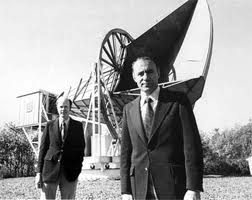
We know what the temperature of the universe is today, that is, we know the temperature far away from stars (which otherwise completely overwhelm the ‘background’ temperature). In 1964 scientists Arno Penzias and Robert Woodrow Wilson from the Bell Laboratories in Holmdel, New Jersey found that radiation that they could attribute to nothing else was being picked up by their radio telescopes. It corresponded to a temperature of approximately 3 K, and seemed to be coming uniformly from all directions in space, with no perceivable differences.

This radiation was attributed to the relics of the Big Bang, and represented the cooling down of the universe since the Big Bang. One immediate question was why was it so uniform? Why were there no ‘hot-spots’ or cold areas in it?

Several artificial satellites that were ‘tuned’ to the microwave frequency of this radiation were launched, to look for fluctuations in the radiation. Such telescopes included the Russian RELIKT-1 and the American COBE.

The data from these satellites was mapped and showed that the temperature was indeed constant, and with variations so tiny that they were difficult to explain.


For further information about any of the people or satellites named, or any of the terms used, look them up on Wikipedia or a guide to cosmology.

See also the sections of this web site about
• The Big Bang • Gravitational Waves • Dark Matter and Dark Energy

Cosmic Microwave Background Radiation
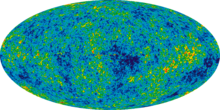
Cosmic Microwave Background Radiation: A WMAP image of the temperature anisotropy.

The ESA Planck satellite (shown below the map) has recently mapped the CMBR to an even greater level of accuracy; here is their latest map
Planck CMBR map
The Planck satellite’s CMBR map; red indicates zones a smidgeon warmer than average, blue colder.
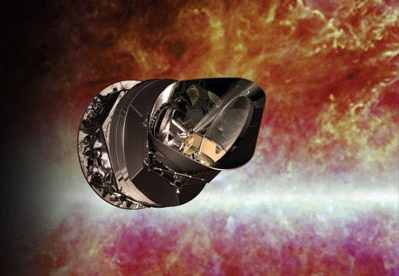
Planck spacecraft and the Milky Way
ESA’s Planck satellite with a background of part of the Milky Way

Cosmic background radiation is well explained as radiation left over from an early stage in the development of the universe, and its discovery is considered a landmark test of the Big Bang model of the universe. When the universe was young, before the formation of stars and planets, it was smaller, much hotter, and filled with a uniform glow from its white-hot fog of plasma. As the universe expanded, both the plasma and the radiation filling it grew cooler. When the universe cooled enough, protons and electrons could form neutral atoms. These atoms could no longer absorb the thermal radiation, and the universe became transparent instead of being an opaque fog. The photons that existed at that time have been propagating ever since, though growing fainter and less energetic, since exactly the same photons fill a larger and larger universe. This is the source for the alternate term relic radiation.

Precise measurements of cosmic background radiation are critical to cosmology, since any proposed model of the universe must explain this radiation. The CMBR has a thermal black body spectrum at a temperature of 2.725 K.

The glow is very nearly uniform in all directions, but the tiny remaining variations (anisotrophies) show a very specific pattern equal to that expected if a fairly uniformly distributed hot gas is expanded to the current size of the universe. In particular, the spatial power spectrum (how much difference is observed versus how far apart the regions are on the sky) contains small irregularities which vary with the size of the region examined.

They have been measured in detail, and match what would be expected if small thermal variations, generated by quantum fluctuations of matter in a very tiny space, had expanded to the size of the observable universe we see today. This is still a very active field of study, with scientists seeking both better data (for example, the Planck spacecraft) and better interpretations of the initial conditions of expansion.

Although many different processes might produce the general form of a black body spectrum, no model other than the Big Bang has yet explained the fluctuations. As a result, most cosmologists consider the Big Bang model of the universe to be the best explanation for the CMBR.

The radiation is smooth to roughly one part in 100,000.

The mechanism for producing such a uniform ‘glow’ is explained by the inflation component of the theory of quantum mechanics. It can only be explained if objects which end up on opposite sides of the current universe are ‘in touch’ with each other at some stage. If they are in touch at some stage, they can exchange energy in such a way that they have similar or compatible properties. Without this contact, the universe would have burst like a toy balloon, flinging material of all sizes and properties in a very random manner.

Before inflation, such contact was possible; without it the universe would probably have expanded at a very slow rate (remember its expansion factor of 1058 times the speed of light with inflation), and the result would have been very irregular like the relics of the toy balloon.
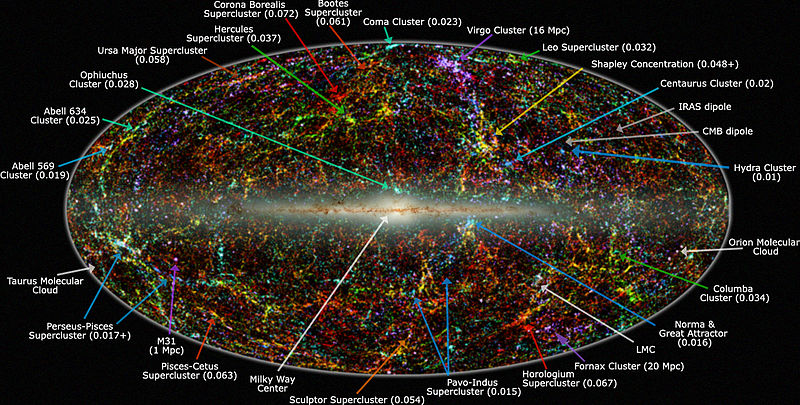

Chart from NASA of the CMB

This panoramic view of the entire near-infrared sky reveals the distribution of galaxies beyond the Milky Way.
The galaxies are colour-coded by red-shift; the numbers are measures of the red-shifts of groups of galaxies.
Timetable of the CMBR Discovery

1929
Edwin Hubble
In 1929, Edwin Hubble (1889 — 1953) [right] discovered that the distances to far away galaxies were generally proportional to their red-shifts — an idea originally suggested by Lemaître (below) in 1927. Hubble’s observation was taken to indicate that all very distant galaxies and clusters have an apparent velocity directly away from our vantage point: the farther away, the higher the apparent velocity.
1931
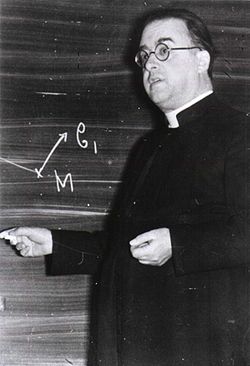
Georges Lemaître
Georges Lemaître (1894 — 1966) [left], a Belgian priest and cosmologist, first proposed what would become the Big Bang theory in his “hypothesis of the primeval atom.”, a radical departure from scientific orthodoxy in the 1930s. Many astronomers at the time were still uncomfortable with the idea that the universe is expanding. That the entire observable universe of galaxies began with a bang seemed preposterous.
Andrew McKellar

1941
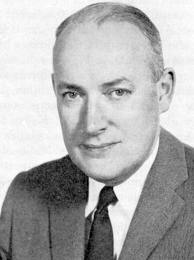
Andrew McKellar (1910 — 1960) [right], a Canadian astronomer, was attempting to measure the average temperature of the interstellar medium, and reported the observation of an average bolometric temperature of 2.3 K based on the study of interstellar absorption lines.
1946
Robert H Dicke
George Gamow
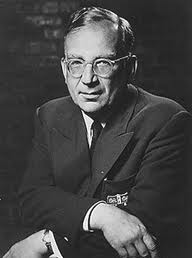
Robert H Dicke (1916 — 1997) [left], an American physicist, predicted “...radiation from cosmic matter” at <20 K but he did not refer to background radiation.
1948
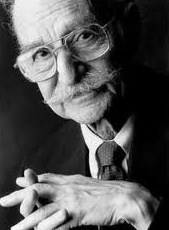
George Gamow, Russian: Геóргий Антóнович Гáмов, (1904 — 1968) [right], a Russian-born theoretical physicist and cosmologist, calculated a temperature of 50 K, assuming a 3-billion-year old Universe, commenting “...it is in reasonable agreement with the actual temperature of interstellar space”, but he did not mention background radiation. George Gamow introduced big bang nucleosynthesis (BBN) and his associates, Ralph Alpher and Robert Herman, predicted the cosmic microwave background radiation (CMB). Gamow’s book One Two Three ... Infinity: Facts and Speculations of Science inspired me, as a teenager, to become much more interested in cosmology; I had the book constantly on loan from my local public library for months.
1948
Ralph Alpher Robert Herman
Ralph Alpher (1921 – 2007) and Robert Herman (1914 – 1997) [pictured], both U.S. cosmologists, estimated “the temperature in the Universe” at 5 K. Although they did not specifically mention microwave background radiation, it may be inferred.

[More in next column]

[From previous column]

March 1949
Sir Fred Hoyle
Sir Fred Hoyle FRS (1915 — 2001) is credited with coining the term Big Bang during a radio broadcast. It is popularly reported that Hoyle, who favoured an alternative “steady state” cosmological model, intended this to be pejorative, but Hoyle explicitly denied this and said it was just a striking image meant to highlight the difference between the two models. (In the steady state model, new matter would be created as the Universe expanded; in this model, the Universe is roughly the same at any point in time.)
1950
Alpher and Herman re-estimated the temperature at 28 K.
1953
Gamow estimated 7 K.
1955
Émile Le Roux of the Nançay Radio Observatory, in a sky survey at λ=33 cm, reported a near-isotropic background radiation of 3 K ±2.
1956
Gamow estimated 6 K.
1957
Tigran Shmaonov reported that “the absolute effective temperature of the radioemission background... is 4±3K”. He noted that the “measurements showed that radiation intensity was independent of either time or direction of observation...” It is now clear that Shmaonov did observe the cosmic microwave background at a wavelength of 3.2 cm.
1960s
Dicke re-estimated a MBR (microwave background radiation) temperature of 40 K.
1964
A G Doroshkevich and Igor Novikov (Soviet physicists) published a brief paper, where they said the CMB radiation phenomenon was detectable.
1964 — 65
Arno Penzias (born 1933) and Robert Woodrow Wilson (born 1936), American physicists and astronomers and Nobel laureates) measured the temperature to be approximately 3 K. Dicke, P J E Peebles, P G Roll, and D T Wilkinson interpreted this radiation as a signature of the big bang.
1983
RELIKT-1 (Russian: РЕЛИКТ-1), a Soviet CMB anisotropy experiment was launched on board the Prognoz 9 (Прогноз-9) satellite, launched on 1st July 1983 [COSPAR ID: 1983-067A].
1990
FIRAS (Far-InfraRed Absolute Spectrophotometer) on COBE (COsmic Background Explorer, also referred to as Explorer 66, a satellite dedicated to cosmology, launched November 18, 1989 [COSPAR ID: 1989-089A]) measured the black body form of the CMB spectrum with exquisite precision.
April 1992
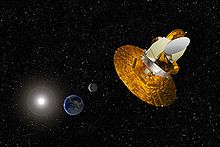
Wilkinson Microwave Anisotropy Probe (WMAP)
Scientists who analysed data from COBE DMR (Differential Microwave Radiometer) announced the discovery of the primary temperature anisotropy.
1999
First measurements of acoustic oscillations in the CMB anisotropy angular power spectrum from the TOCO, BOOMERANG, and Maxima Experiments.
June 2001
Wilkinson Microwave Anisotropy Probe (WMAP) [right], also referred to as Explorer 80, launched [COSPAR ID: 2001-027A].
2002
Polarization discovered by DASI, part of NASA’s ERAST Project.
2004
E-mode polarization spectrum obtained by the Cosmic Background Imager (CBI) in the Chilean Andes.
2005
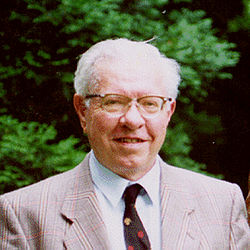
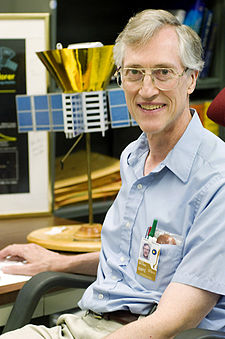
John C Mather
George Smoot
Alpher awarded the National Medal of Science for his ground-breaking work in nucleosynthesis and prediction that the universe expansion leaves behind background radiation, thus providing a model for the Big Bang theory.
2006
Two of COBE’s principal investigators, John C Mather and George Smoot [pictured here], received the Nobel Prize in Physics for their work on precision measurement of the CMBR.