The Big Bang

Wikipedia Articles about the Big Bang

These articles, others in Wikipedia, and their associated links, may help to explain this subject better than I can:

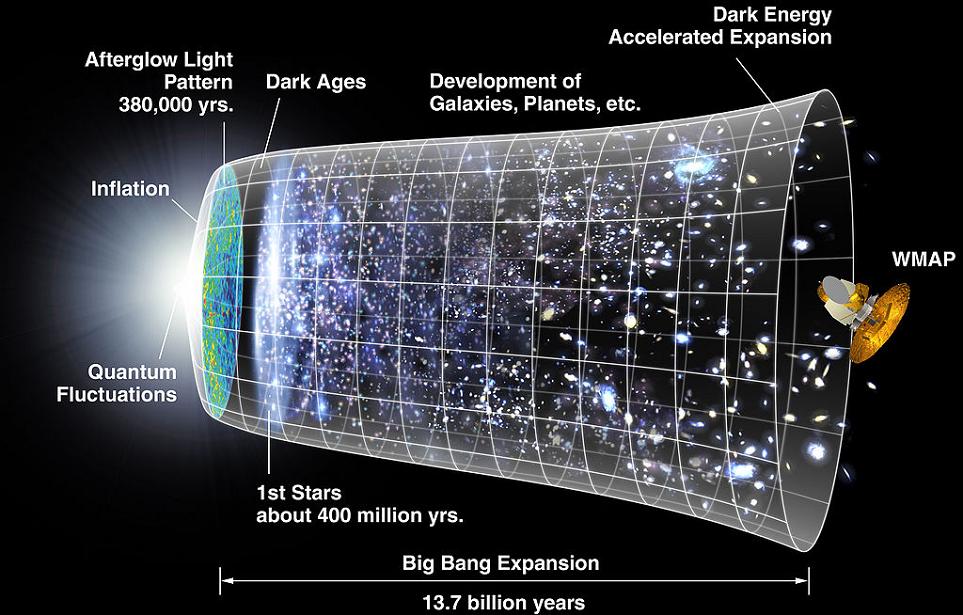
Expansion Timeline

I believe the most recent age of the universe has been refined to 13.82 billion years – but then what’s 120 million years between friends?
WMAP is the Wilkinson Microwave Anisotropy Probe

Time Zero and a Tiny Bit More

Forget about Bishop James Ussher (1581 – 1656), Archbishop of Armagh, Primate of All Ireland, and Vice-Chancellor of Trinity College, Dublin, who ‘calculated’ from an intricate correlation of Middle Eastern and Mediterranean histories and Holy Writ that the first day of creation was Sunday 23rd October 4004 BCE (though the time of 9 o’clock in the morning is wrongly attributed to Ussher), that Adam and Eve were driven from Paradise on Monday 10th November 4004 BCE, and that the ark touched down on Mount Ararat on 5th May 2348 BCE ‘on a Wednesday’. Poppycock! Though there are no doubt some ‘born-again’ idiots who believe it all.

The Universe is believed by most scientists to be about 13.7 billion (that’s 13.7 × 109) years old. (The most recent figure is 13.75 ± 0.13 billion years, that’s 4.336 × 1017 seconds in SI units).

A light-year is the distance light travels in one year, about 9.4605284 × 1015 metres. (Note that a light-year is a distance.)

The speed of light is 299,792,458 metres per second (let’s use the figure 300,000 kilometres a second, 186,000 miles a second or 700 million miles an hour in these explanations, for the sake of simplicity) — those figures are approximate, but the true figure is, in a perfect vacuum, an exact constant speed, not one centimetre per second more nor one centimetre per second less. And that is its speed regardless of the speed of an observer — so if one observer was moving towards an object at say 100,000 kilometres a second, and another observer was moving away from that same object at 100,000 kilometres a second, they would both measure the speed of light as having the same value, approximately 300,000 kilometres a second. This is not the same as the analogy often made with the Doppler effect and the sound of moving vehicles — that’s more analogous to the wavelength or frequency of the light, not its speed. Albert Einstein based his Theories of Relativity on the observed fact that the speed of light never changed.

Scientists believe they know what the universe has been like for the last twelve or more billion years. And they believe that its general appearance and properties are much the same as they are now. (This leaves to one side that the universe is expanding, and therefore stars and galaxies are getting further apart. It also ignores the changes that take place within stars and galaxies, their ‘evolution’, which results in the production of all the heavy elements.)

Before that, things get rather more uncertain, though the Standard model of the universe has some fairly certain views of how it was. In particular, the theory has quite a lot to say about the first few moments of the universe’s existence, and up to 370,000 years.

Back to a Tiny Bit after Time Zero

We can think of ‘time zero’, but we don’t know what the universe was like then. Quantum mechanics doesn’t have anything to say about it. Indeed, it can’t because, as I said in the discussion of the uncertainty principle, energy changes multiplied by time differences is subject to a forced minimum value, according to the uncertainty principle. So if we ask about a specific (micro) time, time 0, we can know nothing about the energy state of the object we’re interested in. Although Planck’s constant is minute, quantum mechanics cannot even begin to tell us anything about the early universe.

The earliest phases of the Big Bang are subject to much speculation. In the most common models, the universe was filled homogeneously and isotropically with an incredibly high energy density and huge temperatures and pressures and was very rapidly expanding and cooling.

It is not until we reach time 10-43 second (that is to say, 10-43 second after our supposed time 0) that quantum mechanics tells us anything about the possible condition of the universe. A phase transition at around that time (possibly at time 10-37 or 10-35 second) caused a cosmic inflation, during which the universe grew at an enormously fast rate.

Back From Our Digression Into Uncertainty

What the Uncertainty Principle and Quantum Mechanics tell us is that whatever happened before the universe was 10-43 second old (if the word “before” has any meaning here) is unknowable, not just unknown.

At this point, approximately 13.7 billion years ago, the force of gravity is believed to have been as powerful as the other fundamental forces (weak, strong and electromagnetic), which hints at the possibility that all the forces were unified, in other words, all the same thing. Inconceivably hot and dense, the state of the universe during the Planck epoch was unstable or transitory, tending to evolve, giving rise to the familiar manifestations of the fundamental forces through a process known as symmetry breaking (see below). Modern cosmology now suggests that the Planck epoch may have inaugurated a period of unification or the Grand unification epoch, and that symmetry breaking then quickly led to the era of cosmic inflation, the Inflationary epoch, during which the universe greatly expanded in scale over a very short period of time.

As there presently exists no widely accepted framework for how to combine quantum mechanics with relativistic gravity, science is not currently able to make predictions about events occurring over intervals shorter than the Planck time or distances shorter than one Planck length, the distance light travels in one Planck time — about 1.616 × 10-35 metre. Without an understanding of quantum gravity, a theory unifying quantum mechanics and relativistic gravity, the physics of the Planck epoch are unclear, and the exact manner in which the fundamental forces were unified, and how they came to be separate entities, is still poorly understood. Three of the four forces have been successfully integrated in a common framework, but gravity remains problematic. If quantum effects are ignored, the universe starts from a singularity (a single point) with an infinite density. This conclusion could change when quantum gravity is taken into account.

String theory and Loop quantum gravity are leading candidates for a theory of unification, which have yielded meaningful insights already, but work in noncommutative geometry and other fields also holds promise for our understanding of the very beginning.

Phase Transitions and Symmetry Breaking

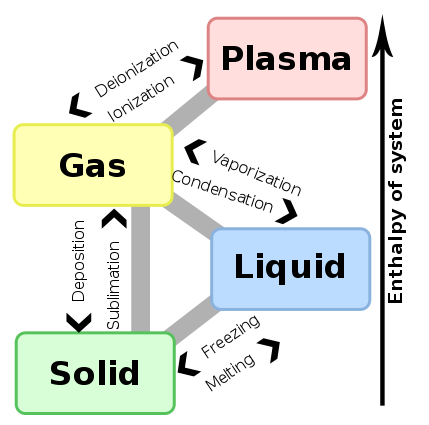
Phase Transition

This diagram shows the nomenclature for the different phase transitions. Enthalpy is a measure of the total energy of a thermodynamic system. It includes the internal energy, which is the energy required to create a system, and the amount of energy required to make room for it by displacing its environment and establishing its volume and pressure

Phase Transitions and Symmetry Breaking are closely related concepts. The most common example of phase transitions concerns the behaviour of water. When it is very cold, it is ‘ice’, a solid. Warming it up causes a phase transition from a solid to a liquid, and it becomes ‘water’. A further transition occurs when the water is heated further to become ‘steam’, a gas. So phase transitions occur, for water, normally at about 273 K and 373 K.

A phase transition is the transformation of a thermodynamic system from one phase (state of matter) to another. A specific phase of a thermodynamic system and the states of matter have uniform physical properties.

During a phase transition of a given medium certain properties of the medium change, often discontinuously, as a result of some external condition, such as temperature, pressure, and others. For example, a liquid may become gas upon heating to the boiling point, resulting in an abrupt change in volume. The measurement of the external conditions at which the transformation occurs is termed the phase transition point.

Phase transitions are common occurrences observed in nature and many engineering techniques exploit certain types of phase transition. The term is most commonly used to describe transitions between solid, liquid and gaseous states of matter, in rare cases including plasma.

Symmetry-breaking phase transitions play an important role in cosmology. It has been speculated that, in the hot early universe, the ‘vacuum’ (by which we mean the various quantum fields that fill space) possessed a large number of symmetries. As the universe expanded and cooled, the vacuum underwent a series of symmetry-breaking phase transitions. For example, the electroweak transition broke the SU(2)×U(1) symmetry of the electroweak field into the U(1) symmetry of the present-day electromagnetic field. (Don’t worry about these mathematical terms; they are the sort of things that earn people Nobel Prizes!). This transition is important to understanding the asymmetry between the amount of matter and antimatter in the present-day universe. See Wikipedia for a description of symmetry-breaking phase transitions.

Books on Cosmology and Quantum Mechanics

Superstrings and the Search for the Theory of Everything: F. David Peat, Contemporary Books, 1988

A Brief History of Time: Stephen Hawking, Bantam Books, 1988

In Search of Schrödinger’s Cat: Quantum Physics and Reality, John Gribbin, Black Swan, 1991

Black Holes & Time Warps: Einstein’s Outrageous Legacy, Kip S Thorne, W W Norton & Co, 1994

The Elegant Universe: Superstrings, Hidden Dimensions, and the Quest for the Ultimate Theory, Brian Greene, Vintage, 2000

Before the Beginning: Our Universe and Others, Martin Rees, Free Press, 2002

The Big Bang: A View from the 21st Century, David M Harland, Springer-Praxis, 2003

The Fabric of the Cosmos: Space, Time, and the Texture of Reality, Brian Greene, Penguin Books, 2004

Big Bang: The most important scientific discovery of all time and why you need to know about it, Simon Singh, Harper Perennial, 2005

How Old is the Universe?: David A Weintraub, Princeton University Press, 2011

Higgs (The Invention & Discovery of the ‘God Particle’): Jim Baggott, Oxford University Press, 2012

Inflation

When inflation occurred it increased the volume of the universe by a factor of approximately 1050. Inflation lasted until the universe was 10-34 second old. The diameter of the universe increased from one billionth the diameter of a proton (about 1.6×10⁻²⁵ metre) to the size of a grapefruit (about 10-1 metre in diameter). Such an increase, of the order of 1024 times took place in 10-34 second, a ‘speed’ of 1058 metres per second!

That’s of the order of 1058 times the speed of light!

This does not violate Einstein’s limit on movement above the speed of light. Remember, we are talking here of the real fabric of the universe which is expanding; Einstein speaks only of objects within the universe — you or I or a photon cannot travel at more than 300,000 kilometres a second according to Einstein. But he has nothing to say about the fabric of the universe itself.

A Brief Digression Into Uncertainty

In physical cosmology, the Planck epoch (or Planck era), named after Max Planck, is the earliest period of time in the history of the universe, from zero to approximately 10-43 second (Planck time), during which, it is believed, quantum effects of gravity were significant. One could also say that it is the earliest moment in time, as the Planck time is perhaps the shortest possible interval of time, and the Planck epoch lasted only this brief instant.

Quantum mechanics is the name for the scientific principles that explain the behaviour of matter and its interactions with energy on the scale of atoms and atomic particles.

Classical physics (that is, physics based on the principles developed by Sir Isaac Newton explains matter and energy at the macroscopic level, the scale familiar to human experience, including the behaviour of astronomical bodies. It remains the key to measurement for much of modern science and technology; but at the end of the 19th Century observers discovered phenomena in both the large (macro) and the small (micro) worlds that classical physics could not explain. Coming to terms with these limitations led to the development of quantum mechanics, a major revolution in physics.

Some aspects of quantum mechanics can seem counter-intuitive, because they describe behaviour quite different from that seen at larger length scales, where classical physics is an excellent approximation. In the words of Richard Feynman, quantum mechanics deals with “nature as she is – absurd.”. Or, as Niels Bohr put it, “...those who are not shocked when they first come across quantum theory cannot possibly have understood it,” – quoted in Heisenberg, Physics and Beyond (New York: Harper and Row, 1971).


The Heisenberg Uncertainty Principle

In quantum mechanics, the Heisenberg Uncertainty Principle defines a fundamental limit on the accuracy with which certain pairs of physical properties of a particle, such as its position and its momentum, can be simultaneously known. The more precisely one of these is measured, the less precisely the other can be controlled, determined, or known.

Published by Werner Heisenberg (1901 — 1976) in 1927, the uncertainty principle was a key discovery in the early development of quantum theory. It implies that it is impossible to simultaneously measure the present position while also determining the future motion of a particle, or of any system small enough to require quantum mechanical treatment.

Intuitively, the principle can be understood by considering a typical measurement of a particle. It is impossible to determine both momentum and position by means of the same measurement. Assume that its initial momentum has been accurately calculated by measuring its mass, the force applied to it, and the length of time it was subjected to that force. Then to measure its position after it is no longer being accelerated would require another measurement to be done by scattering light or other particles off it. But each such interaction will alter its momentum by an unknown and indeterminable increment, degrading our knowledge of its momentum while augmenting our knowledge of its position. So Heisenberg argues that every measurement destroys part of our knowledge of the system that was obtained by previous measurements.

The uncertainty principle states a fundamental property of quantum systems, and it is NOT a statement about the observational success of current technology. It does not mean that our scientific experiments are inadequate in some way; it means that we CANNOT now, nor will ever be able to measure the system with greater accuracy.

The principle states specifically that the product of the uncertainties in position and momentum is always equal to or greater than one half of the reduced Planck constant denoted by ℏ, which is defined as the re-scaling ℎ/(2π) of the Planck constant ℎ. (Mathematically, the uncertainty relation between position and momentum arises because the expressions of the wave function in the two corresponding bases are Fourier transforms of one another [that is, position and momentum are conjugate variables]. In the mathematical formulation of quantum mechanics, any non-commuting operators are subject to similar uncertainty limits.)

The Planck constant has dimensions of physical action; these are the same as those of angular momentum, that is, energy multiplied by time, or momentum multiplied by distance. In SI units, the Planck constant is expressed in joule seconds.

ℏ is 1.054571726×10⁻³⁴ J⋅s (which is 6.58211928×10⁻¹⁶ eV⋅s or 1.054571726×10⁻²⁷ erg⋅s).

Many types of energy, such as photons (discrete units of light), behave in some respects like particles and in other respects like waves. Radiators of photons (such as neon lights) have emission spectra that are discontinuous, in that only certain frequencies of light are present. Quantum mechanics predicts the energies, the colours, and the spectral intensities of all forms of electromagnetic radiation.

Heisenberg’s
Uncertainity Principle:
σxσp ≥ ½ℏ

where:
σx is the standard deviation of position, and σp is the standard deviation of momentum

But quantum mechanics theory says that the more closely one pins down one measure (such as the position of a particle), the less precise another measurement pertaining to the same particle (such as its momentum) must become. Put another way, measuring position first and then measuring momentum does not have the same outcome as measuring momentum first and then measuring position; the act of measuring the first property necessarily introduces additional energy into the micro-system being studied, thereby perturbing that system.

Even more disconcerting, pairs of particles can be created as entangled twins — which means that a measurement which pins down one property of one of the particles will instantaneously pin down the same or another property of its entangled twin, regardless of the distance separating them — though this may be regarded as merely a mathematical anomaly, rather than a real one.

Other than the position-momentum uncertainty relation, the most important uncertainty relation is that between energy and time. Nevertheless, Albert Einstein and Niels Bohr understood the heuristic meaning of the principle — a state that only exists for a short time cannot have a definite energy. To have a definite energy, the frequency of the state must accurately be defined, and this requires the state to hang around for many cycles, the reciprocal of the required accuracy.

Another common misconception is that the energy-time uncertainty principle says that the conservation of energy can be temporarily violated — energy can be ‘borrowed’ from the universe as long as it is ‘returned’ within a short amount of time. Although this agrees with the spirit of relativistic quantum mechanics, it is based on the false axiom that the energy of the universe is an exactly known parameter at all times. More accurately, when events transpire at shorter time intervals, there is a greater uncertainty in the energy of these events. Therefore it is not that the conservation of energy is violated when quantum field theory uses temporary electron-positron pairs in its calculations, but that the energy of quantum systems is not known with enough precision to limit their behaviour to a single, simple history. Thus the influence of all histories must be incorporated into quantum calculations, including those with much greater or much less energy than the mean of the measured or calculated energy distribution.

After Inflation

Elementary particles are described in another section.

After inflation stopped, the Universe consisted of a quark-gluon plasma, as well as all other elementary particles. Temperatures were so high that the random motions of particles were at relativistic speeds (speeds close to that of light), and particle-antiparticle pairs of all kinds were being continuously created and destroyed in collisions. At some point an unknown reaction called baryogenesis violated the conservation of baryon number, leading to a very small excess of quarks and leptons over antiquarks and antileptons — of the order of one part in 30 million. This resulted in the predominance of matter over antimatter in the present universe.

The universe continued to grow in size and fall in temperature, so the typical energy of each particle was decreasing. Symmetry-breaking phase transitions put the fundamental forces of physics and the parameters of elementary particles into their present form.

After about 10-11 seconds, the picture becomes less speculative, since particle energies drop to values that can be attained in particle physics experiments. At about 10-6 seconds, quarks and gluons combined to form baryons such as protons and neutrons. The small excess of quarks over antiquarks led to a small excess of baryons over antibaryons. The temperature was now no longer high enough to create new proton-antiproton pairs (similarly for neutrons-antineutrons), so a mass annihilation immediately followed, leaving just one in 1010 of the original protons and neutrons, and none of their antiparticles. A similar process happened at about 1 second for electrons and positrons. After these annihilations, the remaining protons, neutrons and electrons were no longer moving relativistically and the energy density of the universe was dominated by photons (with a minor contribution from neutrinos).

After 1.5 millionths of a second, the temperature had fallen to 1,000 billion (1012) K, at which point the number of protons and neutrons was frozen, because below this temperature these particles were too massive to be able to turn back into photons.

After 5 seconds, the temperature had fallen to 6 billion K, and the number of electrons was frozen, because below this temperature they were too massive to be able to turn back into photons.

After 3 minutes, it had fallen to 1 billion K, at which temperature protons are stable but neutrons can decay and the density was about that of air. There were seven times as many protons as neutrons, and all remaining neutrons were stable in deuterium or helium nuclei. Protons and neutrons collided to form deuterium nuclei; deuterium nuclei and protons collided to form helium nuclei in a process called Big Bang nucleosynthesis. Nuclear fusion ended. 75% of the total mass of all protons and neutrons was in hydrogen and the remainder in helium. As the universe cooled, the rest mass energy density of matter came to gravitationally dominate that of the photon radiation.

After about 379,000 years the temperature was 3,000 K. Electrons combined with hydrogen and helium nuclei into atoms (mostly hydrogen), and neutral hydrogen and helium atoms formed; hence the radiation decoupled from matter and continued through space largely unimpeded. The universe became transparent; this relic radiation is known as the cosmic microwave background radiation (CMB or CMBR).

Once the Universe had become transparent, it developed into a form that we can see evolving today. Stars formed and grouped into galaxies. Galaxies formed super-galactic groups. Stars evolved and exploded, forming all the other elements we know.
See also the sections of this web site about

Cosmic Microwave Background Radiation

Dark Matter and Dark Energy

Gravitational Waves