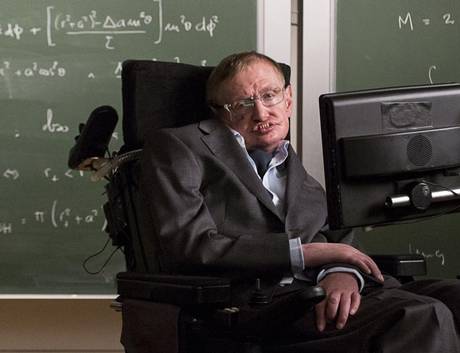
Stephen Hawking (born 1942)
No account of important scientists would be complete without Stephen Hawking who never fails to surprise. Here’s his latest theory:
Stephen Hawking: ‘There are no black holes’
At least not in the way we perceive them now, he suggests
from Heather Saul in The Independent, Saturday 25th January 2014
Stephen Hawking has produced a “mind-bending” new theory that argues black holes do not actually exist – at least not in the way we currently perceive them. Instead, in his paper, Information Preservation and Weather Forecasting for Black Holes, Hawking proposes that black holes can exist without event horizons, the invisible cover believed to surround every black hole.
During a previous lecture, Into the Black Hole, Hawkins described an event horizon as the boundary of a black hole, “where gravity is just strong enough to drag light back, and prevent it escaping”. “Falling through the event horizon, is a bit like going over Niagara Falls in a canoe”, he said. “If you are above the falls, you can get away if you paddle fast enough, but once you are over the edge, you are lost. There’s no way back. “As you get nearer the falls, the current gets faster. This means it pulls harder on the front of the canoe, than the back. There’s a danger that the canoe will be pulled apart. It is the same with black holes.”
But now, Hawking is proposing apparent horizons could exist instead, which would only hold light and information temporarily before releasing them back into space in garbled form, Nature has reported. The internationally-renowned theoretical physicist suggests that quantum mechanics and general relativity remain intact, but black holes do not have an event horizon to catch fire.
His work attempts to address the black-hole firewall paradox first discovered by theoretical physicist Joseph Polchinski and his colleagues almost two years ago, when Polchinski and his team began investigating what would happen to an astronaut who fell into a black hole. They hypothesised that instead of being gradually ripped apart by gravitational forces, the event horizon would be transformed into a highly energetic region, and anyone who fell in would hit a wall of fire and burn to death in an instant – violating Albert Einstein’s theory of relativity.
In his paper, Hawking writes: “The absence of event horizons means that there are no black holes – in the sense of regimes from which light can’t escape to infinity.” He told Nature journal: “There is no escape from a black hole in classical theory, but quantum theory, however, “enables energy and information to escape from a black hole.” Don Page, a physicist and expert on black holes at the University of Alberta in Edmonton, Canada told Nature that “the picture Hawking gives sounds pretty reasonable”. “You could say that it is radical to propose there’s no event horizon”, he said. “But these are highly quantum conditions, and there’s ambiguity about what space-time even is, let alone whether there is a definite region that can be marked as an event horizon.”
A selection of his Works
- A Brief History of Time (1988)
- Black Holes and Baby Universes and Other Essays (1993)
- The Universe in a Nutshell (2001)
- On The Shoulders of Giants (2002)
- A Briefer History of Time (2005)
- God Created the Integers:
The Mathematical Breakthroughs That Changed History (2005) - The Grand Design (2010)
- My Brief History (2013)
Some Scientists not in the Limelight Today
There are, of course, many other modern scientists doing important and valuable work in various areas. However, it is in the nature of things that recognition comes only when the ideas and discoveries are proven, and become accepted truths in the scientific sense. (For example, despite a century having passed since Einstein’s theories of Relativity, their validity is still being questioned in some quarters, especially as the fit between his propositions and quantum mechanics has still not been made.)
Alan Turing (1912 — 1954)
Alan Turing was one of the world’s most prominent people in the early era of computing, though his brilliant work on breaking German cyphers was never recognized in his lifetime. Following a conviction for committing a homosexual act, he committed suicide in 1954. 2012 marks the centenary of his birth, and I hope you approve of my contribution to describing his life and the ingenious machines he fought against. If not, then please look him up on the web and appreciate what he did for our freedom. See Alan Turing.
Isaac Newton (1642 — 1727)
Classical physics (that is, physics based on the principles developed by Sir Isaac Newton explains matter and energy at the macroscopic level, the scale familiar to human experience, including the behaviour of astronomical bodies. It remains the key to measurement for much of modern science and technology; but at the end of the 19th Century observers discovered phenomena in both the large (macro) and the small (micro) worlds that classical physics could not explain. Coming to terms with these limitations led to the development of quantum mechanics, a major revolution in physics. Newton was an English physicist, mathematician and philosopher.
Patrick Moore (1923 – 2012)
I mustn’t overlook the man who has popularized Astronomy most, Patrick Moore.
His most famous contribution to the popularization of science was his television series The Sky At Night. He also wrote many books, of which my earliest encounter was his Guide to the Moon. I met him once when I, a teenager, attended Astronomy evening classes, and he came along as a guest speaker; he had just a dishevelled appearance then as recently! His death in December 2012 was obviously sad, but, as a keen cricketer, he would no doubt admit that he’d had a good innings.
A bit of a mysogynist, he once said: “The trouble is that the BBC now is run by women and it shows: soap operas, cooking, quizzes, kitchen-sink plays. You wouldn’t have had that in the golden days.”
Because of his long-running television career and eccentric demeanour, Moore was widely recognised and became a popular public figure, even to people with no interest in astronomy. In 1976, this was used to good effect for an April Fool’s spoof on BBC Radio 2, when Moore announced that at 9.47 am, a once-in-a-lifetime astronomical event was going to occur: Pluto would pass behind Jupiter, temporarily causing a gravitational alignment which would reduce the Earth’s own gravity. Moore informed listeners that if they could jump at the exact moment that this event occurred, they would experience a temporary floating sensation. The BBC received many telephone calls from listeners claiming that they actually experienced the sensation! Moore joined the Flat Earth Society as an ironic joke. He was also a virtuoso on the xylophone. See Moore’s Obituary in The Guardian.
See the Sky at Night site. There are lots of good links from the programme’s site to other astronomical ones.
Werner Heisenberg (1901 — 1976)
Heisenberg was a German theoretical physicist who was awarded the Nobel Prize for Physics “for the creation of quantum mechanics”. Heisenberg, along with Max Born and Pascual Jordan, set forth the matrix formulation of quantum mechanics in 1925. In 1927 he published his uncertainty principle, upon which he built his philosophy and for which he is best known.
He also made important contributions to the theories of the hydrodynamics of turbulent flows, the atomic nucleus, cosmic rays, ferromagnetism, and subatomic particles, and he was instrumental in planning the first West German nuclear reactor at Karlsruhe, together with a research reactor in Munich, in 1957.
Max Planck (1858 — 1947)
Max Planck was a German theoretical physicist who originated quantum theory, which won him the Nobel Prize for Physics in 1918.
In April 1885 the University of Kiel appointed Planck as associate professor of theoretical physics. Further work on entropy and its treatment, especially as applied in physical chemistry, followed. He published his Treatise on Thermodynamics in 1897, proposing a thermodynamic basis for Svante Arrhenius’s theory of electrolytic dissociation. In 1894 he turned his attention to the problem of black-body radiation.
ℏ
Albert Einstein (1879 — 1955)
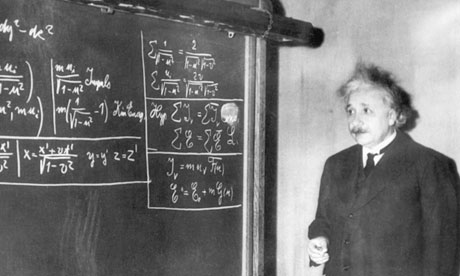
Albert Einstein giving a Lecture and a Portrait of Albert Einstein
Einstein was a German-born theoretical physicist, principally known for his work on the Special and General Theories of Relativity. Articles and biographies abound, so I shall say little more. (See also EPR Experiment.)
Richard Feynman (1918 — 1988)
Richard Phillips Feynman was an American theoretical physicist known for his work in the path integral formulation of quantum mechanics, the theory of quantum electrodynamics, and the physics of the superfluidity of supercooled liquid helium, as well as in particle physics (he proposed the parton model). For his contributions to the development of quantum electrodynamics, Feynman, jointly with Julian Schwinger and Sin-Itiro Tomonaga, received the Nobel Prize in Physics in 1965. He developed a widely used pictorial representation scheme for the mathematical expressions governing the behavior of subatomic particles, which later became known as Feynman diagrams.
Some aspects of quantum mechanics can seem counter-intuitive, because they describe behaviour quite different from that seen at larger length scales, where classical physics is an excellent approximation. In the words of Feynman, quantum mechanics deals with “nature as she is — absurd.”
Or, as Niels Bohr put it, “...those who are not shocked when they first come across quantum theory cannot possibly have understood it,” — quoted in Heisenberg, Physics and Beyond (New York: Harper and Row, 1971).
Niels Bohr (1885 — 1962)
Niels Henrik David Bohr was a Danish physicist who made foundational contributions to understanding atomic structure and quantum mechanics, for which he received the Nobel Prize in Physics in 1922. Bohr mentored and collaborated with many of the top physicists of the century at his institute in Copenhagen.
He developed the Bohr model of the atom with the atomic nucleus at the centre and electrons in orbit around it, which he compared to the planets orbiting the Sun. He also worked on the idea in quantum mechanics that electrons move from one energy level to another in discrete steps, not continuously.
Abdus Salam (1926 — 1996)
I studied Maths at Imperial College, London, but have forgotten most of what I learnt there; at least I hope that the rigour of Mathematics has rubbed off on me.
I was there when Professor Abdus Salam (1926 — 1996) was a lecturer; in 1979 he became a Nobel laureate in Physics for his work on the electroweak unification of the electromagnetic and weak forces. I have tried to give an elementary account of what is genuinely a very complex one elsewhere. (See Big Bang.)
Colin Pillinger (1943 — 2014)
I don’t know why I’d missed including Colin Pillinger (1943–2014) in my list; he became the voice of astronomy when Beagle 2 attempted its Martian landing. Rest in Space
Other scientists associated with atomic physics, gravitational theories and quantum mechanics are Wolfgang Pauli (1900 – 1958), an Austrian theoretical physicist, Enrico Fermi (1901 – 1954), an Italian-born, naturalized American physicist, Satyendra Nath Bose (1894 – 1974) after whom the boson was named; he was an Indian mathematician and physicist noted for his collaboration with Einstein in developing a theory regarding the gaslike qualities of electromagnetic radiation and James Chadwick (1891 – 1974) discoverer of the neutron; see atoms.