The Galápagos Islands – Las Islas Galápagos
Ecuador flag

Galápagos flag
Famous as being the inspiration for Charles Darwin’s theory of evolution by natural selection, the Galápagos Islands (officially the Archipiélago de Colón) are an archipelago of volcanic islands distributed near the equator, 600 miles west of Ecuador in the Pacific Ocean. They are known for their vast number of endemic species and are already a World Heritage Site. Although their population is only 25,000, tourism their main source of income and is strictly controlled, having risen from just over 41,000 people visiting in 1991 to over 185,000 today.
The Galápagos Archipelago consists of 7,880 km2 (3,040 sq mi) of land spread over 45,000 km2 (17,000 sq mi) of ocean. The largest of the islands, Isabela, measures 4,640 km2 (1,790 sq mi) and makes up half of the total land area of the islands. Volcán Wolf on Isabela is the highest point, with an elevation of 1,707 m (5,600 ft) above sea level.
A very interesting holiday in Ecuador several years ago included a trip to the Galápagos Islands. There are many web sites about these islands, but I found this and other photographs on The Guardian’s web-site. Enjoy. Other pictures and information are all over the web if you’re interested.
The main centre of population is on Santa Cruz (or Indefatigable, the oval island at the middle of the photo); the capital, Puerto Aroya is on its south side. The airport is on Baltra (South Seymour), a tiny island at the northern tip of Santa Cruz. A new airport is being built on the biggest island, Isabela (Albemarle), the sea-horse-shaped and largest island.
The amazing thing about the animals on the Galápagos Islands, as suggested by the photograph of Sir David Attenborough nose-to-nose with a marine iguana, is their tameness. Until recent years, with the arrival of humans there, the birds, mammals and reptiles had no natural predators, so had no need to fear anyone, leading to the downfall of many species. Soon after the discovery of the Galápagos, passing sailors regarded the giant tortoises as an excellent source of food, and plundered many of the islands. Humans imported goats, rabbits and other animals which competed with the indigenous creatures for food; the giant tortoises, for example, couldn’t consume vegetation at the same speed as goats, and their populations suffered disastrously. A recent campaign to eradicate goats has been started by the Ecuadorian government, much to the hostility of the settlers on the islands.
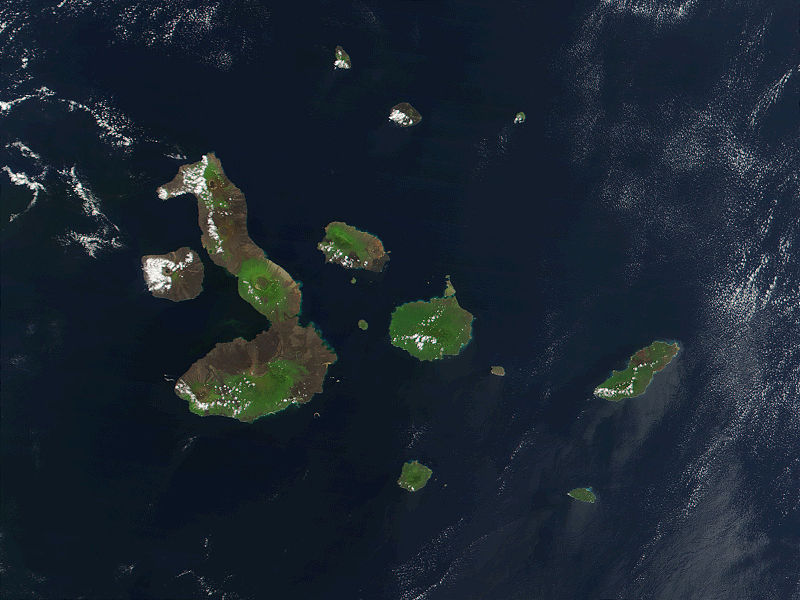
The Galápagos Islands from space; Pinta (English name Abington or Abingdon) is the most northerly island in this photo
Volcanic Island Chains
A volcanic island is formed when a magma plume forces its way through the Earth’s crust. The crust, a tectonic plate (in this case the Nazca Plate) moves slowly so the volcano stops erupting as the plate moves away from the ‘hotspot’ and a new volcano forms above it. The crust above the Galápagos Islands is moving east–southeast at a rate of about 2.5 inches (6.4 cm) per year and diving under the South American Plate. The first islands formed here at least 8 million and possibly up to 90 million years ago.
In a similar way, the Hawaiian chain of 137 islands was formed as the Pacific Plate moved slowly northwestward over a hotspot in the Earth’s mantle at about 32 miles (51 km) per million years. The islands in the northwest of the archipelago are older and typically smaller, due to longer exposure to erosion.