Scott Beale
Scott Beale
Laughing Squid Logo
Laughing Squid features interesting art, culture and technology from around the web. It is also an independently owned and operated cloud-based web hosting company. Laughing Squid was founded in 1995 by primary tentacle Scott Beale, who is the Editor-In-Chief of the blog. He is joined by Managing Editor Rusty Blazenhoff, Senior Contributing Editor EDW Lynch, Contributing Editor-at-Large mikl-em and several awesome guest bloggers. See their web.
Scott Beale after Escher
Ascending and Descending, by Scott Beale, 2007 after Escher
Relativity, by Scott Beale, 1953 after Escher
More mathematical shapes that I find very artistic are in my main Mathematics page and in the page on polyhedra, which includes fractals.
Digital-based “Rain Room”
Here’s art and science working together. A man walks through the Rain Room, an art installation at the Barbican in London.
As the visitor walks through the room, the rain stops around them.
Known for their distinctive approach to digital-based contemporary art, Random International’s experimental artworks come alive through audience interaction. Their largest and most ambitious installation yet, Rain Room is a 100 square metre field of falling water for visitors to walk through and experience how it might feel to control the rain. On entering The Curve the visitor hears the sound of water and feels moisture in the air before discovering the thousands of falling droplets that respond to their presence and movement. This exhibit is now unfortunately closed.
Alex Grey
Alex Grey
Gaia, 1989; oil on linen
Alex Grey is an American artist specializing in spiritual and psychedelic art (or visionary art).
He claims: The greatest Psychdelic artist today explains all with exceptional eloquance.
M C Escher
Maurits Cornelis Escher (1898 – 1972), usually referred to as M C Escher and nicknamed “Mauk”, was a Dutch graphic artist.
There’s an asteroid 4444 Escher named after him; further information about it is on the NASA Jet Propulsion Laboratory web-site
The picture on the left is a self-portrait of Escher from 1929
Treppenhaus (House of Stairs)
Escher: Ascending and Descending
Relativity, 1953
Waterfall
Another World
Tessellation
Belvedere
Circle Limit III, 1959
The Universiteit Twente (where the ⇐ small stellated dodecahedron is exhibited); Enschede is a city in the eastern Netherlands in the Overijssel province in the Twente region. Enschede is also known as Eanske in the local dialect of Twents
Drawing Hands, 1948
Men
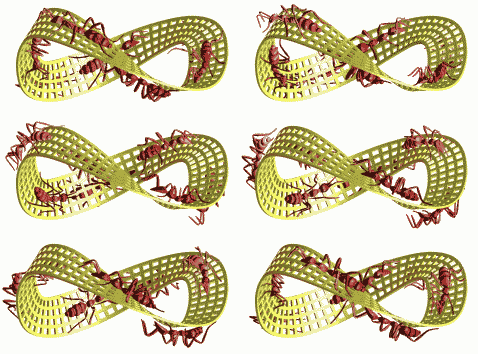
Moebius Ants
Moebius Ants Detail
Another Form of Art – Wall Paintings by Eric Grohe (Banksy, Eat Your Heart Out!)
This is Eric Grohe, in his element, 30 feet off the ground. He does most of the artwork by himself and researches, paints and designs each project from scratch. His wife Kathy, also an artist, serves as project manager.
Mount Carmel College of Nursing, Columbus, Ohio
Before Eric...
...during his work...
...and after...
...the finished product
How to Dress up a Drab Shopping Mall in Niagara, New York State
Before...
...and after...
...look at the detail on the left...
...and on the right
How many birds fly into this wall every day?
The Great American Crossroad, Bucyrus, Ohio (pop. 12,362)
Fun(?) Facts about Bucyrus, Ohio
- The first daily weather reports were started on 24th December 1887 in the Evening Telegraph.
- In 1942 Camp Millard, a training camp for the 753rd Railway Shop Battalion was established at the fairgrounds to train men during World War II.
- A D Juillard, founder of the Juillard School of Music, helped establish the public library.
- In 1838, a mastodon skeleton was uncovered by Abraham Hahn, in a shallow, but swampy area of Bucyrus.
Before Eric Grohe’s work...
...and after...
Liberty Remembers – the Liberty Wall
It’s hard to believe you’re looking at a flat two-dimensional wall
Before...
...during...
...and after
Miller Brewery Fermenting Rooms
Past meets Present in the Miller Brewery fermenting rooms.
This is before he got to work on it...
...and this is what he made of it...
Hooks, clipboards and aprons were added to the surface of the murals to enhance the illusion...
A detail view looking down the illusional hallway...
Remember, you’re looking at flat walls! Amazing, isn’t it? How many people walk into the walls, while trying to go down a hallway that does not exist?