
Loading...
On this page are pictures, some rotating to show better their structure, of the 5 regular convex solids – the Platonic polyhedra (tetrahedron, cube [or hexahedron], octahedron, dodecahedron and isosahedron); the 4 regular star polyhedra or Kepler–Poinsot polyhedra (the great stellated dodecahedron, the small stellated dodecahedron, the great icosahedron and the great dodecahedron; and the 13 Archimedean solids [truncated tetrahedron, cuboctahedron, truncated cube, truncated octahedron, [small] rhombicuboctahedron, truncated cuboctahedron or great rhombicuboctahedron, snub cube or snub hexahedron or snub cuboctahedron, icosidodecahedron, truncated dodecahedron, truncated icosahedron, [small] rhombicosidodecahedron, truncated icosidodecahedron or great rhombicosidodecahedron]). These are all “Regular Polyhedra”.
Some of their names are pretty daunting, but they are all beautiful figures. I also define some of the terms used, like polyhedron, stellation, truncation, rectification and the Schläfli symbol.
There are the dodecadodecahedron, the pentagram, the Kepler star and other more peculiar shapes. We also take a quick peek into the fourth dimension.
Finally, there’s a delve into the strange world of fractals: the Mandelbrot-set, Julia-set, Koch snowflake, an animated mountain, a flame, dragon trees, fractal art, a fractal cheetah and a tiger, fractal waves and the beautiful yet weird restless growth by Matthew Haggett. And enjoy this series of fractals and mathematical patterns: Bridges 2015: a meeting of maths and art – in pictures
A polyhedron (plural polyhedra or polyhedrons) is a geometric solid in three dimensions with flat faces and straight edges. The word polyhedron comes from the Classical Greek πολúεδρον meaning “many faces”. Polyhedra are often named according to the number of faces, again based on Classical Greek, for example tetrahedron (4), pentahedron (5), hexahedron (6), heptahedron (7), triacontahedron (30), and so on.
This may be qualified by a description of the kinds of faces present, for example the rhombic dodecahedron or the pentagonal dodecahedron.
Other common names indicate that some operation has been performed on a simpler polyhedron, for example the truncated cube looks like a cube with its corners cut off, and has 14 faces (so it is also a tetrakaidecahedron or tetradecahedron (no difference in meaning is ascribed – the Greek word και [kai] means “and”).
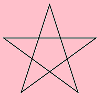
Below some of the diagrams that follow are numbers in braces, the Schläfli symbol of the solid; the first number represents the number of sides of the polygon faces, and the second is the number of these polygons at each vertex. The pentagram (the regular five-pointed star, right) has the symbol {5/2}, representing the vertices of a pentagon but connected alternately.
The five regular convex solids – the tetrahedron, cube or hexahedron, octahedron, dodecahedron and the icosahedron – are called the Platonic polyhedra, named after the ancient Greek philosopher Plato, who theorized that the classical elements were constructed from the regular solids.
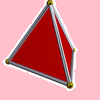
{3, 3}
Tetrahedron
Face: triangle
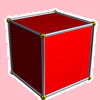
{4, 3}
Cube or Hexahedron
Face: square
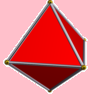
{3, 4}
Octahedron
Face: triangle
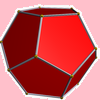
{5, 3}
Dodecahedron
Face: pentagon
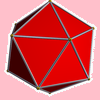
{3, 5}
Icosahedron
Face: triangle
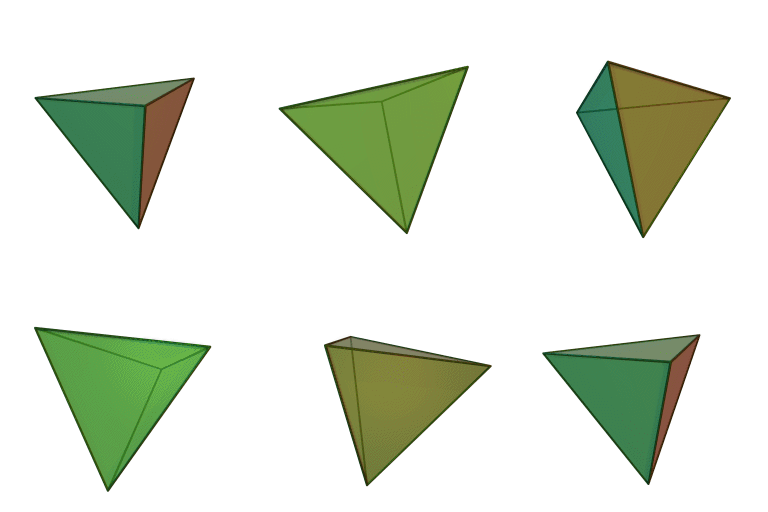
Tetrahedron
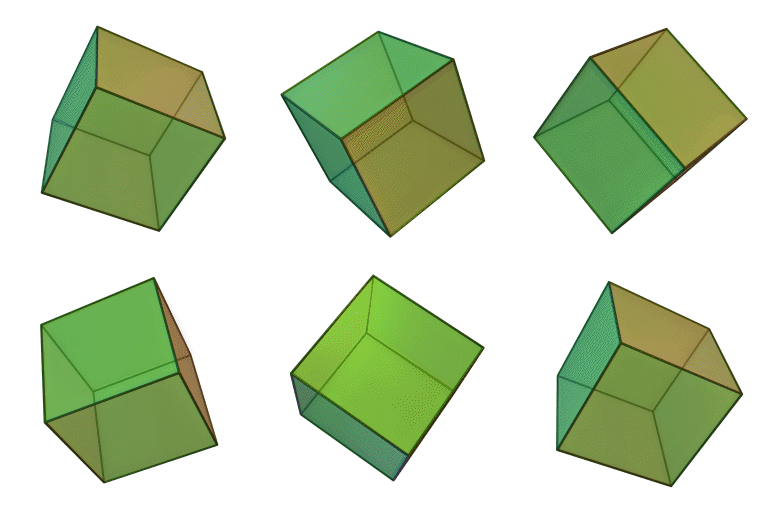
Hexahedron (or cube)
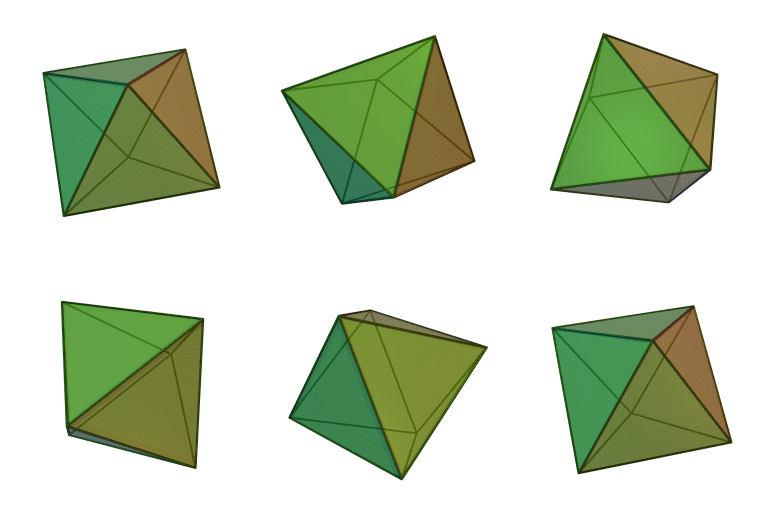
Octahedron
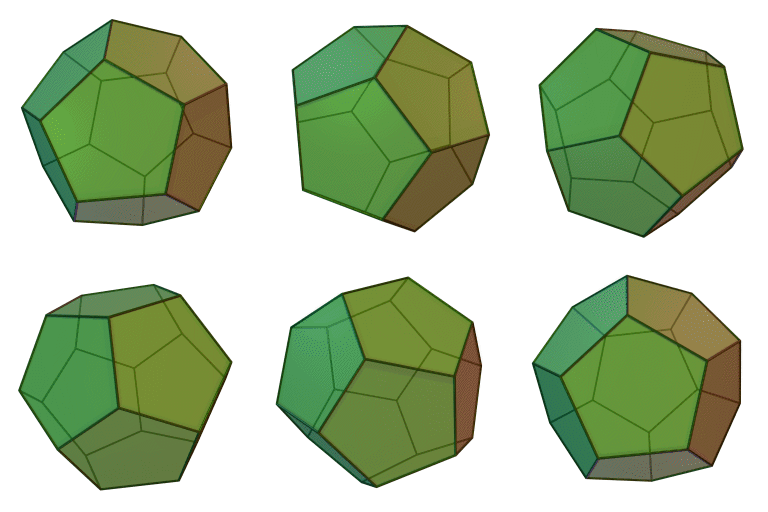
Dodecahedron
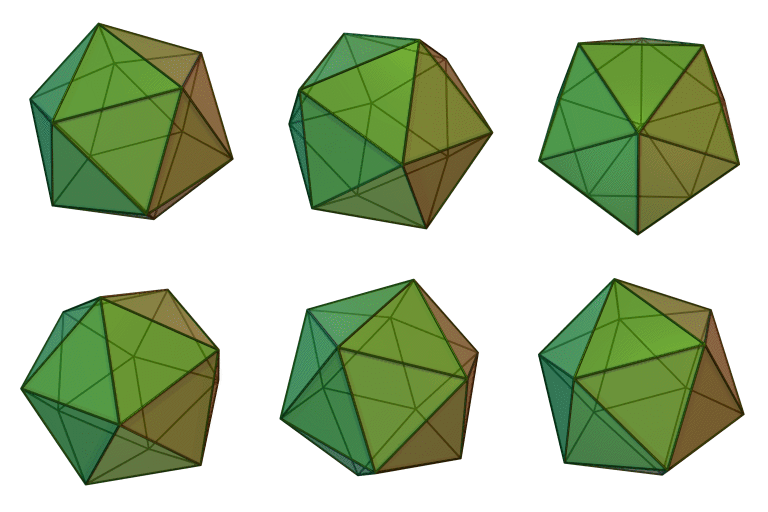
Icosahedron
A Kepler–Poinsot polyhedron is any of four regular star polyhedra obtained by stellating the regular convex dodecahedron and icosahedron, and differ from these in having regular pentagrammic (pentagon or pentagram) or triangular faces or vertex figures. The diagrams show these solids, one yellow-filled, red-outlined face labelled on each.
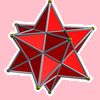

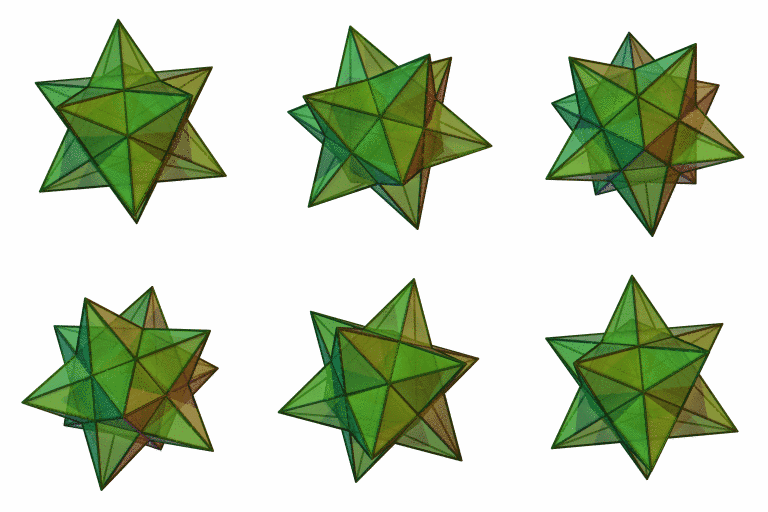
The Small Stellated Dodecahedron (see Escher’s version) is composed of 12 pentagrammic faces, with five pentagrams meeting at each vertex. It shares the same vertex arrangement (its “convex hull”) as the convex regular icosahedron. It also shares the same edge arrangement as the great icosahedron. It is considered the first of three stellations of the dodecahedron.
Other related polyhedra are: the dodecadodecahedron, the truncated great dodecahedron, and the great dodecahedron.
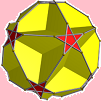
This polyhedron is the truncation of the great dodecahedron. The truncated small stellated dodecahedron looks like a dodecahedron on the surface, but it has 24 faces: 12 pentagons from the truncated vertices and 12 overlapping (as truncated pentagrams).
Stellation is a process of constructing new polyhedra by extending elements such as edges or face planes, usually in a symmetrical way, until they meet each other again. The new figure is a stellation of the original.
Truncation is a process of constructing new polyhedra by slicing off vertices symmetrically to produce a new complex form.
Rectification is a process of truncating a polyhedron by marking the midpoints of all its edges and cutting off its vertices at those points; the resulting polyhedron will be bounded by the vertex figures and the rectified facets of the original polyhedron. A rectified cube is a cuboctahedron – edges reduced to vertices, and vertices expanded into new faces.
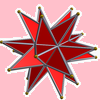
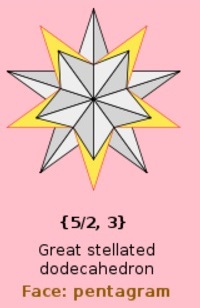
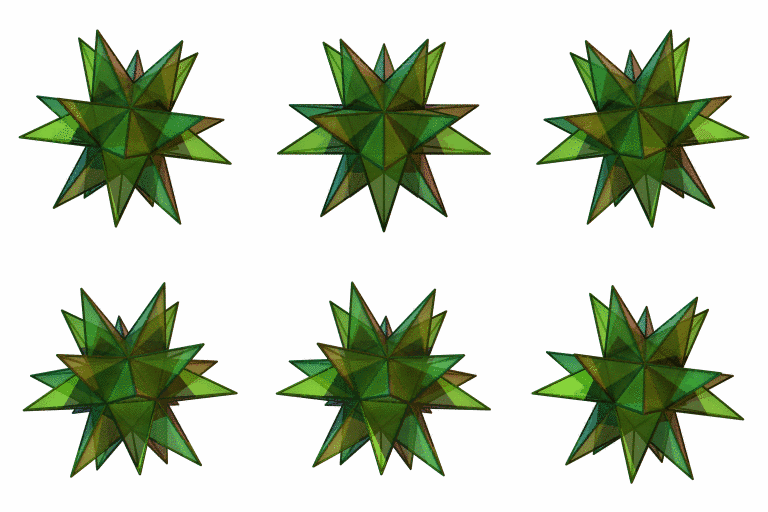
The Great Stellated Dodecahedron is composed of 12 intersecting pentagrammic faces, with three pentagrams meeting at each vertex. It shares its vertex arrangement with the regular dodecahedron, as well as being a stellation of a (smaller) dodecahedron. It is the only dodecahedral stellation with this property, apart from the dodecahedron itself. Its dual, the great icosahedron, is related in a similar fashion to the icosahedron. Shaving the triangular pyramids off results in an icosahedron. If the pentagrammic faces are broken into triangles, it is topologically related to the triakis icosahedron (an icosahedron with triangular pyramids augmented to each face; this interpretation is expressed in the name, “triakis”), with the same face connectivity, but much taller isosceles triangle faces.
Other related polyhedra: a truncation process applied to the great stellated dodecahedron produces a series of uniform polyhedra. Truncating edges down to points produces the great icosidodecahedron as a rectified great stellated dodecahedron. The process completes as a birectification, reducing the original faces down to points, and producing the great icosahedron.
This 43-metre tall star spanning 14 metres is called the Peace Star or Kepler Star, a sculpture by Norwegian artist Vebjørn Sands. It is located at Gardermoen (Oslo) Airport. It consists of an icosahedron and a dodecahedron inside a great stellated dodecahedron.

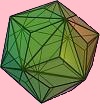
The (quasi-)truncated dodecadodecahedron is a nonconvex uniform polyhedron with 120 vertices and 54 faces: 30 squares, 12 decagons, and 12 decagrams; the central region of the polyhedron is connected to the exterior via 20 small triangular holes.
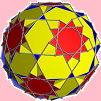
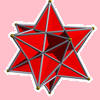
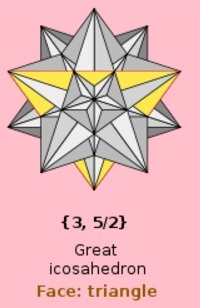

The Great Icosahedron is composed of 20 intersecting triangular faces, having five triangles meeting at each vertex in a pentagrammic sequence. It shares the same vertex arrangement as the regular convex icosahedron. It also shares the same edge arrangement as the small stellated dodecahedron.
A truncation operation, repeatedly applied to the great icosahedron, produces a sequence of uniform polyhedra. Truncating edges down to points produces the great icosidodecahedron as a rectified great icosahedron. The process completes as a birectification, reducing the original faces down to points, and producing the great stellated dodecahedron. The truncated great stellated dodecahedron is a degenerate polyhedron, with 20 triangular faces from the truncated vertices, and 12 (hidden) pentagonal faces as truncations of the original pentagram faces, the latter forming a great dodecahedron inscribed within and sharing the edges of the icosahedron.

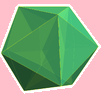
The truncated great stellated dodecahedron (or the small complex icosidodecahedron) is a degenerate uniform star polyhedron, with 20 triangular faces from the truncated vertices, and 12 (hidden) pentagonal faces as truncations of the original pentagram faces, the latter forming a great dodecahedron inscribed within and sharing the edges of the icosahedron. It has 60 (doubled) edges and 12 vertices; all edges are doubled (making it degenerate), sharing 4 faces. It can be seen as a compound of the icosahedron and the great dodecahedron where all vertices and edges coincide; it appears to be an icosahedron because the great dodecahedron is completely contained inside the icosahedron. (Believe me, the mathematics are horrendous unless you’re into advanced topography!)
If you plan to make models of polyhedra, I’d recommend Polyhedron Models by Magnus J Wenninger (CUP) and Mathematical Models by H M Cundy and A P Rollet (OUP). Start on a simple model like a cube! Thin coloured card is a good medium and a colourless glue.
Wikipedia’s List of uniform polyhedra is also a good place to start.
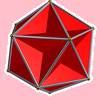
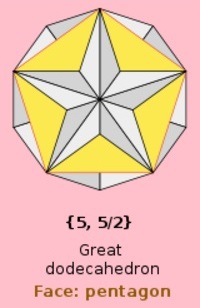
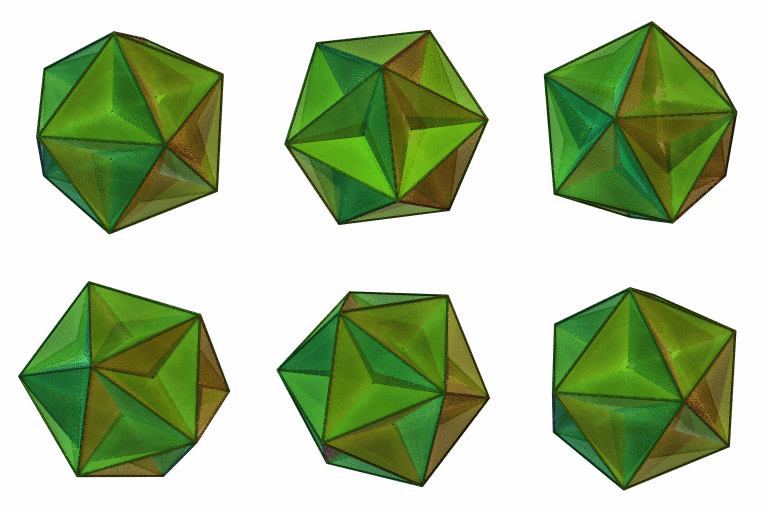
The Great Dodecahedron is composed of 12 pentagonal faces (six pairs of parallel pentagons), with five pentagons meeting at each vertex, intersecting each other making a pentagrammic path. It can also be considered as the second of three stellations of the dodecahedron. It shares the same edge arrangement as the convex regular icosahedron.
If the great dodecahedron is considered as a properly intersected surface geometry, it has the same topology as a triakis icosahedron with concave pyramids rather than convex ones.
A truncation process applied to the great dodecahedron produces a series of nonconvex uniform polyhedra. Truncating edges down to points produces the dodecadodecahedron as a rectified great dodecahedron. The process completes as a birectification, reducing the original faces down to points, and producing the small stellated dodecahedron.
The truncated small stellated dodecahedron looks like a dodecahedron on the surface, but it has 24 pentagonal faces: 12 as the truncation facets of the former vertices, and 12 more (coinciding with the first set) as truncated pentagrams.
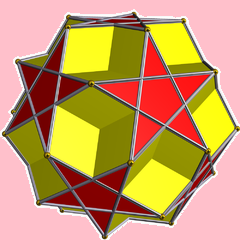
The Dodecadodecahedron is a nonconvex uniform polyhedron, with the icosidodecahedron as its convex hull. It also shares its edge arrangement with the small dodecahemicosahedron (having the pentagrammic faces in common), and with the great dodecahemicosahedron (pentagonal faces in common).
It can be considered a rectified great dodecahedron. It is the centre of a truncation sequence between a small stellated dodecahedron and a great dodecahedron; the truncated small stellated dodecahedron looks like a dodecahedron on the surface, but it has 24 faces – 12 pentagons from the truncated vertices and 12 overlapping as truncated pentagrams. The truncation of the dodecadodecahedron itself is not uniform, but it has a uniform quasitruncation, the truncated dodecadodecahedron.
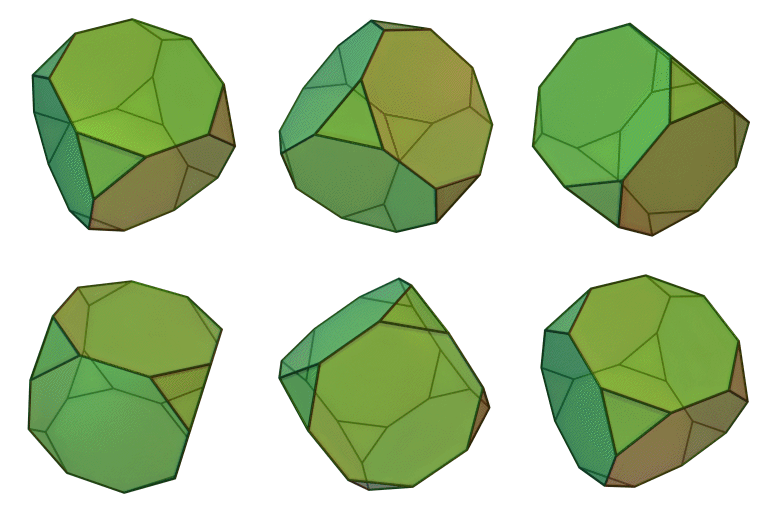
Truncated Hexahedron or Truncated Cube rotating
An Archimedean solid is a highly symmetric, semi-regular convex polyhedron composed of two or more types of regular polygons meeting in identical vertices. They are distinct from the Platonic solids, which are composed of only one type of polygon meeting in identical vertices. “Identical vertices” mean that for any two vertices, there must be an isometry of the entire solid that takes one vertex to the other.
Prisms and antiprisms are generally not considered to be Archimedean solids, despite meeting this definition. With this restriction, there are only 13 Archimedean solids, 15 if the mirror images of two enantiomorphs, see below, are counted separately. An n-sided antiprism is a polyhedron composed of two parallel copies of some particular n-sided polygon, connected by an alternating band of triangles. Antiprisms are similar to prisms except the bases are twisted relative to each other, and that the side faces are triangles, rather than quadrilaterals.
Here the vertex configuration refers to the type of regular polygons that meet at any given vertex. For example, a vertex configuration of (4,6,8) means that a square, hexagon, and octagon meet at a vertex (with the order taken to be clockwise around the vertex).
These are the Archimedean solids, with brief descriptions of each:
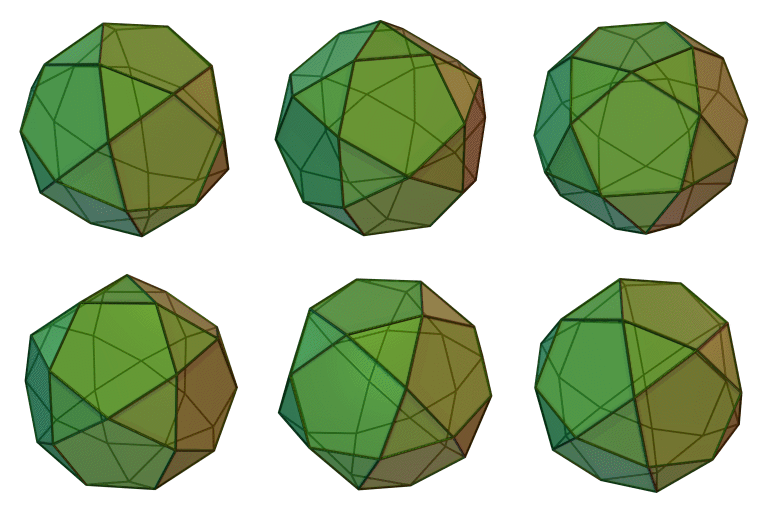
Icosidodecahedron rotating

Truncated Tetrahedron (3.6.6); faces: 4 triangles, 4 hexagons; 18 edges; 12 vertices

Cuboctahedron (3.4.3.4); faces: 8 triangles 6 squares; 24 edges; 12 vertices

Truncated Cube or Truncated Hexahedron; (3.8.8); faces: 8 triangles, 6 octagons; 36 edges; 24 vertices (see bottom right of this page)

Truncated Octahedron; (4.6.6); faces: 6 squares, 8 hexagons; 36 edges; 24 vertices

Rhombicuboctahedron or Small Rhombicuboctahedron; (3.4.4.4); faces: 8 triangles, 18 squares; 48 edges; 24 vertices

Snub Cube or Snub Hexahedron or Snub Cuboctahedron (2 chiral forms); (3.3.3.3.4); faces: 32 triangles, 6 squares; 60 edges; 24 vertices

Truncated Cuboctahedron or Great Rhombicuboctahedron; (4.6.8); faces: 12 squares, 8 hexagons, 6 octagons; 72 edges; 48 vertices

Icosidodecahedron; (3.5.3.5); faces: 20 triangles, 12 pentagons; 60 edges; 30 vertices

Truncated Dodecahedron; (3.10.10); faces: 20 triangles, 12 decagons; 90 edges; 60 vertices

Truncated Icosahedron; (5.6.6); faces: 12 pentagons, 20 hexagons; 90 edges; 60 vertices

Rhombicosidodecahedron or Small Rhombicosidodecahedron; (3.4.5.4); faces: 20 triangles, 30 squares, 12 pentagons; 120 edges; 60 vertices

Snub Dodecahedron or Snub Icosidodecahedron (2 chiral forms); (3.3.3.3.5); faces: 80 triangles, 12 pentagons; 150 edges; 60 vertices

Truncated Icosidodecahedron or Great Rhombicosidodecahedron; (4.6.10); faces: 30 squares, 20 hexagons, 12 decagons; 180 edges; 120 vertices
The Platonic, Kepler–Poinsot and Archimedean solids are by no means all of the regular polyhedra. Ignoring the infinity of prisms, here are some more peculiar shapes:

Ditrigonal Dodecadodecahedron

Medial Rhombic Triacontahedron

Medial Triambic Icosahedron

Excavated Dodecahedron (the third stellation of the icosahedron)

Great Ditrigonal
Icosidodecahedron

Small Ditrigonal
Icosidodecahedron
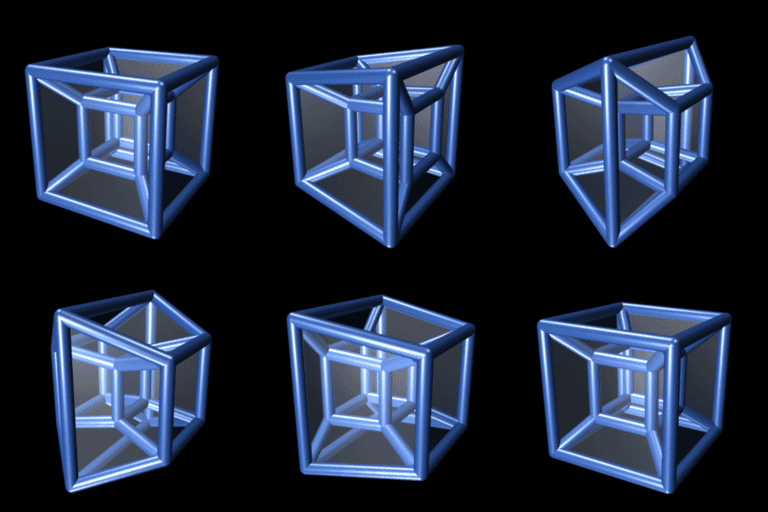
2D animation of a 3D projection of a rotating 4D tesseract or hypercube. This tesseract is initially oriented so that all edges are parallel to one of the four coordinate space axes. The rotation takes place in the xw plane. The tesseract, also called an 8-cell or regular octachoron or cubic prism, is the four-dimensional analog of the cube; the tesseract is to the cube as the cube is to the square. Just as the surface of the cube consists of 6 square faces, the hypersurface of the tesseract consists of 8 cubical cells.
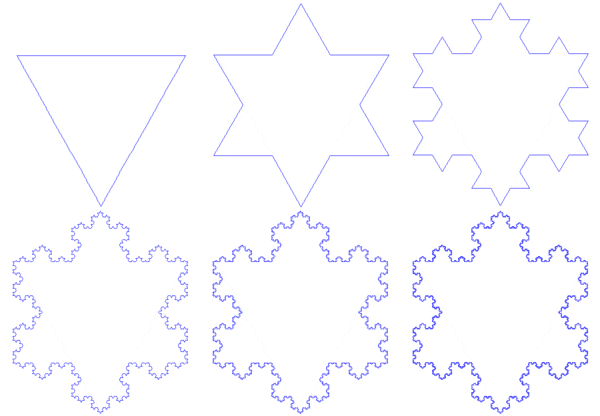
Fractals are an intriguing and beautiful aspect of mathematical topology.
A fractal is “a rough or fragmented geometric shape that can be split into parts, each of which is (at least approximately) a reduced-size copy of the whole,” a property called self-similarity,  according to Wikipedia.
They consist essentially of a simple form, such as the equilateral triangle (the Koch Snowflake shown above), and then gradually become more elaborate as successive steps are taken.
For example, in the case of the Koch Snowflake, each step consists of replacing the middle third of each line by two lines; the three of them (the original middle third and its two replacements) form a smaller equilateral triangle. Repeat and repeat and repeat and repeat...
With each successive step, the total length of the lines increases by a third. However, as you can see from the limited number of steps in the animation, the area enclosed by the shape remains almost the same (certainly less than the area of a square that would enclose the original triangle).
So we have an enclosed area that is finite, but as we continue with more steps, its boundary becomes unlimited (infinite) in length.
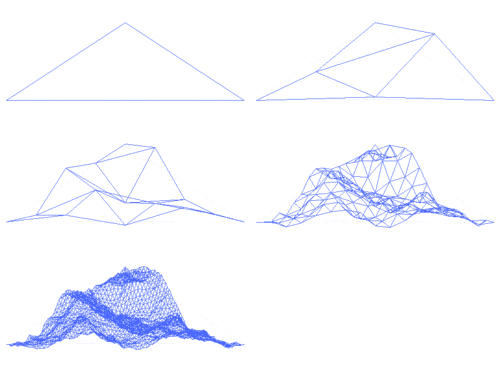
Graphics designers have taken simple forms, like the lattice of lines shown above, and after several simple mathematical steps, they create (or rather, the maths creates) a form that looks remarkably natural and, in the case of that shape on the right, resembles a mountain. And that example only shows four steps; what detail there would be if you took forty steps, with crags and gullies galore!
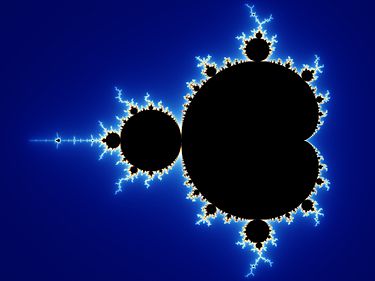
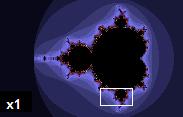
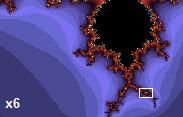
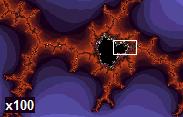
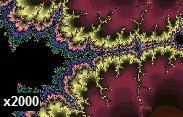
The ultimate use of this technique produces figures like the Mandelbrot Set, in which, at whatever magnification you examine the object, it has the same basic structure and appearance. Such figures are shown here, each successive one being a magnification of a small part of the previous. As well as producing mountains and coastlines, film producers can use the technique to create convincing landscapes in futuristic, mythical, and sci-fi movies.
Click on any of the miniatures below to see an enlargement.
For more information on fractals, go to the main Wikipedia article on fractals. Search through and enjoy this web-site. I like the Fractal flame, the Dragon trees and the Julia-set fractal.


.png)