
Loading...
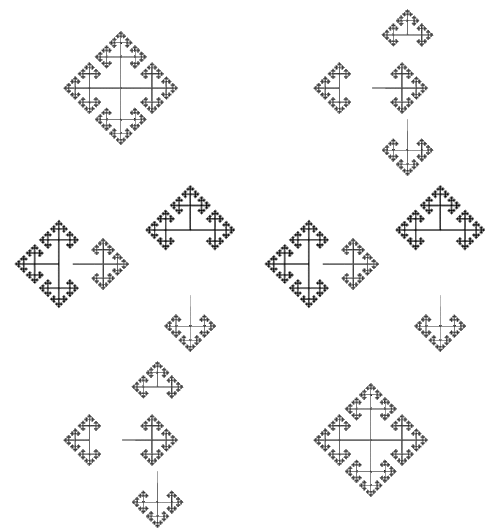
Cayley Graph
This page includes a word or two about infinities, Cantor, Newton, e, and i, numbers like a billion, really big prime numbers, encryption and factorisation, some numerical nonsense, the old problem of squaring the circle, SI units and SI prefixes, Fermat’s Last Theorem and Riemann’s Hypothesis, Euclid’s Postulates, Incompleteness Theorems, and interesting numbers.
Beautiful Maths was a term used by G H Hardy, and he’d have approved of the proof that √2 is irrational and included Fermat’s Two-Square theorem in the “beautiful” category.
See also Polyhedra, which includes some ‘Impossible’ Figures and some Fractals.
Finally, Conway’s Game of Life (or simply “Life”): A Cellular Automaton devised by the British Mathematician John Horton Conway in 1970 is clever and intriguing.
Maths is full of paradoxes; see the Cayley graph animation across the page, and the jokes here; read about the Banach–Tarski paradox and tell me if you can understand the Maths behind it – I can’t!
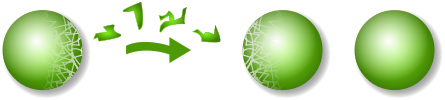
Can a ball be decomposed into a finite number of point sets and reassembled into two balls identical to the original?

This is the usual symbol for infinity, sometimes known as the lemniscate.
When you get further into the subject, you learn that there’s more than one infinity. This one: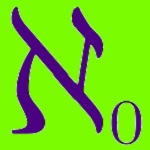
is called ‘alef-zero’ (ℵ [alef] is the first character of the Hebrew alphabet) and is the number you aim to reach when you count 1, 2, 3, 4, 5... It is also the number of fractional numbers, which can also be counted if you arrange them in a certain order; so the number of fractions is the same as the number of whole numbers.
ℵ0 is believed to be the smallest infinity, and the one that may be the next is the number of numbers between 0 and 1 (which is uncountable), or between any other pair of countable or natural numbers. It’s relatively easy to prove that there are more numbers between 0 and 1 (all the fractions and all the numbers that can’t be expressed as fractions) than ℵ0, but I’m not going to do it here; it’s called Cantor’s diagonal argument and Wikipedia explains it adequately.

In fact there are a whole infinity of infinities, all different from each other. Paradoxically, if you ask the question as to whether there is another infinity between ℵ0 and the number of real numbers (which is 2ℵ0 also identified as c, the cardinality of the continuum) the answer can neither be proved nor disproved! Just one of the fascinating paradoxes of mathematics.
I first became fascinated by infinity when, as a teenager, I bought a book by Georg Cantor (1845 — 1918), a German mathematician, best known as the inventor of set theory, which has become a fundamental theory in mathematics. Cantor established the importance of one-to-one correspondence between sets, defined ‘infinite’ and ‘well-ordered’ sets, and proved that the real numbers are ‘more numerous’ than the natural numbers. In fact, Cantor’s theory implies the existence of an infinity of infinities. He defined the cardinal (counting, like 1, 2, 3...) and ordinal (order, like 1st, 2nd, 3rd...) numbers and their arithmetic.
One of Cantor’s most important results was that the cardinality of the continuum is greater than that of the natural numbers; that is, there are more real numbers than natural numbers. Cantor showed that in his diagonal argument or his first uncountability proof.
[Some of these terms and concepts may well baffle the average reader; I make no apology for using them as they are fundamental to an understanding of infinity. If necessary, look them up on Wikipedia or another, preferably academic, web-site or in any good maths book for more insight into their meaning.]
After learning of the natural and real numbers, I went on to learn of Euler’s number e, where the exponential function ex, with e being the number such that the function ex is its own derivative (a measure of how a function changes as its input changes; see Calculus on Wikipedia or any Maths text book on the subject). e is the base of natural logarithms, and it turns up all over the place in mathematics. Its value is 2.71828182845904523536028747135266249775724709369995... and on and on, never repeating given a long enough sequence of digits,
just like π which is 3.14159265358979323846264338327950288419716939937510...
The Calculus was ‘invented’ or ‘developed’ by Sir Isaac Newton.
Then came imaginary numbers, based on the square root of −1. “There’s no such thing” it’s often claimed by non-mathematicians, but then how many of them have ever seen ‘−1 cow’?
Part of the beauty of mathematics for me is how these numbers can all be brought together in the very simple equation:
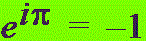
where:

The Σ (with the characters below and above it) means ‘add together all the numbers 1/n! for all the ns from 1 to infinity.’
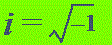
i is the square root of −1

is all the whole numbers up to n multiplied together, so
6! = 1 × 2 × 3 × 4 × 5 × 6

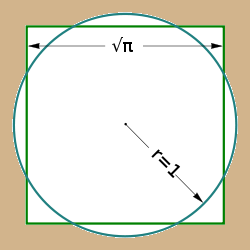
Squaring the circle is a problem proposed by ancient geometers — to construct a square with the same area as a given circle by using only a finite number of steps with compass and straightedge.
In 1882, the task was proved to be impossible, as a consequence of the Lindemann-Weierstrass theorem which proves that π is a transcendental number, rather than an irrational algebraic number (it is not the root of any polynomial equation with rational coefficients).
The expression ‘squaring the circle’ is sometimes used as a metaphor for doing something logically or intuitively impossible. The areas of the square and the circle here are equal.
The International System of Units (SI) uses a standard set of units:
As well as these seven units, there are some obvious ones like square metre (m2) to express area.
More complicated ones are volt (V) to express voltage, electrical potential difference, or electromotive force, which is expressed in kg⋅m2⋅s-3⋅A-1.
The electron volt (symbol eV) is not a derived SI unit though it is very useful in particle accelerator sciences; it is a unit of energy defined as the amount of energy gained by the charge of a single electron moved across an electric potential difference of one volt. Thus it is equal to 1.602176565×10⁻¹⁹ J. (J for joule is another derived unit representing energy, work or heat and is measured in SI units as kg⋅m2⋅s-2) In high-energy physics, electron-volt is often used as a unit of momentum. A potential difference of 1 volt causes an electron to gain a discrete amount of energy (i.e., 1 eV). This gives rise to usage of eV (and keV, MeV, GeV or TeV) as units of momentum, for the energy supplied results in acceleration of the particle.
For more about SI Derived Units, see Wikipedia.
The SI system also uses standardized numeric prefixes, as follows:
Multiples |
deca- (da) |
hecto- (h) |
kilo- (k) |
mega- (M) |
giga- (G) |
Fractions |
deci- (d) |
centi- (c) |
milli- (m) |
micro- (μ) |
nano- (n) |
Multiples |
tera- (T) |
peta- (P) |
exa- (E) |
zetta- (Z) |
yotta- (Y) |
Fractions |
pico- (p) |
femto- (f) |
atto- (a) |
zepto- (z) |
yocto- (y) |
Other, unofficial, SI prefixes are:
Multiples |
xenna- (X) |
weka- (W) |
vendeka- or vendekta- (V) |
udeka- (U) |
|
[The initial letters and uppercase/lowercase |
Fractions |
xenno- or xento- (x) |
weko- or wekto- (w) |
vendeko- or vendekto- (v) |
udeko- or udekto- (u) |
trekto- (t) |
If you are really interested in number naming schemes, see Wikipedia.
If we start with a set of self-consistent axioms in logic or mathematics, like Euclid’s Postulates, we might suppose that there is a way of proving (or disproving) any theorem about the realm covered by these axioms, using just this set of axioms. In fact, the fifth (parallel lines) axiom was believed to be provable from the other four. But in vain!
In 1931, Kurt Gödel (1906 – 1978), an Austrian logician, mathematician and philosopher proved that whatever initial set of axioms you take, there are statements that are true, but which cannot be proved from these axioms.
The first incompleteness theorem states that for any self-consistent recursive axiomatic system powerful enough to describe the arithmetic of the natural numbers, there are true propositions about the natural numbers that cannot be proved from the axioms.
The two incompleteness theorems can be stated briefly as:
For example, Riemann’s Hypothesis, so fundamental to much of modern mathematics, may be true but unprovable, or false but unprovable.
When I first read about Gödel’s theorems, I frankly found them incredible. I felt that if something was true, somewhere there must exist a proof of it.
Read more about the subject on the web (for example, at The Stanford Encyclopedia of Philosophy, Institute for Advanced Study, or at Wikipedia).
Or read An Introduction to Gödel’s Theorems, Peter Smith – Cambridge University Press (Cambridge Introductions to Philosophy).
When he was ten years old, Andrew Wiles (who was born in 1953) borrowed a book from his local library. In it he found that a mathematical theorem which he (a 10-year-old) could understand, had been conjectured by Pierre de Fermat in 1637, but never proved. Yet it seemed so simple to him! The Conjecture was that the equation
xn + yn=zn
had no solutions in whole numbers for x, y and z if n was any whole number bigger than 2. If n=2, we have
x2 + y2=z2
which is Pythagoras’ Theorem — remember it from school lessons? ‘In a right-angled triangle, the square on the hypotenuse is equal to the sum of the squares on the other two sides’.
The Conjecture fascinated Andrew, who was determined to prove it, especially as Fermat had noted in a copy of a textbook that he had a proof but it was too large to fit in the margin.
After years of painstaking work, Wiles managed to prove the Conjecture (or Fermat’s Last Theorem) in 1995. Prize after mathematical prize, award after award, a knighthood in 2000, and even an asteroid 9999 named after him all followed. Simon Singh wrote a book and directed a TV documentary on Wiles.
There was a BBC Horizon programme about Fermat’s Last Theorem, directed by Simon Singh; and see a pre-Wiles (1990) visualization of the theorem here.
Your next task, which may well be as difficult as Wiles’s, is to prove...
which says that the non-trivial zeros of the Riemann Zeta function,
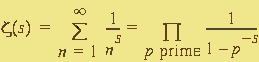
all have a real part equal to ½. It is of IMMENSE importance in mathematics that this hypothesis is proved (or disproved) because so many other hypotheses depend on it.
See Wikipedia for pointers to more information.
[I first saw this on the BBC’s QI TV programme]
A dozen, a gross, and a score,
Plus three times the square root of four,
Divided by seven,
Plus five times eleven,
Is nine squared and not a bit more.
1 is interesting as it’s the very first positive whole number; 2 is the smallest even number; 3 is the smallest odd prime number; 4 is the lowest square (apart from the trivial 1); 5 is the number of fingers on a hand; 6 is the first perfect number (6 = 1 + 2 + 3 and 1, 2 and 3 are its factors); and so on.
[As an aside, 28 is the next perfect number: 1, 2, 4, 7, 14 being its factors.]
If not all numbers are interesting, then there must be a number that is the smallest uninteresting number. And that, in itself is interesting, to be the smallest boring number. So we must conclude that all whole numbers are interesting. QED
Just to show the doubters that nothing ever changes in maths, The Guardian reported on 6th February 2013 about The largest prime number yet discovered – all 17 million digits of it. (17 million digits would take up 17 megabytes of storage in your computer; this whole Maths web page takes up only about 60 kilobytes.) They said:
Ever since Euclid proved there were an infinite number of prime numbers, mathematicians have been on a quest to find higher and higher examples.
The number 257,885,161 – 1 has picked up the baton as the largest known prime number, a result that is tremendously exciting for mathematicians, if rather irrelevant to the rest of mathematics.*
Primes are numbers that can only be divided by themselves and 1, such as 2, 3, 5, 7 and 11. Ever since the ancient Greek geometer Euclid proved there were an infinite number of them, mathematicians have been on a quest to find higher and higher examples. The current highest prime is 17 million digits long and was discovered using a computer in Warrensburg, Missouri, as part of the Great Internet Mersenne Prime Search (Gimps), a distributed computing project that has involved tens of thousands of machines since 1996. The previous highest prime was discovered by Gimps in 2008, but it was only (only?) 13 million digits long.
Mathematicians like discovering high primes not because they are useful (or not yet, anyway) but because they are there. It is a fun challenge and a measure of the power of distributed computing projects. The campaign group Electronic Frontier Foundation gave a prize for the first 1m-digit and 10m-digit primes, and will give $150,000 (£96,000) to the discoverer of the first 100m-digit prime.
The most efficient way to look for high primes is to look for Mersenne primes, which are named after a French 17th-century monk. They are primes that can be written in the form 2p − 1, where p is also prime. Before Gimps, only 34 Mersenne primes were known. With the latest discovery the number has risen to 48.
The last Mersenne prime discovered was in 2009, making the four-year wait until this week’s announcement the longest period with no new primes since Gimps began.
The new largest-known prime is the third discovered by Curtis Cooper of the University of Central Missouri, who was running Gimps software on 1,000 university computers. The number is so large that it took one of the computers 39 days to check it was indeed prime.
The record continues to be broken.
As of January 2016, the largest known prime number is 274,207,281 − 1, a number with 22,338,618 digits. It too was found in 2016 by the Great Internet Mersenne Prime Search.
See Wikipedia for more big prime numbers.
* My observation: it isn’t completely true that large prime numbers are irrelevant. Whenever you send an encoded message across the internet (such as making a credit-card payment) you are under the protection of encryption algorithms that rely on intruders not knowing what their component factors are – and they are extremely large prime numbers.
Which leads conveniently to...
The RSA public-key cryptosystem is widely used for secure data transmission. In such a cryptosystem, the encryption key is public and differs from the decryption key which is kept secret. RSA numbers are sets of two very large prime numbers that enable messages to be encrypted and decrypted without being broken.
RSA-768 has 232 decimal digits (768 bits), and was factored on 12th December 2009 over the span of 2 years by a 13-man team.
| RSA-768 = | 1, 230, 186, 684, 530, 117, 755, 130, 494, 958, 384, 962, 720, 772, 853, 569, 595, 334, 792, 197, 322, 452, 151, 726, 400, 507, 263, 657, 518, 745, 202, 199, 786, 469, 389, 956, 474, 942, 774, 063, 845, 925, 192, 557, 326, 303, 453, 731, 548, 268, 507, 917, 026, 122, 142, 913, 461, 670, 429, 214, 311, 602, 221, 240, 479, 274, 737, 794, 080, 665, 351, 419, 597, 459, 856, 902, 143, 413 |
| = | 33, 478, 071, 698, 956, 898, 786, 044, 169, 848, 212, 690, 817, 704, 794, 983, 713, 768, 568, 912, 431, 388, 982, 883, 793, 878, 002, 287, 614, 711, 652, 531, 743, 087, 737, 814, 467, 999, 489 |
| × | 36, 746, 043, 666, 799, 590, 428, 244, 633, 799, 627, 952, 632, 279, 158, 164, 343, 087, 642, 676, 032, 283, 815, 739, 666, 511, 279, 233, 373, 417, 143, 396, 810, 270, 092, 798, 736, 308, 917 |
Part of the problem of breaking into public-key cryptosystems is to find the prime factors of the encryption key. While this is far beyond me, it does require, on its fringes, the determination of whether a particular number is divisible by another. This table shows how to easily determine whether a number is divisible by numbers from 2 to 20. (Wikipedia has an extended list with alternative algorithms, and explanations of why particular methods work.)
| Divisible by | Test |
|---|---|
| 2 | The last digit is even (0, 2, 4, 6 or 8) |
| 3 | Add the digits; if the result is divisible by 3, so is the original. Apply this recursively for very large numbers (e.g. starting with 511,279,233,373,417,143,396,810,270,092,798,736,302,919, we get 5 + 1 + 1 + 2 + 7 + 9 + 2 + 3 + 3 + 3 + 7 + 3 + 4 + 1 + 7 + 1 + 4 + 3 + 3 + 9 + 6 + 8 + 1 + 0 + 2 + 7 + 0 + 0 + 9 + 2 + 7 + 9 + 8 + 7 + 3 + 6 + 3 + 0 + 2 + 9 + 1 + 9 = 177; 1 + 7 + 7 = 15; 1 + 5 = 6, which is divisible by 3 and so is the original number) |
| 4 | The number formed by the last two digits is divisible by 4 |
| 5 | The final digit is 0 or 5 |
| 6 | The number is divisible by 2 and by 3 |
| 7 | Split the number into groups of three starting from the rightmost triple; alternately subtract and add these numbers (e.g. starting with the same number above with commas breaking it up: 511,279,233,373,417,143,396,810,270,092,798,736,302,919, we get 919 − 302 + 736 − 798 + 092 − 270 + 810 − 396 + 143 − 417 + 373 − 233 + 279 − 511 = 413 which is divisible by 7, by a simple calculation) [This and similar algorithms for 11 and 13 work because 7, 11 and 13 are the factors of 1001.] |
| 8 | The number formed by the last three digits is divisible by 8 |
| 9 | Add the digits; if the result is divisible by 9, so is the original number |
| 10 | The last digit is 0 |
| 11 | Alternately subtract and add the digits of the number; so with 511,279,233,373,417,143,396,810,270,092,798,736,302,919, we get 5 − 1 + 1 − 2 + 7 − 9 + 2 − 3 + 3 − 3 + 7 − 3 + 4 − 1 + 7 − 1 + 4 − 3 + 3 − 9 + 6 − 8 + 1 − 0 + 2 − 7 + 0 − 0 + 9 − 2 + 7 − 9 + 8 − 7 + 3 − 6 + 3 − 0 + 2 − 9 + 1 − 9 = −7, not divisible by 11 |
| 12 | The number is divisible by 3 and by 4 |
| 13 | Split the number into groups of three starting from the rightmost triple; alternately subtract and add these numbers (just as for 7 above). So using the same number as for 7, we get 511,279,233,373,417,143,396,810,270,092,798,736,302,919, which gives 919 − 302 + 736 − 798 + 092 − 270 + 810 − 396 + 143 − 417 + 373 − 233 + 279 − 511 = 413, not divisible by 13 |
| 14 | The number is divisible by 2 and by 7 |
| 15 | The number is divisible by 3 and by 5 |
| 16 | The number formed by the last four digits is divisible by 16 |
| 17 | Add the number formed by the last two digits to four times the number formed by the rest. So for 1168, take 68 + (4×11) = 112; then 112 is 12 + (4×1) = 16, so 1168 is divisible by 16 |
| 18 | The number is divisible by 2 and by 9 |
| 19 | Add twice the last digit to the number formed by the rest. So for 1387, take (2×7) + 138 = 152, then (2×2) + 15 = 19 |
| 20 | The last two digits are 00, 20, 40, 60 or 80 |
If there were as many monkeys as there are atoms in the observable universe typing extremely fast for trillions of times the life of the universe, the probability of the monkeys replicating even a single page of Shakespeare is unfathomably minute...
Take the text of Hamlet which contains approximately 130,000 letters. For any string of 130,000 letters from the set a to z of 26 letters, the average number of letters, n, that needs to be typed until Hamlet appears is (rounded) 3.4 × 10183,946 because n = 26130,000 and
log10(n) = 130,000 × log10(26) = 183,946.5352.
So n = 100.5352 × 10183,946 = 3.429 × 10183,946;
or including punctuation (26 letters × 2 for capitalisation, 12 for punctuation, totalling 64 characters),
199,749 × log10(64) = 4.4 × 10360,783
which is generous as it assumes capital letters are separate keys, as opposed to a key combination, which makes the task vastly harder.
There are ∼1080 protons in the observable universe. Assume the monkeys type for 1038 years (1020 years is when all stellar remnants will have either been ejected from their galaxies or fallen into black holes, 1038 years is when all but 0.1% of protons have decayed). Assuming the monkeys type non-stop at a ridiculous 400 words per minute (the world record is 216 wpm for a single minute), that’s about 2,000 characters per minute. Shakespeare’s average word length is a bit under 5 letters. There are about half a million minutes in a year, this means each monkey must type half a billion characters per year.
This gives a total of 1080 × 1038 × 109 = 10127 letters typed – which is still exceedingly close to zero compared with 10360,783. For a one in a trillion chance, multiply the letters typed by a trillion:
10127 × 1015 = 10142.
10360,783/10142 = 10360,641.
Conclusion: It ain’t gonna happen!
In fact it’s more likely, given the number of monkeys and the length of time discussed above, that a Chaucerian chimpanzee or a Simian Shakespeare would have evolved.
In this section I’ll refer to some very large and very small numbers. There is no internationally agreed convention for representing them (see Long and short scales which explains the ambiguity), so here’s what I’ll use:
Star Wars Day: “May the Fourth be with you!”
Similarly, Mole Day is celebrated by chemists on October 23rd between 6:02 am and 6:02 pm, the time and date being derived from Avogadro’s number (see amount of a substance in International System of Units), which is approximately 6.02×10²³. Square Root Day is celebrated on days when both the day of the month and the month are the square root of the last two digits of the year. For example, the last Square Root Day was 4th April 2016 (4/4/16), and the next Square Root Day will be 5th May 2025 (5/5/25); the same dates occur each century.
On 9/11/1921 Albert Einstein received the Nobel Prize in Physics “for his services to Theoretical Physics, and especially for his discovery of the law of the photoelectric effect”.
On 9/11/1956 street fighting broke out in Budapest. The Russian-supported Hungarian government took action to stop this fighting, which was started by “doggedly resisting rebels”. Steps taken by Soviet troops and local police did very little, however, to stop this outbreak of violence. It was suspected that this area’s failing economy, and the fear that it ignited, were what lead to the chaos in the city. Budapest was suffering from a severe food, electricity, and coal shortage at this time. Moreover, a general strike was underway, and Hungary’s rail system was not in operation.
9/11/1967 saw the first issue of Rolling Stone Magazine, founded by Jann Wenner, about music, popular culture and politics. The first published issue featured John Lennon.
On 9/11/1970 General Charles de Gaulle, died of a heart attack. He was a wartime hero and former president of France and is seen as one of the greatest leaders France ever had as he was a leading member of the resistance movement against German rule in World War II.
On 9/11/1989 East Germany opened its borders, allowing its citizens to freely cross into the West for the first time since the Berlin Wall was built in 1961. Some Germans used hammers to chip away at the Berlin Wall as keepsakes or in their own small way try to destroy the infamous symbol of East-West division.
Apart from those, nothing else of great significance occurred on 9th November. (Though if it’s a significant date for you, I’m sorry — no offence intended.)
147 is supposed to be the highest break achievable in the game of Snooker, and involves potting all 15 red balls (one point each), each followed by a black (seven points) [the black ball being placed back on the table each time], and then the ‘colours’ (yellow [2 points], green [3], brown [4], blue [5], pink [6] and black [7]) in order.
In fact, a higher break is possible if the first player plays a foul shot and leaves the cue ball snookered from the reds. The second player can nominate any colour as a ‘red’, which he pots for one point. The colour is put back on the table. As a result of potting this ‘red’ he can now sink the black (7 points) which is put back on the table. There are now all the reds and colours available for 147 points plus the extra 8 he scored at the start. 147+8=155.
That begs the question — what is the minimum score that will win a game?
The answer is 22 (brown, blue, pink and black), the loser potting 15 reds, yellow and green for 20 points.
The BBC Light Programme used to broadcast on 247 metres on the Medium Wave, as well as 1500 metres Long Wave.
The number of the bus my mother used to catch to get to Harefield Hospital to see my father many, many years ago.
This has got something to do with a beer-drinking sport.
The answer to the ultimate question of Life, the Universe and Everything as revealed in Douglas Adams’s The Hitchhiker’s Guide to the Galaxy.
Use your imagination, and don’t blame me for what it comes up with!
In mathematics:
Away from mathematics, the Book of Revelation (13:17-18) cryptically asserts 666 to be ‘the number of a man’; in modern popular culture, 666 has become one of the most widely recognized symbols for the Antichrist or the Devil.
And with its Satanic associations, people who avoid the number 666 or the sequence 6-6-6 suffer from hexakosioihexekontahexaphobia.
Using the American notation for dates, 3.14 (March 14th) has been declared as Pi Day, because that is an approximation to the number π. The digits go on and on and on, never ending up by repeating long enough sequences. According to the Pi Search page, the digits of my birthday (written in the form ddmmyyyy) occur four times in the first 200 million digits of π, at the 56,431,555th, 98,824,485th, 173,240,907th and 191,287,807th positions counting from the first digit after the decimal point. (The “3.” is not counted). There are no occurrences in the American form mmddyyyy, but 24 if I omit the leading “0” from the month (mddyyyy), and hundreds of the form ddmmyy. Try yours! 22nd July is Pi Approximation Day.
I’ve often wondered what leaping lords, French hens, swimming swans, and especially the partridge who won’t come out of the pear tree have to do with Christmas?
Now I’ve found out.
From 1558 until 1829, Roman Catholics in England were not permitted to practice their faith openly. So someone wrote this carol as a catechism song for young Catholics. It has two levels of meaning: the surface meaning plus a hidden meaning known only to members of their church. Each element in the carol has a code word for a religious ‘truth’ which the children could remember.
| 12 drummers drumming, | 12 Points of belief in the Apostles’ Creed |
| 11 pipers piping, | 11 Faithful disciples |
| 10 lords a-leaping, | 10 Commandments |
| 9 ladies dancing, | 9 Fruits of the Holy Spirit (Love, Joy, Peace, Patience, Kindness, Goodness, Faithfulness, Gentleness and Self-Control) |
| 8 maids a-milking, | 8 Eight beatitudes |
| 7 swans a-swimming, | 7 Gifts of the Holy Spirit (Prophesy, Serving, Teaching, Exhortation, Contribution, Leadership and Mercy) |
| 6 geese a-laying, | 6 Days of creation |
 | 5 The first five books of the Old Testament |
| 4 calling birds, | 4 Gospels of Matthew, Mark, Luke and John |
| 3 French hens, | 3 Faith, hope and love |
| 2 turtle doves, and | 2 Old and New Testaments |
| 1 partridge in a pear tree | 1 Jesus Christ |
So there is your history lesson for today. I suspect that “Green Grow the Rushes, Oh!” has a similar origin. Read my views on religions.
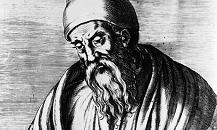
Euclid (Εύκλείδης) of Alexandria
(fl. c. 300 BCE)
Euclid’s fifth postulate cannot be proven as a theorem, although this was attempted by many people. Euclid himself used only the first four postulates (‘absolute geometry’) for the first 28 propositions of the Elements, but was forced to invoke the parallel postulate on the 29th. In 1823, Janos Bolyai and Nicolai Lobachevsky independently realized that entirely self-consistent “non-Euclidean geometries” could be created in which the parallel postulate did not hold. (Gauss had also discovered but suppressed the existence of non-Euclidean geometries.)
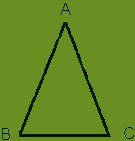
Years ago at school I was taught the theorem that the two base angles of an isosceles triangle are equal. The method used was long, as developed by the ancient Greeks. Many years later, I learnt that a new proof of the theorem had been ‘discovered’ by a computer, whose only input had been the original Euclidean axioms; what is more the newly-discovered proof was extremely simple. Here it is:
In an isosceles triangle ABC (BC being the base line), triangle ABC is congruent to triangle ACB (AB=AC, AC=AB, and angle BAC=angle CAB; two pairs of equal sides and their included angles equal prove congruence). So angle ABC=angle ACB; QED. It’s so neat and simple. I’m sure Hardy would have called it a ‘beautiful proof’.

The five regular convex solids — that’s all there are, five in total. There are some other very complex regular solids, like the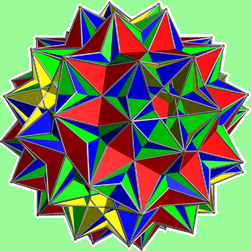
great disnub dirhombidodecahedron
which have quite beautiful shapes, but they’re not convex. See Polyhedra.
If you are interested in making models of things like the great disnub dirhombidodecahedron, two books I’d suggest are Polyhedron Models by Magnus J Wenninger (CUP) and Mathematical Models by H M Cundy and A P Rollet (OUP), but I’d recommend starting on a simple model first, like a cube! Thin coloured card is a good medium.
An example of a beautiful theorem is Pythagoras’s proof of the ‘irrationality’ of the square-root of 2. A ‘rational number’ is a fraction a/b, where a and b are whole numbers: we may suppose that a and b have no common factor, since if they had we could remove it (by dividing both by it, leaving still two whole numbers. To say that ‘the square-root of 2 is irrational’ is merely another way of saying that 2 cannot be expressed in the form (a/b)2; and this is the same as saying that the equation
a2 = 2b2 ......[A]
cannot be satisfied by integral values of a and b which have no common factor. This is a theorem of pure arithmetic, which does not demand any knowledge of ‘irrational numbers’ or depend on any theory about their nature.
We argue by reductio ad absurdum (producing a contradiction); we suppose that [A] is true, a and b being integers without any common factor. It follows from [A] that a2 is even (since 2b2 is divisible by 2), and therefore that a is even (since the square of an odd number is odd). If a is even then
a = 2c ......[B]
for some integral value of c; and therefore
2b2 = a2 = (2c)2 = 4c2
or
b2 = 2c2 ......[C]
Hence b2 is even, and therefore (for the same reason as before) b is even. That is to say, a and b are both even, and so have common factor 2. This contradicts our hypothesis, and therefore the hypothesis is false.
Another famous and beautiful theorem is Fermat’s ‘two square’ theorem. The primes may (if we ignore the special prime 2) be arranged in two classes; the primes
5, 13, 17, 29, 37, 41, ......
which leave remainder 1 when divided by 4, and the primes
3, 7, 11, 19, 23, 31, ......
which leave remainder 3. All the primes of the first class, and none of the second, can be expressed as the sum of two integral squares, thus:
5 = 12 + 22, 13 = 22 + 32, 17 = 12 + 42, 29 = 22 + 52
but 3, 7, 11, and 19 are not expressible in this way (as the reader may check by trial). This is Fermat’s theorem, which is ranked, very justly, as one of the finest of arithmetic. Unfortunately, there is no proof within the comprehension of anybody but a fairly expert mathematician.
G. H. Hardy reflecting on his life as a mathematician, A Mathematician’s Apology (a PDF file, 175 KB), first published in November 1940
“...mathematics... is a young man’s game... Newton gave up mathematics at fifty, and had lost his enthusiasm long before; he had recognized no doubt by the time he was forty that his greatest creative days were over. His greatest idea of all, fluxions and the law of gravitation, came to him about 1666, when he was twenty-four — ‘in those days I was in the prime of my age for invention, and minded mathematics and philosophy more than at any time since’. He made big discoveries until he was nearly forty (the ‘elliptic orbit’ at thirty-seven), but after that he did little but polish and perfect.
“Galois died at twenty-one, Abel at twenty-seven, Ramanujan at thirty-three, Riemann at forty...”
And
And
“A mathematician has no material to work with but ideas, and [...] ideas wear less with time than words.
“The mathematician’s patterns, like the painter’s or the poet’s must be beautiful; the ideas like the colours or the words, must fit together in a harmonious way. Beauty is the first test: there is no permanent place in the world for ugly mathematics.
“It may be very hard to define mathematical beauty, but that is just as true of beauty of any kind — we may not know quite what we mean by a beautiful poem, but that does not prevent us from recognizing one when we read it.
“...Chess problems are the hymn-tunes of mathematics... Chess problems are unimportant...
“A serious mathematical theorem, a theorem which connects significant ideas, is likely to lead to important advance in mathematics itself and even in other sciences. No chess problem has ever affected the general development of scientific though[t]: Pythagoras, Newton, Einstein have in their times changed its whole direction.”
Two examples of what Hardy, and many others, have considered to be ‘beautiful theorems’ are in the right column in this section.
Hardy concludes his monograph with these thoughts:
The Nothing That Is, Robert Kaplan,
Allen Lane – The Penguin Press, 1999
The Joy Of Pi, David Blatner,
Allen Lane – The Penguin Press, 1997
The Music of the Primes: Why an Unsolved Problem in Mathematics Matters,
Marcus du Sautoy, Harper Perennial, 2005
There are a number of paperback books published by “Penguin Books” under their “Pelican Books” imprint in the 1950s, 1960s and 1970s, by Martin Gardner of Scientific American; they have titles like Mathematical Puzzles and Diversions and Mathematical Circus; excellent reading if you like that sort of thing.
In a similar vein is Fallacies in Mathematics, E A Maxwell,
Cambridge University Press, 1963; my copy’s cover price was 6s.6d. or 95 cents.
The Principles of Mathematics, Bertrand Russell, Allen & Unwin, first published 1903
A History of Mathematics, J F Scott, Taylor & Francis, 1960
You may happen upon any of these in a second-hand bookshop.