Loading...
Astronomy and its concepts; Cosmology
Spacecraft and Space Science
Science and Scientists
Mathematics
including the game of Life, Polyhedra and Fractals
Computing
Thinking about Science
Of course, science isn’t just astronomy, cosmology and mathematics. But those are its areas that interest me. So I won’t even attempt to cover other aspects like Biology, Chemistry and so on. Start with Wikipedia, Wikispecies, Google or wherever your interest lies. (You could start with the Universe!)
Try reading this article Science is boring from The Guardian.
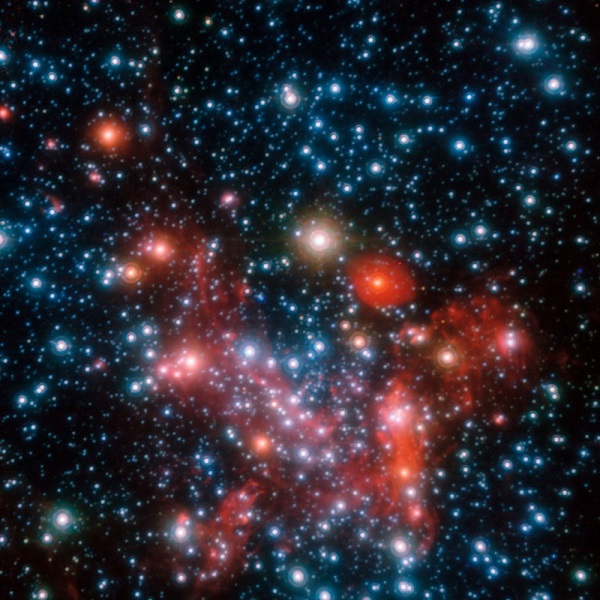
[Below]: The Centre of the Milky Way as photographed by the Hubble Space Telescope.
Click here for an animation of stars orbiting its central massive black hole
Didn’t you have a sneaking wonder what all this fuss about the Higgs boson might be about? BE HONEST!
Modern astronomy, cosmology and, for that matter, particle physics would have not advanced as it has without the use of satellites and other space probes. Nor would telecommunications.
A propos of nothing [Attention! Cliché alert!], I found this little gem on the Guardian’s web, which I’d like to share:
Michael Faraday’s lectures at London’s Royal Institution in the early 19th century were so popular
that the carriages dropping people off to see him used to choke Albemarle Street in Mayfair
– as a result, the street was designated the first one-way road in London.

Science fiction can be fun, but I think it’s more interesting when it has a modicum of real science about it; in other words there’s no room for “little green men” or reptilian aliens that Doctor Who, for example, seems to enjoy mastering. As for the Independence Day aliens, I’m sorry, but they don’t pass muster!
Impression of an Enormous Black Hole Blast
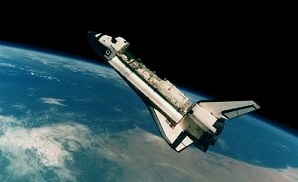
One of the Space Shuttles
Printed Circuit Board
...The universe is 13.7 billion years old; we may imagine that going back two million years, to the time when the light we are currently seeing from the Andromeda Galaxy was emitted, the universe was 13,698,000,000 years old. (Such travels in time are called ‘thought experiments’.)
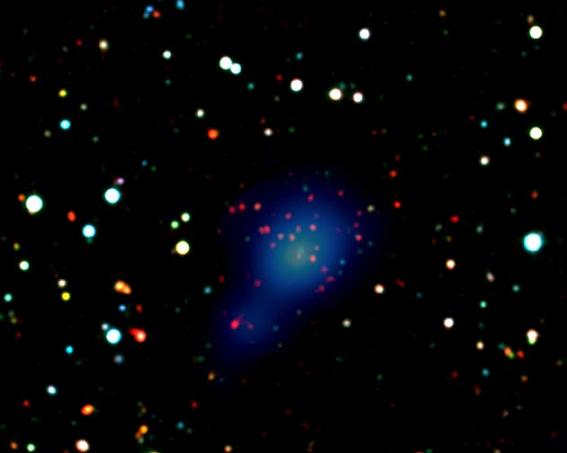
Going back even further, we may find a cluster of galaxies named XMMXCS 2215-1738 [the blue fuzziness in the photograph]. Sorry about the awful name; I acknowledge that it’s the sort of thing likely to put people off science. [Mind you, Wolfgang Amadeus Mozart’s Offertory in C, “Benedictus sit Deus”, Köchel 66a is a pretty intimidating mouthful to a non-musician.] Those galaxies lie about 10 billion light-years away. The cluster was discovered by the XMM Cluster Survey in 2006. Its light that we now see was emitted when the universe was some 3.7 billion years old.
But if we go back another 3.7 billion light-years, we should arrive to see the universe when it began. Well, we should but the universe isn’t quite that simple. Many other questions present themselves. Can we go back further in time? Can we go back twenty billion years from now? The simple answer is that we don’t know. Quantum mechanics doesn’t tell us; in fact it seems to suggest that such questions have no meaning. Or have they? Perhaps time just started 13.7 billion years ago.
Out of this world: why the most important art today is made in space. Forget the Turner prize. This is art that reflects the true grandeur of the universe – it is the Sistine Chapel of the scientific age [by Jonathan Jones in The Guardian]