
Loading...
Loading...
Note in the diagrams the presence of α Centauri, Barnard’s Star, Ross 128, Ross 248 and Lalande 21185 as well as Proxima Centauri.
Some other stars have a high “proper motion”, that is, they move fastest across the sky and are therefore quite close to us. This includes Teegarden’s star, which is an M-type brown dwarf in Aries, about 12 light years from the Solar System. Despite its proximity (the 24th nearest) it is very dim and can only be seen through very large telescopes; it was discovered in 2003.
The second map shows all the star systems within 14 light-years of the Sun (shown as “Sol”, the Latin name of the Sun – not to be confused with the length of a Martian day, also called a “sol”). It does not include four brown dwarfs discovered after 2009. Double and triple stars are shown “stacked”, but the true location is the star closest to the central plane. The colours are derived from conventional names for the spectral types and do not represent their observed colours. The coordinate system is right ascension and declination. Hours of RA are marked, as well as distance in multiples of 5 light-years.
At a distance of up to 16.3 light-years from the Solar System, there are 55 stellar systems containing a total of 56 hydrogen-fusing stars (of which 46 are red dwarfs), 14 brown dwarfs, and 4 white dwarfs. Despite the relative proximity of these objects to the Earth, only nine of them have an apparent magnitude less than 6.5, which means only about 13% of these objects can be observed with the naked eye. Besides the Sun, only three are first-magnitude stars: Alpha Centauri, Sirius, and Procyon. All of these objects are located in the Local Bubble, a region within the Orion – Cygnus Arm of the Milky Way Galaxy.
...continuing from our look at the Solar System, the environs of our own star, we reach...
Alpha Centauri, also known as Rigil Kentaurus, Rigil Kent or Toliman) is the brightest star in the southern constellation of Centaurus. Although it appears to the unaided eye as a single object, Alpha Centauri is actually a binary star system (designated Alpha Centauri AB or α Cen AB) whose combined visual magnitude of -0.27 would qualify it as the third single brightest star in the night sky after the -1.46 magnitude Sirius and the -0.72 magnitude Canopus.
Its individual component stars are named Alpha Centauri A (α Cen A), with 110% of the mass and 151.9% the luminosity of the Sun, and Alpha Centauri B (α Cen B), at 90.7% of the Sun’s mass and 50.0% of its luminosity (α Cen B is believed to have at least one planet, discovered in 2012). During the stars’ 79.91 year orbit about their common centre of gravity, the distance between them varies from about that between Pluto and the Sun to that between Saturn and the Sun. They average 4.37 light years from the Sun.
A third star, known as Proxima Centauri, Proxima or Alpha Centauri C (α Cen C), is probably gravitationally associated with Alpha Centauri AB. Proxima is now placed at the slightly smaller distance of 4.24 light years from the Sun, making it the closest star to the Sun, even though it is not visible to the naked eye. The true separation of Proxima from Alpha Centauri AB is about 0.2 light years or 13,000 astronomical units (AU), equivalent to 400 times the size of Neptune’s orbit.
Barnard’s Star, showing its position every 5 years from 1985 to 2005 [but you must click on it]
After the α Cen trio is Barnard’s Star in the constellation Ophiuchus. It is dim with an apparent magnitude of nine, not visible to the unaided eye; however, it is much brighter in the infrared than it is in visible light. In 1916 American astronomer E E Barnard measured its proper motion as 10.3 arcseconds per year, the largest-known of any star relative to the Solar System. Its mass is believed to be 0.144 solar masses and its radius 0.196±0.008 that of the sun. It is an M-type dwarf, with a surface temperature of about 3,000° and is about 10 billion years old.
Images of Luhman 16 made by the Wide-field Infrared Survey Explorer (WISE) Earth-orbiting satellite. In the inset, it is resolved into a pair
Next in distance from us is a twin pair of brown dwarf stars, Luhman 16AB in Vela, about 6.6 light-years from the Sun. They are the closest known brown dwarfs, of types L and T. Luhman 16 A and B orbit each other at a distance of about 3 AU with an orbital period of approximately 25 years. The pair of dwarfs was announced in 2013; perturbations of their orbits suggest a possible planet. Luhman 16 is also the nearest known star/brown-dwarf system to Alpha Centauri, located 3.63 ly from it. This is due to both systems being located in neighbouring constellations, in the same part of the sky as seen from Earth but Luhman 16 is a bit farther away. Before the discovery of Luhman 16, the Solar System was the nearest known system to Alpha Centauri.
 This video takes you on a fly-through of the space around the nearest stars to the Sun.
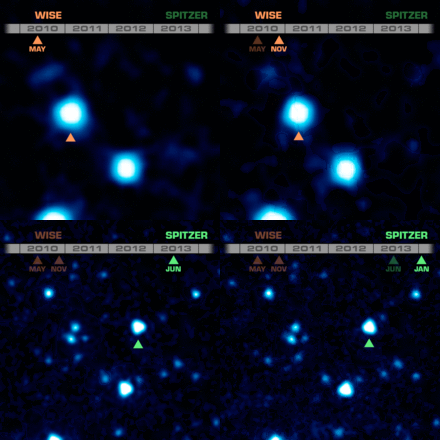
WISE 0855–0714 is a (sub-)brown dwarf 7.53+0.27
−0.25 light-years from Earth announced in April 2014 by Kevin Luhman using data from the Wide-field Infrared Survey Explorer (WISE). As of 2014, WISE 0855–0714 has the third-highest proper motion (8130±22 milliarcseconds/year [mas/yr]) after Barnard’s Star (10300 mas/yr) and Kapteyn’s Star (8600 mas/yr). It also has the fourth-largest parallax (433±15 mas/yr) of any known star or brown dwarf, meaning it is the fourth closest extrasolar system to the Sun. It is also the coldest object of its type found in interstellar space, having a temperature between 225 to 260 K (−48 to −13 °C).
Based on models of brown dwarfs, WISE 0855–0714 is estimated to have a mass of 3 to 10 MJ (3 to 10 times Jupiter’s mass). This is in the range of a sub-brown dwarf or other planetary-mass object. The IAU considers an object with a mass above 13 MJ, capable of fusing deuterium, to be a brown dwarf. A lighter object orbiting another object is considered a planet. So far this WISE object is alone, though it could be a rogue planet, something first identified in 2004 in the case of Cha 110913-773444.
Wolf 359 (CN Leonis) is a red dwarf that is one of the faintest and lowest-mass stars known. It has a temperature of about 2,800°, low enough for chemical compounds to form and survive, with water and titanium oxide observed in the spectrum. Wolf 359 is a relatively young star with an age of less than a billion years. No companions or disks of debris have been detected in orbit around it.
The next star out is Lalande 21185, a red M-class dwarf in Ursa Major. It is often referred to by its alternative names, BD+36 2147, Gliese 411 and HD 95735. It has no known planets; any that are present would have masses smaller than Jupiter.
On the right, photographed by the Hubble Telescope is Sirius (α Canis Majoris) which is in a different league – the brightest star in the night sky with a visual apparent magnitude of −1.46, it is almost twice as bright as Canopus (α Carinae), the next brightest star. The name “Sirius” is derived from the Ancient Greek: Σείριος (Seirios, “glowing” or “scorcher”) is actually a binary star system, consisting of a white main-sequence star of spectral type A1V, termed Sirius A, and a faint white dwarf companion of spectral type DA2, Sirius B. The distance separating Sirius A from its companion varies between 8.2 and 31.5 AU.
Luyten 726-8 (also known as Gliese 65) is a binary star system that is one of Earth’s nearest neighbours, at about 8.7 light years from Earth in the constellation Cetus. Luyten 726-8B is also known under the variable star designation UV Ceti, being the archetype for the class of flare stars.
The star system was discovered in 1948 by Willem Jacob Luyten in the course of compiling a catalog of stars of high proper motion; he noted its exceptionally high proper motion of 3.37 arc seconds annually and cataloged it as Luyten 726-8. The two stars are of nearly equal brightness, with visual magnitudes of 12.57 and 11.99 as seen from Earth. They orbit one another every 26.52 years, with a semi-major axis of 1.95 arcseconds an eccentricity of 0.62 and an inclination of 0.62; its orbital inclination is 127.3°. The distance between the two stars varies from 2.1 to 8.8 astronomical units (310 to 1,320 Gm). The Luyten 726-8 system is approximately 2.68±0.02 parsecs (8.73±0.06 light years) from the Earth, in the constellation Cetus, and is thus the seventh-closest star system to Earth. Its own nearest neighbour is Tau Ceti, 0.88 parsecs (2.87 light years) away from it. If the radial velocity is +29 km/s then approximately 28,700 years ago Luyten 726-8 was at its minimal distance of 2.21 parsecs (7.2 light years) from the Sun.
Luyten 726-8A was found to be a variable star and given the variable star designation BL Ceti. It is a red dwarf of spectral type M5.5e. It is also a flare star, and classified as a UV Ceti variable type, but it is not nearly as remarkable or extreme in its behaviour as its companion star UV Ceti. BL Ceti is also known as G 272-061. Its mass is 0.102 ± 0.010 and its radius 0.14 those of the Sun. It has a very low luminosity, 0.00006 that of the Sun and a temperature of 2,670 K.
Soon after the discovery of Luyten 726-8A, the slightly brighter companion star Luyten 726-8B was discovered. Like Luyten 726-8A, this star was also found to be variable and given the variable star designation UV Ceti. Although UV Ceti was not the first flare star discovered, it is the most prominent example of such a star, so similar flare stars are now classified as UV Ceti type variable stars. This star goes through fairly extreme changes of brightness: for instance, in 1952, its brightness increased by 75 times in only 20 seconds. UV Ceti is a red dwarf of spectral type M6.0e. Its mass, radius and luminosity relative to the Sun are 0.100±0.010, 0.14 and 0.00004.
In approximately 31,500 years, Luyten 726-8 will have a close encounter with Epsilon Eridani at the minimal distance of about 0.93 light year. Luyten 726-8 can penetrate a conjectured Oort cloud about Epsilon Eridani, which may gravitationally perturb some long-period comets. The duration of mutual transit of two star systems within 1 light year from each other is about 4,600 years. Luyten 726-8 is a possible member of the Hyades Stream.
More about these in the List of nearest known stars in Wikipedia.
The night sky, taken from the Earth with a Canon 5D Mark II DSLR. Here, two lost hikers stand in a bubble of torchlight in Yosemite National Park, California. The picture captures the last remnants of daylight and the bright dust clouds of the Milky Way. The image strongly conveys the wonder, beauty and awe of astronomy.
Graphic designer Chad Powell from Ventnor, Isle of Wight, captured the ethereal beauty of the night sky over the Isle of Wight. He used the local architecture, coves and plant life of the island in the foreground of his photographs to create a contrast with the dramatic sky. The echium pininana, which grows all around Ventnor Botanic Garden and local gardens, appears to reach towards the stunning celestial display.
A part of the Milky Way that is not seen from the northern skies of Europe and North America.
MangaiaOePan by Tung Tezel. The southern Milky Way viewed over the hilltops outside the village of Oneroa on the coast of Mangaia in the Cook Islands. The panorama was created using nine 30-second exposures. Moisture in the atmosphere created the diffusion and colour effects of the stars.
The Milky Way as seen in the Mardi Khola valley in the Himalayas, with clouds of galactic dust illuminated in red by young stars. Anton Jankovoy braved freezing temperatures for this shot during a trek in Nepal.
Around 35,000 citizen scientists discovered more than 5,000 bubbles in the disc of our Milky Way galaxy, after poring over infrared observations from NASA’s Spitzer Space Telescope. Young, hot stars blow these shells into surrounding gas and dust, highlighting areas of new star formation. Online volunteers in the Milky Way Project have so far turned up 10 times as many bubbles as previous surveys.
Zooniverse is a citizen science web portal that grew from the original Galaxy Zoo project. It hosts numerous projects which allow users to participate in scientific research from classifying galaxies to collating climate data. Unlike many early internet-based citizen science projects such as SETI@home which used spare computer processing power to analyse data, known as volunteer computing, Zooniverse projects require the active participation of human volunteers to complete research tasks. As of August 2013, the community consists of over 850,000 volunteers, collectively referred to as “Zooites”.
The Galactic Centre is the rotational centre of the Milky Way. It is located about 25,000 to 28,000 light-years away, in the direction of the constellation Sagittarius. There is strong evidence consistent with the existence of a supermassive black hole at the Galactic Centre.
The complex astronomical radio source Sagittarius A appears to be located almost exactly at the Galactic Centre, and contains an intense compact radio source, Sagittarius A*, which coincides with a supermassive black hole. Accretion of gas onto the black hole, probably involving a disk around it, would release energy to power the radio source, itself much larger than the black hole. The latter is too small to see with present instruments.
A study in 2008 which linked radio telescopes in Hawaii, Arizona and California (Very Long Baseline Interferometry) measured the diameter of Sagittarius A* to be 44 million km (0.3 AU).] For comparison, the radius of Earth’s orbit around the Sun is about 150 million km (1.0 AU), whereas the distance of Mercury from the Sun at closest approach (perihelion) is 46 million km (0.3 AU). Thus the diameter of the radio source is slightly less than the distance from Mercury to the Sun.
Scientists at the Max Planck Institute for Extraterrestrial Physics in Germany using Chilean telescopes have confirmed the existence of a supermassive black hole at the Galactic Centre, of the order of 4.31 million solar masses.
On 5th January 2015, NASA reported observing an X-ray flare 400 times brighter than usual, a record-breaker, from Sagittarius A*. The unusual event may have been caused by the breaking apart of an asteroid falling into the black hole or by the entanglement of magnetic field lines within gas flowing into Sagittarius A*.

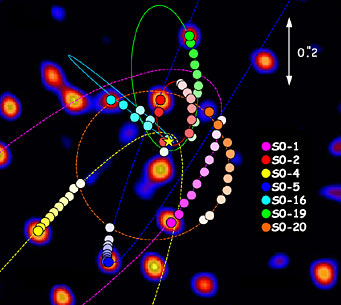
The stars within the Milky Way’s central 1/10th light-year loop around the known location of the central black hole (the white star symbol in the animation). The fuzzy blobs are diffraction-limited star images in an infrared adaptive-optics frame taken by a 10-metre Keck telescope in 2004. Watch SO-16 and SO-2 especially. The frame is 1 arcsecond (0.13 light-year) square.
While every star in this image has been seen to move, estimates of orbital parameters are only possible for those that have shown significant curvature. The annual average positions for these stars are plotted as coloured dots (which have increasing colour saturation with time). Also plotted are the best-fitting orbits which provide the clearest estimate yet on the mass of the central black hole: 4.5±0.4 million Suns, with a diameter of 0.1 astronomical unit (about 9 million miles).
It is believed that all spiral galaxies, and maybe others, have huge black holes at their centres, and that the formation of a galaxy and its black hole are intimately linked; but how and why are still mysteries. (See also Spiral Arms of Galaxies)
Objects whose gravitational fields are too strong for light to escape were first considered in the 18th century. The first modern solution of general relativity that would characterize a black hole was found by Karl Schwarzschild in 1916, although its interpretation as a region of space from which nothing can escape was first published by David Finkelstein in 1958.
Nevertheless black holes are associated with the emission of enormous amounts of energy, far more than a supernova. This is believed to be because matter falling into a black hole forms a disc around it, which rotates at a significant fraction of the speed of light. This in turn causes energy to be radiated, mostly along the axis of the spinning disc.
Tau Ceti (τ Cet, τ Ceti) is a star in the constellation Cetus that is spectrally similar to the Sun, although it has only about 78% of the Sun’s mass (0.783±0.012 solar masses) and a radius of 0.793±0.004 that of the Sun. At a distance of 11.905±0.007 light-years from the Solar System, it is a relatively nearby star, and is the closest solitary G-class (G8.5 V) star. [Alpha Centauri A is closer, but is a member of a triple system.] The star appears stable, with little stellar variation. Its surface temperature is 5,344±50 K, and it rotates once every 34 days. It is about 5.8 billion years old.
Tau Ceti is metal-deficient, a deficiency usually associated with systems having no giant planets and few terrestrial planets. Observations have however detected more than ten times as much dust surrounding Tau Ceti as is present in the Solar System.
Since December 2012, there has been evidence of possibly five planets orbiting Tau Ceti, with one of these being potentially in the habitable zone. Because of its debris disk, any planet orbiting Tau Ceti would face far more impact events than the Earth. Despite this hurdle to habitability, its Sun-like characteristics have led to widespread interest in the star. Given its stability, similarity and relative proximity to the Sun, Tau Ceti is consistently listed as a target for the Search for Extra-Terrestrial Intelligence (SETI), and it appears in some science fiction literature.
It can be seen with the unaided eye as a third-magnitude (3.50±0.01) star, with absolute magnitude 5.69±0.01. It can not be observed above latitude 75°N, as that is 90° north of the declination, 15°S. In practice, atmospheric effects will reduce visibility of the object when it is near the horizon.
As seen from Tau Ceti, the Sun would be a third-magnitude star in the constellation Boötes near Tau Boötis. The absolute magnitude of the Sun is 4.8, so, at a distance of 3.65 parsecs, the Sun would have an apparent magnitude 2.6.
M 31 Andromeda Galaxy (NGC 224) is a spiral galaxy around 2.5 million light years from Earth in the constellation Andromeda. The galaxy is visible to the naked eye on moonless nights as a smudge of light and is the most distant object visible without a telescope. But the photographer from Michigan who took the image above used the observatory in his back garden to reveal an enormous swirling spiral of billions of stars, glowing gas and dark dust. Andromeda will be even more impressive in 4.5 billion years’ time, when it is expected to collide with our own galaxy, the Milky Way.
Twenty-six new black hole candidates have been discovered in the Andromeda galaxy. The discoveries were made using NASA’s Chandra and the European Space Agency’s XMM-Newton satellites which recorded the X-ray light emitted by stars being ripped apart as they fell into the black holes.
Hubble has taken another look at the Andromeda Galaxy to capture the highest-resolution image ever taken of space. 1.5 billion pixels make up the image, which would need 750 high-definition TV screens to view it in its entirety at full size. This highest-resolution photo ever captured of space has 1,000 times the resolution of a normal high-definition picture, and displaying the entire photo would require the equivalent of 750 HD television screens, researchers at the University of Washington who took the photo say.
The Andromeda Galaxy, because of its proximity to the Milky Way Galaxy, was chosen as the ideal candidate for the image, and the result is a new benchmark for precise study of a large spiral galaxy. Even from millions of light years away, the strength of the Hubble telescope is enough to show individual stars within a 61,000-light-year-long swathe of the galaxy’s pancake-shaped disk.
“Never before have astronomers been able to see individual stars inside an external spiral galaxy over such a large contiguous area,” NASA says on its website. “Most of the stars in the universe live inside such majestic star cities, and this is the first data that reveal populations of stars in context to their home galaxy”.
The final image which was presented in January 2015 at the at the 225th Meeting of the Astronomical Society, took 3 years to create as a composite of 7,398 separate images captured by Hubble from 411 points in space. The level of detail in the image, which shows 100 million stars, is “like photographing a beach and resolving individual grains of sand”, NASA said. The photo can be downloaded from NASA’s Hubble site, allowing individuals to zoom in and out on the image.
At one edge of the panorama is the innermost hub, or bulge, of the galaxy, and at the other side the image reveals lanes of stars and dust that get progressively thinner in Andromeda’s outer disk. Dark silhouettes are evidence of complex dust structures, while an underlying even distribution of cool red stars traces the evolution of Andromeda over billions of years. The image was created by instruments aboard Hubble viewing the galaxy in visible, near-ultraviolet and near-infrared wavelengths.
Outside our galaxy (the “Milky Way”) there is a local group of more than 54 galaxies, including some dwarf galaxies. The Andromeda Galaxy (M31) and the Triangulum Galaxy (M33) are the main galaxies in the group together with the Milky Way. Its gravitational centre is located somewhere between the Milky Way and the Andromeda Galaxy. The group covers a diameter of 10 megalight-years (3.1 megaparsecs) and has a binary (dumbbell) distribution. The group is estimated to have a total mass of 1.29±0.14×10¹² solar masses and has a velocity dispersion of 61±8 km/s. The group itself is part of the Virgo Supercluster which is one of millions of superclusters in the observable universe.
The Small Magellanic Cloud (SMC) in Tucana is one of the Milky Way’s closest galactic neighbours (this photo had a long exposure and many nebulae appear in it). Even though it is a dwarf galaxy, the SMC is so bright that it is visible to the unaided eye from the Southern Hemisphere and near the equator.
Many navigators, including Ferdinand Magellan whose name was given to the Large and Small Clouds, used it to help find their way across the oceans.
The Large Magellanic Cloud (LMC) is a satellite dwarf galaxy of the Milky Way that is among the closest galaxies to Earth. At about 163,000 light-years from Earth, the dwarf galaxy looks like a faint cloud in Southern Hemisphere skies. It lies on the border of the constellations Dorado and Mensa. The European Southern Observatory (ESO) captured this image using various colour filters. The stars are shown in their natural colours, while light from glowing ionised hydrogen (red) and oxygen (blue) is overlaid.
The LMC has a mass equivalent to approximately 10 billion times the mass of our Sun (1010 solar masses), making it roughly 1/100 as massive as the Milky Way, and a diameter of about 14,000 light-years. The LMC is the fourth largest galaxy in the Local Group, after the Andromeda Galaxy (M31), the Milky Way Galaxy, and the Triangulum Galaxy (M33).
The LMC was believed to be the closest galactic object to Earth until 1994, when astronomers found the Sagittarius Dwarf Elliptical Galaxy (about 16 kiloparsecs). Globular cluster M54 coincides with one of this galaxy’s two bright knots, and is also receding at about the same velocity. It may also be at the same distance, about 88,000 light years. Another discovery in 2003 – the Canis Major Dwarf Galaxy – turned out to be even closer (12.9 kiloparsecs).
30 Doradus (also known as the Tarantula Nebula, or NGC 2070) is an H II region in the Large Magellanic Cloud (LMC).
Known as the Tarantula Nebula for its spidery appearance, the 30 Doradus complex is a monstrous stellar factory. It is the largest emission nebula in the sky, and can be seen far down in the southern sky at a distance of about 170,000 light-years, in the southern constellation Dorado (the Swordfish or the Goldfish). It is part of one of the Milky Way’s neighbouring galaxies, the Large Magellanic Cloud.
An expanding shell of debris called SNR 0519-69.0 is left behind after the explosion of a massive star in the LMC, a satellite galaxy to the Milky Way. The orbiting Chandra X-Ray Observatory detected the X-ray emissions from gas heated up to millions of degrees; those emissions are shown here in blue. The outer edge of the explosion (shown in red) and the stars in the field of view were seen in visible light from the HST. NASA released this picture on 22nd January 2015 to celebrate 2015 as the UN International Year of Light.
The Tarantula Nebula is thought to contain more than half a million times the mass of the Sun in gas and this vast, blazing labyrinth hosts some of the most massive stars known. The nebula owes its name to the arrangement of its brightest patches of nebulosity, that somewhat resemble the legs of a spider. They extend from a central ‘body’ where a cluster of hot stars (designated R136) illuminates and shapes the nebula. This name, of the biggest spiders on the Earth, is also very fitting in view of the gigantic proportions of the celestial nebula – it measures nearly 1,000 light-years across and extends over more than one third of a degree: almost, but not quite, the size of the full Moon. If it were in our own Galaxy, at the distance of another stellar nursery, the Orion Nebula (1,500 light-years away), it would cover one quarter of the sky and even be visible in daylight.
R136 (formally known as RMC 136 from the Radcliffe Observatory Magellanic Clouds catalogue) is the central concentration of stars in the NGC 2070 star cluster, which lies at the centre of the Tarantula Nebula in the Large Magellanic Cloud. When originally named it was an unresolved stellar object (catalogued as HD 38268 and Wolf-Rayet star Brey 82) but is now known to include 72 class O and Wolf Rayet stars within 5 parsecs (20 arc seconds) of the centre of the cluster. The extreme number and concentration of young massive stars in this part of the LMC qualifies it as a starburst region. It is only a few million years old and resides in the 30 Doradus Nebula, a turbulent star-birth region in the Large Magellanic Cloud There is no known star-forming region in the Local Group as active and as luminous as 30 Doradus.
R136 produces most of the energy that makes the Tarantula Nebula visible. The estimated mass of the cluster is 450,000 solar masses, suggesting it may become a globular cluster in the future. R136 has around 200 times the stellar density of a typical OB association such as Cygnus OB2. The central R136 concentration of the cluster is about 2 parsecs across, although the whole NGC 2070 cluster is much larger.
R136 is thought to be less than 2 million years old. None of the member stars are significantly evolved and none are thought to have exploded as supernovae. The brightest stars are all extremely massive fully convective stars. There are no red supergiants, blue hypergiants, or luminous blue variables within the cluster. A small number of class B stars have been detected in the outskirts of the cluster, but less massive and less luminous stars cannot be resolved from the dense cluster core at the large distance of the LMC.
The cluster R136 contains many of the most massive and luminous stars known, including R136a1. Within the central 5 parsecs there are 32 of the hottest type O stars (O2 – O3.5), 40 other O stars, and 12 Wolf-Rayet stars, mostly of the extremely luminous WNh type. Within 150 parsecs there are a further 325 O stars and 19 Wolf-Rayet stars. Several runaway stars have been associated with R136, including VFTS 682. R136 was first resolved into three components R136a, R136b, and R136c. R136a was resolved using speckle interferometry and eventually space-based observations into as many as 24 components, named R136a1, R136a2, and R136a3, all three being extremely massive WNh stars several million times more luminous than the sun.
Star clusters are groups of stars that formed around the same time from a single cloud of gas and dust. The stars with the most mass tend to form in the centre of the cluster, while those with less mass dominate the outer regions. This, along with the greater number of stars concentrated in the centre, makes the middle of the cluster brighter than the outer areas.
If you look at the photographs of other galaxies, especially spiral galaxies that present their faces towards us, you will notice how the stars collect in “spiral arms”.
On closer examination you will notice that these spiral arms are not completely uniform but are broken up into clumps or groups of stars. In some cases the individual stars can only be seen through powerful telescopes. Intermingled with the stars are many clouds of dark gas or dust.
Our galaxy, the Milky Way, has a large number of clouds imbedded in it; we’re in the local interstellar cloud. The Voyager spacecraft that have now passed out of the gravitational pull of the Sun are entering this particular cloud.
The Local Cloud (or Local Interstellar Cloud) is the interstellar cloud roughly 30 light-years across through which the Solar System is currently moving. It is currently unknown if the Sun is embedded in this Cloud, or in the region where the Local Cloud is interacting with the neighbouring G-Cloud. The Solar System is thought to have entered the Local Cloud at some point between 44,000 and 150,000 years ago and is expected to remain within it for another 10,000 to 20,000 years. The cloud has a temperature of about 6,000 K (5,730 °C), about the same temperature as the surface of the Sun. However, its specific heat capacity is very low because it is not very dense, with 0.3 atoms per cubic centimetre, less dense than the average for the interstellar medium in the Milky Way (0.5 atoms/cm3).
The G-Cloud (or G-Cloud complex) is an interstellar cloud located next to the Local Interstellar Cloud. The Sun is currently moving towards it. It is currently unknown whether the Sun is embedded in the Local Interstellar Cloud, or in the region where the two clouds are interacting. The G-Cloud contains the stars Alpha Centauri, Proxima Centauri and Altair (and possibly others).
Astronomers knew some time ago that our Milky Way galaxy was just a part of a large cluster of supergalaxies. Now it’s got a new name and more has been discovered about it. Laniakea (for that’s its name) is described in this article and video from The Guardian.
A slice of the Laniakea supercluster in the supergalactic equatorial plane. The black dot indicates the location of the Milky Way galaxy. Each white speck is an individual galaxy. Shaded contours represent density, with high densities shown as red, intermediate as green and voids as blue. The white streaks are “velocity flow streams”.
The upper diagram shows a slice of the Laniakea Supercluster in the supergalactic equatorial plane. The supergalactic plane is a reference plane in a cosmological coordinate system and passes through the Sun, the Milky Way’s centre, and the centre of the Virgo Cluster of galaxies. It’s almost perpendicular to the galactic plane of the Milky Way. The Milky Way is at the little blue dot toward the right-hand edge of the circled region (just below the reddish area, which is the Virgo Cluster). Each white speck is an individual galaxy. Shaded contours represent density, with high densities shown as red, intermediate as green and voids as blue. The white streaks are “velocity flow streams”.
[SDvision interactive visualization software by DP at CEA/Saclay, France]
Laniakea has four main superclusters of galaxies:
Members of the Virgo Cluster include Messier 49, 58, 59, 60, 61, 84, 85, 86, 87, 88, 89, 91, 98, 99 and 100, and NGC 4216, 4262, 4435, 4438, 4450, 4526, 4527, 4536, 4550, 4567, 4568, 4571, 4651 and 4654.
For more information about the galaxies, clusters and superclusters of galaxies in our part of the universe, see Richard Powell’s Atlas of the Universe (whole site recommended). [Licensed under CC BY-SA 2.5 via Wikimedia Commons.] Note that this series of charts and tables is not completely up-to-date; research is continuously revealing more. Also see Wikipedia, but that page is in need of updating.
The second diagram is taken from Richard Powell’s work; because of advances in discovery, it names the “Virgo Supercluster” but not “Laniakea”
Sky and Telescope magazine has more about Laniakea.
Astronomers have pushed the boundaries of what’s possible with the Hubble Space Telescope to see a galaxy at a time when the universe was only 3% of its current age. Galaxy GN-z11, shown in the inset, currently holds the record for the most distant galaxy ever seen. The infant galaxy is blazing with bright, young, blue stars, but looks red in this image because its light has been stretched to longer spectral wavelengths by the expansion of the universe.
Its discovery came from the Hubble Space Telescope’s Great Observatories Origins Deep Survey (GOODS). The survey field contains tens of thousands of galaxies stretching far back into time. Galaxy GN-z11 appears to us as it was 13.4 billion years ago, only 400 million years after the Big Bang. A combination of imaging from Hubble and the Spitzer Space Telescope shows that GN-z11 is 25 times smaller than our Milky Way galaxy. It has just one percent of our galaxy’s mass in stars. But GN-z11 is growing fast, forming stars at a rate about 20 times greater than our galaxy does today. The team’s findings appeared in the 8th March 2016, edition of The Astrophysical Journal.
Astronomers called this infant galaxy “surprisingly bright”. They’re speaking relatively, of course, the had to push the boundaries of what’s possible with the Hubble Space Telescope in order to see it. The new most-distant-known galaxy is located in our sky in the direction of the constellation of Ursa Major. Astronomer Pascal Oesch of Yale, who led the research, said in a statement: “We’ve taken a major step back in time, beyond what we’d ever expected to be able to do with Hubble. We see GN-z11 at a time when the universe was only three percent of its current age.”
Astronomers say they’re now closing in on the first galaxies that formed in the universe. According to their statement: “This measurement provides strong evidence that some unusual and unexpectedly bright galaxies found earlier in Hubble images are really at extraordinary distances. Previously, the team had estimated GN-z11’s distance by determining its colour through imaging with Hubble and NASA’s Spitzer Space Telescope. Now, for the first time for a galaxy at such an extreme distance, the team used Hubble’s Wide Field Camera 3 to precisely measure the distance to GN-z11 spectroscopically by splitting the light into its component colours.”
Astronomers measure large distances by determining the red-shift of a galaxy. Galaxies show red-shifts because our universe is expanding, with each galaxy receding from every other galaxy. As this happens, the light of galaxies appears to us to be stretched to longer, redder wavelengths as it travels through expanding space to reach our telescopes. The greater the redshift, the farther the galaxy.
Its remote position puts GN-z11 at the beginning of what astronomers call the reionization era. In this early time in the universe, starlight from the first galaxies started to heat and lift the fog of cold hydrogen gas that filled the universe. The previous record-holding galaxy was seen in the middle of this epoch, about 150 million years later.
This illustration shows a timeline of the Universe, stretching from the present day (left) back to the Big Bang, 13.8 billion years ago (right). The newly discovered galaxy GN-z11 is the most distant galaxy discovered so far, at a redshift of 11.1, which corresponds to 400 million years after the Big Bang. The previous record holder’s position is also identified. Before astronomers determined the distance for GN-z11, the most distant galaxy measured spectroscopically had a redshift of 8.68 (13.2 billion years in the past). Now, the team has confirmed GN-z11 to be at a redshift of 11.1, nearly 200 million years closer to the time of the Big Bang.
Astronomers are looking forward to the launch of the James Webb Space Telescope in 2018. Pascal Oesch commented: “Hubble and Spitzer are already reaching into Webb territory.”
They said this discovery also has important consequences for NASA’s planned Wide-Field Infrared Survey Telescope (WFIRST), which, they say:“...will have the ability to find thousands of such bright, very distant galaxies.“
The animation below shows the location of galaxy GN-z11. The video begins by locating the Big Dipper, then shows the constellation Ursa Major. It then zooms into the GOODS North field of galaxies, and ends with a Hubble image of the young galaxy.
A black hole is a place in space where gravity pulls so much that even light can not get out. The gravity is so strong because matter has been squeezed into a tiny space. This can happen when a star is dying. Because no light can get out, you can’t see black holes. They are invisible.
However, their effects may be felt by their gravitational pull on other bodies, like stars, and even on light.
On 28th March 2011, NASA’s Swift spacecraft detected intense X-ray flares thought to be caused by a black hole devouring a star. In one model a sun-like star on an eccentric orbit plunges too close to its galaxy’s central black hole. About half of the star’s mass feeds an accretion disk around the black hole, which in turn powers a particle jet that beams radiation towards Earth.
Swift was launched on 20th November 2004 from Cape Canaveral, by a Boeing Delta II rocket. Its mission was to solve the mystery of the origin of gamma-ray bursts, which scientists think are the birth cries of black holes. Each gamma-ray burst is a short-lived event, lasting only a few milliseconds to a few minutes, never to appear again. They occur several times daily somewhere in the universe, and Swift, with a suite of three main instruments, should detect several weekly. By early 2015 it had detected 942 gamma-ray bursts.