Answer to the London, sewing machine question
London was Cobbett’s Great Wen,
the sewing machine was invented by Elias Howe,
Hoo is a village in Kent by the Medway,
James Watt had a unit of power named after him,
nicknames often end in -y
and Ware is in Herts.
So we have when, how, who, what, why, and where.
Back to question
Answer to the Auxiliary Verbs question
The key to the Auxiliary Verbs question is join the army (or something similar).
Back to question
Answer to the Underground Distances question
London Underground distances are measured in kilometres from an origin (0.000 km) at the far end of the platform of the former Central line terminus at Ongar. Distances are measured westwards from Ongar along the Central line to the termini at West Ruislip and Ealing Broadway. This is an historical remnant of when the Epping – Ongar section was still part of the Central line.
Distances on other Underground lines are measured from “transfer points” where pairs of lines meet:
Transfer points for distances on the London Underground
| From line | To line | Transfer point | Distance |
| Central | District | Mile End | 33.1 |
| District | Piccadilly | Barons Court | 47.8 |
| Piccadilly | Metropolitan | Rayners Lane | 64.4 |
| Piccadilly | Victoria | Finsbury Park | 34.5 |
| Piccadilly | Northern | Kings Cross loop | 38.4 |
| Metropolitan | Jubilee | Finchley Road | 50.1 |
| Jubilee | Bakerloo | Baker Street | 46.5 |
| District | East London* | St Mary’s Junction | 33.45 |
The Circle and Hammersmith and City lines are essentially composed of segments of the District and Metropolitan lines, and their distance markers are determined accordingly.
* The East London line (originally the Shoreditch – New Cross/New Cross Gate section of the Metropolitan line) is now part of the London Overground Highbury & Islington – West Croydon/Clapham Junction section. Much of the London Overground system is inherited from national rail routes.
The Waterloo and City line is disconnected from the rest, originally a part of the British Railways system; its distance markers are calculated from 0.00 km at the end of the Waterloo depôt.
Back to question
Answer to the Three-way Duel puzzle
Claude’s best plan is to shoot into the air (or, at least away from his opponents) with his first shot. Then Bill would have to shoot at Aaron with the next shot, otherwise Aaron is bound to kill him. (If Claude manages to kill one of the others with his first shot, he is certain to be killed if Bill dies; or 80% sure to die if Aaron is killed.) So, after ‘passing’ with his first shot, Claude waits, hoping that Bill misses Aaron (a 20% chance); then Aaron would kill Bill. Claude’s second shot stands a 50% chance of getting Aaron, otherwise he’d die.
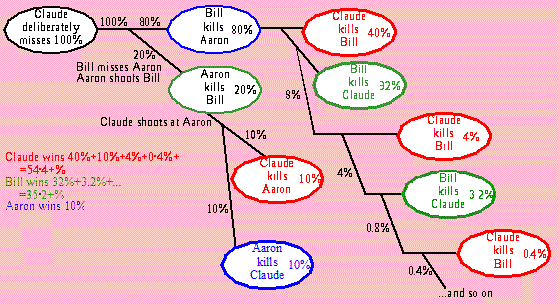
As you can see from the diagram, Calamity Claude stands the best chance of winning if he deliberately misses on the first round, with better than a 54% chance of surviving. Buffalo Bill has a 35% chance, and Accurate Aaron only 10%. (It just seems wrong, but that’s how it turns out!)
Back to question
Answer to the Casablanca question
Ilsa (Ingrid Bergman) is popularly quoted as saying: “Play it again, Sam”. But those exact words never appeared in the film. The script was:
Ilsa: Play it once, Sam. For old times’ sake.
Sam (Dooley Wilson): [lying] I don’t know what you mean, Miss Ilsa.
Ilsa: Play it, Sam. Play “As Time Goes By.”
Sam: [lying] Oh, I can’t remember it, Miss Ilsa. I’m a little rusty on it.
Ilsa: I’ll hum it for you. Da-dy-da-dy-da-dum, da-dy-da-dee-da-dum...
[Sam begins playing]
Ilsa: Sing it, Sam.
Sam: [singing] You must remember this
A kiss is still a kiss
A sigh is just a sigh
The fundamental things apply
As time goes by.
And when two lovers woo,
They still say, ‘I love you’
On that you can rely
No matter what the future brings–...
Rick (Humphrey Bogart): [rushing up] Sam, I thought I told you never to play–...
[Sees Ilsa. Sam closes the piano and rolls it away]
This film is also famous for the classic lines by Captain Renault (Claude Rains):
Major Strasser’s been shot.
[Renault looks at Rick, Rick gives him a look]
Round up the usual suspects.
Back to question
Answer to the Round Britain Quiz nocturnal lemur question
The lemur is an aye-aye,
Circe (an enchantress said by Homer to have turned the companions of Odysseus into swine by means of a magic drink) lived on the island of Aeaea,
and the Jovian (meaning ‘pertaining to Jupiter’) attendant is the satellite Io.
These are all words containing only vowels. So the agriculturalist is
‘Old MacDonald [who] had a farm, E–I–E–I–O’.
Finally, the Catalan informal name for ‘grandma’ is iaia, pronounced /ya-ya/.
Back to question
Answer to the Ballet Dancer question
Tutu connects a ballet dancer and an African religious leader. And Tu (singularly) was a chemical element, thulium. (In other words, Tu was the chemical symbol for the element but it is now Tm.) It’s not Tungsten which is W.
Back to question
Answer to the First Crossword Clue
Crossword Clue Answer: WATER (clue is H to O, that is, H2O).
Back to question
Answer to the “Motorists, we salute you” question
Answer: Some fifty years ago the RAC (and its competitor, the AA [Automobile Association]) had motorcycle patrols which toured around, looking for any of its members whose cars had broken down; and providing assistance where they could. Members would proudly display an RAC badge on their car’s radiator grille, and any RAC patrolman passing in the opposite direction would salute the driver of the car.
Sometimes he didn’t salute. This was often an indication to the driver that there was a Police checkpoint or speed trap ahead. Nothing was said (so the patrolman couldn’t be accused of impeding the Police in their duties) just the lack of a salute might carry this meaning.
Back to question
Answer to the What Connects question
Answer: Georgia. The references are to:
- Asteroid number 359
- A country that was once part of the Soviet Union
- Cities in Indiana, New Jersey and Vermont
- Georgia Avenue in Washington DC
- Georgia Street in Vancouver, British Columbia
- and the US state
Back to question
Answer to the Union Jack question
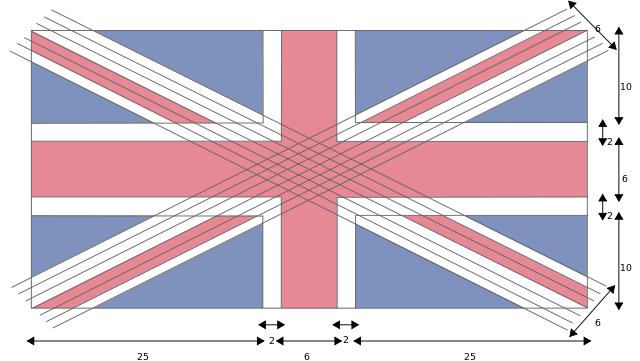
The flag on the left in the question is correctly orientated. Traditionally, flying a flag upside down is understood as a distress signal. In the case of the Union Flag, the difference is so subtle as to be easily missed by many. Indeed, many people have displayed it upside down inadvertently.
Wikipedia has an informative article on the flag.
Here are the specifications of the flag (a 3:5 ratio version can also be used):
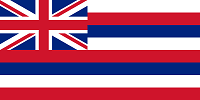
Ka Hae Hawai‘i, the flag of Hawaii
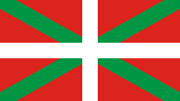
Ikurrina (Basque) or ikurriña (Spanish),
the flag of the Basque Country
Back to Question
Answer to the Second Crossword Clue
Crossword Clue Answer: PANORAMA (a view; an orphan has neither a pa nor a ma).
Back to Clue
Answer to the Coronation Street Question
It’s in Llareggub in Dylan Thomas’s “Under Milk Wood”. (See here.)
Back to Question
Answer to Find the Connection
The New Zealand national rugby union team, officially nicknamed the All Blacks perform a haka – a Māori challenge or posture dance – before each match.
In the computer security context, a hacker is someone who seeks and exploits weaknesses in a computer system or computer network. Hackers may be motivated by a multitude of reasons, such as profit, protest, challenge or enjoyment.
“Yes, Minister” was a satirical British sitcom written by Antony Jay and Jonathan Lynn. The sequel, “Yes, Prime Minister” continued with the same cast and followed the events of the premiership of The Rt Hon Jim Hacker MP, played by Paul Eddington after his unexpected elevation to Number 10 upon the resignation of the previous PM.
So the connection is their common pronunciation.
Back to Question
Answer to the “What’s this all about?” Questions
Iechyd da i chwi yn awr ac yn oesoedd means “Good health to you now and forever”.
It’s in Welsh.
This greeting in Welsh is one of 55 languages included on the Voyager Golden Record chosen to be representative of Earth in NASA’s Voyager space program launched in 1977. The same Golden Record was mounted on each of the two spacecraft.
It’s now in the far realms of the solar system, entering different parts of interstellar space (Voyager 1 and Voyager 2 are heading in almost opposite directions).
Back to Questions
Answers to the two “Hidin’” Questions
These refer to the nicknames of the symphonies of Joseph Haydn (the heading is a punning clue).
Haydn wrote 106 symphonies in all but only 104 were numbered by Eusebius Mandyczewski in his 1908 catalogue. See Wikipedia for details.
- 82 is the Bear, 85 is the Queen, 83 is the Hen and 84 is In nomine Domini. These are four of the six so-called “Paris symphonies” (numbers 82 to 87); and 82 + 85 = 83 + 84.
The result of 104 (the London) + 47 (the Palindrome) − 48 (the Maria Teresia) is 103 (the Drumroll).
The twelve “London symphonies” are numbers 93 to 104, though confusingly 104 is also called “the London”.
- Symphonies “A” and “B” have no nicknames and were not included in Mandyczewski’ catalogue but bring the total number to 106 – they are sometimes called 105 and 106, but are not in the chronical order attempted by Mandyczewski.
Back to Questions.
Key to ‘All that glitters/glisters is not gold’
A tricky one this — Shakespeare’s version of the proverb uses the word ‘glisters’ (the line comes from the secondary plot, the puzzle of Portia’s boxes in The Merchant of Venice [Act II — Scene VII]).
- Prince of Morocco:
- All that glisters is not gold
Often have you heard that told
Many a man his life hath sold
But my outside to behold
Gilded tombs do worms enfold
Had you been as wise as bold,
Young in limbs, in judgment old
Your answer had not been inscroll’d:
Fare you well; your suit is cold.
This dates from about 1535. The version with ‘glitters’ is a little later, around 1548. Both mean the same thing, though the proverb dates from a much earlier period, for example, as a translation of the Latin non omne quod nitet aurum est (‘not all that shines is gold’), and may even go back to the time of Aesop (c. 620 — 564 BCE).
It is said to derive from the fact that panning for gold often results in finding pyrite, nicknamed ‘fool’s gold’, which reflects substantially more light than authentic gold does. Gold in its raw form normally appears dull and does not glitter (nor glister).
Back to question
Answer to the questions about Macbeth
None of woman born shall harm Macbeth: Macduff was born by Caesarian section, which was very uncommon at the time; the strangeness of the birth made it mysterious and almost mystical. So he was not “born” because he was not delivered naturally.
Macbeth shall never vanquish’d be until Great Birnam wood to high Dunsinane hill shall come against him was dismissed by Macbeth in the words “That will never be. Who can impress the forest, bid the tree unfix his earth-bound root? Sweet bodements {omens}! Good!”
Malcolm (son of King Duncan, who Macbeth has killed) leads an army, along with Macduff and an English army against Dunsinane Castle. While encamped in Birnam Wood, the soldiers are ordered to cut down and carry tree limbs to camouflage their numbers. Macbeth is certain that the witches’ prophecies guarantee his invincibility, but is struck with fear when he learns that the English army is advancing on Dunsinane shielded with boughs cut from Birnam Wood, in apparent fulfillment of one of the prophecies.
Back to question
Answer to “What does this mean?”
Nothing! It’s just mumbo-jumbo, Sweet F.A.
Who was Fanny Adams, I wonder?
I remember a scene in one of Kenneth Horne’s radio comedies in which a character says, “I must call Lord Sweet, the Chairman of the Football Association.” Horne picks up the telephone and says “Hello. Sweet, F. A. here.”
Back to question
The answer to the question “Who was Fanny Adams?”,
for those with a strong stomach, is here
Key to the wordless National Anthem puzzle
Spain has no words to its anthem, La Marcha Real, although in 2007 a national competition to write words was launched; politicians are unable to decide on whether it should be in Castilian Spanish, Catalan, Basque or Galician! Some other countries (like Switzerland, Canada and New Zealand) have multilingual anthems.
Back to question
Answer about the Least-Used Public Railway Station Open in Great Britain
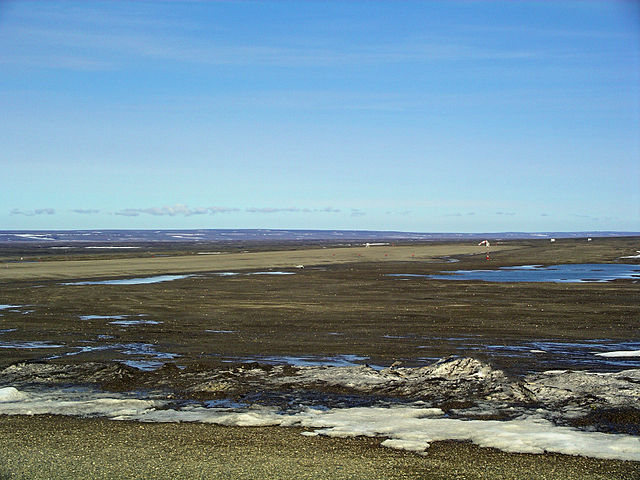
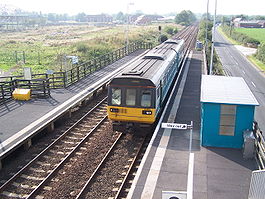
Teesside Airport railway station serves Durham Tees Valley Airport.
It has two stopping Northern Rail trains a week, on Sundays only: at 10:29 to MetroCentre via Sunderland and Newcastle, and at 12:19 to Darlington.
There were just eight passenger entries or exits in the year from April 2012 to March 2013.
By way of contrast, London Waterloo station had 95,936,000 passengers entering or leaving in 2012/13 and another 9,389,000 interchanging (not including users of the London Underground). More at List of busiest railway stations in Great Britain.
Back to question
Answer to the question about The Ides of March
The Romans did not number days of a month sequentially from the first to the last day. Instead, they counted back from three fixed points of the month: the Nones (5th or 7th, depending on the length of the month), the Ides (13th day of the months with 29 days, or 15th day of March, May, July, and October, the months with 31 days), and the Kalends (1st) of the following month. (The Ides were supposed to be determined by the full moon, reflecting the lunar origin of the Roman calendar. On the earliest calendar, the Ides of March would have been the first full moon of the new year.)
The Ides of March (Latin: Idus Martii or Idus Martiae) corresponds to 15th March and became notorious as the date of the assassination of Julius Caesar in 44 BCE.
When Julius Caesar added days to some months, he added them to the end of the month, so as not to disturb the dates of festivals in those months. This increased the count of all days after the Ides in those months, and had some odd effects. For example, the emperor Augustus was born in 63 BCE on the 23rd day of September. In the pre-Julian calendar, this is seven days before the Kalends of October (or, in Roman style, counting inclusively, a.d. VIII Kal. Oct.), but in the Julian calendar, it is eight days (a.d. IX Kal. Oct.). Because of this ambiguity, his birthday was sometimes celebrated on both dates.
Back to question
Key to Flag puzzle
The flag is the “Star Spangled Banner” which was the U.S. national flag from 1795 to 1818. Seeing the flag during the battle of Baltimore (1812) inspired Francis Scott Key to write the poem Defence of Fort McHenry, which, retitled with the flag’s name of the closing lines of the first stanza and set to the tune To Anacreon in Heaven, later became the national anthem of the United States.
Back to question
Key to the Vera Lynn puzzle
There’ll Be Bluebirds Over the White Cliffs of Dover; the bluebird is not indigenous to Britain, so the words are inappropriate, however tear-jerking or patriotic they sound.
Back to question
Key to the String puzzle
Answer: Click on my Astronomy page; then in the paragraph on Interactive Model Showing the Scale of the Universe there’s a mention of a string.
Go further; in NASA’s Astronomy Picture of the Day for 12th March 2012, you’ll find, if you scroll completely to the left, that a “string” is about 10−35 metres long.
That’s pretty small! In fact it’s 0.00000 00000 00000 00000 00000 00000 00001 metres.
Back to question
Key to the Sequence puzzle
Answer: The six places listed are the starting points of the major A-roads in the UK, which radiate from London – well, near London in the case of the A6:
- A1: Museum of London to Edinburgh (see the A7 below).
- A2: Borough Station to Jubilee Way, Dover Harbour.
- A3: Monument Station to Portsmouth Harbour.
- A4: Holborn Circus to Avonmouth Way, Bristol.
- A5: Marble Arch to another harbour, at Holyhead, on the Isle of Anglesey (Ynys Môn).
- A6: St Mary’s Road, Telford Way, Luton to Carlisle (see the A7 below).
The A7, A8 and A9 in theory radiate from Edinburgh, near Edinburgh in the case of the A9.
- A7: So the next (after the A6) is the junction of North Bridge and Princes Street, Edinburgh (the start of the A7). This road junction in Edinburgh is also the terminating point of the A1, which relates the A1 and the A7, the second part of the question. Similarly the A6 and A7 both terminate in Carlisle, at the junction of Botchergate and The Crescent, near the railway station.
To complete the list:
- A8: Not far from Haymarket station, Edinburgh to the roundabout where Dalrymple Street meets the High Street in Greenock, but has ‘missing’ sections that carry different road numbers.
- A9: Bridge of Allan, Stirlingshire, to Scrabster Harbour, Thurso, but is largely superseded in the south by the M9 motorway.
Back to question
Key to the ‘+ S + S’ puzzle
The starting word is PRINCE + S = PRINCES + another S = PRINCESS; there may be other solutions.
Back to question
13 letters and 6 words
“To be or not to be, that is the question”. (There was a hint in that it came under the Shakespeare category.)
Back to question
Answer to “connect and give the number of the most famous”
- The highest point in Antigua and Barbuda is Mount Obama
- Obama, Fukui is a city in Japan
- The Obama Domain was a feudal domain in the Edo-period Japan, and Obama Castle (Fukui) was the castle from which the Domain was governed
- Obama Castle was a mountain castle in the former Mutsu Province in Japan
- The Obama Line is a railway line operated by West Japan Railway Company and Higashi-Obama and Obama are railway stations on the line
- The Obama Nishi Interchange is the terminus interchange on the Maizuru-Wakasa Expressway between Tsuruga and Miki, Japan
- And Obama Day is a national holiday in Kenya
Have you spotted the connection yet?
Barack Obama (born 1961) is the 44th and current President of the United States. (There have been 43 people sworn into office, and 44 presidencies, as Grover Cleveland served two non-consecutive terms and is counted chronologically as both the 22nd and 24th president.)
Back to question
Key to the non-rectangular National Flag puzzle
Nepal is the only nation with a non-rectangular national flag, it being two overlapping right-angled triangles. Some, like Switzerland’s, are square, but a square is a special case of a rectangle, so that doesn’t count.

Back to question
Key to the Official Language puzzle
The Welsh Language Measure 2011 gave the Welsh language official status in Wales, making it the only language that is de jure official in any part of the United Kingdom. Even English isn’t!
Back to question
Answer to an Enigma
The answer lies in the heading; these are all the people for whom a section of Edward Elgar’s “Enigma” Variations was written. They were:
(1) Alice Elgar (his wife), (2) Hew David Steuart-Powell, (3) Richard Baxter Townshend, (4) William Meath Baker, (5) Richard Penrose Arnold, (6) Isabel Fitton, (7) Troyte Griffith, (8) Winifred Norbury, (9) A.J.Jaeger (as I told you), (10) Dora Penny, (11) George Robertson Sinclair, (12) Basil G. Nevison, (13) Lady Mary Lygon, and finally (14) Edward Elgar himself.
A.J.J. is better known as “Nimrod”, the most famous Variation;
and E.D.U. is a play on the nickname his wife used for him – “E-doo”.
Back to question
Answer to The Red Bus Stops at Victoria question
So far as I’m aware, only one word fits the bill – only.
These are the subtleties of meaning:
Only the red bus stops at Victoria
— Buses of other colours don’t stop there.
The only red bus stops at Victoria
— All other buses are of other colours.
The red only bus stops at Victoria
— There are other buses with red and another colour.
The red bus only stops at Victoria
— It may continue to a further place, but none before Victoria.
The red bus stops only at Victoria
— It may continue to another destination, but stops nowhere else than Victoria and its terminus.
The red bus stops at only Victoria
— It continues to another destination, but stops nowhere else than Victoria and its terminus.
The red bus stops at Victoria only
— (Same as previous)
Back to question
Key to the “Water water everywhere...” puzzle
“Water water everywhere and not a drop to drink”: the correct quotation is: Water, water everywhere, nor any drop to drink.
Back to question
The Sequence gives you the Seven Colours of the Rainbow
- The King of Wessex from 865 to 871 was Æthelred I (Old English: Æþelræd), giving you red.
- King William III of England from 1689 to 1702 was “William of Orange”.
- The third-longest river in Asia, with an estimated length of 5,464 km, is the Huang He or Yellow River, which follows the Yangtze and Yenisei Rivers.
- “Kalaallit Nunaat” is the Greenlandic name of Greenland; it is an autonomous country, in area (2,166,000 km2 in 2015) the world’s largest island, over three-quarters of which is covered by the only contemporary ice sheet outside of Antarctica. With a population of about 55,984 in 2015 it is the least densely populated country in the world.
- Blue nevus (also known as “blue neuronevus”, “dermal melanocytoma”, and “nevus bleu”) is a type of “melanocytic nevus”, sometimes referred to as a mole on the skin.
- The consortium of gravitational-wave physicists in India is the Indian Initiative in Gravitational-wave Observations (or INDIGO).
- The girl with the lisp in Richmal Crompton’s Just William series of books for children was Violet-Elizabeth Bott.
That’s Red – Orange – Yellow – Green – Blue – Indigo – Violet
Back to question
Answer to What is the Common Factor?
I couldn’t resist this one as the answer is my given name, Kenneth, an English given name and surname. The name is an Anglicised form of two entirely different Gaelic personal names: Cainnech, the modern Gaelic form being Coinneach, derived from a byname – a descriptive word or phrase or a glorified nickname, meaning “handsome” or “comely”, and Cinaed, partly derived from the Celtic *aidhu, meaning “fire” (the asterisk [*] means that the word is inferred or reconstructed, rather than historically documented or attested; Aidhu is a Hindi name). A short form of Kenneth is Ken; a pet form is Kenny (but please don’t call me that!).
- Kenneth, Indiana was a whistle stop on the railroad, located at 40°45′40″N 86°28′23″W. A post office was there from 1892 until 1929. Its Zip code is 46947.
- Kenneth, Minnesota is at 43.75327°N, 96.07182°W, and its Zip code is 56147.
- Kenneth City, Florida is at 27°48′58″N 82°42′55″W, and its Zip code is 33709.
- Inch Kenneth, Argyllshire is at 56.44171°N 6.16317°W, OS grid reference NM435355 in the parish of Kilfinichen and Kilvickeon, and is part of the Loch Na Keal National Scenic Area, one of 40 in Scotland. Its Gaelic name is Innis Choinnich, meaning Island of Kenneth, follower of St Columba.
- In 2005, hurricane Kenneth was the prime storm in the east Pacific, lasting throughout the second half of September. The 2011 Pacific hurricane season was a moderately active Pacific hurricane season with six major hurricanes. Hurricane Kenneth was the strongest November storm on record.
- John Kenneth Galbraith (1908 – 2006) was a Canadian and, later, American economist, public official, and diplomat, and a leading proponent of 20th-century American liberalism. His books on economic topics were bestsellers from the 1950s through the 2000s, during which time Galbraith fulfilled the role of public intellectual. As an economist, he was a Keynesian and an institutionalist. Galbraith was a long-time Harvard faculty member and stayed with Harvard University for half a century as a professor of economics. He was a prolific author and wrote four dozen books, including several novels, and published more than a thousand articles and essays on various subjects. He was active in Democratic Party politics, serving in the administrations of Franklin D. Roosevelt, Harry S. Truman, John F. Kennedy, and Lyndon B. Johnson. He served as United States Ambassador to India under the Kennedy administration. His prodigious literary output and outspokenness made him, arguably, “the best-known economist in the world” during his lifetime.
- Sir Kenneth Charles Branagh (born 1960) is a British actor, director, producer and screenwriter from Northern Ireland. He has directed or starred in several film adaptations of William Shakespeare’s plays. He has also starred in numerous other films and television series, has directed severable notable films, and narrated several BBC documentary series. Branagh has been nominated for five Academy Awards, five Golden Globes, and has won an Emmy and three BAFTAs.
- Kenneth Joseph Arrow is an American economist, writer, and political theorist. His most significant work is the “Arrow’s impossibility theorem”, which in short, states that no rank-order voting system can be designed that satisfies three criteria; see more about Arrow and this theorem here.
- The three Kings of Scotland were Kenneth MacAlpin I (Coinneach mac Ailpein – the modern Gaelic equivalent), reigned 843–848; Kenneth II (Coinneach mac Mhaoil Chaluim), 971–995; and Kenneth III (Coinneach mac Dhuibh), 1005–1034.
Back to question
More about Kenneth Joseph Arrow and his Impossibility Theorem
Kenneth Joseph Arrow (born 1921) is an American economist, writer, and political theorist. He is the joint winner of the Nobel Memorial Prize in Economics with John Hicks in 1972. To date, he is the youngest person to have received this award, at 51. In economics, he is a figure in post-World War II neo-classical economic theory and many of his former graduate students have gone on to win the Nobel Memorial Prize themselves. His most significant works are his contributions to social choice theory, notably “Arrow’s impossibility theorem”, and his work on general equilibrium analysis. He has also provided foundational work in many other areas of economics, including endogenous growth theory and the economics of information.
In short, “Arrow’s impossibility theorem” states that no rank-order voting system can be designed that satisfies these three “fairness” criteria:
- If every voter prefers alternative X over alternative Y, then the group prefers X over Y.
- If every voter’s preference between X and Y remains unchanged, then the group’s preference between X and Y will also remain unchanged (even if voters’ preferences between other pairs like X and Z, Y and Z, or Z and W change).
- There is no “dictator”: no single voter possesses the power to always determine the group’s preference.
Voting systems that use cardinal utility (which conveys more information than rank orders) are not covered by the theorem. The theorem can also be sidestepped by weakening the notion of independence. Arrow rejected cardinal utility as a meaningful tool for expressing social welfare, and so focused his theorem on preference rankings.
The axiomatic approach Arrow adopted can treat all conceivable rules (that are based on preferences) within one unified framework. In that sense, the approach is qualitatively different from the earlier one in voting theory, in which rules were investigated one by one. One can therefore say that the contemporary paradigm of social choice theory started from this theorem.
Back to answer
Key to the Airport Codes puzzle
- LCY is London City Airport, England
- LAX is Los Angeles International Airport, California, United States
- CDG is Charles de Gaulle Airport (Roissy Airport), Paris, France
- JFK is John F. Kennedy International Airport, New York, United States
- LPL is Liverpool John Lennon Airport in Merseyside, England
- ZRH is Zürich Airport, Switzerland
- HEL is Helsinki Airport, Helsinki/Vantaa, Finland
- ATL is Hartsfield–Jackson Atlanta International Airport, Georgia, United States
- GLA is Glasgow International Airport, Scotland
- BCN is Barcelona El Prat Airport, El Prat de Llobregat (near Barcelona), Spain
- GVA is Cointrin International Airport, Geneva Airport, Switzerland. It is so close to the French border that French internal flights use it, their passengers using a separate entrance so they never officially enter Swiss territory
- SOU is Southampton Airport, Eastleigh (near Southampton), England
- GRO is Girona–Costa Brava Airport, Girona, Spain
- ISC is St Mary’s Airport in the Isles of Scilly off southwest England
- LEQ is Land’s End Airport, Cornwall, England
- WRY is Westray Airport, Orkney Islands, Scotland (see my Air Transport page)
- PPW is Papa Westray Airport (ditto)
- QAM is Amiens-Glisy Airport, Picardy, France; the clue is to the First World War song “Roses of Picardy”
- FUJ is Fukue Airport (Gotō Fukue Airport), Gotō, Nagasaki, Japan
- BOH is Bournemouth Airport (formerly Hurn Airport), Bournemouth, England
- YSY is Sachs Harbour (David Nasogaluak Jr. Saaryuaq) Airport, NW Territories, Canada
- HNL is Honolulu International Airport, Hawaii, United States
- TUL is Tulsa International Airport, Oklahoma, United States (the clue referring to the song “Twenty-Four Hours from Tulsa” by Burt Bacharach and Hal David, a hit for Gene Pitney)
Back to question
Answer to Coins Question
Australia is where the practice of Swedish rounding is most commonly used, not Sweden. It was “invented” in Sweden but is mostly used in Australia and New Zealand more recently. Ireland was the most recent country to adopt it on 28th October 2015.
Back to question
Answer to how many Lakes Question
There is only one Lake, Bassenthwaite Lake in the English Lake District and illustrated in the question.
All the other bodies of water in the district, such as Windermere, Coniston Water, Ullswater and Buttermere are meres, tarns and waters.
- A mere is a lake that is broad in relation to its depth
- A tarn is a mountain lake or pool, formed in a theatre-like valley formed by glacial erosion. In Scotland this is called a “corrie”, in Wales a “cwm”.
- A water is anything else, including Ullswater [illustrated in the question]
Wikipedia has a list of all 94 of them.
Back to question
Answer to Together Question
Anthony Wayne England, better known as “Tony” England, is an American former NASA astronaut. Selected in 1967, England was among a group of astronauts who served as backups during the Apollo and Skylab programs. Like most others in his class, he flew during the Space Shuttle program, serving as a mission specialist on STS-51F in 1985. He has logged more than 3,000 hours of flying time and 188 hours in space.
John Nicholson Ireland was an English composer and teacher of classical music. The majority of his work consists of piano miniatures and of songs with piano. His best-known works include the hymn The Holy Boy and a setting of the poem Sea Fever by John Masefield.
Patricia Janet Scotland, Baroness Scotland of Asthal, PC, QC is a British barrister and jurist, who served in many ministerial positions within the UK Government, most notably as the Attorney General for England and Wales and Advocate General for Northern Ireland.
Jimmy Wales is an American Internet entrepreneur, the co-founder and promoter of the online non-profit encyclopedia Wikipedia and the for-profit Wikia web hosting company.
Put them together and you get the British Isles.
Back to question
Answer to Polar Bear – Penguins Question
None. Polar bears live in the Arctic, penguins in the Antarctic, though a few make their way north as far as South Africa, New Zealand, and even the Galápagos Islands. So the two species never meet.
Back to question
Answer to Diluting Wine Question
There’s no difference.
The total amount of liquid at the start was one litre;it’s still one litre, and each jug contains exactly one half of that litre.
So however much water was transferred initially, the same amount of the mixture was transferred back.
Some of that was wine, some water, but the amount of wine in the wine jug is exactly the same as the amount of water in the water jug; and conversely, the amount of wine in the water jug is exactly the same as the amount of water in the wine jug. In the second transfer of liquid, some of it may be wine, some water, or all wine or all water. It doesn’t matter, and stirring after the first transfer makes no difference.
Back to question
Answers to the XYZ of British Railways
- “X” is “Acton”. North Acton, East Acton and West Acton are all on the London Underground Central line; Acton Town is on the LU District and Piccadilly Lines; South Acton and Acton Central are on the London Overground; Acton Main Line is served by First Great Western trains from Paddington; and Acton Bridge is in Cheshire, on the London Midland line between Crewe and Liverpool.
- “Y” is “Ealing”. North Ealing, South Ealing and Ealing Common are all on the London Underground Piccadilly line; Ealing Common is also on the LU District line; West Ealing is served by First Great Western trains from Paddington; and Ealing Broadway is also served by First Great Western, and is on the LU Central and District lines
- “Z” is “Ardrossan” in Scotland, and has stations called Ardrossan Harbour, Ardrossan Town and Ardrossan South Beach on one of the Scotrail lines south-west of Glasgow Central.
- The other (non-London) Charing Cross is one Scotrail stop out of Queen Street Glasgow towards Partick.
- Bat & Ball is just outside Sevenoaks, Kent, towards Swanley and London.
- IBM Halt is a privately sponsored halt on the Wemyss Bay (Inverclyde) Scotrail line from Glasgow Central. (No prizes for guessing who the sponsor is!)
- Jewellery Quarter is on the Metro line from Birmingham Snow Hill to Wolverhampton St George’s.
- Denham Golf Club is on the Chiltern Railways line from London Marylebone to the north-west via Bicester.
- Hall-i’-th’-Wood is on the Northern Rail line from Bolton to Blackburn.
Back to question
Key to the “HAD HAD...” and “THAT IS...” puzzles
Here’s the answer to the HAD HAD question:
Jim, whereas Jane had had “had”, had had “had had”; “had had” had had the teacher’s approval. (and don’t forget the final full stop); the required punctuation is underlined.
And the THAT IS answer:
That that is, is. That that is not, is not. Is that it? It is.
Back to questions
Key to Small Ad
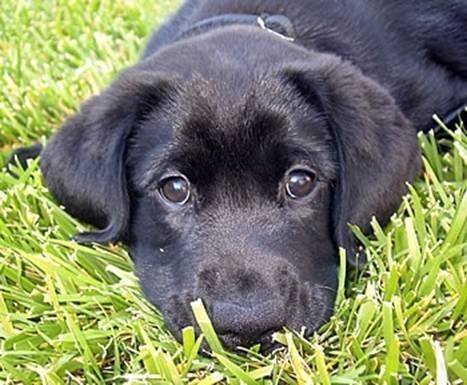
Over 150 men found themselves talking to the Truro RSPCA.
My reasons for doubting its authenticity are that ‘cosy’ was written ‘cozy’, the telephone number was not a Truro one, and ‘pickup truck, hunting, camping and fishing trips’ all betray its American origin to me. Highly amusing, though.
Back to ad
Commonwealth
The two new members of the British Commonwealth, which had no previous links to the UK are:
- Mozambique: Gained independence from Portugal on 26th June 1975. Joined on 13th November 1995, the first country to be admitted to the Commonwealth without any former colonial or constitutional links with the United Kingdom.
- Rwanda: Gained independence from Belgium on 1st July 1962. Joined the British Commonwealth on 29th November 2009.
For the record. the current members of the British Commonwealth are:
Antigua and Barbuda, Australia, Bahamas, Bangladesh, Barbados, Belize, Botswana, Brunei, Cameroon (mostly the formerly French territory of Cameroun, uniting with the much smaller former British mandate/trust territory of Southern Cameroons), Canada, Cyprus, Dominica, The Gambia, Ghana, Grenada, Guyana, India (incorporated former French and Portuguese India and Sikkim), Jamaica, Kenya, Kiribati, Lesotho, Malawi, Malaysia (joined as the Federation of Malaya in 1957; reformed as Malaysia on 16th September 1963 with its federation with Singapore, which became a separate state in 1965, Sabah, and Sarawak), Maldives, Malta, Mauritius, Namibia, Nauru, New Zealand, Nigeria, Pakistan, Papua New Guinea, Saint Kitts and Nevis, Saint Lucia, Saint Vincent and the Grenadines, Samoa, Seychelles, Sierra Leone, Singapore, Solomon Islands, South Africa, Sri Lanka, Swaziland, Tanzania (merger of Tanganyika and Zanzibar), Tonga, Trinidad and Tobago, Tuvalu, Uganda, United Kingdom, Vanuatu (gained independence from joint rule of France and United Kingdom) and Zambia.
These countries have applied for membership:
Algeria, Madagascar, Somaliland (an unrecognised self-declared sovereign state internationally recognised as part of Somalia), South Sudan, Sudan and Yemen.
Fiji is a suspended member; Ireland and Zimbabwe are former members that have left the Commonwealth. Malaya (reformed as the Federation of Malaysia with Singapore, Sabah, and Sarawak), Newfoundland (joined Canada in 1949), Tanganyika and Zanzibar (merged to form Tanzania in 1964) are dissolved members for the reasons stated.
Back to question
Peru and Turkey
‘Peru’ and ‘Turkey’ are obviously the names of countries in English.
The Portuguese word for ‘turkey’ (the bird) is ‘peru’.
Back to question
Answer to Sequence Question
The names all refer to the city that is today the capital of Kazakhstan.
Over the years its name was changed for various reasons, as shown in the question; details are on Wikipedia. In 1998 it became Астана (Astana), its present name (hence the underlining of ‘final’ in the question).
In 1997 the city became the capital of Kazakhstan, replacing Алматы (Almaty), formerly known as Алма-Ата (Alma-Ata) and Вҍрный (Vеrnɨy).
Japanese architect Kisho Kurokawa designed the master plan of Astana.
Back to question
Answer to “Who was Sweet Fanny Adams?”
Fanny Adams was an 8-year-old girl who was butchered to death near Alton, Hants on 24th August 1867 by Frederick Baker. He was hanged outside Winchester Gaol, the last execution to take place at Winchester. (See also here)
Fanny’s grave is still in Alton Cemetery. The headstone reads:
Sacred to the memory of Fanny Adams aged 8 years and 4 months who was cruelly murdered on Saturday August 24th 1867.
Fear not them which kill the body but are not able to kill the soul but rather fear Him which is able to destroy both body and soul in hell. Matthew 10 v 28.
This stone was erected by voluntary subscription.
The gruesomeness continues in the phrase ‘Sweet Fanny Adams’.
According to Wikipedia:
In 1869 new rations of tinned mutton were introduced for British seamen. They were unimpressed by it, and decided it must be the butchered remains of Fanny Adams. The way her body had been strewn over a wide area presumably encouraged speculation that parts of her had been found at the Royal Navy victualling yard in Deptford, which was a large facility which included stores, a bakery and an abattoir.
“Fanny Adams” became slang for mutton or stew and then for anything worthless — from which comes the current use of “sweet Fanny Adams” (or just “sweet F. A.”) to mean “nothing at all”. It can be seen as a euphemism for “fuck all” — which means the same.
This is not the only example of Royal Navy slang relating to unpopular rations: even today, tins of steak and kidney pudding are known as “baby’s head”. The large tins the mutton was delivered in were reused as mess tins. Mess tins or cooking pots are still known as Fannys.
Back to the original question
Answer to the Morse and Swift question
The answer is Yahoo.
As I indicated, the question is rather obscure. This is the connection:

Tim Morse
Yahoo! Inc., an American multinational internet corporation, is perhaps best known for its web portal, search engine (Yahoo! Search), Yahoo! Directory, Yahoo! Mail, Yahoo! News, Yahoo! Groups, Yahoo! Answers, advertising, online mapping, video sharing, and social media website and services.
Yahoo! inclusive was founded by Jerry Yang and David Filo in 1994. In 2009, Yahoo! appointed Carol Bartz as its new Chief Executive Officer and a member of the board of directors. On 6th September 2011, Bartz was removed from her position at Yahoo! by chairman Roy Bostock, and Chief Financial Officer Tim Morse was named as interim Chief Executive Officer of the company. On 4th January 2012, Scott Thompson, former President of PayPal, was named the new Chief Executive Officer.
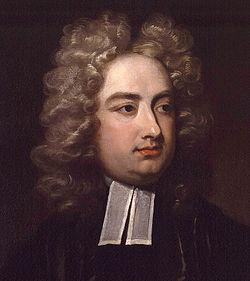
Jonathan Swift
That’s the Morse part. Now for Swift.
Jonathan Swift (30th November 1667 — 19th October 1745) was an Irish satirist, essayist, political pamphleteer (first for the Whigs, then for the Tories), poet and cleric who became Dean of St. Patrick’s Cathedral, Dublin. He is remembered especially for his work Gulliver’s Travels. Swift is probably the foremost prose satirist in the English language, and is less well known for his poetry. Swift originally published all of his works under pseudonyms, such as Lemuel Gulliver, or anonymously.
In Gulliver’s Travels, after his expeditions to Lilliput and Blefuscu, Brobdingnag, Laputa (the flying island), Balnibarbi, Luggnagg, Glubbdubdrib, and Japan, Gulliver returns home and then goes back to sea; his crew mutiny and abandon him in a landing boat. He comes first upon a race of (apparently) hideous deformed and savage humanoid creatures to which he conceives a violent antipathy. Shortly thereafter he meets a horse and comes to understand that they call themselves Houyhnhnms [pronounced either /'huːˌnəm/ or /'hwˌnəm/] (which in their language means “the perfection of nature”), and that they are the rulers, while the deformed creatures called Yahoos are human beings in their base form.
Gulliver becomes a member of the horse’s household, and comes to both admire and emulate the Houyhnhnms and their lifestyle, rejecting his fellow humans as merely Yahoos endowed with some semblance of reason which they only use to exacerbate and add to the vices Nature gave them. However, an Assembly of the Houyhnhnms rules that Gulliver, a Yahoo with some semblance of reason, is a danger to their civilization, and expels him. He is then rescued and is surprised to see that his rescuer, Captain Pedro de Mendez is a Yahoo, and a wise, courteous and generous person.
Back to question
Answer to Lunar Brick Wall question
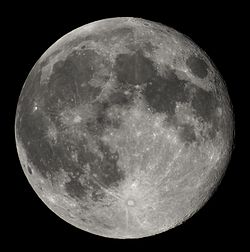
Full moon
The answer is seventy-three and one-third bricks.
As I hinted, the dimensions of the moon are irrelevant. Why? A bit of elementary maths:
Suppose the diameter of the moon is d metres then the diameter of the circle formed by the top row of bricks is d+7 metres; the 7 is twice the height of the wall, because the wall has to be allowed for twice.
Remember from your maths classes at school the formula c = π × d, where c is the circumference of a circle and d is its diameter?
Then the difference in the circumferences (which is essentially what the question is all about) is:
The circumference of the top of the wall minus that of the bottom,
That is π × (d + 7) minus π × d metres,
The π × d cancels out, leaving the difference as π × 7 metres.
The rest is easy:
π = 31/7 = 22/7
So the difference is π × 7 = 22 metres;
So the number of bricks extra in the top row is 22 × 100 centimetres divided by 30 centimetres which is 73 1/3 bricks — let’s call it 74, as we need one for the extra third.
Back to question
Answer to What Comes Next?
If you cut off the left-hand side of each of the figures, you get a list of figures [sic] from 1 to 5:

So the answer is the number 6 with its reflection:  (ugly to draw!)
Back to puzzles
Answer to Who Said This? (Number 1)
Thomas Jefferson said in 1799:
“Whenever a man has cast a longing eye on offices, a rottenness begins in his conduct.”
Back to puzzles
Answer to Who Said This? (Number 2)
W S Gilbert wrote in HMS Pinafore:
“I always voted at my party’s call,
And I never thought of thinking for myself at all.”
The lines in the song were uttered by The Rt. Hon. Sir Joseph Porter, KCB (First Lord of the Admiralty).
Back to puzzles
Answer to Who Said This? (Number 3)
Mao Zedong said in On Protracted War (May 1938):
“Politics is war without bloodshed while war is politics with bloodshed.”
Back to puzzles
Answer to Who Said This? (Number 4)
Ken Livingstone said:
“If voting changed anything they’d abolish it.”
Back to puzzles
Answer to Who Said This? (Number 5)
George Burns said:
“Too bad all the people who know how to run the country are busy driving taxi cabs and cutting hair.”
Back to puzzles
Answer to Who Said This? (Number 6)
Wendell Phillips (1811 – 1884), an American abolitionist, Native American advocate and orator said:
“Difference of religion breeds more quarrels than difference of politics.”
Back to puzzles
Answer to Who Said This? (Number 7)
President John F Kennedy said:
“Those who make peaceful revolution impossible will make violent revolution inevitable.”
Back to puzzles
Answer to Who Said This? (Number 8)
Adolf Hitler said:
“The great masses of the people will more easily fall victim to a big lie, than to a small one.”
Back to puzzles
Answer to Who Said This? (Number 9)
P J O’Rourke said in Parliament of Whores (1991):
“Giving money and power to government is like giving whiskey and car keys to teenage boys.”
Back to puzzles
Answer to Who Said This? (Number 10)
Winston Churchill said:
“The greatest lesson in life is to know that even fools are right sometimes.”
Back to puzzles
Where’s the Cat?
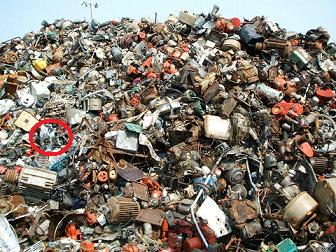
The cat is near the left side of the photograph, about half-way down; it’s black-and-white, is walking towards the lower right, and is circled in red in the picture below.
Back to question
Dam...
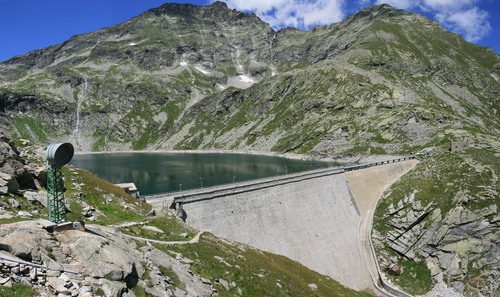
Can you see the little dots on the wall?
What do you think they are?
Look closer maybe... [Click on the picture]
Dam... G...
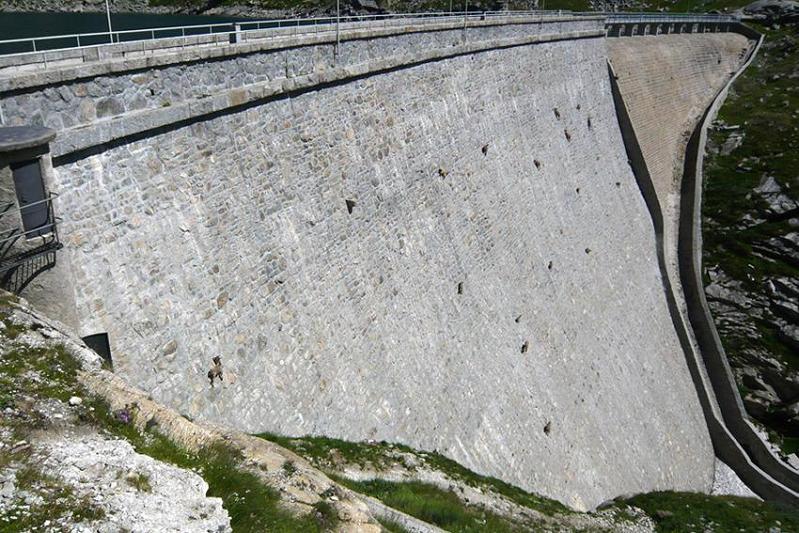
Still don’t know what they are? — Let’s take a closer look again...
Dam... Go...
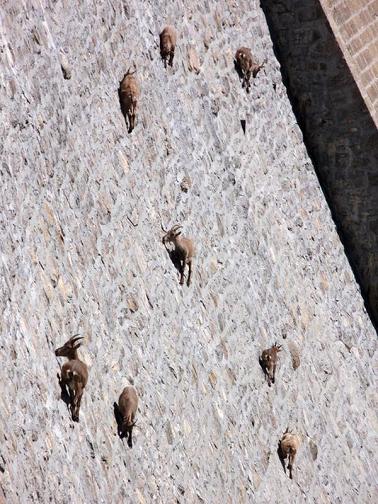
...and closer...
...Dam Goa...
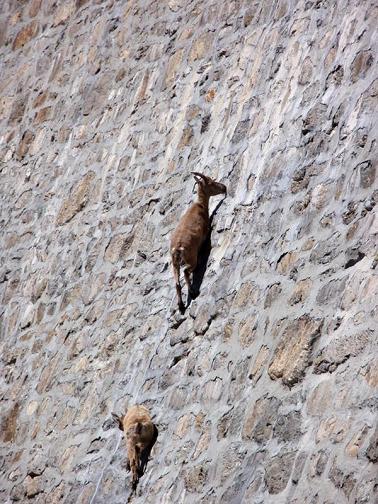
...keep going...
...Dam Goat!
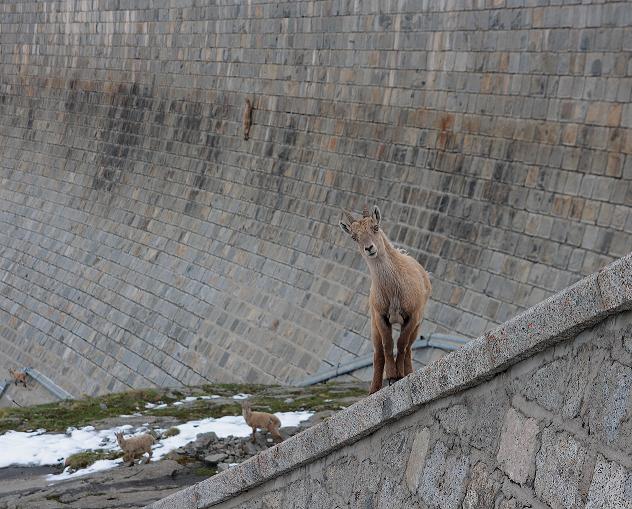
Well I’ll be damned! They are European Ibex and they like to eat the moss and lichen,
and lick the salt off the dam wall. Just when you think you’ve seen everything!
Go to the Puzzles page