90482 Orcus
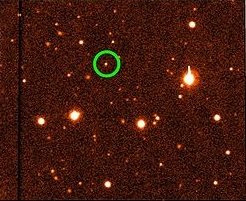
On 17th February 2004, astronomers from Caltech, Gemini Observatory, and Yale University announced the discovery of Orcus. The discovery was made by the team of Mike Brown (Caltech), Chad Trujillo (Gemini Observatory) and David Rabinowitz (Yale).
90482 Orcus is a trans-Neptunian object in the Kuiper belt with a large moon, Vanth. Precovery images as early as 8th November 1951 were later identified. It is believed to be a dwarf planet by some astronomers, and is massive enough to be considered one under the 2006 draft proposal of the IAU, though the IAU has not formally recognized it as such.

The motion of Orcus and Pluto in a rotating frame with a period equal to Neptune’s orbital period – Neptune is held stationary. Pluto is grey and Orcus is red. Neptune is the white (stationary) dot at 5 o’clock. Uranus is blue, Saturn yellow, and Jupiter red. There are 41 frames each having 3×164.8 years (3 times Neptune’s orbital period). Orcus itself is always a great distance away from Neptune (there is always an angular separation of over 60° between them). Over a 14,000-year period Orcus stays more than 18 AU from Neptune.
Orcus is a plutino, possibly a plutoid, locked in a 2:3 resonance with Neptune, making two revolutions around the Sun, while Neptune makes three. This is much like Pluto, except that it is constrained to always be in the opposite phase of its orbit from Pluto – Orcus is at aphelion when Pluto is at perihelion and vice versa (both have perihelia above the ecliptic). Because of this, along with its large moon Vanth that recalls Pluto’s large moon Charon, Orcus has been seen as the anti-Pluto. This was a major consideration in selecting its name, as the deity Orcus was the Etruscan equivalent of the Roman Pluto, and later became an alternative name for Pluto. Its earlier name was 2004 DW.
The surface of Orcus is relatively bright with albedo reaching 30%, grey in color and water rich. The ice is predominantly in crystalline form, which may be related to past cryovolcanic activity. Other compounds like methane or ammonia may also be present. The existence of a satellite allowed astronomers to determine the mass of the system, which is approximately equal to that of the Saturnian moon Tethys. The ratio of masses of Orcus and Vanth is uncertain, possibly anywhere from 1:33 to 1:12. The diameter of Orcus is estimated to be 761 or 807 km and the diameter of Vanth 378 or 267 km respectively, depending on their relative albedos.
Orcus’s aphelion (the next being in 2019) is 48.07 AU (7.19117 Tm), its perihelion is 30.27 AU (4.52833 Tm) and its semi-major axis is 39.173 AU (5.86018 Tm). Simulations by the Deep Ecliptic Survey (DES) show that over the next 10 million years Orcus can acquire a perihelion distance (qmin) as small as 27.8 AU. The orbital eccentricity is 0.22718 and its orbital period is 245.18 years (89,552 days). Its mean anomaly is 166.38°, inclination: 20.573°, longitude of ascending node is 268.606° and the argument of its perihelion is 73.031°.
Orcus’s diameter is 917±25 km, 807±100 km (assuming equal albedos for Orcus and Vanth) or 761±100 km (if Vanth’s albedo is 0.12). The mass of the system is 6.41±0.19×10²⁰ kg. The mean density of Orcus is 1.53+0.15−0.13 g/cm3 to 2.3±0.8 g/cm3. The equatorial surface gravity about 0.27 m/s2, the escape velocity is about 0.45 km/s, its rotation period is 13.188 hours. The albedo is 0.28±0.04, 0.27+0.07−0.05 or 19.75+3.40−2.76% depending on the assumptions made in calculating it. The temperature is <44 K; its spectral type (neutral) is B−V=0.68, V−R=0.37. The apparent magnitude at opposition is 19.1 and the absolute magnitude (H) is 2.3 (2.27±0.05). Vanth’s absolute magnitude is 4.88±0.05.
The rotation period of the primary is not known. Different photometric surveys have produced different results. Some show low amplitude variations with periods ranging from 7 to 21 hours, while others show no variability. However the value obtained by Ortiz et al., about 10.5 hours seems to be the most likely. The rotational poles of Orcus probably coincide with the orbital poles of its moon, Vanth. This means that Orcus is currently viewed pole-on, which could explain the near absence of any rotational modulation of its brightness. If, however, the primary is tidally locked with the satellite, the rotational period will coincide with the 9.7-day orbital period of Vanth.
The absolute magnitude of Orcus is about 2.3 (comparable with the 2.6 of cubewano 50000 Quaoar). The detection of Orcus by the Spitzer Space Telescope in the far infrared and by Herschel Space Telescope in submillimeter constrains its diameter to 850 ± 90 km. Orcus appears to have an albedo of about 22% to 34%, which may be typical of trans-Neptunian objects approaching the 1000 km diameter range.
In the magnitude and size estimates reported above it was assumed that Orcus is a singular object. The presence of a relatively large satellite (Vanth, see below) may change them considerably. The absolute magnitude of Vanth is estimated at 4.88, which means that it is about 11 times fainter than Orcus itself. If the albedos of both bodies are the same at 0.27 then the size of Orcus is about 810 km, while the size of Vanth is about 270 km. If, however, the albedo of Vanth is only 0.12—typical for small reddish Kuiper belt objects, their sizes are approximately 760 and 380 km, respectively.
Since Orcus is known to be a binary system, the mass of the system has been estimated to be 6.32±0.05×10²⁰ kg, or about 3.8% the mass of largest known dwarf planet Eris. How this mass is partitioned between Orcus and Vanth depends of their relative sizes. If the satellite’s size is about 1/3 that of the primary, then its mass is only 3% of the total mass. On the other hand, if the size of Vanth is 380 km (see above), then its mass could be as high as 1/12 of the total system mass or about 8% of the mass of Orcus.
The density of the primary (and secondary assuming the same density) is about 2.3 g/cm3.
The first spectroscopic observations in 2004 showed that the visible spectrum of Orcus is flat (neutral in color) and featureless, while in the near-infrared there were moderately strong water absorption bands at 1.5 and 2.0 μm. Thus Orcus appeared to be different from other trans-Neptunian objects like Ixion with red visible and often featureless infrared spectra. Further Infrared observations in 2004 by the European Southern Observatory and the Gemini telescope give results consistent with mixtures of water ice and carbonaceous compounds, such as tholins. The water and methane ices can cover no more than 50% and 30% of the surface, respectively. This means the proportion of ice on the surface is less than on Charon, but similar to that on Triton.
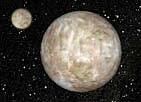
An Artist’s Impression of Orcus and Vanth
Later in 2008–2010 new infrared spectroscopic observations with a higher signal-to-noise ratio revealed additional spectral features. Among them are a deep water ice absorption band at 1.65 μm, which is an evidence of the crystalline water ice on the surface of Orcus, and a new absorption band at 2.22 μm. The origin of the latter feature is not completely clear. It can be caused either by ammonia/ammonium dissolved in the water ice or by methane/ethane ices. The radiative transfer modeling showed that a mixture of water ice, tholins (as a darkening agent), ethane ice and ammonium ion (NH4+) provides the best match to the spectra, while a combination of water ice, tholins, methane ice and ammonia hydrate gives a slightly inferior result. On the other hand, a mixture of only ammonia hydrate, tholins and water ice failed to provide a satisfactory match. So, as of 2010, the only reliably identified compounds on the surface of Orcus are crystalline water ice and, possibly, dark tholins. A firm identification of ammonia, methane and other hydrocarbons requires better infrared spectra.
Orcus straddles the edge for trans-Neptunian objects massive enough to retain volatiles such as methane on the surface. The reflectance spectrum of Orcus shows the deepest water-ice absorption bands of any Kuiper belt object (KBO) that is not associated with the Haumea collisional family. The large icy satellites of Uranus have infrared spectra quite similar to that of Orcus. Among other trans-Neptunian objects Pluto’s moon Charon appears to be most similar to Orcus. It has a higher albedo but very similar visible and near-infrared spectra. Their densities are also similar and both have water ice rich surfaces. Quaoar – a trans-Neptunian object of similar size – has strong water ice absorption features in its spectra but also has a very red color in the visible implying the presence of the ultrared matter on its surface. Dwarf planet Haumea and objects from its collisional family have much higher albedos and much deeper water absorption bands than Orcus. Finally, (208996) 2003 AZ84 – another large object in 2:3 resonance with Neptune – has spectral properties very similar to Orcus.
The presence of crystalline water ice, and possibly ammonia ice may indicate that a renewal mechanism was active in the past on the surface of Orcus. Ammonia so far has not been detected on any TNO or icy satellite of the outer planets other than Miranda. The 1.65 μm band on Orcus is broad and deep (12%), as on Charon, Quaoar, Haumea, and icy satellites of giant planets. On the other hand the crystalline water ice on the surfaces of TNOs should be completely amorphized by the galactic and Solar radiation in about 10 million years. Some calculations indicate that cryovolcanism, which is considered one of the possible renewal mechanisms, may indeed be possible for TNOs larger than about 1000 km. Orcus may have experienced at least one such episode in the past, which turned the amorphous water ice on its surface into crystalline. The preferred type of volcanism may have been explosive aqueous volcanism driven by an explosive dissolution of methane from water–ammonia melts.
Models of internal heating via radioactive decay suggest that Orcus may be capable of sustaining an internal ocean of liquid water.