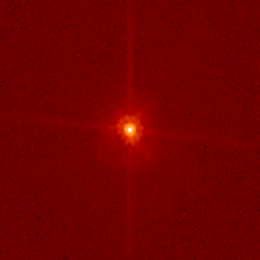
Besides Pluto, Makemake is the only other dwarf planet that was bright enough for Clyde Tombaugh to have possibly detected during his search for trans-Neptunian planets around 1930. At the time of Tombaugh’s survey, Makemake was only a few degrees from the ecliptic, near the border of Taurus and Auriga, at an apparent magnitude of 16.0. This position, however, was also very near the Milky Way, and Makemake would have been almost impossible to find against the dense background of stars. Tombaugh continued searching for some years after the discovery of Pluto, but he failed to find Makemake or any other trans-Neptunian objects.
As of 2009, Makemake is at a distance of 52 astronomical units (7.8×10⁹ km) from the Sun, almost as far from the Sun as it ever reaches on its orbit. Makemake follows an orbit very similar to that of Haumea – highly inclined at 29° and a moderate eccentricity of about 0.16. Nevertheless, Makemake’s orbit is slightly farther from the Sun in terms of both the semi-major axis and perihelion. Its orbital period is nearly 310 years, more than Pluto’s 248 years and Haumea’s 283 years. Both Makemake and Haumea are currently far from the ecliptic – the angular distance is almost 29°. Makemake is approaching its 2033 aphelion, while Haumea passed its aphelion in early 1992.
Makemake is a classical Kuiper belt object, which means its orbit lies far enough from Neptune to remain stable over the age of the Solar System. Unlike plutinos, which can cross Neptune’s orbit due to their 2:3 resonance with the planet, the classical objects have perihelia further from the Sun, free from Neptune’s perturbation. Such objects have relatively low eccentricities (below 0.2) and orbit the Sun in much the same way the planets do. Makemake, however, is a member of the “dynamically hot” class of classical KBOs, meaning that it has a high inclination compared to others in its population. Makemake is, probably coincidentally, near the 11:6 resonance with Neptune.
Makemake is currently visually the second-brightest Kuiper belt object after Pluto, having a March opposition apparent magnitude of 16.7 in the constellation Coma Berenices. This is bright enough to be visible using a high-end amateur telescope. Combining the detection in infrared by the Spitzer Space Telescope and Herschel Space Telescope with the similarities of spectrum with Pluto yielded an estimated diameter from 1,360 to 1,480 km. From the 2011 stellar occultation by Makemake, its diameter has been measured to be (1502±45)×(1430±9) km. This is slightly larger than Haumea, making Makemake likely to be the third largest known trans-Neptunian object after Eris and Pluto. Makemake was the fourth dwarf planet recognized, as it has a bright V-band absolute magnitude of −0.44 that practically guarantees it is large enough to achieve hydrostatic equilibrium.
Makemake’s high geometrical albedo of 77% suggests an average surface temperature of about 32 to 36 K. From the 2011 stellar occultation, Makemake’s density has been estimated to be 1.7±0.3 g/cm3; using a volatile-retention model so that nitrogen escapes while methane is retained.
In a letter written to the journal Astronomy and Astrophysics in 2006, Licandro et al. reported the measurements of the visible and near-infrared spectrum of Makemake. They used the William Herschel Telescope and Telescopio Nazionale Galileo and showed that the surface of Makemake resembles that of Pluto. Like Pluto, Makemake appears red in the visible spectrum, and significantly redder than the surface of Eris (see the albedo and colour comparison diagram above). The near-infrared spectrum is marked by the presence of the broad methane (CH4) absorption bands. Methane is observed also on Pluto and Eris, but its spectral signature is much weaker.
Spectral analysis of Makemake’s surface revealed that methane must be present in the form of large grains at least one centimetre in size. In addition, large amounts of ethane and tholins may be present as well, most likely created by photolysis of methane by solar radiation. The tholins are probably responsible for the red color of the visible spectrum. Although evidence exists for the presence of nitrogen ice on its surface, at least mixed with other ices, there is nowhere near the same level of nitrogen as on Pluto and Triton, where it composes more than 98% of the crust. The relative lack of nitrogen ice suggests that its supply of nitrogen has somehow been depleted over the age of the Solar System.
The far-infrared (24–70 μm) and submillimeter (70–500 μm) photometry performed by Spitzer and Herschel telescopes revealed that the surface of Makemake is not homogeneous. While the majority of it is covered by nitrogen and methane ices, where the albedo ranges from 78 to 90%, there are small patches of dark terrain whose albedo is only 2 to 12%, and which make up 3–7% of the surface.
Makemake was expected to have an atmosphere similar to that of Pluto but with a lower surface pressure. However, on 23rd April 2011 astronomers had an opportunity to analyze its atmosphere as it passed in front of a 18th magnitude star and abruptly blocked its light. The results showed that Makemake presently lacks a substantial atmosphere and placed an upper limit of 4–12 nanobar for the pressure at its surface.
The presence of methane and possibly nitrogen suggests that Makemake could have a transient atmosphere similar to that of Pluto near its perihelion. Nitrogen, if present, will be the dominant component of it. The existence of an atmosphere also provides a natural explanation for the nitrogen depletion – since the gravity of Makemake is weaker than that of Pluto, Eris and Neptune’s moon Triton, a large amount of nitrogen was probably lost via atmospheric escape; methane is lighter than nitrogen, but has significantly lower vapour pressure at temperatures prevalent at the surface of Makemake (32–36 K), which hinders its escape; the result of this process is a higher relative abundance of methane.
No satellites have been detected around Makemake so far. A satellite having a brightness 1% of that of the primary would have been detected if it had been at the distance 0.4 arcseconds or further from Makemake. This contrasts with the other largest trans-Neptunian objects, which all possess at least one satellite: Eris has one, Haumea has two and Pluto has five. 10% to 20% of all trans-Neptunian objects are expected to have one or more satellites. Because satellites offer a simple method to measure an object’s mass, the lack of a satellite makes obtaining an accurate figure for Makemake’s mass more difficult.