PacoMouseCYD
Additional WiFi throttle, Jan 27, 2026
PacoMouseCYD came about after discovering the Cheap Yellow Display (CYD) board to see how to have a simple additional throttle for controlling locomotives with a WiFi connection.
It supports the protocols Z21, Xpressnet LAN, Loconet over TCP/IP (LBserver & Binary) and ECoS by WiFi ...
Read more ...PacoMouse
Additional customizable throttle, Sep 27, 2025
New version of PacoMouse, a simple additional throttle to control our model layout now with lever switch direction control option. Added Czech language.
Read more ...ArduXED
Additional throttle for guests, Jul 20, 2025

ArduXED (Arduino Xpressnet Einfacher Drehregler) is a simple additional throttle ideal to leave to our guests or our young fans so that they can control a single train of our model.
The throttle only has a potentiometer for controlling the locomotive's speed, a switch for selecting the direction of travel, and a button to activate a function. All you need to do is add an Arduino, a diode, and a MAX485 as an interface to the Xpressnet bus.
Read more ...GitHub
GitHub repositories, Jul 15, 2025
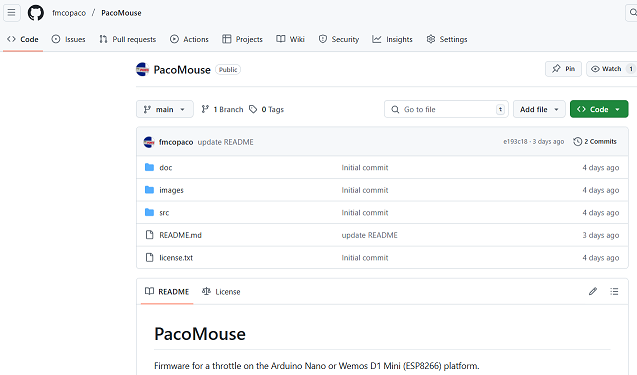
I uploaded to GitHub some of my designs (PacoMouse, LocoSpeed, PacoWagon, PacoWagonDisplay, FastClockLN) and the book 'Lenguage de Programación Arduino' with its examples.
Read more ...PacoMouse
Additional customizable throttle, Apr 10, 2025
New version of PacoMouse, a simple additional throttle to control our model layout. It can be mounted in different versions with Loconet or Xpressnet connection, or WiFi connection with Z21, ECoS, Loconet over TCP or Xpressnet LAN protocols
Now with support for ECoS, Loconet over TCP, Xpressnet LAN and touchpad. Automation...
Read more ...SemafCoil
Decoder for one light signal and one turnout, Feb 22, 2025
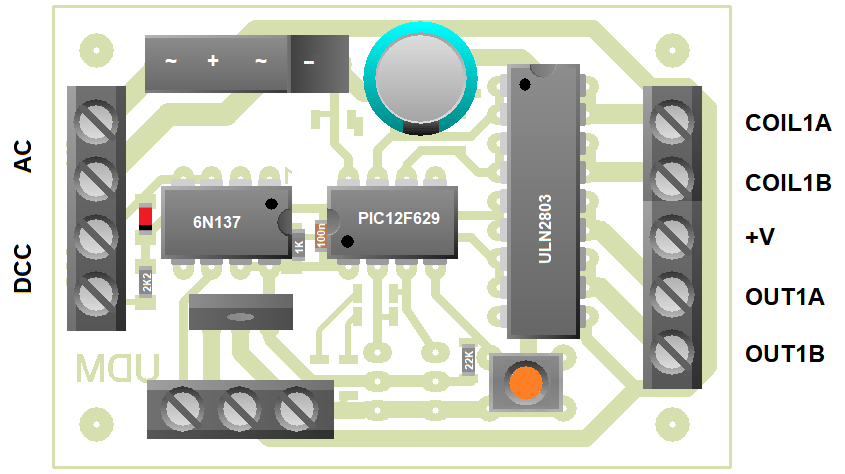
The SemafCoil decoder is a DCC accessory decoder specially designed to control a two-light signal and a turnout.
The decoder uses 2 freely selectable accessory addresses. In the first address the signal is changed (red/green), in the second address, the turnout is moved (straight/diverge). The pulse duration is programmable up to 4 seconds, which makes it suitable for use with coil or motor-driven turnouts.
Read more ...PacoMouse
Additional customizable throttle, May 28, 2024

PacoMouse is a simple additional throttle to control our model layout. It can be mounted in different versions with Loconet or Xpressnet connection, or WiFi connection with Z21 protocol.
Based on an Arduino Nano (also Uno or Pro Mini) for the Loconet or Xpressnet versions or a Wemos D1 mini (ESP8266) for the Z21 version, it has an EC11 type rotary encoder with a push button, a 3x4 or 4x4 keyboard and an SSD1306, SH1106 or SSD1309 OLED screen (sizes 0.96", 1.3" or 2.42").
Read more ...FastClockLN
Display for Loconet Fast Clock, Apr 21, 2024

Simple Loconet Fast Clock display based on an Arduino Nano, with four 8x8 dot matrix displays with the MX7219, four buttons and an optional real-time clock (RTC) module with the DS3231.
Read more ...LNB2CDE
Loconet-B to CDE adapter, Apr 11, 2024

The LNB2CDE adapter allows you to connect digital amplifiers (boosters) with CDE input to command stations with Loconet-B output. The LNB2CDE has two CDE connections for boosters with their own monitoring and short circuit notification. By programming LNCV you can configure the way in which the LNB2CDE will notify the command station of short circuits.
Read more ...RetroDCC
Digital retro or vintage, Dec 25, 2023

Over the years I have been collecting different DCC digital devices that today we could call "retro" or "vintage" and that have been used to develop my designs.
All of these products are no longer manufactured and their capabilities are limited compared to current products, but thanks to the fact that the DCC standard is still compatible with the first versions, they can continue to be used to control our DCC digital trains...
Read more ...dccFunc5
Function decoder with 5 outputs, Jul 14, 2023

The dccFunc5 decoder is a function decoder specially created for lighting with LED diodes controllable by a short or long locomotive address with 5 outputs.
It has 5 programmable outputs that are fed directly from the PIC, selectable with functions F0 to F28, or with the locomotive stopped or running for each direction or DCC polarity of the rail. Function outputs can have incandescent, fluorescent or flashing light effect and brightness selection. ...
Read more ...UniSemaf25
Universal decoder for railroad signaling with 5 outputs, Jul 13, 2023

The UniSemaf25 decoder is an accessory decoder specially created for LED lighting of railroad signaling, fully configurable and pre-configured for various types of signals. It has 5 programmable outputs that are fed directly from the PIC that internally incorporates the resistors for the LEDs.
Small in size, it can be incorporated into the base of the light signal and is powered directly from DCC ...
Read more ...ServoPoint 4p
Decoder for a servo with 4 positions, Jul 12, 2023

The ServoPoint 4p decoder is a DCC accessory decoder specially created to control a servo with 2, 3 or 4 positions and a relay independent or linked to the servo positions.
The decoder uses 3 consecutive accessory addresses. The first one moves the servo to positions A or B, the second one moves the servo to positions C or D. The last one changes the relay if it is independent of the servo positions or moves the servo to the position to the that the relay is linked so that it changes when the servo reaches the position.
Read more ...VoltAmpDCC
Voltmeter-Ammeter DCC, Jul 10, 2023

In the market there are cheap modules that combine DC Voltmeter and Ammeter in a single instrument with a maximum range of 100V (30V when self-powered) and 10A. These modules measure current and direct voltage, if you want to use these modules for the DCC signal measurement of our Boosters need a small adapter circuit.
Read more ...LocoSpeed
Speed meter with Arduino, Jul 9, 2023

LocoSpeed data can now be viewed in the Chrome, Edge or Opera web browser.
Read more ...History
Website update history, Jul 9, 2023

Website update history with all my designs and articles
Read more ...About...
Welcome to the Paco Cañada website.
Here you will find electronic gadgets for one of my hobbys: model railroad

