
The Roco system, although with some particularities, uses the Xpressnet bus, so in addition to the Roco controls, other controls that use the same bus as the Lenz ones can be connected.
| Manufacturer | Model | Article | Type | Bus | Retro | Protocol | Booster |
|---|---|---|---|---|---|---|---|
| Roco | Lokmaus1 | 10750 | Throttle | MausBus | - | - | - |
| Roco | Lokmaus2 | 10760 | C. Station + Throttle | Xpressnet | - | - | - |
| Roco | Booster | 10761 | Booster | Xpressnet | - | DCC | 2,5A |
| Roco | RouteControl | 10772 | Other | MausBus, Xpressnet | - | - | - |

This was the first Roco digital system developed by Lenz, with a bus called MausBus with a DIN5 connector that is not compatible with Xpressnet and about which there is not much information available.
With the Lokmaus1 you can control locomotives 1 to 8 using a selector and it has two buttons to control the functions F0 and F1
I only got the throttle, I couldn't get the 10751 command station but I was able to use it by connecting it to the Fleischmann TwinCenter command station.
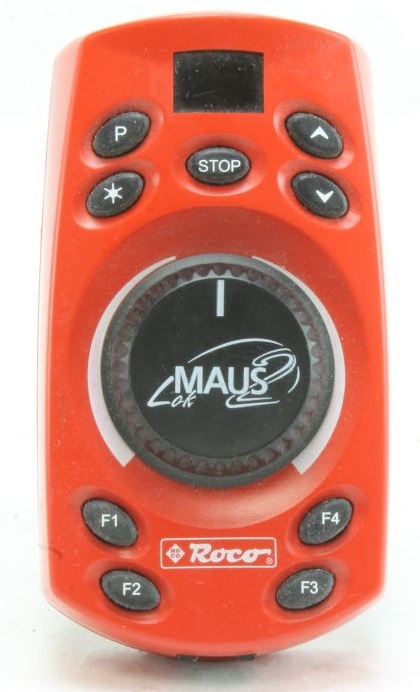
The second generation of Lokmaus, with Xpressnet bus and control of up to 99 locomotives and functions F0 to F4.
The peculiarity of the Lokmaus2, like its older brother the Multimaus, is that, in reality, it is the command station if it is connected to the 'Master' connector of the Roco 10761 booster, while if it is connected to the 'Slave' connector it acts only as a throttle.
I have a special affection for this throttle since it was the first commercial digital system I bought. I used it to try to develop an Xpressnet interface for the DCCGen which ended up becoming my NanoX command station.
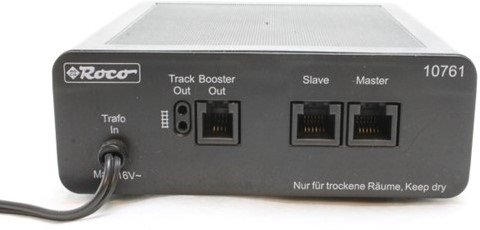
Contrary to what many people think, this black box is not the commnad station of the Lokmaus2 or the Multimaus, it is just a booster. The Lokmaus1 black box was indeed the command station.
It can deliver up to 2.5A and the input DCC signal comes through the two outer cables of the six in the RJ12 'Master' connector. Only the four interior cables are connected between the RJ12 connectors, so the 'Slave' connector does not input the DCC signal to the booster. This ingenious system allows the Lokmaus2/Multimaus to detect which connector it is plugged into and act as a simple throttle or as a command station. Short circuit protection is provided by the throttle that acts as the command station since the booster does not have one.
There must always be a single Lokmaus2 or Multimaus controller connected to the 'Master' and there can be up to 31 connected to the 'Slave'
The RJ11 'Booster Out' connector allows you to connect a Roco 10762 booster that uses the same PCB with two RJ11 connectors but does not mount the RJ12 connectors, so it is possible to convert a 10762 booster into a 10765 by adding the missing RJ11 connector.

This throttle allows you to move the digitized turnouts from the Roco command station and is capable of memorizing up to 32 routes.
It comes with two cables, one RJ12-DIN5 for MausBus and another RJ12-RJ12 for Xpressnet. Connected to the MausBus it can control turnouts 1 to 128, if connected to the Xpressnet then it controls turnouts 1 to 256.