
The Lenz system uses the Xpressnet bus so in addition to the Lenz throttles you can connect other throttles that use the same bus as the Roco ones.
| Manufacturer | Model | Article | Type | Bus | Retro | Protocol | Booster |
|---|---|---|---|---|---|---|---|
| Lenz | Compact | 60500 | C. Station + Throttle | Xpressnet | - | DCC | 2,5A |
| Lenz | LZ100 | 20101 | C. Station | Xpressnet, CDE | RS | DCC | - |
| Lenz | LZV100 | 20110 | C. Station | Xpressnet, CDE | RS | DCC | 5A |
| Lenz | LH90 | 21090 | Throttle | Xpressnet | - | - | - |
| Lenz | LH100 | 21100 | Throttle | Xpressnet | - | - | - |
| Lenz | LH200 | 21200 | C. Station + Throttle | Xpressnet | - | - | - |
| Lenz | LV101 | 22101 | Booster | Xpressnet, CDE | - | DCC | 5A |
| Lenz | LV102 | 22102 | Booster | CDE | - | DCC | 5A |

This command station is capable of controlling locomotives 1 to 99 and their functions F0 to F2 and has an Xpressnet bus
It can also control turnouts 1 to 99 and can be set to function as a command station or as an additional throttle for another Xpressnet command station.

The base of the Lenz system has had several versions from v2.3 with 99 locomotives, functions F0 to F4 and 256 turnouts to version v3.6 with 9999 locomotives, functions F0 to F28 and 1024 turnouts simply by changing the internal EEPROM.
Until v3.0, the most popular one that was also used by Roco and other commnad stations, it could only be programmed up to CV256, later versions already allowed programming up to CV1024.
This control panel does not have an internal booster so it needs to be connected to an external booster such as the LV101

This control unit is internally composed of two interconnected PCBs, one with the LZ100 commnad station and the other with the LV102 booster.
It can deliver up to 5A and allows the output voltage to be adjusted between 11.5V and 22V, it can also be adjusted to produce the RailCom 'cutout' although it cannot read the CVs in PoM.
The last version of Xpressnet that it had was v3.6 capable of controlling 9999 locomotives, functions F0 to F28 and 1024 turnouts.

This throttle allows you to control up to locomotive 9999, functions F0 to F8 and move the digitized turnouts up to 999.
To change direction, it incorporates a toggle switch that also serves as an emergency stop for the locomotive.
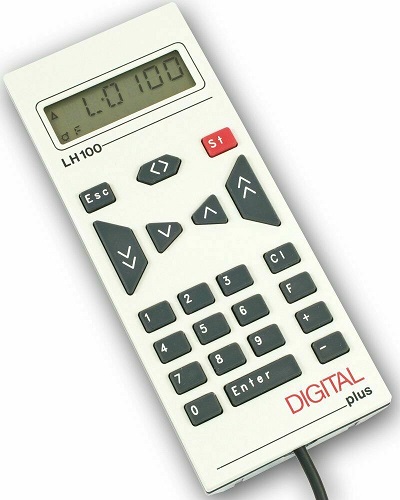
This throttle allows you to control up to locomotive 9999, functions F0 to F12 (F0 to F28 with version v3.6), and move the digitized switches up to 999.
To update it to version v3.6, it had to be sent to Lenz to have the microprocessor changed.
It does not have a potentiometer or rotary encoder but the control of the locomotive is by keyboard, although it is still comfortable to use.

This throttle allows you to control up to locomotive 9999, functions F0 to F8 and move the digitized turnouts up to 999.
To change direction, it incorporates a toggle switch that also serves as an emergency stop for the locomotive.
It can function as a commnad station if connected to the LV101 booster with a six-wire RJ12 cable.

This booster can deliver 5A and allows you to adjust the output voltage between 11.5V and 22V using internal DIP switches.
It has an RJ12 Xpressnet connector for connecting an LH200 throttle, when it acts as a command station, similar to the Lokmaus2 system.

This booster can deliver 5A and allows the output voltage to be adjusted between 11.5V and 22V by programming the CV7 in PoM.
It can also be set to produce a RailCom cutout.