|
|
Two
principles, one probable paradox and a humble suggestion, all concerning
percentages of translation and non-translation into various languages,
particularly English
Anthony
Pym 1999
Abstract:
Data on translations of books into various languages
have been used as part of arguments that there should
be less translations from English and more translations
into English. However there is some empirical evidence
that the relative proportions of translations and nontranslations
from and to English fall into line with two general
principles: 1) The more books published in a language,
the more books tend to be translated from that
language; and 2) The more books published in a language,
the lower the rate of translations tends to be in
that language. As a probable paradox, it is also hypothesized
that 3) The more foreign-language books are published
in a country, the higher the percentage of translations
in that country. A further suggestion is that 4) The
inner diversity of English carries out the work that
translations are called upon to do in the case of smaller
languages. These hypotheses suggest that the relative
abundance of translations alone cannot tell us how open
or hegemonic a culture is, nor whether there should
be more translations into English.
The
Debate
One must accept
that translations account for only 2 to 4 percent of books
published in the United States or the United Kingdom.
This general proportion or rate is much lower than the
percentages often cited for other countries: 15 to 18
percent for France, 11 to 14 for Germany, some 25 for
Italy, 25 to 26 for Spain, to bring together reports for
years between 1985 and 1992 (Ganne and Minon 1992; Venuti
1995: 12-14). Nor can one really doubt that translations
from English account for a good deal of the movements
into other languages. UNESCO figures indicate that English
was the source language for an average of 41% of all translations
in 1978-1980 (the years that will interest me here) and
this proportion may have been as high as 49% in 1987 (Venuti
1998: 160). Let's accept these rough numbers. What do
they mean?
On the surface,
the disparity between what is translated into English
(not much) and what is rendered from it (a lot) is great
enough for Lawrence Venuti to talk about "a trade imbalance
with serious cultural ramifications" (1992: 14). It
prompts him to complain about the commercial opportunism
of American and British publishing companies: "Quite
simply, a lot of money is made from translating English,
but little is invested in translating into it" (1998:
160-1). And this is just part of an unhealthy world
situation where American and British publishers have
"reaped the financial benefits of successfully imposing
Anglo-American cultural values on a vast foreign readership,
while producing cultures in the United Kingdom and the
United States that are aggressively monolingual" (1992:
15). The result, says Venuti, is symptomatic of "a complacency
in Anglo-American relations with cultural others, a
complacency that can be described--without too much
exaggeration--as imperialistic abroad and xenophobic
at home" (1995: 17). I've picked phrases from three
of Venuti's books, which make more or less the same
argument on this point. Now, do the numbers really mean
all that?
I suspect
not. Or better, some pernicious exploitation no doubt
exists, but I don't quite see how the data can reveal
the scandal. I'll try to explain my doubts in two ways:
first in terms of a mental warm-up, second with some
actual numbers.
Two
Simple Mind Games*
The first warm-up
exercise is just common sense. Imagine, if you will, that
there is a language with a huge number of books in it,
and another with just a few books. Now, which of these
languages is going to have the greater number of books
translated from it? Why, all else being equal, the bigger
one, of course. So we might imagine that there are a lot
of translations from English just because there are a
hell of a lot of books published in English. And this
need not imply any global conspiracy on the part of publishing
companies. (That was a game for simple minds.)
Second game:
Let me suggest, as a general idea, that a language in
which a lot of books are published will have a lower
translation rate (i.e. translations as a proportion
of all books published) than one in which less books
are published. I've put forward this idea in several
places already (Pym 1996, 1998); no one seems to understand;
so I'll go slowly, again.
Here I'm
talking about any language whatsoever. Forget about
English, French and the rest for a moment. All we have
to picture is the same scene as the one we've just thought
about: Language A, with a lot of books, has more things
that could be translated than does Language B, which
has less books.
For example,
Language A has 100 books, and Language B has 10.
Now, let's
impose an ideal world where translation rates apply
to all books independently of their origin. Let's say
10% of all books in this imaginary world are worth translating
and are translated. That means 10% of all A's books
are translated into B, and 10% of all B's books are
translated into A. Universal justice! But look what
happens: Language A gets just one book from B and finishes
up with a translation rate of 0.99% (one translation
for the 101 books published). And B receives 10 translations
from A, so its translation rate is actually 50% (translations
now account for half of all books published).
From this
game I conclude that a low translation rate in
a language may be due to no more than a relatively high
number of books published in that language. And this
seems as obvious as the idea that the more books there
are in a language, the more translations there are likely
to be from that language (the finding of our
first game). It also seems clear that any analysis that
does not compare the numbers of books is manipulating
a pretty poor version of materialism.
Is something
wrong here? Let me address two possible objections.
First, you
might say, my second game is deceptive because, in reality,
there are many languages involved; we have to picture
an extended-play scenario. Okay, now imagine five languages
that have 100, 80, 50, 30 and 10 books respectively.
If our 10% rule is applied we get translation rates
of 14.5%, 19.2%, 30.5%, 44.4% and 72.2% respectively
(take a few minutes to work it out for yourself while
waiting for a bus, train or plane). So the differences
become even more pronounced!
Second,
some might object, the ideal world should have a 10%
rate or whatever for each individual language,
such that Language A with 100 books would be obliged
to translate all the 10 books from Language B, and Language
B with just 10 books would be obliged to translate no
more than one book from Language A. Fair enough, that's
a possible scenario. But, in our extended-play model,
if each language takes its translations in accordance
with the distribution of books available to be translated,
the biggest one will still have the most books translated
from it (take a few more minutes to work it out, once
you get on the bus, train or plane). So even this does
not entirely solve the problem of a general "trade imbalance".
Further, I wonder if our theorists would be entirely
happy with a command economy that were really so indifferent
to the relative qualities of books. Would they really
want to judge and translate texts solely in terms of
their origin?
Some
Unruly Data
The games only
give us models and hypotheses. To test them we need data
on the translations and nontranslations published in a
fairly wide range of languages. The numbers most readily
available are those in the UNESCO yearbooks, although
the yearbooks become less complete and appear less trustworthy
from 1986 (thanks in no small measure to the withdrawal
of the United States). I have thus decided to look at
the data published in 1985, which actually includes figures
for 1978-1983. Some notes on these numbers are necessary
before proceeding:
- This is
a terrible database: key countries are missing in many
of the tables; the figures given in different tables
sometimes do not agree with each other; the notes on
the language breakdowns are incomplete.
- This is
also a tricky database because different countries have
different definitions of the basic categories (e.g.
what counts as a book; what counts as literature; whether
we are counting first editions or all editions). Care
must thus be taken to ensure that the raw data for each
country are compared only with other raw data for the
same country (e.g. translations in Germany vs. nontranslations
in Germany), so that the more blatant differences in
definition can be overcome. In search of the least perilous
path I have looked at the numbers of first-edition titles
in all categories of books (by whatever definition)
for 21 languages (which were actually all the languages
available for comparison with any degree of certitude).
- This is
an intriguing database because it gives information
on books published in non-national languages (e.g. books
in French published in Sweden). This enables us to estimate
the total number of books published in English
etc. without being limited to national categories such
as the United States or the United Kingdom. It also
gives us some kind of measure as to how non-nationalist
certain countries are about their publishing (on which,
more below).
- The database
gives figures for several years, so some anomalies can
be ironed out by taking the means. It also covers a
fair range of languages, both big and small.
- The period
concerned was one of relative stability in political
terms, perhaps free of the high volatility that marks
the translational development of languages with few
books. For example, we find from another source (Vallverdú
1978) that translation rates into Catalan were at 55%
in 1965, 8.3% in 1973, and 16.5% in 1977. Our test numbers
should try to avoid such rapid shifts, which are due
more to local developmental factors than to the general
(and boringly stable) principles we are interested in
falsifying.
- Perhaps
because of the above reasons, the percentages of translations
found in the UNESCO data are generally lower than those
given in other sources for more recent dates. I found
only 13% (instead of 25%) for Spanish; only 11% for
German and French apiece. However, since the rate for
English is just over 2% both here and in other sources,
the fundamental difference we are interested in was
not quite obscured by the uncertainties of UNESCO. This
allows us to take a deep breath and proceed, no matter
how bad the data.
Two
Principles Tested
Our first mind
game suggested that the more books were published in a
language, the more translations there would be from that
language. When we test this principle on our data, here's
what we get:
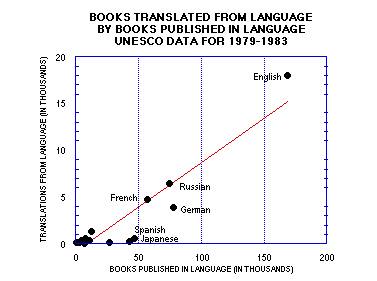
Well, yes,
English is a long way out there by itself. And about
twelve languages are huddled together in the bottom
left corner, with not many books published and thus
not many that they could have had translated. But the
diagonal line here, the regression, averages all of
that out and tells us that the general hypothesis holds.
In fact the correlation is pretty damn good (p<.0001,
R2=0.869), as might be expected for such a banal hypothesis.
The only slight hitch is that English is clearly above
the regression line, which might suggest that more books
are indeed translated from it than is the norm for this
field. I shall return to this problem later. For the
moment, let's simply note that the fact that 41% or
so of all translations are from English no longer looks
quite so scandalous.
Our second
game suggested that the more books were published in
a language, the lower the translation rate would be
in that language. In other words, the bigger you get,
the less the share of your cultural energy you put into
intranslations (i.e. translations into your home language).
When we test this on our data we get the following picture:
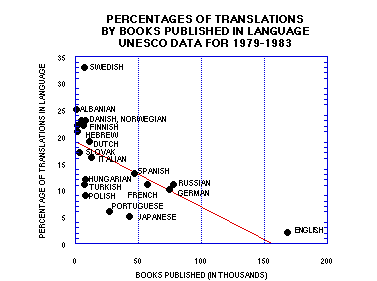
Once again
English is way out on a limb, at a point that is difficult
to compare with other languages. I also note with
a grin that the highest translation rate in the sample
was for Albanian, which might thus be the ideal pluralist
culture (this was the Albanian language in 1979-81)
that some theorists would have us aspire to. If only
English, like Albanian, had a rate of 25%! But as
the scatterplot suggests, Albanian had a high translation
rate not just because of any cultural openness but
perhaps also because it had so few books published.
Unfortunately
the relation here is not as strong as one might have
hoped for (p=.0009, R2=0.465, which is just under
the 0.5 we'd like for a convincing correlation). Yet
the picture seems clear enough in general terms, especially
for the languages with the larger numbers of publications.
As the number of books grows, the percentage of translations
tends to decline. Further, the languages above the
regression line could be the ones translating more
than their relative share; the ones below the line
are translating less than the mean. Now, which side
of the line is English on?
A
Bonus Paradox: Translation vs. Foreign-Language Reading
Since there
was no third game above, we might as well play it here.
Or you could play it in a bookshop next time you travel.
Just walk around and try to estimate the percentage
of translations on the shelves (and if you're not yet
convinced that English is dominant, take a close look
at the business-management or computing sections). You
might get estimates as high as 40% or 50%, or even 80%
for some fields if the bookshop is at all academic or
intellectual. But what you will also find, in many countries,
are foreign books that are not translated, usually on
sale in the major trade languages of our day, increasingly
in English. That is, in many countries the tendency
is to read directly in foreign languages, without translation.
And this practice, unevenly distributed, must necessarily
skew any attempt to associate 'cultural openness' (or
any such value) with a high rate of translations. If
the Swedes, for example, are all reading in English,
they shouldn't really need translations from English,
and they will potentially have a very open culture with
a rather low translation rate. So all the arguments
that might be based on translation data, including ours,
are at best limited in what they can say about the relative
virtues of cultures.
The hypothesis
to be tested, the one that seems quite logical, is
that the more a country consumes foreign-language
books without translation, the lower the translation
rate will tend to be into its national language or
languages.
To test
this hypothesis we really need reliable data on book
exports and imports between a wide range of languages.
I do not have any such data. But what I do have, sitting
in the middle of all the UNESCO tables, are numbers
of non-national-language books published in a lot
of countries (e.g. books published in French in Germany).
Faute de mieuxI propose that these numbers
indicate uses of nontranslation that are compatible
with a certain degree of cultural openness. True,
these numbers may concern more the country's foreign
projection than its internal consumption patterns.
But that is no reason for not looking at the data.
Here's
what happens to our hypothesis:
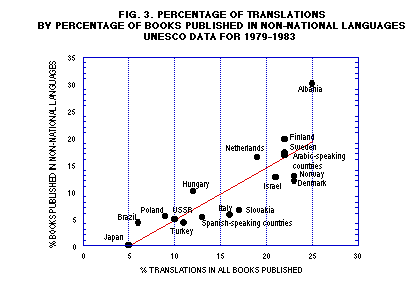
Despite
severe limitations on the data (UNESCO doesn't tell
us about non-national-language publications in the
United States, the United Kingdom, France or Germany),
the results are perhaps interesting enough to write
home about. Our logical hypothesis is shown to be
quite wrong. When countries publish a lot of books
in foreign languages, they alsoend to translate
a lot of books from foreign languages. The R2 here
is a high 0.717 (p<.0001), which is a good correlation
for a hypothesis that is not at all banal.
Exactly
what this means requires more information. It could
be that intranslation and extranslation are simply
moving hand-in-hand, as complementary sides of increased
cross-cultural exchange. Or it may just be that translations
and non-national-language publications more actively
help each other in raising public awareness about
foreign books, with each practice stimulating more
than its own narrow market, as was argued by Schlösser
(1937: 2) when observing similar phenomena in the
German reception of English literary texts.
Such speculation
goes beyond my present concerns. All I am really interested
in showing is that if translation rates are to indicate
something like cultural openness, nontranslation
rates might be assumed to operate the same way,at
least until we find good data able to prove that translation
and foreign-language-reading are compensatory rather
than complementary intercultural strategies.
And
a Suggestion about the State of English
I am not
arguing that there is no cultural hegemony. In fact,
if we attempt a slightly different kind of calculation,
translations into English might have been numerous enough
to develop a certain kind of productive hegemony. For
the period 1960-1986 the Index Translationum
lists more than 2.5 times as many translations in Britain
and the United States (1,872,050) than in France (688,720)
or Italy (577,950). That is, the number of publications
in English is now so great that readers can indeed find
more translations there than they can in some languages
with higher translation rates. This perhaps amounts
to saying that imperialism can bring certain translational
rewards; the victors carry off the trophies. Less provocatively,
it means we are being less than astute whenever we try
simple comparisons (the above lineal regressions) between
the world's major trade language and other languages.
The sheer
size of English means it has its own dynamics. It
is not only the first language of some 320 million
people worldwide, but also a second language for perhaps
that number again. It is an official or dominant language
in over 60 countries and "routinely in evidence" in
a further 75 countries (Crystal 1997). It has multiple
standardized varieties and is the matrix language
for some 44 creoles and pidgins across the globe.
This is one hell of a big language, with countless
variations churning within it.
I suggest
that sheer size brings with it a very high degree
of inner diversity-, visible in a wide range of distinct
yet more or less mutually comprehensible varieties.
Further, many of those different standards and non-standards
gain access to printed communication, and do so in
many different countries. Our data give some 24% of
all books in English being published outside of the
United States or the United Kingdom; the presence
of writers born beyond those two main centres has
become a regular feature of English-language literature.
In fact, to complete my argument, the sheer size of
English could mean that a lot of the diversity and
new blood that other language groups seek through
translation, English-language cultures may be getting
without translation (for the same argument in slightly
different terms, see Constantin 1992: 126). Thus,
in order to carry out a comparison between the United
Kingdom and, say, Albania, we might want to take some
of that 24% non-central publication rate for English
and add it on to the United Kingdom's basic translation
rate.
The point,
once again, is that if we are trying to gain some
degree of cultural openness or diversity, translation
alone is neither a sufficient measure nor a sufficient
remedy. Nontranslation may also be a measure of cultural
variety and openness. We cheerfully conclude that
English could even be in advance of Albanian cultural
ideals.
Note
* The author
would like to thank Gideon Toury for correcting the
numbers in the mind games.
References
Constantin,
Jean-Paul. 1992. 'Les éditeurs'. Françoise
Barret-Ducrocq, ed. Traduire l'Europe. Paris: Payot.
125-133.
Ganne,
Valérie, and Marc Minon. 1992. 'Géographies
de la traduction'. Françoise Barret-Ducrocq,
ed. Traduire l'Europe. Paris: Payot. 55-95.
Crystal,
David. 1997. English as a Global Language. Cambridge
University Press.
Pym, Anthony.
1996. "Venuti's Visibility", Target 8/2. 165-177.
Pym, Anthony.
1998. Method in Translation History. Manchester: St
Jerome.
Schlösser,
Anselm. 1937. Die englische Literatur in Deutschland
von 1895 bis 1934. Jena: Biedermann.
UNESCO.
1985. Statistical Yearbook /Annuaire statistique /
Anuario estadístico. Paris: Unesco.
Vallverdú,
Francesc. 1987. "Els problemes de la traducció".
Carme Arnau et al., Una aproximació a la literatura
catalana i universal. Barcelona: Fundació Caixa
de Pensions. 95-107.
Venuti,
Lawrence. 1992. "Introduction". Lawrence Venuti, ed.
Rethinking Translation. Discourse, Subjectivity, Ideology.
London and New York: Routledge. 1-17.
Venuti,
Lawrence. 1995. The Translator's Invisibility. A History
of Translation. London and New York: Routledge.
Venuti,
Lawrence. 1998. The Scandals of Translation. Towards
an Ethics of Difference. London and New York: Routledge.
- Last update
2 February 1999
|
© Anthony
Pym 2014
URV. Av. Catalunya, 35
45002 Tarragona, Spain
Fax: + 34 977 299 488
|