|
25-29
June 1996
Christine
Schäffner and Beverly Adab
Department
of Languages and European Studies
Aston
University
Aston
Triangle
Birmingham
B4 7ET
Dear
Christine and Beverly,
Many
thanks for your kind invitation; it's always a great pleasure
to participate in this kind of thing. In this case, though,
I must confess to some perplexity as to the exact nature
of the terms, particularly the bit about 'hybrids'. Do you
mean something like Mendelian genetics (you know, with the
eye colours that jump generations, or my mother's once-red
hair that appears on me if I let my beard grow)? No,
I can't make much sense of that when applied to translation,
though God knows just about every other metaphor has had
at least one go at our subject. Or perhaps you mean hybrids
in the sense of a good old mix, like blue and yellow giving
us green? But no, that'd be too easy; it'd simply stir up
all those millennial fears about cultures and languages
getting lost in each other, producing a murky neutral grey,
some kind of bleak imperialised future. Vive la différance!
would reply the non-translating Derrideans. No, surely that's
a little too facile as well. But if not Mendelian and not
colours, then what?
How
about this?
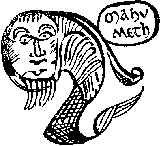
Now
that's gotta be a hybrid! A face on a fish with something
like a feather on the side. To say nothing of the funny
writing, which I'll explain in a minute. There you have
it, ladies: my point of departure, not that the above doubts
have been forgotten. Let me also indicate where I want to
go from here: You say translations are hybrids, more or
less, perhaps like this little picture. Okay. So what happens
if I convince you that non-translations are hybrids or at
least promoters of hybridisation? Where would that leave
us? If translations are X (hybrids, or whatever) and non-translations
are also X, then everything is X and we're back to square
one. Which in this case may not be a bad place to be (it's
hard to start with hybrids; easier to come back to them).
Yet I'll take my professional heresy just one step further:
What if I convince you that translations are actually agents
of dehybridisation, that they work against the producing
of things like our little picture? What a cunning bastard
I'd be! Mind you, the argument isn't all that recherché:
since any translated text marks a line between at last two
languages and cultures, it posits the separation and thus
the possible purity of both. And if imagined purity is some
kind of opposite of hybrids, whatever the latter may be,
translations help it rather than hinder it, QED. Far better,
I suggest, to do without translations and to see little
hybrids everywhere, although we may need something like
translations to see them, which is why we can only come
back to them. Things are getting complicated. And I haven't
even mentioned the more likely hybrids, the human translators,
who are quite frankly of far more interest to me than any
abstract hypothesis about text genres. But let's explain
the picture first.
Well,
it's from a translation. More exactly, it's from manuscript
copies of the first Latin translation of the Qur'an, which
explains why the funny writing says 'Mahumeth'. The translation
itself was carried out in Hispania in 1142-43; the drawing
was added later by an anonymous copyist. Derrida would insist
the iconic hybrid is a supplement to the translation, though
I hesitate to make such references. The drawing was copied
again by Marie-Thérèse d'Alverny in her analysis
of the Qur'an translation, and again by Jacques Le Goff
who stuck it in Les intellectuels au Moyen-Age without telling
anyone what the drawing was actually of. That's one reason
why I'd like to explain it here.
The
Qur'an translation was carried out along with a whole series
of supplementary documents: texts on the nature of Islam,
on the life of the prophet, and lists of Islamic heresies,
since the translation was supposed to help Christians debate
against Islam, not to believe in it. This was the age of
the incipient Crusades; the translation comes from the most
immediate frontier with the most immediate other of Christendom.
The drawing is actually a supplement to one of the supplementary
texts: it accompanies the lines where the boss of the project,
Petrus Venerabilis (Peter the Venerable, abbot of Cluny),
tries to explain why the Qur'an is heretical even though
it contains much material from the Christian Bible, which
obviously cannot be heretical: there is a lot of the self
in the other, so the translated text cannot be condemned
outright. His terms are as follows: '...et sic, ut ait ille,
undique monstruosus humano capiti ceruicem equinam et pennas
auium copulat'. Islam isn't wrong in itself; it just breaks
the rules of genre, sticking a monstrous human head on a
horse's neck (which I struggle to see in the drawing) and
adding a few feathers. The result is a hybrid, a monster,
precisely of the kind that postcolonial studies often finds
when self meets other in a frontier region, when there is
anxiety about crossing boundaries: the great risk of translating
the Qur'an is obviously that it might attract a Christian
to Islam, creating traitors rather than a triumphant identity.
Beware, says the drawing, there are monsters out there,
like the sea monsters on navigation charts: go no further.
But also: Beware, if you venture beyond, you yourself might
become a monstrous hybrid, neither here nor there, lost
in heresy. Thus does the self produce the imaginary mix
so as to affirm its purity, expressing anxiety about the
attraction of the other and the quite real possibility of
becoming something in-between.
A
postcolonial citation, just to touch a few bases: James
Donald analyses 'the grotesque as a boundary phenomenon
of hybridization or mixing, in which self and other become
enmeshed in an inclusive, heterogeneous, dangerously unstable
zone... The point is that the exclusion necessary to the
formation of social identity at [one] level is simultaneously
a production at the level of the Imaginary, and a production,
what is more, of a complex hybrid fantasy emerging out of
the very attempt to demarcate boundaries, to unite and purify
the social collectivity.' This is from something called
'How English is it?', in New Formations 8 (1988), pp. 36-37,
drawing on Stallybrass and White's The Poetics and Politics
of Transgression (1986). Sounds pretty good! Not that I've
read much of that stuff. I've pinched the citation from
Robert Dixon's Writing the Colonial Adventure (1995), parts
of which are actually quite a good read, with all sorts
of stories about imaginary hybrid tribes, troppo whites
and cross-cultural dressing in the wilds of Australia, all
cemented into place by abundant references to Homi Bhabha
and the rest. Yet the point that really interests me is
that the imaginary hybrid - the awareness of possible hybridisation
- is produced in a frontier space, as part of an exclusion
of the other, as part of a separation of identities.
Note
that postcolonial studies can describe all that without
even the slightest reference to translation. Robert Dixon's
book, the one I just pinched the citation from, has about
200 pages retelling and analysing Anglo-Australian popular
fiction between 1875 and 1914: yards of ripping yarns, tons
of hybrids, a fair swathe of references to languages and
their mixing, to language learning and language forgetting,
but nothing at all on translation. The phenomena of hybridisation
would seem not to require translation. If this is so, what
reason could we have for putting the two terms together?
Well,
our picture of a hybrid was at least attached to a translation.
Yet there is more to it than that.
Discrepancies
exist between the picture and the text that accompanies
it: mainly a fish we can see in the drawing but not in the
text. So where did the fish come from? In fact, where did
the whole idea come from? Any self-respecting translation
theorist should have guessed the answer about two pages
ago. For the sake of the rest of us, let me cite the beginning
of Horace's Ars poetica, which might have something to do
with the question of hybrids and translations: 'Humano capiti
ceruicem pictor equinam / iungere si velit, et varias inducere
plumas / undique collatis membris, ut turpiter atrum / desinat
in piscem mulier formosa superne, / spectatum admissi risum
teneatis, amici?' Fairclough's translation is fair enough
for my purposes: 'If a painter chose to join a human head
to the neck of a horse, and to spread feathers of many a
hue over limbs picked up now here now there, so that what
at the top is a lovely woman ends below in a black and ugly
fish, could you, my friends, if favoured with a private
view, refrain from laughing?'
That's
it. The anonymous producer of our picture clearly corrected
the reference to Horace, adding the fish that Petrus Venerabilis
had somehow left out. Yet what interests me even more than
the detail is the way the hybrid relates to translation,
since Horace has been of some little importance for classical
discussions of our subject.
The
Ars poetica is well worth reading and re-reading, from beginning
to end. Horace is writing a letter (can translation theory
be done in a letter?) to a father and two sons of the Piso
family (no one knows much about them) giving advice on how
to write poetry, especially drama. His main message, as
we see in the opening reference to a hybrid, is that the
established (Roman) genres shouldn't be mixed. To do so,
wilfully to violate norms by producing hybrids, would simply
merit ridicule. Or so say the norms of the rhetorical question.
The
opening reference to a mad painter corresponds to the final
image, at the very end of the letter, of a mad poet: 'He,
with head upraised, splutters verses and off he strays;
then if, like a fowler with his eyes upon blackbirds, he
fall into a well or pit, despite his far-reaching cry "Help,
O fellow-citizens!" [succurrite... io cives!] not a soul
will care to pull him out' (457-460). If you don't observe
the rules, you're laughable, necessarily mad, since no fellow
citizen will save you when need be. A hybrid, you see, is
by definition not like one's fellow citizens. More exactly,
by imagining and ridiculing hybrids we can define the fellowship,
the affective and iconic relations, the bonds of belonging
that ensure mutual help, cooperation, in this case on the
level of the civitas, a civilised society. Hybrids, as one-off
creatures, may be stronger for a moment, individually gifted
or inspired, but they have no fellow citizens in the civilised
world. Alone, they do not belong.
Horace's
reactionary defence of established norms is also, of course,
a defence against outside interference with those norms.
Hence, perhaps, the only piece translation scholars usually
care to cite: 'nec verbo verbum curabis reddere fidus /
interpres' (133-34), 'do not seek to render word for word
as a slavish translator'. We all know that many generations
have misinterpreted the line, from Jerome to the early Renaissance
theorists studied by Norton right down to André Lefevere
and, in her introduction to a 1993 anthology, Siri Nergaard.
That is, centuries of citers have believed, as Mildred Larson
puts it, 'Horace stated that a faithful translator will
not translate word-for-word' (these and similar misinterpretations
can be found cited in García Yebra's Traducción:
Historia y Teoría of 1994). No, he didn't state that,
no matter how much as the Latin of the isolated lines might
justify the reading. In context, Horace is telling the would-be
dramatist to avoid precisely the word-for-word strategy
he attributes to the fidus interpres: the faithful translator
works word-for-word; the good Roman poet should not.
And
why not? Horace gives two parallel reasonings. First, the
poet should avoid imitating common expression, since slavish
imitation is like leaping into an Aesopic well ('nec desilies
imitator in artum') 'out of which neither shame nor the
laws of your task will keep you from stirring' (134-45).
Nor, we might add, will any fellow citizen bother to pull
you out. Second, if the poet were merely to repeat something
that has been said, the work would hardly make sense in
cost-benefit terms: 'parturient montes, nascetur ridiculus
mus', 'Mountains will labour, to birth will come a ridiculous
mouse!' (139). A nice classical quote: put it in your pocket
for use against translation theorists. But here, note well,
it is the faithful translator (interpres - a figure between
prices, a commercial translator) who is being aligned not
just with word-for-wordness but also with falling into a
hole (like the mad poet) and producing something ridiculous
(like the painter's hybrid).
Now,
Horace does not actually say that faithful translators are
bad because their word-for-word strategies bring foreign
interference into the Latin language, upsetting the norms
and producing linguistic hybrids. Yet I believe his argument
could be extended in this direction. In support of my claim,
look at a cognate of interpres used just one page prior
to the bit about faithful translators: 'post effert animi
motus interprete lingua', 'then, with the tongue for interpreter
she [nature] proclaims the emotions of the soul' (111).
Nature uses the tongue - language - to translate something
prior to language. This would be natural translation, if
ever there was such a thing. Clearly, not all translating
is bad, nor is it all word-for-word (this one is word-for-motus).
But which language is involved here? And what happens if
the translating goes wrong? Horace explains: 'If the speaker's
words sound discordant with his fortunes, the Romans, in
boxes and pit alike, will raise a loud guffaw' (113-14).
The language of natural translation is the Roman tongue;
it is not word-for-word because this language translates
directly from a natural order, expressing ideas on which
all social classes agree; and if the natural translation
goes wrong, if it should upset the transparency of established
structure, all good fellow citizens will merely greet it
with laughter: it will be a ridiculous hybrid genre.
This
reference to natural translation, you see, acts as a kind
of bookmark for what would come later: Horace doesn't talk
about any sense-for-sense transfer as such (he only mentions
word-for-word), yet this natural translating of motus is
the ideology necessary for the sense-for-sense to be found
in Cicero, Jerome, and indeed any idealism of deverbalised
meaning, at base a romance of transparent language and unchanging
social order. The unbearably long tradition of binary translation
theory (one method or the other) is already implicit here,
even though the question of hybrids is aligned with only
one side, the word-for-word.
At
this point you might be worried that I'm a long way from
home. I want to argue that translation works against hybridisation.
Yet Horace is implying precisely the opposite; he invites
us to see translation is an agent of hybridisation. I insist,
though, that this and perhaps all binary translation theory
is fundamentally reactionary. Translation is aligned with
hybrids only in order to make non-translation, the categories
of apparently primary social belonging, seem pure and unadulterated,
even when accorded the richness of creative dramatic poetry.
This imagined purity can then project sense-for-sense.
Horace's
tropes ricochet down the centuries of theorisation. In Schleiermacher,
just in case anyone caught my reading of him in the journal
Translation and Literature last year, the figure of the
Blendling (the-translator-as-bastard) is clearly the hybrid,
social isolation is in the translator-as-child-abandoned-to-troupes-of-acrobats
(perhaps drawn from Dryden's translator-as-tight-rope-walker),
the stilted opposition to nature is word-for-wordness negating
'natural gymnastics', and ridicule is in the smiles with
which masters look down on the bad translator's laborious
literalism, all this in the form of rhetorical questions.
If you haven't read the passage, don't bother. Believe me,
Schleiermacher is involved in much the same game as Horace,
associating literalist translation with the risk of hybridisation,
precisely in order to preserve the ideal of belonging as
non-hybrid. Of course, the German theorist seeks a mode
of translation that will keep the risk within acceptable
limits, developing rather than adulterating Germanic identity.
And herein lies a key: Schleiermacher can only control the
risks by excluding commercial translation (Dolmetschen,
negotiations, the stuff of the interpres) and by insisting
that the translator, like any citizen, must belong to only
one culture: 'Wie Einem Lande, so auch Einer Sprache oder
der andern, muß der Mensch sich entschließen
anzugehören', people must finally belong to one country
or another, one language or another. If not, if I were a
real hybrid using my in-between situation to do translations,
who would pull me out of a pit if need be?
Strange
translation theories: translations themselves, as texts,
can run the risk of being hybrids, since that preserves
the illusory purity of non-translations as non-hybrids.
Yet translators as people cannot; they must be qualified
as faithful (fidus) for Horace, as German for Schleiermacher,
and as general target-culture members for most of our self-describing
Descriptive Translation Studies. Strange theories, since
it seems to me that translators, by the very nature of their
plural competencies, if not always thanks to mixed birth
and extensive mental or physical travel, are quite likely
to live and work in the cultural overlaps or intersections
marked by hybridisation, in what I would like to call 'intercultural
space'. I mean that translators, as people, are more likely
to be hybrids than are the texts they produce. As such,
they have long been controlled by normalising discourses
on their allegiance (fidelity, duty, loyalty and the like)
or simply shelved behind discourses on the qualities of
their texts. Petrus Venerabilis could describe the Qur'an
as a hybrid, but he did all he could to avoid the consequences
of translators sharing the same status. His translation
team comprised at least one Mozarab, one anonymous 'native
informant', two scientific Latinists not particularly interested
in religion, but then also Petrus's own private secretary,
to make sure the Latin was really Latin and not the product
of any half-baked infiltrators from the frontier regions
(what languages did they use when discussing the Qur'an?).
Norman Daniel has called the result 'a Clunaic paraphrase',
hardly the sort of textual hybrid we might expect from the
drawing or the border situation. The figure of the hybrid
might have something to do with translations, but that does
not mean all translations are necessarily hybrids.
I
have two things left to say. The first is easy, since it's
no more than a question: What would happen if human translators,
despite their hybrid situation, were not quite alone in
their intercultural predicaments? What if there were many
others there, in the intersections of cultures, able to
form some kind of intercultural community, able to pull
each other out of pits? Surely then, and perhaps only then,
what we are calling hybridisation could start gaining respectable
press in translation studies, at the same time avoiding
at least some of the unwitting affirmations of non-translational
purity. If that were possible, I might even recover enthusiasm
for translation studies.
My
second point follows on from this but is more difficult
to argue: I would like to suggest that the people sharing
the translator's intercultural space are increasingly the
authors of source texts, and that the real hybrids, the
out-and-out weirdos, are more likely to be precisely those
source texts.
Perhaps
I should explain that most of my own professional translating
these days involves work on texts that are either overtly
multilingual or at least multidiscursive, incorporating
fragments from various sources and various degrees of lingual
competence. Here, for example, is an EU report the drug
problem in Guyana: the main author is a Senegalese who writes
in bureaucratic French and tries to do something similar
in English; the second author, responsible for parts of
the same text, is visibly a native speaker of British English
who has studied law, since he produces legalistic prose
no matter what the circumstances; and interspersed with
this French+bad English+legal English are crumbs from previous
reports of all kinds, ranging from UN jargon to CIA notes.
The result is indeed a horse-necked feathered girl's head
on a fish! And that's without explaining how this work comes
to me from a Catalan-Spanish client in Barcelona.... So
what do I, as a translator, do with this hybrid? Why, I
put it all into good English, as neutral and bland as possible
(not a trace of my native Strine!), translating, correcting,
revising, homogenising, reordering, adding and subtracting
where necessary, since I'm paid to produce a text that will
attract the necessary subsidy. From extremely heterogeneous
sources I write an English that lives almost nowhere (well,
is Brussels a place?). Another case, one of my favourites,
is a report on the sociology of domestic appliances, written
in a Spanish-English-Spanglish mix that can only be properly
domesticated when a French subtext is deciphered: for example,
the designers of appliances are called 'innovators'/'innovadores',
since some previous author has sought to avoid the Anglicism
'designer' in French, thus coining 'innovateur', rendered
into Spanish and Spanglish as such before I happily returned
it to the original 'designer'. Through an archeology of
the multilingual source I, as translator, could happily
plaster over most of the fissures.
Perhaps
you'll object that these are mere exceptions. True, not
all sources are quite so multi. Yet even the apparently
monolingual texts I receive freely incorporate foreign terms
and rarely give a damn about the correctness of their national
norms. The reason is simple: these texts are only meant
to be read by the research teams involved; within restricted
intercultural circles they can freely communicate in several
languages or bad language; and it's only when the thing
reaches me, the translator, that any exit to monolingual
or inexpert readers is assumed and dehybridisation has to
take place. Within the kitchen, anything goes; the translator's
task, in this context, is to make the dish look coherent
and to serve it in the form most suited to the external
readership.
In
case you still don't believe sources are becoming more hybrid
than their translations, in case doubters want to see and
touch, here are excerpts from the minutes of an EU meeting
held, apparently, in English:
DK:
Denmark supports the Structural Business Statistics Regulation
although it is thought to be of too great detail. The Danish
statistics have got the responsibility of a general Company
register, from the very beginning all sectors were covered.
FIN:
the Finnish register has been existing for a long time and
is now being revised to meet the requirement of the Regulation.
It is quite comprehensive. The statistical units are however
a difficulty.
B:
Some work is ongoing with the Social Security Office to find
the local units. Not considered will be the associations with
no employees and the public sector.
L:
the company register was published a fortnight ago in two
volumes: per activity class and alphabetical order. It is
also available on informatic support.
S:
Concerning the improvement of the Register the quality of
the classification has to be refined as a priority.
A:
In 1996 the Register will be extended to deduce a kind of
demography of the enterprises.
D.
An important prerequisite is the introduction of a law on
business services statistics (Dienstleistungs-statistikgesetz).
N.
The delegate invokes the problem of which group would be looking
after the implementation of the structural regulation.
F:
France has been researching these sectors some years ago already.
At national level use is already made of the approach of surveys
in turn.
GR:
Greece would appreciate having the possibility to update the
Register regarding new start-ups in order to cover completely
new enterprises demography. It is not clear how long it will
take to set up the Register.
E:
Small problems and gaps still in the services area due to
classification.
UK:
It is considered that classifications do not always give answers
to the needs as they are sometimes not fine enough. In the
future, a product breakdown will be asked in annual enquiries.
Note
that the macrotext is itself passably hybrid, all in the
present tense, when something Anglo-Saxon within me wants
minutes to be in the past. As for the details, the various
languages and norms should be clear enough: the infinite
patience of the Finnish 'It is quite comprehensive'; the
German need to make a law and give us its name; the French
'surveys in turn' (enquêtes tournantes) for 'cyclical
surveys'; the nice passives that virtually only come from
the United Kingdom, though even that text could do with
some polish. Leave the linguistic analysis for that Monday
morning translation class (yes, translation) for which you
never have anything prepared. What interests me here is
the fact that, no matter how ridiculous the text on the
level of grammar, all these people obviously understood
each other's English well enough to carry out the meeting
in that language. No mountains were labouring. Of course,
one might hope a few francophone participants will improve
their English with time, although it might be more cost-beneficial
to teach the others some basic French, so that no one gets
thrown by the occasional opaque calque, so that the members
of this small intercultural community can effectively pull
each other out of linguistic pits.
Whatever
the case, this, ladies, is your hybrid space. It is a space
of text production from within cultural overlaps. You might
argue, if you're clever, that most of the people participating
in this meeting were effectively working as translators,
expressing their thoughts in a foreign language. Yes, but
not quite. Technically, what these people have produced
is as much a non-translation as anything else, since there
are no paratextual markers to tell us otherwise and the
text producers were paid only to produce texts. These people
are in the same space as translators, but they are not working
as translators. The person paid to translate and mark the
text as a translation was in this case my wife, whose task
was not only to put it all into good French but also to
clear away the mixes, to pretend there was never any real
hybrid there, and of course to waste EU money in the maintenance
of that illusion. The real question, though, is this: Since
all these people communicated in English, why do they need
a translation into French (some two months after the meeting!)?
Whatever answer you find, it must surely include an ideological
warding off of hybrids.
So
much for my examples. Here, in summary, are a few hypotheses
that might be matched against your own:
·
Contemporary professional non-literary translation in Europe
(isn't that what you wanted to discuss?) is an agent of
dehybridisation for the simple reason that source-text generation
processes are increasingly multilingual, whereas translational
outputs are normally monolingual.
·
Translation in general (my subject) is an agent of dehybridisation
in the sense that it creates and projects the illusion of
the non-hybrid text.
·
Translators as an intercultural community are nevertheless
a focus of massive hybridisation on the ethnic, cultural
and linguistic levels.
·
The increasingly intercultural nature of source-text generation
processes means that translators are not alone; they share
much of their intercultural space with those who do indeed
produce textual hybrids.
I
naïvely hope my arguments will have some kind of consequence
for translation studies. We cannot continue to re-cite the
classical authorities of the past; we cannot passively describe
translations in terms of 'interference'; nor should we be
content when deconstructionist clones claim that all translations
are by definition transgressions, elements of some kind
of futureless liberation. Such arguments simply manipulate
the translation-as-hybrid to affirm the illusory homogeneity
of non-translations. That, I'm afraid, is a blindly reactionary
game, forever caught in the geometry of one-side-or-the-other.
Far better, I suggest, to look at the mixes that actually
occur in the space of translators as people, and at the
even greater mixes ensuing from the intercultural communities
that provide translators with professional contexts. Far
better, that is, to do rather more than translation studies
currently allows.
If
there is to be any kind of liberation from nationalist ideals
(and that's what I want), it will not come from the ideologies
of hybrids. Nor will it come from the employment of translators
to produce pretty texts. What we must accept, I believe,
is the existence of substantial intercultural communities.
From that basis we can ask a few important questions for
our future.
Best
wishes to you both,
Anthony
- Last update
11 March 1999
|