|
A lecture delivered to the CETRA
seminar, Leuven, July 13 1993.
The most violent intercultural relationships
at this end of the twentieth century are associated with disputes over
borders. They often ensue from notions of cultural sovereignty, from beliefs
that a culture has some kind of unalienable right to some kind of specificity.
Such beliefs become most problematic when expressed as claims to a particular
territory, to a cultural homeland, spreading across the space of one particular
color on a map of world cultures. A few steps then reach notions of all-purpose
cultures, all-purpose languages, and all-purpose sovereign states to make
sure everything stays in place, as if there were no alternative solutions
to violent intercultural relations. But are there any alternatives? Where
might they be found?
Some would say borders are not properly
cultural but are imposed by external manipulation, perhaps by apparently
noncultural factors like global politics, rationalist economics, or local
appeals to racism and ethnocentricism. Cultures are thus seen as open,
heterogeneous, dynamically evolving and axiomatically guiltless entities.
Alternatives to borders would be found simply by liberating the cultural
from the noncultural. Yet such noble idealism can only solve the problems
of cultures by simply not seeing them. When one bothers to take a good
look, particularly at recent conflicts like Bosnia, there are no firm criteria
able to separate the question of different cultures from that of different
ethnicities and thus from conflicting territorial claims. Indeed, derivation
of the term 'culture' from colere, to till, suggests that cultures are
by nature sedentary, occupying land, requiring time in one place for their
benefits to be reaped. We might thus talk about something like territorial
cultures, based on the filling of space and time. We could even try to
solve the problems of such cultures by drawing fragmentary color maps,
like the various maps proposed in recent years for the division of Bosnia.
The color-map approach at least has the advantage of recognizing that territorial
cultures oppose other territorial cultures, that they define themselves
by opposition, that they construct and indeed change borders. But the real
question is whether all cultures need be territorial. What kind of borders
should define a city like Sarajevo?
Answers to this question cannot be
reached by fiat, by declaring all cultures suddenly open, placeless and
mixed. The task must be approached carefully, through attention to what
happens in and around actual intercultural relationships. The office of
map-makers must be appreciated in all its difficulty. One of the most complex
and fundamentally ambiguous intercultural relationships, potentially subject
to mapping, is of course translation. Its relation to borders deserves
to be studied with particular attention, especially in a Europe that seems
unable to stop translating. What is translation doing to our borders? What
should it be doing? What can it tell us about more general alternative
solutions?
Most approaches to translation assume
there is a border between two cultures well before any translator enters
the scene. Translation thus crosses a pre-existing border. Yet this is
not necessarily so. In the interests of breaking down a few barriers, I
would like to put forward five ideas that might encourage us to think about
translation without presupposing borders between cultures. My long-term
general aim is to shape a vision of relatively borderless cultures. My
immediate purpose is simply to suggest alternatives.
First idea:
Borders need not be lines
The traditional study of translations
presupposes borders simply by arranging texts on desktops in a certain
way. We place the source on one side and the target on the other, then
develop tricks for making our eyes ricochet from one to the other. The
centre of our space is a border between two texts, by definition between
two cultures. As we proceed and allow the texts to define themselves reciprocally,
we arrive at conclusions about what belongs on one side and what belongs
on the other. We discover something about what is common and what is specific
to the cultures concerned. This comparative procedure further defines the
intercultural border defining its space.
This is not an entirely negative
way of working on translations. It elaborates a form already implicit in
the very nature of translation, since even pseudotranslations project a
line between cultures. The challenge, however, is to think about translation
without simply presupposing these borders. There are several ways of doing
this.
Let us imagine, for example, that
the formal border actually presented by a translation is not a line but
a point or a vague locus. This could be seen as a place centred by a moving
text intersecting a pre-existing border. We could see the border as vertical,
the movement then being horizontal. Where the two lines cross, there lies
a translation. The border has become a point. We have reached one minor
alternative.
To reach a slightly more radical
alternative, think of this point as a place formed on the horizontal line
only. One can think horizontally. If we follow the transcultural trajectory
of a text, the moment of translation appears as a discontinuity, a sudden
change of quality. This discontinuity need not mean that any vertical line
is being intersected. Indeed, if we can imagine the text in its untranslated
state gradually moving further and further away from its locus of maximum
comprehensibility, moving towards peripheries of weakly or alternatively
encoded time and space, the moment of translation can be seen as a break
responding to continuous semantic degradation, restoring a sufficient degree
of comprehensibility to allow further movement, possibly in quite a different
direction. Everything can happen along the one line. A full application
of this idea requires some appreciation of the way discourse genres retain
different degrees of elasticity, different capacities to remain meaningful
over distance, different translation requirements if they are to continue
their voyage (Pym 1992a: 103-116). Yet the aspect I want to stress here
is that the apparently intersected line, the supposedly pre-existing cultural
border, is not necessarily part of the conceptual geometry of translation.
It may well be something that is constructed après coup, as a result
of translations. If this is so, translation itself can be seen as a momentary
place on a horizontal trajectory rather than as a vertical line between
cultures.
This idea can be pursued in two directions.
On the one hand, the place of translation can be developed into a situational
geometry of translator, client, potential readers, source-text analysis,
alternative target-text strategies, and so on. The place becomes a discursive
locus in itself, apt for the production and discussion of what I have elsewhere
termed internal knowledge about translation (Pym 1993). It is a place for
exchanges between translators, would-be translators, competent controllers
of translators, and indeed anyone willing and able to compare source and
target texts. Although the discourses produced in this internal space often
presuppose an intercultural border, they themselves are constantly on both
sides at once, effectively annulling the function of the border as a barrier,
even when they are unable to recognize his function. On the other hand,
one can insist that translations are generally not produced for such strictly
internal discourses. The ostensible
function of a translation is to be received by someone who does not have
access to the source text, who cannot fully appreciate the various comparisons
and strategies involved, and who can thus only have external access to
the phenomenon of translation. On this second level, that of external knowledge,
the translation-as-received does indeed construct a frontier, signifying
the absence or opacity of a source text that belongs to a whole world beyond
the limits of familiarity. If internal knowledge effectively annuls intercultural
borders by crossing them, external knowledge can play an active role in
their construction.
The distinction between internal
and external knowledge should not be understood as any absolute division
of labour. Translations are not just for readers who cannot translate.
Some external readers have access to partial internal knowledge; some internal
translators and critics make efforts to understand external positions.
And yet the basic distinction remains far stronger for translation than
is the case for wider distinctions between (internal) writing positions
and (external) reading positions. Thanks to its definitional presumption
of linguistic opacity, translation itself separates the two kinds of knowledge.
Actual subjects may have access to various proportions of one kind of knowledge
or the other, but the basic distinction remains part of the phenomenal
level of translation. More important, the internal/external distinction
does not express any line between two cultures. The difference is instead
between certain
intercultural positions (internal
knowledge) and relative unawareness of those positions (external knowledge).
Or more neatly, it is between the border as place (seen internally) and
the border as line (seen externally). This difference is yet another alternative
to the traditional view of cultural borders.
Second idea:
Translative signs represent movements
If the geometry of internal knowledge
is based on a place and not a line, its mode of description should not
presuppose linear frontiers. This particularly concerns projects like José
Lambert's call for world literature maps, which sounds as necessary as
it is ambitious. And yet, if one sets out to describe 'literature in France,
in Germany, in Italy, instead of French, German or Italian literature'
(Lambert 1991: 141), one is still presupposing a linear geometry - national
borders - that most properly supports external rather than internal knowledge.
One is still producing a kind of fragmentary Vance-Owen color map, of remarkably
little historical avail against a nineteenth-century Serbo-Croat-Bosnian
nation map.
Happily, color maps are not the only
solution here. A more elegant and economical approach, particularly for
those with limited palettes, is to insist that even the externality of
a translation first marks a border point and then - but not always - a
border line. Rather than map entire literatures or cultures, one could
simply map translations, represented as a distribution of points. The great
advantage of this latter approach is that it avoids presupposing continuous
linear frontiers between cultures. It indicates operative border points;
it shows dots instead of lines. Translations can thus tell us something
about a border-to-be, although no cartographer is required to join up the
points vertically so as to form a linear frontier. The points can remain
points, indicating but not sealing the general areas occupied by cultures,
showing but not presupposing degrees of permeability or closure.
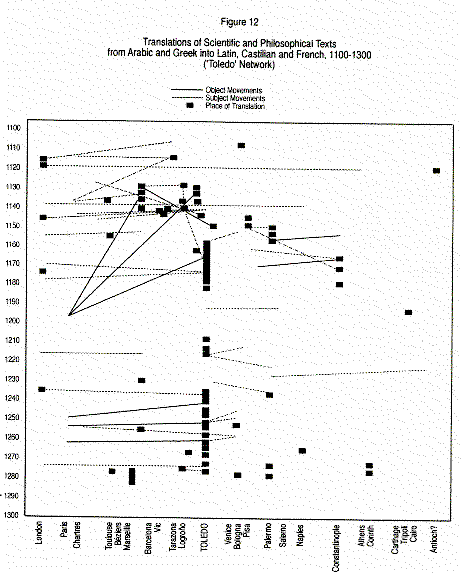
Such maps could remain at the level
of points. Indeed, the map I am preparing of twelfth and thirteenth-century
scientific and philosophical translations into European languages (not
here, I'm afraid: it's now on p. 96 of Method in Translation History) must
largely remain so, for want of good information on the movements of source
texts, translators and translations. But where sufficient information on
such movements is available, the points can be joined up not vertically
but sideways, by lines representing the trajectories of texts and translators.
The points still indicate potential intercultural borders (one immediately
sees exactly when Toledo was on the vertical border between the Christian
and Islamic worlds), but the nonvertical lines now show something quite
different. They make up transcultural networks, connecting several cultures,
forming zones of intensity, peripheries, major crossover areas and the
like, all in a geometry that is neither culture-specific nor universalistic.
Translation can thus be studied in terms of concrete transcultural networks
instead of ideally specific cultures. This is another alternative.
Such network maps have certain implications
for the conceptualization of translation itself. I have already suggested
that translation is a place on the horizontal trajectory of a materially
moving text. We can now go one step further. Since it is possible to use
translations in order to map horizontal trajectories (I have a map to prove
it), translations can be seen as representing these material movements
rather than anterior source texts. Or more simply, translation can represent
transfer (cf. Pym 1992b: 186). The idea may require some explanation.
Translation analysis traditionally
assumes that a target text in some way represents a source text, since
this is the semiotic basis for a comparison of separate cultures and an
affirmation of presupposed borders. But
translation is also a
discursive act that can represent its own locus. Analysis
from this second point of view need only focus on those
aspects of a target text that are peculiarly translative,
on the paratextual signs or significant deviants that mark
a translation as a translation. Since these marginal signs
cannot represent anything actually in the source text or
culture, they must stand for the way the translation itself
came about. That is, in terms of our mapping, they represent
the various transfer movements that made the translation
possible. To read translations in this way is partly to
interpret what they say about networks. Further, comparison
with composite transfer maps (like Figure
1) can indicate what translations do not say about networks
(only the materiality of the network can really say what
is or is not a pseudotranslation). Both approaches involve
thinking in ways that overcome intercultural borders.
Translative signs are particularly
intriguing in that they can be read from both internal and external perspectives.
For instance, the title-sign 'translated by' might introduce a defining
clause from an internal perspective and a relative clause when read from
an external position. The analysis of such signs can bring together two
kinds of knowledge, helping to counterbalance the arrogance of those who
believe all knowledge should be internal.
Third idea:
Translation is a transaction cost
The transfer of texts usually plays
a role in the real or virtual transfer of something else. Merchandise is
unmetaphorically transferred, often with the help of translated texts.
But many other kinds of value are created with the help of translation,
including diplomatic or cultural recognition, military cooperation or pressure,
stored and circulating capital, goodwill and prestige. The role of translation
is not just to make these values correspond, to find agreement on meanings
or prices, as might be read into the etymology of the interpreter as interpres,
a figure between prices. It is also to function as an added commercial
cost in its own right, since some part of the final agreed value or price
has to find its way into the translator's pocket. If this were not so,
translation history would be an improbable tale of countless altruistic
idiots.
Translation involves a transaction
cost that has to be accounted for. Someone has to pay for it, sooner or
later. And questions of who pays, how much, and what for, depend on factors
that are rarely bound by intercultural borders. These problems have more
to do with communication partners seeking cooperation and mutual benefits.
Some stimulation can be gained here
from the theory of relative transaction costs in international negotiations.
I do not wish to go into prisoners' dilemmas and the like, which too often
paste nationalist sovereignty onto liberal individualism. Let me just retain
two outcomes. First, the theory of cooperation between rational egoists
logically concludes that partners will not enter into agreements when the
transaction costs outweigh the projected benefits of cooperation. If the
translation of a text costs more than the benefits to ensue from the translation,
the project should not go ahead. Second, the theory also proposes that
cooperation will not ensue when transaction costs are so low that agreements
can be entered
into with an unrestrained number
of different partners: 'under certain conditions an infinite series of
available coalitions may form' (Keohane 1984: 87). In this second scenario
each relationship risks being a one-off affair, such that the partners
fail to build up mutual trust, prediction and shared principles of action.
Some degree of translation is thus good, since the cost involved effectively
selects and limits the communication partners. Putting these two limits
together, long-term or multiple-play cooperation can only ensue when transaction
costs are at an Aristotelian mean, restraining the potential participants
but not outweighing the projected benefits. Translation only works when
it is not too expensive and not too cheap with respect to the mutual benefits
to be obtained.
If translation can be seen as a transaction
cost, translation networks can be rationalistically interpreted as maps
of relationships where these costs have actually remained within the required
limits. The fringes of a network will be places where translation was either
prohibitively expensive (e.g. no translators could understand the source
text) or benignly inexpensive (e.g. everyone can read the source text).
The sites of greatest intensity will indicate where the mean was best attained,
where translation was most effective at building up networks and promoting
cooperation. The assumptions may be historically naive, but the resulting
approach happily avoids assuming eternal intercultural borders. Cooperation
is a real alternative to conflictual difference.
Fourth idea:
The principles of translation are shaped by relations between translators
A current trend in translation theory
is to consider translation norms as culture-specific. This is unobjectionable
for as long as culture-specific means 'historical' or 'non-universal.'
But if left at that, the term does little to relate such norms to concrete
networks. The danger, of course, is that this term culture-specific can
be read as saying that each culture translates the way it wants to, independently
of the way other cultures translate. Such a reading would ensue from the
common normalizing assumption that translators belong to the target culture,
thus returning theory to presuppositions of intercultural borders.
Thought about networks demands that
these assumptions be questioned. Do translators invariably belong to target
cultures? Their cultural identity seems more likely to be displaced towards
intercultures; their work should be more indicative of a border area than
any specific gravity. From this perspective, analysis can begin from the
(falsifiable) hypothesis that translation norms are fundamentally intercultural,
being shared within the intercultures participating in networks.
Some evidence can be
found for this view, and not only in clear examples like
interpreters working both ways for two mutually present
clients. Very few of the translators producing the Spanish
dots in Figure 1 were
wholly Hispanic Christians. Most were Jews, Conversos, Mozarabs,
or from England or Italy. They translated according to the
norms of their intercultural community. Is this an exceptional
case? Even examples of radically opposed norms can reveal
some evidence of interculturality. At the end of the last
century, French prose translators had rather specific principles
concerning the use of omission, to the extent that a high-profile
French critic could claim that 'no great novel has ever
been rendered into French without cuts' (Wyzewa 1901: 599).
But why was this claim made? Precisely because another translation
critic had lamented the fact that such cuts did not conform
to the norms of other European cultures. Even if the conventional
cuts were peculiarly French, the debate about them took
place in an intercultural situation. At much the same time,
some German nationalists were arguing in favour of translating
like the French: M. G. Conrad (1889) proposed that German
translators make more cuts as an act of adaptive protectionism
against the disloyal cultural competition - unfair trade
practices - of French translators.
These debates took place within intercultural
networks, not within single cultures. Their history should not be bound
by borders. The frames of traditional narratives (like 'translation in
France,' or 'in Germany') have to be rethought.
Let us suppose that a traditional
approach sees translation as something that happens between two cultures.
The basic link would be Culture1, Tr, Culture2 (the translator connects
one culture to another). A network based on this pattern would then have
strings of translation and retranslation formed in the
following way:
...Culture1, Tr, Culture2, Tr, Culture3, Tr, Culture4...
But internal knowledge can also focus
on just part of this string in order to formulate the alternative basic
link Tr1, Culture, Tr2 (a culture connects one translator to another).
That is, it can see translation history as a series of relationships between
translators (more exactly, between those with internal knowledge about
the translations in question). For instance, some Spanish translators of
the mid-fifteenth century are traditionally considered pre-Humanist, as
opposed to the more properly Humanist Italian translators whose Latin versions
they rendered into Castilian (cf. Russell 1985, Round 1993). Our alternative
link, however, would see the Spanish and Italian translators as actors
within the one process, sharing norms and negotiating new principles within
one and the same culture, at once Humanist and pre-Humanist (Pym 1992c).
Whereas the traditional basic link uses cultural specificity as the heuristic
source of elements to be compared, our alternative model describes it as
a measure of disturbance or transformation in the passage from translator
to translator. If intercultural borders are nevertheless present and operative,
this model challenges them to show themselves as sources of disturbance
or transformation.
Fifth idea:
Translation is a temporary communication strategy
All the above would suggest that
translation is a good thing. This is indeed the general conclusion reached
or intimated by most work on translation, often in the spirit of promulgating
internal knowledge, mostly in ignorance of the actual historical effects
of external knowledge. But if we are attentive to external knowledge, some
assessment must be made of the way translations project and maintain intercultural
borders. If translations are always a good thing, separated cultures might
also always be good things. I and some Bosnians have doubts about this.
Despite the limited visions of many
theorists, translation is only one option in a range of possible strategies
for intercultural communication. The most significant alternative to translation
is polyglotism, of having a person speak several languages and operate
within several cultures, within multicultural communities. Societies that
consume many translations are perhaps likely not to learn foreign languages
(so might say a naïve economist); they perhaps invest in training
specialized groups to learn the languages for them; they may resist tendencies
towards polyglotism. The bearers of internal knowledge would thus be translating
so that others need not translate for or from themselves. Translation and
polyglotism would be mutually opposed strategies. Polyglotism would be
the most radical alternative to interlingual borders, and perhaps to intercultural
borders as well.
This is indeed the thought implied
in a recent report on government subsidies for translations. Dominique
Colas makes no bones about the general interests at stake:
'The nation-state prefers translation
to linguistic pluralism. Translation maintains the nation-state's principle
of superposing cultural and political frontiers, whereas linguistic pluralism
undoes it by affirming multiple cultural loyalties.' (1992: 101)
A state policy in favour of translation
into a national language would be against individuals speaking several
languages, or more exactly against mixes of cultures. And state financing
of translation studies, of our own activities, would equally be in the
interests of superposing cultural and political frontiers, ultimately affirming
the borders of territorial cultures. One might go further. Hobsbawm (1990:
117) has described the 'examination-passing classes' as connecting nationalism
with language, promoting the idea that political and cultural boundaries
should coincide. After all, such classes have the most to gain from all
the linguistic work and administrative positions thus created. The same
classes now proclaim the need for more translations. It's all work for
us and our students.
These arguments are interesting but
incomplete. There are several reasons why universal polyglotism is not
the alternative I want to propose here.
First, there is no guarantee that
translation and polyglotism are in fact mutually opposed. Both factors
could well derive from the same openness to intercultural exchange; they
often occur together; they can be complementary rather than reciprocally
exclusive.
Second, translation and language-learning
are markedly different with respect to their durability as strategies.
The training of polyglot individuals involves extremely high initial costs
but very low long-term costs once the languages have been learnt. Translations,
on the other hand, are essentially high-costone-off affairs. Their quantitative
historical distribution, in response to specific demands, tends to be parabolic,
peaking and then declining to background levels. Thus, although translations
can build up into sizeable text flows, repetition brings only minimal reduction
in the high initial costs. Translation is not a good kind of transaction
cost for long-term relationships. It can function well as a short-term
strategy for
intercultural communication but
becomes decidedly uneconomical for long-term or extremely voluminous flows.
Third, and in ultimate agreement
with Colas's general analysis, translation may nevertheless become a long-term
strategy under the non-market conditions created by state subsidies. And
it is often government subsidies, not actually read translations, that
many examination-passers most directly seek.
My suggestion here has two parts.
On the one hand, translation, if left to itself, tends to be a short-term
strategy, in keeping with the conceptual logic of loci instead of lines.
On the other hand, if subsidized as a long-term policy, it must ultimately
support the logic of the lines enclosing territorial cultures, and must
do so in the interests of monocultural political units.
The real question is whether public
policies should intervene to support translation in the interests of territorial
cultures, or should they just let translation peaks give way to non-translative
strategies. At what price should translation become a long-term communication
strategy?
This is a key issue for the future
of Europe, and not merely on the financial level. Since advances in corpus-based
machine translation are likely to reproduce the economics of language learning,
our thought in this field cannot be merely economic. It is really a question
of what kind of cultures we want to encourage. Current European ideologies
are quick to praise multilingualism (= each group has its own language)
and the resulting need for translation, glossing over the actual transaction
costs through abundant references to 'democracy, transparency and equality'
(as in Brackeniers 1992: 20). But this kind of multilingualism is not the
same as polyglotism (= individuals able to speak several languages), which
can replace translation by making individuals their own translators. The
confusion of the two concepts enables a plurality of nations to pretend
to be pluralist. It is an expensive and ideologically insidious confusion.
Serious attention should be given to Coulmas's argument that 'the [then]
EC has been used by member states to defend their languages' privileged
position rather than being given the chance to produce a language policy
of its own' (1990: 8). Rich nation-states have so far been prepared to
pay for their linguistic nationalism within the institutions of the European
Union. But that is certainly no guarantee that the resulting use of long-term
translation will or should last.
One of the models referred to in
the planning of the EU language regime (favorably reported in Nyborg (1982:
9) was a national parliament that worked in four languages; there was simultaneous
interpreting in all four languages; all documents were translated in all
four languages; parliamentary motions were adopted simultaneously in all
four languages. This ideal translation regime, upon which a supranational
European regime could be modeled, was of course Yugoslavia, the fate of
which suggests that translation can indeed maintain cultural enmities under
the guise of cooperation and exchange. The example should raise serious
doubts about the association of long-term translation with democratic ideals.
Societies that use long-term translation are not necessarily better off
because of it.
If translation is a short-term activity,
it should be expected to change rather than just reinforce intercultural
borders; it could provide alternatives to existing borders. If, however,
translation is subsidized as a long-term activity, it seems destined to
reinforce intercultural borders. These are working hypotheses worth investigating.
A conclusion
I am unconvinced that translation
is anywhere near the universally positive answer it is made out to be.
I would hope it is just a momentary step along the way to some better form
of intercultural communication, and perhaps to some better form of culture.
And I suspect specifically long-term translation is ultimately in the interests
of territorial cultures. To question its goodness is thus to question the
ideal of territorial cultures.
No translation map, no amount of
translation studies, can say how Bosnian conflicts should have been resolved.
One can merely trace the borders and the movements, the divisions and the
flows of weapons and refugees creating new translation situations throughout
Europe. But the use of such maps need not always be passive. Just as texts
and populations have been moved by ethnic cleansing, so the past history
of these cultures can be mapped as movements of texts and populations.
Almost every apparently territorial culture can be mapped back to a series
of movements, translations. The nomadic bases of Indoeuropean civilization
may yet undo those who claim that their nations were always already there.
Alain Rey's etymological survey of
our words for translation goes back several times to transducere, related
to the shepherding and leading of flocks, the principle source of nomadic
wealth (1992: 14-15). Although long-term translation may be good for the
borders of territorial cultures, one should not forget that the activity
itself is carried out by people who move, or at least, by people unable
to forget that they have moved. The farming culture derived from colere
not only came later than the nomadic culture of transducere but has always
required nomadic intermediaries for trade, for exchange, for translation.
The trouble is that, until now, territorial cultures have been the only
ones to map their histories. Transfer maps, histories of movements, might
alter that monopoly.
Like all the intermediaries needed
for exchange, translators require the professional freedom to move from
culture to culture, land to land, accepting a certain disenfranchisement
and even disinterest as the condition of their task. Theirs need not be
a territorial sense of culture. If they have a culture, it is about borders,
not limited by them. Their conceptual geometry is ultimately that of the
nomad, travelling from market to market, complementing sedentary culture
but not fighting for it. If their work can be limited to a momentary strategy,
if they can keep moving, translators might even promote some kind of fleeting
victory for an apparent contradiction in etymologies, nomadic culture.
References
Brackeniers, Edouard. 1992. "L'Europe
et le multilinguisme." Les gens du passage. Ed. Christine Pagnoulle. Liège:
L3 - Liège Language and Literature. 17-20.
Colas, Dominique. 1992. "Les politiques
d'aide." Traduire l'Europe. Ed. Françoise Barret-Ducrocq. Paris:
Payot.
Conrad, M.G. 1889. "Wie stellen wir
uns zu den Franzosen?," Die Gesellschaft Dez. 1889, 1689-1690.
Coulmas, Florian. 1991. "European
integration and the idea of a national language." A Language Policy for
the European Community. Prospects and Quandaries. Ed. Florian Coulmas.
Berlin, New York: Mouton de Gruyter. 1-37.
Hobsbawm, E.J. 1990. Nations and
nationalism since 1780. Programme, myth, reality. Cambridge, New York,
Port Chester, Melbourne, Sydney: Cambridge University Press.
Keohane, Robert O. 1984. After Hegemony.
Cooperation and Discord in the World Political Economy. Princeton University
Press.
Nyborg, Kai (Rapporteur). 1982. "Rapport
sur le multilinguisme de la Communauté européenne." Parlement
Européen. Documents de séance 1982-1983. Document 1-306/82.
Lambert, José. 1991. "In quest
of literary world maps." Interculturality and the Historical Study of Translation.
Ed. Harald Kittel & Armin Paul Frank. Berlin: Schmidt.
Pym, Anthony. 1992a. Translation
and Text Transfer. Frankfurt/Main: Lang.
Pym, Anthony. 1992b. "The Relations
between Translation and Material Text Transfer." Target 4/2. 171-189.
Pym, Anthony. 1992c. "Negotiation
theory as an approach to translation history. An inductive lesson from
fifteenth-century Castile." Translation and Knowledge. Ed. Yves Gambier
& Jorma Tommola. Turku: University of Turku - Centre for Translation
and Interpreting. 27-39.
Pym, Anthony. 1993. Epistemological
problems in translation and its teaching. Calaceit: Caminade.
Rey, Alain. 1992. "Traduire, interpréter:
les mots pour le dire." Terminologie et traduction 2/3. 13-23.
Round, Nicholas. 1993. "Libro llamado
Fedrón". Plato's "Phaedo" translated by Pero Díaz de Toledo.
London: Tamesis.
Russell, Peter. 1985. Traducciones
y traductores en la península ibérica (1400-1550). Bellaterra:
Universitat Autònoma de Barcelona.
Wyzewa, Téodor de, & Léon
Bazalgette. 1901. "Les Droits d'un traducteur." La Plume 295 (1 août).
599-600. |